Archive for The Open Journal of Astrophysics

New Publication at the Open Journal of Astrophysics

Posted in OJAp Papers, Open Access, The Universe and Stuff with tags , , , on May 18, 2023 by telescoper

It’s time to announce yet another new paper at the Open Journal of Astrophysics. This one was published yesterday (17th May).

The latest paper is the 17th paper so far in Volume 6 (2023) and the 82nd in all. With this one we have now published as many papers so far in 2023 as we did in all of last year. With significantly less than half the year gone, and a large number of papers in the pipeline, I think it’s quite likely we will exceed a total of 100 papers by the end of 2023. How’s that for cosmic acceleration?

The primary classification for this paper is Instrumentation and Methods for Astrophysics and its title is “Deep-field Metacalibration”. This article describes a technique that reduces the pixel noise in estimators of weak gravitational lensing shear signals by using a deeper imaging survey for calibration.

The authors are Zhuoqi (“Jackie”) Zhang (University of Chicago, IL, USA), Erin Sheldon (Brookhaven National Laboratory, NY, USA), and Matthew Becker (Argonne National Laborary, IL, USA).

Here is a screen grab of the overlay which includes the  abstract:
 

You can click on the image of the overlay to make it larger should you wish to do so. You can find the officially accepted version of the paper, along with all other astrophysics and cosmology research papers worth reading, on the arXiv here.

To Preprint or not to Preprint?

Posted in Open Access with tags , , , , on May 16, 2023 by telescoper

In my capacity as managing editor of the Open Journal of Astrophysics I’ve received a few emails recently disagreeing with our policy of asking authors to submit their papers to the arXiv before submitting them to OJAp. Before reflecting on the wider issue, let me just point out that we don’t actually require papers to on the arXiv first. It is possible to submit a PDF directly to the Scholastica platform. We do however say in our For Authors page:

We strongly encourage authors to submit in the manner described above (i.e. on the arXiv first). We can receive and review papers submitted directly to this platform but since the final version must be on the arXiv in order to be published we feel it is far better to submit it there first in order to establish that it is on an appropriate topic for this journal.

Looking back over the 81 papers we have published, only a handful were submitted directly to the platform; the vast majority were put on the arXiv first.

This behaviour is in some sense a continuation of a very old practice in astrophysics. I can’t resist sharing this, one of the interesting astronomical curiosities I’ve acquired over the years, which is a preprint of the classic work of Burbidge, Burbidge, Fowler and Hoyle in 1957 (a paper usually referred to as B2FH after the initials of its authors), which is such an important contribution to the literature that it has its own wikipedia page.

Younger readers will probably not realize that preprints were not always produced in the electronic form they are today. We all used to make large numbers of these and post them at great expense to (potentially) interested colleagues before publication in order to get comments. That was extremely useful because a paper could take over a year to be published after being refereed for a journal: that’s too long a timescale when a PhD or PDRA position is only a few years in duration. The first papers I was given to read as a new graduate student in 1985 were all preprints that were not published until well into the following year. In some cases I had more or less figured out what they were about by the time they appeared in a journal!

The B2FH paper was published in 1957 but the practice of circulating preprints persisted well into the 1990s. Usually these were produced by institutions with a distinctive design, logo, etc which gave them a professional look, which made it easier to distinguish `serious’ papers from crank material (which was also in circulation). This also suggested that some internal refereeing inside an institution had taken place before an “official” preprint was produced and this lending it an air of trustworthiness. Smaller institutions couldn’t afford all this, so were somewhat excluded from the preprint business.

With the arrival of the arXiv the practice of circulating hard copies of preprints in astrophysics gradually died out, to be replaced by ever-increasing numbers of electronic articles. The arXiv does have some gatekeeping – in the sense there are some controls on who can deposit a preprint there – but it is far easier to circulate a preprint now than it was.

It is still the case that big institutions and collaborations insist on quite strict internal refereeing before publishing a preprint – and some even insist on waiting for a paper to be accepted by a journal before adding it to the arXiv – but there’s no denying that among the wheat there is quite a lot of chaff, some of which attracts media coverage that it does not deserve. It must be admitted, however, that the same can be said of some papers that have passed peer review and appeared in high-profile journals! No system that is operated by human beings will ever be flawless, and peer review is no exception.

Nowadays, in astrophysics, the single most important point of access to scientific literature is through the arXiv, which is why the Open Journal of Astrophysics was set up as an overlay journal to provide a level of rigorous peer review for preprints, not only to provide quality control but also to improve papers through the editorial process. In fact, I think the latter is more important than the former.

New Publication at the Open Journal of Astrophysics

Posted in OJAp Papers, The Universe and Stuff with tags , , , , , , , on April 25, 2023 by telescoper

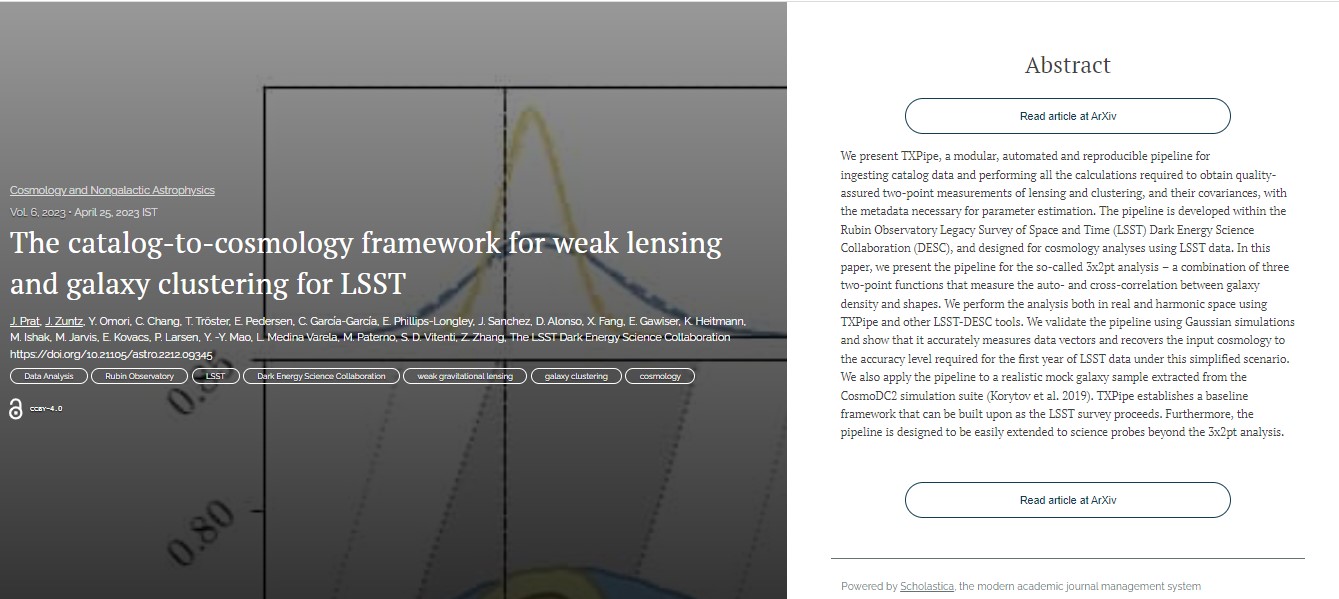
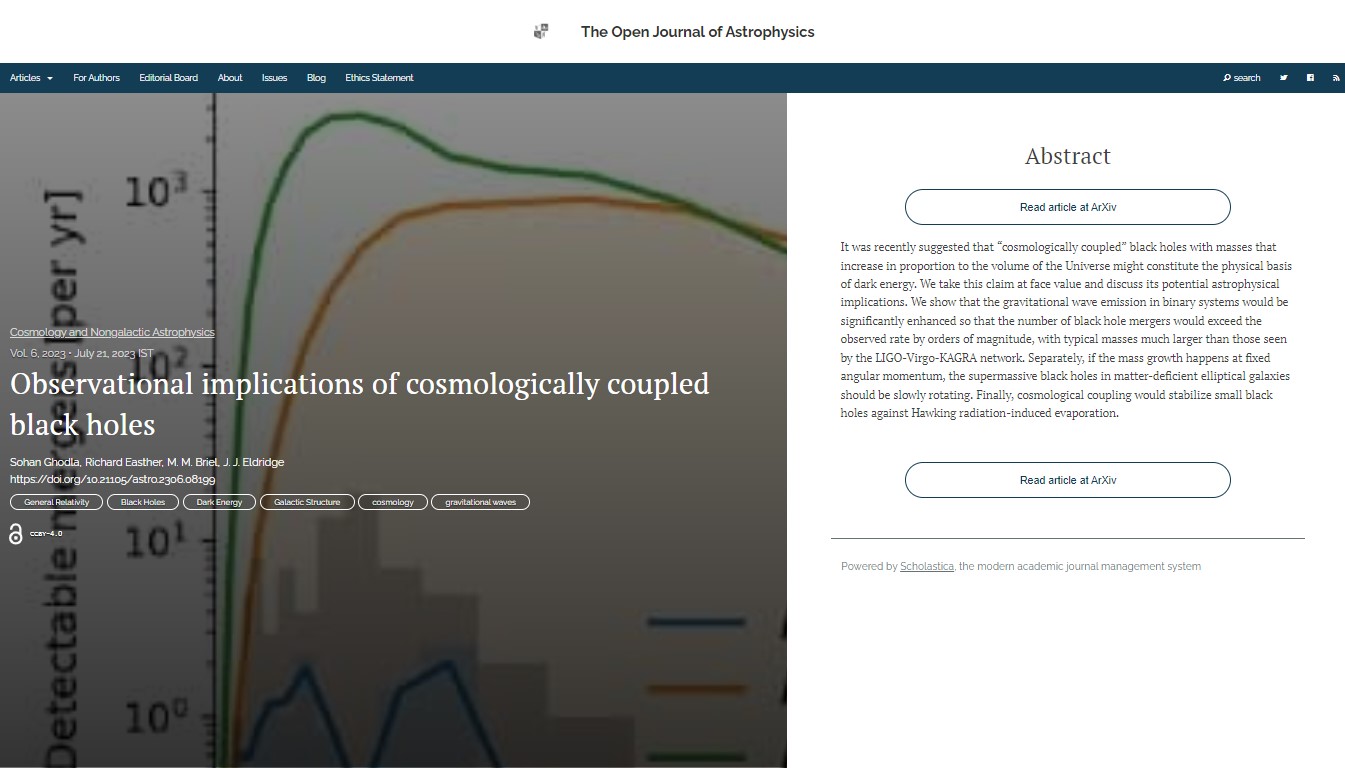
It’s time once more to announce a new paper at the Open Journal of Astrophysics. The latest paper is the 13th paper so far in Volume 6 (2023) and the 78th in all. This one is another for the folder marked Cosmology and NonGalactic Astrophysics and its title is “The catalog-to-cosmology framework for weak lensing and galaxy clustering for LSST”.

The lead author is Judit Prat of the University of Chicago (Illinois, USA) and there are 21 co-authors from elsewhere in the USA and in the UK. The paper is written on behalf of the LSST Dark Energy Science Collaboration (LSST DESC), which is the international science collaboration that will make high accuracy measurements of fundamental cosmological parameters using data from the Rubin Observatory Legacy Survey of Space and Time (LSST). The OJAp has published a number of papers involving LSST DESC, and I’m very happy that such an important consortium has chosen to publish with us.

Here is a screen grab of the overlay which includes the  abstract:

You can click on the image of the overlay to make it larger should you wish to do so. You can find the officially accepted version of the paper on the arXiv here.
New Publication at the Open Journal of Astrophysics

Posted in OJAp Papers, Open Access, The Universe and Stuff with tags , , , , on April 18, 2023 by telescoper

Back after a short hiatus due to the Easter holidays, it’s time to announce yet another new paper at the Open Journal of Astrophysics. This one was accepted for publication a few weeks ago but the final version only appeared on the arXiv yesterday. Since OJAp is an arXiv-overlay journal, we have to wait for authors to upload the accepted version before we can publish the overlay.

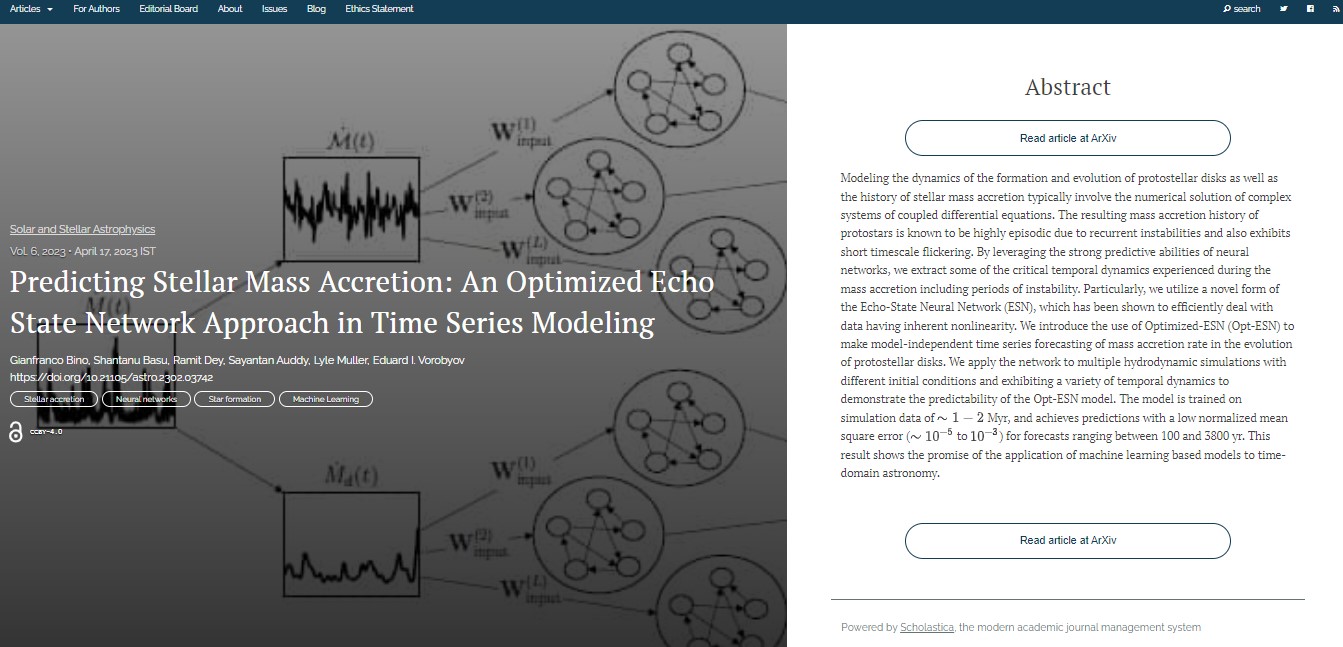
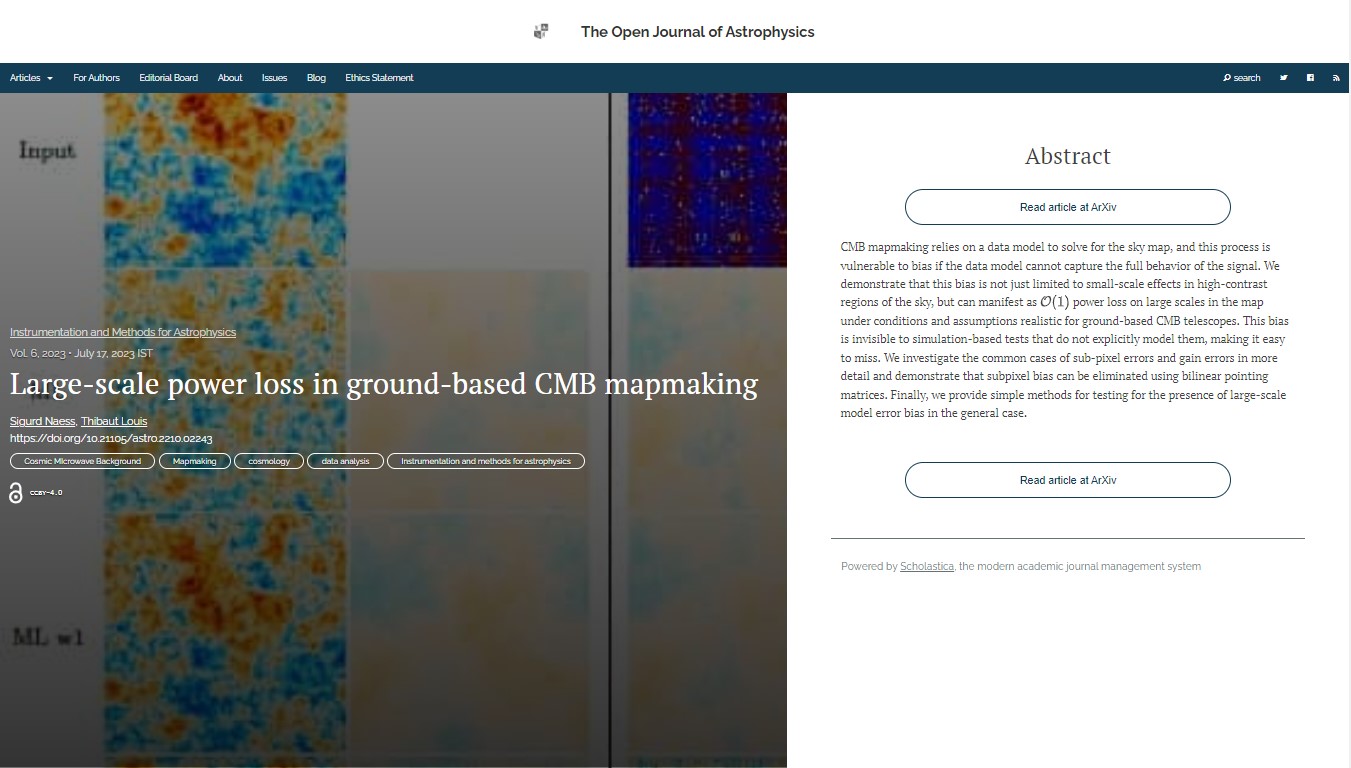
Anyway, the latest paper is the 12th paper so far in Volume 6 (2023) and the 77th in all. This one is in the currently under-populated folder marked Solar and Stellar Astrophysics and its title is “Predicting Stellar Mass Accretion: An Optimized Echo State Network Approach in Time Series Modeling”.

The authors are: Gianfranco Bino, Shantanu Basu & Ramit Dey (all at the University of Western Ontario, Canada), Sayantan Auddy (Jet Propulsion Laboratory, Pasadena, USA), Lyle Muller (University of Western Ontario, Canada) and Eduardo I. Vorobyov (University of Vienna, Austria & Southern Federal University, Russia).

Here is a screen grab of the overlay which includes the  abstract:

You can click on the image of the overlay to make it larger should you wish to do so. You can find the officially accepted version of the paper on the arXiv here.
How do we make accessible research papers a reality?

Posted in Open Access with tags , , , , on March 21, 2023 by telescoper

I wanted to advertise an event – an accessibility forum – organized by arXiv that looks interesting to anyone interested in open access publishing understood in the widest possible sense. It’s advertised as a practical forum, free for all:

Hosted by arXiv, this half-day online forum will center the experiences of academic researchers with disabilities who face barriers to accessing and reading papers. The forum will be useful for people across the academic authoring and publishing ecosystem who are committed to making accessible research papers a reality. Together, we can chart a path towards fully accessible research papers, and leave with practical next steps for our own organizations.

It’s on April 17th, from 1pm to 5pm Eastern Time (USA), which is 6pm to 10pm Dublin Time. You can find more details including information on how to register, here.

We usually focus on open access publishing in terms of the costs involved, but there is much more we can do in other respects to make scientific research as accessible as possible to as wide a community as possible. Having said that, this announcement did inspire me to go off

When I saw the word “ecosystem” in the description above, it reminded me of a brief discussion I had recently with a colleague who asked what I hoped to achieve with the Open Journal of Astrophysics (other than “world domination”). My answer was that I just wanted to show that there is a practical way to bypass the enormous expense of the traditional journal industry. Instead of just sitting around complaining about the state of things I wanted to demonstrate that it doesn’t have to be the way it is. The way the number of submissions to OJAp is increasing, it seems more and more people are becoming convinced.

It seems to me that the switch from subscription charges to the dreaded Article Processing Charge has help generate momentum in this direction, by making it even more explicit that the current arrangements are unsustainable. Previously the profits of the big publishers were hidden in library budgets. Now they are hitting researchers and their grants directly, as authors now have to pay, and people who previously hadn’t thought much about the absurdity of it all are now realizing what a racket academic publishing really is.

Increasing numbers of researchers think that the current ecosystem is doomed. I am convinced that it will die a natural death soon enough. But a question I am often asked is what will replace it? I think the answer to that is very clear: a worldwide network of institutional and/or subject-based repositories that share research literature freely for the common good. Universities and research centres should simply bypass the grotesque parasite that is the publishing industry. Indeed, I would be in favour of hastening the demise of the Academic Journal Racket by having institutions make it a disciplinary offence for any researcher to pay an APC.

We’re lucky in physics and astronomy because arXiv has already done the hard work for us. Indeed, it is now a fact universally acknowledged that every research paper worth reading in these disciplines can be found on arXiv. Old-style journals are no longer necessary. It is great that arXiv is being joined by similar ventures in other fields, such as BiorXiv and EarthArxiv. I’m sure many more will follow. What is needed is a global effort to link these repositories to each other and to peer review mechanisms. One way is through overlays as demonstrated by the Open Journal of Astrophysics, there being no reason why the idea can’t be extended beyond arXiv. Other routes are possible, of course, and I would love to see different models developed. I think the next few years are going to be very exciting.

Clarivate’s Web of Inconsistency

Posted in Open Access, The Universe and Stuff with tags , , , , on March 13, 2023 by telescoper

I am involved in the (painfully slow) process of trying to get the Open Journal of Astrophysics listed by Clarivate, which some researchers – or rather, their funding agencies – feel to be important. One of the reasons for this seems to be that some researchers are only allowed to publish in journals with an official Journal Impact Factor (JIF) and Clarivate has set itself up as the gatekeeper for those, although they can easily be calculated using data in the public domain.

Leaving Clarivate aside for a moment, I was googling around this morning and found an independent listing of the Journal Impact Factor for the Open Journal of Astrophysics for 2021, namely 7.4, and found the following description.

Nice. Not bad, considering the Open Journal of Astrophysics is run on a shoestring.

Anyway, although I have grave reservations about the JIF, wanting to make the Open Journal available to as wide a range of authors as possible, I applied for listing by Clarivate in August 2022. I waited and waited. Then, a couple of weeks ago somebody asked me on social media about it and I tagged Clarivate in my reply. No doubt by sheer coincidence I received a reply from Clarivate last week, just a matter of days after mentioning them on social media. A similar thing has happened before. It seems that if you want to ask Clarivate something you have to ask them in public.

At least they replied eventually. We’re still not listed though. Not yet anyway. Among the feedback I received was this:

The volume of scholarly works published annually is expected to be within ranges appropriate to the subject area. However, we have noticed that the publication volume is not in line with similar journals covering this subject area.

When we first started up the Open Journal of Astrophysics I expected this would be an issue as we are new and have published many fewer papers than the big hitters in the field such as MNRAS and ApJ. However, after doing a bit of research among the astronomical journals actually listed on the Web of Science, I changed my mind and thought it wouldn’t be a problem. It seems I was wrong.

Take, for example, the Serbian Astronomical Journal which is listed by Clarivate. I’m mentioning this journal not because I have anything against it: it’s a free Open Access journal and that is very laudable. I just want to use it as an examplar to demonstrate an inconsistency in the above feedback.

According to its web page, the Serbian Astronomical Journal (SerAJ) has an official impact factor of 1.1. A search on NASA/ADS reveals that since 2019 it has published 46 papers which have garnered a total of 69 citations between them. This journal has been published under its current name since 1998.

The Open Journal of Astrophysics (OJAp) is not listed by Clarivate so does not have an official journal impact factor, but I have calculated one here and it is also mentioned above. Since 2019 the Open Journal of Astrophysics has published 69 papers (actually 70, but one has not yet appeared on NASA/ADS). These papers have so far received a total of 1365 citations.

So OJAp has published 50% more papers than SerAJ, with twenty times the citation impact, and a far higher JIF, yet OJAp is not listed by Clarivate but SerAJ is. Can anyone out there explain the reason to me, or shall I assume the obvious?

New Publication at the Open Journal of Astrophysics

Posted in OJAp Papers, Open Access, The Universe and Stuff with tags , , , , on February 20, 2023 by telescoper

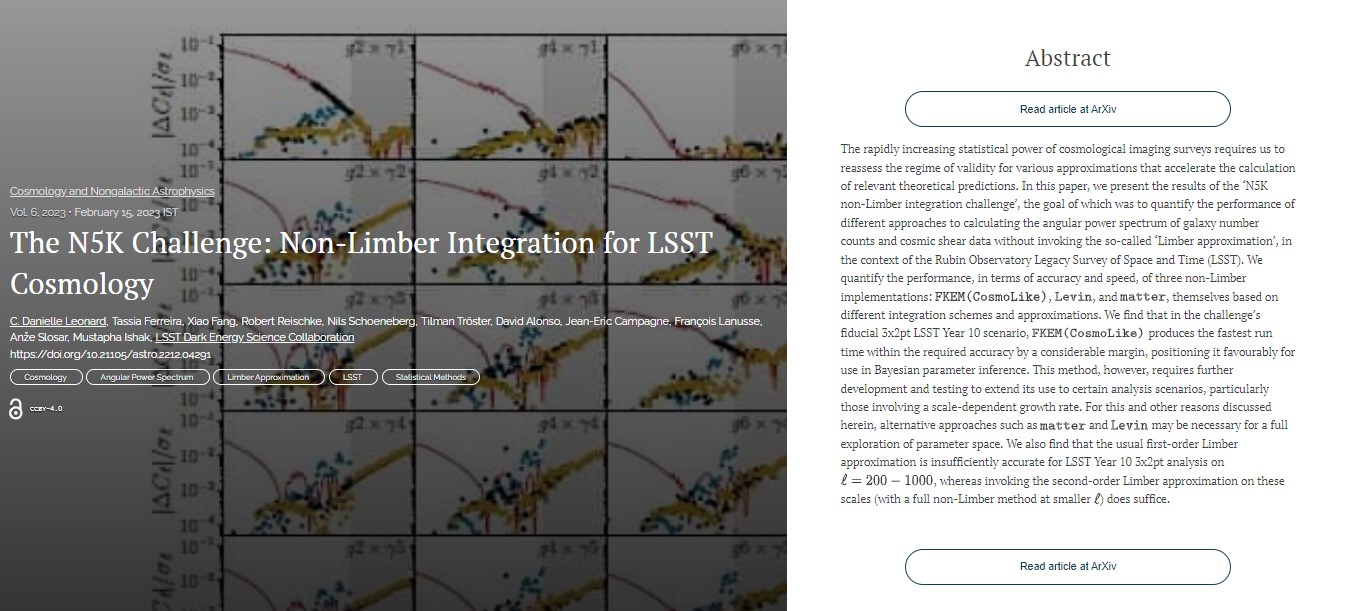
It’s time to announce yet another new paper at the Open Journal of Astrophysics Open Journal of Astrophysics. This was published last week (on 15th February 2023) but there was a slight delay in getting the DOI activated and all the metadata registered so I waited until that was done before announcing the paper here.

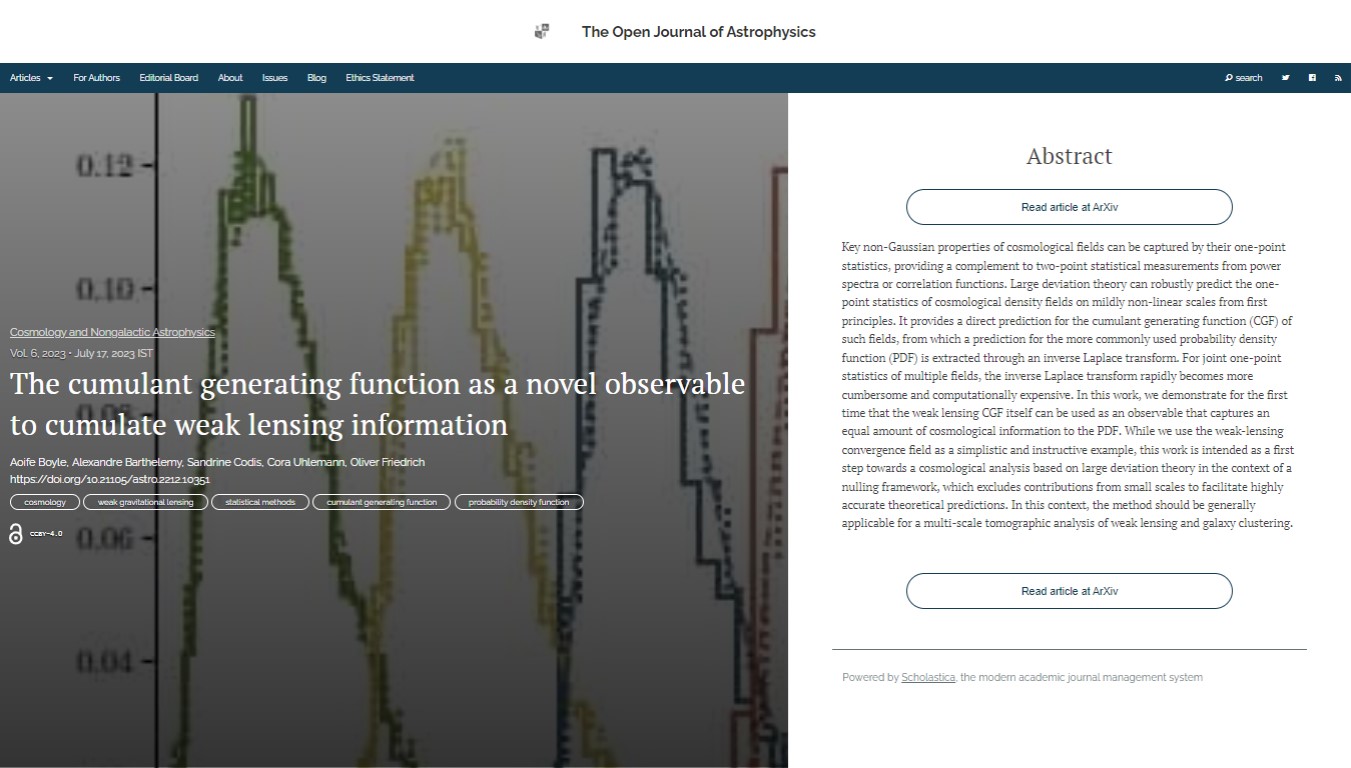
The latest paper is the 8th paper in Volume 6 (2023) as well as the 73rd in all. This one is another one for the folder marked Cosmology and Nongalactic Astrophysics. The title is “The N5K Challenge: Non-Limber Integration for LSST Cosmology”. The paper is about ways of avoiding using the ubiquitous Limber Approximation which, I discovered this morning, is now 70 years old, Nelson Limber’s original paper on the subject having been published in January 1953.

The lead author of the paper is Danielle Leonard of Newcastle University and there are ten co-authors from around the world in countries including UK, USA, Brazil, Germany, Spain, Switzerland and France on behalf of the LSST Dark Energy Science Collaboration.

Here is a screen grab of the overlay which includes the  abstract:


You can click on the image of the overlay to make it larger should you wish to do so. You can find the officially accepted version of the paper on the arXiv here.
New Publication at the Open Journal of Astrophysics

Posted in OJAp Papers, Open Access, The Universe and Stuff with tags , , , on February 14, 2023 by telescoper

It’s time to announce another new paper at the Open Journal of Astrophysics. This was published yesterday (13th February 2023). The rate of submissions has increased greatly in recent weeks, so  I am thinking seriously about switching to a weekly round-up on here instead of individual posts, but for the meantime I’ll carry on.

The latest paper is the 7th paper in Volume 6 (2023) as well as the 72nd  in all. This one is another one for the folder marked Instrumentation and Methods for Astrophysics. The title is “FRBSTATS: A web-based platform for visualization of fast radio burst properties”. This paper describes a software platform which can be accessed directly here. If you want to read more about Fast Radio Bursts, you can look here.

The authors of the paper are Apostolos Spanakis-Misirlis, who gives his affiliations as the University of Piraeus and University of Crete (Greece), and Cameron Van Eck of ANU in Canberra, Australia

Here is a screen grab of the overlay which includes the  abstract:


You can click on the image of the overlay to make it larger should you wish to do so. You can find the officially accepted version of the paper on the arXiv here.

New Publication at the Open Journal of Astrophysics

Posted in OJAp Papers, Open Access, The Universe and Stuff with tags , , , , on February 6, 2023 by telescoper

Well, it may be a Bank Holiday here in Ireland but there’s no break for the Open Journal of Astrophysics and it’s time to announce yet another paper hot off the press.

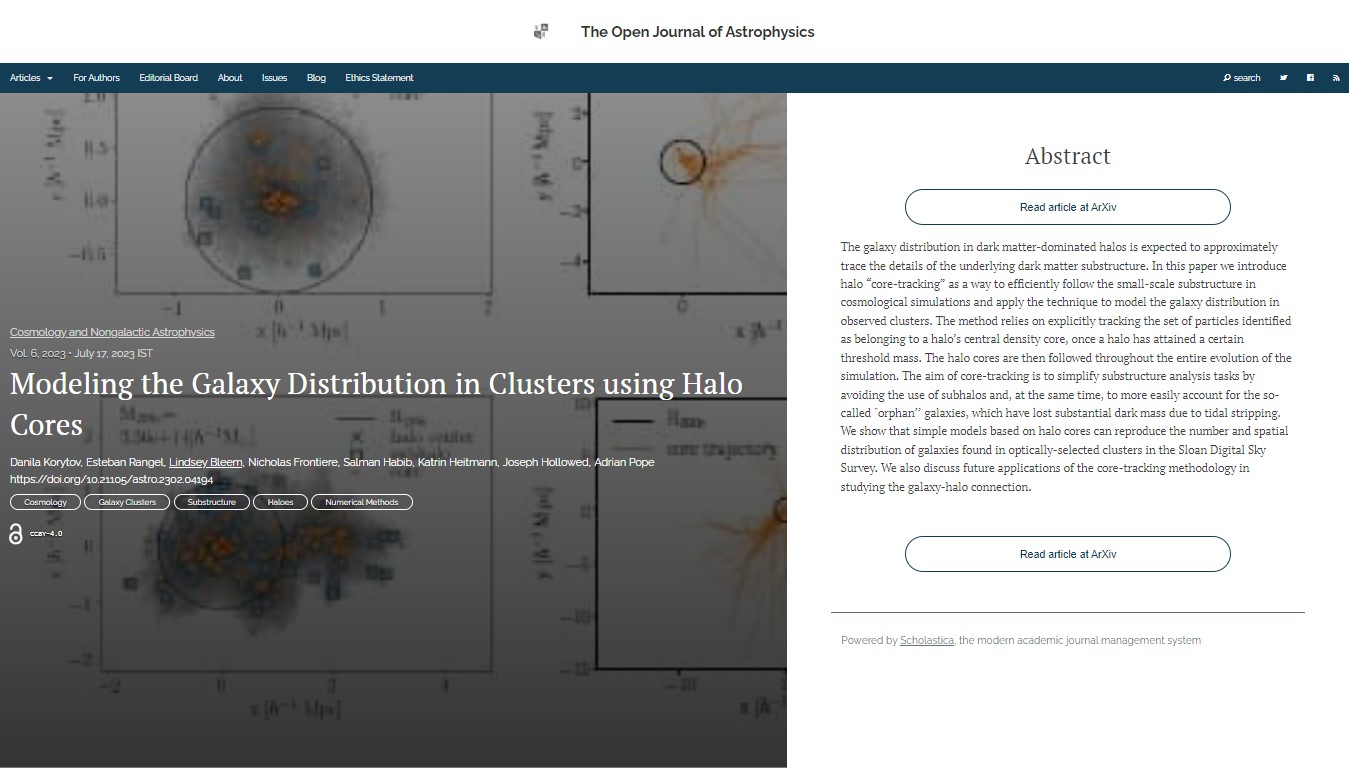
The latest paper is the 5th paper in Volume 6 (2023) as well as the 70th in all. This one is in the folder marked Instrumentation and Methods for Astrophysics. The title is “PSFs of coadded images”; for those of you not up with the lingo, “PSF” stands for point spread function.

The authors of this paper are Rachel Mandelbaum (1), Mike Jarvis (2), Robert H. Lupton (3), James Bosch (3), Arun Kannawadi (3), Michael D. Murphy (1) and Tianqing Zhang (1) and the LSST Dark Energy Science Collaboration. The affiliations of the individual authors are: (1) Carnegie Mellon University, Pittsburgh PA; (2) University of Pennsylvania, Philadelphia PA; (3) Princeton University, Princeton NJ; all in the USA of course.

Here is a screen grab of the overlay which includes the  abstract:


You can click on the image of the overlay to make it larger should you wish to do so. You can find the officially accepted version of the paper on the arXiv here.
New Publication at the Open Journal of Astrophysics

Posted in OJAp Papers, Open Access, The Universe and Stuff with tags , , , , , , on February 3, 2023 by telescoper

The articles are coming in thick and fast at the Open Journal of Astrophysics. and why trying to get them refereed and published as quickly as we can. It’s time to announce yet another paper. This one was published officially yesterday (2nd February 2023) but I just found time to post about it here today before I go to my 9am tutorial.

The latest paper is the 4th paper in Volume 6 (2023) as well as the 69th in all. This one is in the Astrophysics of Galaxies folder.

The latest publication is entitled “Wide Binaries from GAIA EDR3: preference for GR over MOND?”.  The authors of this paper,  Charalambos Pittordis and Will Sutherland, are both based at Queen Mary, University of London. We published a related paper last month.

Here is a screen grab of the overlay which includes the  abstract:


You can click on the image to make it larger should you wish to do so. You can find the officially accepted version of the paper on the arXiv here.