Time to announce another publication in the Open Journal of Astrophysics. This one is the ninth paper in Volume 4 (2021) and the 40th in all.
The latest publication is entitled Black Hole Shadow Drift and Photon Ring Frequency Drift. The authors are Emmanuel Frion (Helsinki), Leonardo Giani (Queensland) and Tays Miranda (Jyväskylä).
Here is a screen grab of the overlay which includes the abstract:
You can click on the image to make it larger should you wish to do so. You can find the arXiv version of the paper here. This one is also in the folder marked Cosmology and Nongalactic Astrophysics; although primarily in general relativity and quantum cosmology (gr-qc) it is cross-listed in astro-ph so it eligible for publication with us.
The end of the summer has been heralded by the arrival at OJAp HQ of a number of revised versions so I expect to be publishing a few more papers in the next few weeks!
Time to announce another publication in the Open Journal of Astrophysics. This one is the eighth paper in Volume 4 (2021) and the 39th in all.
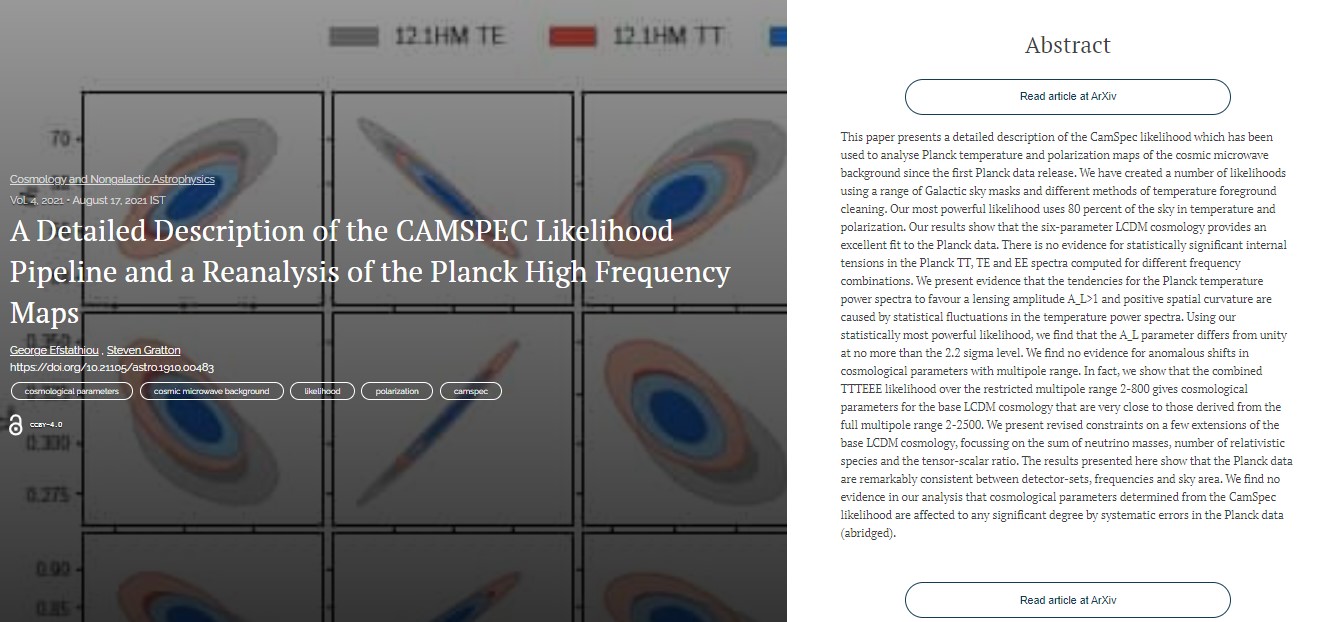
The latest publication is entitled A Detailed Description of the CAMSPEC Likelihood Pipeline and a Reanalysis of the Planck High Frequency Maps. The authors are George Efstathiou and Steven Gratton of the Kavli Institute for Cosmology at the University of Cambridge.
Here is a screen grab of the overlay which includes the abstract:
You can click on the image to make it larger should you wish to do so. You can find the arXiv version of the paper here. This one is also in the folder marked Cosmology and Nongalactic Astrophysics.
This is a long and detailed paper, running to 92 pages in PDF form. Our Editorial process relies on referees being willing to volunteer their time to read and comment on submissions and this one in particular required a great deal of effort. I am always grateful to referees but in this case I am even more grateful than usual the diligence displayed during and the many useful comments received. I know who our reviewers are and they know who they are, but shall remain anonymous!
I was reminded yesterday that today, 14th August, is the 30th anniversary of the start of the arXiv so I thought I’d send a quick birthday greeting to mark the occasion. In case you weren’t aware, arXiv is a free distribution service and an open-access archive containing (currently) 1,928,825 scholarly articles in the fields of physics, mathematics, computer science, quantitative biology, quantitative finance, statistics, electrical engineering and systems science, and economics.
There was a precursor to the arXiv in the form of an email distribution list for preprints, but arXiv proper started on 14th August 1991. It was based at Los Alamos National Laboratory (LANL) with a mirror site in SISSA (Trieste) that was used by those of us in Europe. In the beginning, arXiv was quite a small-scale thing and it wasn’t that easy to upload full papers including figures. In fact the SISSA system was run from a single IBM 386 PC (called “Babbage”). As it expanded, the running of arXiv was taken over Cornell University. You can read more about the history here.
You have to remember that journals didn’t generally have electronic submission in those days: you had to send paper manuscripts in the post to the Editorial office. Likewise many of us carried on sending out paper preprints for some time after the arXiv was set up. Younger researchers should be grateful they don’t have to put up with the absolute chore of producing papers the old-fashioned way!
The astrophysics section of arXiv (“astro-ph”) started in April 1992. Although astrophysicists generally were quick to latch on to this new method of distributing preprints, it took me a little time to get onto arXiv: my first papers did not appear there until February 1993; my first publication was in 1986 so there are quite a few of my early papers that aren’t on arXiv at all. In 1993 I was working at Queen Mary & Westfield College (as it was then called). I was working a lot with collaborators based in Italy at the time and they decided to start posting our joint papers on arXiv. Without that impetus it would have taken me much longer to get to grips with it.
In case you’re interested, my first paper to appear on the arXiv was this one on 23rd February 1993 but it was followed a day later by two others, this one and that one. I don’t remember very well, but this was an exercise in catching up and all three of those papers were actually published in journals before we put them on arXiv. It was only later that we got into the habit of posting papers on arXiv at the same time as submitting to a journal, which I think is the best way to do it!
The Open Journal of Astrophysics would not have been possible without the arXiv but in a wider sense the astrophysics community has a very great deal to thank the arXiv for, but remember that it is funded by donations and is run on a shoestring. If you agree that it’s a tremendously useful asset for your research then please consider making a donation.
Back from my short trip, I now have time to announce another publication in the Open Journal of Astrophysics. This one was published at the end of last month, but owing to the holiday season there was a delay in activating the DOI and registering the metadata so I have delayed posting about it until just now. It is the seventh paper in Volume 4 (2021) and the 38th in all.
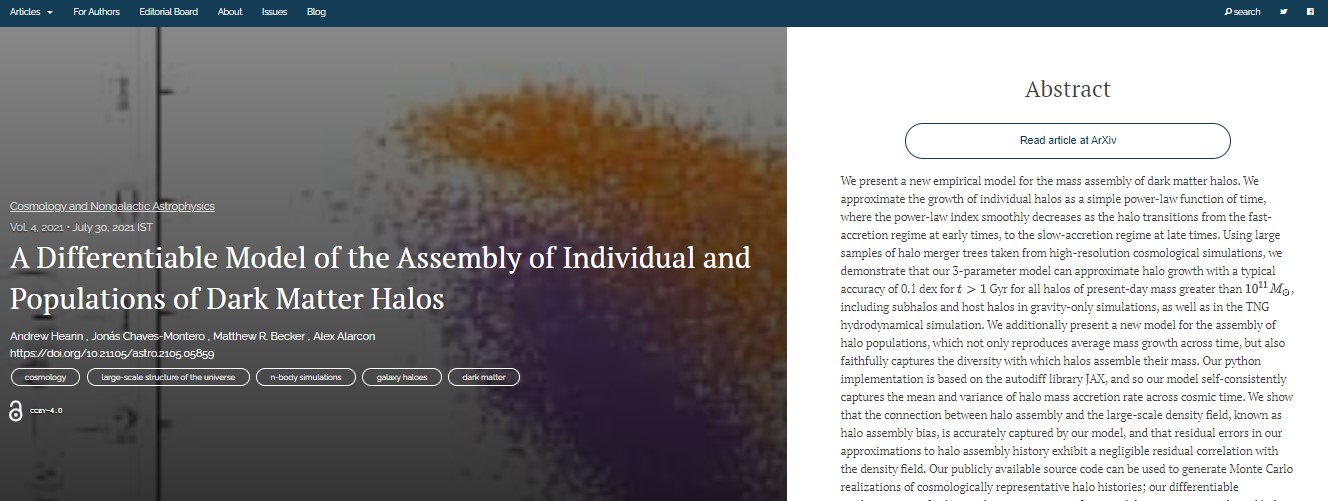
The latest publication is entitled A Differentiable Model of the Assembly of Individual and Populations of Dark Matter Halos. The authors are Andrew P. Hearin, Jonás Chaves-Montero, Matthew R. Becker and Alex Alarcon, all of the Argonne National Laboratory.
Here is a screen grab of the overlay which includes the abstract:
You can click on the image to make it larger should you wish to do so. You can find the arXiv version of the paper here. This one is also in the folder marked Cosmology and Nongalactic Astrophysics.
We’ve had a bit of a surge in submissions over the last few weeks – no doubt due to authors using their “vacation” to finish off papers. August is not the best month for finding referees, but we’ll do our best to process them quickly!
Time to announce another publication in the Open Journal of Astrophysics. This one was actually published at the end of last month, but owing to the holiday season there was a delay in activating the DOI and registering the metadata so I have delayed posting about it until just now. It is the sixth paper in Volume 4 (2021) and the 37th in all.
The latest publication is entitled Euclid: Forecasts for k-cut 3 × 2 point statistics. The first author is Peter L. Taylor of the Jet Propulsion Lab in Pasadena, USA and there are almost 100 authors altogether. This is definitely the paper with the longest author list we have published so far, and also the first paper we have published on behalf of the Euclid Consortium. I am a member of Euclid so I of course recused myself from the editorial process.
Here is a screen grab of the overlay which includes the abstract:
You can click on the image to make it larger should you wish to do so. You can find the arXiv version of the paper here. This one is, fairly obviously, in the Cosmology and Nongalactic Astrophysics folder..
The Euclid Consortium has a strict protocol for papers it publishes which, together with the large number of authors, not to mention the pandemic, meant it took quite a long time to make the revisions suggested by referees. Still, it has turned out a very nice paper I think. I am also very pleased that a major consortium such as Euclid has decided to publish in OJAp.
We have another bunch of papers in the pipeline – in fact one further has already been published – so watch this space for further developments!
I’ll end with a reminder to prospective authors that the OJA now has the facility to include supplementary files (e.g. code or data sets) along with the papers we publish. If any existing authors (i.e. of papers we have already published) would like us to add supplementary files retrospectively then please contact us with a request!
Time to announce another publication in the Open Journal of Astrophysics. This one was actually published last Friday, but I didn’t get time to post about it until just now. It is the fifth paper in Volume 4 (2021) and the 36th paper in all.
The latest publication is entitled Gravitational Wave Direct Detection does not Constrain the Tensor Spectral Index at CMB Scalesand the author is Will Kinney of the State University of New York at Buffalo (which is SUNY Buffalo, for short).
Here is a screen grab of the overlay which includes the abstract:
You can click on the image to make it larger should you wish to do so. You can find the arXiv version of the paper here. This one is, fairly obviously, in the Cosmology and Nongalactic Astrophysics folder..
Over the last few months I have noticed that it has taken a bit longer to get referee reports on papers and also for authors to complete their revisions. I think that’s probably a consequence of the pandemic and people being generally overworked. We do have a number of papers at various stages of the pipeline, so although we’re a bit behind where we were last year in terms of papers published I think may well catch up in the next month or two.
I’ll end with a reminder to prospective authors that the OJA now has the facility to include supplementary files (e.g. code or data sets) along with the papers we publish. If any existing authors (i.e. of papers we have already published) would like us to add supplementary files retrospectively then please contact us with a request!
Time to announce another publication in the Open Journal of Astrophysics. This one was actually published on Friday actually, but I didn’t get time to post about it until just now. It is the fourth paper in Volume 4 (2021) and the 35th paper in all.
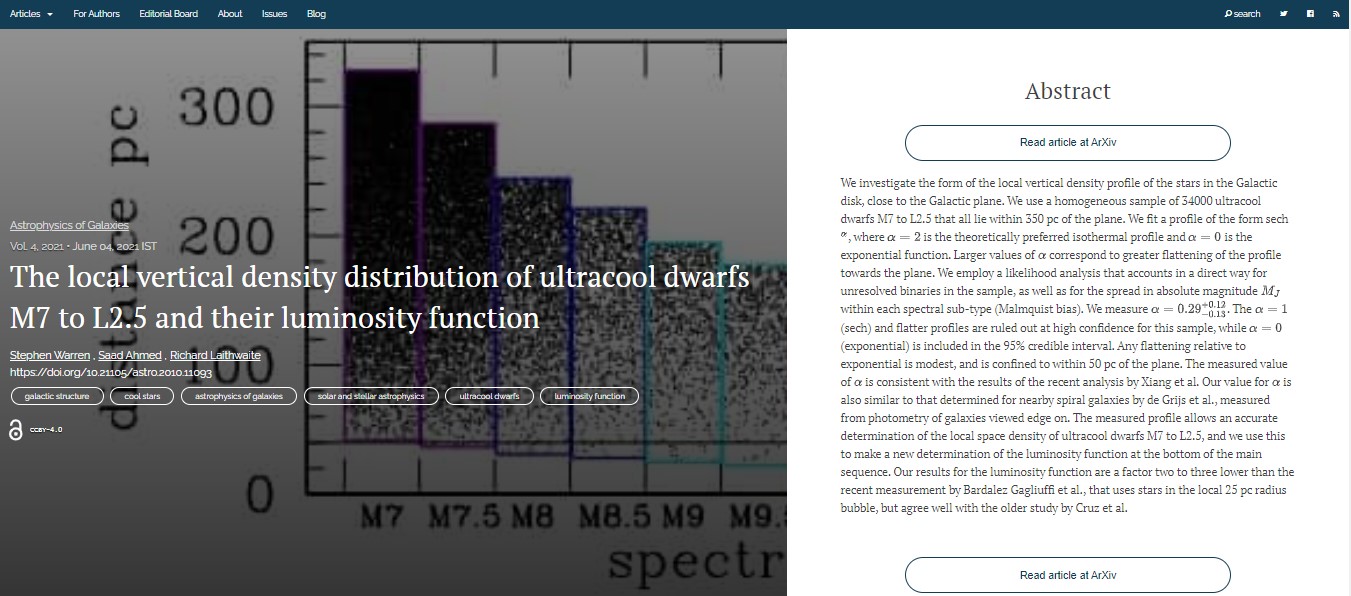
The latest publication is entitled The local vertical density distribution of ultracool dwarfs M7 to L2.5 and their luminosity function and the ultracool authors are Steve Warren (Imperial College), Saad Ahmed (Open University) and Richard Laithwaite (Imperial College).
Here is a screen grab of the overlay which includes the abstract:
You can click on the image to make it larger should you wish to do so. You can find the arXiv version of the paper here. This one is in the Astrophysics of Galaxies section but it also has overlap with Solar and Stellar Astrophysics.
Over the last few months I have noticed that it has taken a bit longer to get referee reports on papers and also for authors to complete their revisions. I think that’s probably a consequence of the pandemic and people being generally overworked. We do have a number of papers at various stages of the pipeline, so although we’re a bit behind where we were last year in terms of papers published I think may well catch up in the next month or two.
I’ll end with a reminder to prospective authors that the OJA now has the facility to include supplementary files (e.g. code or data sets) along with the papers we publish. If any existing authors (i.e. of papers we have already published) would like us to add supplementary files retrospectively then please contact us with a request!
I have from time to time posted videos from the series of Cosmology Talks curated by Shaun Hotchkiss. These are usually technical talks at the level you might expect for a cosmology seminar, but this time it’s something different. Shaun asked me if I’d like to give a talk about the Open Journal of Astrophysics, so one night last week we recorded this. We ended up chatting about quite a lot of things so it turned out longer than most of the videos in the series, but it’s not a technical talk so I hope you’ll find it bearable!
Since the Open Journal of Astrophysics is an arXiv overlay journal which is totally dependent on the arXiv platform we had to wait until arXiv announced its policy before following it with one of our own, which were recently able to do.
The arXiv now allows the following options:
In full text works: the author name can be changed in the PDF and/or LaTeX source where it appears in the author list, acknowledgments, and email address.
In metadata: the name and email address can be changed in the author list metadata and in the submission history metadata for all existing versions.
In user accounts: the name, username, and email address can all be changed.
The arXiv policy notes, however, that
We are not currently able to support name changes in references and citations of works. Also, arXiv cannot make changes to other services, including third party search and discovery tools that may display author lists for papers on arXiv.
Since the Open Journal of Astrophysics deposits author metadata for all our papers with the Crossref system we can plug this gap by undertaking to redeposit all necessary information to reflect author name changes. Since author metadata is attached to the DOI we issue, this will ensure that citations and references tracked through this system are updated when an author changes their name.
If any author of a paper published in the Open Journal of Astrophysics wishes to make use of this policy the best procedure is to first contact the arXiv under their policy. Once any changes have been made to the arXiv submission the author should contact us with a request. We will then make any necessary changes to the overlay on the Open Journal of Astrophysics site and redeposit amended metadata to Crossref free of charge. We also undertake to ensure entries are updated at the NASA/ADS system.
Following the guidance from COPE the Open Journal of Astrophysics will neither seek permission from nor inform co-authors of any such change.
A list of other journals/publishers and their name change policies can be found here.
The views presented here are personal and not necessarily those of my employer (or anyone else for that matter).
Feel free to comment on any of the posts on this blog but comments may be moderated; anonymous comments and any considered by me to be vexatious and/or abusive and/or defamatory will not be accepted. I do not necessarily endorse, support, sanction, encourage, verify or agree with the opinions or statements of any information or other content in the comments on this site and do not in any way guarantee their accuracy or reliability.






 In the Dark