Archive for The Open Journal of Astrophysics

Four New Publications at the Open Journal of Astrophysics

Posted in OJAp Papers, Open Access, The Universe and Stuff with tags , , , , , , , , , , , , , on December 14, 2024 by telescoper

It’s Saturday morning once again so here’s another quick update of activity at the Open Journal of Astrophysics. Since the last update a week ago we have published  four papers, which takes the count in Volume 7 (2024) up to 114 and the total published altogether by OJAp up to 229. If we publish just one more paper between now and the end of the year, we will have published as many papers in 2024 as we have in all previous years.

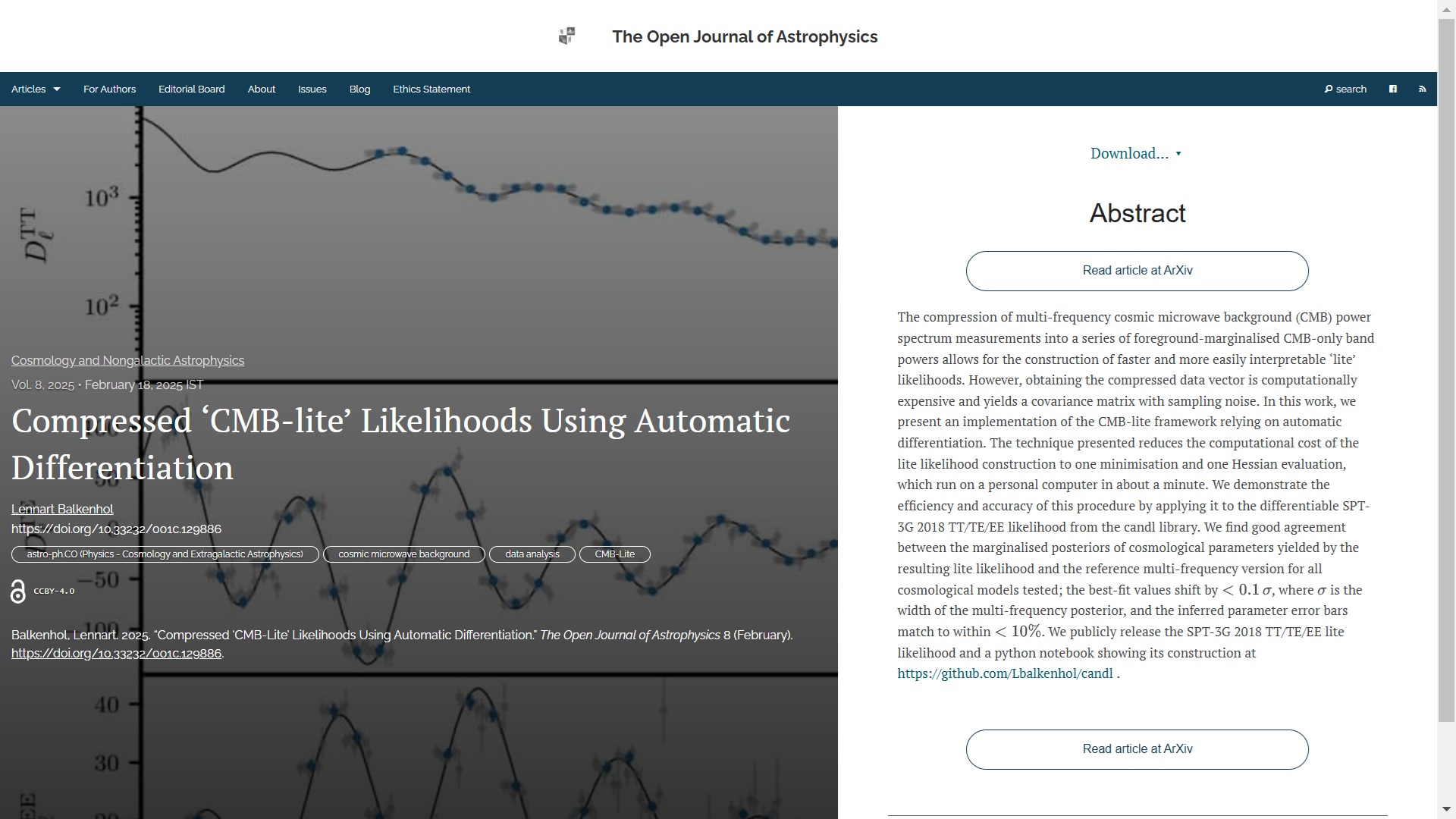
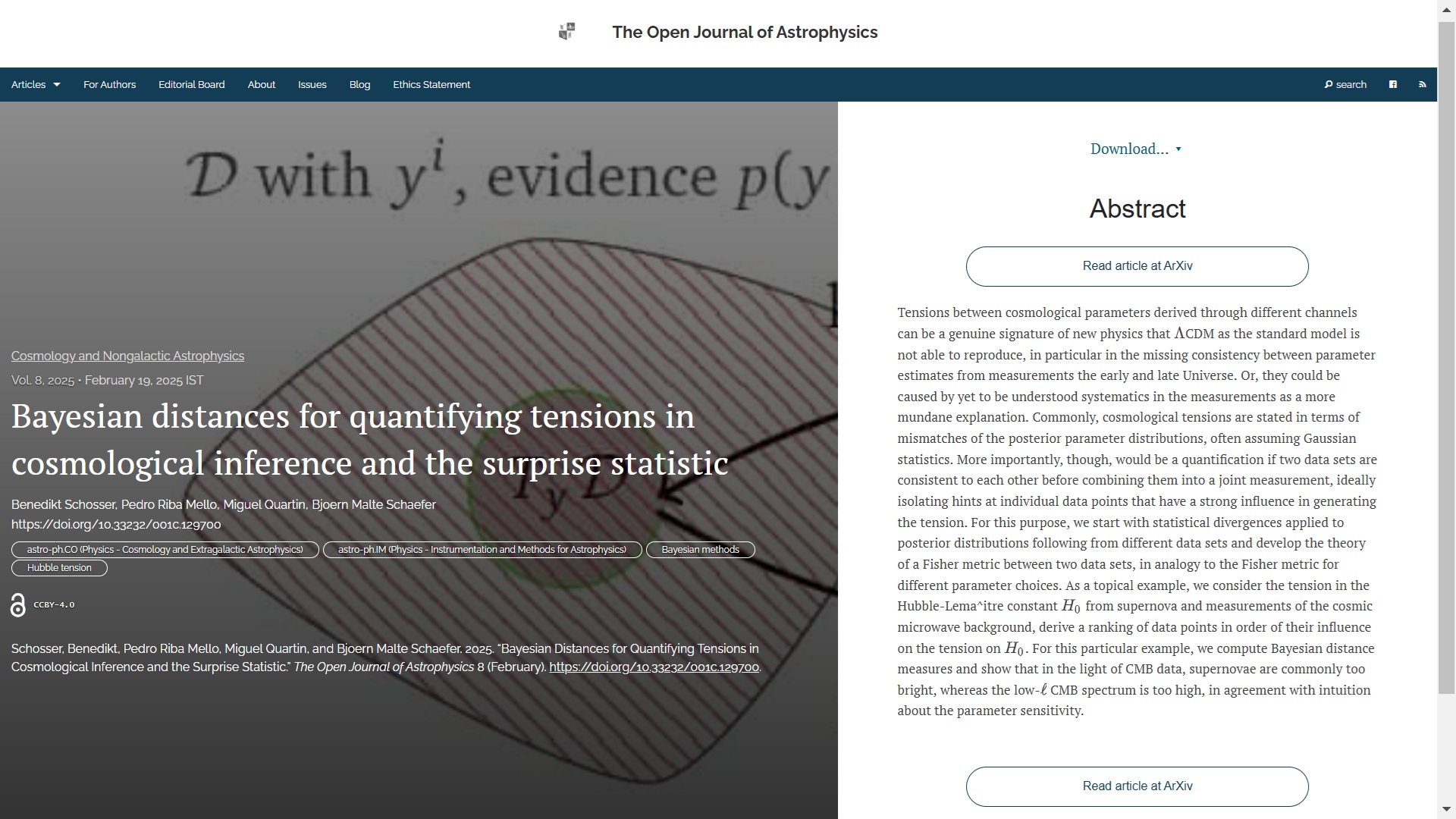
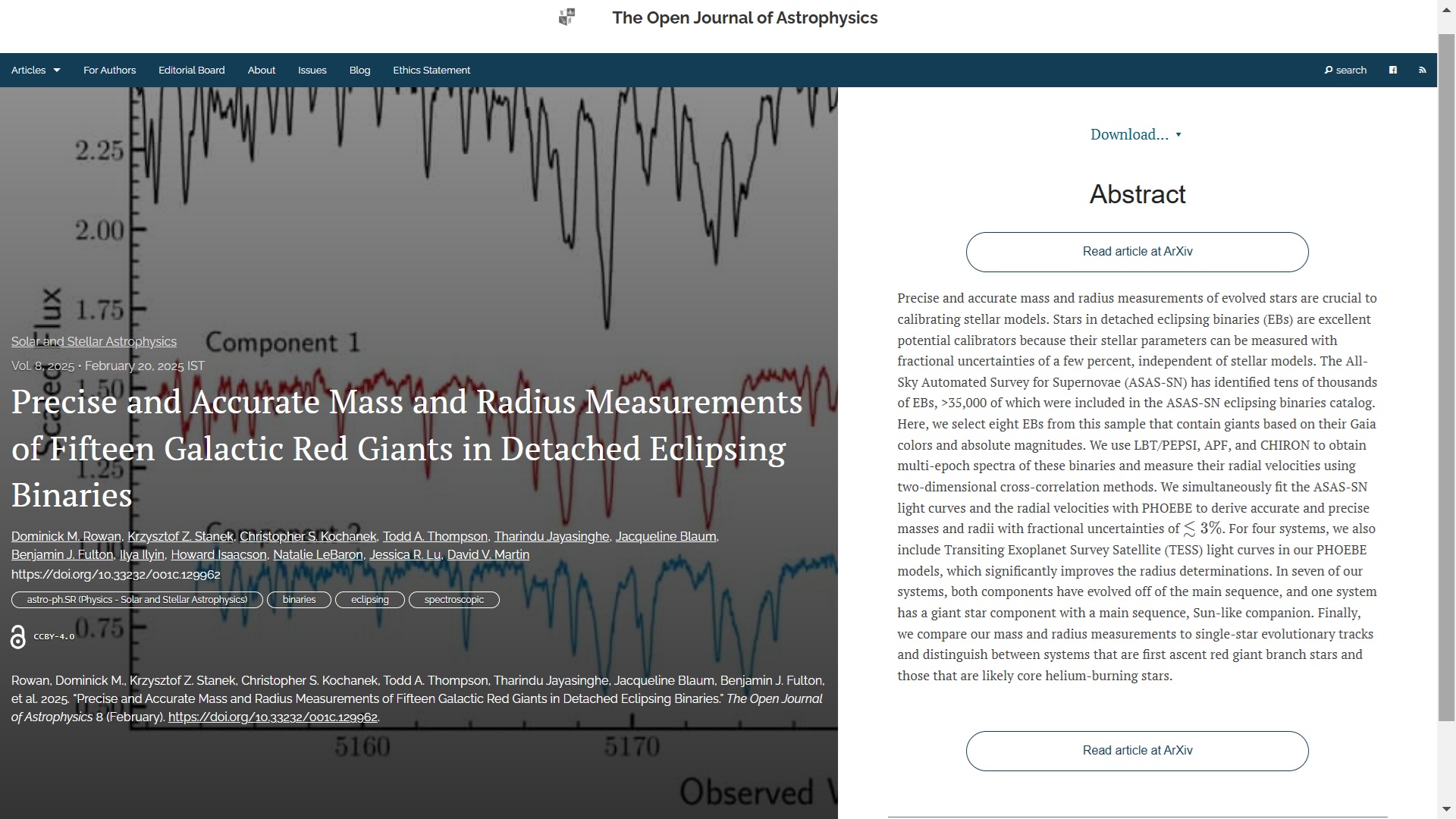
Anyway, in chronological order of publication, the four papers published this week, with their overlays, are as follows. You can click on the images of the overlays to make them larger should you wish to do so.

First one up is “Star formation beyond galaxies: widespread in-situ formation of intra-cluster stars” by Niusha Ahvazi & Laura V. Sales (UC Riverside, USA), Julio F. Navarro (U. Victoria, Canada), Andrew Benson (Carnegie Obs. USA), Alessandro Boselli (Aix Marseille U., France) and Richard D’Souza (Vatican Obs.). The paper, which is in the folder marked Astrophysics of Galaxies, The paper presents a simulation-based analysis of a diffuse star forming component in galaxy clusters extending for hundreds of kiloparsecs and tracing the distribution of neutral gas in the cluster host halo.

Here is a screen grab of the overlay, which includes the abstract:

You can find the officially accepted version of the paper on the arXiv here.

The second paper to announce, published on 10th December 2024 in the folder Cosmology and NonGalactic Astrophysics, is “Cosmological Constraints from Combining Photometric Galaxy Surveys and Gravitational Wave Observatories” by E.L. Gagnon, D. Anbajagane, J. Prat, C. Chang, and J. Frieman (all of U. Chicago, USA). This article quantifies the expected cosmological information gain from combining the forecast LSST 3x2pt analysis with the large-scale auto-correlation of GW sources from proposed next-generation GW experiments.

You can see the overlay here:

The accepted version of this paper can be found on the arXiv here.

The third paper, also published on 10th December 2024, but in the folder marked Earth and Planetary Astrophysics, has the title “A potential exomoon from the predicted planet obliquity of β Pictoris b” and is written by Michael Poon, Hanno Rein, and Dang Pham all of the University of Toronto, Canada. It presents discussion, based on the β Pictoris system, of the idea that the presence of exomoons can excite misalignment between the spin and orbit axis (obliquity) in exoplanet systems

Here is the overlay

The final version accepted on arXiv is here.

Last of this quartet, published on 11th December 2024, and in the folder Cosmology and NonGalactic Astrophysics is “Map-level baryonification: Efficient modelling of higher-order correlations in the weak lensing and thermal Sunyaev-Zeldovich fields” and is by Dhayaa Anbajagane & Shivam Pandey (U. Chicago) and Chihway Chang (Columbia U.), all based in the USA.

The paper proposes an extension of the semi-analytic formalism to weak lensing and thermal Sunyaev-Zeldovich (tSZ) fields directly on the full-sky, with an emphasis on higher-order correlations. The overlay is here:

You can find the official accepted version on the arXiv here.

That’s all for this week. I’ll do another update next Saturday, and that will probably be the last one of the year. If we publish just one more paper between now and 31st December, we will have published as many papers in 2024 as we have in all previous years put together!

Reaching Nelson

Posted in Cricket, History, OJAp Papers with tags , , , , , on December 9, 2024 by telescoper

This morning I published another paper at the Open Journal of Astrophysics and in the process I noticed that took us to a total 111 articles this year. I got to thinking about the significance of that number in cricket, where it goes by the name of Nelson

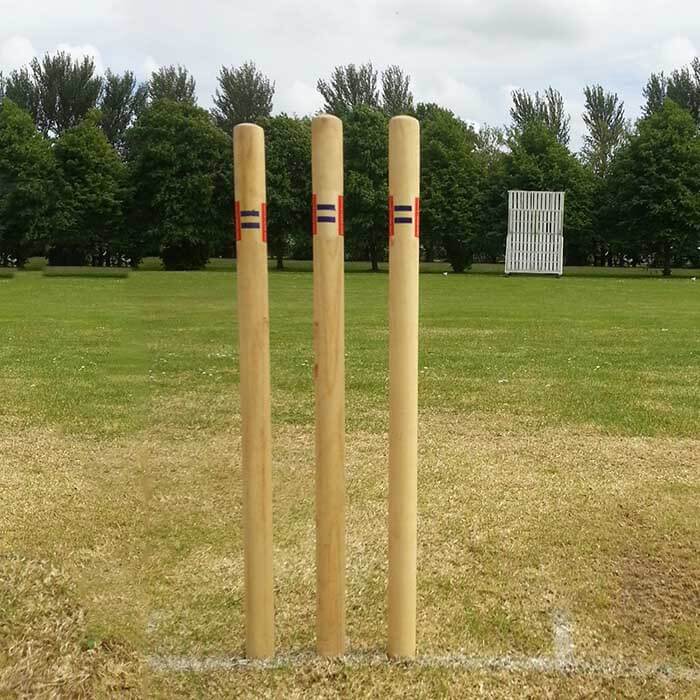
In cricket – at least in England – Nelson is supposed to be an unlucky number. The reason for this could well be that the number 111 looks like a set of stumps without the bails (see left). (For those of you not up with the lingo, the bails are two smaller bits of wood that sit on top of the stumps. ) The absence of the bails could mean that they have been dislodged, signifying that a batter is out. Also umpires remove the bails at close of play, so it could indicate that the match is over.

What’s less clear is the connection with Horatio, Lord Nelson (right). The version I was told at school was that Nelson had “one eye, one arm, and one Trafalgar”. Some also say “Destiny” instead of “Trafalgar”. Those are polite versions. Others say the third one refers to a part of the male anatomy. Bill Frindall used to say “one eye, one arm, and one et cetera“. Who knows which, if any, of these is right?

In any case this does give me the chance to point out that, contrary to popular myth, Nelson didn’t lose an eye anyway. In 1794, Nelson was in action at the Siege of Calvi during the Invasion of Corsica when a cannonball struck a nearby sandbag and sprayed him with sand and gravel. Nelson’s right eye was damaged by this, but he didn’t lose it although he had little effective vision through it thereafter.

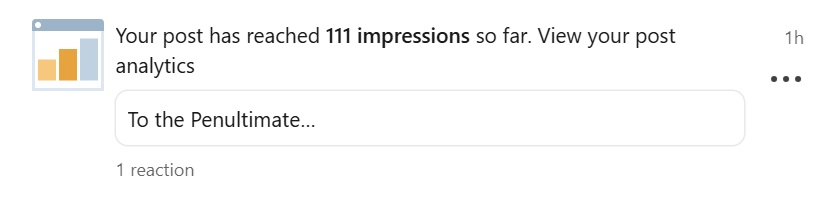
Meanwhile, I just saw this notification on LinkedIn about yesterday’s post:

Seven Years in Maynooth!

Posted in Biographical, Education, Maynooth with tags , on December 1, 2024 by telescoper
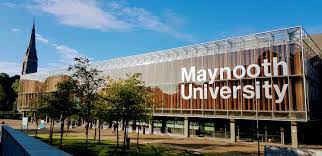
Maynooth University Library, home of the famous cat

As the count continues in the General Election in Ireland, the result of which seems likely to be the same old government, I am reminded that today is 1st December 2024, which means that it’s seven years to the day since I started work at Maynooth University. Despite the frustrations I’m still happy I made the move all that time ago.

One big change that has happened over the last year is that the Department of Theoretical Physics that I joined in 2017 no longer exists. It has now been subsumed into a new Department of Physics alongside the old Department of Experimental Physics. This is something that should have happened years ago, and should also have been handled in a better way. As it is, The Merger really just involved merging the two budgets with little thought given to how the new Department would function. As a result it still operates largely as two separate sub-Departments. Any benefits of the reorganization have therefore yet to accrue. The good side of this is that Senior Management seems to have lost interest in pushing us around, and it’s now up to the new Department to self-organize. I suppose in due course there will be changes, but in due course I will have retired.

When I wrote last year on the occasion of the sixth year of my appointment at Maynooth, I complained that the University had still not fulfilled the terms of my employment contract. With The Merger, members of the former Department of Theoretical Physics now have access to the technical support previously enjoyed by the Department of Experimental Physics so I suppose that particular ticket is closed. This blatant disregard for written contractual terms demonstrates, however, why I have so little trust in the University management. In that vein, it still concerns me that my contract says that I am employed by the Department of Theoretical Physics. Legally, does it matter that I am employed to work in an entity that doesn’t exist?

The thing I’m probably most proud of over the past seven years is, with the huge help of staff at Maynooth University Library, getting the Open Journal of Astrophysics off the ground and attracting some excellent papers. This year has seen yet more significant growth, with submissions and publications more than doubling this year, after an increase of a factor of three the year before. We’re still smaller than many of the mainstream astrophysics journals, but we’re still growing.

Anyway, I continue to enjoy the teaching, though doing two new modules in a term, plus an undergraduate project, plus supervising three PhD students, is quite a lot of work for an old man. That reminds me I have some correcting to do…

New Publication at the Open Journal of Astrophysics

Posted in OJAp Papers, Open Access, The Universe and Stuff with tags , , , , , on November 23, 2024 by telescoper

It’s Saturday morning so it’s time for the usual weekly update of publications at the Open Journal of Astrophysics. This week’s report will be short because there is only one paper to report this week, being  the 105th paper in Volume 7 (2024)  and the 220th  altogether. It was published on Wednesday 19th November 2024.

The title of the latest paper is”Early Bright Galaxies from Helium Enhancements in High-Redshift Star Clusters” and the authors are Harley Katz (U. Chicago), Alexander P. Ji (U. Chicago), Grace Telford (Princeton) & Peter Senchyna (Carnegie Observatories), all based in the USA. This paper, which is in the folder marked Astrophysics of Galaxies, discusses chemical abundance – specfically Helium enhancement – as a factor in the luminosity of high-redshift galaxies

Here is the overlay of the paper containing the abstract:


You can click on the image of the overlay to make it larger should you wish to do so. You can also find the officially accepted version of the paper on the arXiv here.

That’s all for this week – tune in next Saturday for next week’s update!

Galactic Outflows

Posted in Open Access, The Universe and Stuff with tags , , , on November 22, 2024 by telescoper

We have a visiting speaker for a colloquium this afternoon in the form of Dr Martin Rey, formerly of Oxford University and now a lecturer at the University of Bath. Last night at dinner I learned that he has a YouTube channel called Cosmic Rey (geddit?) so I thought I’d share one of the videos here.

The paper relating to this video can be found on the arXiv here.

P.S. Martin has now joined the Editorial Board of the Open Journal of Astrophysics.

The Future of Diamond Open Access in Astrophysics

Posted in Biographical, Open Access with tags , , , , , , on November 17, 2024 by telescoper

The Open Journal of Astrophysics is now reasonably well established as a Diamond Open Access journal for the astrophysics community. We have published over a hundred articles so far this year at such a low cost that we can make our publications free to read and to publish. Thanks for all this is due to the volunteers on our Editorial Board, the excellent team at Maynooth University library, who have supported this project for 6 years, to the arXiv, as well of course to the authors who have chosen to publish with us.

Although we have established a good base, we’re still much smaller than the mainstream journals publishing just a few percent of their output. There is no sign of a slowdown at OJAp. Indeed there are signs that pace will pick up. I heard last week, for example, that Oxford University Press (the publisher of Monthly Notices of the Royal Astronomical Society) has decided to cancel the ‘Read-and-Publish’ agreement that allowed authors from Australian institutions to avoid APCs. I imagine we’ll get quite a few more submissions from Down Under thanks to that decision.

Nevertheless, we’ve a long way to go to catch up with the likes of A&A, MNRAS and ApJ in terms of numbers. If activity continues to grow then we will incur greater costs – our provider, Scholastica, charges us per paper. Those costs will still be smaller than regular journals, but I think it’s unfair that the expense of running a journal that serves the global astrophysics community should fall entirely on one small University in Ireland.

Expense is only one issue. I never envisaged that OJAp would be unique. It was more intended to be a proof of concept. I would like to see a range of Diamond Open Access journals offering a choice for authors and serving different sub-disciplines. Most universities nowadays have publishing operations so there could be network of federated journals, some based on arXiv and some based on other repositories. Perhaps institutions are worried about the expense but, as we have shown the actual cost, is far less than they are wasting on Article Processing Charges. I rather think it’s not the money that is the issue, just the unimaginatively risk-averse thinking in what passes these days for university management.

There are two simple – but not mutually exclusive – possibilities.

One is that astrophysics institutions club together and donate funds not only to keep OJAp going, but also to allow us to invest in improvements. A donation equivalent to the cost of just one APC for a typical journal would help us enormously. We do actually get some donations already, but more would always be welcome. In the long run, an investment in Diamond Open Access would pay back many times in savings; OJAp has already saved the worldwide community over £500,000.

The other is that other members of the community follow the lead of OJAp and set up their own journals. I wouldn’t see others as much as competitors, more as allies with community-led federated system. In the light of the OUP decision mentioned above, why don’t Australian research institutions set up their own version of OJAp? I’d be happy to discuss how to start up such a journal with anyone interested.

If you would like to discuss either of these possibilities please use the comment box below or email me here.

P.S. There is another issue concerning the future of OJAp, which is that I will be retiring in a few years, but now isn’t the time to discuss that one!

Two New Publications at the Open Journal of Astrophysics

Posted in OJAp Papers, Open Access, The Universe and Stuff with tags , , , , , , , , on November 16, 2024 by telescoper

Once again it’s time for a Saturday morning update on activity at the  Open Journal of Astrophysics.  Since the last update we have published two more papers, taking  the count in Volume 7 (2024) up to 104 and the total published by OJAp up to 219.

The first paper of the most recent pair, published on November 13 2024,  in the folder Cosmology and NonGalactic Astrophysics, is “Stochastic Super-resolution of Cosmological Simulations with Denoising Diffusion Models” by Andreas Schanz, Florian List and Oliver Hahn (all based in the University of Vienna, Austria). It presents a  discussion of denoising diffusion in generative models for achieving super-resolution in simulations of cosmic large-scale structure.

Here is a screen grab of the overlay which includes the abstract:


You can click on the image of the overlay to make it larger should you wish to do so.  You can find the officially accepted version of this paper on the arXiv here.

The second paper to be published this week is also in the folder marked Cosmology and NonGalactic Astrophysics. It was published on November 14 and has the title “Halo mass functions at high redshift” by Hannah O’Brennan, John A. Regan, Chris Power (*), Saoirse Ward, John Brennan, and Joe McCaffrey. Five of the six authors are colleagues of mine from the National University of Ireland, Maynooth; Chris Power (marked with a *) is from the University of Western Australia.

Here is a screen grab of the overlay which includes the abstract:


You can click on the image of the overlay to make it larger should you wish to do so. You can find the officially accepted version of the paper on the arXiv here.

That concludes this week’s update. More  next week!

Four New Publications at the Open Journal of Astrophysics

Posted in OJAp Papers, Open Access, The Universe and Stuff with tags , , , , , , , , , , , , , , , , on November 9, 2024 by telescoper

Once again it’s time for a quick update of activity at the Open Journal of Astrophysics. Since the last update a week ago we have published  four papers, which takes the count in Volume 7 (2024) up to 102 and the total published altogether by OJAp up to 217.   This means not only that we have reached a century for the year but also that so far in 2024 we have published more than double the number of papers that we published in all of 2023. I blogged about the significance of the figure 217 here.

In chronological order, the four papers published this week, with their overlays, are as follows. You can click on the images of the overlays to make them larger should you wish to do so.

First one up is “A generative model for Gaia astrometric orbit catalogs: selection functions for binary stars, giant planets, and compact object companions” by Kareem El-Badry (Caltech, USA), Casey Lam (Carnegie Observatories), Berry Holl & Jean-Louis Halbwachs (U. Geneva), Hans-Walter Rix (MPA Heidelberg, Germany), Tsevi Mazeh (Tel Aviv, Israel) and Sahar Shahaf (Weizmann Institute of Science, Israel). This one is in the folder Solar and Stellar Astrophysics. The paper presents a forward method for estimating the selection function (i.e. the probability of a system with a given set of parameters being included in a catalog). It was published on November 4th 2024.

Here is a screen grab of the overlay, which includes the abstract:


You can find the officially accepted version of the paper on the arXiv here.

The second paper to announce, published on 5th November 2024. is “Primordial magnetogenesis in a bouncing model with dark energy” by Marcus V. Bomfim (Rio de Janeiro, Brazil), Emmanuel Frion (Western U. Canada), Nelson Pinto-Neto (Espírito Santo, Brazil), and Sandro D. P. Vitenti (Paraná, Brazil). This paper, in the section on Cosmology and NonGalactic Astrophysics, presents a discussion of the possible generation of magnetic fields on cosmological scales by in a model involving a scalar field coupled to electromagnetism

You can see the overlay here:


The accepted version of this paper can be found on the arXiv here.

The third paper, published on 6th November 2024 in the folder marked Astrophysics of Galaxies, is called  “Evidence for large scale compressible turbulence in the ISM of CSWA13, a star-Forming Lensed Galaxy at z = 1.87 with outflowing wind” by Itzhak Goldman (Tel Aviv, Israel). It presents a statistical analysis of the spatial distribution and kinematics of nebular gas with discussion of the nature of the turbulence present.

Here is the overlay


The final version accepted on arXiv is here.

Last in this batch is “Star formation in the high-extinction Planck cold clump PGCC G120.69+2.66” by Anlaug Amanda Djupvik (Aarhus, Denmark), João L. Yun (Lisbon, Portugal), and Fernando Comerón (ESO, Garching, Germany). It was published on 7th November 2024 in the folder marked Astrophysics of Galaxies. The paper uses imaging and spectroscopy  information to identify sites of star formation in a molecular cloud. This is the overlay:

You can find the official accepted version on the arXiv here.

That’s all for now. I will post another update in a week.

Saving Money via Diamond Open Access

Posted in Open Access with tags , , , , , on November 7, 2024 by telescoper

This morning I published a paper at the Open Journal of Astrophysics that brought the total number of publications there to 217. That may not seem a very significant number but I’ve had it in the back of my mind for some time. Some time ago Monthly Notices of the Royal Astronomical Society (MNRAS) decided to go Gold Open Access, charging a baseline APC of £2310 per article. I know that cost is not paid directly by authors from institutions with Read and Publish agreements with Oxford University Press (the publisher ofn MNRAS) but that doesn’t mean that it’s free: funds are still siphoned off from library budgets.

Anyway, taking the indicative cost of an APC to be the £2310 charged by MNRAS – some journals charge a lot more – the fact that we have published 217 papers means we have now saved the astronomical community around 217 × £2310 which is over £500k (€600k) in APCs. The cost to us is just a few percent of that figure.

The issue of University funding is a very live one in England, in Ireland and in The Netherlands. None of the financial crises can be solved completely by moving away from APCs but there is no justification at all for continuing to hand millions per year out of a shrinking pot over to greedy publishers. Surely this is an excellent time for Higher Education Institutions collectively to make a decisive move in the direction of Diamond Open Access?

Three New Publications at the Open Journal of Astrophysics

Posted in OJAp Papers, Open Access, The Universe and Stuff with tags , , , , , , , , , , , on November 2, 2024 by telescoper

It’s Saturday, so it’s time once again for another summary of business at the  Open Journal of Astrophysics. This week I have three papers to announce, which brings the total we have published so far this year (Vol. 7) to 98 and the total published by OJAp to 213.

First one up, published on Tuesday 29th October 2024, is “Cosmology with shear ratios: a joint study of weak lensing and spectroscopic redshift datasets” by Ni Emas & Chris Blake (Swinburne U., Australia), Rossana Ruggeri (Queensland U, Australia) and Anna Porredon (Ruhr University, Bochum, Germany). This paper is in the folder marked Cosmology and NonGalactic Astrophysics. The paper investigates the use of shear ratios as a cosmological diagnostic, with applications to lensing surveys

Here is a screen grab of the overlay, which includes the abstract:

You can read the paper directly on arXiv here.

The second paper to present, also published on Tuesday 29th October 2024, is “Echo Location: Distances to Galactic Supernovae From ASAS-SN Light Echoes and 3D Dust Maps” by Kyle D. Neumann (Penn State), Michael A. Tucker & Christopher S. Kochanek (Ohio State), Benjamin J. Shappee (U. Hawaii), and K. Z. Stanek (Ohio State), all based in the USA. This paper is in the folder marked High-Energy Astrophysical Phenomena and it presents a new approach to estimating the distance to a source by combining light echoes with recent three-dimensional dust maps with application to supernova distances.

The overlay looks like this:


You can read this paper directly on the arXiv here.

Last, but by no means least, comes  “A deconstruction of methods to derive one-point lensing statistics” by Viviane Alfradique (Universidade Federal do Rio De Janeiro, Brazil), Tiago Castro (INAF Trieste, Italy), Valerio Marra (Trieste), Miguel Quartin (Rio de Janeiro), Carlo Giocoli (INAF Bologna, Italy), and Pierluigi Monaco (Trieste).  Published in the folder marked Cosmology and NonGalactic Astrophysics, it describes a comparative study of different methods of approximating the one-point probability density function (PDF) for use in the statistical analysis of gravitational lensing.

Here is a screengrab of the overlay:


To read the accepted version of this on the arXiv please go here.

That’s it for this week. I hope to post another update next weekend, by when we might well have reached a century for this year!