Archive for theoretical physics

Physics: Mathematical or Theoretical or Experimental?

Posted in Education, Maynooth, The Universe and Stuff with tags , , , on November 26, 2018 by telescoper

Fresh from doing two Open Day talks last week I thought I’d write a few words here about something that cropped up in the question-and-answer session.

For a start, I should explain that here at Maynooth University there are two Physics departments, one the Department of Theoretical Physics (of which I am a Faculty member) and the other the Department of Experimental Physics. These two units are in the same building but are largely separate in terms of teaching and research.

For instance, when students enter on our General Science degree programme they have to choose four subjects in the first year, including Mathematics (much as I did when I did my Natural Sciences degree at Cambridge back in the day). Picking `double physics’ (i.e. Experimental Physics and Theoretical Physics) uses up two of those choices, whereas Physics was a single choice in the first year of my degree.

To confuse matters still further, the Department of Theoretical Physics only recently changed its name from the Department of Mathematical Physics and some of our documentation still carries that title. I got asked several times at the weekend what’s the difference between Theoretical Physics and Mathematical Physics?

As far as Maynooth is concerned we basically use those terms interchangeably and, although it might appear a little confusing at first, having both terms scattered around our webpages means that Google searches for both `Mathematical Physics’ and `Theoretical Physics’ will find us.

It’s interesting though that Wikipedia has different pages for Mathematical Physics and Theoretical Physics. The former begins

Mathematical physics refers to the development of mathematical methods for application to problems in physics. The Journal of Mathematical Physics defines the field as “the application of mathematics to problems in physics and the development of mathematical methods suitable for such applications and for the formulation of physical theories”. It is a branch of applied mathematics, but deals with physical problems.

while the latter starts

Theoretical physics is a branch of physics that employs mathematical models and abstractions of physical objects and systems to rationalize, explain and predict natural phenomena. This is in contrast to experimental physics, which uses experimental tools to probe these phenomena.

The difference is subtle,and there is obviously a huge amount in common between these two definitions, but it is perhaps that Theoretical Physics is more focused on the use of mathematics to account for the results of experiment and observations whereas Mathematical Physics concerns itself more with the development of the necessary mathematical techniques, but I’m sure there will be readers of this blog who disagree with this interpretation.

For the record here is what Wikipedia says about Experimental Physics:

Experimental physics is the category of disciplines and sub-disciplines in the field of physics that are concerned with the observation of physical phenomena and experiments. Methods vary from discipline to discipline, from simple experiments and observations, such as the Cavendish experiment, to more complicated ones, such as the Large Hadron Collider.

I’d say that theoretical physicists are more likely than mathematical physicists to be working closely with experimentalists. I count myself as a theoretical physicist (that’s what I did in Part II at Cambridge, anyway) though I do work a lot with data.

Anyway, as an experiment, I asked the audience at my Open Day talks if they could name a famous physicist. Most popular among the responses were the names you would have guessed: Einstein, Hawking, Feynman, Dirac, Newton, Schrodinger, and some less familiar names such as Leonard Susskind and Brian Greene. Every single one of these is (or was) a theorist of some kind. This is confirmed by the fact that many potential students mention similar names in the personal statements they write in support of their university applications. For better or worse, it seems that to many potential students Physics largely means Theoretical (or Mathematical) Physics.

Although it is probably good for our recruitment that there are so many high-profile theoretical physicists, it probably says more about how little the general public knows about what physics actually is and how it really works. For me the important thing is the interplay between theory and experiment (or observation), as it is in that aspect where the whole exceeds the sum of the parts.

It might seem a bit strange to have two Physics departments in one University – though it seems to work alright in Cambridge! – but I think it works pretty well. The one problem is that there isn’t a clear entry point for `Physics’ without an adjective. Students can carry Theoretical Physics and Experimental Physics through all the way to final year and get a joint honours degree (50% theory and 50% experiment) or they can pick one to do single honours, but we might attract a few more students if the former possibility were just called `Physics’. Perhaps.

On the Second (Open) Day..

Posted in Education, Maynooth with tags , on November 24, 2018 by telescoper

I’ve been back on campus all morning today (Saturday 24th November) at Maynooth University for the second Open Day. I’m just taking a short break to have a sandwich and a cup of tea before rejoining the fray and giving the Subject Talk at 2.10pm on behalf of the Department of Theoretical Physics.

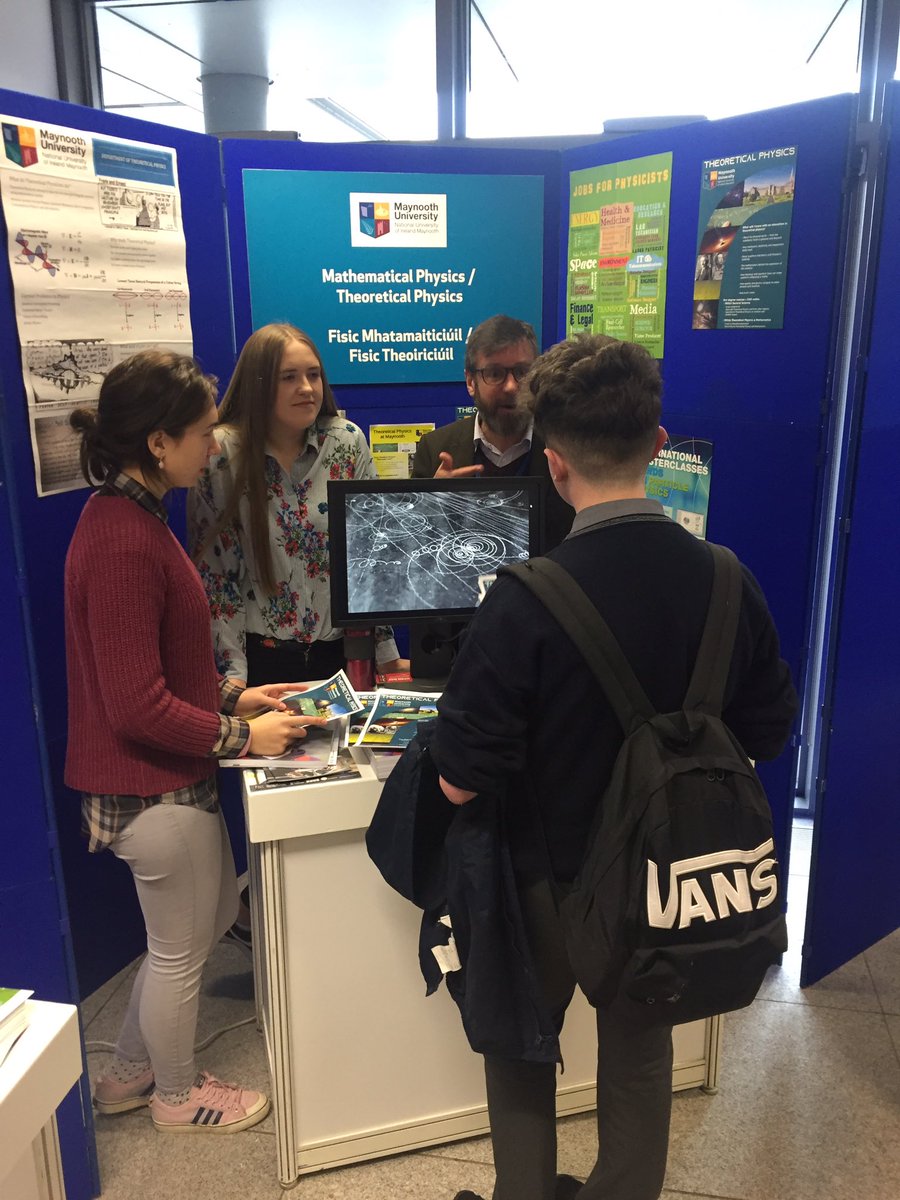
Yesterday’s Open Day was a very busy day. I’m given to understand that there was a record crowd  of over 3000 visitors. We were certainly not short of people to talk to at our stand in Iontas.

I think being a number of school trips contributed to the high attendance. Today has been more individual prospective students and parents. Also it’s been a bit rainy this morning so numbers might be down a bit compared to yesterday, but we’ve been busy again on the stall.

Anyway the main reason for writing this post is to thank all our student helpers including Rebekah, Eibhlin, Philip, Cai, Tigernach and Ryan for contributing over the two days and staff members Paul and Jiri for doing their stint. Their only material reward for helping has been a lunch voucher for one of the campus refectories.

UPDATE: The talk was very well attended and ended with lots and lots of questions, so I think I’ll call it a success. Now home to put my feet up and have a nice cup of tea!

Theoretical Physics at Maynooth University Open Days!

Posted in Education, Maynooth with tags , on November 22, 2018 by telescoper

Well, tomorrow (Friday 23rd November) and Saturday 24th November are both open days at Maynooth University. If you want to find out more about them you can look here where you will find this video which has some nice views of the campus:

I used to give Open Day talks quite frequently in a previous existence as Head of School of Mathematical and Physical Sciences at the University of Sussex and now I’m at it again, giving talks on behalf of the Department of Theoretical Physics on each Open Day. If you come along, please say hello either at the lectures (1.10pm on Friday and 2.10 on Saturday)! We also have a stall in the Iontas Building from 9.30 each day where you can meet staff and students and talk to them about the course, or anything else vaguely related to Theoretical Physics. There are other stalls, of course, but the Theoretical Physics one is obviously em>way more interesting than the others!

Looking for fun pictures to put in my talk I stumbled across this:

I think that’s the only one I need, really!

Jazz, STEM and the Creative Process

Posted in Art, Jazz, The Universe and Stuff with tags , , , , , , on January 23, 2016 by telescoper

The Times Higher has given me yet  another reason to be disgruntled this week, in the form of an article that talks about the possible effect of the proposed Teaching Excellence Framework (TEF) on “creative” subjects. What bothers me about this piece is not that it criticises the TEF – I think that’s an unworkable idea that will cause untold damage to the University system if, as seems likely, it is railroaded through for political reasons – but that the author (Nigel Carrington, Vice-Chancellor of the University of Arts London), like so many others, lazily implies that STEM disciplines are not creative. I think some of the most intensively creative people in the world are to be found in science and engineering and creativity is something we try very hard to nurture in students at Sussex University regardless of discipline.

Anyway, while feeling grumpy about this article, I remembered this video of an interview with the great jazz pianist, Bill Evans. Jazz is undoubtedly an intensely creative form, not only because it requires spontaneous real-time conversion of ideas into sounds. Evans talks with great passion and insight about creativity in music-making, but the striking thing about what he says at the  very beginning about the need to analyse your subject at a very elementary level before proceeding in order to create something that’s “real” applies equally well to, e.g. theoretical physics as it does to jazz.

In the following section he reiterates this point, but also stresses the discipline imposed by a particular form and why this does not limit creativity but makes it stronger.

It’s better to do something simple that is real. It’s something you can build on. because you know what you’re doing. Whereas, if you try to approximate something very advanced and don’t know what you’re doing, you can’t build on it.

No matter how far I might diverge or find freedom in this format, it only is free insofar that it has reference to the strictness of the original form. That’s what gives it its strength.

In much the same way, theoretical physics is not made less creative because it has to obey the strict rules of mathematics but more so. This is true also in the fine arts: the more limited the canvas the more creative the artist must be, but it also applies to, e.g. engineering design. Self-teaching is important in STEM subjects too: the only really effective way of learning, e.g. physics, is by devoting time to working through ideas in your own mind, not by sitting passively in lectures.

All subjects require technical skill, but there is more to being a great jazz musician than mastery of the instrument just as there’s more to being a research scientist than doing textbook problems. So here’s to creativity wherever it is found, and let’s have a bit more appreciation for the creative aspects of science and engineering!


Physics & Astronomy at Sussex – The Videos!

Posted in Brighton, Education with tags , , on January 20, 2016 by telescoper

So the annual University admissions cycle is getting into gear, which means I’ll be spending quite a few Saturdays giving talks and chatting to prospective students and their parents. As we prepare for  the first of Applicant Visit Days at the University of Sussex (on Saturday 23rd January) we’ve produced a number of videos featuring current students in the Department of Physics & Astronomy. I thought I’d share a couple here.

First here’s Anjelah, a student on our 4-year MPhys degree in Theoretical Physics. She still seems quite keen, despite having taken my Theoretical Physics module in her second year!

Here’s Joe, a 4-year MPhys (Physics) student:

And here’s another by Linn, who is on the BSc in Physics with Astrophysics degree:

You’ll notice that both of them talk about our dedicated study spaces, which the students really like. We’re one of the few Physics & Astronomy Departments in the UK – in fact the only that I know of – that has turned over the management of a large suite of rooms over to our students. We don’t just allow them to use the rooms 24 hours a day; we also give them a budget for furniture and books and they basically decide what they want and how to arrange it all. We also provide a constant supply of free tea and coffee (although I have to admit that I do pop in there from time to time and help myself too).


Helping Blind Students with Mathematics and Physics

Posted in Education with tags , , , , on October 16, 2015 by telescoper

This short video clip features Daniel Hajas, a third-year theoretical physics student in the Department of Physics & Astronomy at the University of Sussex who has been working on technology intended to help visually impaired students to   engage with the charts, graphs and equations involved in studying mathematics and physics. Here is a news item arising from a recent poster competition for which Daniel, who is himself visually impaired, highlighted the challenges faced by blind students by exhibiting a completely blank poster, explaining that this was how a blind person would experience a complex equation. In the video he explains a little more about the work he has been doing.


Through My Vision

Posted in Education with tags , , , , on May 31, 2015 by telescoper

I just saw this video and thought I would post it here. It features Daniel Hajas, one of our second-year Theoretical Physics students in the Department of Physics and Astronomy at the University of Sussex. In this short documentary he talks about his life and the challenges he faces as a blind person studying physics. Some of it was filmed inside the School of Mathematical and Physical Sciences, so you might see some people you recognise…

A Problems Class in Complex Analysis

Posted in Education, The Universe and Stuff with tags , , , , , on May 15, 2015 by telescoper

My theoretical physics examination is coming up on Monday and the students are hard at working revising for it (or at least they should be) so I thought I’d lend a hand by deploying some digital technology in the form of the following online interactive video-based learning resource on Complex Analysis:

End of Term Balls

Posted in Biographical, Education with tags , , , , on April 18, 2015 by telescoper

I haven’t had time to post for the last couple of days because I’ve been too bust with end-of-term business (and pleasure). Yesterday (Friday) was the last day of teaching term and this week I had to get a lot of things finished because of various deadlines, as well as attending numerous meetings. It’s been quite an exhausting week, not just because of that but also because by tradition the two departments within the School of Mathematical and Physical Sciences at the University of Sussex, the Department of Mathematics and the Department of Physics & Astronomy, hold their annual Staff-Student Balls on consecutive days. When I arrived here just over two years ago I decided that I should attend both or neither, as to attend at only one would look like favouritism. In fact this is the third time I’ve attended both of them. Let no-one say I don’t take my obligations seriously.  It’s a tough job, but someone has to do it. Holding both balls so close together  poses some problems for a person of my age, but I coped and also tried to weigh them up relative to each other and see  which was  most impressive.

Actually, both were really well organized. The Mathematics Ball was held in the elegant Hilton Metropole hotel and the Physics one in the Holiday Inn, both on the seafront. As has been the case in previous years the Mathematics ball is a bit more refined and sedate, the Physics one a little more raucous. Also this year there was a very large difference in the number of people going, with over 200 at the Physics Ball and only just over half that number at the Mathematics one. In terms of all-round fun I have to declare the Physics Ball the winner last year, but both occasions were very enjoyable. I’d like to say a very public thank you to the organizers of both events, especially Sinem and Jordan for Mathematics and Francis for Physics. Very well done.

The highlight of the Physics Ball was an after-dinner speech by particle physicist Jon Butterworth, who has an excellent blog called Life and Physics on the Guardian website. I’ve actually been in contact with Jon many times through social media (especially Twitter) over a period of over six years, but we never actually met in person until last night. I think he was a bit nervous beforehand because he had never done an after-dinner speech before, in the end though his talk was funny and wise, and extremely well received. Mind you, I did make it easy for him by giving a short speech to introduce him, and after a speech by me almost anyone would look good!

Thereafter the evening continued with drinking and dancing. After a while most people present were rather tired and emotional.  I even think some might even have been drunk. I eventually got home about 2am, after declining an invitation to go to the after-party. I’m far too old for that sort of thing. Social events like this can be a little bit difficult, for a number of reasons. One is that there’s an inevitable “distance” between students and staff, not just in terms of age but also in the sense that the staff have positions of responsibility for the students. Students are not children, of course, so we’re not legally  in loco parentis, but something of that kind of relationship is definitely there. Although it doesn’t stop either side letting their hair down once in a while, I always find there’s a little bit of tension especially if the revels get a bit out of hand. To help occasions like this run smoothly I think it’s the responsibility of the staff members present to drink heavily in order to put the students at ease. United by a common bond of inebriation, the staff-student divide crumbles and a good time is had by all.

There’s another thing I find a bit strange. Chatting to students last night was the first time I had spoken to many of my students like that, i.e. outside the lecture  or tutorial. I see the same faces in my lectures day in, day out but all I do is talk to them about physics. I really don’t know much about them at all. But it is especially nice when on occasions like this students come up, as several did last night, and say that they enjoyed my lectures. Actually, it’s more than just nice. Amid all the bureaucracy and committee meetings, it’s very valuable to be reminded what the job is really all about.


P.S. Apologies for not having any pictures. I left my phone in the office on Friday when I went home to get changed. I will post some if anyone can supply appropriate images. Or, better still, inappropriate ones!


From Real Time to Imaginary Time

Posted in Brighton, Education, The Universe and Stuff with tags , , , , , , , , , , , on February 24, 2014 by telescoper

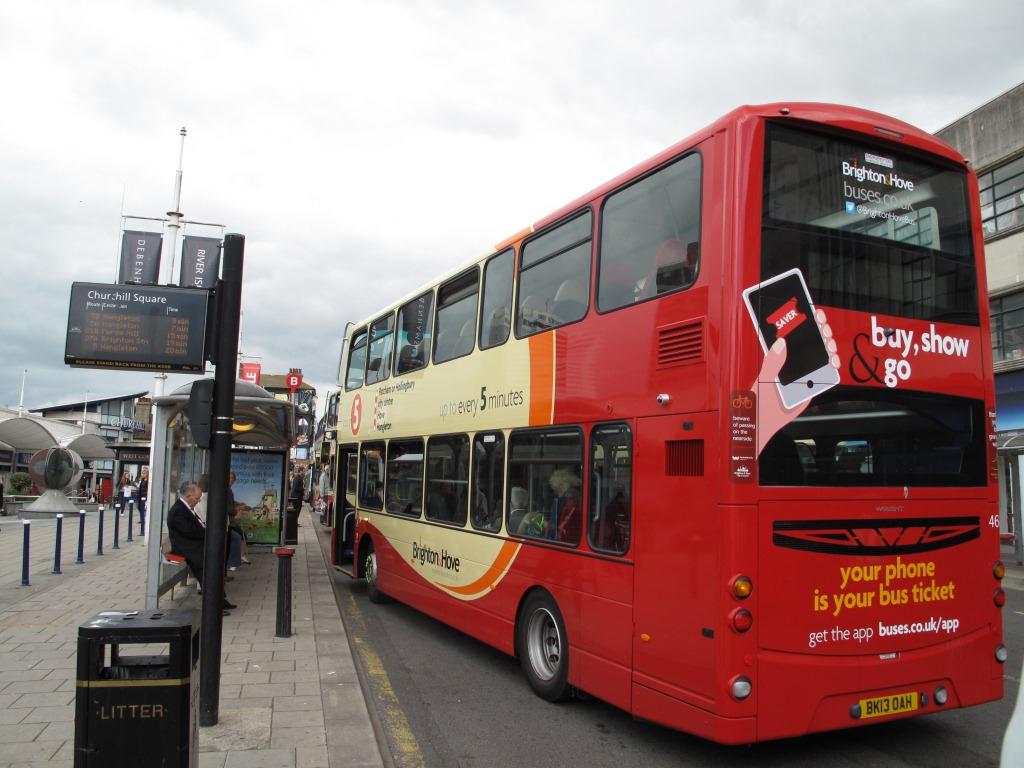
Yesterday, after yet another Sunday afternoon in my office on the University of Sussex campus, I once again encountered the baffling nature of the “real time boards” at the bus-stop at Falmer Station (just over the road from the University). These boards are meant to show the expected arrival times of buses; an example can be seen on the left of the picture below, taken at Churchill Square (in the City Centre).

???????????????????????????????

The real-time board system works pretty well in central Brighton, but it’s a very different story at Falmer, especially for the Number 23 which is my preferred bus home. Yesterday provided a typical illustration of the problem: the time of the first bus on the list, a No. 23, was shown as “1 min” when I arrived at the stop. It then quickly moved to “due” (a word which I’ll comment about later). It then moved back to “2 mins” for about 5 minutes and then back to “due” again. It stayed like that for over 10 minutes at which point the bus that was second on the list (a No. 28 from Lewes) appeared. Rather than risk waiting any longer for the 23 I got on the 28 and had a slightly longer walk home from the stop at the other end. Just as well I did because the 23 vanished entirely from the screen as soon as I boarded the other bus. This apparent time-travel isn’t unusual at Falmer, although I’ve never really understood why.

By sheer coincidence when I got to the bus stop to catch a bus to campus this morning there was a chap from Brighton and Hove buses there. He was explaining what sometimes goes wrong with the real time boards to a lady, so I joined in the conversation and asked him if he knew why Falmer is so unreliable. He was happy to oblige. It turns out that the way the real-time boards work depends on each bus having a GPS system that communicates to a central computer via a radio link. If the radio link drops out for some reason – as it apparently does quite often up at Falmer (mobile phone connectivity is poor here also) – the system looks up the expected time of the bus after the one that it has lost contact with. Thus it is that a bus can apparently be “due” and then apparently go back in time. Also, if a bus has to divert from the route programmed into the GPS tracker then it is also removed from the real-time boards.

However, there is another system in operation alongside the GPS tracker. When a bus actually stops at a stop and opens its doors the onboard computer communicates this to the central system at the same time as the location signs inside the bus are updated. At this point the real-time boards are reset.

The unreliability I’ve observed at Falmer is in fact caused by two problems: (i) the patchy radio coverage as the bus wanders around the hilly environs of Falmer campus; and (ii) the No. 23 is on a new route around the back of campus which means that it vanishes from the system entirely when it wanders off the old route, as would happen if the bus were to break down.

Mystery solved then, in a sense, but it means there’s a systematic problem that isn’t going to be fixed in the short-term. Would it be better to switch off the boards than have them show inaccurate information? Perhaps, but only if it were always wrong. In fact the boards seem to work OK for the more frequent bus, the No. 25. My strategy is therefore never to rely on the information provided concerning the No. 23 and just get the first bus that comes. It’s not a problem anyway during the week because there’s a bus every few minutes, but on a Sunday evening it is quite irksome to see apparently random times on the screens.

All this talk about real-time boards reminds me of a question I was asked in a lecture last week. I was starting a new section of my Theoretical Physics module for 2nd Year students on Complex Analysis: the Cauchy-Riemann equations, Conformal Transformations, Contour Integrals and all that Jazz. To start the section I went on a bit of a ramble about the ubiquity of complex numbers in physics and whether this means that imaginary numbers are, in some sense, real. You can find an enjoyable polemic on this subject, given the answer “no” to the question here.

Anyway, I got the class to suggest examples of the use of complex numbers in physics. The things you’d expect came up such as circuit theory, wave propagation etc. Then somebody mentioned that somewhere they had heard of imaginary time. The context had probably been provided Stephen Hawking who mentioned this in his book A Brief History of Time. In fact the trick of introducing imaginary time is called a Wick Rotation and the basic idea is simple. In special relativity we deal with four-dimensional space-time intervals of the form

ds^2 = -c^2dt^2 + dx^2 + dy^2 +dz^2,

i.e. the metric describing Minkowski space. The minus sign in front of the time bit is essential to the causal structure of space-time but it causes quite a few mathematical difficulties. However if we make the substitution

\tau \rightarrow i c t

then the metric becomes

ds^2 = d\tau^2 + dx^2 + dy^2 +dz^2,

which corresponds to a four-dimensional Euclidean space which is in many situations much easier to handle mathematically.

Complex variables and complex functions provide the theoretical physicist with a host of extremely elegant techniques for solving tricky problems. But does that mean they are somehow “built in” to nature? I don’t think so. I don’t think the Brighton & Hove Bus company uses imaginary time on its display boards either, although it does sometimes seem that way.


POSTSCRIPT. I forgot to include my planned rant about the use of the word “due”. The boards displaying train times at railway stations usually give the destination and planned departure time of the train, e.g. “Brighton 11.15”. If things are running to schedule this information is supplemented by the phrase “On Time”. If not, which is sadly a more likely contingency in the UK, this changes to “due 11.37” or some such. This really annoys me.: the train is due at 11.15. If it doesn’t come until after then, it’s overdue or, in other words, late.