Archive for weak gravitational lensing

Three New Publications at the Open Journal of Astrophysics

Posted in OJAp Papers, Open Access, The Universe and Stuff with tags , , , , , , , , , , , , , , , , , on June 8, 2024 by telescoper

Time for another roundup of business at the  Open Journal of Astrophysics. This time I have three papers to announce, which brings the total we have published so far this year (Vol. 7) to 45 and the total published by OJAp to 160. We’re still on track to publish around 100 papers this year or more, compared to last year’s 50.

First one up, published on 3rd June 2024, is “Log-Normal Waiting Time Widths Characterize Dynamics” by Jonathan Katz of Washington University (St Louis, Missouri, USA). This paper presents a discussion of the connection between waiting time distributions and dynamics for aperiodic astrophysical systems, with emphasis on log-normal distributions.  This paper is in the folder marked High-Energy Astrophysical Phenomena.

Here is a screen grab of the overlay, which includes the abstract:


You can read the paper directly on arXiv here.

The second paper to present is “An Empirical Model For Intrinsic Alignments: Insights From Cosmological Simulations” by Nicholas Van Alfen (Northeastern University, Boston, USA), Duncan Campbell (Carnegie Mellon University, Pittsburgh, USA), Jonathan Blazek (Northeastern University), C. Danielle Leonard (Newcastle University, UK), Francois Lanusse (Université Paris-Saclay, France), Andrew Hearin (Argonne National Laboratory, USA), Rachel Mandelbaum (Carnegie Mellon University) and The LSST Dark Energy Science Collaboration.  This paper presents an extension of the halo model (specifically the Halo Occupation Distribution, HOD) to include intrinsic alignment effects for the study of weak gravitational lensing. This paper is in the folder marked Cosmology and Nongalactic Astrophysics. It was published on Tuesday June 4th 2024.

The overlay looks like this:


You can read this paper directly on the arXiv here.

Last, but by no means least, comes  “Towards Cosmography of the Local Universe”  which proposes the multipoles of the distance-redshift relation as new cosmological observables that have a direct physical interpretation in terms of kinematical quantities of the underlying matter flow. This was also published on 4th June. The authors are Julian Adamek (IfA Zurich, Switzerland), Chris Clarkson (Queen Mary, London, UK), Ruth Durrer (Geneva, Switzerland), Asta Heinesen (U. Lyon, France & NBI Copenhagen, Denmark), Martin Kunz (Geneva), and Hayley J. Macpherson (Chicago, USA).

Here is a screengrab of the overlay:


To read the accepted version of this on the arXiv please go here. This paper is also in the folder marked Cosmology and Nongalactic Astrophysics.
That’s it for this week. I aim to post another update next weekend.


Three New Publications at the Open Journal of Astrophysics

Posted in OJAp Papers, Open Access, The Universe and Stuff with tags , , , , , , , , on May 25, 2024 by telescoper

After a very busy and unusual week, it’s time to get back to normal with the usual  Saturday roundup of business at the  Open Journal of Astrophysics. If you want to know how many papers we have published so far this year (Vol. 7), the answer is 42. The total published by OJAp is now 157. We’re still on track to publish around 100 papers this year, possibly more, compared to last year’s 50.

All the members of this week’s trio are in the folder marked Cosmology and Nongalactic Astrophysics, and indeed all three relate in one way or another to the topic of weak gravitational lensing.  All three were published on Wednesday 22nd May 2024.

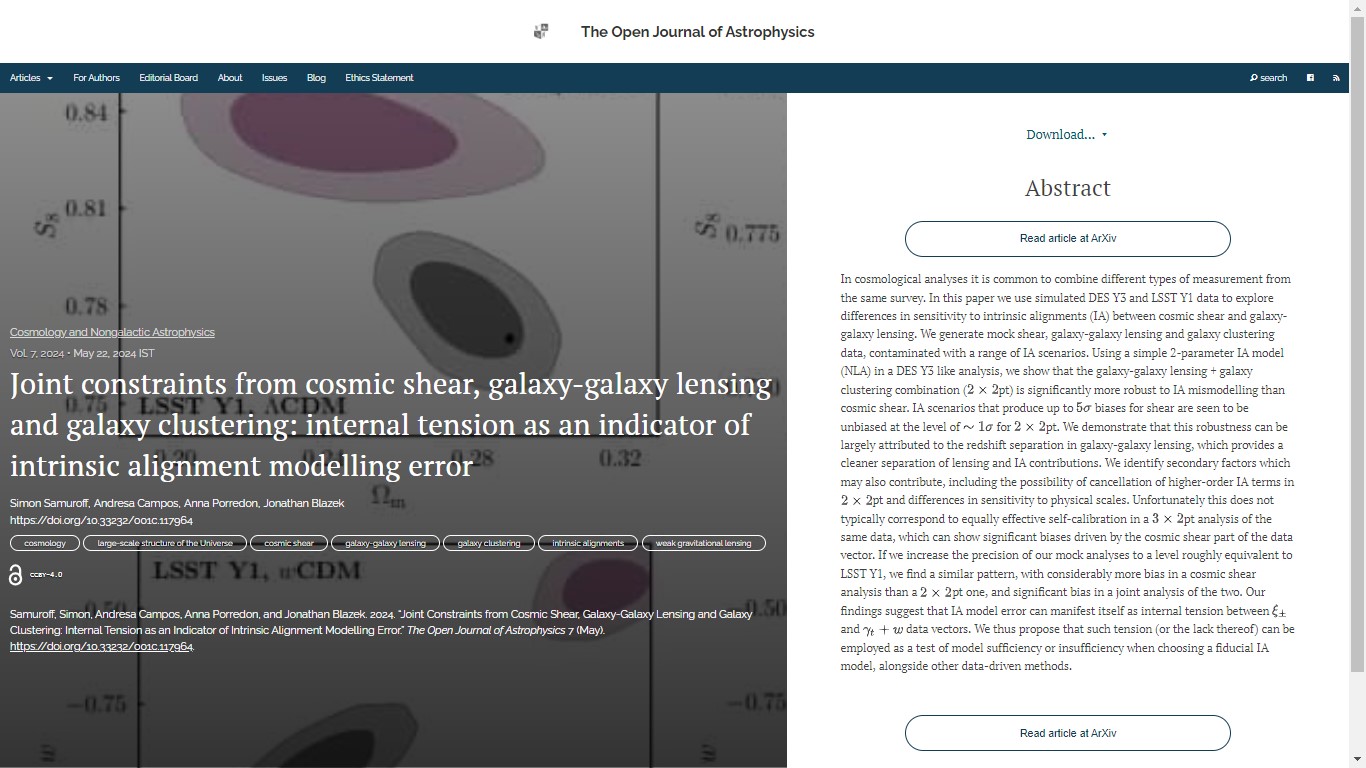
First one up is “Joint constraints from cosmic shear, galaxy-galaxy lensing and galaxy clustering: internal tension as an indicator of intrinsic alignment modelling error” which is by Simon Samuroff (Northeastern U., USA), Andresa Campos (Carnegie Mellon U., USA), Anna Porredon (Bochum, Germany) and Jonathan Blazek (Edinburgh, UK).   A combined statistical approach to the identification of errors arising in cosmic shear analysis due to intrinsic alignments.

Here is a screen grab of the overlay, which includes the abstract:

You can read the paper directly on arXiv here.

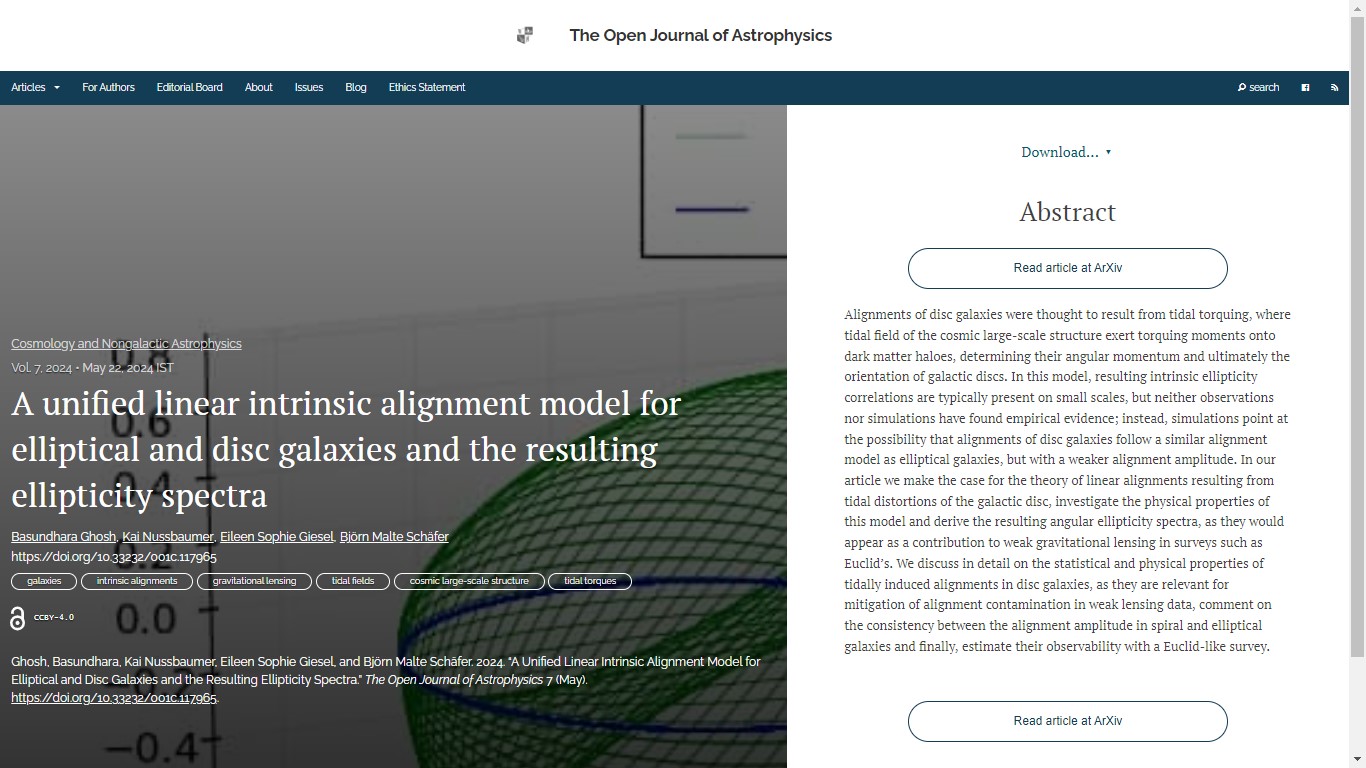
The second paper to present is “A unified linear intrinsic alignment model for elliptical and disc galaxies and the resulting ellipticity spectra” by Basundhara Ghosh (Bangalore, India), with Kai Nussbaumer, Eileen Sophie Giesel & Björn Malte Schäfer (Heidelberg, Germany). It presents a discussion of the physical origin of intrinsic alignments of both elliptical and disk galaxies and the implications for cosmological studies

The overlay looks like this:


You can read this paper directly on the arXiv here.

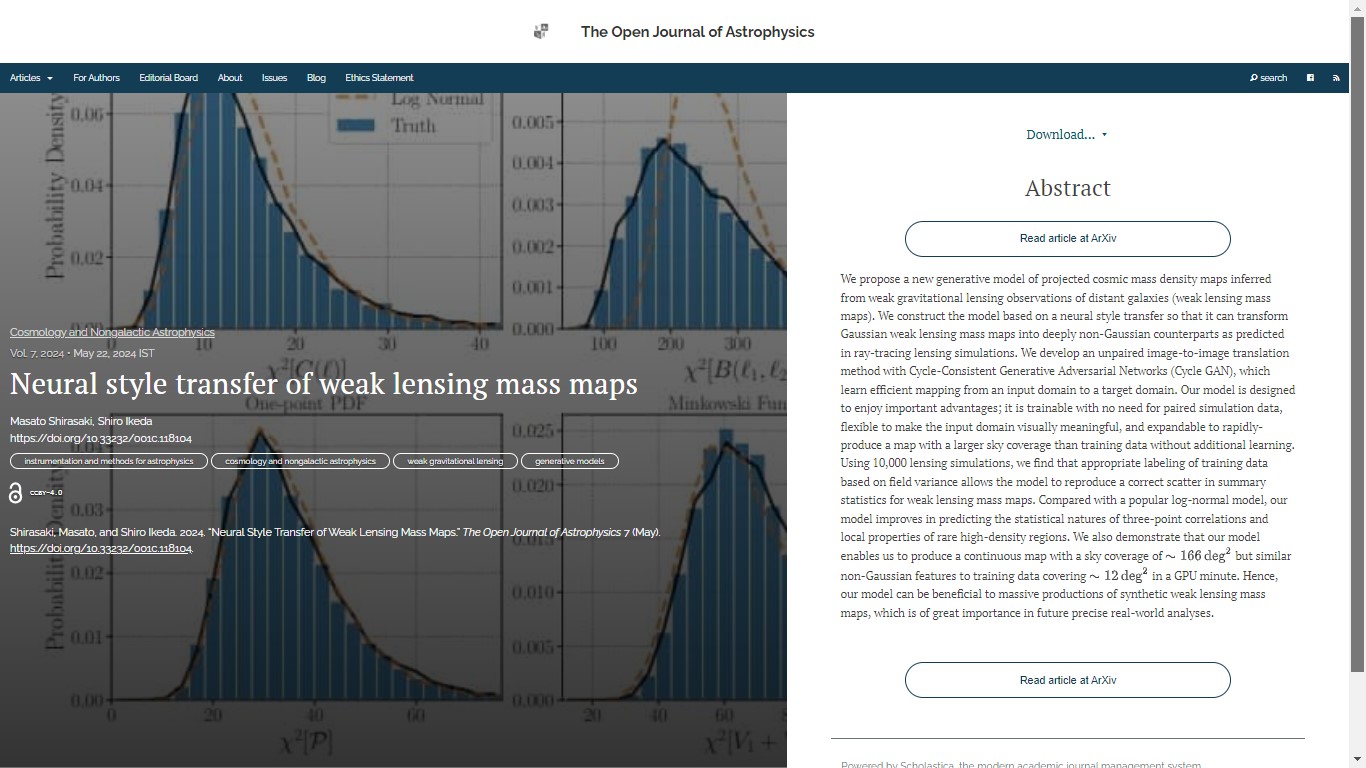
The last paper of this batch is entitled “Neural style transfer of weak lensing mass maps”  and proposes a generative model for the mass-production of weak-lensing maps. The authors are Masato Shirasaki and Shiro Ikeda (both of the University of Tokyo, Japan)

Here is a screengrab of the overlay:


To read the accepted version of this on the arXiv please go here.
That’s all for now. I will do another update next week.


Cosmology Talks: Intrinsic Alignments – A Guide for All Cosmologists

Posted in OJAp Papers, The Universe and Stuff, YouTube with tags , , , , , , , , , on February 24, 2024 by telescoper

I was just thinking this afternoon that I haven’t posted recently any of the Cosmology Talks curated by Shaun Hotchkiss, then I looked and found that I had the perfect excuse for doing so. This particular talk is actually about one of the two new OJAp papers I announced in my previous post, i.e. “The IA Guide: A Breakdown of Intrinsic Alignment Formalisms” and the authors are: Claire Lamman (Harvard, USA);  Eleni Tsaprazi (Stockholm, Sweden);  Jingjing Shi (Tokyo, Japan); Nikolina Niko Šarčević (Newcastle, UK); Susan Pyne (UCL, UK); Elisa Legnani (Barcelona, Spain); and Tassia Ferreira (Oxford, UK).

Here is Shaun’s description of the video:

Claire Lamman, Jingjing Shi, Niko Šarčević, Susan Pyne, Elisa Legnani and Tassia Ferreira tell us about the intrinsic alignments guide they wrote (along with Eleni Tsaprazi, who couldn’t make the video recording).

They wanted to write something that wasn’t quite a review, but also wasn’t quite a set of lecture notes. Instead they aimed for what might be best framed as a “cheat sheet” for intrinsic alignments. Everything you need to know about the topic, compressed into one article. However, there’s still a lot about the topic, so the compression is still 33 pages and 10 figures big.

To construct the guide they broke the topic of intrinsic alignments into sub-fields and then asked questions like “what are the key equations for this sub-field?”, “what are the different notations people use?”, “what might be confusing to a newcomer?” They then wrote the guide to answer those questions, even including subsections with quick definitions of each common term, and short lists of common alternative notations.

And here is the video!

Two New Publications at the Open Journal of Astrophysics

Posted in OJAp Papers, Open Access, The Universe and Stuff with tags , , , , , , , , , , on February 24, 2024 by telescoper

It’s Saturday morning in Sydney, and time to post another update relating to the  Open Journal of Astrophysics.  Since the last update we have published two more papers, taking  the count in Volume 7 (2024) up to 15 and the total published by OJAp up to 130. I should have posted these before leaving but it slipped my mind.

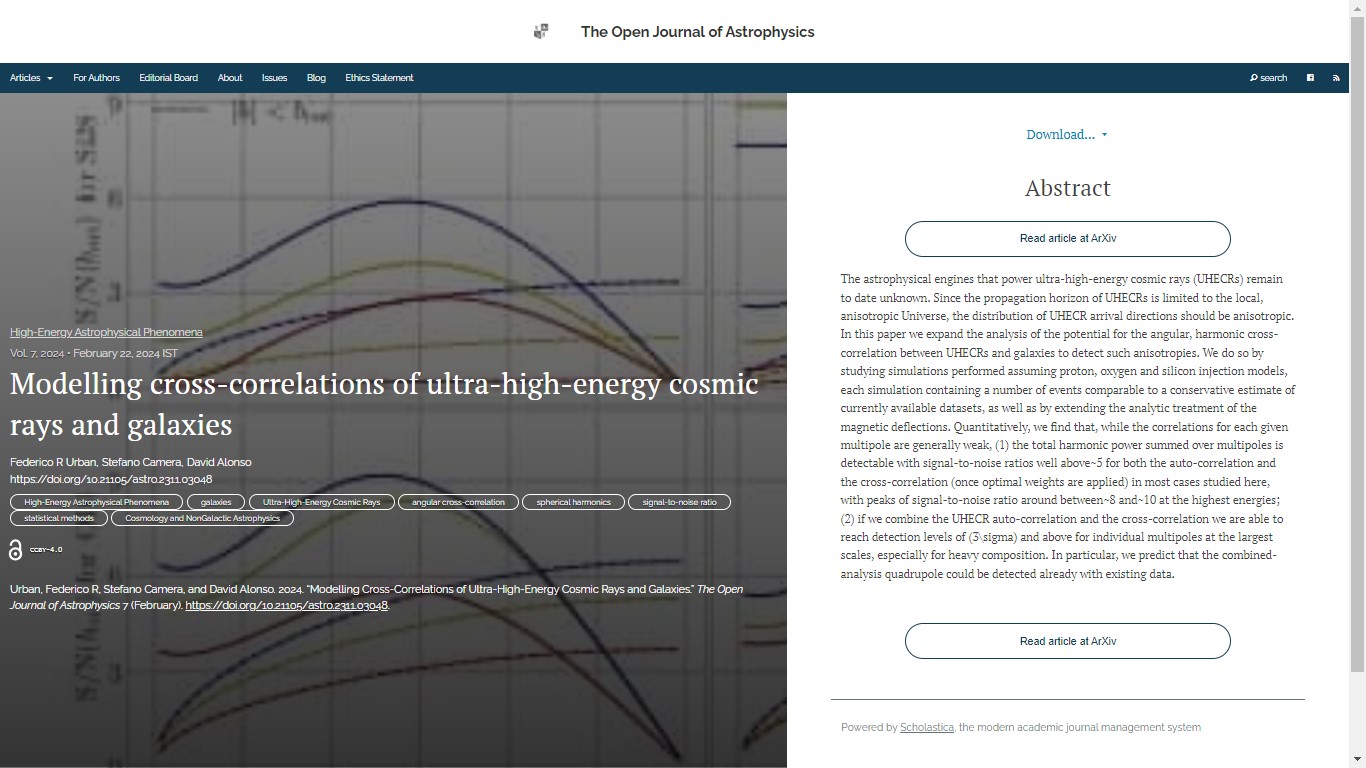
The first paper of the most recent pair – published on  Thursday 22nd February – is “Modelling cross-correlations of ultra-high-energy cosmic rays and galaxies” by Federico Urban (Prague, Czech Republic), Stefano Camera (Torino, Italy) and David Alonso (Oxford, UK). It presents a discussion of the possible statistical correlations between Ultra-High-Energy Cosmic-Ray (UHECR) directions in various models and structure in the galaxy distribution and whether or not this signal could be measurable.  This one is in the folder marked “High-Energy Astrophysical Phenomena“.

Here is a screen grab of the overlay which includes the abstract:

You can click on the image of the overlay to make it larger should you wish to do so. You can find the officially accepted version of the paper on the arXiv here.

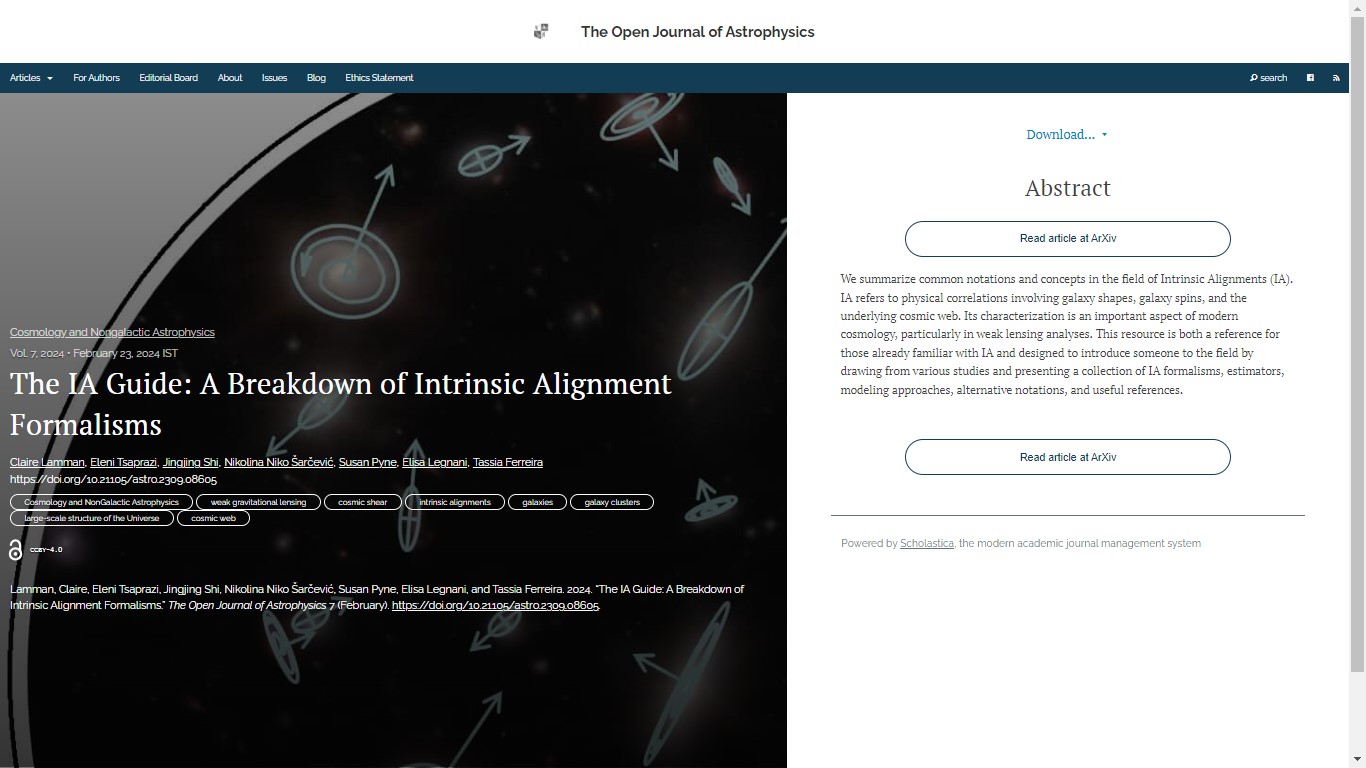
The second paper was published on Friday 23rd February and has the title “The IA Guide: A Breakdown of Intrinsic Alignment Formalisms” and the authors are: Claire Lamman (Harvard, USA);  Eleni Tsaprazi (Stockholm, Sweden);  Jingjing Shi (Tokyo, Japan); Nikolina Niko Šarčević (Newcastle, UK); Susan Pyne (UCL, UK); Elisa Legnani (Barcelona, Spain); and Tassia Ferreira (Oxford, UK). This one, which is in the folder marked Cosmology and NonGalactic Astrophysics, presents a review of Intrinsic Alignments, i.e. physical correlations involving galaxy shapes, galaxy spins, and larger scale structure, especially important for weak gravitational lensing

Here is a screen grab of the overlay which includes the abstract:


You can click on the image of the overlay to make it larger should you wish to do so. You can find the officially accepted version of the paper on the arXiv here.

That concludes this week’s update!

New Publication at the Open Journal of Astrophysics

Posted in OJAp Papers, Open Access, The Universe and Stuff with tags , , , , , on October 22, 2023 by telescoper

It’s Sunday but I’ll be a bit busy next week so I’m taking the opportunity today to announce yet another new paper at the Open Journal of Astrophysics. This one was published on Friday 20th October.

The latest paper is the 41st  so far in Volume 6 (2023) and the 106th in all. It is a product of the Dark Energy Survey team and the Kilo-Degree Survey Collaboration, which amounts to about 160 authors altogether. The corresponding author for this article was the Astronomer Royal for Scotland Professor Catherine Heymans, no less.

The primary classification for this paper is Cosmology and NonGalactic Astrophysics and its title is “DES Y3 + KiDS-1000: Consistent cosmology combining cosmic shear surveys”. The article presents a joint analysis of the Dark Energy Survey Year 3 data and the Kilo-Degree Survey data, with a discussion of the implications for cosmological parameters. The key figure – a very important one – is this:

If you want to know more about the result and why it is so important you could read the paper. It is, however, rather long: 40 pages including 21 figures and 15 tables. Do not despair, though, because here is a video explaining the work in the series of Cosmology Talks presented by Shaun Hotchkiss:

Anyway, here is the overlay of the paper containing the abstract:

You can click on the image of the overlay to make it larger should you wish to do so. You can find the officially accepted version of the paper on the arXiv here.

Two New Publications at the Open Journal of Astrophysics

Posted in OJAp Papers, Open Access, The Universe and Stuff with tags , , , , , , , , on October 20, 2023 by telescoper

It’s Friday so it’s a good time to catch up with the week’s action at the Open Journal of Astrophysics, where there have been two new publications so far this week. These papers take us up to a total of 40  in Volume 6 (2023) and 105 in total since we started publishing.

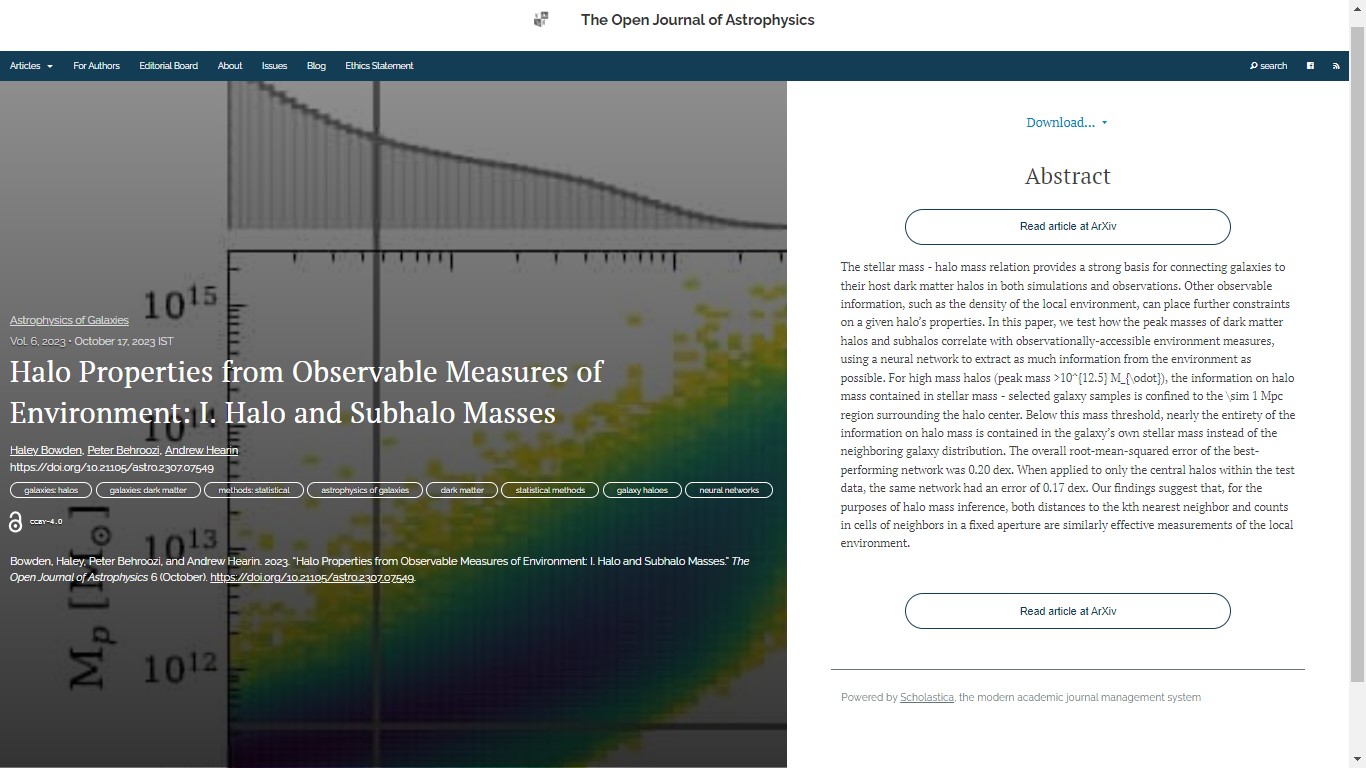
The title of the first paper is “Halo Properties from Observable Measures of Environment: I. Halo and Subhalo Masses” and its primary classification is Astrophysics of Galaxies. it is an exploration using neural networks of how the peak masses of dark matter halos and subhaloes correlate with observationally-accessible measures of their dependence on environment.

The authors based in the United States of America: Haley Bowden and Peter Behroozi of the University of Arizona, and Andrew Hearin of the Argonne National Laboratory

Here is a screen grab of the overlay which includes the abstract:


You can click on the image of the overlay to make it larger should you wish to do so. You can find the officially accepted version of the paper on the arXiv here.

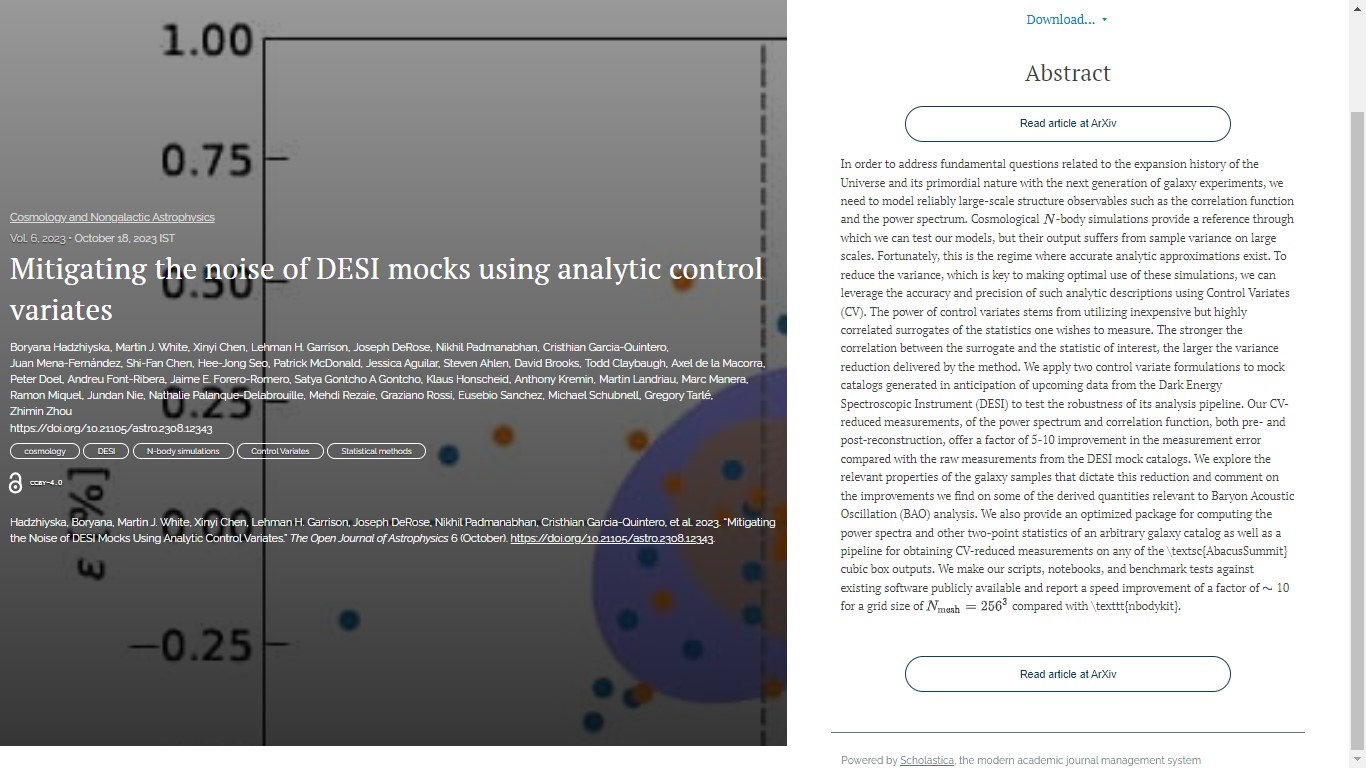
The second paper was published on 18th October 2023.  The primary classification for this one is Cosmology and Nongalactic Astrophysics and is “Mitigating the noise of DESI mocks using analytic control variates”. For those of you not up with the lingo, DESI stands for the Dark Energy Spectroscopic Instrument and you can read more about it here.

The lead author for this one is Boryana Hadzhiyska of the Lawrence Berkeley Laboratory and the University of California, Berkeley (USA) and there are 32 other authors. This paper presents a method for reducing the effects of sample variance on cosmological simulations using analytical approximations and tests it using DESI data.

Here is a screen grab of the overlay which includes the abstract:


You can click on the image of the overlay to make it larger should you wish to do so. You can find the officially accepted version of the paper on the arXiv here.

New Publication at the Open Journal of Astrophysics

Posted in OJAp Papers, Open Access, The Universe and Stuff with tags , , , on June 21, 2023 by telescoper

I may be away at a conference, but it’s still time to announce yet another new paper at the Open Journal of Astrophysics. This one was published on Monday 19th June.

The latest paper is the 20th  so far in Volume 6 (2023) and the 85th in all,  so with still more than half of 2023 remaining and many papers still in the pipeline, we’re on track to reach a total of 100 papers by the end of 2023!

The primary classification for this paper is Cosmology and Nongalactic Astrophysics and its title is “Sparse Bayesian mass-mapping using trans-dimensional MCMC”.  The paper describes a new trans-dimensional Markov Chain Monte Carlo sampler for mass-mapping, using wavelets, for the construction of mass maps from weak gravitational lensing which, as I’ve previously mentioned on this blog, is what the cool kids do these days.

The authors are: Augustin Marignier, Thomas D. Kitching & Jason D. McEwen (MSSL, Mullard Space Science Laboratory), Ana M. G. Ferreira (Department of Earth Sciences), all at University College London.

Here is a screen grab of the overlay which includes the  abstract:


You can click on the image of the overlay to make it larger should you wish to do so. You can find the officially accepted version of the paper on the arXiv here.

R.I.P. Nick Kaiser (1954-2023)

Posted in R.I.P., The Universe and Stuff with tags , , on June 14, 2023 by telescoper
Nick Kaiser (1954-2023)

It was with a sense of shock that I heard this afternoon of the death of the age of 68 of cosmologist Nick Kaiser. It seems like only yesterday that we were celebrating the award of the Gruber Prize to Nick, but that was back in 2019. In a field filled with very clever people, Nick was one of the cleverest and also one of the nicest.

I have never worked directly with Nick Kaiser but he had an enormous influence on me, especially early on in my career. When I was doing my PhD, Nick was based in Cambridge and if I remember correctly he was the first person ever to ask me a question during a conference talk when I gave one there in 1987. Nick was never shy about making such interventions, sometimes somewhat mischievously. At first he terrified me because I didn’t know him except by scientific reputation, and didn’t realize what a nice guy he was. His question was actually very helpful, as it allowed me explain something that I’d skipped because I was under time pressure. His response to my explanation was very complimentary and supportive, which encouraged me a lot, and we chatted for quite a while after the session (in a pub). He was very friendly and approachable, and very far from the intimidating character I’d expected. Anyway, his 1984 paper on cluster correlations was the direct motivation for my very first publication (in 1986).

I mentioned yesterday that many of the papers published by the Open Journal of Astrophysics over the last few years have been in the field of weak gravitational lensing. It is safe to say that is a field that was basically created by Nick; see the paper by Kaiser & Squires (1993) that kicked it all off. You could also say the same about the use of redshift-space distortions, concerning which he wrote a seminal paper in 1987. These are two techniques that will be applied in the analysis of data from the Euclid spacecraft, to be launched next month.

These are just a few of things that Nick did. He did many others, always original and always interesting. In recognition of his achievements he was made a Fellow of the Royal Society in 2008, won the Gold Medal of the Royal Astronomical Society in 2017, the Daniel Chalonge and Hector de Vega Medals in 2018, and the Gruber Prize for Astronomy in 2019.

It’s hard to characterize someone of such intellectual breadth, but it always seemed to me that his approach was driven by a very deep physical insight. He was often able to identify what were the fundamental aspects of apparently complicated phenomena and build simple models that captured most of the physics. Using this approach he could penetrate the thickets in which others might get lost. He was perfectly capable of undertaking more complicated calculations to elaborate the details, but he always started by focussing on the basics.

I met Nick many times here and there, usually at conferences. He was always enthusiastic and energetic and entertaining, and was great company to talk to over a drink or several. You always had a good laugh talking to Nick, but you always learnt something too. His son studied in Cardiff some years ago, while I was working there, and Nick sometimes came to visit on the pretext of giving a seminar. I remember once he almost missed his own talk because we were sitting in a pub chatting.

Nick spent recent years in Paris; I remember his presence when I did an online colloquium for the Daniel Chalonge – Hector de Vega School in 2021. He certainly seemed in fine health and good spirits then. Indeed, he gave a talk in the same series that year which you can download here.

Nick’s untimely death is particularly shocking because he was ultra-fit. I think he got hooked on ultra-endurance events while living in Hawaii, as the first Ironman events were held there. Mere marathons were not enough for him. I think I last saw him in person in 2016 during a meeting in Italy. While most of us laboured on the “easy” hiking trails, Nick found them uninteresting and went running off looking for greater challenges.

It still hasn’t really sunk in that Nick has gone. I know I’m not the only one who feels that way. I think the sense of loss will pervade the cosmological community for a considerable time. I send deepest condolences to his family, friends, colleagues and co-workers. He’ll be hugely missed by a huge number of people.

Rest in peace, Nick.

New Publication at the Open Journal of Astrophysics

Posted in OJAp Papers, The Universe and Stuff with tags , , , , , on May 26, 2023 by telescoper

It’s time to announce yet another new paper at the Open Journal of Astrophysics. This one was published yesterday (25th May).

The latest paper is the 18th paper so far in Volume 6 (2023) and the 83rd in all. With this one we have now published more papers in 2023 than we did in all of last year. With significantly less than half the year gone, and a large number of papers in the pipeline, I think it’s quite likely we will exceed a total of 100 papers by the end of 2023.

The primary classification for this paper is Cosmology and Nongalactic Astrophysics and its title is “The Effect of Splashback on Weak Lensing Mass Estimates of Galaxy Clusters and Groups”. For the uninitiated  “Splashback” of infalling material produces features in the radial density profile of galaxy clusters. This paper discusses the effect of this on cluster masses derived from weak lensing measurements.

The authors, most of whom have multiple affiliations, are: Yuanyuan Zhang (NOIRLab, Tucson, AZ, USA), Susmita Adhikari (IISER, Pune, India), Matteo Costanzi (Univ. Trieste, Italy) and Josh Frieman, Jim Annis & Chihway Chang (Univ. Chicago, IL, USA).

Here is a screen grab of the overlay which includes the  abstract:


You can click on the image of the overlay to make it larger should you wish to do so. You can find the officially accepted version of the paper, along with all other astrophysics and cosmology research papers worth reading, on the arXiv here.

New Publication at the Open Journal of Astrophysics

Posted in OJAp Papers, Open Access, The Universe and Stuff with tags , , , on May 18, 2023 by telescoper

It’s time to announce yet another new paper at the Open Journal of Astrophysics. This one was published yesterday (17th May).

The latest paper is the 17th paper so far in Volume 6 (2023) and the 82nd in all. With this one we have now published as many papers so far in 2023 as we did in all of last year. With significantly less than half the year gone, and a large number of papers in the pipeline, I think it’s quite likely we will exceed a total of 100 papers by the end of 2023. How’s that for cosmic acceleration?

The primary classification for this paper is Instrumentation and Methods for Astrophysics and its title is “Deep-field Metacalibration”. This article describes a technique that reduces the pixel noise in estimators of weak gravitational lensing shear signals by using a deeper imaging survey for calibration.

The authors are Zhuoqi (“Jackie”) Zhang (University of Chicago, IL, USA), Erin Sheldon (Brookhaven National Laboratory, NY, USA), and Matthew Becker (Argonne National Laborary, IL, USA).

Here is a screen grab of the overlay which includes the  abstract:


You can click on the image of the overlay to make it larger should you wish to do so. You can find the officially accepted version of the paper, along with all other astrophysics and cosmology research papers worth reading, on the arXiv here.