Archive for WMAP

Doubts about the Evidence for Penrose’s Cyclic Universe

Posted in Bad Statistics, Cosmic Anomalies, The Universe and Stuff with tags , , , , , , on November 28, 2010 by telescoper

A strange paper by Gurzadyan and Penrose hit the Arxiv a week or so ago. It seems to have generated quite a lot of reaction in the blogosphere and has now made it onto the BBC News, so I think it merits a comment.

The authors claim to have found evidence that supports Roger Penrose‘s conformal cyclic cosmology in the form of a series of (concentric) rings of unexpectedly low variance in the pattern of fluctuations in the cosmic microwave background seen by the Wilkinson Microwave Anisotropy Probe (WMAP). There’s no doubt that a real discovery of such signals in the WMAP data would point towards something radically different from the standard Big Bang cosmology.

I haven’t tried to reproduce Gurzadyan & Penrose’s result in detail, as I haven’t had time to look at it, and I’m not going to rule it out without doing a careful analysis myself. However, what I will say here is that I think you should take the statistical part of their analysis with a huge pinch of salt.

Here’s why.

The authors report a hugely significant detection of their effect (they quote a “6-σ” result; in other words, the expected feature is expected to arise in the standard cosmological model with a probability of less than 10-7. The type of signal can be seen in their Figure 2, which I reproduce here:
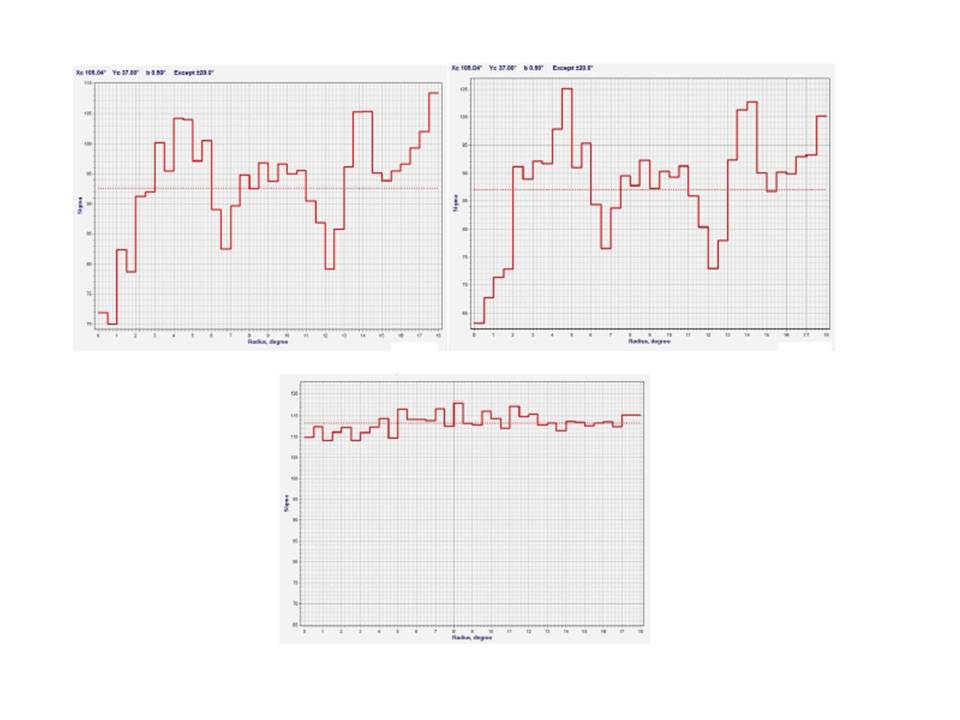
Sorry they’re hard to read, but these show the variance measured on concentric rings (y-axis) of varying radius (x-axis) as seen in the WMAP W (94 Ghz) and V (54 Ghz) frequency channels (top two panels) compared with what is seen in a simulation with purely Gaussian fluctuations generated within the framework of the standard cosmological model (lower panel). The contrast looks superficially impressive, but there’s much less to it than meets the eye.

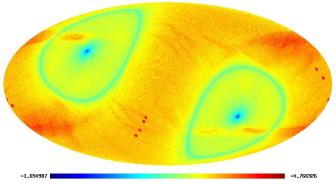
For a start, the separate WMAP W and V channels are not the same as the cosmic microwave background. There is a great deal of galactic foreground that has to be cleaned out of these maps before the pristine primordial radiation can be isolated. The fact similar patterns can be found in the BOOMERANG data by no means rules out a foreground contribution as a common explanation of anomalous variance. The authors have excluded the region at low galactic latitude (|b|<20°) in order to avoid the most heavily contaminated parts of the sky, but this is by no means guaranteed to eliminate foreground contributions entirely. Here is the all-sky WMAP W-band map for example:

Moreover, these maps also contain considerable systematic effects arising from the scanning strategy of the WMAP satellite. The most obvious of these is that the signal-to-noise varies across the sky, but there are others, such as the finite size of the beam of the WMAP telescope.

Neither galactic foregrounds nor correlated noise are present in the Gaussian simulation shown in the lower panel, and the authors do not say what kind of beam smoothing is used either. The comparison of WMAP single-channel data with simple Gaussian simulations is consequently deeply flawed and the significance level quoted for the result is certainly meaningless.

Having not looked looked at this in detail myself I’m not going to say that the authors’ conclusions are necessarily false, but I would be very surprised if an effect this large was real given the strenuous efforts so many people have made to probe the detailed statistics of the WMAP data; see, e.g., various items in my blog category on cosmic anomalies. Cosmologists have been wrong before, of course, but then so have even eminent physicists like Roger Penrose…

Another point that I’m not sure about at all is even if the rings of low variance are real – which I doubt – do they really provide evidence of a cyclic universe? It doesn’t seem obvious to me that the model Penrose advocates would actually produce a CMB sky that had such properties anyway.

Above all, I stress that this paper has not been subjected to proper peer review. If I were the referee I’d demand a much higher level of rigour in the analysis before I would allow it to be published in a scientific journal. Until the analysis is done satisfactorily, I suggest that serious students of cosmology shouldn’t get too excited by this result.

It occurs to me that other cosmologists out there might have looked at this result in more detail than I have had time to. If so, please feel free to add your comments in the box…

IMPORTANT UPDATE: 7th December. Two papers have now appeared on the arXiv (here and here) which refute the Gurzadyan-Penrose claim. Apparently, the data behave as Gurzadyan and Penrose claim, but so do proper simulations. In otherwords, it’s the bottom panel of the figure that’s wrong.

ANOTHER UPDATE: 8th December. Gurzadyan and Penrose have responded with a two-page paper which makes so little sense I had better not comment at all.

Share/Bookmark

Nobel Predictions

Posted in The Universe and Stuff with tags , , , on September 24, 2010 by telescoper

I was quite interested to see, in this week’s Times Higher, a set of predictions of the winners of this years Nobel Prizes. I’ve taken the liberty of publishing the table here, although for reasons of taste I’ve removed the column pertaining to Economics.

Year Medicine Chemistry Physics
2010 D. L. Coleman, J. M. Friedman (leptin)
E. A. McCulloch, J. E. Till (stem cells)
and S. Yamanaka (iPS cells)
R. M. Steinman (dendritic cells)
P. O. Brown (DNA microarrays)
S. Kitagawa, O. M. Yaghi (metal-organic frameworks)
S. J. Lippard (metallointercalators)
C. L. Bennett, L. A. Page,
D. N. Spergel (WMAP)
T. W. Ebbesen (surface plasmon photonics)
S. Perlmutter, A. G. Riess, B. P. Schmidt (dark energy)
2009 E.H. Blackburn, C. W. Greider, J.W. Szostak (telomeres) (won in 2009)
J.E. Rothman, R. Schekman (vesicle transport)
S. Ogawa (fMRI)
M. Grätzel (solar cells)
J.K. Barton, B. Giese, G.B. Schuster (charge transfer in DNA)
B. List (organic asymmetric catalysis)
Y. Aharonov, M.V. Berry (Aharonov-Bohm effect and Berry phase)
J.I. Cirac, P. Zoller (quantum optics)
J.B. Pendry, S. Schultz, D.R. Smith (negative refraction)
2008 S. Akira, B.A. Beutler, J. Hoffmann (toll-like receptors)
V.R. Ambros, G. Ruvkun (miRNAs)
R. Collins, R. Peto (meta-analysis)
Roger Y. Tsien (green fluorescent protein)
C.M. Lieber (nanomaterials)
K. Matyjaszewski (ATRP)
A.K. Geim, K. Novoselov (graphene)
V.C. Rubin (dark matter)
R. Penrose, D. Schechtman (Penrose tilings, quasicrystals)
2007 F.H. Gage (neurogenesis)
R.J. Ellis, F.U. Hartl, A.L. Horwich (chaperones)
J. Massagué (TGF-beta)
S.J. Danishefsky (epothilones)
D. Seebach (synthetic organic methods)
B.M. Trost (organometallic and bio-organic chemistry)
S. Iijima (nanotubes)
A.B. McDonald (neutrino mass)
M.J. Rees (cosmology)
2006 Mario Capecchi, Martin J. Evans and Oliver Smithies (gene targeting) (won in 2007)
P. Chambon, R.M. Evans, E.V. Jensen (hormone receptors)
A.J. Jeffreys (DNA profiling)
G.R. Crabtree, S.L. Schreiber (small molecule chembio)
T.J. Marks (organometallic)
D.A. Evans, S.V. Ley (natural products)
Albert Fert and Peter Grünberg (GMR) (won in 2007)
A.H. Guth, A. Linde, P.J. Steinhardt (inflation)
E. Desurvire, M. Nakazawa, D.N. Payne (erbium-doped fibre amplifiers)
2002-05 M.J. Berridge (cell signalling)
A.G. Knudson, B. Vogelstein, R.A. Weinberg (tumour suppressor genes)
F.S. Collins, E.S. Lander, J.C. Venter (gene sequencing)
Robert H. Grubbs (metathesis method) (predicted and won in 2005)
A. Bax (NMR and proteins)
K.C. Nicolaou (total synthesis, taxol)
G.M. Whitesides, S. Shinkai, J.F. Stoddart (nano self-assembly)
M.B. Green, J.H. Schwarz, E. Witten (string theory)
Y. Tokura (condensed matter)
S. Nakamura (gallium nitride-based LEDs)

It’s quite interesting to see two sets of contenders from the field of cosmology, one from the Wilkinson Microwave Anisotropy Probe (WMAP) and another from the two groups studying high-redshift supernovae whose studies have led to the inference that the universe is accelerating thus indicating the presence of dark energy. Although both these studies are immensely important, I’d actually be surprised if either is the winner of the physics prize. In the case of WMAP I think it’s probably a bit too soon after the 2006 award for COBE for the microwave background to collect another prize. In the case of the supernovae searches I think it’s still too early to say that we actually know what is going on with the apparent accelerated expansion.

You never know, though, and I’d personally be delighted if either of these groups found themselves invited to Stockholm this December.

Interested to see how these predictions were made I had a quick look at the link the Times Higher kindly provided for further explanation, at which point my heart sank. I should have realised that it would be the dreaded Thomson Reuters, purveyors of unreliable numerology to the unwary. They base their predictions on the kind of bibliometric flummery of which they are expert peddlers, but which is not at all similar to the way the Nobel Foundation does its selections. No wonder, then, that their track-record in predicting Nobel prizes is so utterly abysmal…


Share/Bookmark

Publish or be Damned

Posted in Science Politics, The Universe and Stuff with tags , , , , , , , , , on August 23, 2010 by telescoper

For tonight’s post I thought I’d compose a commentary on a couple of connected controversies suggested by an interestingly provocative piece by Nigel Hawkes in the Independent this weekend entitled Peer Review journals aren’t worth the paper they’re written on. Here is an excerpt:

The truth is that peer review is largely hokum. What happens if a peer-reviewed journal rejects a paper? It gets sent to another peer-reviewed journal a bit further down the pecking order, which is happy to publish it. Peer review seldom detects fraud, or even mistakes. It is biased against women and against less famous institutions. Its benefits are statistically insignificant and its risks – academic log-rolling, suppression of unfashionable ideas, and the irresistible opportunity to put a spoke in a rival’s wheel – are seldom examined.

In contrast to many of my academic colleagues I largely agree with Nigel Hawkes, but I urge you to read the piece yourself to see whether you are convinced by his argument.

I’m not actually convinced that peer review is as biased as Hawkes asserts. I rather think that the strongest argument against  the scientific journal establishment  is the ruthless racketeering of the academic publishers that profit from it.  Still, I do think he has a point. Scientists who garner esteem and influence in the public domain through their work should be required to defend it our in the open to both scientists and non-scientists alike. I’m not saying that’s easy to do in the face of ill-informed or even illiterate criticism, but it is in my view a necessary price to pay, especially when the research is funded by the taxpayer.

It’s not that I think many scientists are involved in sinister activities, manipulating their data and fiddling their results behind closed doors, but that as long as there is an aura of secrecy it will always fuel the conspiracy theories on which the enemies of reason thrive. We often hear the accusation that scientists behave as if they are priests. I don’t think they do, but there are certainly aspects of scientific practice that make it appear that way, and the closed world of academic publishing is one of the things that desperately needs to be opened up.

For a start, I think we scientists should forget academic journals and peer review, and publish our results directly in open access repositories. In the old days journals were necessary to communicate scientific work. Peer review guaranteed a certain level of quality. But nowadays it is unnecessary. Good work will achieve visibility through the attention others give it. Likewise open scrutiny will be a far more effective way of identifying errors than the existing referee process. Some steps will have to be taken to prevent abuse of the access to databases and even then I suspect a great deal of crank papers will make it through. But in the long run, I strongly believe this is the only way that science can develop in the age of digital democracy.

But scrapping the journals is only part of the story. I’d also argue that all scientists undertaking publically funded research should be required to put their raw data in the public domain too. I would allow a short proprietary period after the experiments, observations or whatever form of data collection is involved. I can also see that ethical issues may require certain data to be witheld, such as the names of subjects in medical trials. Issues will also arise when research is funded commercially rather than by the taxpaper. However, I still maintain that full disclosure of all raw data should be the rule rather than the exception. After all, if it’s research that’s funded by the public, it is really the public that owns the data anyway.

In astronomy this is pretty much the way things operate nowadays, in fact. Maybe stargazers have a more romantic way of thinking about scientific progress than their more earthly counterparts, but it is quite normal – even obligatory for certain publically funded projects – for surveys to release all their data. I used to think that it was enough just to publish the final results, but I’ve become so distrustful of the abuse of statistics throughout the field that I think it is necessary for independent scientists to check every step of the analysis of every major result. In the past it was simply too difficult to publish large catalogues in a form that anyone could use, but nowadays that is simply no longer the case. Astronomers have embraced this reality, and it is liberated them.

To give a good example of the benefits of this approach, take the Wilkinson Microwave Anisotropy Probe (WMAP) which released full data sets after one, three, five and seven years of operation. Scores of groups around the world have done their best to find glitches in the data and errors in the analysis without turning up anything particularly significant. The standing of the WMAP team is all the higher for having done this, although I don’t know whether they would have chosen to had they not been required to do so under the terms of their funding!

In the world of astronomy research it’s not at all unusual to find data for the object or set of objects you’re interested in from a public database, or by politely asking another team if they wouldn’t mind sharing their results. And if you happen to come across a puzzling result you suspect might be erroneous and want to check the calculations, you just ask the author for the numbers and, generally speaking, they send the numbers to you. A disagreement may ensue about who is right and who is wrong, but that’s the way science is supposed to work.  Everything must be open to question. It’s often a chaotic process, but it’s a process all the same, and it is one that has servedus incredibly well.

I was quite surprised recently to learn that this isn’t the way other scientific disciplines operate at all. When I challenged the statistical analysis in a paper on neuroscience recently, my request to have a look at the data myself was greeted with a frosty refusal. The authors seemed to take it as a personal affront that anyone might have the nerve to question their study. I had no alternative but to go public with my doubts, and my concerns have never been satisfactorily answered. How many other examples are there wherein application of the scientific method has come to a grinding halt because of compulsive secrecy? Nobody likes to have their failings exposed in public, and I’m sure no scientists likes see an error pointed out, but surely it’s better to be seen to have made an error than to maintain a front that perpetuates the suspicion of malpractice?

Another, more topical, example concerns the University of East Anglia’s Climatic Research Unit which was involved in the Climategate scandal and which has apparently now decided that it wants to share its data. Fine, but I find it absolutely amazing that such centres have been able to get away with being so secretive in the past. Their behaviour was guaranteed to lead to suspicions that they had something to hide. The public debate about climate change may be noisy and generally ill-informed but it’s a debate we must have out in the open.

I’m not going to get all sanctimonious about `pure’ science nor am I going to question the motives of  individuals working in disciplines I know very little about. I would, however, say that from the outside it certainly appears that there is often a lot more going on in the world of academic research than the simple quest for knowledge.

Of course there are risks in opening up the operation of science in the way I’m suggesting. Cranks will probably proliferate, but we’ll no doubt get used to them- I’m a cosmologist and I’m pretty much used to them already! Some good work may find it a bit harder to be recognized. Lack of peer review may mean more erroneous results see the light of day. Empire-builders won’t like it much either, as a truly open system of publication will be a great leveller of reputations. But in the final analysis, the risk of sticking to our arcane practices is far higher. Public distrust will grow and centuries of progress may be swept aside on a wave of irrationality. If the price for avoiding that is to change our attitude to who owns our data, then it’s a price well worth paying.


Share/Bookmark

Cosmology on its beam-ends?

Posted in Cosmic Anomalies, The Universe and Stuff with tags , , , , on June 14, 2010 by telescoper

Interesting press release today from the Royal Astronomical Society about a paper (preprint version here) which casts doubt on whether the Wilkinson Microwave Anisotropy Probe supports the standard cosmological model to the extent that is generally claimed. Apologies if this is a bit more technical than my usual posts (but I like occasionally to pretend that it’s a science blog).

The abstract of the paper (by Sawangwit & Shanks) reads

Using the published WMAP 5-year data, we first show how sensitive the WMAP power spectra are to the form of the WMAP beam. It is well known that the beam profile derived from observations of Jupiter is non-Gaussian and indeed extends, in the W band for example, well beyond its 12.’6 FWHM core out to more than 1 degree in radius. This means that even though the core width corresponds to wavenumber l ~ 1800, the form of the beam still significantly affects the WMAP results even at l~200 which is the scale of the first acoustic peak. The difference between the beam convolved Cl; and the final Cl is ~ 70% at the scale of the first peak, rising to ~ 400% at the scale of the second.  New estimates of the Q, V and W-band beam profiles are then presented, based on a stacking analysis of the WMAP5 radio source catalogue and temperature maps. The radio sources show a significantly (3-4σ) broader beam profile on scales of 10′-30′ than that found by the WMAP team whose beam analysis is based on measurements of Jupiter. Beyond these scales the beam profiles from the radio sources are too noisy to give useful information. Furthermore, we find tentative evidence for a non-linear relation between WMAP and ATCA/IRAM 95 GHz source fluxes. We discuss whether the wide beam profiles could be caused either by radio source extension or clustering and find that neither explanation is likely. We also argue against the possibility that Eddington bias is affecting our results. The reasons for the difference between the radio source and the Jupiter beam profiles are therefore still unclear. If the radio source profiles were then used to define the WMAP beam, there could be a significant change in the amplitude and position of even the first acoustic peak. It is therefore important to identify the reasons for the differences between these two beam profile estimates.

The press release puts it somewhat more dramatically

New research by astronomers in the Physics Department at Durham University suggests that the conventional wisdom about the content of the Universe may be wrong. Graduate student Utane Sawangwit and Professor Tom Shanks looked at observations from the Wilkinson Microwave Anisotropy Probe (WMAP) satellite to study the remnant heat from the Big Bang. The two scientists find evidence that the errors in its data may be much larger than previously thought, which in turn makes the standard model of the Universe open to question. The team publish their results in a letter to the journal Monthly Notices of the Royal Astronomical Society.

I dare say the WMAP team will respond in due course, but this paper spurred me to mention some work on this topic that was done by my friend (and former student) Lung-Yih Chiang. During his last visit to Cardiff we discussed this at great length and got very excited at one point when we thought we had discovered an error along the lines that the present paper claims. However, looking more carefully into it we decided that this wasn’t the case and we abandoned our plans to publish a paper on it.

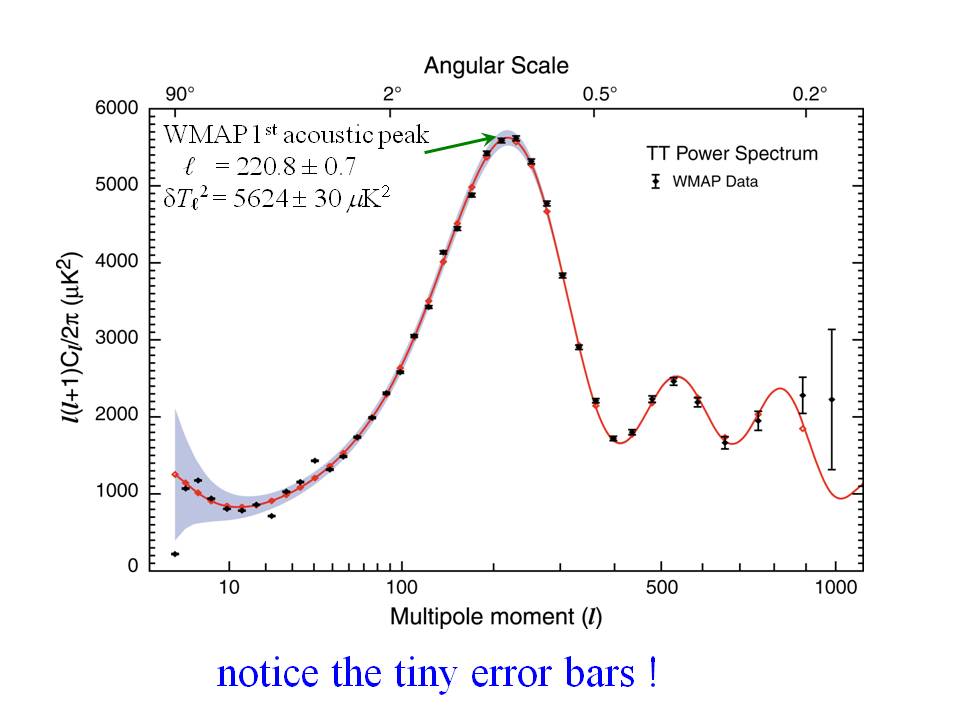
Let me show you a few slides from a presentation that Lung-Yih gave to me a while ago. For a start here is the famous power-spectrum of the temperature fluctuations of the cosmic microwave background which plays an essential role in determining the parameters of the standard cosmology:

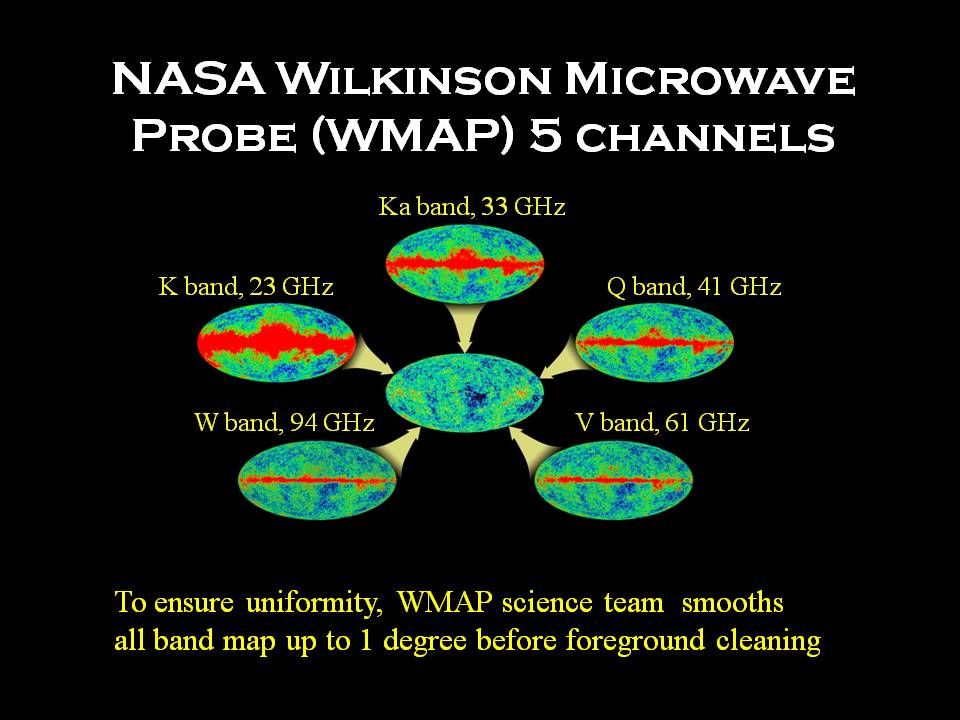
The position of the so-called “acoustic peak” plays an important role in determining the overall curvature of space-time on cosmological scales and the higher-order peaks pin down other parameters. However, it must be remembered that WMAP doesn’t just observe the cosmic microwave background. The signal it receives is heavily polluted by contamination from within our Galaxy and there is also significant instrumental noise.  To deal with this problem, the WMAP team exploit the five different frequency channels with which the probe is equipped, as shown in the picture below.

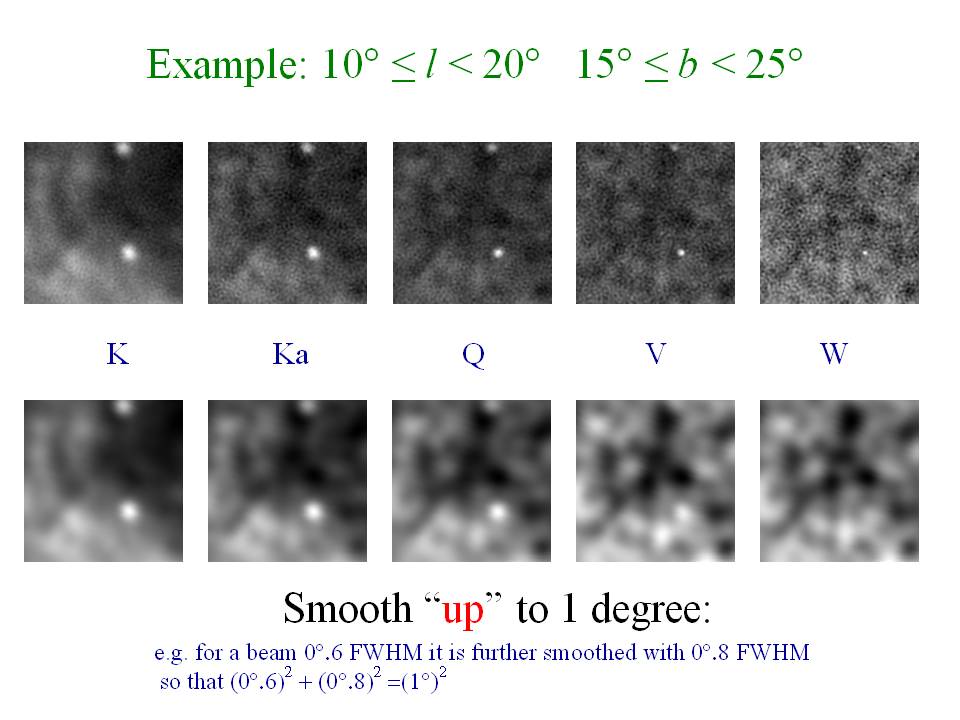
The CMB, being described by a black-body spectrum, has a sky temperature that doesn’t vary with frequency. Foreground emission, on the other hand, has an effective temperature that varies with frequency in way that is fairly well understood. The five available channels can therefore be used to model and subtract the foreground contribution to the overall signal. However, the different channels have different angular resolution (because they correspond to different wavelengths of radiation). Here are some sample patches of sky illustrating this

At each frequency the sky is blurred out by the “beam” of the WMAP optical system; the blurring is worse at low frequencies than at high frequencies. In order to do the foreground subtraction, the WMAP team therefore smooth all the frequency maps to have the same resolution, i.e. so the net effect of optical resolution and artificial smoothing produces the same overall blurring (actually 1 degree).  This requires accurate knowledge of the precise form of the beam response of the experiment to do it accurately. A rough example (for illustration only) is given in the caption above.

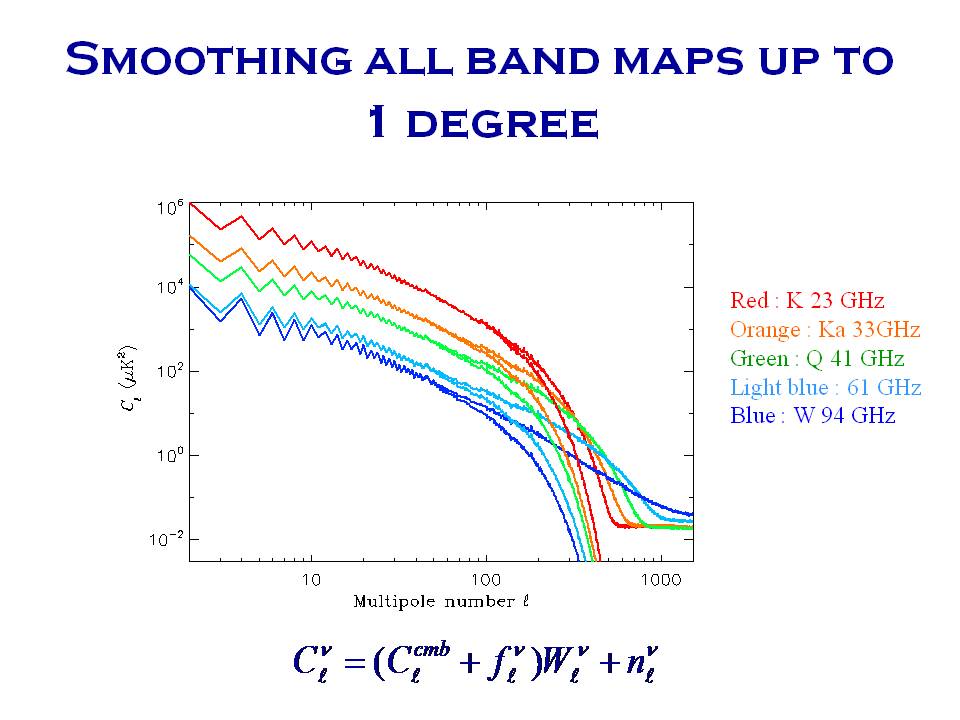
Now, here are the power spectra of the maps in each frequency channel

Note this is Cl not l(l+1)Cl as in the first plot of the spectrum. Now you see how much foreground there is in the data: the curves would lie on top of each other if the signal were pure CMB, i.e. if it did not vary with frequency. The equation at the bottom basically just says that the overall spectrum is a smoothed version of the CMB plus the foregrounds  plus noise. Note, crucially,  that the smoothing suppresses the interesting high-l wiggles.

I haven’t got space-time enough to go into how the foreground subtraction is carried out, but once it is done it is necessary to “unblur” the maps in order to see the structure at small angular scales, i.e. at large spherical harmonic numbers l. The initial process of convolving the sky pattern with a filter corresponds to multiplying the power-spectrum with a “window function” that decreases sharply at high l, so to deconvolve the spectrum one essentially has to divide by this window function to reinstate the power removed at high harmonics.

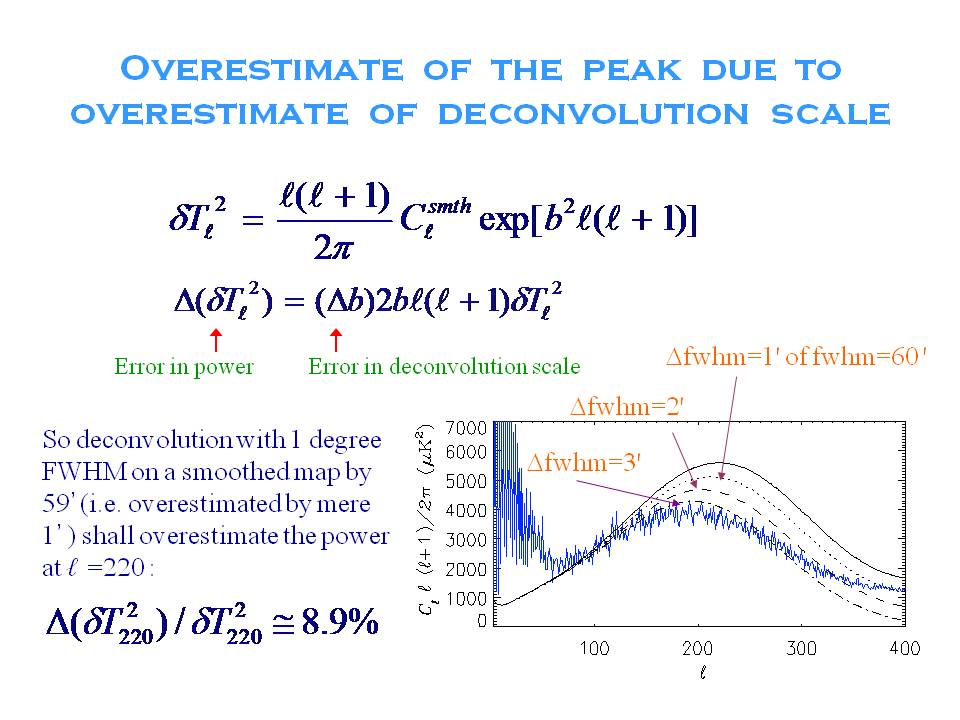
This is where it all gets very tricky. The smoothing applied is very close to the scale of the acoustic peaks so you have to do it very carefully to avoid introducing artificial structure in Cl or obliterating structure that you want to see. Moreover, a small error in the beam gets blown up in the deconvolution so one can go badly wrong in recovering the final spectrum. In other words, you need to know the beam very well to have any chance of getting close to the right answer!

The next picture gives a rough model for how much the “recovered” spectrum depends on the error produced by making even a small error in the beam profile which, for illustration only, is assumed to be Gaussian. It also shows how sensitive the shape of the deconvolved spectrum is to small errors in the beam.

Incidentally, the ratty blue line shows the spectrum obtained from a small patch of the sky rather than the whole sky. We were interested to see how much the spectrum varied across the sky so broke it up into square patches about the same size as those analysed by the Boomerang experiment. This turns out to be a pretty good way of getting the acoustic peak position but, as you can see, you lose information at low l (i.e. on scales larger than the patch).

The WMAP beam isn’t actually Gaussian – it differs quite markedly in its tails, which means that there’s even more cross-talk between different harmonic modes than in this example – but I hope you get the basic point. As Sawangwit & Shanks say, you need to know the beam very well to get the right fluctuation spectrum out. Move the acoustic peak around only slightly and all bets are off about the cosmological parameters and, perhaps, the evidence for dark energy and dark matter. Lung-Yih looked at the way the WMAP had done it and concluded that if their published beam shape was right then they had done a good job and there’s nothing substantially wrong with the results shown in the first graph.

Sawangwit & Shanks suggest the beam isn’t right so the recovered angular spectrum is suspect. I’ll need to look a bit more at the evidence they consider before commenting on that, although if anyone else has worked through it I’d be happy to hear from them through the comments box!

The Seven Year Itch

Posted in Bad Statistics, Cosmic Anomalies, The Universe and Stuff with tags , , , on January 27, 2010 by telescoper

I was just thinking last night that it’s been a while since I posted anything in the file marked cosmic anomalies, and this morning I woke up to find a blizzard of papers on the arXiv from the Wilkinson Microwave Anisotropy Probe (WMAP) team. These relate to an analysis of the latest data accumulated now over seven years of operation; a full list of the papers is given here.

I haven’t had time to read all of them yet, but I thought it was worth drawing attention to the particular one that relates to the issue of cosmic anomalies. I’ve taken the liberty of including the abstract here:

A simple six-parameter LCDM model provides a successful fit to WMAP data, both when the data are analyzed alone and in combination with other cosmological data. Even so, it is appropriate to search for any hints of deviations from the now standard model of cosmology, which includes inflation, dark energy, dark matter, baryons, and neutrinos. The cosmological community has subjected the WMAP data to extensive and varied analyses. While there is widespread agreement as to the overall success of the six-parameter LCDM model, various “anomalies” have been reported relative to that model. In this paper we examine potential anomalies and present analyses and assessments of their significance. In most cases we find that claimed anomalies depend on posterior selection of some aspect or subset of the data. Compared with sky simulations based on the best fit model, one can select for low probability features of the WMAP data. Low probability features are expected, but it is not usually straightforward to determine whether any particular low probability feature is the result of the a posteriori selection or of non-standard cosmology. We examine in detail the properties of the power spectrum with respect to the LCDM model. We examine several potential or previously claimed anomalies in the sky maps and power spectra, including cold spots, low quadrupole power, quadropole-octupole alignment, hemispherical or dipole power asymmetry, and quadrupole power asymmetry. We conclude that there is no compelling evidence for deviations from the LCDM model, which is generally an acceptable statistical fit to WMAP and other cosmological data.

Since I’m one of those annoying people who have been sniffing around the WMAP data for signs of departures from the standard model, I thought I’d comment on this issue.

As the abstract says, the  LCDM model does indeed provide a good fit to the data, and the fact that it does so with only 6 free parameters is particularly impressive. On the other hand, this modelling process involves the compression of an enormous amount of data into just six numbers. If we always filter everything through the standard model analysis pipeline then it is possible that some vital information about departures from this framework might be lost. My point has always been that every now and again it is worth looking in the wastebasket to see if there’s any evidence that something interesting might have been discarded.

Various potential anomalies – mentioned in the above abstract – have been identified in this way, but usually there has turned out to be less to them than meets the eye. There are two reasons not to get too carried away.

The first reason is that no experiment – not even one as brilliant as WMAP – is entirely free from systematic artefacts. Before we get too excited and start abandoning our standard model for more exotic cosmologies, we need to be absolutely sure that we’re not just seeing residual foregrounds, instrument errors, beam asymmetries or some other effect that isn’t anything to do with cosmology. Because it has performed so well, WMAP has been able to do much more science than was originally envisaged, but every experiment is ultimately limited by its own systematics and WMAP is no different. There is some (circumstantial) evidence that some of the reported anomalies may be at least partly accounted for by  glitches of this sort.

The second point relates to basic statistical theory. Generally speaking, an anomaly A (some property of the data) is flagged as such because it is deemed to be improbable given a model M (in this case the LCDM). In other words the conditional probability P(A|M) is a small number. As I’ve repeatedly ranted about in my bad statistics posts, this does not necessarily mean that P(M|A)- the probability of the model being right – is small. If you look at 1000 different properties of the data, you have a good chance of finding something that happens with a probability of 1 in a thousand. This is what the abstract means by a posteriori reasoning: it’s not the same as talking out of your posterior, but is sometimes close to it.

In order to decide how seriously to take an anomaly, you need to work out P(M|A), the probability of the model given the anomaly, which requires that  you not only take into account all the other properties of the data that are explained by the model (i.e. those that aren’t anomalous), but also specify an alternative model that explains the anomaly better than the standard model. If you do this, without introducing too many free parameters, then this may be taken as compelling evidence for an alternative model. No such model exists -at least for the time being – so the message of the paper is rightly skeptical.

So, to summarize, I think what the WMAP team say is basically sensible, although I maintain that rummaging around in the trash is a good thing to do. Models are there to be tested and surely the best way to test them is to focus on things that look odd rather than simply congratulating oneself about the things that fit? It is extremely impressive that such intense scrutiny over the last seven years has revealed so few oddities, but that just means that we should look even harder..

Before too long, data from Planck will provide an even sterner test of the standard framework. We really do need an independent experiment to see whether there is something out there that WMAP might have missed. But we’ll have to wait a few years for that.

So far it’s WMAP 7 Planck 0, but there’s plenty of time for an upset. Unless they close us all down.

Another take on cosmic anisotropy

Posted in Cosmic Anomalies, The Universe and Stuff with tags , , , on October 22, 2009 by telescoper

Yesterday we had a nice seminar here by Antony Lewis who is currently at Cambridge, but will be on his way to Sussex in the New Year to take up a lectureship there. I thought I’d put a brief post up here so I can add it to my collection of items concerning cosmic anomalies. I admit that I had missed the paper he talked about (by himself and Duncan Hanson) when it came out on the ArXiv last month, so I’m very glad his visit drew this to my attention.

What Hanson & Lewis did was to think of a number of simple models in which the pattern of fluctuations in the temperature of the cosmic microwave background radiation across the sky might have a preferred direction. They then construct optimal estimators for the parameters in these models (assuming the underlying fluctuations are Gaussian) and then apply these estimators to the data from the Wilkinson Microwave Anisotropy Probe (WMAP). Their subsequent analysis attempts to answer the question whether the data prefer these anisotropic models to the bog-standard cosmology which is statistically isotropic.

I strongly suggest you read their paper in detail because it contains a lot of interesting things, but I wanted to pick out one result for special mention. One of their models involves a primordial power spectrum that is intrinsically anisotropic. The model is of the form

P(\vec{ k})=P(k) [1+a(k)g(\vec{k})]

compared to the standard P(k), which does not depend on the direction of the wavevector. They find that the WMAP measurements strongly prefer this model to the standard one. Great! A departure from the standard cosmological model! New Physics! Re-write your textbooks!

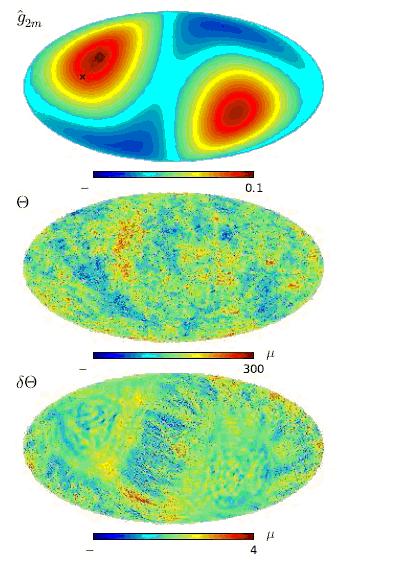
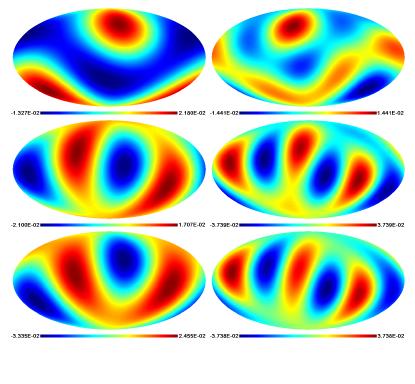
Well, not really. The direction revealed by the best-choice parameter fit to the data is shown in the smoothed picture  (top). Underneath it are simulations of the sky predicted by their  model decomposed into an isoptropic part (in the middle) and an anisotropic part (at the bottom).

lewis2

You can see immediately that the asymmetry axis is extremely close to the scan axis of the WMAP satellite, i.e. at right angles to the Ecliptic plane.

This immediately suggests that it might not be a primordial effect at all but either (a) a signal that is aligned with the Ecliptic plane (i.e. something emanating from the Solar System) or (b) something arising from the WMAP scanning strategy. Antony went on to give strong evidence that it wasn’t primordial and it wasn’t from the Solar System. The WMAP satellite has a number of independent differencing assemblies. Anything external to the satellite should produce the same signal in all of them, but the observed signal varies markedly from one to another. The conclusion, then, is that this particular anomaly is largely generated by an instrumental systematic.

The best candidate for such an effect is that it is an artefact of a asymmetry in the beams of the two telescopes on the satellite. Since the scan pattern has a preferred direction, the beam profile may introduce a direction-dependent signal into the data. No attempt has been made to correct for this effect in the published maps so far, and it seems to me to be very likely that this is the root of this particular anomaly.

We will have to see the extent to which beam systematics will limit the ability of Planck to shed further light on this issue.

Another Day at the ArXiv..

Posted in Cosmic Anomalies, The Universe and Stuff with tags , , , , , , , on October 8, 2009 by telescoper

Every now and again I remember that this is supposed to be some sort of science blog. This happened again this morning after three hours of meetings with my undergraduate project students. Dealing with questions about simulating the cosmic microwave background, measuring the bending of light during an eclipse, and how to do QCD calculations on a lattice reminded me that I’m supposed to know something about stuff like that.

Anyway, looking for something to post about while I eat my lunchtime sandwich, I turned to the estimable arXiv and turned to the section marked astro-ph, and to the new submissions category, for inspiration.

I’m one of the old-fashioned types who still gets an email every day of the new submissions. In the old days there were only a few, but today’s new submissions were 77 in number, only about half-a-dozen of which seemed directly relevant to things I’m interested in. It’s always a bit of a struggle keeping up and I often miss important things. There’s no way I can read as widely around my own field as I would like to, or as I used to in the past, but that’s the information revolution for you…

Anyway, the thing that leapt out at me first was an interesting paper by Dikarev et al (accepted for publication in the Astrophysical Journal) that speculates about the possibility that dust grains in the solar system might be producing emission that messes up measurements of the cosmic microwave background, thus possibly causing the curious cosmic anomalies seen by WMAP I’ve blogged about on more than one previous occasion.

Their abstract reads:

Analyses of the cosmic microwave background (CMB) radiation maps made by the Wilkinson Microwave Anisotropy Probe (WMAP) have revealed anomalies not predicted by the standard inflationary cosmology. In particular, the power of the quadrupole moment of the CMB fluctuations is remarkably low, and the quadrupole and octopole moments are aligned mutually and with the geometry of the Solar system. It has been suggested in the literature that microwave sky pollution by an unidentified dust cloud in the vicinity of the Solar system may be the cause for these anomalies. In this paper, we simulate the thermal emission by clouds of spherical homogeneous particles of several materials. Spectral constraints from the WMAP multi-wavelength data and earlier infrared observations on the hypothetical dust cloud are used to determine the dust cloud’s physical characteristics. In order for its emissivity to demonstrate a flat, CMB-like wavelength dependence over the WMAP wavelengths (3 through 14 mm), and to be invisible in the infrared light, its particles must be macroscopic. Silicate spheres from several millimetres in size and carbonaceous particles an order of magnitude smaller will suffice. According to our estimates of the abundance of such particles in the Zodiacal cloud and trans-neptunian belt, yielding the optical depths of the order of 1E-7 for each cloud, the Solar-system dust can well contribute 10 microKelvin (within an order of magnitude) in the microwaves. This is not only intriguingly close to the magnitude of the anomalies (about 30 microKelvin), but also alarmingly above the presently believed magnitude of systematic biases of the WMAP results (below 5 microKelvin) and, to an even greater degree, of the future missions with higher sensitivities, e.g. PLANCK.

I haven’t read the paper in detail yet, but will definitely do so. In the meantime I’d be interested to hear the reaction to this claim from dusty experts!

Of course we know there is dust in the solar system, and were reminded of this in spectacular style earlier this week by the discovery (by the Spitzer telescope) of an enormous new ring around Saturn.

That tenuous link gives me an excuse to include a gratuitous pretty picture:

It may look impressive, but I hope things like that are not messing up the CMB. Has anyone got a vacuum cleaner?

Lessening Anomalies

Posted in Cosmic Anomalies, The Universe and Stuff with tags , , , , , on September 15, 2009 by telescoper

An interesting paper caught my eye on today’s ArXiv and I thought I’d post something here because it relates to an ongoing theme on this blog about the possibility that there might be anomalies in the observed pattern of temperature fluctuations in the cosmic microwave background (CMB). See my other posts here, here, here, here and here for related discussions.

One of the authors of the new paper, John Peacock, is an occasional commenter on this blog. He was also the Chief Inquisitor at my PhD (or rather DPhil) examination, which took place 21 years ago. The four-and-a-half hours of grilling I went through that afternoon reduced me to a gibbering wreck but the examiners obviously felt sorry for me and let me pass anyway. I’m not one to hold a grudge so I’ll resist the temptation to be churlish towards my erstwhile tormentor.

The most recent paper is about the possible  contribution of  the integrated Sachs-Wolfe (ISW) effect to these anomalies. The ISW mechanism generates temperature variations in the CMB because photons travel along a line of sight through a time-varying gravitational potential between the last-scattering surface and the observer. The integrated effect is zero if the potential does not evolve because the energy shift falling into a well exactly balances that involved in climbing out of one. If in transit the well gets a bit deeper, however, there is a net contribution.

The specific thing about the ISW effect that makes it measurable is that the temperature variations it induces should correlate with the pattern of structure in the galaxy distribution, as it is these that generate the potential fluctuations through which CMB photons travel. Francis & Peacock try to assess the ISW contribution using data from the 2MASS all-sky survey of galaxies. This in itself contains important cosmological clues but in the context of this particular question it is a nuisance, like any other foreground contamination, so they subtract it off the maps obtained from the Wilkinson Microwave Anisotropy Probe (WMAP) in an attempt to get a cleaner map of the primordial CMB sky.

The results are shown in the picture below which presents  the lowest order spherical harmonic modes, the quadrupole (left) and octopole (right) for the  ISW component (top) , WMAP data (middle) and at the bottom we have the cleaned CMB sky (i.e. the middle minus the top). The ISW subtraction doesn’t make a huge difference to the visual appearance of the CMB maps but it is enough to substantially reduce to the statistical significance of at least some of the reported anomalies I mentioned above. This reinforces how careful we have to be in analysing the data before jumping to cosmological conclusions.

peacock

There should also be a further contribution from fluctuations beyond the depth of the 2MASS survey (about 0.3 in redshift).  The actual ISW effect could therefore  be significantly larger than this estimate.

The Axle of Elvis

Posted in Cosmic Anomalies, The Universe and Stuff with tags , , , , , , on August 6, 2009 by telescoper

An interesting paper on the arXiv yesterday gave me a prod to expand a little on one of the cosmic anomalies I’ve blogged about before.

Before explaining what this is all about, let me just briefly introduce a bit of lingo. The pattern of variations fluctuations in the temperature of the cosmic microwave background (CMB) across the sky, such as is revealed by the Wilkinson Microwave Anisotropy Probe (WMAP), is usually presented in terms of the behaviour of its spherical harmonic components. The temperature as a function of position is represented as a superposition of spherical harmonic modes labelled by two numbers, the degree l and the order m. The degree basically sets the characteristic angular scale of the mode (large  scales have low l, and small scales have high l). For example the dipole mode has l=1 and it corresponds to variation across the sky on a scale of 180 degrees; the quadrupole (l=2) has a scale of 90 degrees, and so on. For a fixed l the order m runs from -l to +l and each order represents a particular pattern with that given scale.

The spherical harmonic coefficients that tell you how much of each mode is present in the signal are generally  complex numbers having real and imaginary parts or, equivalently, an amplitude and a phase.  The exception to this are the modes with m=0, the zonal modes, which have no azimuthal variation: they vary only with latitude, not longitude. These have no imaginary part so don’t really have a phase. For the other modes, the phase controls the variation with azimuthal angle around the axis of the chosen coordinate system, which in the case of the CMB is usually taken to be the Galactic one.

In the simplest versions of cosmic inflation, each of the spherical harmonic modes should be statistically independent and randomly distributed in both amplitude and phase. What this really means is that the harmonic modes are in a state of maximum statistical disorder or entropy. This property also guarantees that the temperature fluctuations over the sky should be described by  a Gaussian distribution.

That was perhaps a bit technical but the key idea is that if you decompose the overall pattern of fluctuations into its spherical harmonic components the individual mode patterns should look completely different. The quadrupole and octopole, for example, shouldn’t line up in any particular way.

Evidence that this wasn’t the case started to emerge when WMAP released its first set of data in 2003 with indications of an alignment between the modes of low degree. In their  analysis, Kate Land and Joao Magueijo dubbed this feature The Axis of Evil; the name has stuck.They concluded that there was a statistically significant alignment (at 99.9% confidence) between the multipoles of low degree (l=2 and 3), meaning that the measured alignment is only expected to arise by chance in one in a thousand simulated skies. More recently, further investigation of this effect using subsequent releases of data from the WMAP experiment and a more detailed treatment of the analysis (including its stability with respect to Galactic cuts) suggested that the result is not quite as robust as had originally been claimed. .

Here are the low-l modes of the WMAP data so you see what we’re talking about. The top row of the picture contains the modes for l=2 (quadrupole) and l=3 (octopole) and the bottom shows l=4 and l=5.


The two small red blobs mark the two ends of the preferred axis of each mode. The orientation of this axis is consistent across all the modes shown but the statistical significance is much stronger for the ones with lower l.

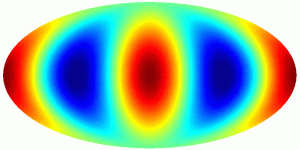
It’s probably worth mentioning a couple of neglected aspects of this phenomenon. One is that the observed quadrupole and octopole appear not only to be aligned with each other but also appear to be dominated by sectoral orders, i.e those with m=l. These are the modes which are, in a sense, opposite to the zonal modes in that they vary only with longitude and not with latitude. Here’s what the sectoral mode of the quadrupole looks like:

map22

Changing the phase of this mode would result in the pattern moving to the left or right, i.e. changing its origin, but wouldn’t change the orientation. Which brings me to the other remarkable thing, namely that the two lowest modes also have  correlated phases. The blue patch to the right of Galactic centre is in the same place for both these modes. You can see the same feature in the full-resolution map (which involves modes up to l~700 or so):

I don’t know whether there is really anything anomalous about the low degree multipoles, but I hope this is a question that Planck (with its extra sensitivity, better frequency coverage and different experimental strategy) will hopefully shed some light on. It could be some sort of artifact of the measurement process or it could be an indication of something beyond the standard cosmology. It could also just be a fluke. Or even the result of an over-active imagination, like seeing Elvis in your local Tesco.

On its own I don’t think this is going to overthrow the standard model of cosmology. Introducing extra parameters to a model in order to explain a result with a likelihood that is only marginally low in a simpler model does not make sense, at least not to a proper Bayesian who knows about model selection…

However, it is worth mentioning that the Axis of Evil isn’t the only cosmic anomaly to have been reported. If an explanation is found with relatively few parameters that can account for all of these curiosities in one fell swoop then it would stand a good chance of convincing us all that there is more to the Universe than we thought. And that would be fun.

Space Camp

Posted in Uncategorized with tags , , , , , on July 4, 2009 by telescoper

The other day I was looking through my copy of the Men’s Disciplinary Rubberwear Gazette (which I buy for the Spot-the-Ball competition). Turning to the advertisements, I discovered that the Science & Technology Facilities Council is conducting a review of its space facilities and operations. Always eager to push back the frontiers of science, I hurried down to their address in Swindon to find out what was going on.

ME: Hello. Is there anyone there?

JULIAN: Oh hello. My name’s Julian, and this is my friend Sandy.

SANDY: Oooh hello! What can we do for you?

ME: Hello to you both. Is this Polaris House?

JULIAN: Not quite. Since we took over we changed the name…

ME: To?

SANDY: It’s now called Polari House…

JULIAN: On account of that’s the only language spoken around here.

ME: So you’re in charge of the British Space Programme then?

JULIAN:  Yes, owing to the budget, the national handbag isn’t as full as it used to be so now it’s just me and her.

SANDY: But never fear we’re both dab hands with thrusters.

JULIAN: Our motto is “You can vada about in any band, with a satellite run  by Jules and…

SANDY: …Sand.

ME: I heard that you’re looking for some input.

SANDY: Ooooh. He’s bold, in’e?

ME: I mean for your consultation exercise…

JULIAN: Oh yes. I forgot about that. Well I’m sure we’d welcome your contribution any time, ducky.

ME: Well I was wondering what you could tell me about Moonlite?

SANDY: You’ve come to the right place. She had an experience by Moonlight, didn’t you Jules?

JULIAN: Yes. Up the Acropolis…

ME: I mean the Space Mission “Moonlite”

SANDY: Oh, of course. Well, it’s only small but it’s very stimulating.

JULIAN: Hmmm.

SANDY: Yes. It gets blasted off into space and whooshes off to the Moon…

JULIAN: …the backside thereof…

SANDY: ..and when it gets there it shoves these probes in to see what happens.

ME: Why?

SANDY: Why not?

ME: Seems a bit pointless to me.

JULIAN: There’s no pleasing some people is there?

ME: Haven’t you got anything more impressive?

SANDY: Like what?

ME:  Maybe something that goes a bit further out? Mars, perhaps?

JULIAN: Well the French have this plan to send some great butch omi to troll around on Mars but we haven’t got the metzas so we have to satisfy ourselves with something a bit more bijou…

SANDY: Hmm…You can say that again.

JULIAN: You don’t have to be big to be bona.

SANDY: Anyway, we had our shot at Mars and it went willets up.

ME: Oh yes, I remember that thing named after a dog.

JULIAN: That’s right. Poodle.

ME: Do you think a man will ever get as far as Uranus?

JULIAN&SANDY: Oooh! Bold!

SANDY: Well I’ll tell you what. I’ll show you something that can vada out to the very edge of the Universe!

ME: That sounds exciting.

JULIAN: I’ll try to get it up right now.

ME: Well…er…

JULIAN: I mean on the computer

ME: I say, that’s an impressive piece of equipment

JULIAN: Thank you

SANDY: Oh don’t encourage her…

ME: I meant the computer.

JULIAN: Yes, it’s a 14″ console.

SANDY:  And, believe me, 14 inches will console anyone!

JULIAN; There you are. Look at that.

ME: It looks very impressive. What is it?

SANDY: This is an experiment designed to charper for the heat of the Big Bang.

JULIAN. Ooer.

SANDY: The Americans launched WMAP and the Europeans had PLANCK. We’ve merged the two ideas and have called it ….PLMAP.

ME: Wouldn’t it have been better if you’d made the name the other way around? On second thoughts maybe not..

JULIAN: It’s a little down-market but we have high hopes.

SANDY: Yes, Planck had two instruments called HFI and LFI. We couldn’t afford two so we made do with one.

JULIAN: It’s called MFI. That’s why it’s a bit naff.

ME: I see. What are these two round things either side?

SANDY: They’re the bolometers…

ME: What is this this long thing in between pointing up? And why is it leaning to one side?

SANDY: Well that’s not unusual in my experience …

JULIAN:  Shush. It’s an off-axis Gregorian telescope if you must know.

ME: And what about this round the back?

SANDY: That’s your actual dish. It’s very receptive, if you know what I mean.

ME: So what does it all do?

JULIAN: It’s designed to make a map of what George Smoot called “The Eek of God”. It’s fabulosa…

SANDY: Or it would be if someone hadn’t neglected to read the small print.

ME: Why? Is there are problem?

JULIAN: Well, frankly, yes. We ran out of money.

SANDY: It was only when we got it out the box we realised.

ME: What?

JULIAN & SANDY: Batteries Not Included!

(With thanks to cosmic variance for the inspiration, and apologies to Barry Took and Marty Feldman, who wrote the original Julian and Sandy sketches for the radio show Round the Horne.)