Archive for January, 2024

Mathematical Mystics at Maynooth

Posted in History, mathematics, Maynooth with tags , , , on January 25, 2024 by telescoper

I’m indebted to my colleague David Malone for sending me this small excerpt from an old issue of the Kalendarium of St Patrick’s College, Maynooth, dating back to the 1960s, which deals with the appointments of new members of staff

Halfway down you will see a reference to Mathematical Mystics!

This is obviously a mistake. It should of course be Mathematical Psychics Physics. I also think the name of the Mathematical Mystics lecturer should be Tigran Tchrakian. I think these are both transcription errors from somebody’s very bad handwriting! The current Department of Theoretical Physics at Maynooth was formerly known by the title Mathematical Physics.

There are some other points of interest. in Experimental Physics you will find mention of a young Susan Lawlor who is now better known as Susan McKenna-Lawlor, a very eminent astrophysicist who specialized in space instrumentation, now in her eighties.

I’m also amused by the existence of a lecturer in Elocution

The historical background of St Patrick’s College is that it was primarily a Catholic theological institution (founded in 1795) although it taught secular courses and was a recognized college of the National University of Ireland from 1910. It was only in the mid-1960s that it was opened to lay students, which expanded the numbers considerably. In 1997 that the secular part separated and formed NUI Maynooth (now known by the marketing people as Maynooth University). The remaining theological institution is known as St Patrick’s Pontifical University (or St Patrick’s College or just Maynooth College).

A major role for St Patrick’s College was the training of priests and I suppose it was important that priests should be well spoken, hence the lectures on elocution…

Near the top in connection with Sociology you can see the title An tAth which is the Irish language way of writing the abbreviation “Fr” for “Father”, indicating a priest; “father” is athair and the an is a definite article. Note the lower case t in front of Ath which is an example of prothesis.

Finally, right at the top of the page you can see the name Donal Linehan, which will be familiar to Irish rugby fans but I don’t know if there’s a family connection between the former Ireland intentional who is now a TV commentator and the lecturer in Roman and Civil Law.

R.I.P. Arno Penzias (1933-2024)

Posted in History, R.I.P., The Universe and Stuff with tags , , , on January 24, 2024 by telescoper

Yesterday I heard the sad news of the death, at the age of 90, of American physicist and radio astronomer Arno Penzias.

I’ve used the above image hundreds of times in popular talks. It shows Robert W. Wilson (left) and Arno A. Penzias (right) standing in front of the famous horn antenna that (accidentally) discovered what we now know to be the cosmic microwave background, radiation left over after the Big Bang.

Penzias and Wilson made their historic measurements in 1964, published their results in 1965, and received the Nobel Prize for Physics in 1978. At the time of this experiment, the scientists were working at Bell Telephone Laboratories at Holmdel, New Jersey, on Project Echo. The antenna was built to receive radio signals bounced off a passive satellite in a low Earth orbit to check the feasibility of satellite radio communication. They found excess noise in their receiver, which was eventually identified as a relic of a time when the Universe was extremely hot. Coincidentally, the theory of this yet undiscovered radiation was being worked on by Bob Dicke and his group in Princeton at about the same time (and also in New Jersey). Discussions ensued, and the discovery paper by Penzias & Wilson appeared in the Astrophysical Journal in 1965 beside a paper by Dicke et al. giving the theoretical interpretation.

The discovery of the cosmic microwave background was probably the most important result in observational cosmology after that of the Hubble expansion and it paved the way for the establishment and further development of the Big Bang theory. One of the two discoverers of the CMB has now left us, leaving a priceless legacy.

Rest in peace, Arno Allan Penzias (1933-2024)

Prophet Song by Paul Lynch

Posted in Literature, Maynooth with tags , , , on January 23, 2024 by telescoper

My ongoing quest to keep up with the literature brings me to the winner of the 2023 Booker Prize, Prophet Song by Paul Lynch. Before writing a few comments on this extraordinary work I should mention the Maynooth connection: the book was written during the writer’s tenure as Writer-in-Residence at Maynooth University which involves teaching creativity and novel-writing, on the MA in Creative Writing, which is now in its second year.

So to the book, which is a grimly compelling novel set in an alternative Ireland after a far-right takeover revolving around Eilish Stack and her family. Her husband, Larry, a trade unionist, is detained by the state police and her efforts to find him get tangled up in the disintegration of society into civil war during which she tries desperately to keep herself and her family together as anarchy descends. We learn little of what goes on in the wider world, except what Eilish herself sees and rumours she picks up from others, but eventually, her home engulfed by the fighting, she is forced to attempt to flee with what remains of her family and cruelly exploited by human traffickers.

I won’t give away any details, but the story is bleak and at times is truly harrowing. I had to stop reading at one point – when Eilish visits a military hospital in the penultimate chapter, for those of you who have read it.

I have to admit that it took me a while to get the hang of Lynch’s writing style, with no conventional division into paragraphs and minimal punctuation. For example, speech is not included in quotation marks but embedded into the often very long sentences that blur the distinction between Eilish’s inner thoughts and the outer reality. Once I got used to it, however, I found it gripping despite the relentless horror of Eilish’s situation: Lynch conjures up an atmosphere of dread and hopelessness as effectively as George Orwell does in Nineteen Eighty-Four, with which this book has been rightly compared, but the prose also seems to me to be heavily influenced by James Joyce.

This is not an easy read, but is an important novel that should be read. I don’t think it will be long before it is on the syllabus for Leaving Certificate English.

I’ll just make further comment. Many of the reviews I have read of this book describe it as an “alternative future” and a warning about the rise of the fascism, but that’s only a part of the story. To me, it’s not really an alternative future, but an alternative present. The point is all the horrors described in this book – the murders, the abductions, the torture, the indiscriminate slaughter of innocent civilians, the people trafficking are actually happening right now elsewhere in the world, but those of us living in safer places can view them from a safe distance or, more likely, just ignore them. The novel’s power is that it makes such things happen on the familiar streets of Dublin, making the unthinkable an alternative reality.

You have to wait until near the very end of the book for Paul Lynch to explain the title, which he says far more eloquently, essentially what I said in the preceding paragraph.

…and the prophet sings not of the end of the world but of what has been done and what will be done and what is being done to some but not others, that the world is always ending over and over again in one place but not another and that the end of the world is always a local event, it comes to your country and visits your town and knocks on the door of your house and becomes to others but some distant warning, a brief report on the news, an echo of events that has passed into folklore…

Paul Lynch, Prophet Song

The tale ends with a crowd of refugees – Eilish and her young children among them – getting into small boats to attempt to reach safety across the sea. Frail as it is, that’s their only hope of survival and a better life…

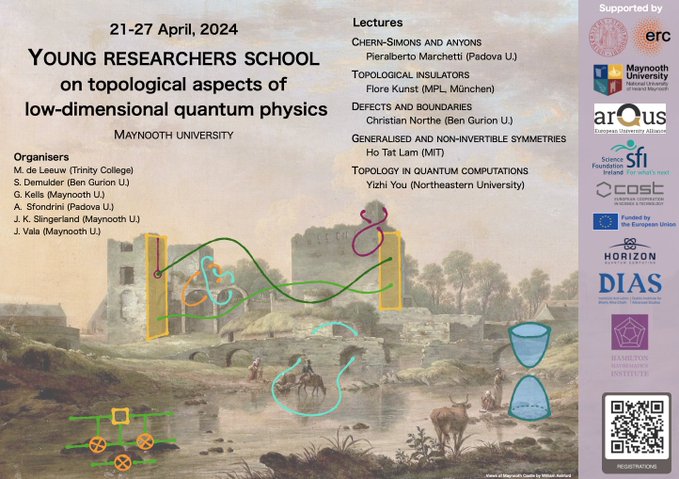
Spring School on Topological Aspects of Low-dimensional Quantum Physics at Maynooth!

Posted in Maynooth, The Universe and Stuff with tags , , on January 23, 2024 by telescoper

I’ve been asked by colleagues not in Barcelona to use the medium of this blog to advertise the fact that Maynooth University is hosting an exciting spring school for Early Career Researchers this April:

Registration is now open!

For further information and to register see here. Please forward to anyone who might be interested!

Storm on the Island – Seamus Heaney

Posted in Poetry with tags , , , on January 22, 2024 by telescoper

We are prepared: we build our houses squat,
Sink walls in rock and roof them with good slate.
This wizened earth has never troubled us
With hay, so, as you see, there are no stacks
Or stooks that can be lost. Nor are there trees
Which might prove company when it blows full
Blast: you know what I mean – leaves and branches
Can raise a tragic chorus in a gale
So that you listen to the thing you fear
Forgetting that it pummels your house too.
But there are no trees, no natural shelter.
You might think that the sea is company,
Exploding comfortably down on the cliffs
But no: when it begins, the flung spray hits
The very windows, spits like a tame cat
Turned savage. We just sit tight while wind dives
And strafes invisibly. Space is a salvo,
We are bombarded with the empty air.
Strange, it is a huge nothing that we fear.

by Seamus Heaney (1939-2013)

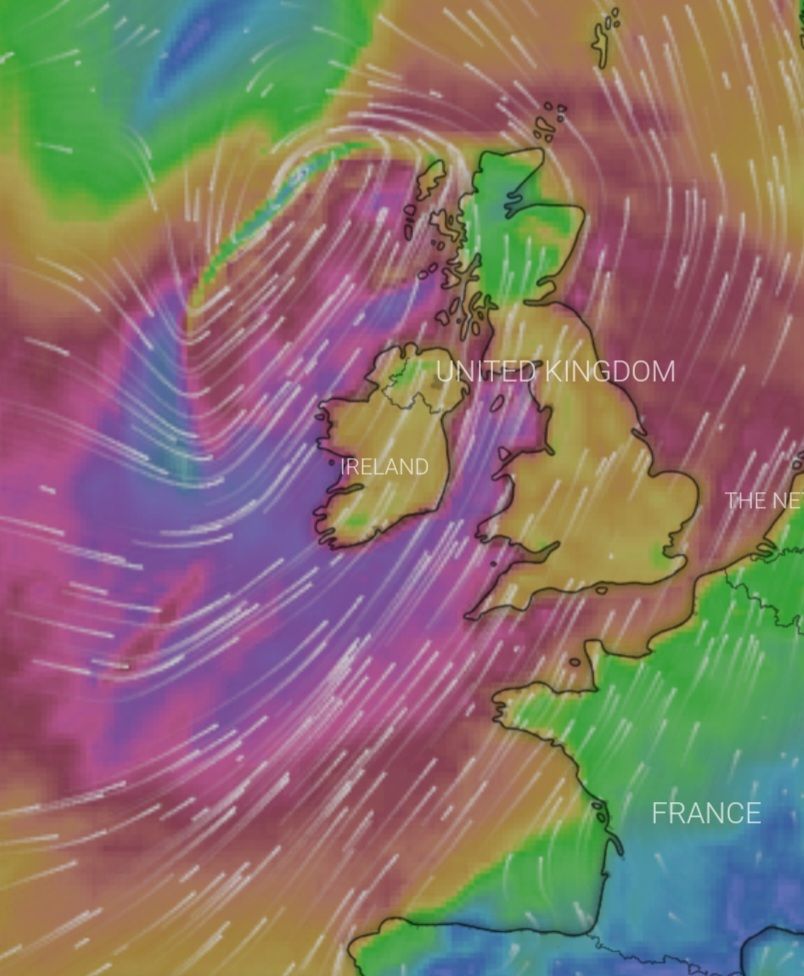
Storm Isha passed overnight, bringing down many trees and leaving many thousands of households without power.

Replacing Academic Journals

Posted in Open Access with tags , , on January 21, 2024 by telescoper

I just saw an interesting paper published by the Royal Society last year with the abstract:

Replacing traditional journals with a more modern solution is not a new idea. Here, we propose ways to overcome the social dilemma underlying the decades of inaction. Any solution needs to not only resolve the current problems but also be capable of preventing takeover by corporations: it needs to replace traditional journals with a decentralized, resilient, evolvable network that is interconnected by open standards and open-source norms under the governance of the scholarly community. It needs to replace the monopolies connected to journals with a genuine, functioning and well-regulated market. In this new market, substitutable service providers compete and innovate according to the conditions of the scholarly community, avoiding sustained vendor lock-in. Therefore, a standards body needs to form under the governance of the scholarly community to allow the development of open scholarly infrastructures servicing the entire research workflow. We propose a redirection of money from legacy publishers to the new network by funding bodies broadening their minimal infrastructure requirements at recipient institutions to include modern infrastructure components replacing and complementing journal functionalities. Such updated eligibility criteria by funding agencies would help realign the financial incentives for recipient institutions with public and scholarly interest.

https://royalsocietypublishing.org/doi/10.1098/rsos.230206

The article is well worth reading in full. It says things that I have said on this blog (e.g. here) but rather more eloquently than I managed. I’ll just make a couple of comments.

First, in the first paragraph of the first section it says:

Replacing traditional journals with a more modern solution is not a new idea […], but the lack of progress since the first calls and ideas more than 20 years ago has convinced an increasing number of experts that the time for small tweaks is long gone and a disruptive break is now overdue.

I agree, of course, and I think one of the problems is the perennial problem of academia: there’s a huge excess of talking over doing. With the Open Journal of Astrophysics I’m proud to be one of the doers. Incidentally, a senior member of the Royal Astronomical Society recently told me that they were finding OApJ “disruptive”. That is, of course, the point. We need a lot more disruption.

Another issue I’ve written about before is whether there is any future in academic journals as such at all. The concept dates from the 17th Century – when it was extremely valuable and useful – but is now very outdated. As I wrote here more than a decade ago:

I’d say that, at least in my discipline, traditional journals are simply no longer necessary for communicating scientific research. I find all the  papers I need to do my research on the arXiv and most of my colleagues do the same. We simply don’t need old-fashioned journals anymore.  Yet we keep paying for them. It’s time for those of us who believe that  we should spend as much of our funding as we can on research instead of throwing it away on expensive and outdated methods of publication to put an end to this absurd system. We academics need to get the academic publishing industry off our backs.

https://telescoper.blog/2015/11/05/enough-of-the-academic-publishing-racket/

The revolution has been a slower process than I expected, but I do sense that the worm is at last turning.

Stormy Weather – Billie Holiday

Posted in Jazz with tags , on January 21, 2024 by telescoper

Recorded in New York, July 27, 1952 with: Joe Newman (tp); Paul Quinichette (ts); Oscar Peterson (p); Freddy Green (g); Ray Brown (b); and Gus Johnson (d).

Cosmology Discussions

Posted in Uncategorized with tags on January 20, 2024 by telescoper

(Based on an idea stolen from here.)

Three New Publications at the Open Journal of Astrophysics

Posted in OJAp Papers, Open Access, The Universe and Stuff with tags , , , , , , , , , , , , , , , , , on January 20, 2024 by telescoper

As promised yesterday, it’s time for a roundup of the week’s business at the  Open Journal of Astrophysics. This past week we have published three papers, taking  the count in Volume 7 (2024) up to 4 and the total published by OJAp up to 119. There are quite a few more ready to go as people return from the Christmas break.

In chronological order, the three papers published this week, with their overlays, are as follows. You can click on the images of the overlays to make them larger should you wish to do so.

First one up is “Prospects for studying the mass and gas in protoclusters with future CMB observations” by  Anna Gardner and Eric Baxter (Hawaii, USA), Srinivasan Raghunathan (NCSA, USA), Weiguang Cui (Edinburgh, UK), and Daniel Ceverino (Madrid, Spain). This paper, published on 17th January 2024, uses realistic hydrodynamical simulations to probe the ability of CMB Stage 4-like (CMB-S4) experiments to detect and characterize protoclusters via gravitational lensing and the Sunyaev-Zel’dovich effect. This paper is in the category of Cosmology and Nongalactic Astrophysics.

Here is a screen grab of the overlay, which includes the abstract:


You can find the officially accepted version of the paper on the arXiv here.

The second paper to announce is “SDSS J125417.98+274004.6: An X-ray Detected Minor Merger Dual AGN” and is by Marko Mićić, Brenna Wells, Olivia Holmes, and Jimmy Irwin (all of the University of Alabama, USA).  This presents the discovery of a dual AGN in a merger between the galaxy SDSS J125417.98+274004.6 and dwarf satellite, studied using X-ray observations from the Chandra satellite. The paper was also published on 18th January 2024 in the category Astrophysics of Galaxies . You can see the overlay here:


The accepted version of this paper can be found on the arXiv here.

The last paper of this batch is  entitled “Population III star formation: multiple gas phases prevent the use of an equation of state at high densities” and the authors are:  Lewis Prole (Maynooth, Ireland), Paul Clark (Cardiff, UK), Felix Priestley (Cardiff, UK), Simon Glover (Heidelberg, Germany) and John Regan (Maynooth, Ireland). This paper, which presents a comparison of results obtained using chemical networks and a simpler equation-of-state approach for primordial star formation (showing the limitations of the latter) was published on 19th January 2024 and also in the folder marked Astrophysics of Galaxies.

Here is the overlay:


You can find the full text for this one on the arXiv here.

And that concludes the update. There’ll be more next week!


Article Processing Charges for Monthly Notices of the Royal Astronomical Society

Posted in Open Access with tags , , , , , on January 19, 2024 by telescoper

As it was foretold, since January 1st 2024 the journal Monthly Notices of the Royal Astronomical Society (MNRAS) is now charging authors an Article Processing Charge (APC) at the (suitably astronomical) level of £2310 (approx €2700 at current rates) for each paper. There are exemptions in certain situations, such as if the author’s institution has signed up to a read-and-publish agreement via JISC (although that still involves a researcher’s institution paying unjustifiable amounts to the publisher).

The fundamental fact is that it just doesn’t cost £2310 to publish a paper online. That APC level is – for one paper – larger than the entire running costs of the Open Journal of Astrophysics for a year.

I did actually laugh out loud when I saw the spin the RAS tried to put on this decision:

The RAS is excited to be a key contributor to the open science movement, helping to drive discoverability and change.

Au contraire. Gold Open Access a serious hindrance to the open science movement, as it involves hugely inflated costs to the authors in attempt to protect revenue in the face of declining subscription income. This means that many potential authors just will not be able to pay. That’s not Open Access. Switching from a ‘fleece-the-libraries’ model to a ‘fleece-the-authors’ alternative can in no way be regarded as a progressive move.

It is true that some institutions will pay the APC on behalf of their authors, but that is hardly the point. If institutions have cash to pay for astronomy publications to be open access then they would do far more good to the research community by giving it to the arXiv rather than to the publishing industry. When authors themselves see how much they have to pay to publish their work, many will realize that it is simply not worth the money. I refuse to pay any APC on principle.

The question for the Royal Astronomical Society, and indeed the other learned societies that fund their activities in a similar way, is whether they can find a sustainable funding model that takes proper account of the digital publishing revolution. If their revenue from publishing does fall, can they replace it? And, if not, in what form can they survive? I’d like to think that future operating models for such organizations would involve serving their respective communities, rather than fleecing them. I’d advocate a institutional subscriptions as a fairer and more transparent alternative to syphoning funds from library budgets or research grants.

Meanwhile, the new regime at MNRAS (and possibly its acceptance on Scopus) have led to steadily increasing activity at the Open Journal of Astrophysics. This morning I announced three more papers. I will post about them on here tomorrow. Diamond Open Access is the way forward. It’s just a question of time before everyone realizes it.