Archive for February, 2025

Debussy, McNeff & Rachmaninov at the NCH

Posted in Uncategorized with tags , , , , , , , , on February 1, 2025 by telescoper

Last night was my first trip of the year to the National Concert Hall in Dublin. I had planned to go on 17th January but by the time I got around to buying a ticket it was sold out. Fortunately, it was broadcast live on the radio and is still available on the RTÉ Player. I had a ticket for last Friday’s concert but bottled out of going because of transport worries about Storm Éowyn. That concert went ahead, apparently, but wasn’t broadcast so I missed it. Last night was third time lucky, and I’m very glad I got there!

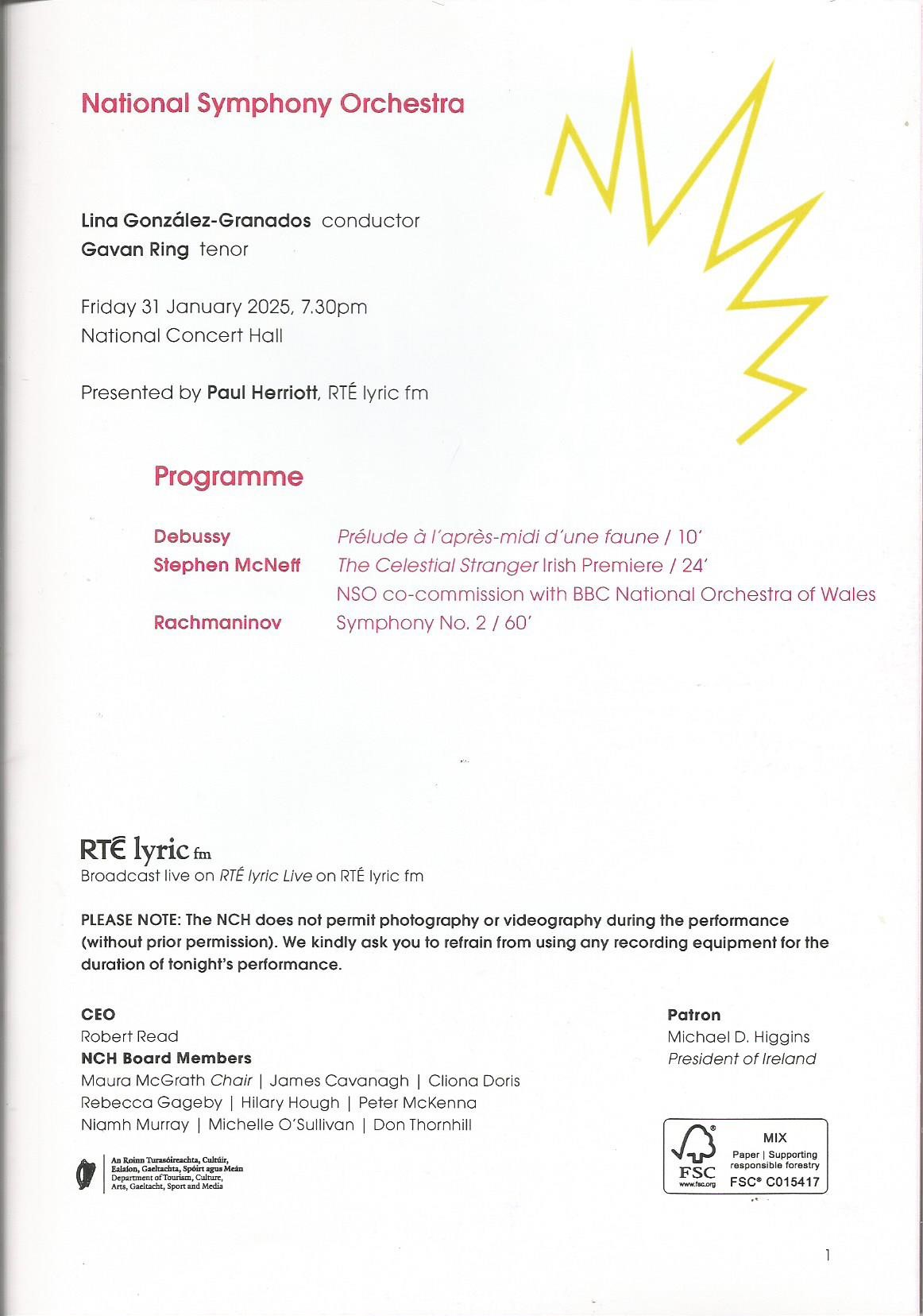
The conductor of the National Symphony Orchestra for last night’s performance was Columbian-born Lina González-Granados in what I believe to have been her first appearance with the NSO. I certainly hope she comes back as she was very good indeed. I think the members of the orchestra enjoyed themselves as much as the audience!

As you can see from the programme, the concert opened with a very familiar piece, Prélude à l’après-midi d’un faune by Claude Debussy, which was performed with all the shimmering sensuality it demands. Some very lush playing by the strings on this one, and lovely work by the woodwinds made it sound very fresh although I’ve heard it many times.

After that tenor Gavan Ring joined the orchestra to perform the Irish Premiere of The Celestial Stranger, a song cycle composed by Belfast born composer Stephen McNeff. This consists of settings of five poems, two by Thomas Traherne (including the one that gives its name to the collection, a remarkable work that I will post in its entirety later on). The next poem is by Walt Whitman and is titled As The Time Draws Nigh in the programme, but is not the well-known Whitman poem of that title but seems to have been adapted from various texts, including Years of the Modern. After that is a famous poem by Dylan Thomas, The hand that signed the paper and the cycle concludes with an adaptation of Farewell to Thee, written by Liliʻuokalani (former monarch of Hawaii). It’s a varied collection but there is a narrative behind the choice: a visitor from outerspace (the Celestial Stranger) arrives on Earth and reacts joyfully to begin with. As time goes on, however, he finds out more about war and and death and finally takes his leave.

The music is as varied as the choice of verse. I felt some influence of Britten in the first piece, but the rest is very different. Gavan Ring was in fine voice and the orchestra responded very well to the very different demands of this work compared to the first.

After the interval it was time for the main course of the evening, Rachmaninov’s Second Symphony. It’s a remarkable work because it’s not only a “proper” symphony in its construction and development but also the best part of an hour of one glorious melody after another. It’s a gorgeous work altogether, but the third movement (Adagio) is especially beautiful. I love the way Rachmaninov starts this movement one of his big romantic tunes, but then hides it while passages develop through a solo  clarinet and strings. You know the tune is coming back though, and when it does the emotional impact brought the audience to a collective swoon. This is romantic music in all senses of the word, just the ticket for a cole January evening. It was a very fine performance, not least because you could see how much both conductor and orchestra were enjoying themselves. Hats off to Lina González-Granados who had just the right balance of control and expressiveness. She look quite exhauasted at the end, actually. She had worked hard to earn her standing ovation.

Weekly Update from the Open Journal of Astrophysics – 01/02/2025

Posted in OJAp Papers, Open Access, The Universe and Stuff with tags , , , , , , , , , , , , , , , , , , on February 1, 2025 by telescoper

It’s Saturday morning, so once again it’s time for an update of papers published at the Open Journal of Astrophysics. There were no papers to report last week but since the last update we have published four new papers, which brings the number in Volume 8 (2025) up to 11 and the total so far published by OJAp up to 246.

In chronological order of publication, the four papers published this week, with their overlays, are as follows. You can click on the images of the overlays to make them larger should you wish to do so.

First one up is  “A halo model approach for mock catalogs of time-variable strong gravitational lenses” by Katsuya T. Abe & Masamune Oguri (Chiba U, Japan), Simon Birrer & Narayan Khadka (Stony Brook, USA), Philip J. Marshall (Stanford, USA), Cameron Lemon (Stockholm U., Sweden), Anupreeta More (IUCAA, India), and the LSST Dark Energy Science Collaboration. It was published on 27th January 2025 in the folder marked Cosmology and NonGalactic Astrophysics. The paper discusses how to generate mock catalogs of strongly lensed QSOs and Supernovae on galaxy-, group-, and cluster-scales based on a halo model that incorporates dark matter halos, galaxies, and subhalos.


You can find the officially accepted version of this paper on arXiv here.

This paper, also published on Monday 27th January 2025, but in the folder Astrophysics of Galaxies, is “The Soltan argument at redshift 6: UV-luminous quasars contribute less than 10% to early black hole mass growth” by Knud Jahnke (MPI Heidelberg, Germany). This paper presents an argument that almost all growth of supermassive black hole mass at z>6 does not take place in UV-luminous quasars.

Here is a screen grab of the overlay, which includes the abstract:You can find the officially accepted version of the paper on the arXiv here.

The third paper to announce, published on 29th January 2025 in the folder Cosmology and NonGalactic Astrophysics, is “A Heavy Seed Black Hole Mass Function at High Redshift – Prospects for LISA” by Joe McCaffrey & John Regan (Maynooth U., Ireland), Britton Smith (Edinburgh U., UK), John Wise (Georgia Institute of Technology, USA), Brian O’Shea (Michigan State U., USA) and Michael Norman (University of California, San Diego). This is a numerical study of the growth rates of massive black holes in the early Universe and implications for their detection via gravitational wave emission.

You can see the overlay here:


The accepted version of this paper can be found on the arXiv here.

The last paper of this batch is “Forecasting the Detection of Lyman-alpha Forest Weak Lensing from the Dark Energy Spectroscopic Instrument and Other Future Surveys” by Patrick Shaw & Rupert A. C. Croft (Carnegie Mellon U., USA) and R. Benton Metcalf (U. Bologna, Italy). This paper, published on January 30th 2025, is about extending the applicationof  Lyman-α forest weak gravitational lensing to lower angular source densities than has previously been done, with forecasts for future spectral surveys. It is in the folder marked Cosmology and NonGalactic Astrophysics.

The overlay is here


You can find the accepted version on arXiv here.

Incidentally, we currently have 121 papers under review, including 81 under a revise and resubmit request.

That’s all for this week. I’ll do another update next Saturday.