Archive for August, 2025

Alternatives to Scopus

Posted in Open Access with tags , , , , , on August 7, 2025 by telescoper

Yesterday I had a very interesting meeting with the Library Staff who are working behind the scenes on the Open Journal of Astrophysics. Most of the meeting was about reviewing the finances of the journal, so I had a look at the official accounts. These confirmed that the total cost incurred is under $30 per paper. The financial year here at Maynooth runs from October 1st to September 30th – don’t ask me why – so this year is not yet complete but will be just over $5000 dollars. We will have published about 180 papers in that period.

People ask me how the journal can be so inexpensive, and the answer is that we keep publishing costs to a minimum by offering a “no frills” service, and also because our editors and referees are all unpaid.

Anyway, in the course of the meeting I mentioned Scopus (which is owned by publishing behemoth Elsevier). This is used by many universities and funding agencies as a source of bibliometric information, but my experience is that it is unreliable and poorly managed. I thought I would share a few other, better, bibliometric databases here.

We have for some time being indexed in the Directory of Open Access Journals (DOAJ) and in fact our articles’ metadata are automatically deposited there every time we publish a paper. This however only covers fully Open Access journals which excludes some journals.

The go-to repository for astrophysicists is the NASA Astrophysics Data System, known to its friends as ADS. This has very complete bibliographic information going back over 100 years, as well as links to catalogues and other supplementary information. It’s also fairly complete for general physics.

Scopus being so awful I was pleased to find a system which is more general than NASA/ADS but with wider coverage. OpenAlex fits the bill rather well. It’s not quite complete but far better than Scopus. Articles from the Open Journal of Astrophysics are index there, and the information is almost as complete as NASA/ADS.

One candidate is Scimago. This is largely concerned with the (in my opinion) pointless task of journal rankings, but the Open Journal of Astrophysics is listed there. Again the information is not totally complete, but it’s not bad.

One thing I’ve learned over the last few years is that if you want to compare the impact of journals or individual articles it’s absolutely essential to use the same source of information because there is a huge variation between databases. When I look at astrophysics articles I always use NASA/ADS, but in other fields you could use OpenAlex or Scimago. There are no circumstances that justify the use of Scopus, even if your boss tells you to…

Good Luck in Your Repeat Exams!

Posted in Education, Maynooth with tags , , , on August 6, 2025 by telescoper

Since the repeat examination period at Maynooth University starts today, Wednesday 6th August, I thought’d I’d send a quick message for students taking one or more exams…

Cricket Limbo

Posted in Cricket, Music with tags , , , , , on August 5, 2025 by telescoper

Since moving to Ireland I haven’t seen much cricket, though I do follow some games on the internet and watch the highlights from time to time. Yesterday’s final-day victory by India over England by just six runs at the Oval brought to an end an excellent series of five Test matches, drawn 2-2 with one match drawn. Chris Woakes had to go into bat at Number 11 with an arm in a sling because of a dislocated shoulder. Shades of Colin Cowdrey going in to bat against the West Indies at Lord’s in 1963 with a broken arm. Neither Cowdrey nor Woakes faced a ball, actually. England drew in 1963, while still six runs behind with one wicket standing, while Woakes was not out as India won by six runs. A series draw just about seems a fair result to me.

Test cricket is something special and the 2025 England vs India series had more than the usual share of memorable moments. The two teams were evenly matched, tempers got a bit frayed from time to time, but both sides should be congratulated for providing such magnificent fare. A Test Match series is a cricket feast like no other.

As Keith Flett mentions in his blog, the Oval test has traditionally the last of the summer, usually taking place later in August, the lengthening shadows given that distinctive end-of-season feel. This year, however, the Oval test finished on 4th August (yesterday), and there’s no more Test cricket this summer. The schedule has been pushed forward to accommodate the gimmicky and unintestering competion called The Hundred, which starts today. The first of the last three County Championship fixtures don’t start until September 8th. It’s all a bit shit, really.

Anyway, just for nostalgia’s sake, I thought I’d post the old theme song from the BBC’s cricket coverage (when it used to be free on TV). It is Soul Limbo by Booker T. & the M.G.’s. We never got to hear the whole track, but as proper cricket is in Limbo for a month it seems appropriate to do so now.

Autumn Repeats

Posted in Education, History, Maynooth with tags , , , , , on August 5, 2025 by telescoper

As I mentioned yesterday, it is almost time for the repeat examination period to begin once again. In fact the first papers are due tomorrow (6th August). A couple of years ago, Maynooth University produced this nice good luck message for those resitting so I’ll repeat it here:

I was a bit surprised when I first arrived here in Ireland that the August repeat examinations are called the Autumn Repeats. After all, they happen in August which is generally regarded as summer rather than Autumn. The term is, I think, a relic of the old Celtic calendar in which the start of Autumn coincides with the start of harvesting, the old festival of Lúnasa being when people celebrated the Celtic deity Lugh, who would bring a good harvest or who, if not satisfied, could bring his wrath to bear in storms that would mess everything up. Lúnasa is the name for August in modern Irish; Lá Lúnasa is 1st August, and the first Monday in August (Lá Saoire i mí Lúnasa) (yesterday) is a Bank Holiday.

Anyway, the repeat examinations start tomorrow and go on for ten days or so, I will have four different papers to grade, though I’m expecting only one candidate each for three of them.

Every year at this time I mention the difference between the system of repeats in Maynooth compared to other institutions with which I am familiar, especially in the UK. Elsewhere, students generally take resits when, because they have failed one or more examinations the previous May, they have not accumulated sufficient credits to proceed to the next year of their course. Passing the resit allows them to retrieve lost credit, but their mark is generally capped at a bare pass (usually 40%). That means the student gets the credit they need for their degree but their average (which determines whether they get 1st, 2nd or 3rd class Honours) is affected. This is the case unless a student has extenuating circumstances affecting the earlier examination, such as bad health or family emergency, in which case they take the resit as a `sit’, i.e. for the first time with an uncapped mark.

Here in Maynooth, however, the mark obtained in a repeat examination is usually not capped. Indeed, some students – though not many – elect to take the repeat examination even if they passed earlier in the summer, in order to increase their average mark.

Some people don’t like the idea of uncapped repeats because they feel that it would lead to many students playing games, i.e. deliberately not taking exams in May with the intention of spreading some of their examination  load into August. The Institute of Physics has decided to impose capped resits as part of its accreditation requirements. Some people here seem to think IOP accreditation is worth having so we’re being pushed into that requirement. I find it heavy-handed and unhelpful. It is also unimportant unless you want to do postgraduate study in physics in the UK. It doesn’t matter at all anywhere else.

If you think students have an unfair advantage if they don’t take a full diet of examinations in May, then the logical conclusion is that part-time students have an unfair advantage as do students taking micro-credentials consisting of just one or two modules. It’s the essence of the modular system that each module result should be considered on its own merit, not in relation to other modules a student may or may not have taken at the same time. One can of course argue whether the modular system is good or not, but if you have it then you should act consistently in accordance with it. You wouldn’t penalize students who have to work to support their study relative to those who don’t, would you?

And there’s no real evidence of students actually playing the system in the way the IOP thinks they do anyway. For one thing the results from the repeat examination period are not confirmed until early September so that students that deploy this strategy do not know whether they are going to be able to start their course until just a couple of weeks before term. That could cause lots of problems securing accommodation, etc, so it doesn’t seem to me to be a good ploy. Finallists adopting this strategy will not be able to graduate with the rest of their cohort and may miss several months of potential employment. I think most of our students are smart enough to realize that it’s a risky strategy.

Anyway, I’d welcome comments for or against whether resits/repeats should be capped/uncapped and on what practice is adopted in your institution.

Lá Saoire i mí Lúnasa

Posted in Biographical, Education, mathematics, Maynooth with tags , , , , on August 4, 2025 by telescoper

Today, Monday 4th August 2024, being the first Monday in August, is a Bank Holiday in Ireland. This holiday was created by the Bank Holiday Act of 1871 when Ireland was under British rule. While the August Bank holiday was subsequently moved to the end of August in England and Wales, it has remained at the start of August in Ireland.

We have had some proper Bank Holiday weather, in the form of Storm Floris. Although the worst of this passed to the West of Maynooth, the winds were powerful enough to blow one of my wheelie bins over.

As I mentioned last week, the first day of August marks the old pagan festival of Lughnasadh, named after the God Lugh, on which is celebrated the beginning of the harvest season. This coincides with the English Lammas Day, one of many Christian festivals with pagan origins. Traditionally this is the start of the harvest season and is celebrated accordingly, with rites involving the first fruit and bread baked from flour obtained from the first corn. It is also one of the cross-quarter days, lying roughly half-way between the Summer Solstice and the Autumnal Equinox (in the Northern Hemisphere).

I’m reminded that this time last year I was still on sabbatical. That seems like ages ago. When I resumed teaching last September I had to teach two modules I’d never taught before: a fourth-year Mathematical physics course on Differential Equations and Complex Analysis and a second-year Engineering Mathematics course. This time should be a bit easier as I get to do both of these again. Over the year I also had a final-year undergraduate project student and an MSc student. Both have been a pleasure to work with. The Masters course lasts a calendar year so that one isn’t quite finished, but the deadline for handing in their dissertation is close, next Monday (11th) in fact.

After I return to work tomorrow the next big item on the agenda is the repeat examination period, which starts on Wednesday August 6th. The fates have conspired to require me to be “on call” for four papers next Saturday (two of my own and two covering for a colleague): three of these are scheduled at 12.30 and the other one at 15.30 so I’l have to be by the phone all afternoon in case any matters arise. I also have three others scattered through the approximately ten days of the examination period.

After the repeat examinations are done, the marks uploaded, and the Examination Board has done its work, the next job will be to prepare for the new intake of students. This year’s Leaving Certificate results will be announced on Friday 22nd August, at which point we’ll see how many students (if any) we have studying Physics next academic year which, if all goes to plan, will be my antepenultimate…

Weekend Water Worries

Posted in Biographical, Maynooth with tags , on August 3, 2025 by telescoper

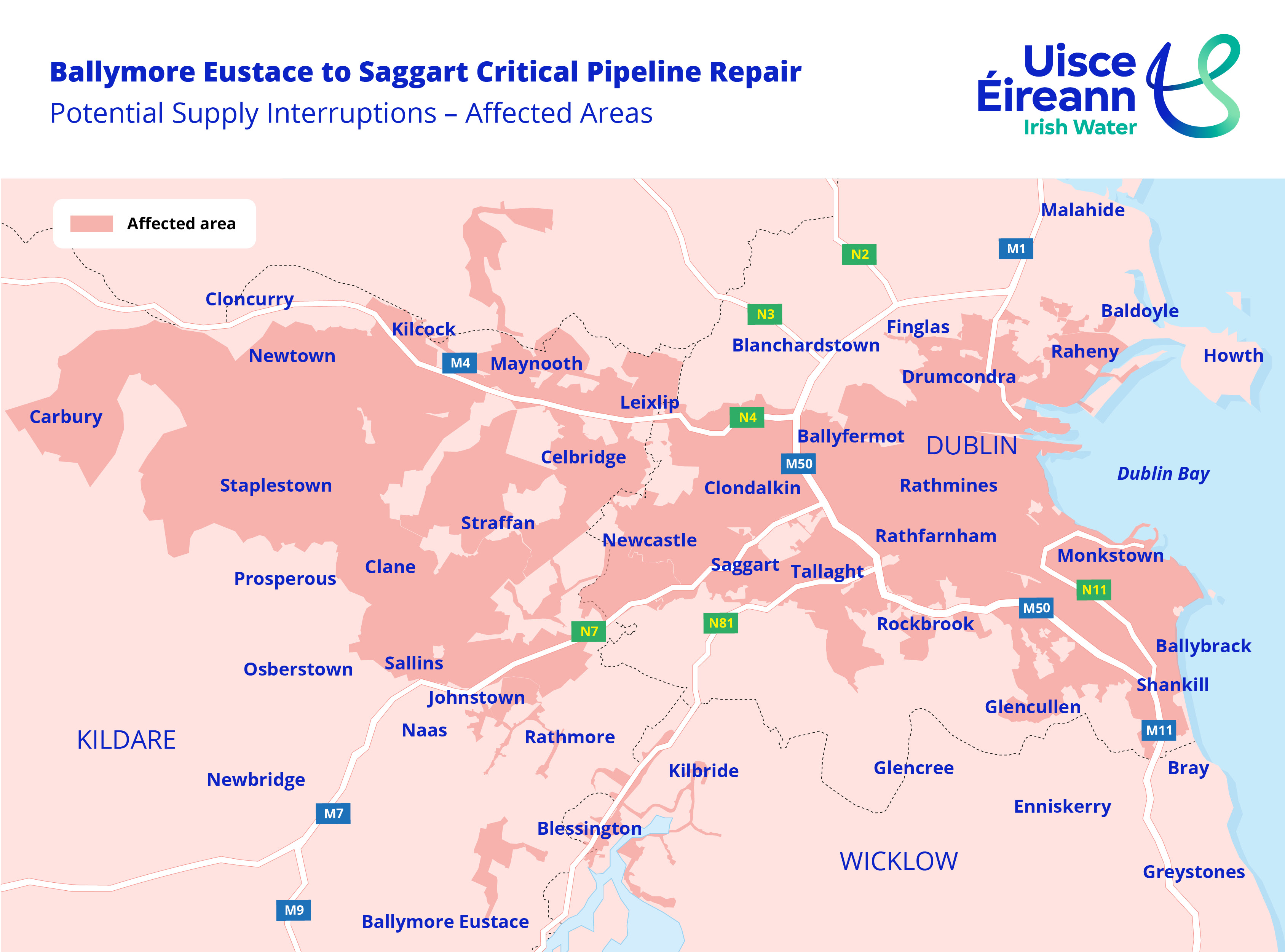
My heart sank a little last week when I received notice that Uisce Éireann would be doing major repairs to a main water pipeline in the Greater Dublin area over this bank holiday weekend. The planned works involved replacing an entire section of one of the main water pipelines, which would potentially disrupt the supply to a wide area, as demonstrated on this map:

Only a relatively small area was to have its drinking water supply cut off entirely, but residents in the rest of the shaded area above (which includes Maynooth) were requested to conserve water so as not to use up all the water already in the system that would not be replenished while the main was being replaced and a warning was in place about possible disruption to the water supply. I was worried that this might get very awkward if the works overran. Fair play to Uisce Éireann, though, because the works were completed on time earlier today. I haven’t noticed any disruption at all.

P.S. I have done my bit to help conserve water over the weekend by drinking only wine and beer.

Weekly Update from the Open Journal of Astrophysics – 02/08/2025

Posted in OJAp Papers, Open Access, The Universe and Stuff with tags , , , , , , , , , , , , , , , , , , , , , , , , , , , , on August 2, 2025 by telescoper

It’s Saturday morning again, and it’s the start of a new month, so it’s time for an update of papers published at the Open Journal of Astrophysics. Since the last update we have published five new papers, which brings the number in Volume 8 (2025) up to 110, and the total so far published by OJAp up to 345. I expect we’ll the total number we published last year (120) sometime this month. I predict that by the end of this year we will have published around 180 papers in Volume 8 and around 400 altogether.

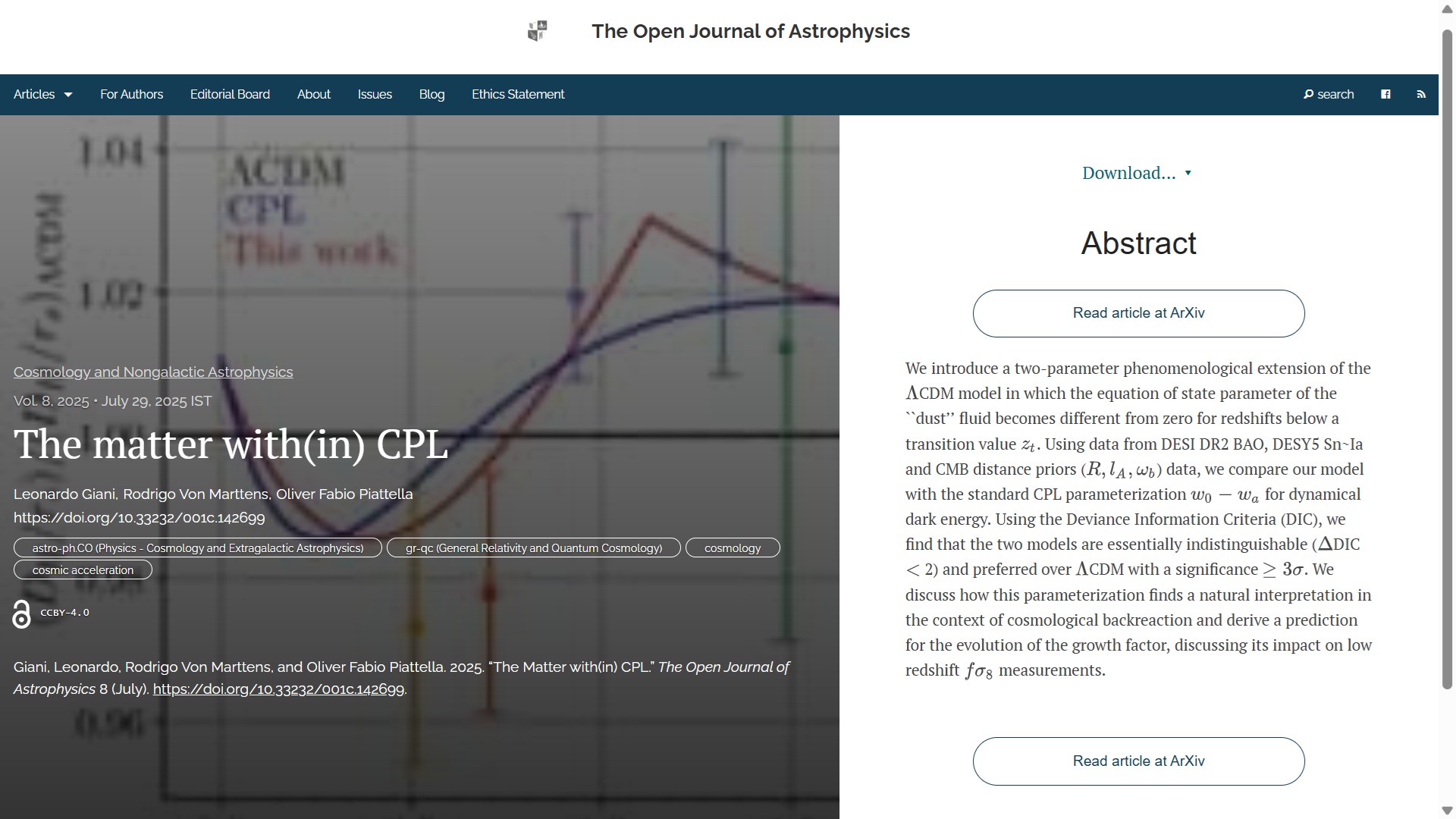
The papers published this week, with their overlays, are as follows. You can click on the images of the overlays to make them larger should you wish to do so.

The first paper to report is “The matter with(in) CPL” by Leonardo Giani (U. Queensland, Australia), Rodrigo Von Marttens (Universidade Federal da Bahia, Brazil) and Oliver Fabio Piattella (Universita degli Studi dell’Insubria, Italy). This was published on Monday 29th July 2025 in the folder Cosmology and Nongalactic Astrophysics. This article presents a new parameterization of the standard model and its implications for the interpretation of cosmological observations.

The overlay is here:


The officially-accepted version can be found on arXiv here.

The second paper of the week, published on Tuesday 30th July in the folder Instrumentation and Methods for Astrophysics, is “An automated method for finding the most distant quasars” by Lena Lenz, Daniel Mortlock, Boris Leistedt & Rhys Barnett (Imperial College London, UK) and Paul C. Hewett (U. Cambridge, UK)”.  This paper presents an automated, reproduceable and objective high-redshift quasar selection pipeline, tested on simulations and real data from the Sloan Digital Sky Survey (SDSS) and UKIRT Infrared Deep Sky Survey (UKIDSS). The overlay is here:


You can find the officially accepted version of the paper on arXiv here.

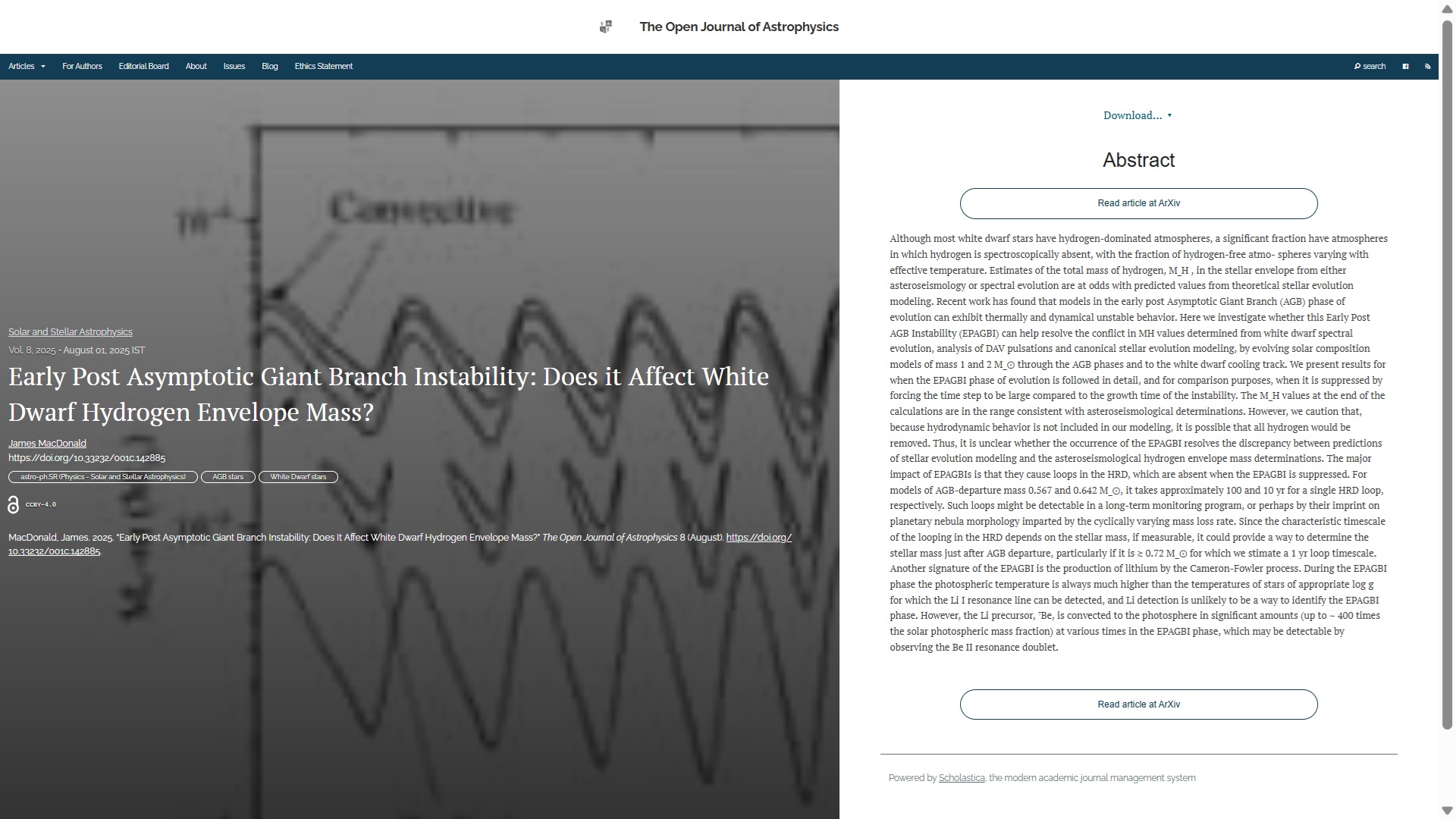
The third paper of the week is “Early Post Asymptotic Giant Branch Instability: Does it Affect White Dwarf Hydrogen Envelope Mass?” by James MacDonald (University of Delaware, USA). This one was published on Friday 1st Auguest (i.e. yesterday) in the folder Solar and Stellar Astrophysics. It is an investigation into whether Early Post AGB Instability (EPAGBI) can affect determinations of the total abundance of hydrogen in white dwarf stars.

The overlay is here:

The final version is on arXiv here.


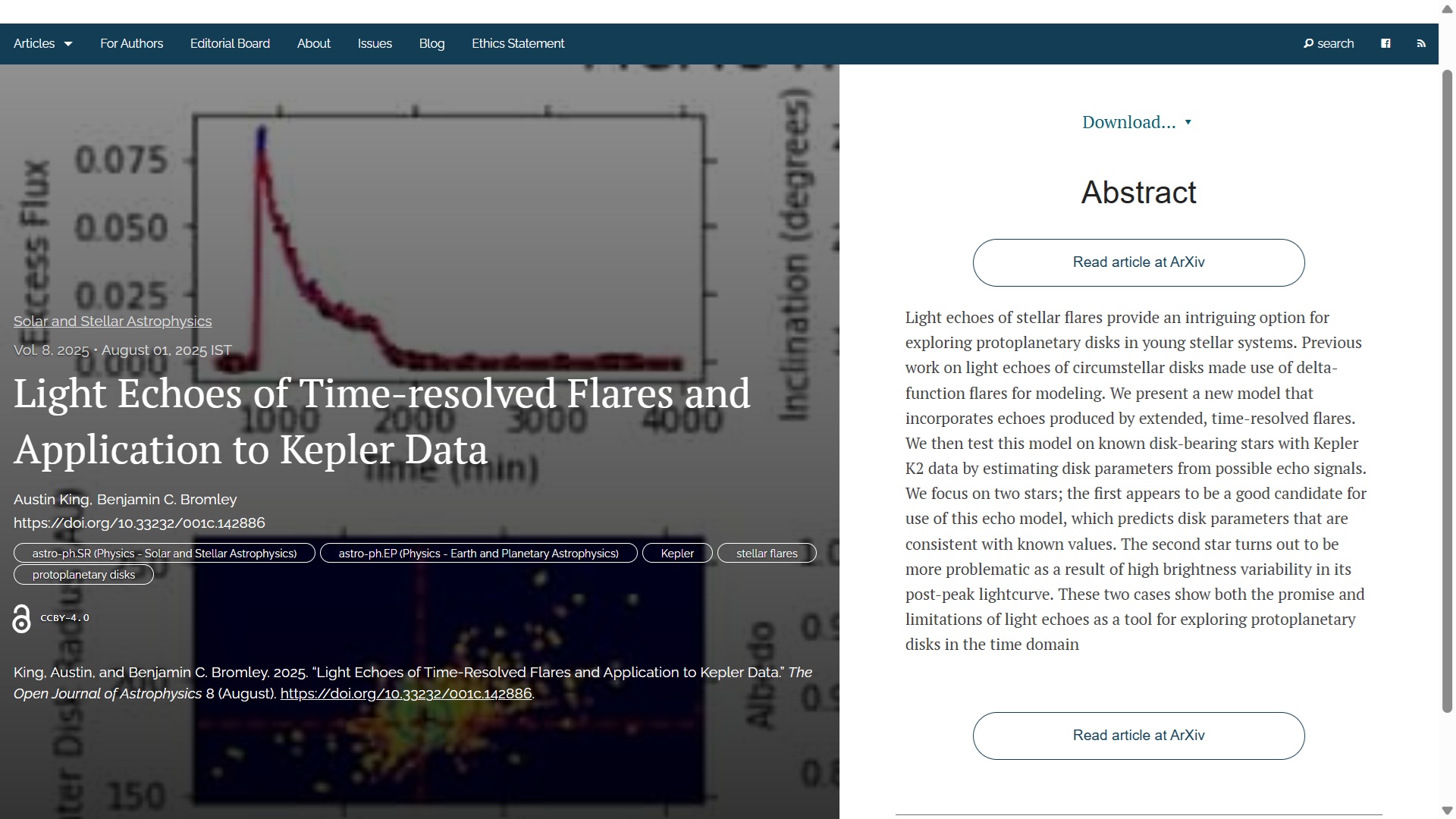
The fourth paper of the week, also published on Friday 1st August, is “Light Echoes of Time-resolved Flares and Application to Kepler Data” by Austin King and Benjamin C. Bromley (University of Utah, USA).  This describes a new model for circumstellar disks that incorporates echoes produced by extended, time-resolved flares. It is published in the folder Solar and Stellar Astrophysics. Here is the overlay:

You can find the officially-accepted version on arXiv here.


The fifth and final article published this week, also published on Friday 1st August,  is “Wide Binaries from Gaia DR3 : testing GR vs MOND with realistic triple modelling” by Charalambos Pittordis, Will Sutherland and Paul Shepherd (Queen Mary, University of London, UK). This presents a test for modified gravity from a sample of wide-binary stars from Gaia DR3, finding that (unmodified) Newtonian gravity provides a better fit to the data. It is in the folder Astrophysics of Galaxies.

The overlay is here:


You can find the officially-accepted version on arXiv here.

And that’s all the papers for this week. I’ll do another update next Saturday.

The Astronomer Royal and Royal Astronomers

Posted in Maynooth with tags , , , , , , on August 1, 2025 by telescoper

The appointment, announced yesterday, of Professor Michelle Dougherty as Astronomer Royal, replacing Professor Martin Rees who has held the title since 1995, has prompted me to make a couple or three pedantic comments.

First the BBC story announcing this appointment is headlined:

This is actually incorrect. Last time I looked, Scotland was still part of the United Kingdom, and Scotland has its own Astronomer Royal. That position has been held since 2021 by Catherine Heymans. Technically, therefore, the first female Astronomer Royal was Catherine not Michelle.

Anyway, yesterday’s news made me look up a few things about the Astronomer Royals. One thing that is interesting (to me) is that the position of Astronomer Royal for Scotland has only existed since 1834, which is not only well after the Act of Union 1707 that joined Scotland, England and Wales in Great Britain, but also after the Act of Union 1800 that joined Ireland and Great Britain into the United Kingdom. The position of Astronomer Royal to which Michelle Dougherty has been appointed was founded in 1675. The UK didn’t have an Astronomer Royal between 1675 and 1800, however, but because the United Kingdom didn’t exist in this period!

More importantly this got me thinking about the situation in Ireland. In fact there was a position called Royal Astronomer of Ireland, which was created in 1783, before the Act of Union 1800. This position was coupled with the Andrews Professorship of Astronomy and was held by the Director of Dunsink Observatory. The most famous holder of these positions was William Rowan Hamilton.

This arrangement was similar to that in Scotland in that, until 1995, the position of Astronomer Royal for Scotland was coupled to the Regius Professorship of Astronomy at Edinburgh University and the Directorship of the Royal Observatory in Edinburgh, but these were decoupled when the Royal Observatories were reorganized. The position of Astronomer Royal for Scotland was actually vacant for five years during this time. Malcolm Longair held the post from 1980 to 1990, but John Brown did not take up the office until 1995.

This situation in Ireland is a bit more extreme than this. The last Royal Astronomer for Ireland was Henry Plummer – best known for the Plummer sphere. He was an Englishman and he resigned and returned to England in 1921, the year the War of Independence ended. To cut a long story short the Anglo-Irish Treaty which ended the War of Independence created a “Free State” that still had the British monarch as Head. There could therefore have been a Royal Astronomer in Ireland after 1921, but none was ever appointed. I suppose there were other priorities at the time. The Republic of Ireland was created in 1949 and the Andrews Professorship was subsequently revived in 1981 but more than a century on, the position of Royal Astronomer remains in abeyance.

You might think it obvious that the Republic of Ireland should no longer have a Royal Astronomer, but many Royal things do linger here: there are the Royal Irish Academy*, the Royal College of Surgeons, the Royal Dublin Society (RDS); and the Royal Canal runs through Maynooth, where there is also a Royal City Korean Barbecue.

*The Royal Irish Academy is the Irish equivalent of the Royal Society (except that Elon Musk is not a fellow). Some years ago it held a public consultation about modernisation. My input was that I thought the name was antiquated and irrelevant and I could think of no possible objection to renaming it the Irish Republication Academy.