Archive for October, 2025

Ireland in CERN!

Posted in Science Politics, The Universe and Stuff with tags , , , , , , , , on October 22, 2025 by telescoper
Photo by Pietro Battistoni on Pexels.com

I saw the news today that the Republic of Ireland is now officially an associate member state of the Conseil Européen pour la Recherche Nucléaire, better known as CERN. This has been in the pipeline for a while: I blogged about it here, for example. But today’s the day that Ireland formally joined.

I think this is a very good move for Irish physics, and indeed for Ireland generally. I will, however, repeat a worry that I have expressed previously. There is an important point about CERN membership, however, which I hope is not sidelined. The case for joining CERN made at political levels was largely about the return in terms of the potential in contracts to technology companies based in Ireland from instrumentation and other infrastructure investments. This was also the case for Ireland’s membership of the European Southern Observatory (ESO), which Ireland joined 7 years ago. The same thing is true for involvement in the European Space Agency, which Ireland joined in 1975. These benefits are of course real and valuable and it is entirely right that arguments should involve them.

Looking at CERN membership from a purely scientific point of view, however, the return to Ireland will be negligible unless there is a funding to support scientific exploitation of the facility. That would include funding for academic staff time, and for postgraduate and postdoctoral researchers to build up an active community as well as, e.g., computing facilities. This need not be expensive even relative to the modest cost of associate membership (approximately  €1.9M). I would estimate a figure of around half that would be needed to support CERN-based science. I am given to understand that some funds have been made available as part of the joining arrangements, but I don’t know the details.

As I have mentioned before, Ireland’s membership of ESO provides a cautionary tale. The Irish astronomical community was very happy about the decision to join ESO, but that decision was not accompanied by significant funding to exploit the telescopes. Few astronomers have therefore been able to benefit from ESO membership. While there are other benefits of course, the return to science has been extremely limited. The phrase “to spoil a ship for a ha’porth of tar” springs to mind.

Although Ireland joined ESA almost fifty years ago, the same issue applies there. ESA member countries pay into a mandatory science programme which includes, for example, Euclid. However, the Irish Government did not put any resources on the table to allow full participation in the Euclid Consortium. There is Irish involvement in other ESA projects (such as JWST) but this is somewhat piecemeal. There is no funding programme in Ireland dedicated to the scientific exploitation of ESA projects.

Under current arrangements the best bet in Ireland for funding for ESA, ESO or CERN exploitation is via the European Research Council, but to get a grant from that one has to compete with much better developed communities in those areas.

The recent merger of Science Foundation Ireland and the Irish Research Council to form a single entity called Research Ireland could provide an opportunity to correct this shortfall in funding for science exploitation. The reorganization won’t do anything on its own, however: the overall level of public sector research funding will have to increase dramatically from its current level, well below the OECD average. The recent Budget in Ireland for 2026 does include an allocation of €426 million for research under the National Development Plan, but how much of this will find its way into basic research generally and CERN science in particular?

Autumn Rhythm (Number 30) – Jackson Pollock

Posted in Art with tags , , , on October 21, 2025 by telescoper

by Jackson Pollock (1950, enamel paint on canvas, 266.7 x 525.8 cm, Metropolitan Museum of Art, New York)

This painting, an example of Pollock’s “poured-painting” style, was featured in the 1980 BBC Two series 100 Great Paintings.

The Passage of Time

Posted in Biographical, Education with tags , , , , , on October 20, 2025 by telescoper

The start of this term has been so busy that I forgot that October 1st was the 40th anniversary of the day I officially started as a research student at the University of Sussex (1st October 1985). Reflecting on that event I realized with something approaching horror that 1985 is halfway between 1945 and 2025, so I started my PhD DPhil closer in time to the end of World War 2 than to today. Yikes!

Before travelling to the Sussex to embark on my research degree, I spent a couple of weeks at a summer school for all the new Astronomy PhD students. These are still held annually, although they are now just a week long instead of a fortnight. They are now sponsored by the Science and Technology Facilities Council (STFC) but the one I attended was before that came into being, and even before its predecessor, the Particle Physics and Astronomy Research PPARC. The Science and Engineering Research Council (SERC)  summer school I went to was held at Durham University; we all stayed in St Mary’s College, just over the road from the Physics Department. I remember it well and indeed still have the notes I took during the lectures there.

Another difference in those days was that we got our stipends paid by cheque – every three months, if I remember correctly – directly from the Research Council. Nowadays STFC gives block grants to universities and other research institutions, who then pay the students.

Anyway, here is the summer school conference picture:

Unfortunately (for such a rare and valuable document) it is slightly damaged on the left -hand side. I leave it up to my readers to identify the people in this group who are still in the business 40 years later. I can see quite a few – Moira Jardine, Alan Fitzsimmons, Melvyn Hoare, Jon Loveday and Alastair Edge, among others! A more complete list can be found here.

I don’t think I’m the only member of this group who is thinking of retiring fairly soon. This post was occasioned by the 40th anniversary of the start of my DPhil; my plan is to retire 40 years after the date of the completion of my thesis. That’s less than three years from now…

"What we call the beginning is often the end
And to make an end is to make a beginning.
The end is where we start from. "

from Little Gidding V, Four Quartets by T.S. Eliot

On Cosmography (and going Mainstream)

Posted in Maynooth, The Universe and Stuff with tags , , , , on October 19, 2025 by telescoper

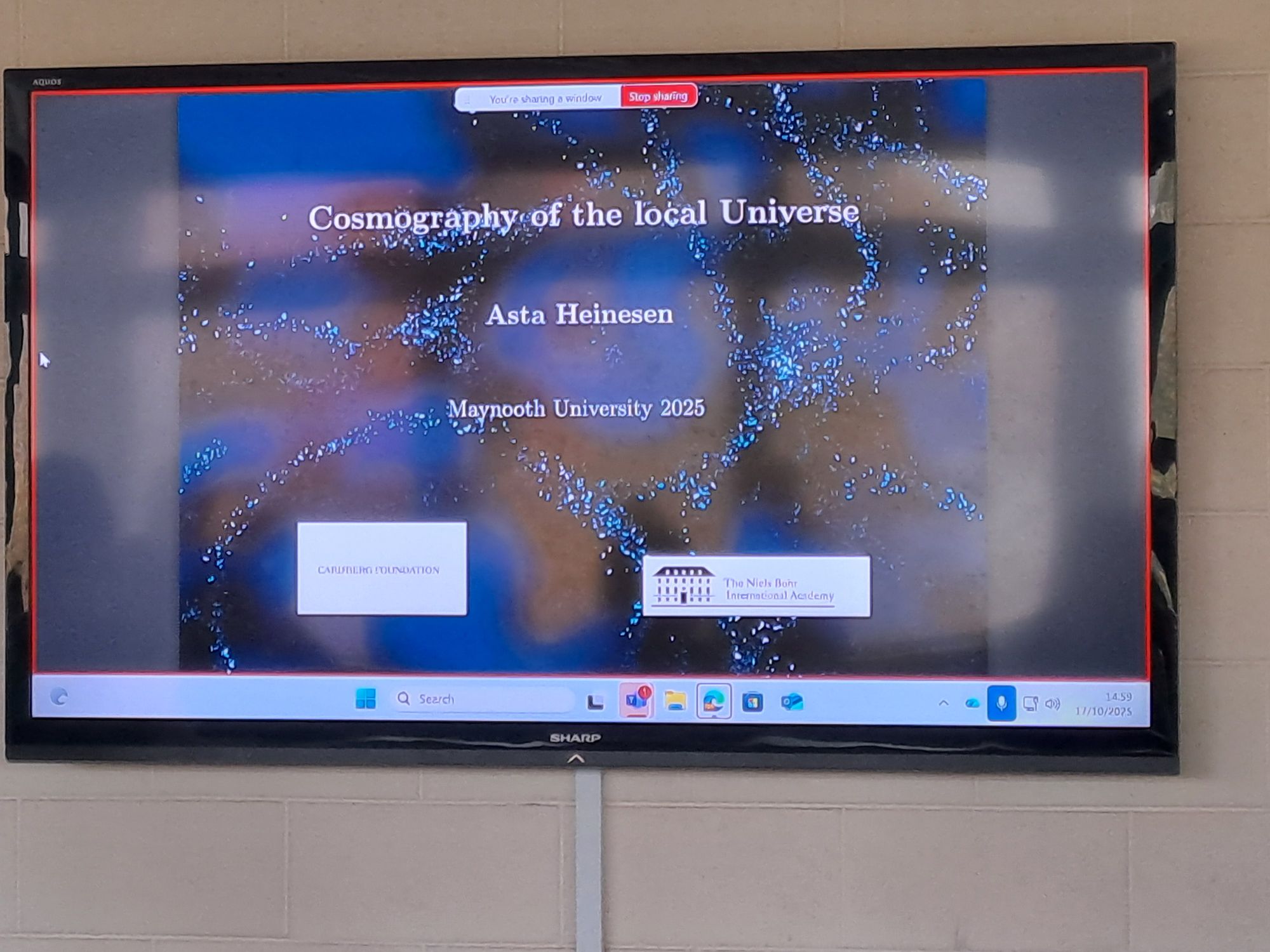
On Friday I attended a colloquium in the Physics Department at Maynooth University by Asta Heinesen of the Niels Bohr Institute in Copenhagen. The talk had the title of Cosmography of the local Universe, as shown on the first slide:

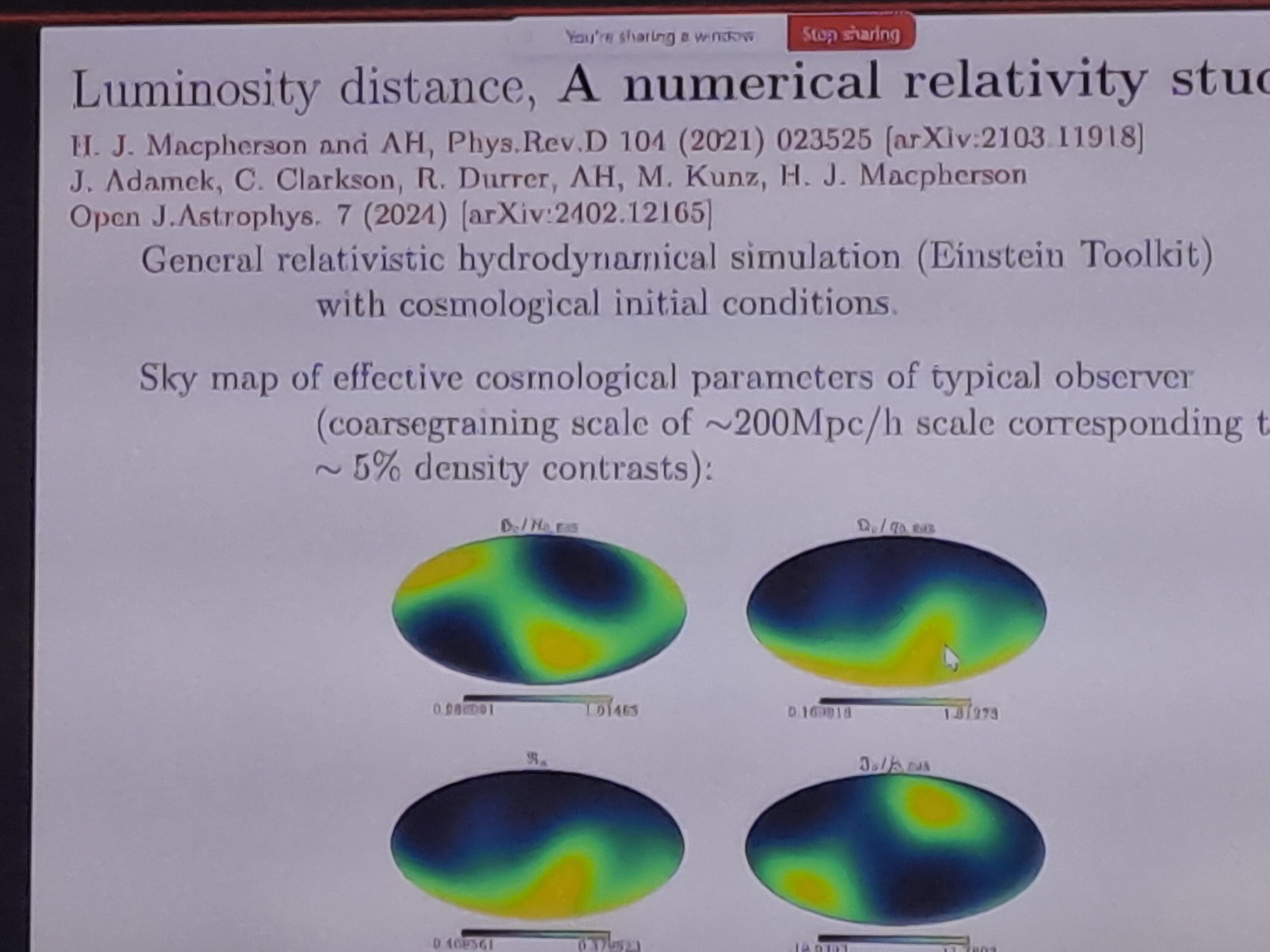
Asta talked about a very interesting programme of work that takes a different approach from most of modern cosmology in that it avoids making the prior assumption of global homogeneity and isotropy embodied by the Friedmann–Lemaître–Robertson–Walker metric. In particular, instead of assuming the isotropic expansion of the Universe, it tries to determine its properties directly using only such measurements as luminosity distances and redshifts. This method is not entirely model-independent because it does assume Lorentz invariance and the conditions required for the Etherington Reciprocity Theorem to hold, but it does not assume any particular form of the metric, so can be applied on scales where the distribution of matter is inhomogeneous and isotropic, e.g. in our local neighbourhood.

To apply this “metric-free” idea one has to construct as general as possible description of the kinematic properties of the underlying matter flow, allowing the global expansion to be anisotropic, and for there to be both rotation and shear. Obviously one would need a large number of measurements to extract anything like a full description of the matter flow, so generally one is restricted to deriving the low-order multipoles (monopole. dipole and quadrupole) as well as the observer’s velocity with respect to the large-scale matter flow.

I found Asta Heinesen’s seminar very stimulating in itself, but it was also nice to see that one of the papers on which it was based is published in the Open Journal of Astrophysics:

When I checked it, I found it was published on my birthday! Here is the overlay:

I announced it on this blog here.

I freely admit that I feel quite proud to have played a small part in helping to get such interesting work published. I’m seeing more and more papers referenced like this, actually. I was reminded of the recent announcement of this year’s list of MacArthur Fellows. among them Kareem El-Badry who has published quite a few papers with the Open Journal of Astrophysics. His biography on the MacArthur Foundation page includes this:

He has published articles in Monthly Notices of the Royal Astronomical SocietyThe Astrophysical Journal, and The Open Journal of Astrophysics, among other leading scientific journals.

I’m pleased to see us listed with the established names. I mention this just in case there are still people out there who think it might damage their career if they publish with a non-mainstream journal. We are mainstream now…

Clyne, Tchaikovsky and Shostakovich at the National Concert Hall

Posted in Biographical, Music with tags , , , , , , , , on October 18, 2025 by telescoper

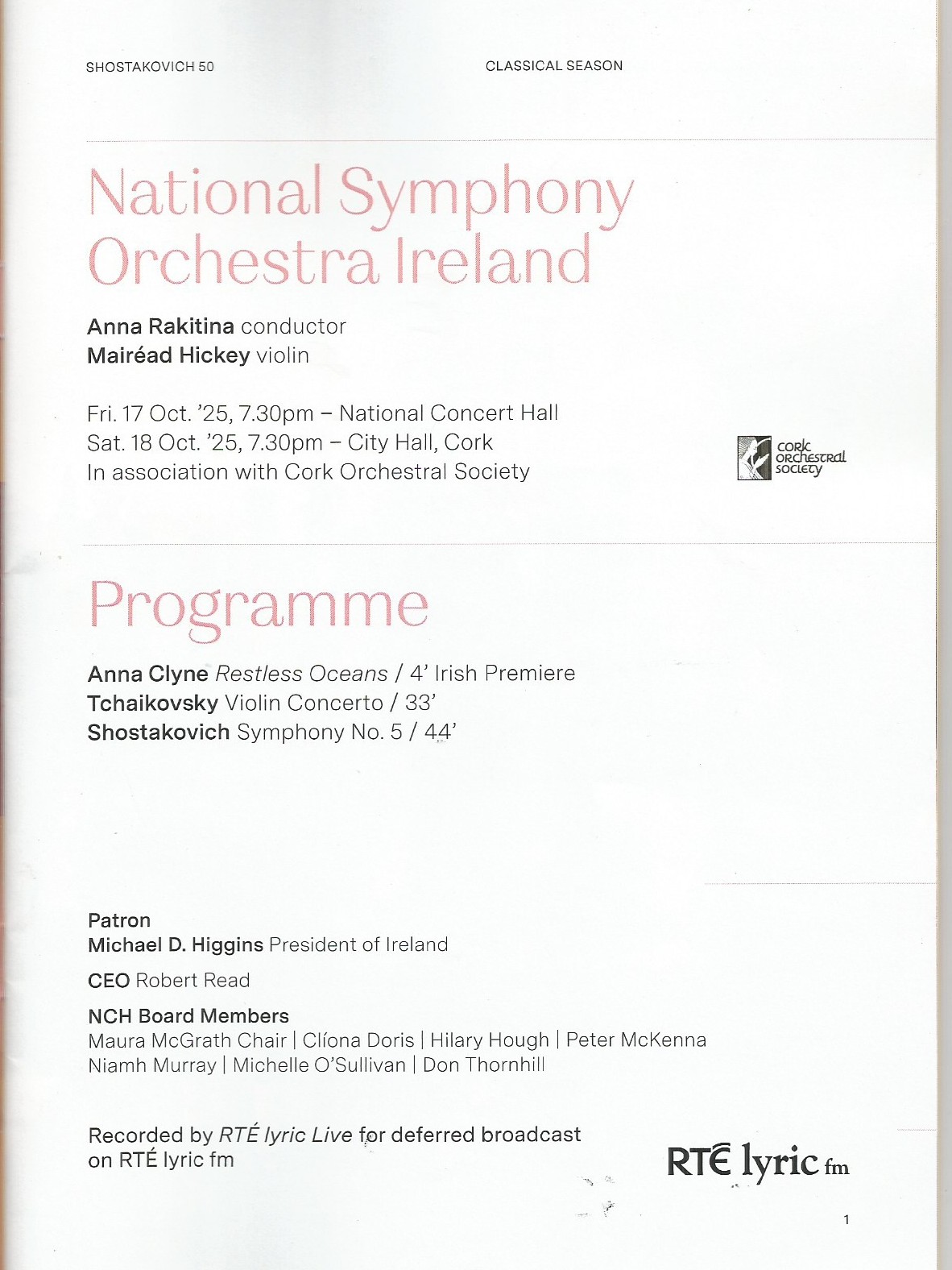
It had been over a month since my last visit to the National Concert Hall in Dublin so I was happy to be able to attend this week’s Friday night concert last night. It was great to see that the venue was very full too. I think that was at least partly down to the fact that one of the pieces featured Irish violinist Mairéad Hickey who has a sizeable local following. Conductor for the evening with National Symphony Orchestra Ireland was Anna Rakitina (who was born in Russia).

The concert began with a short piece by Anna Clyne called Restless Oceans. This is an energetic and an excellent way to get the orchestra revved up for the rest of the evening. I’d never heard this work before and I think it must be the first time I’ve seen a performance in which the string section sang or hummed a wordless accompaniment in one part and, in another, the whole orchestra provided extra percussion by stamping their feet.

After that zesty appetiser, Mairéad Hickey appeared on stage, resplendent in a green dress, to perform the first course proper, the Violin Concerto by Pyotr Ilyich Tchaikovsky. This is a familiar work but it was ravishingly played by Mairéad Hickey, who seem to revel in the virtuosic elements of this work, as well as bringing out the lyricism in the more romantic passages. The only things I don’t like about this composition are the gratuitously showy cadenzas which go on far too long, in my opinion. The audience clearly loved the performance, though, as did I, and we were treated to an encore in the form of some traditional Irish fiddle playing which was lovely.

After the wine break, we had the main dish for the evening, the Symphony No. 5 by Dmitri Shostakovich. This is a very famous work and one of the higlights of the entire symphonic repertoire. It is also perhaps the most accessible of all the Shostakovich symphonies. It was an immediate success with Soviet critics and public alike when it was first performed in 1937, and though it marked Shostakovich’s return to favour with the authorities after his denunciation by Stalin, this work has the composer’s very characteristic sense of things not being quite as they seem on the surface. Indeed, in this and many other of his compositions, seems to manage to say one thing at the same time as saying the exact opposite of that thing; nowadays this might be called `constructive ambiguity’. This is especially true in the finale, in which the sense of triumph it ostensibly portrays seems rather forced, so it approaches a parody of itself. This tension between possible interpretations gives the piece a palpable sense of danger.

Overall the Fifth Symphony is a sombre work, the dark undertone established right at the start with an imposing theme on the cellos and double basses, but it has passages of great beauty too, especially in the slow third movement. Like all great symphonies – and this is one of the greatest – it takes you on a journey full of of excitement and interest. It was a compelling performance by the NSOI, with outstanding playing by the whole orchestra, but especially the woodwinds.The 45 minutes or so of this performance seemed to fly by. It’s ending ending was greeted with rapturous applause and a standing ovation from many in the audience.

It’s interesting to consider that only 60 years had elapsed between the composition of these pieces by Tchaikovsky and Shostakovich, but what different musical worlds they represent!

Weekly Update from the Open Journal of Astrophysics – 18/10/2025

Posted in OJAp Papers, Open Access, The Universe and Stuff with tags , , , , , , , , , , , , , , , , , , , , on October 18, 2025 by telescoper

It’s time once again for the usual Saturday update of the week’s new papers at the Open Journal of Astrophysics. Since the last update we have published four  more papers, which brings the number in Volume 8 (2025) up to 156, and the total so far published by OJAp up to 391.

I’d like to encourage people to follow our feed on the Fediverse via Mastodon (where I announce papers as they are published, including the all-important DOI) so this week I’ll include links to each announcement there.

The first paper to report is “Shot noise in clustering power spectra” by Nicolas Tessore (University College London, UK) and Alex Hall (University of Edinburgh, UK). This was published in the folder Cosmology and NonGalactic Astrophysics on Tuesday October 14th 2025. This presents a discussion of the effects of ‘shot noise’, an additive contribution due to degenerate pairs of points, in angular galaxy clustering power spectra. Here is a screen grab of the overlay:

You can find the officially accepted version of the paper here. The Mastodon announcement is here:

Open Journal of Astrophysics

New Publication at the Open Journal of Astrophysics: "Shot noise in clustering power spectra" by Nicolas Tessore (University College London, UK) and Alex Hall (University of Edinburgh, UK)

doi.org/10.33232/001c.145919

October 14, 2025, 7:07 am 2 boosts 0 favorites

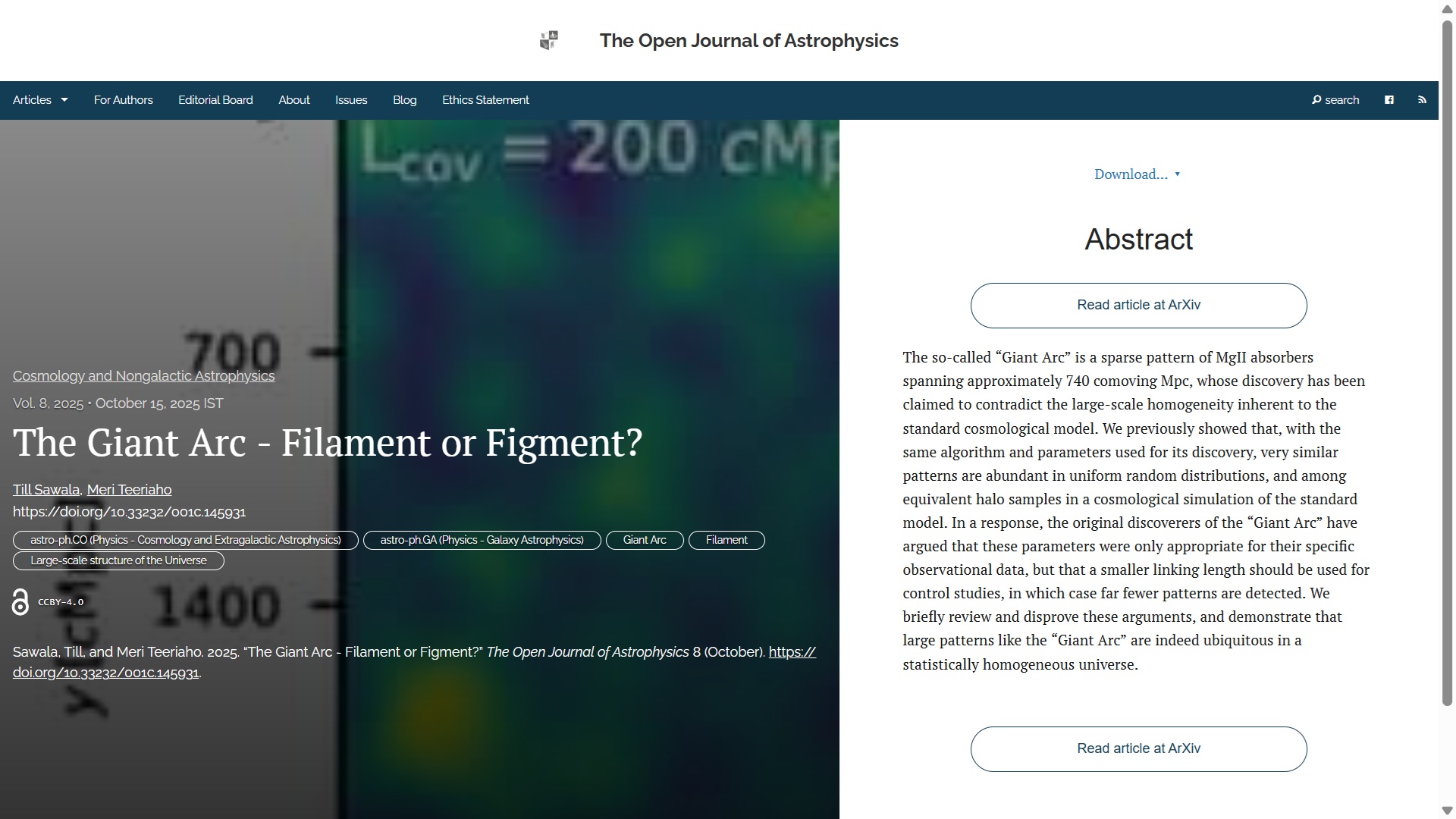
Next one up is “The Giant Arc – Filament or Figment?” by Till Sawala and Meri Teeriaho (University of Helsinki, Finland). This paper discusses the abundance of large arc-like structures formed in the standard cosmological model, with reference to the “Giant Arc” identified in MgII absorption systems. It was published on Wednesday October 15th in the folder Cosmology and NonGalactic Astrophysics. The overlay is here:

The officially accepted version of this paper can be found on the arXiv here and the Mastodon announcement is here:

Open Journal of Astrophysics

New Publication at the Open Journal of Astrophysics: "The Giant Arc – Filament or Figment?" by Till Sawala and Meri Teeriaho (University of Helsinki, Finland)

doi.org/10.33232/001c.145931

October 15, 2025, 6:33 am 2 boosts 3 favorites


The third paper this week,  published on Monday 6th October, is “Detecting wide binaries using machine learning algorithms” by Amoy Ashesh, Harsimran Kaur and Sandeep Aashish (Indian Institute of Technology, Patna, India). This was published on Friday 17th October (yesterday) in the folder Astrophysics of Galaxies. It presents a method for detecting wide binary systems in Gaia data using machine learning algorithms.

The overlay is here:


You can find the officially accepted version of this paper on arXiv here. The announcement on Mastodon is here:

Open Journal of Astrophysics

New Publication at the Open Journal of Astrophysics: "Detecting wide binaries using machine learning algorithms" by Amoy Ashesh, Harsimran Kaur and Sandeep Aashish (Indian Institute of Technology, Patna, India)

doi.org/10.33232/001c.146027

October 17, 2025, 6:55 am 0 boosts 0 favorites

The last one this week is “Learned harmonic mean estimation of the Bayesian evidence with normalizing flows” by Alicja Polanska & Matthew A. Price (University College London, UK), Davide Piras (Université de Genève, CH), Alessio Spurio Mancini (Royal Holloway, London, UK) and Jason D. McEwen (University College London). This one was also published on Friday 17th October, but in the folder Instrumentation and Methods for Astrophysics; it presents a new method for estimating Bayesian evidence for use in model comparison, illustrated with a cosmological example.

The corresponding overlay is here:


You can find the officially accepted version on arXiv here. The Mastodon announcement is here:

Open Journal of Astrophysics

New Publication at the Open Journal of Astrophysics: "Learned harmonic mean estimation of the Bayesian evidence with normalizing flows" by Alicja Polanska & Matthew A. Price (University College London, UK), Davide Piras (Université de Genève, CH), Alessio Spurio Mancini (Royal Holloway, London, UK) and Jason D. McEwen (University College London)

doi.org/10.33232/001c.146026

October 17, 2025, 7:06 am 0 boosts 0 favorites

That concludes the papers for this week. With two weeks to go I think we might reach the 400 total by the end of October.

Testing Times

Posted in Artificial Intelligence, Education, mathematics, Maynooth with tags , , , , on October 17, 2025 by telescoper

As it was foretold, I conducted my first set of my new-style in-class tests this week. These tests, as I mentioned a while ago,  were introduced because of concerns about the integrity of the coursework element of my modules in the light of improvements in Generative AI.

The main events – one for each of my modules – were both yesterday, but one student couldn’t make it at the scheduled time (for good reasons) so I set a special test this morning, which is now over. Because access to the internet is not allowed these tests are invigilated.

It’s been quite a while since I was last required to invigilate a full examination. I think it was back in Nottingham days, actually. I never enjoyed this task even though I took work to do it wasn’t really possible to do much as one had to keep one’s eyes on the students. Crosswords could be done; these are good in this situation because you can solve a few clues at a time. It was disappointing if I happened to take one that was easy enough to do quickly, as there was little to stave off the boredom after completing it. Other things I used to do included counting the number of right-handed and left-handed students, though I never did any detailed statistical analysis of the results.

Anyway, my recent class tests were a bit different. Designed to fit in a lecture slot of 50 minutes duration, they were much shorter than traditional end-of-year exams. They were also “open-book” style, so students could bring anything on paper that they wanted. Phones and laptops were, however, forbidden. During these tests I just sat quietly with my laptop getting some work done, with an occasional glance at the students. It was actually nice to be locked away like this with no disturbance. Time passed very quickly, actually, though perhaps not as quickly as it did for the students taking the tests.

When I first told the students that the tests would be “open-book”, I think they all assumed that would make them easy. I don’t think that was the case, however, as the questions are designed so that the answers can’t be obtained immediately by looking them up in a textbook. Also, having things on paper rather than in your head does slow you down. I’ve never seen much point in examinations as speed tests. I designed this week’s tests so that the questions could be done in about 30 minutes, but the formal duration was 50 minutes. I encouraged students who finished early to use the remaining time to check their work, but some did leave early.

This new regime also meant I had number of teaching sessions without the exertion of having to do any actual teaching, which was nice. The downside is, of course, that I now have stacks of class tests to correct. That will be payback time.

I won’t know how well the students have coped until I have got their grades, but informal feedback was that they seemed reasonably content with the new method of assessment. I’ll be doing the next ones in about three weeks.

Calling all Irish weather and climate enthusiasts! 

Posted in The Universe and Stuff with tags , , , , on October 16, 2025 by telescoper

Just a quick post to share an opportunity to get involved in a bit of Citizen Science. The inestimable Zooniverse has teamed up with Met Éireann, the Irish National Meteorological Service, in a project called Irish Weather Rescue. Your mission, should you choose to accept it, is to help digitize historical weather records that currently only exist on paper. Currently only a few percent of the available records have been digitised.

The project aims to provide access to valuable data that will improve our understanding of how rainfall patterns have changed over longer timescales and provide context for the changes we see in our current climate and possible future climate. Met Éireann’s archive contains an extensive collection of historical weather observations that include meteorological registers, rainfall registers, climatological reports, weather diaries, monthly weather bulletins and maps. These handwritten paper records are at risk of being lost due to the vulnerability of the original paper documents. By creating a digital copy of these records and extracting the data contained in them we can use the data to monitor climate variability and change, support effective climate risk management and improve climate model projections.

To read more about the project and/or volunteer, see here.

There and Back Again

Posted in Biographical on October 15, 2025 by telescoper

So here I am, safely back in Maynooth, after a hassle-free journey in both directions. I went straight to Dublin Airport from a lecture at Maynooth yesterday, as the meeting I attended today started quite early this morning. Obviously that meant I had to stay overnight in a hotel last night, but at least the organisers found me an appropriate room for the night:

I might have that put on a T-shirt!

I always find travelling very tiring. I don’t know why, because basically it just involves sitting around doing very little. The meeting went well, though, so the trip was worth it. I also got to meet up with a certain person last night so it was doubly worth it, but that also no doubt contributed to my fatigue.

Anyway, back to normal tomorrow, so perhaps an early night is called for…

Beginning Astronomy

Posted in Biographical with tags , on October 14, 2025 by telescoper

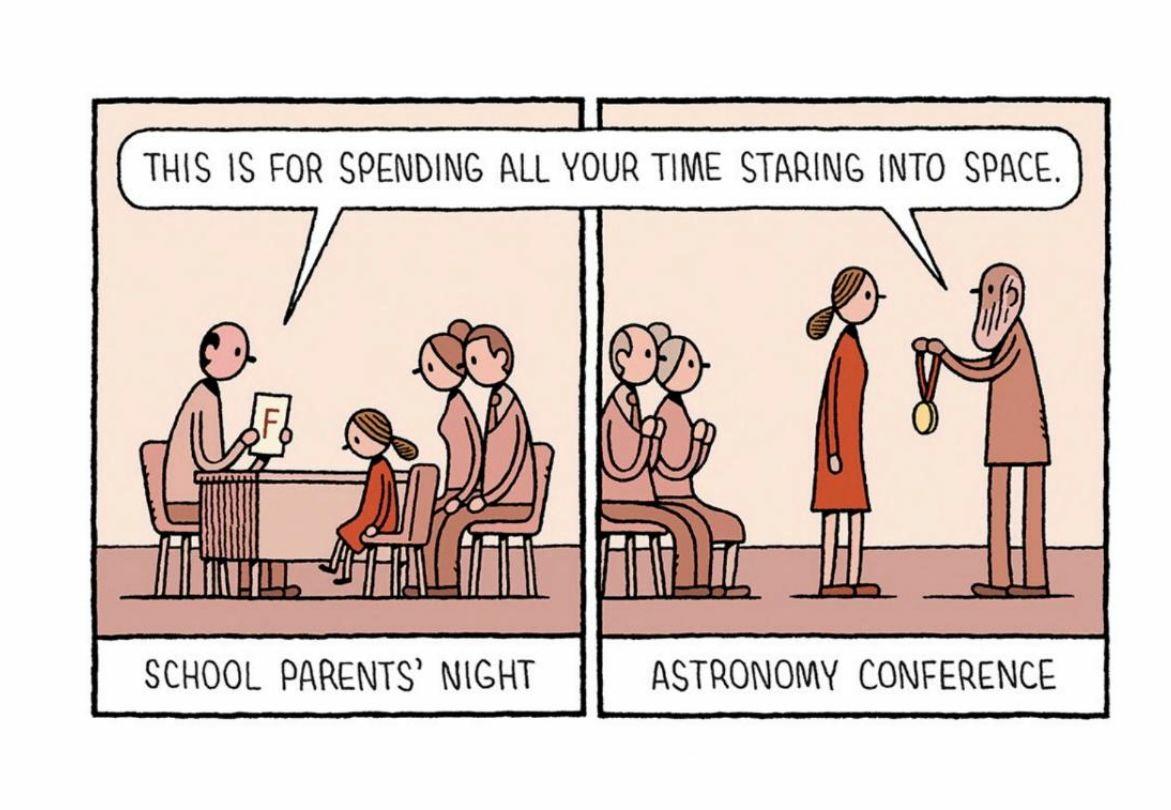
I have a two-hour lecture coming up after which I have immediately to dash to the airport in order to embark on a trip to a foreign country, so in lieu of a proper post here is a nice cartoon I saw on Mastodon.

Natasha Jay 🇪🇺

School Parents Night vs Astronomy Conference

By Tom Gauld in “Physics for Cats”

The first panel shows a parent-teacher conference ("School Parents' Night") where a teacher is giving a girl's parents a failing F grade for their daughter. The second panel shows an "Astronomy Conference" where the same girl, now an adult, is being awarded a medal for her work.
October 12, 2025, 4:31 pm 548 boosts 772 favorites

This also allowed me to check whether the embed facility works, which it seems to do. This actually gives me an idea about how to speed up my weekend updates, which I might try out on Saturday.