When I was a lad, back in England, the name for the Thursday before Good Friday was Maundy Thursday. That term isn’t used here in Ireland, where it seems to be known as Holy Thursday. Anyway, Maynooth University is closed tomorrow (Good Friday) but not today (Holy Thursday). Although today is not an official holiday, some campus facilities are in fact closed – including Pugin Hall, where I often have lunch. This helped me plan my activities for the day.
My agenda for Holy Thursday included:
giving a 9am Computational Physics lecture;
grading the submissions from the last Computational Physics lab test and writing feedback;
meeting with my masters project student;
supervising a computer lab session,;
meeting with my undergraduate project student;
going home, and collapse in a state of exhaustion.
To get to the last item as quickly as possible, I decided my strategy to make use of the lack of availability of food on campus would be to work all the way through lunch to get my grading done.
On the way to campus for the first item on the agenda I noticed how quiet the town was this morning. The schools are on holiday this week and next so there was no school run. The lack of people was even more noticeable when I got to campus, with many fewer students than usual, even at 8.45am. I did consider the possibility that nobody might appear for my lecture, but in the end I had about 30% of those expected. That’s a disappointing number but I gather it’s a better attendance than some of my colleagues got today. When I finished at about 10am, I walked back to my office through a still very quiet North campus.
As usual happens in a day’s work, there were quite a few interruptions – mainly to do with postgraduate matters – but I managed to do all my corrections ahead of the lab this afternoon. I also had my two project meetings, just to keep up-to-date before the break next week. It’s a stressful time for students as we approach the end of the academic year, so I advised them to make sure they book took at least a bit of time off to regroup for the final push and the submission of their reports.
Anyway, I’ve now ticked off every item on my to-do list except the last and will shortly make my way home to complete the job.
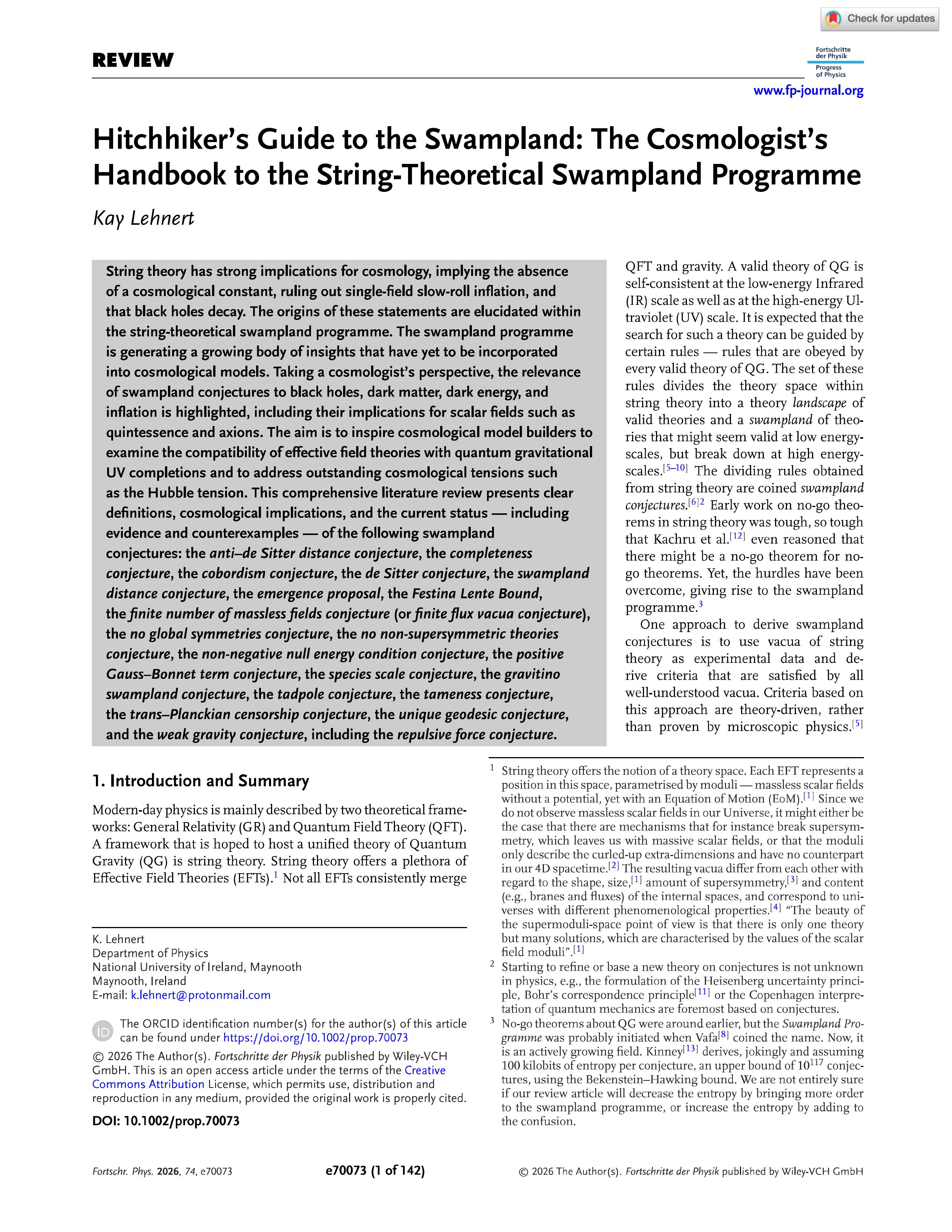
Regular readers of this blog might remember that last year I did a post about a very comprehensive review article which had appeared on arXiv with the title Hitchhiker’s Guide to the Swampland: The Cosmologist’s Handbook to the string-theoretical Swampland Programme. The article is by Kay Lehnert (who happens to be my PhD student). Well, that paper was published last Saturday (28th March 2026) in the journal Fortschritte der Physik (which I translate roughly as “Advances in Physics”, but whose official English title seems to be “Progress of Physics”). Anyway, it is available (and indeed openly accessible) here. And, if you don’t believe me, here’s a grab of the front page showing the deets (as you young people say):
A couple of days ago I received an email from a publisher offering to buy the Open Journal of Astrophysics. This happens from time to time, but it’s interesting to see the offer price increasing. This time it was for $150,000. I don’t know how that valuation was arrived at but I think OJAp is worth a lot more. But then there is a difference between price and value…
The publisher in question this time was XLESCIENCE, which is based in India and which charges typical Article Processing Charges of $1,200 per paper. I wonder how they would plan to make a profit from OJAp, which charges nothing? If a publisher did buy OJAp and started trying to charge an APC, people would just stop using it!
(The offer price is not the only reason I dismissed the approach, however. One other reason is that I don’t want to do business with a commercial publisher. Another reason I wouldn’t consider selling the Open Journal of Astrophysics is that I don’t actually own it. I did think about offering to sell them one of the many other journals I don’t own, just for a laught, but that might have been construed as attempted fraud…)
This episode reminded that some time ago I wrote a piece about funding open access journals. Having made the decision not to charge fees of any kind, we lack any source of income other than Maynooth University. I am very grateful for that support, but we are run on a shoestring budget. We are run entirely by volunteers and keep costs to an absolute minimum, but are not free.
I have written before about what I think the future of Diamond Open Access could look like. I would like to see a range of Diamond Open Access journals offering a choice for authors and serving different sub-disciplines. Most universities nowadays have publishing operations so there could be network of federated journals, some based on arXiv and some based on other repositories and others with different models, such as SciPost. Perhaps institutions are worried about the expense but, as we have shown the actual cost, is far less than they are wasting on Article Processing Charges.
Everything is going well at OJAp, but it is not reasonable that the expense of running a journal that serves the global astrophysics community should fall entirely on one small University in Ireland. It won’t be sustainable in the long run, either, if we continue to grow at the present rate. Compare us with the Diamond Open Access publisher SCIPOST, which has a long list of sponsors covering its costs; we have none. I know that money is very tight in astrophysics these days but if you have access to any potential sources of funding – then please consider supporting OJAp!
It’s Sunday 29th March – Palm Sunday in fact – and Friday 3rd April is Good Friday, which is followed by a break of a week for Easter, so I’ve been looking at what I have to do in the four days between Monday and Thursday.
On Tuesday afternoon part of my 3rd Year Computational Physics class will be doing a supervised test in the computer lab. I (foolishly) promised to ensure they would get their grades before Easter, so I’m going to have to mark them straight away. This is a larger group than usual because some students who would normally be in the lab on Thursdays swtiched to Tuesday so they could go on a trip to Armagh. Anyway, this is the third lab test and at least I have graded the first two tests for all groups in time for the arrival of the new ones.
There will be one more of these lab tests after the Easter break but after that the students will be working full-time for 3 weeks or so on mini-projects. That is the part they usually enjoy most and I’m very happy to see that some have already started work.
Then, on Wednesday I have the second class test for my 4th year Particle Physics module. This is the second such test, and it will be held during a tutorial session. This is a pen-and-paper test rather than a coding test to be done in the lab. For such tests I allow students to bring whatever they like on paper but phones, laptops and tablets are banned. This is the easiest way I could think of to avoid students using AI to solve the problems. In previous years I gave take-home assignments for this module, and I still hand out exercise sheets to be gone over in tutorials, but these are for formative purposes only. The summative assessments are the class tests. There will be three of those, which means they will have to endure one more after Easter. In a normal week I would have a Particle lecture on Friday, but that won’t happen because it’s Good Friday and my lectures apparently aren’t good enough to happen on that day.
As well as the Computational Physics lab test and the Particle Physics class test, next I have two lectures, both at 9am – one on Tuesday and one on Thursday – and another lab session on Thursday which is not a test, but a practical session about solving ODEs.
Then it will be the Easter Break. After that, according to my calculations, there will be four more teaching weeks before the examination period. The last day of teaching is May 8th. Between that and the examinations there is a gap of a week during which I will have to mark all the completed Computational Physics project reports, as well as giving some revision classes if there is demand for them.
Last night the clocks went forward an hour so we are now on Irish Summer Time (GMT+1, the same as BST). Among other things, this means that for the next seven months or so the clock on my oven will actually be set correctly…
One of the more sensible decisions made by the European Parliament some years ago was to approve a directive that will abolish `Daylight Saving Time’. I’ve long felt that the annual ritual of putting the clocks forward in the Spring and back again in the Autumn was a waste of time effort, so I’ll be glad when this silly practice is terminated. It would be better in my view to stick with a single Mean Time throughout the year. This was supposed to happen in 2021 but was delayed by the pandemic and still hasn’t happened.
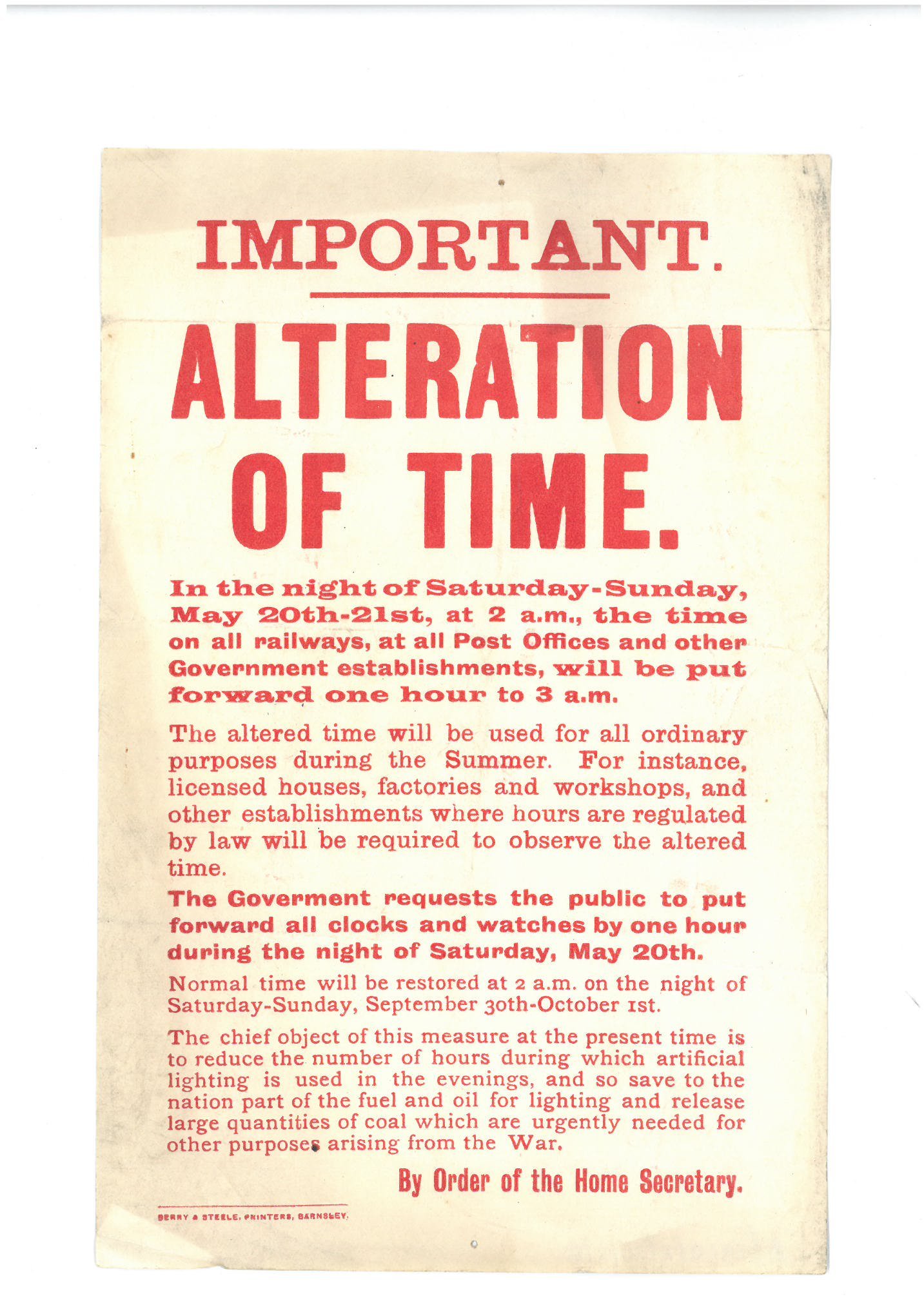
The marvellous poster above is from 1916, when British Summer Time was introduced, though it ran for only about 4 months (May to September), rather than the seven we have now (March to October).
You might be surprised to learn that the practice of changing clocks backwards and forwards is only about a hundred years old. in the United Kingdom. To be honest I’m also surprised that the practice persists to this day, as I can’t see any real advantage in it. Any institution or organization that really wants to change its working hours in summer can easily do so, but the world of work is far more flexible nowadays than it was a hundred years ago and I think few would feel the need.
Anyway, while I am on about Mean Time, here is a another poster from 1916.
Until October 1916, clocks in Ireland were set to Dublin Mean Time, as defined at Dunsink Observatory, rather than Mean Time as defined at Greenwich. The adoption of GMT in Ireland was driven largely by the fact that the British authorities found that the time difference between Dublin and London had confused telegraphic communications during the Easter Rising earlier in 1916. Its imposition was therefore, at least in part, intended to bring Ireland under closer control of Britain. Needless to say, this did not go down well with Irish nationalists.
Ireland had not moved to Summer Time with Britain in May 1916 and was still on Dublin Mean Time, which was 25 minutes 21 seconds behind GMT, so the change to GMT was introduced at the same time as BST ended in the UK, hence the alteration by one hour minus 25 minutes 21 seconds, i.e. 34 minutes and 39 seconds as in the poster.
Once again it’s time for the usual Saturday morning update of activity at the Open Journal of Astrophysics. Since the last update we have published a further eight papers, bringing the number in Volume 9 (2026) to 67 and the total so far published by OJAp up to 515.
I will continue to include the posts made on our Mastodon account (on Fediscience) to encourage you to visit it. Mastodon is a really excellent service, and a more than adequate replacement for X/Twitter (which nobody should be using); these announcements also show the DOI for each paper.
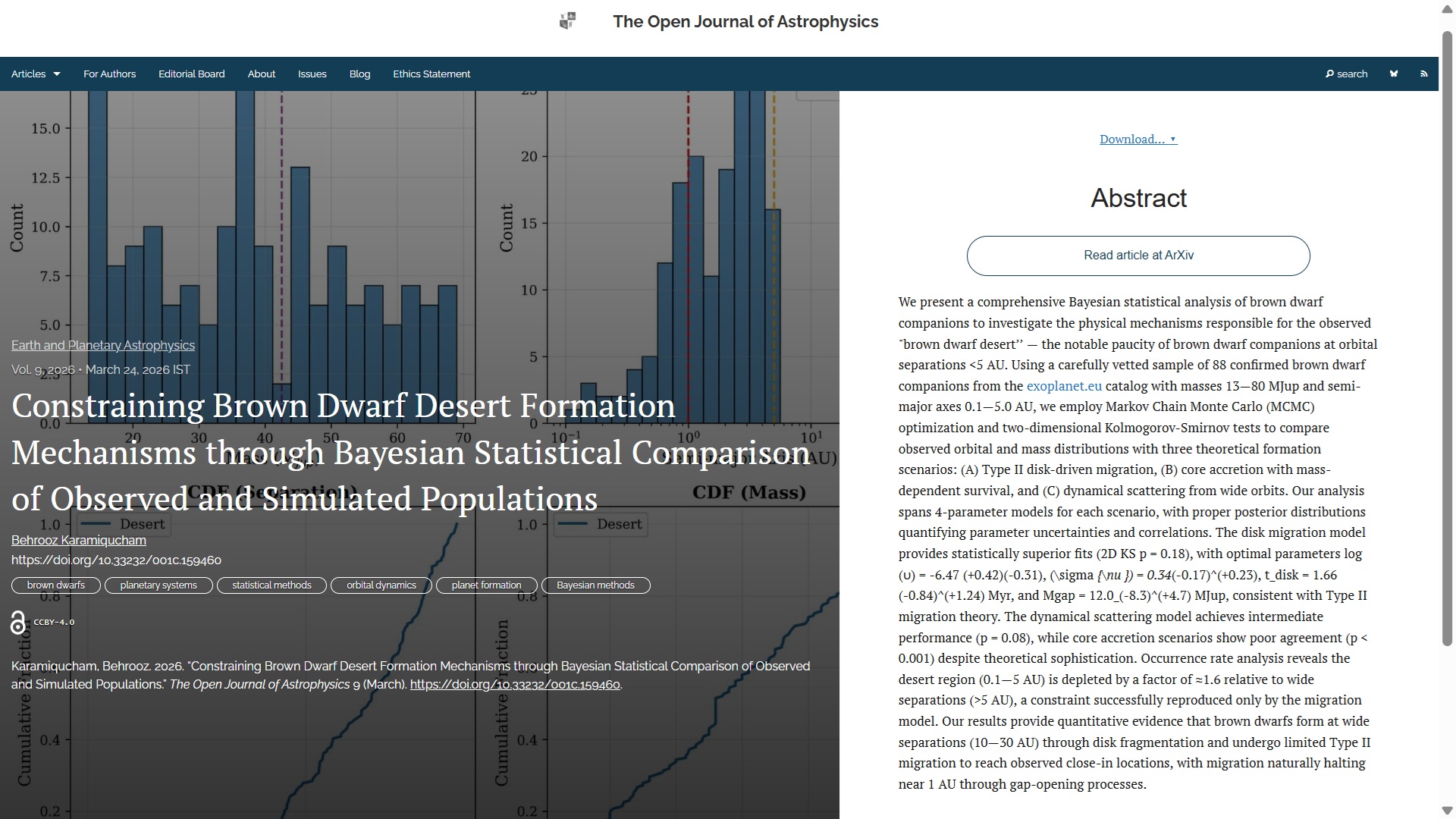
New Publication at the Open Journal of Astrophysics: "Constraining Brown Dwarf Desert Formation Mechanisms through Bayesian Statistical Comparison of Observed and Simulated Populations" by Behrooz Karamiqucham (College of Charleston, USA)
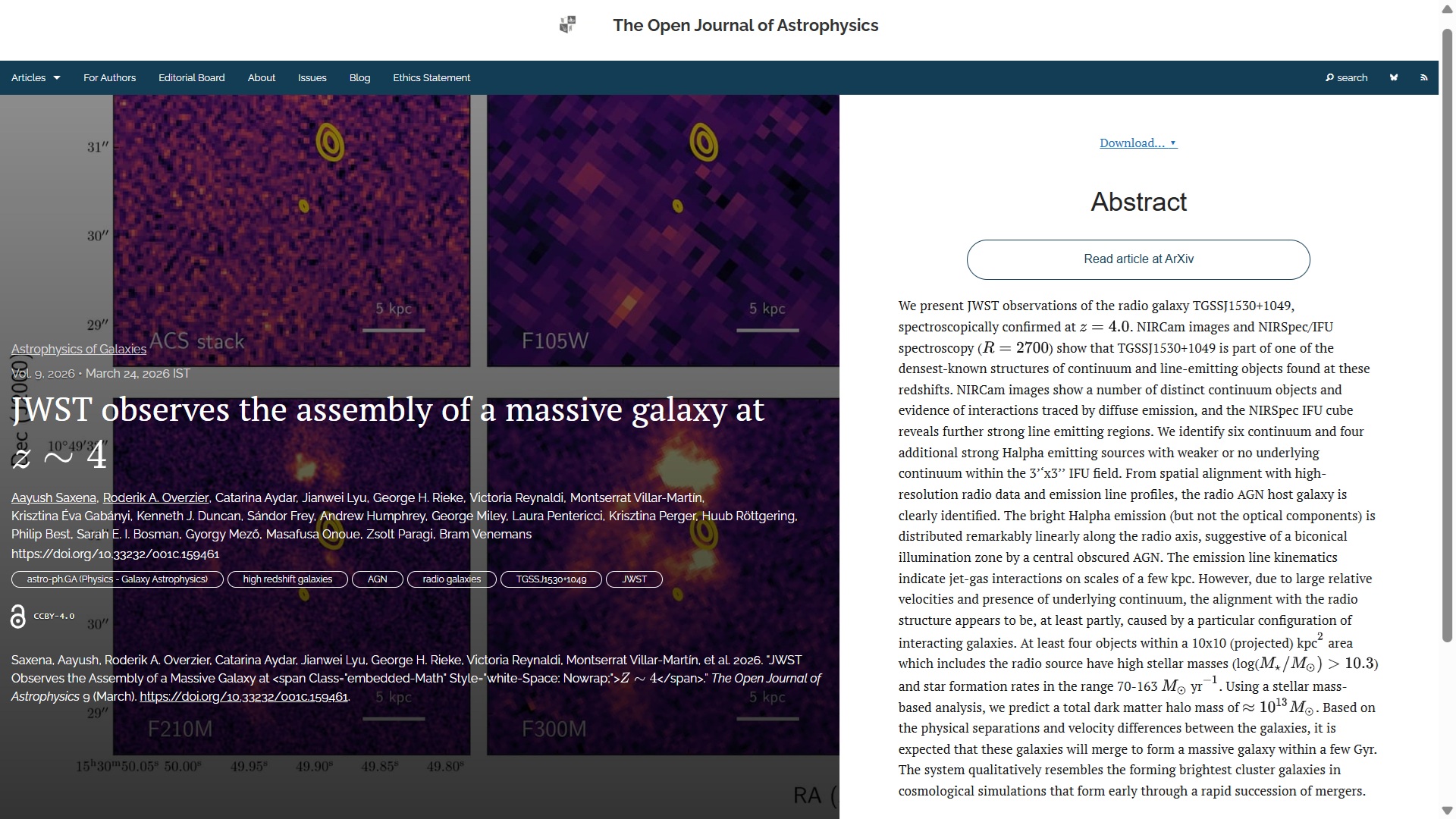
The second paper for this week, also published on Tuesday March 24th, but in the folder Astrophysics of Galaxies, is “JWST observes the assembly of a massive galaxy at z ~ 4” by Aayush Saxena (University of Oxford, UK) and 20 others (based in the UK, Europe, USA, Brazil, Japan and China). The paper presents observations of radio galaxy TGSSJ1530+1049, revealing it as part of a dense structure of emitting objects likely to merge to form a massive galaxy within a few Gyr.
The overlay for this one is here:
The official version of the paper can be found on arXiv here and the Fediverse announcement here:
New Publication at the Open Journal of Astrophysics: "JWST observes the assembly of a massive galaxy at z ~ 4" by Aayush Saxena (University of Oxford, UK) and 20 others (based in the UK, Europe, USA, Brazil, Japan and China)
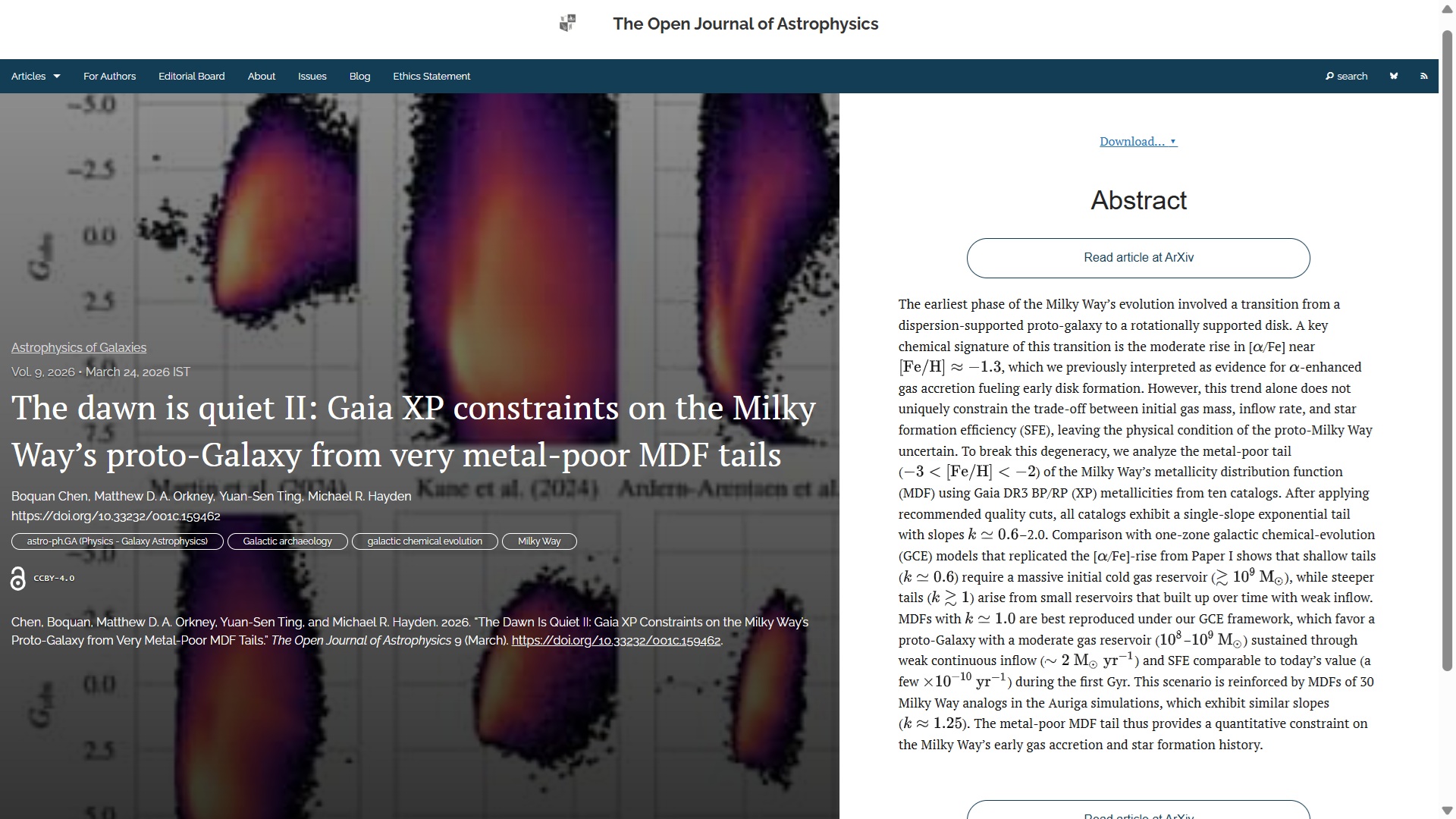
Next one up, the third paper of the week, also published on Tuesday March 24th in the folder Astrophysics of Galaxies, is “The dawn is quiet II: Gaia XP constraints on the Milky Way’s proto-Galaxy from very metal-poor MDF tails” by Boquan Chen (Ohio State U., USA), Matthew D. A. Orkney (Universitat de Barcelona, Spain), Yuan-Sen Ting (Ohio State U.) & Michael R. Hayden (U. Oklahoma, USA). The paper aegues that the Milky Way’s metallicity distribution suggests that its early evolution involved a moderate gas reservoir, sustained by weak continuous inflow, and star formation efficiency similar to the present value.
The overlay for this one is here:
The final, accepted version can be found on arXiv here and the Mastodon announcement is here:
New Publication at the Open Journal of Astrophysics: "The dawn is quiet II: Gaia XP constraints on the Milky Way’s proto-Galaxy from very metal-poor MDF tails" by Boquan Chen (Ohio State U., USA), Matthew D. A. Orkney (Universitat de Barcelona, Spain), Yuan-Sen Ting (Ohio State U.) & Michael R. Hayden (U. Oklahoma, USA)
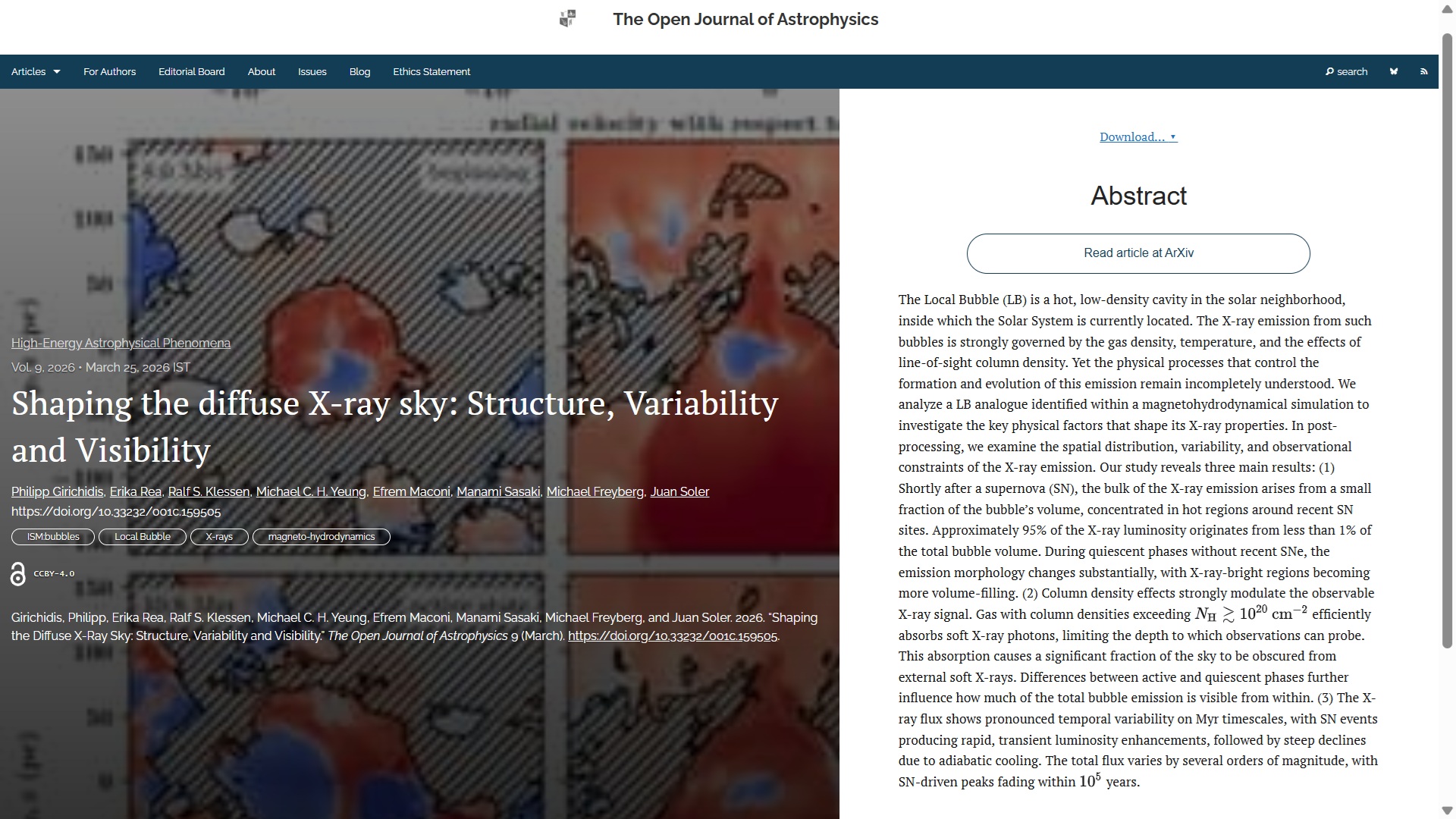
The fourth paper this week, published on Wednesday 25th March 2026 in the folder High-Energy Astrophysical Phenomena is “Shaping the diffuse X-ray sky: Structure, Variability and Visibility” by Philipp Girichidis (Heidelberg U., Germany) and 7 others based in Germany, USA, Austria and Italy. The paper argues that the X-ray properties of the Local Bubble (LB), a low-density cavity in the solar neighborhood reveal that supernova events significantly influence X-ray emissions, which show pronounced temporal variability
The overlay is here:
The finally accepted version of this paper can be found here and the Mastodon announcement is here:
New Publication at the Open Journal of Astrophysics: "Shaping the diffuse X-ray sky: Structure, Variability and Visibility" by Philipp Girichidis (Heidelberg U., Germany) and 7 others based in Germany, USA, Austria and Italy
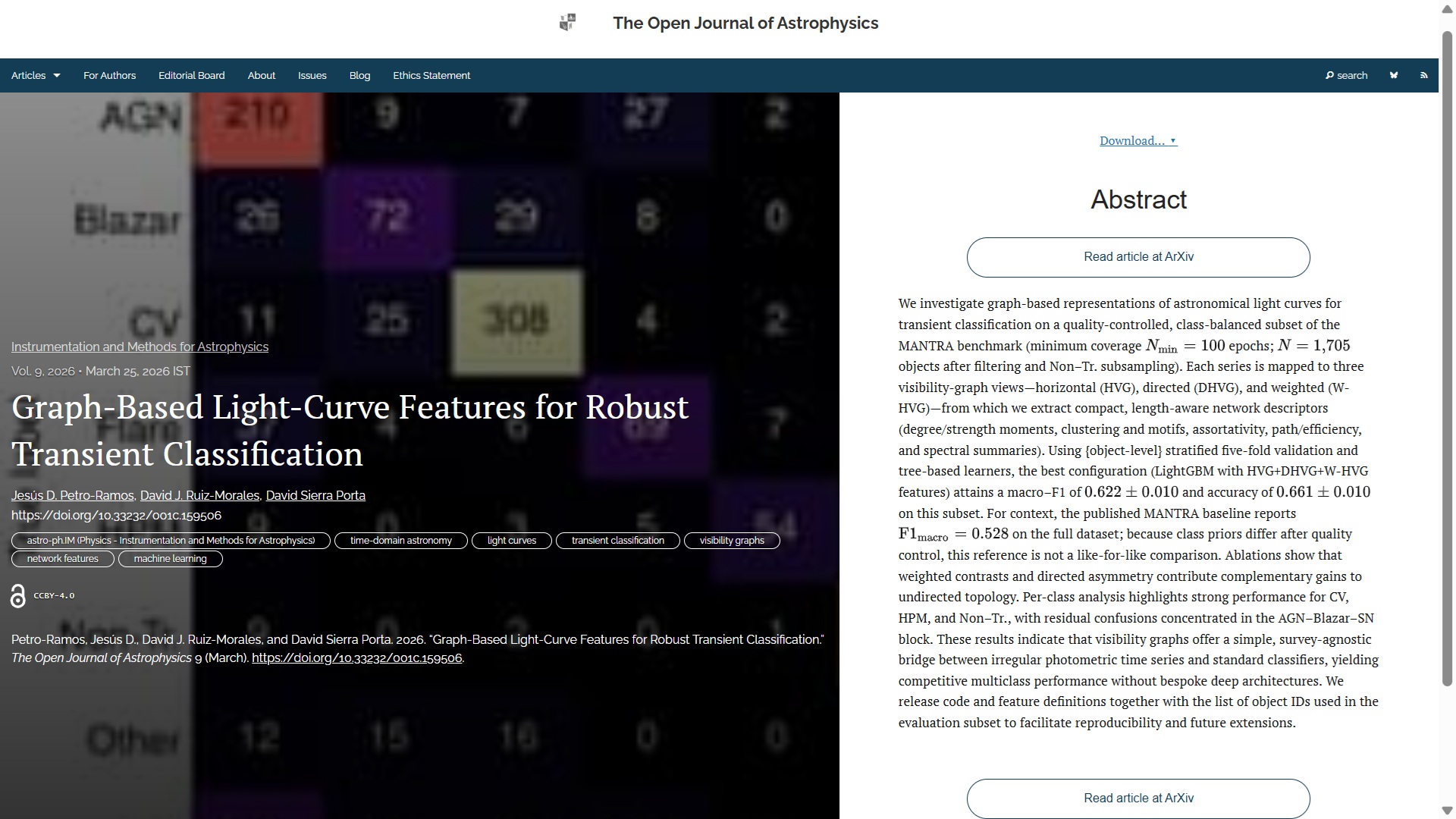
The fifth paper this week, also published on Wednesday 25th March 2026, is “Graph-Based Light-Curve Features for Robust Transient Classification” by Jesús D. Petro-Ramos David J. Ruiz-Morales, David Sierra Porta (Universidad Tecnológica de Bolívar, Colombia). This paper, which is in the folder Instrumentation and Methods for Astrophysics, uses graph-based representations of astronomical light curves for transient classification, achieving competitive multiclass performance, highlighting the potential of visibility graphs as a survey-agnostic tool for classifying time series.
This is the overlay:
The officially accepted version can be found on arXiv here and the Mastodon announcement follows:
New Publication at the Open Journal of Astrophysics: "Graph-Based Light-Curve Features for Robust Transient Classification" by Jesús D. Petro-Ramos David J. Ruiz-Morales, David Sierra Porta (Universidad Tecnológica de Bolívar, Colombia)
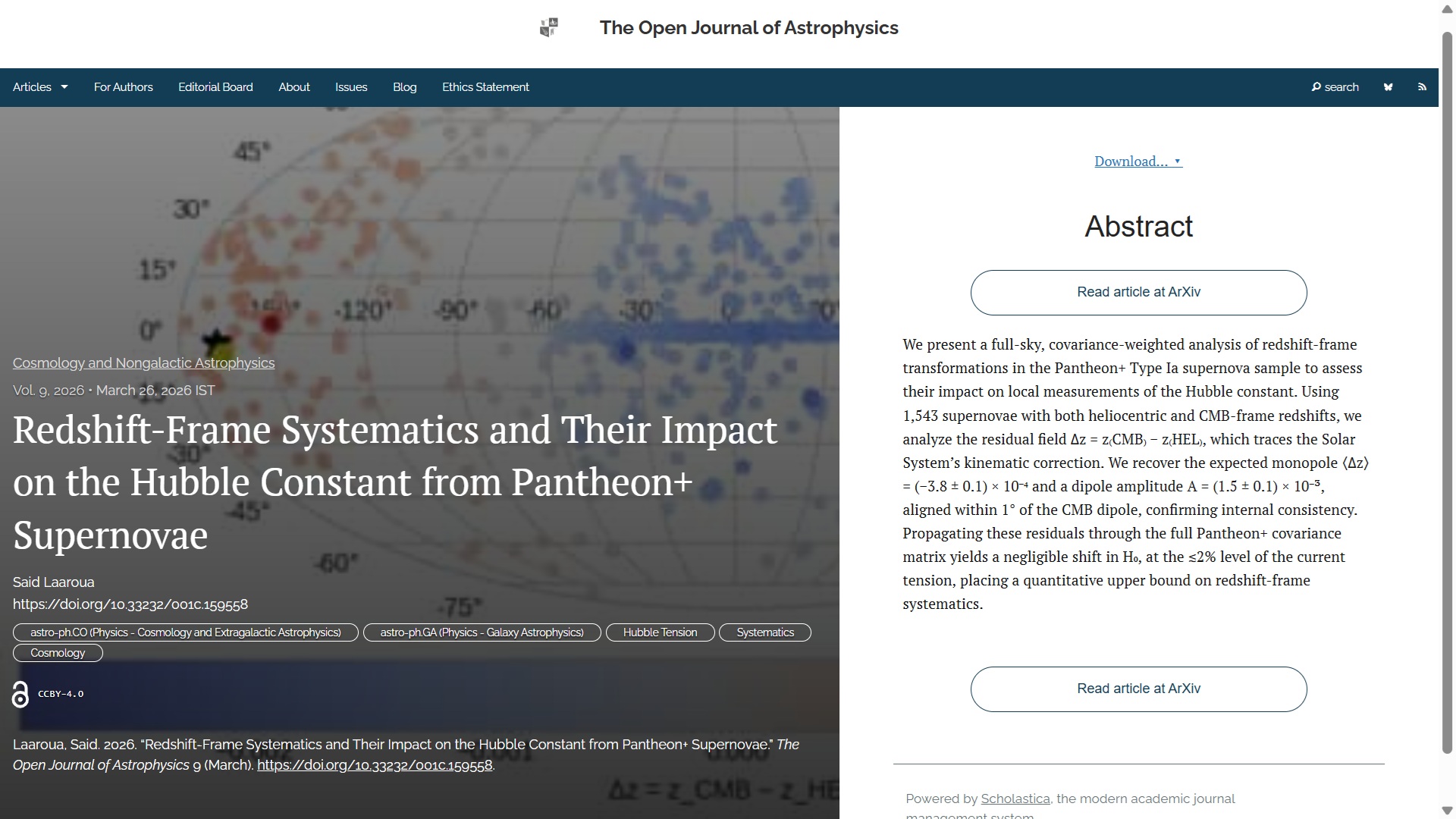
New Publication at the Open Journal of Astrophysics: "Redshift-Frame Systematics and Their Impact on the Hubble Constant from Pantheon+ Supernovae" by Said Laaroua (Santa Rosa Junior College, USA)
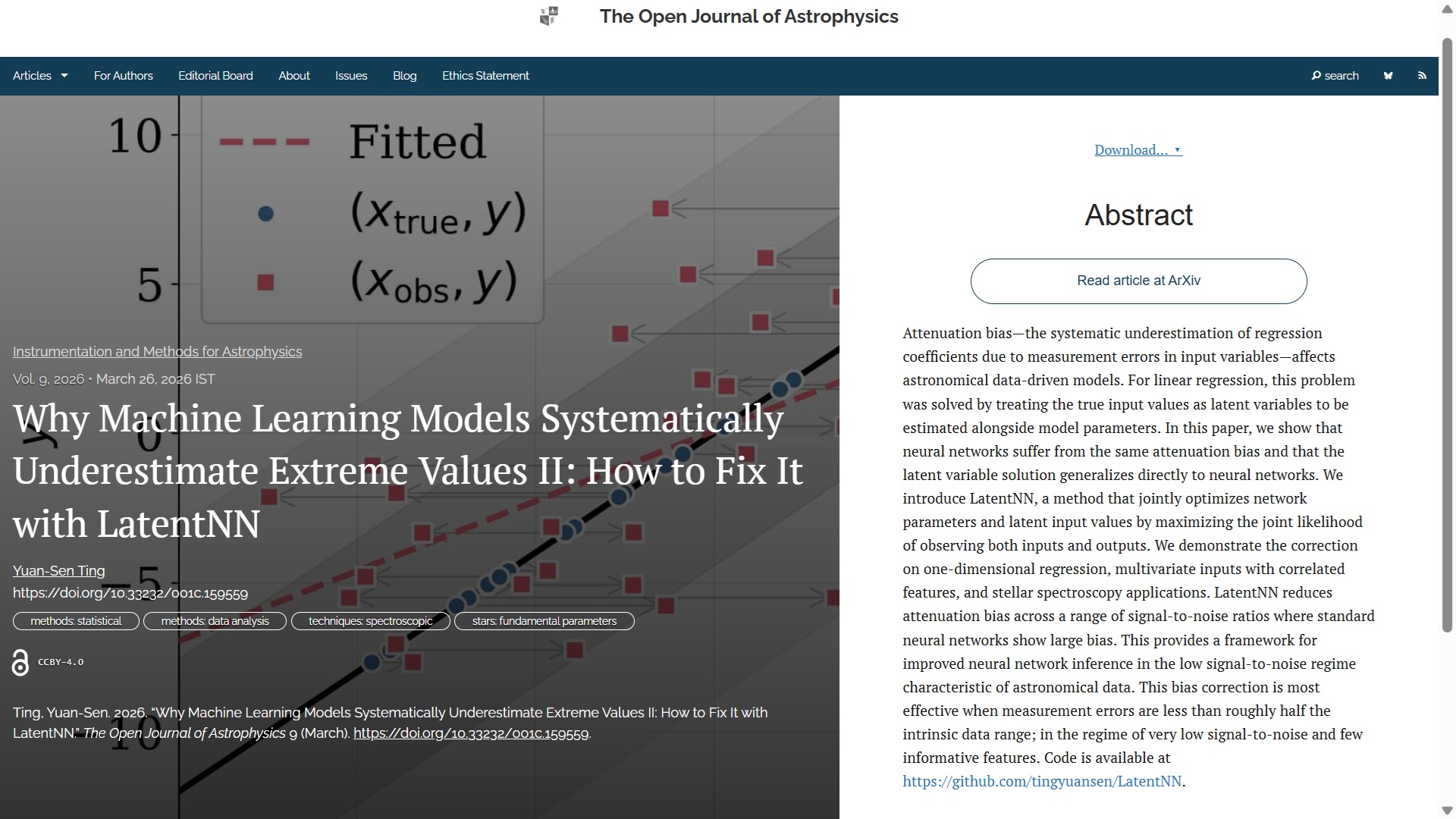
New Publication at the Open Journal of Astrophysics: "Why Machine Learning Models Systematically Underestimate Extreme Values II: How to Fix It with LatentNN" by Yuan-Sen Ting (Ohio State University, USA)
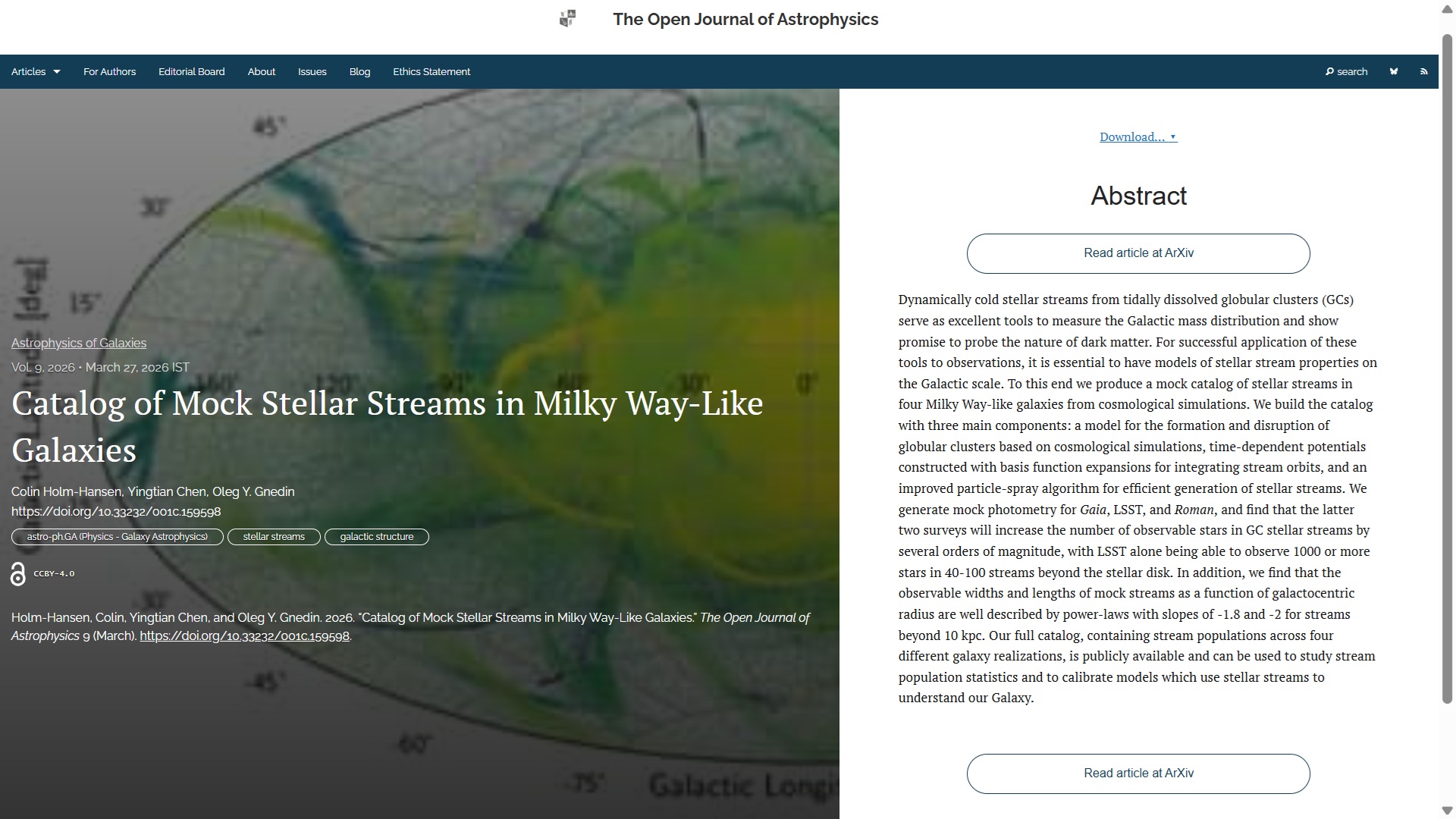
New Publication at the Open Journal of Astrophysics: "Catalog of Mock Stellar Streams in Milky Way-Like Galaxies" by Colin Holm-Hansen, Yingtian Chen and Oleg Y. Gnedin (University of Michigan, USA)
You will have pbserved that this week’s papers cover five of the six main categories on astro-ph. We haven’t yet managed to cover all six in a week – we only missed Solar and Stellar Astrophysics this time!
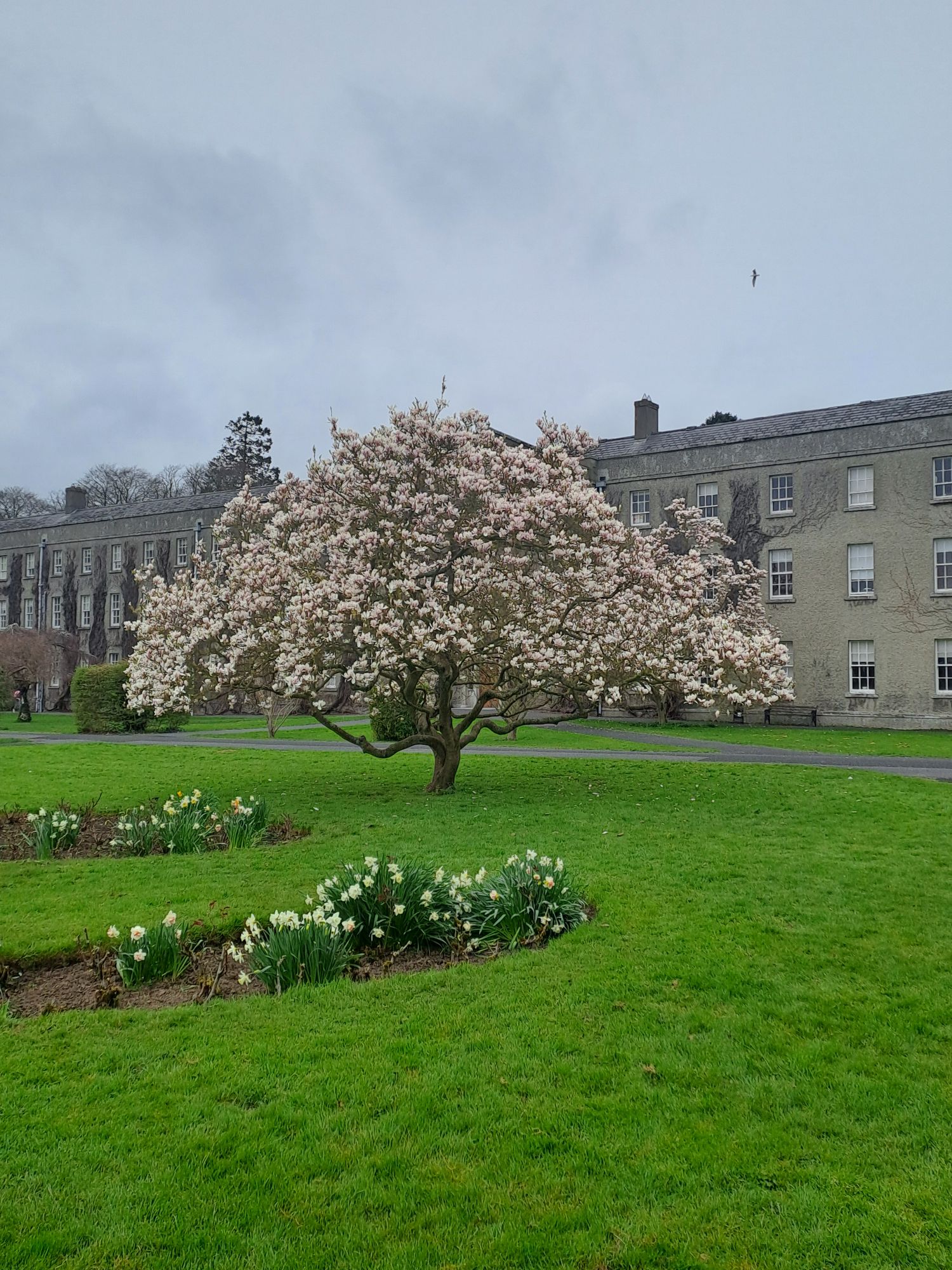
Magnolia and Daffodils in St Joseph’s Square Maynooth
The stormy March is come at last,
With wind and cloud, and changing skies,
I hear the rushing of the blast,
That through the snowy valley flies.

Ah, passing few are they who speak,
Wild stormy month! in praise of thee;
Yet, though thy winds are loud and bleak,
Thou art a welcome month to me.

For thou, to northern lands, again
The glad and glorious sun dost bring,
And thou hast joined the gentle train
And wear’st the gentle name of Spring.

And, in thy reign of blast and storm,
Smiles many a long, bright, sunny day,
When the changed winds are soft and warm,
And heaven puts on the blue of May.

Then sing aloud the gushing rills
And the full springs, from frost set free,
That, brightly leaping down the hills,
Are just set out to meet the sea.

The year’s departing beauty hides
Of wintry storms the sullen threat;
But in thy sternest frown abides
A look of kindly promise yet.

Thou bring’st the hope of those calm skies,
And that soft time of sunny showers,
When the wide bloom, on earth that lies,
Seems of a brighter world than ours.
Some time ago I posted an item about Doggerland which is not (as you might have imagined) a theme park devoted to outdoor sexual activities, but an area now submerged beneath the North Sea that connected Great Britain to continental Europe during and after the last glacial period.
About 12,000 years ago at the start of the Holocene Era, it is thought that the area now covered by the North Sea looked something like this:
(Picture credit: this website). Obviously the cities marked on the map were not there at the time! Britain was connected to the European mainland, although much of the land mass was under glaciers. At the end of the last ice age the glaciers retreated, sea levels rose and the area once covered by Doggerland was submerged. It is thought that this happened around 8500 years ago. Great Britain has been separated from the continent by less than 10,000 years.
Doggerland gets its name from the Dogger Bank, a huge sandbank off the North-Eastern coast of England which is thought to be a glacial moraine left behind by the retreating ice sheet. The Dogger bank lies about 60 miles from the coast, and is about 60 miles wide by 100 miles long. The water is quite shallow – typically 20 metres deep – and is a well-known fishing area. Its name derives from old Dutch fishing vessels called doggers who specialised in catching cod. Modern fishing boats trawlers operating at the Dogger Bank frequently bring up bits of ancient animals (including mammoth and rhinoceros) as well as prehistoric human artefacts, showing that the area was at one time inhabited.
I don’t think anybody knows exactly how long it took Doggerland to become submerged, but it may well have involved one or more catastrophic flooding events.
Well, by way of a sort of update here is a short video that suggests that the archaeological and geological clues indicate that the end of Doggerland was associated with one particularly huge event.
The views presented here are personal and not necessarily those of my employer (or anyone else for that matter).
Feel free to comment on any of the posts on this blog but comments may be moderated; anonymous comments and any considered by me to be vexatious and/or abusive and/or defamatory will not be accepted. I do not necessarily endorse, support, sanction, encourage, verify or agree with the opinions or statements of any information or other content in the comments on this site and do not in any way guarantee their accuracy or reliability.




 In the Dark