So here we are again, on a Saturday morning, with another update of activity at the Open Journal of Astrophysics. Since the last update we have published a further five papers, bringing the number in Volume 9 (2026) to 87 and the total so far published by OJAp up to 535.
I will continue to include the posts made on our Mastodon account (on Fediscience) to encourage you to visit it. Mastodon is a really excellent service, and a more than adequate replacement for X/Twitter (which nobody should be using); these announcements also show the DOI for each paper.
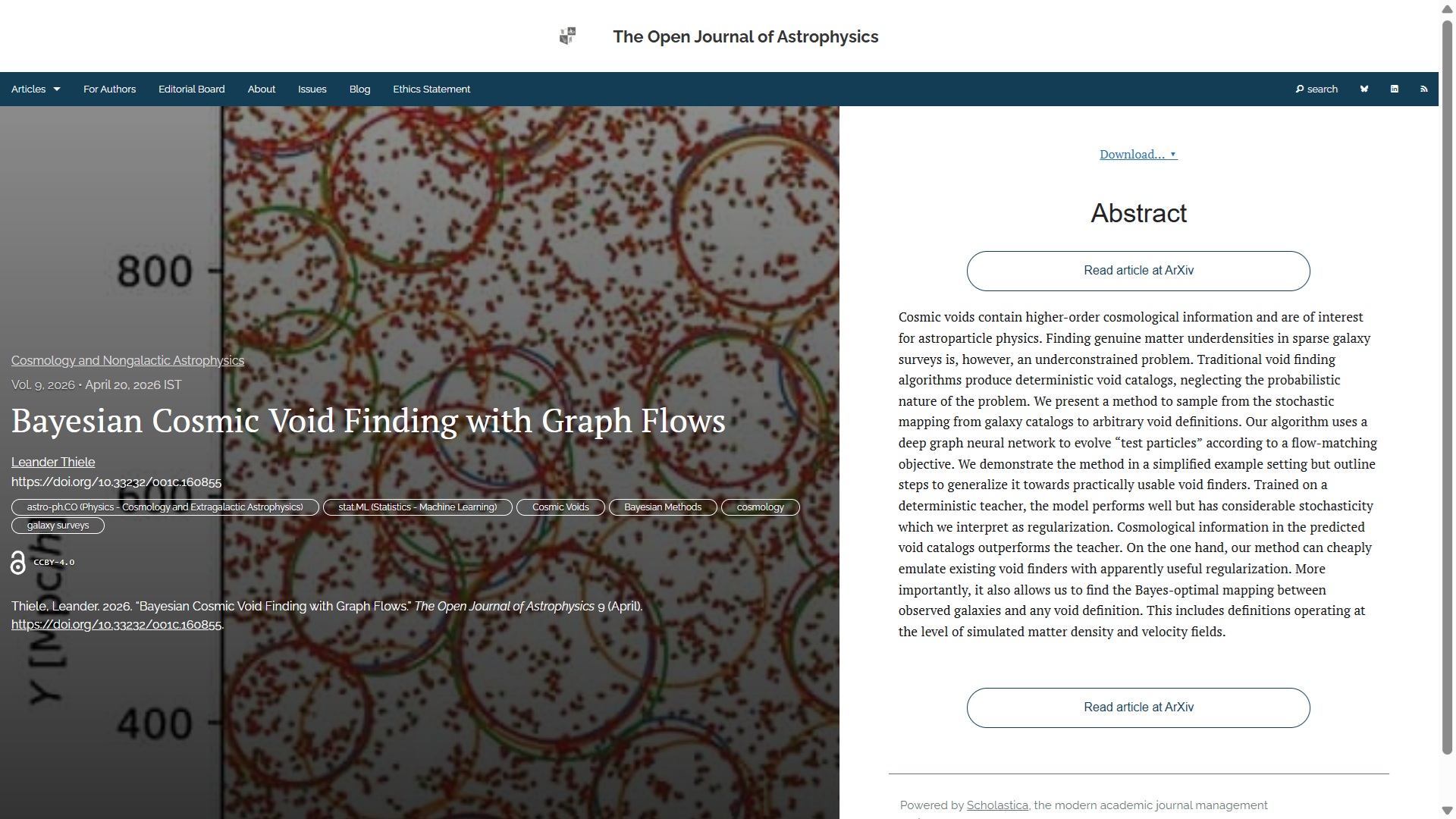
The first paper to report this week is “Bayesian Cosmic Void Finding with Graph Flows” by Leander Thiele (U. Tokyo, Japan). This was published on Monday 20th April in the folder Cosmology and Nongalactic Astrophysics. The paper presents a method using a deep graph neural network to identify cosmic voids in sparse galaxy surveys, improving upon traditional deterministic algorithms by considering the problem’s probabilistic nature. The overlay is here:
You can find the officially accepted version on arXiv here and the announcement on Fediverse here:

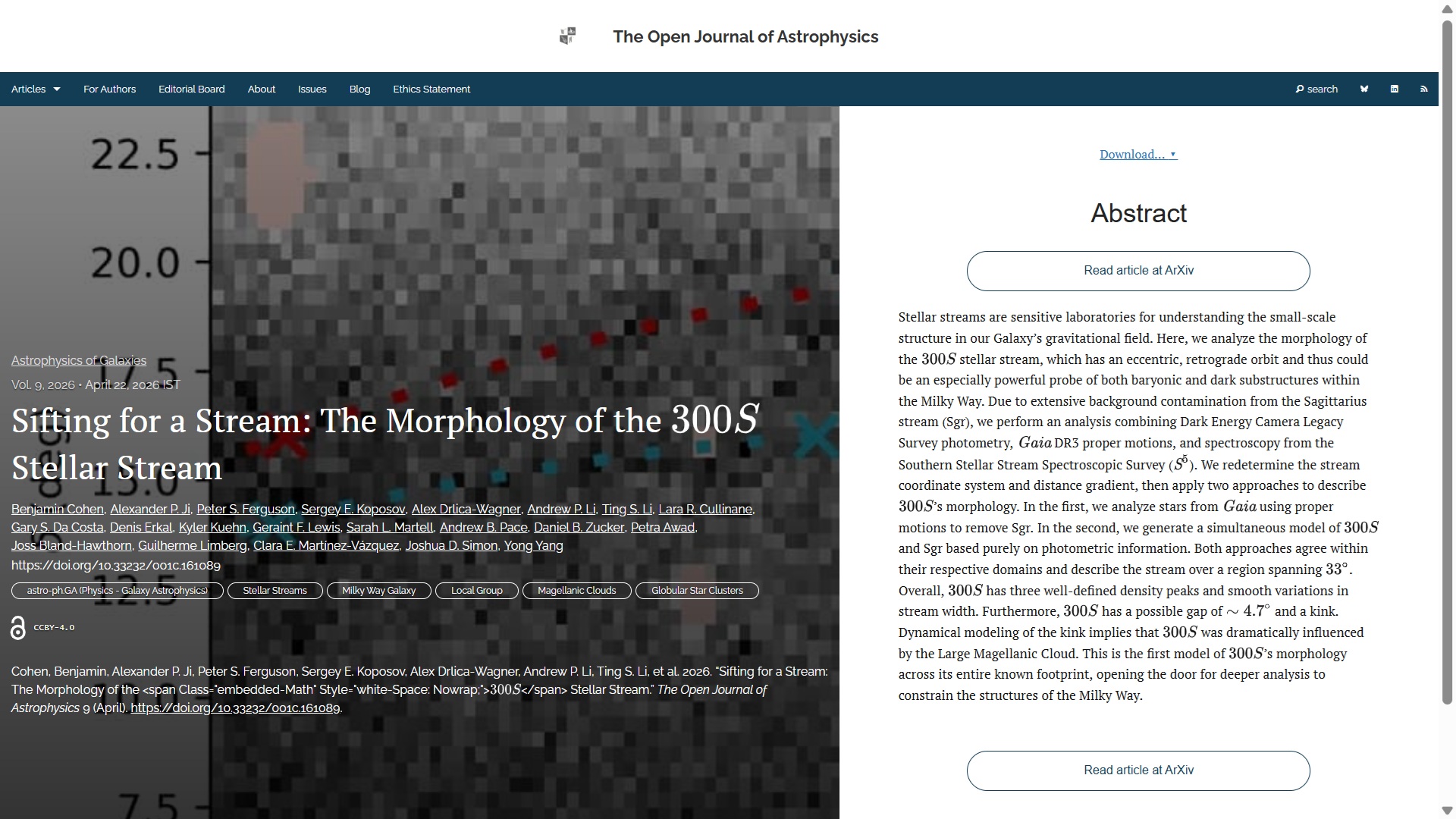
The second paper for this week, published on Wednesday 22nd April in the folder Astrophysics of Galaxies, is “Sifting for a Stream: The Morphology of the 300S Stellar Stream” by Benjamin Cohen (U. Chicago, USA) and 20 others distributed around the world. This study analyzes the morphology of the $300S$ stellar stream, revealing three density peaks, a possible gap, and a kink, suggesting significant influence from the Large Magellanic Cloud on its structure.
The overlay for this one is here:
The official version of the paper can be found on arXiv here and the Fediverse announcement here:
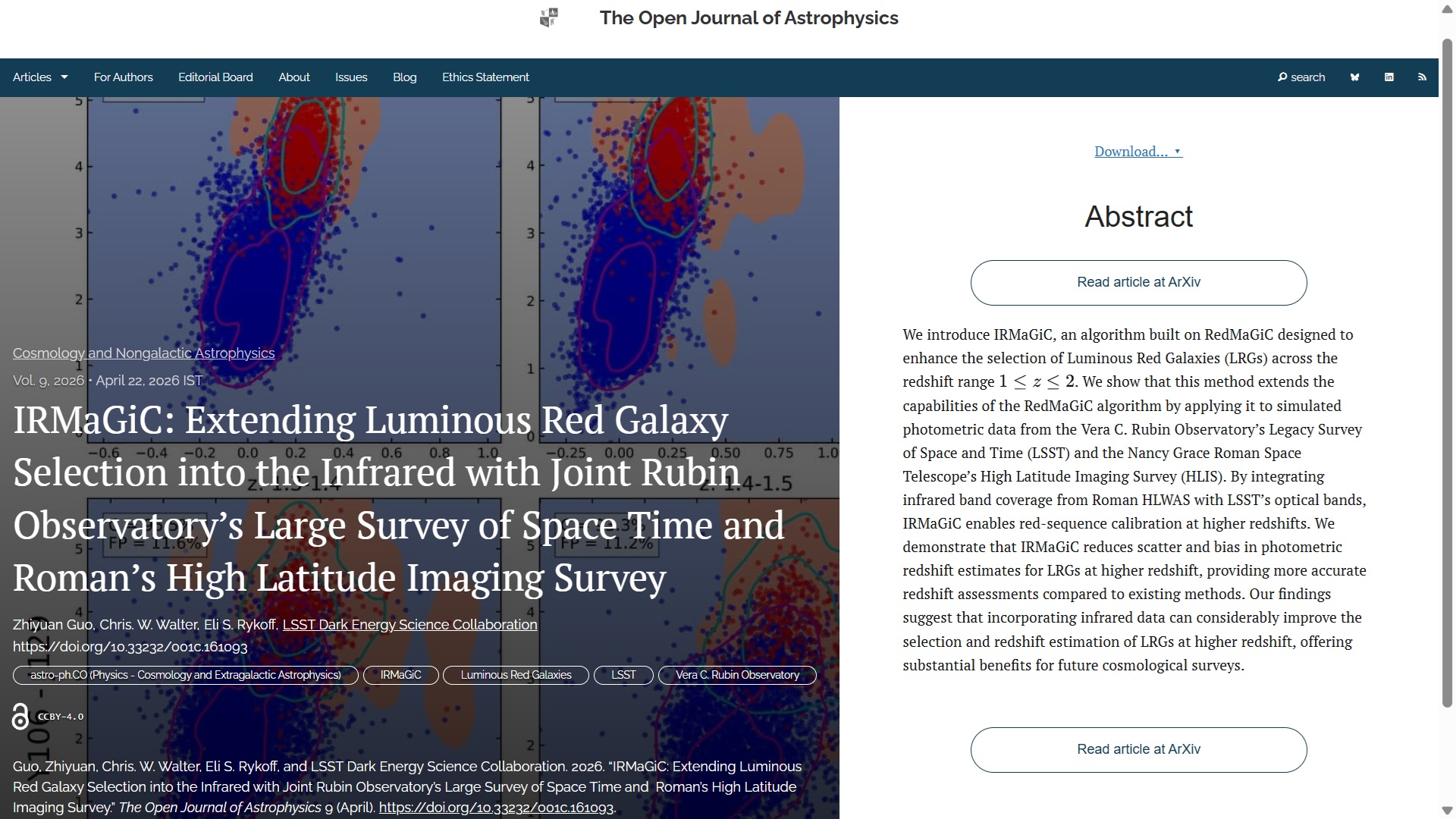
Next one up, the third paper of the week, is “IRMaGiC: Extending Luminous Red Galaxy Selection into the Infrared with Joint Rubin Observatory’s Large Survey of Space Time and Roman’s High Latitude Imaging Survey” by Zhiyuan Guo & Chris. W. Walter (Duke U., USA) and Eli S. Rykoff (Stanford U., USA) on behalf of the LSST Dark Energy Science Collaboration. This was published on Wednesday April 22nd in the folder Cosmology and Nongalactic Astrophysics. The paper introduces IRMaGiC, an algorithm that improves the selection and redshift estimation of Luminous Red Galaxies (LRGs) by incorporating infrared data, enhancing future cosmological surveys.
The overlay for this one is here:
The final, accepted version can be found on arXiv here and the Mastodon announcement is here:
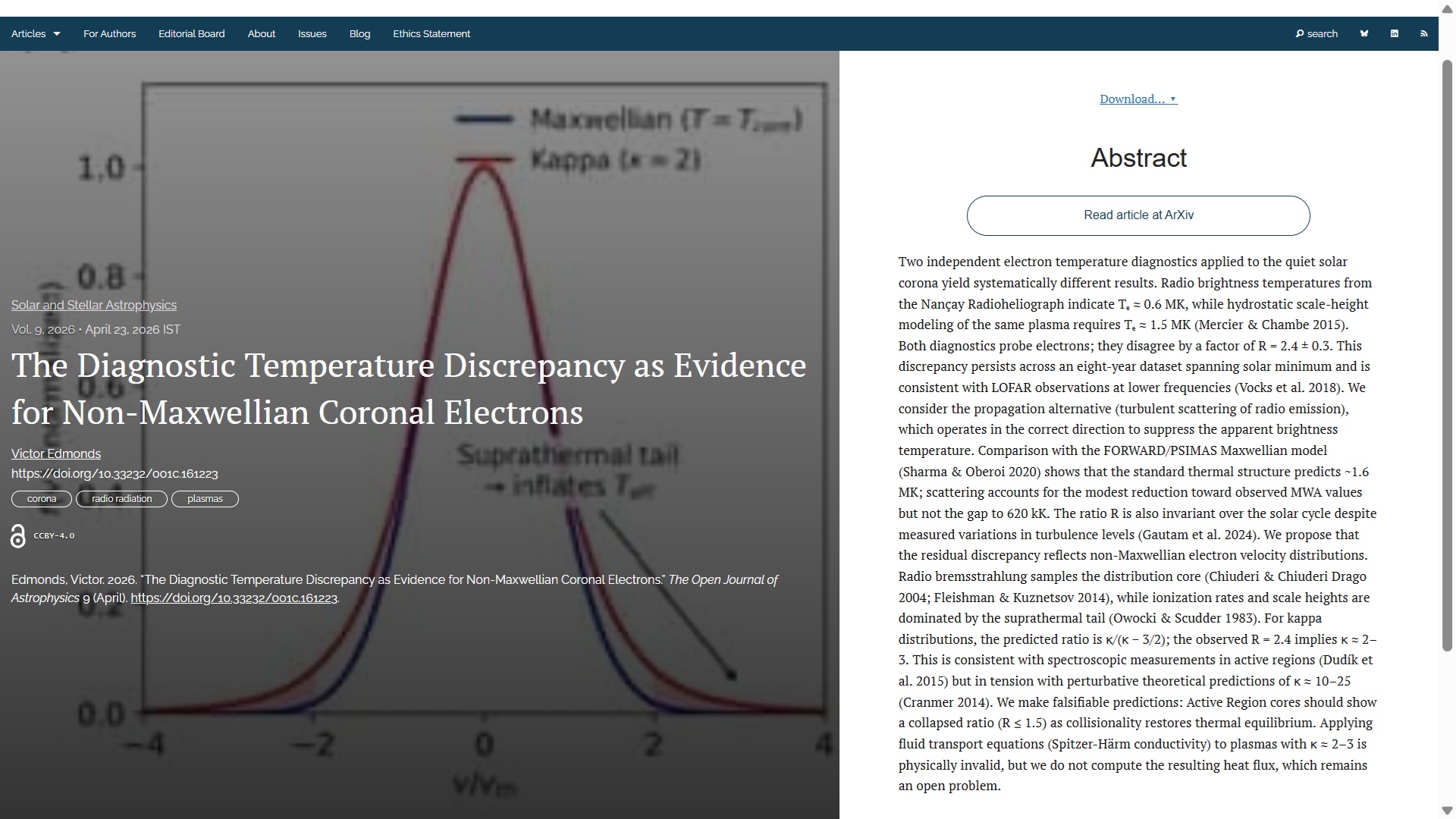
The fourth paper this week, published on Thursday April 23rd, is “The Diagnostic Temperature Discrepancy as Evidence for Non-Maxwellian Coronal Electrons” by Victor Edmonds (Final Stop Consulting, USA). This paper, in the folder Solar and Stellar Astrophysics, presents two methods of measuring electron temperature in the quiet solar corona yielding different results, suggesting non-Maxwellian electron velocity distributions may be responsible for the discrepancy.
The overlay is here:
The finally accepted version of this paper can be found here and the Mastodon announcement follows:
The fifth and final paper for this week was published on Friday 24th April in the folder Astrophysics of Galaxies. The title is “Galaxy evolution in the post-merger regime. IV – The long-term effect of mergers on galactic stellar mass growth and distribution” by Sara L. Ellison (U. Victoria, Canada) and Leonardo Ferreira (Universidade Federal do Rio Grande, Brazil). This study uses a large sample of post-merger galaxies to demonstrate that galaxy mergers trigger significant and extended stellar mass growth in their central regions, independent of stellar population modelling.
The overlay is here:
You can find the authorized version of this paper on arXiv here and the Fediverse announcement is here:
The overlay for this one is here:
You can find the officially-accepted version on arXiv here and the Mastodon announcement here:
And that concludes this week’s update. I’ll do another one at the end of next week.
P.S. Thanks to the efforts of a member of our Editorial Board, the Open Journal of Astrophysics now has a Wikipedia page.


