Archive for the Art Category

Two cultures, or none?

Posted in Art, Biographical, Education with tags , , on February 14, 2013 by telescoper

Just a quick rehash of an old post by way of a follow-up to Sunday’s blog about Emotion and Creativity which touched on the negative stereotypes sometimes used to characterize scientists.

Anti-science attitudes are far from unusual among the Arts & Humanities fraternity, even in the supposedly enlightened environment of a University, which I think is a real shame. After all, you’ll have to work very hard to find a scientist who would be prepared to stand up in front of audience and proudly announce “I hate art”. Many of my scientific colleagues have deep passions for the performing arts (especially music and drama) as well as being very well read across a wide range of subjects.  Many also hold strong  (and often idiosyncratic) political opinions and are involved in a huge range of activities outside science.

In short, scientists don’t just sit in their labs and offices making dangerous chemicals or torturing small animals. We live in the real world and have as much contact with wider society as anyone else. Imagination, creativity and free thinking can be found in scientists, just as they can in the arts.  Scientists both contribute to and participate in our society’s cultural heritage. Scientists are human beings. Culture belongs to us too.

Some time ago there was an article in the Times Higher with the title “Life depends on science but the arts make it worth living“. I agree with a lot of what is written in the piece, in fact, although it does seem also to contain numerous examples of non sequitur and I think it’s both poorly argued and highly exaggerated. The arts are undoubtedly among the things that make  life worth living, but there are others, such as “ordinary” human relationships and the “simple” enjoyment of the natural world, which academics of all persuasions all too frequently neglect.

One of the most prominent examples of non sequitur in the Times Higher article is that we have music, literature, poetry and the rest but how much of this is actually done in universities? The article compares Einstein with Beethoven. Albert went to University in Zurich. Beethoven didn’t go to a university. There’s a big difference between making art and writing about it. One of the big cultural differences between art and science is that we don’t have science critics, although we do have people who popularize it and also people who try to explain it to the general public. Much of the impenetrable cultural analysis that emerges from academia concerning the arts seems to have the opposite aim. Does any university have a Professor of the Public Understanding of Art?

You probably think I’m going to go off on a rant about the famous Two Cultures thesis advanced  by C.P. Snow, but I’m not. I think Snow’s analysis is only marginally relevant. I do think that there are “two cultures”, but these are not “science” and “the arts”. One is a creative, thinking culture that encompasses arts, the humanities and science. The other is its antithesis, a “culture” that sees the sole function of education as being to train people  to take their place on the never-ending treadmill of production and consumption.

The way we are heading, it’s not “two cultures” that we should be worried about. It’s no culture at all.

My Little Sun

Posted in Art, Biographical with tags , , on January 9, 2013 by telescoper

I’m so excited to have won something other than a dictionary for a change!

I’ve just received delivery of the Little Sun that I was promised after entering a little competition on Twitter. It’s a solar-powered light that charges during daylight hours to provide a bright safe source of illumination at night. “Little Sun transforms the light that is for all of us into light that is for each of us…”

IMG-20130109-00034

This gives me an excuse to mention that later this month my contribution to the Charter of Light will go live on the website. Please follow the campaign, which aims to improve light and energy access in the developing world.

Das Letzte Gericht

Posted in Art, Astrohype, The Universe and Stuff with tags , , , on December 20, 2012 by telescoper

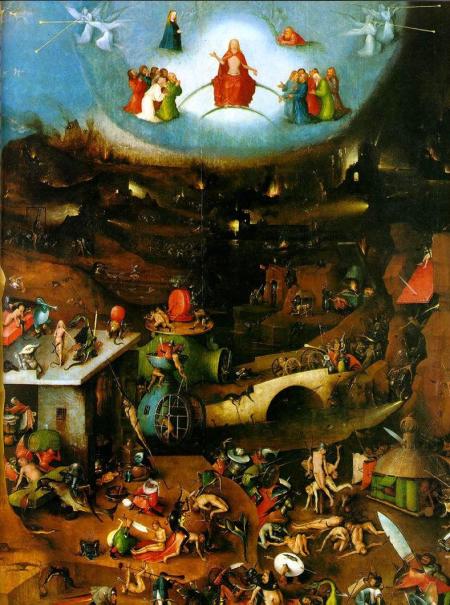
Apparently the world is due to end tomorrow, so I’ve saved quite a lot of money by not having done my Christmas shopping yet. Anyway, the forthcoming Apocalypse reminded me of the painting that I often use to introduce cosmology talks. I usually use this piece of Hieronymus Bosch Das letzte Gericht (The Last Judgement) to illustrate my feelings about the standard cosmological model:

das_letzte_gericht

The top part represents the concordance cosmology. It clearly features an eminent cosmologist surrounded by postdoctoral researchers. Everything appears to be in heavenly harmony, surrounded by a radiant glow of self-satisfaction. The trumpets represent various forms of exaggerated press coverage.

But if you step back from it, and get the whole thing in a proper perspective, you realise that there’s an awful lot going on underneath that’s not so pleasant or easy to interptet. I don’t know what’s going down below there, although the unfortunate figures slaving away in miserable conditions and suffering unimaginable torments, are obviously supposed to represent graduate students. The large knife visible in the bottom right corner clearly symbolises budget cuts looming in the next Comprehensive Spending Review.

The main point is that the concordance model is based on rather strange foundations: nobody understands what the dark matter and dark energy are, for example. Even more fundamentally, the whole thing is based on a shotgun marriage between general relativity and quantum field theory which is doomed to fail somewhere along the line.

Far from being a final theory of the Universe I think we should treat our standard model as a working hypothesis and actively look for departures from it. I’m not at all against the model. As models go, it’s very successful. It’s a good one, but it’s still just a model.

LHC Lights up NBI

Posted in Art, Biographical, The Universe and Stuff with tags , , , on November 16, 2012 by telescoper

Well, first things first. Congratulations to Dr Sabir Ramazanov on his successful thesis defence today! I’ll perhaps write a bit more about the process in due course.

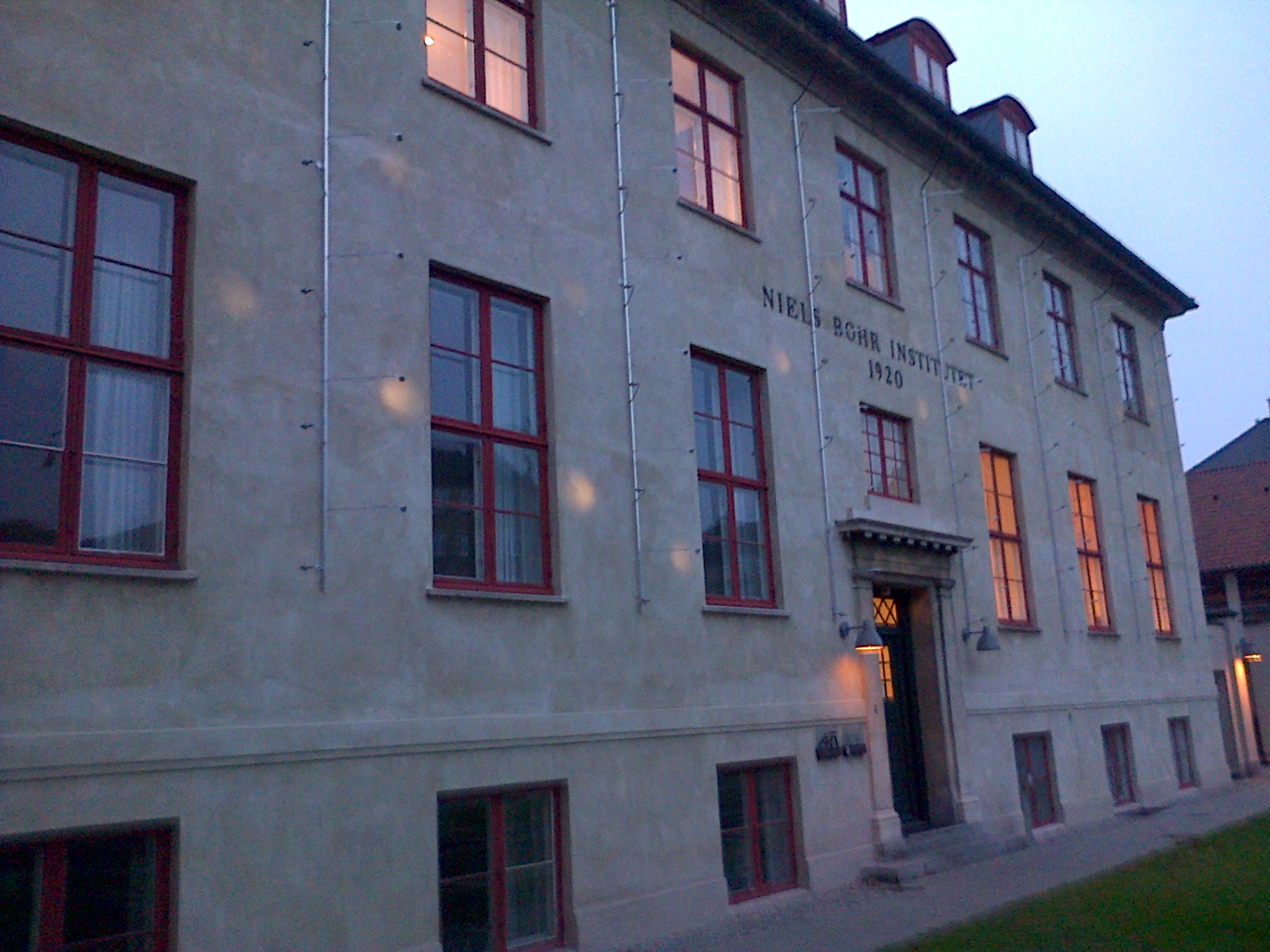
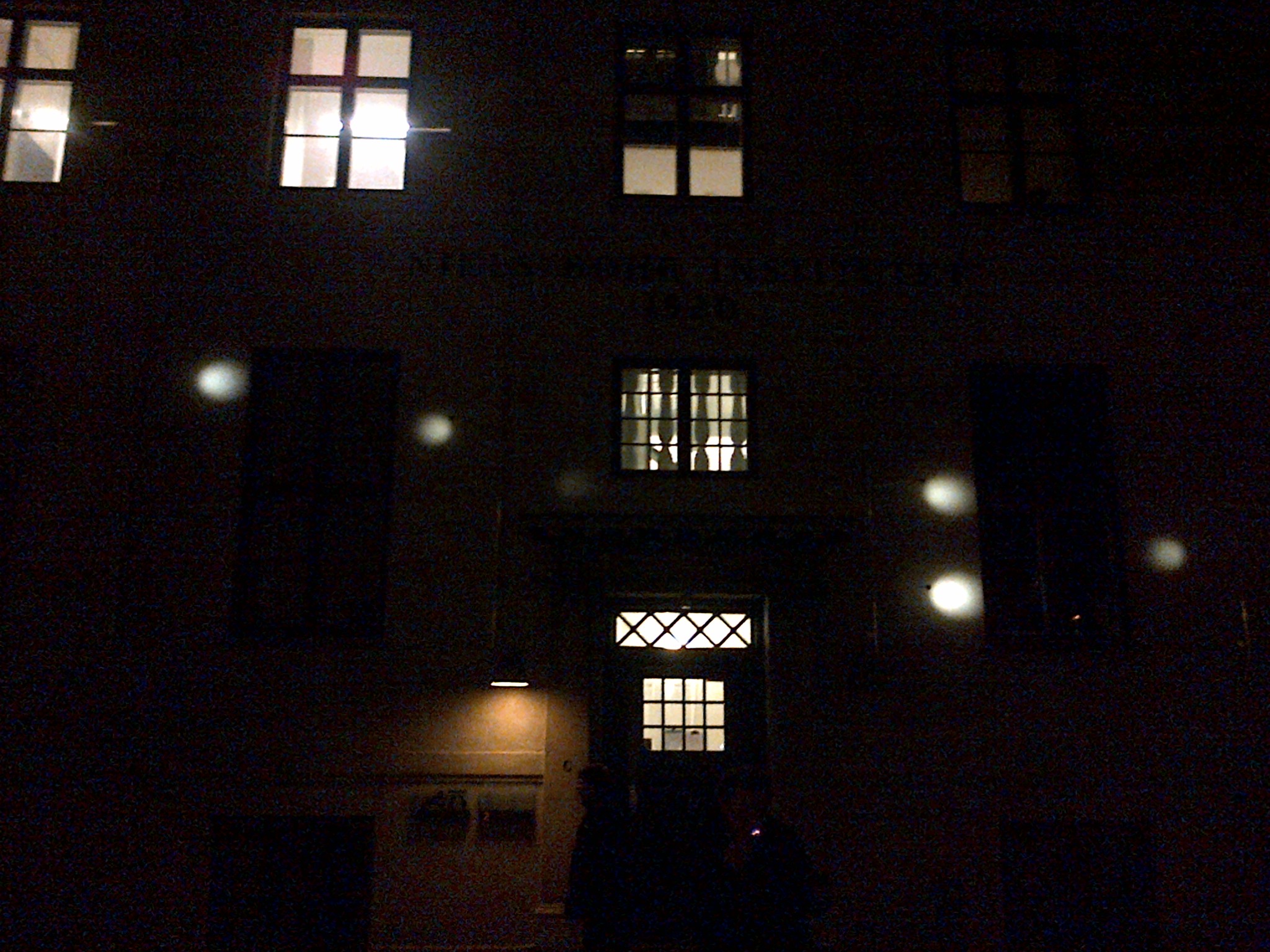
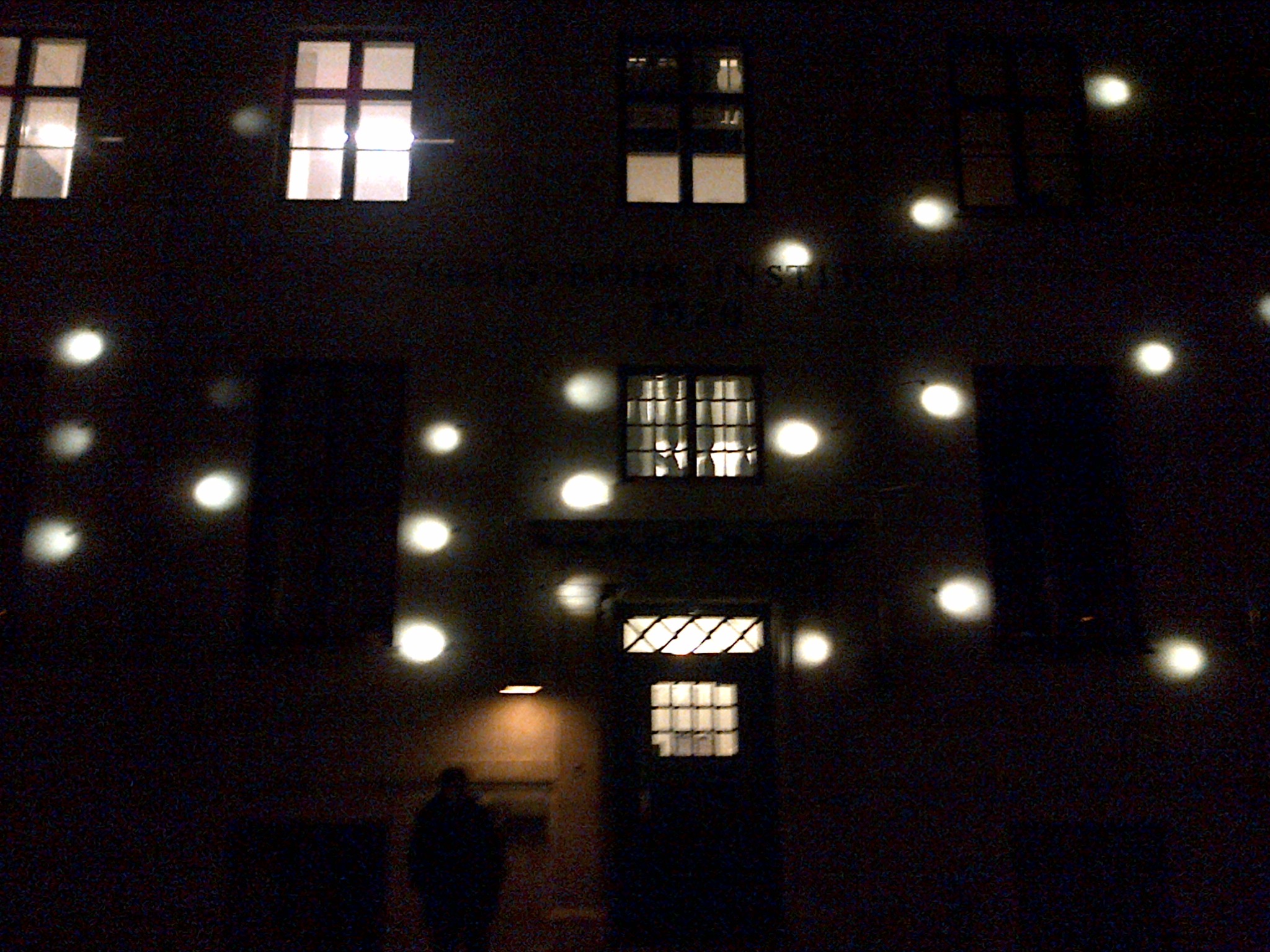
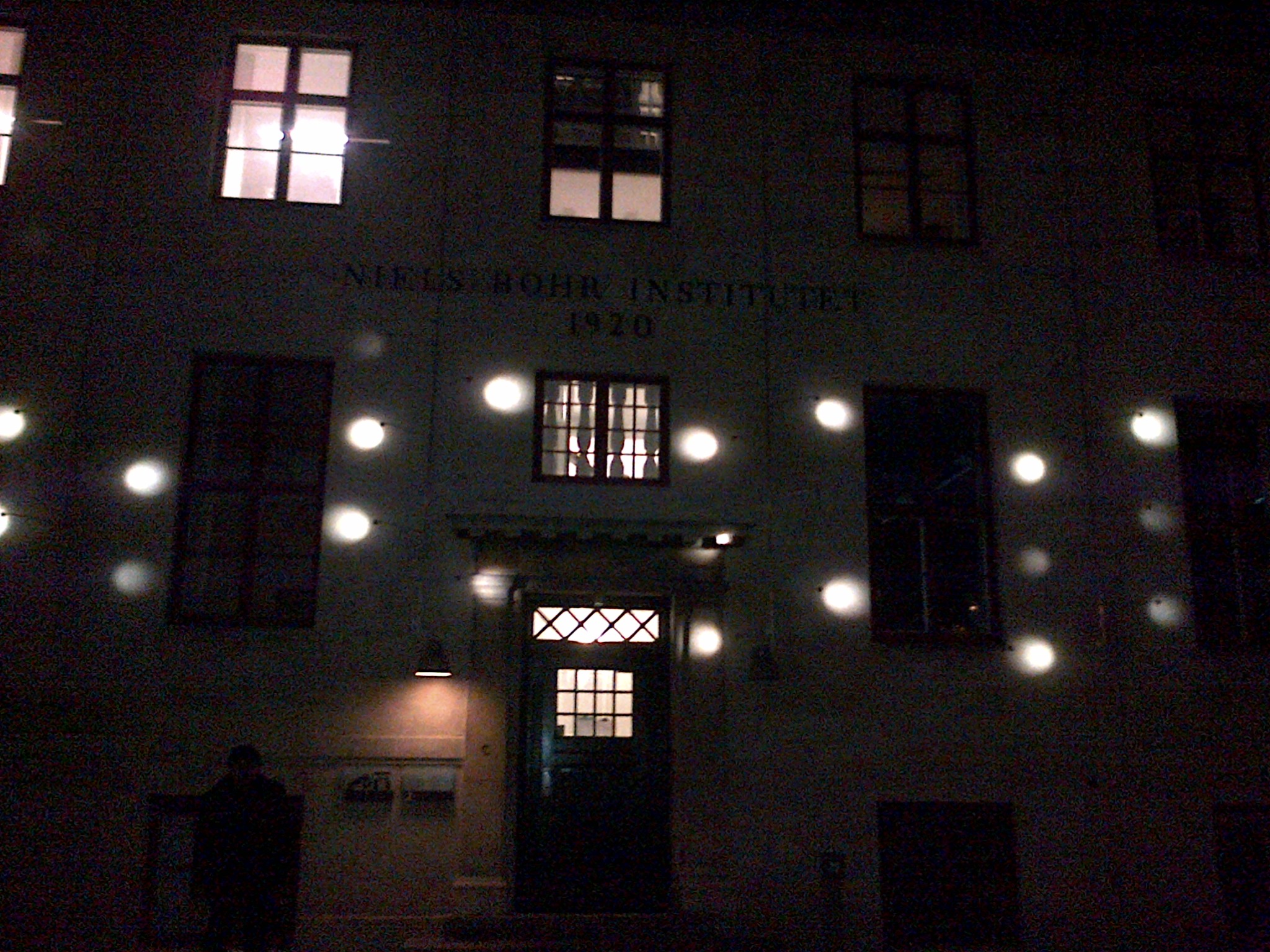
After the formalities were concluded, however, the committee took a breath of fresh air outside the Niels Bohr Institute where, in the fading November twilight, we were treated to a peculiar light show; a set of small spotlights on the front wall of the NBI building is hooked up directly to the ATLAS experiment on the Large Hadron Collider at CERN so that every time an event registers in Geneva it is displayed almost immediately in public here in Copenhagen. Quite appropriate for a place so steeped in physics history. The resolution of the particle tracks is of course not marvellous, but it’s actually quite a remarkable thing to see, although not all that easy to catch it on camera, especially if you’ve had a couple of glasses of wine!

Olafur Eliasson: Space, Art and Little Sun

Posted in Art with tags , , , on July 13, 2012 by telescoper

I recently found a report about a new project by Olafur Eliasson at Tate Modern called Little Sun which seems very intriguing to me. Basically the Little Suns in question are solar-powered LED lamps, with a running time of about 5 hours. Similar, I suppose to the things some of us have in our gardens that charge up during the day and light up at night. Anyway,  the idea is that on Saturday evenings from 28 July to 23 September  the lights at Tate Modern will be switched off, and each visitor given a Little Sun so they can wander around and see the exhibits in the dark. I can imagine that this will a fascinating experience, changing as it will the usual relationship between the viewer and the viewed, and the space enclosing them both. During the day there will also be a gallery open on the building’s third floor, where visitors can learn about solar power, global energy problems, light and its importance to life, as well as create light graffiti, as demonstrated on the little video here:

I’m not sure I’ll the chance to see Little Sun but I hope this encourages at least a few of you to check it out.

I also found this talk by Olafur Eliasson at TEDX some time ago, called Playing with Space and Light. A while ago was invited one of the gatherings of artists and scientists he mentions at the beginning, and found it absolutely fascinating…

Munch at Tate Modern

Posted in Art, Biographical with tags , , , , , on July 8, 2012 by telescoper

On Friday I had the morning off from my stint at the Royal Society Summer Exhibition I mentioned a few days ago, so I took the short walk from my hotel to Tate Modern to see an exhibition of art by Edvard Munch called Edvard Munch: The Modern Eye.  Before seeing the collection, which is housed on the second floor of Tate Modern, I took a picture of the view from the balcony looking across the Thames from Bankside towards St Paul’s.

Not inappropriate weather for this exhibition!

Everyone knows Munch by his famous work The Screamwhich isn’t part of this exhibition. I don’t regret this omission it allows the visitor to focus on his lesser-known works, some of which I think are even more powerful than The Scream which, incidentally, I have seen when it was part of an exhibition of Munch’s work in Berlin in 1995. In fact I bought a poster of that exhibition, the design of which includes a copy of The Scream; it is hanging in my study as I write this.

The gallery’s booklet describes Munch’s paintings as

..profoundly introspective, unflinchingly depicting his experience of ageing, emotional turmoil, sickness and bodily decay.

Indeed. Some of the works are so powerful as to be almost unbearable to look at. I’ll just mention a few that struck me in particular.

One room is filled with a number of almost identical paintings entitled Weeping Woman, in which a naked female figure stands bowed and sobbing within a dreary claustrophobic room. The repetition of this theme across many canvases seems almost compulsive, and they’re painted with crude almost frantic strokes.

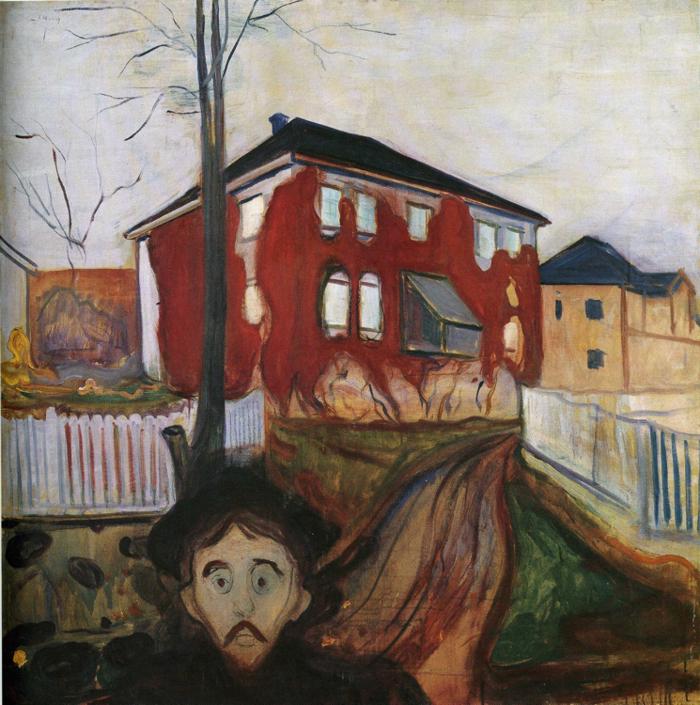
This is a painting called Red Virginia Creeper, a plant that grows on my house in fact, but which in this case has transformed into a dripping bloodstain behind the crudely drawn but obviously bewildered figure in the foreground.

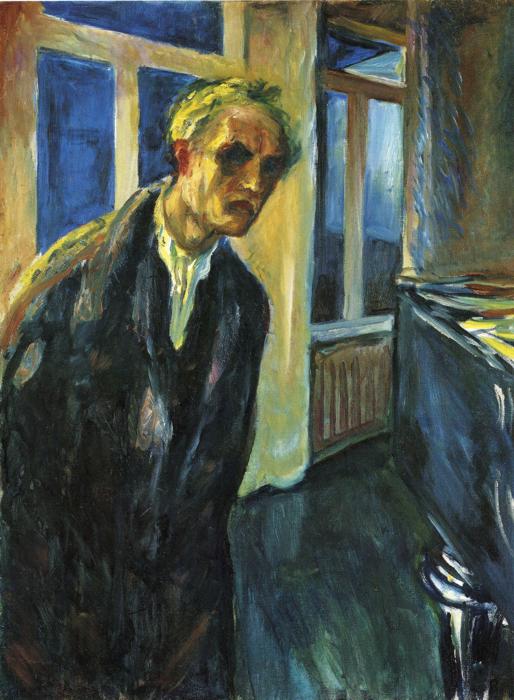
But the most powerful works by Munch were made later in his life. He was born in 1863 (100 years before me) and suffered a complete nervous breakdown in 1908. Here is a self-portrait called The Night Wanderer, showing himself as a gaunt insomniac figure wandering around a darkened house:

Then, right at the end of the exhibition, is his most moving work of all. Self Portrait between Clock and Bed, painted near the end of his life – he died in 1944 – shows a lonely old man standing between the clock, symbolising the remorseless passage of time, and the bed in which he no doubt expected to die.

This exhibition is not exactly a comfortable experience, filled as it is with images of alienation, despair and inner torment, but it was a “must-see” for me as Munch is such an important artist. Groups of schoolchildren were being led around the exhibition while I was there. Most of them giggled. I wonder how long it will be before they understand that the world really can be exactly as Munch painted it?

Anyway, I headed back across the river to the Royal Society to do the afternoon shift at the Herschel Telescope stand, which included playing with an infra-red camera to show the visitors young and old how it detects body heat, and taking pictures of them in the near infra-red as souvenirs. To show that the Munch collection hadn’t affected me too much, I took one of myself.

Experiment Marathon, Reykjavik 2008

Posted in Art, Books, Talks and Reviews, The Universe and Stuff with tags , , , on May 8, 2012 by telescoper

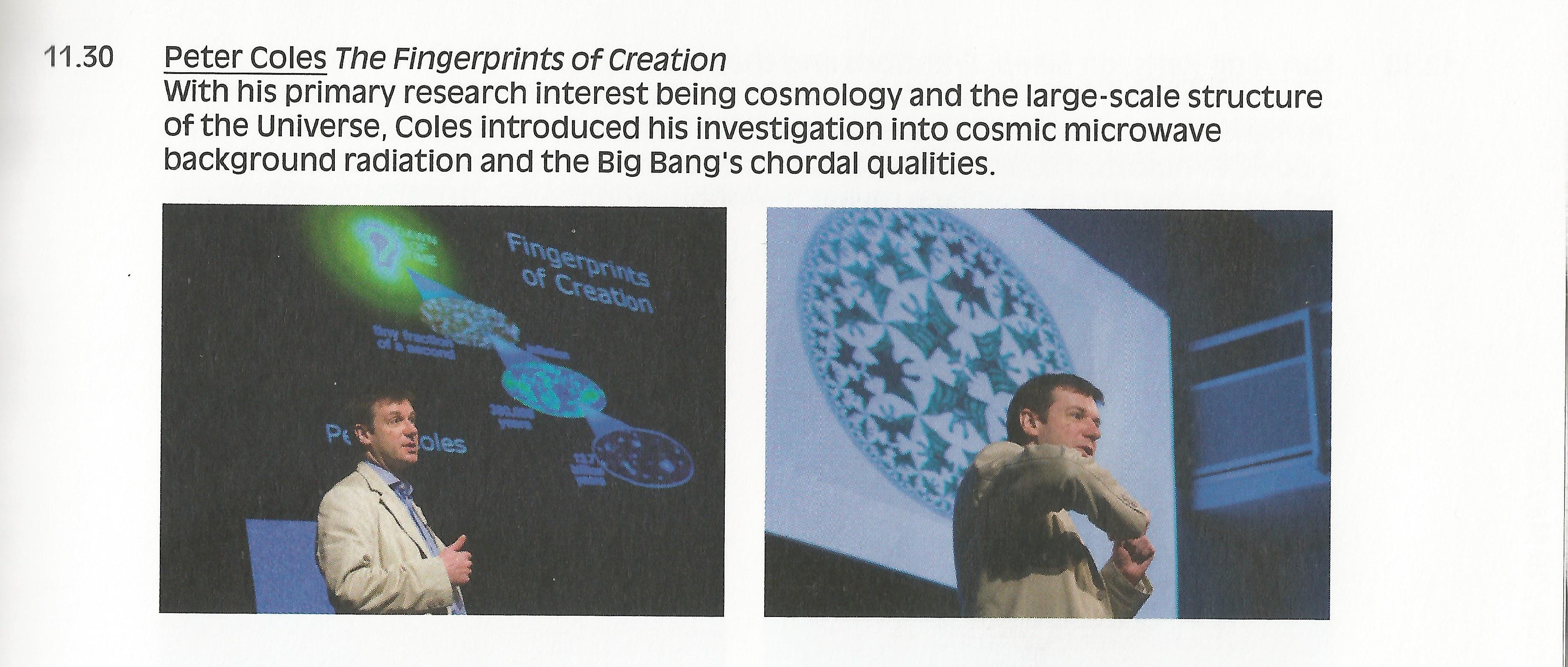
A while ago I blogged about an event I attended, called  Experimental Marathon, which was held in Reykjavik Art Museum in May 2008. I was reminded about this for various reasons recently and managed to dig up a couple of pictures of my presentation, which appeared in the glossy book of the event that was produced later on.

As you can probably infer, I gave a talk which was basically about the cosmic microwave background. My “experiment” was a television set that wasn’t tuned properly producing a screenful of static. I pointed out that some (actually not that much) of the buzz was coming from the beginning of the universe. Pretty unoriginal and gimmicky, I know, but it seemed to go down quite well with the audience and I had some nice questions and comments at the end of my 20 minutes.

During the three days of the event I also got to meet quite a few artists, scientists and other luminaries whose names are on the list here.:

You can find one of the numerous reviews of this event here, which also includes quite a few pictures of various experiments including one that some might consider to be NSFW …

Cosmology, Escher and the Field of Screams

Posted in Art, Education, The Universe and Stuff with tags , , , , , on March 20, 2012 by telescoper

Up early this morning for yet another busy day I thought I’d post a quick follow-up to my recent item about analogies for teaching physics (especially cosmology).

Another concept related to the cosmic microwave background that people sometimes have problems understanding is that of last scattering surface.

Various analogies are useful for this. For example, when you find yourself in thick fog you may have the impression that you are surrounded by an impenetrable wall at some specific distance around you. It’s not a physical barrier, of course, it’s just the distance at which there sufficient water droplets in the air to prevent light from penetrating further. In more technical terms the optical depth of the fog exceeds unity at the distance at which this wall is seen.

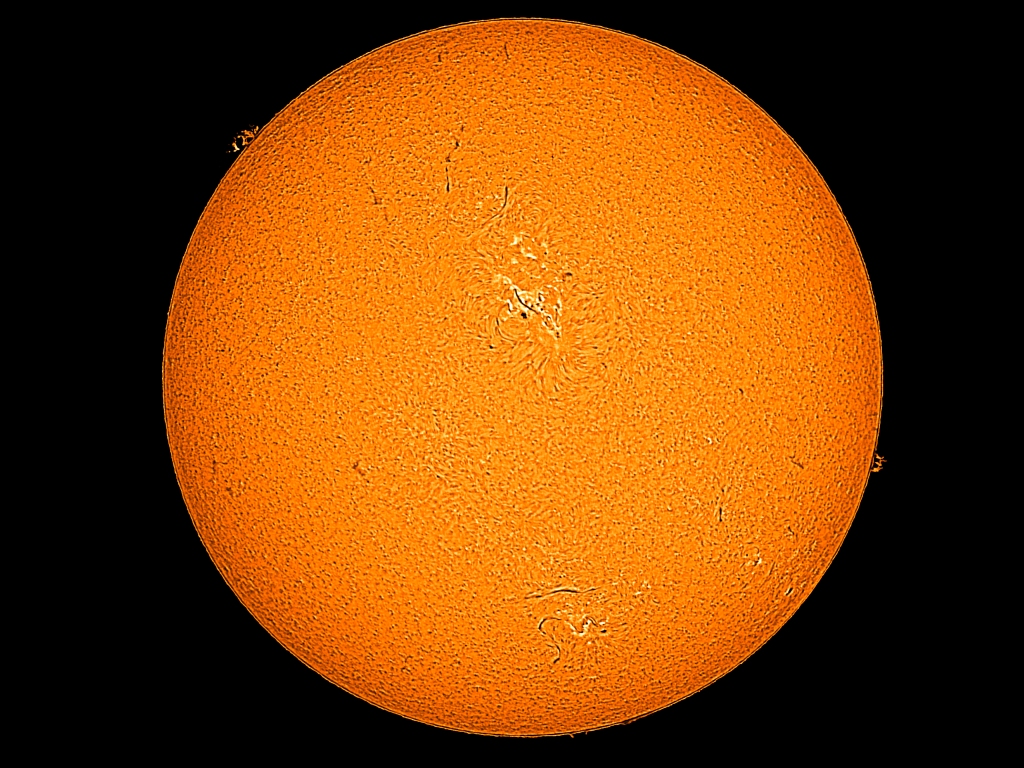
Another more direct analogy is provided by the Sun. Here’s a picture of said object, taken through an H-α filter..

What’s surprising to the uninitiated about an image such as this is that the Sun appears to have a distinct edge, like a solid object. The Sun, however, is far from solid. It’s just a ball of hot gas whose density and temperature fall off with distance from its centre. In the inner parts the Sun is basically opaque, and photons of light diffuse outwards extremely slowly because they are efficiently scattered by the plasma. At a certain radius, however, the material becomes transparent and photons travel without hindrance. What you see is the photosphere which is a sharp edge defined by this transition from opaque to transparent.

The physics defining the Sun’s photosphere is much the same as in the Big Bang, except that in the case of the Sun we are outside looking in whereas we are inside the Universe trying to look out. Take a look at this image from M.C. Escher:

The universe isn’t actually made of Angels and Demons – at least not in the standard model – but if you imagine you are in the centre of the picture  it nicely represents what it is like looking out through an expanding cosmology. Since light travels with finite speed, the further you look out the further you look back into the past when things were denser (and hotter). Eventually you reach a point where the whole Universe was as hot as the surface of a star, this is the cosmic photosphere or the last scattering surface, which is a spherical surface centred on the observer. We can’t see any further than this because what’s beyond is hidden from us by an impenetrable curtain,  but if we could just a little bit further we’d see the Big Bang itself where the density is infinite, not as a point in space but all around us.

Although it looks like we’re in a special place (in the middle) of the image, in the Big Bang theory everywhere is equivalent; any observer would see a cosmic photosphere forming a sphere around them.

And while I’m on about last scattering, here’s another analogy which might be useful if the others aren’t. I call this one the Field of Screams.

Imagine you’re in the middle of a very large, perhaps infinite, field crammed full of people, furnished with synchronised watches, each of whom is screaming at the top of their voice. At a certain instant, say time T, everyone everywhere stops screaming.

What do you hear?

Well , you’ll obviously  notice that it gets quieter straight away as the people closest to you have stopped screaming.  But you will still hear a sound because some of the sound entering your ear set out at a time before t=T. The speed of sound is 300 m/s or so, so after 1 second you will still hear the sound arriving from people further than 300 metres away. It might be faint, but it would be there. After two seconds you’d still be hearing from people further than 600 metres away,. and so on. At any time there’ll be circle around you, defined by the distance sound can have travelled since the screaming stopped – the Circle of Last Screaming. It would appear that you are in the centre of this circle, but anyone anywhere in the field would form the same impression about what’s happening around them.

Change sound to light, and move from two dimensions to three, and you can see how last scattering produces a spherical surface around you. Simples.


Graffiti Politti

Posted in Art, Politics with tags , , , on February 9, 2012 by telescoper

Winterreise – Das Wirtshaus

Posted in Art, Music with tags , , , on February 4, 2012 by telescoper

It’s cold again, and it’s just  started snowing, so here’s some wintry music. I know that the recording of Winterreise by Benjamin Britten and Peter Pears is by no means everyone’s favourite version, but I like it a lot. There’s the added bonus in this video of a glimpse of the art of Caspar David Friedrich.

P.S. Das Wirtshaus means “The Inn”, but in the poem by Müller that forms the lyric for this song, the inn is actually a graveyard…