Today is (apparently) 29th December and this morning I actually got some post. Most of it was sent in the first week of December but has taken about three weeks to get here. Among other things I got: the pension statement I was waiting for (dated 2nd December), a cheque for 40 quid for winning the Times Literary Supplement Crossword Prize (posted 8th December), and a royalty statement from OUP dated, somewhat surprisingly, December 23rd. I still haven’t received the Christmas edition of Private Eye though.
I took a walk this afternoon and was quite surprised on the way to see the Maynooth Airport Hopper bus. This has been suspended since the onset of the pandemic way back in 2020 but now I find it has recently resumed. That will make it much easier to get to and from Dublin Airport if I ever have to do that. I used this service very frequently when I had to commute between Cardiff and Maynooth and don’t know how I would have coped without it. It’s good to see things gradually returning.
The bug I picked up before Christmas is still present but more of an inconvenience than anything more serious. I’ve done no fewer than ten antigen tests and never got a positive result so I’m pretty confident it’s not Covid-19. I haven’t posted anything on this blog for a few days but interestingly I’ve still been getting over 500 reads a day over the Christmas period.
I usually update my Covid-19 figures every week but no data have been recently since 20th December. Testing numbers will be pretty much meaningless because of the Christmas holiday but I’d expect to see a rise in infection levels as we head into the New Year. There are signs that Covid-19 cases are rising steeply once more – there are currently over 700 people in hospital in Ireland with Covid-19 – but I doubt we’re going to see any further lockdown measures heading into the new term.
That reminds me that I foolishly offered to do a couple of revision lectures ahead of my 2nd year Vector Calculus examination (which takes place on January 7th). The first of these will be on 3rd January which doesn’t give me much time to think about what to do. In view of my continuing low-level lurgy I think to minimize the chances of infecting anyone I think I’ll just go in, do my lectures, and come home again.
So here we are, then, the last day of teaching term at Maynooth University. There is still another week before Christmas of course, but no lectures next week. I’ll be returning to action on 3rd January for a couple of revision lectures for my 2nd year module, the exam being on 7th January 2023. Yes, that’s a Saturday. I hope to get those scripts marked before my second and much larger examination on 14th January. Yes, that’s also a Saturday.
It’s been an exhausting term and I’m glad there’s a break. I just have a couple of non-teaching things to do before the official closure on Wednesday 21st, but I think I can do all those from home.
Teaching a group of students from very different backgrounds, such as our first-year general science group, can be very challenging but also very rewarding. Among the fully justified criticisms of my teaaching there were some very nice comments in the module questionnaire returns this year, especially for my team of tutors on MP110 so I think I should end the term by saying a very public thank you to Aoibhinn, Kay, and Thomas, all of whom have been wonderfully support not only of the students but of their ageing lecturer.
Next Semester, which starts after the end of the exam period in late January, should be a little less stressful, as I’m teaching smaller classes in the 3rd year and 4th year.
Just time for a very quick post today to mark the fact that this afternoon I did my last lecture of the 2022 calendar year, a revision class on special relativity. I’ll be back to do further classes in January ahead of the examinations but that’s it for me until after Christmas. It’s been a very hectic term so I’m glad it’s almost over.
Thoughts are now turning to the exams, I ended today’s lecture with some tips about examinations as the January session will be the first most students have ever had at third level. The tips I passed on today included:
Try to get a good night’s sleep before the examination and arrive in plenty of time before the start.
Read the entire paper before starting to answer any questions. In particular, make sure you are aware of any supplementary information, formulae, etc, given in the rubric or at the end.
Start off by tackling the question you are most confident about answering, even if it’s not Question 1. This will help settle any nerves.
Don’t rush! Students often lose marks by making careless errors. Check all your numerical results on your calculator at least twice and – PLEASE – remember to put the units!
Don’t panic! You’re not expected to answer everything perfectly. A first-class mark is anything over 70%, so don’t worry if there are bits you can’t do. If you get stuck on a part of a question, don’t waste too much time on it (especially if it’s just a few marks). Just leave it and move on. You can always come back to it later.
Readers of this blog are welcome to add other tips through the comments box below!
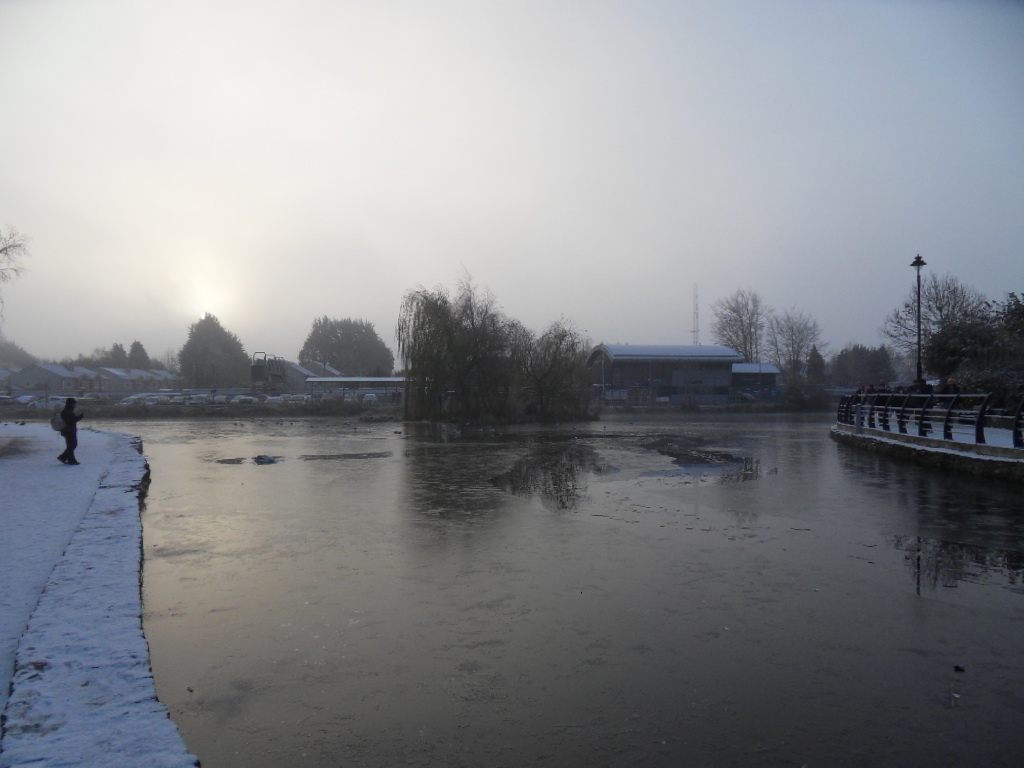
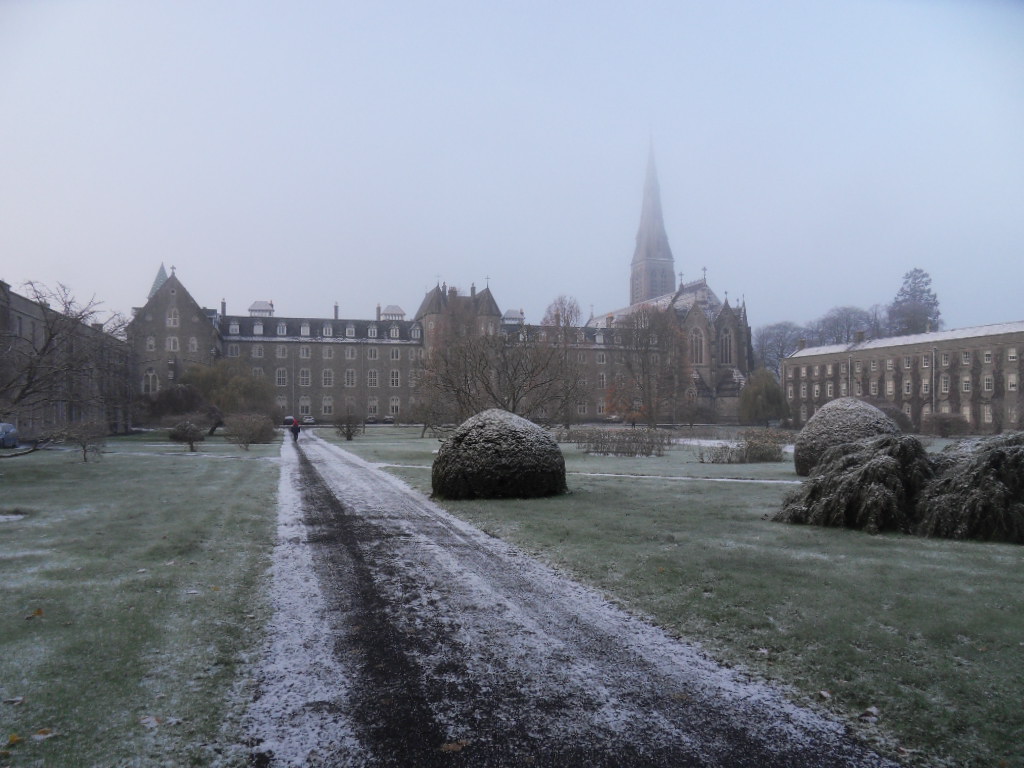
It was -4°C outside my house at about 8.30am when I was getting ready to come to work this morning. There was a light dusting of snow which had frozen overnight so the paths were a bit treacherous. I took a few pictures of Maynooth on the way in. It may have been cold and misty but it was rather atmospheric.
Tháinig sneachta an gheimhridh go luath i mbliana.
Frozen Harbour and Royal CanalSt Patrick’s House from St Joseph’s SquareNew House from St Joseph’s SquareStoyte House from St Joseph’s Square
The Department of Theoretical Physics at Maynooth University invites applications for a PhD in Theoretical Astrophysics starting in September 2023. The successful applicant will work in the group led by Dr. John Regan on a project examining the formation processes of massive black holes in the early Universe. Massive black holes populate the centres of all massive galaxies and are now also observed in both the centres and in off-centre locations in less massive dwarf galaxies.
For more details and instructions on how to apply, see here.
Just a quick post to advertise the fact that the Department of Theoretical Physics at Maynooth University is inviting applications for a Postdoctoral Fellowship Position in Computational and Theoretical Astrophysics. The successful applicant will join the Research Group led by Dr John Regan and is expected to develop their own independent research program within the confines of a research project investigating the formation, growth, and demographics of Black Holes in the early Universe. The group, currently consisting of four PhD students and one additional postdoctoral researcher, is currently engaged in numerous research topics with the goal of understanding early black hole formation. In line with this we are currently implementing an ambitious research project using the EnzoE exascale class code to run large volume, high resolution simulations focused on the first billion years of black hole formation. The successful candidate will be expected to contribute significantly to this research effort but are free to pursue their own research lines under this remit.
For more information, including deadlines and the applications procedure, please see the AAS Jobs register advertisement here.
 It is 1st December 2022, which means that it’s five years to the day since I started work at Maynooth University. So much has happened in that period it seems very much longer since I first arrived here. I’m very happy that I made the move here all those years ago. I won’t deny that the past five years have had their frustrations. The teaching and administrative workload, especially for the three years I was Head of Department, especially during the Covid-19 pandemic, has been very heavy and has made it difficult to be very active in research. Last year was a particularly tough year for the Department of Theoretical Physics, when we were forced to teach a whole year with only half the usual number of full-time teaching staff. It was very depressing not being able to deliver as a good a teaching experience as we wanted without the necessary resources. There never seems to be any shortage of funds for new senior management positions but not for the staff who actually perform the main function of a University. Fortunately our immediate staffing problem has passed and we now have our usual number of lecturers in place. I was entitled to take a sabbatical when I reached the end of my term as Head of Department, but I deferred it because I didn’t want to leave my colleagues short-staffed again before the ship was properly steadied. I will put in a request in January to take it in 2023/24. If anyone out there feels like playing host to an old cosmologist please let me know! On the bright side, I have great colleagues in the Department and the students are very engaged. There are few things in life more rewarding than teaching people who really want to learn. This year so far has been particularly enjoyable, if tiring because we have a large first year. I have also acquired two more PhD students and a Research Masters student. The thing I’m probably most proud of over the past five years is, with the huge help of staff at Maynooth University Library, getting the Open Journal of Astrophysics off the ground and attracting some excellent papers. We’re still growing, though perhaps not as quickly as I’d hoped. The pandemic had something to do with that. So, after a few years of hard and at times dispiriting slog, things are going pretty well. Meanwhile, in Brexit Britain, events have turned out exactly as I predicted, especially this: Brexit will also doom the National Health Service and the UK university system, and clear the way for the destruction of workers’ rights and environmental protection. The poor and the sick will suffer, while only the rich swindlers who bought the referendum result will prosper. The country in which I was born, and in which I have lived for the best part of 54 years, is no longer something of which I want to be a part. In other words I don’t regret for one minute my decision to leave Britain. Incidentally, five years is the term needed to qualify for Irish nationality by residence so if I had needed to I could now apply via that route. I noticed looking at the similar post I wrote on this day last year that academic colleagues in the UK were on strike on that day. They are still taking industrial action, and indeed were on strike yesterday. My biggest fear for the Irish Higher Education system is that it follows the “business model” of soulless teaching factories with courses delivered by demoralized staff on casual teaching contracts. Things are definitely going that way here and this trend must be resisted.
We have reached the end of Week 9 at Maynooth University, so there are now just three weeks to go until end of term. All of sudden the shops are filled with Christmas whatnots and thingies, and I’ve finally bowed to pressure and bought a ticket for this year’s Messiah.
As usual for this time of the year we have a pair of Open Days for undergraduate admissions. The first was today, Friday, and catered mainly for school trips whereas tomorrow’s (i.e. Saturday’s) is usually more parents with their offspring. During the pandemic these events have been online but we’re now having them on campus so that prospective students see the important features on campus in the flesh:
For the last few years, I’ve been the main person responsible for running the Theoretical Physics part of these Open Days but now that duty has passed on to the new Head of Department. It’s not that I disliked doing these events, it’s just that I think it’s better from now on to have a fresher face doing them. Today for me has therefore largely been a normal teaching day and I’m also able to have a lie-in tomorrow morning.
In past years, before the pandemic, some lectures have been cancelled to make way for Friday Open Day talks. That has included the Friday lecture of my 2nd year module on Vector Calculus which takes place in a room previously needed for admissions business on Open Days. Now, however, a new teaching building is available and many of the Open Day talks are in there so my lecture went ahead as planned. The room next door to mine was however used for the Open Day and a group of about ten schoolgirls, dressed in green blazers and plaid skirts in a manner highly reminiscent of the Derry Girls, almost came into my lecture by mistake.
I saw quite a few visitors around the campus this morning, and some came into the Science Building for a look around, but I don’t know how busy the day was in comparison to previous November events on campus. I don’t know how busy it will be tomorrow either, as I shall be putting my feet up at home.
Today wasn’t quite a normal day, however. I had lunch in Pugin Hall. I used to do that regularly before the pandemic but today was the first time I’ve been there since March 2020. Either Pugin Hall has been closed or I’ve been too busy to have anything other than a sandwich in my office.
Following last week’s Maynooth Astrophysics and Cosmology Masterclass, a student asked (in the context of the Big Bang or a black hole) what a singularity is. I thought I’d share my response here in case anyone else was wondering. The following is what I wrote back to my correspondent:
–oo–
In general, a singularity is pathological mathematical situation wherein the value of a particular variable becomes infinite. To give a very simple example, consider the calculation of the Newtonian force due to gravity exerted by a massive body on a test particle at a distance r. This force is proportional to 1/r2,, so that if one tried to calculate the force for objects at zero separation (r=0), the result would be infinite.
Singularities are not always signs of serious mathematical problems. Sometimes they are simply caused by an inappropriate choice of coordinates. For example, something strange and akin to a singularity happens in the standard maps one finds in an atlas. These maps look quite sensible until one looks very near the poles. In a standard equatorial projection, the North Pole does not appear as a point, as it should, but is spread along straight line along the top of the map. But if you were to travel to the North Pole you would not see anything strange or catastrophic there. The singularity that causes this point to appear is an example of a coordinate singularity, and it can be transformed away by using a different projection.
More serious singularities occur with depressing regularity in solutions of the equations of general relativity. Some of these are coordinate singularities like the one discussed above and are not particularly serious. However, Einstein’s theory is special in that it predicts the existence of real singularities where real physical quantities (such as the matter density) become infinite. The curvature of space-time can also become infinite in certain situations.
Probably the most famous example of a singularity lies at the core of a black hole. This appears in the original Schwarzschild interior solution corresponding to an object with perfect spherical symmetry. For many years, physicists thought that the existence of a singularity of this kind was merely due to the special and rather artificial nature of the exactly spherical solution. However, a series of mathematical investigations, culminating in the singularity theorems of Penrose, showed no special symmetry is required and that singularities arise in the generic gravitational collapse problem.
As if to apologize for predicting these singularities in the first place, general relativity does its best to hide them from us. A Schwarzschild black hole is surrounded by an event horizon that effectively protects outside observers from the singularity itself. It seems likely that all singularities in general relativity are protected in this way, and so-called naked singularities are not thought to be physically realistic.
There is also a singularity at the very beginning in the standard Big Bang theory. This again is expected to be a real singularity where the temperature and density become infinite. In this respect the Big Bang can be thought of as a kind of time-reverse of the gravitational collapse that forms a black hole. As was the case with the Schwarzschild solution, many physicists thought that the initial cosmologcal singularity could be a consequence of the special symmetry required by the Cosmological Principle. But this is now known not to be the case. Hawking and Penrose generalized Penrose’s original black hole theorems to show that a singularity invariably exists in the past of an expanding Universe in which certain very general conditions apply.
So is it possible to avoid this singularity? And if so, how?
It is clear that the initial cosmological singularity might well just be a consequence of extrapolating deductions based on the classical ttheory of general relativity into a situation where this theory is no longer valid. Indeed, Einstein himself wrote:
The theory is based on a separation of the concepts of the gravitational field and matter. While this may be a valid approximation for weak fields, it may presumably be quite inadequate for very high densities of matter. One may not therefore assume the validity of the equations for very high densities and it is just possible that in a unified theory there would be no such singularity.
Einstein, A., 1950. The Meaning of Relativity, 3rd Edition, Princeton University Press.
We need new laws of physics to describe the behaviour of matter in the vicinity of the Big Bang, when the density and temperature are much higher than can be achieved in laboratory experiments. In particular, any theory of matter under such extreme conditions must take account of quantum effects on a cosmological scale. The name given to the theory of gravity that replaces general relativity at ultra-high energies by taking these effects into account is quantum gravity, but no such theory has yet been constructed.
There are, however, ways of avoiding the initial singularity in classical general relativity without appealing to quantum effects. First, one can propose an equation of state for matter in the very early Universe that does not obey the conditions laid down by Hawking and Penrose. The most important of these conditions is called the strong energy condition: that r+3p/c2>0 where r is the matter density and p is the pressure. There are various ways in which this condition might indeed be violated. In particular, it is violated by a scalar field when its evolution is dominated by its vacuum energy, which is the condition necessary for driving inflationary Universe models into an accelerated expansion. The vacuum energy of the scalar field may be regarded as an effective cosmological constant; models in which the cosmological constant is included generally have a bounce rather than a singularity: running the clock back, the Universe reaches a minimum size and then expands again.
Whether the singularity is avoidable or not remains an open question, and the issue of whether we can describe the very earliest phases of the Big Bang, before the Planck time, will remain open at least until a complete theory of quantum gravity is constructed.
There are now precisely four weeks to go until the end of teaching term at Maynooth University. Since the FIFA World Cup starts today it seems apt to borrow a sporting cliché and describe this as the final third. Miraculously, given that I’m having to fit 12 weeks of teaching into 11 week term for the first years, I’m almost on schedule with both my modules but I have this weekend come down with something which may affect the rest of term. I don’t think it’s Covid-19 – at least the antigen test I did yesterday was negative – but whatever it is I hope it doesn’t get worse. All the teaching staff in the Department of Theoretical Physics already have very heavy teaching loads already so we simply don’t have any spare staff to cover my lectures if I can’t deliver them. I don’t know what I’ll do in that case. I suppose I could recycle some of last year’s videos, or record some new ones from my sick bed. Let’s hope it doesn’t come to that. It may be just a cold.
Anyway, what was until last week an unusually mild autumn has turned into something much more wintry. The sudden cold snap has set off my arthritis, which is an additional complication on top of whatever bug I’ve got.
Evidence of the Berry Phase
Outside temperatures have plummeted so I have mobilized my bird feeders to take care of the feathered friends in the garden. Fortunately there is ready-made food at this time of the year in the form of berries on the Cotoneaster bushes. I watched a song thrush for about ten minutes tucking in yesterday. Pigeons like them too. The birds usually don’t strip all the berries so there’ll be food of that form for a while but some of the smaller birds can’t eat them so I’ve put out seed and peanuts too.
UPDATE: Monday 21st November. It appears it was just a cold, or something else very mild, as I felt much better this morning and went to work as normal.
The views presented here are personal and not necessarily those of my employer (or anyone else for that matter).
Feel free to comment on any of the posts on this blog but comments may be moderated; anonymous comments and any considered by me to be vexatious and/or abusive and/or defamatory will not be accepted. I do not necessarily endorse, support, sanction, encourage, verify or agree with the opinions or statements of any information or other content in the comments on this site and do not in any way guarantee their accuracy or reliability.




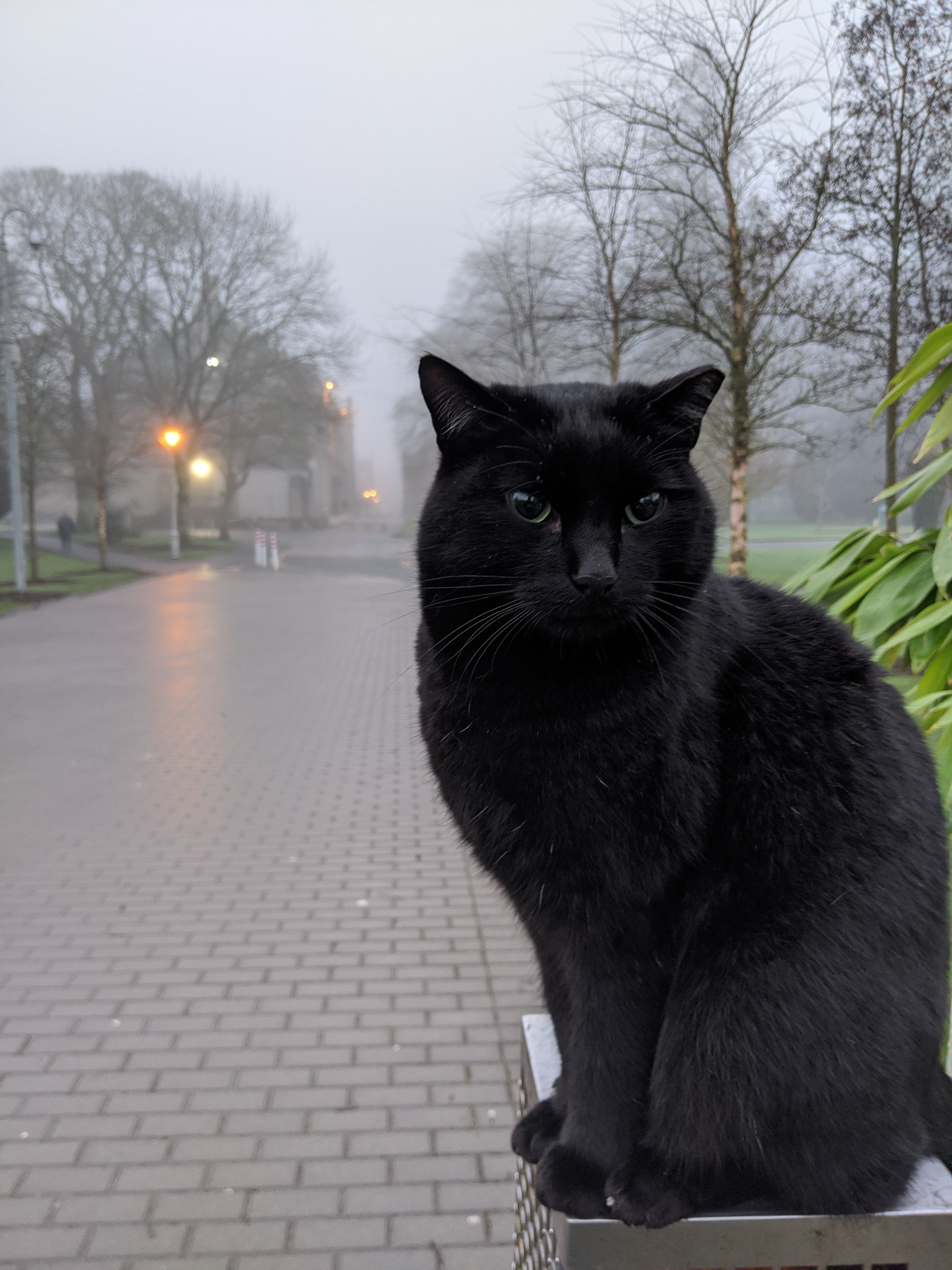


 In the Dark