Archive for the Open Access Category

Name Change Policy at the Open Journal of Astrophysics

Posted in LGBTQ+, Open Access with tags , on April 27, 2021 by telescoper

This lunchtime I took a bit of time out to complete a task that has been on my to-do list for some time. It has been announced in a blog post at the Open Journal of Astrophysics.

The recent announcement by arXiv of a name change policy has enabled the Open Journal of Astrophysics to introduce a policy of its own concerning author name changes. The aim of such a policy is to reduce barriers to changing public records and online identity, thereby fostering diversity and promoting inclusivity. The changes announced follow recommendations by the Committee On Publication Ethics (COPE).

Since the Open Journal of Astrophysics is an arXiv overlay journal which is totally dependent on the arXiv platform we had to wait until arXiv announced its policy before following it with one of our own, which were recently able to do.

The arXiv now allows the following options:

  1. In full text works: the author name can be changed in the PDF and/or LaTeX source where it appears in the author list, acknowledgments, and email address.
  2. In metadata: the name and email address can be changed in the author list metadata and in the submission history metadata for all existing versions.
  3. In user accounts: the name, username, and email address can all be changed.

The arXiv policy notes, however, that

We are not currently able to support name changes in references and citations of works. Also, arXiv cannot make changes to other services, including third party search and discovery tools that may display author lists for papers on arXiv.

Since the Open Journal of Astrophysics deposits author metadata for all our papers with the Crossref system we can plug this gap by undertaking to redeposit all necessary information to reflect author name changes. Since author metadata is attached to the DOI we issue, this will ensure that citations and references tracked through this system are updated when an author changes their name.

If any author of a paper published in the Open Journal of Astrophysics wishes to make use of this policy the best procedure is to first contact the arXiv under their policy. Once any changes have been made to the arXiv submission the author should contact us with a request. We will then make any necessary changes to the overlay on the Open Journal of Astrophysics site and redeposit amended metadata to Crossref free of charge. We also undertake to ensure entries are updated at the NASA/ADS system.

Following the guidance from COPE the Open Journal of Astrophysics will neither seek permission from nor inform co-authors of any such change.

A list of other journals/publishers and their name change policies can be found here.

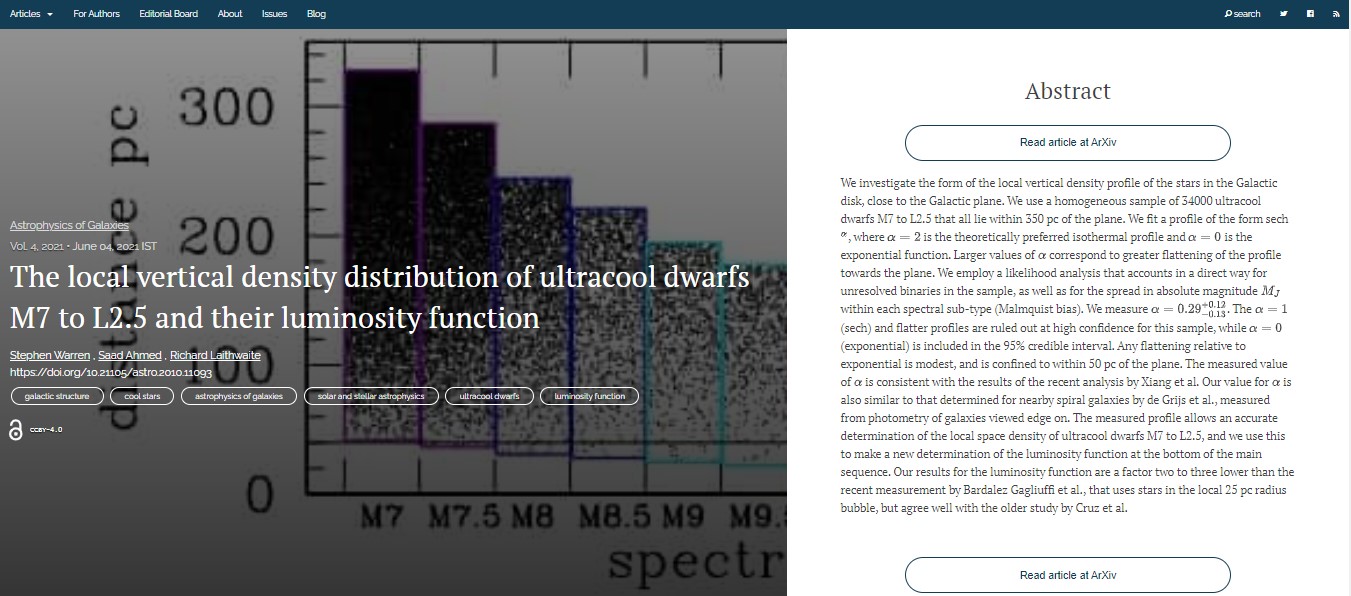
New Publication at the Open Journal of Astrophysics

Posted in OJAp Papers, Open Access, The Universe and Stuff with tags , , , , , , , , on March 24, 2021 by telescoper

Time to announce another publication in the Open Journal of Astrophysics. This one was published yesterday, actually, but I didn’t get time to post about it until just now. It is the third paper in Volume 4 (2021) and the 34th paper in all.

The latest publication is entitled Dwarfs from the Dark (Energy Survey): a machine learning approach to classify dwarf galaxies from multi-band images and is written by Oliver Müller  of the Observatoire Astronomique de Strasbourg (France) and Eva Schnider of the University of Basel (Switzerland).

Here is a screen grab of the overlay which includes the abstract:


You can click on the image to make it larger should you wish to do so. You can find the arXiv version of the paper here. This one is in the Instrumentation and Methods for Astrophysics Folder, though it does overlap with Astrophysics of Galaxies too.

It seems the authors were very happy with the publication process!

Incidentally, the Scholastica platform we are using for the Open Journal of Astrophysics is continuing to develop additional facilities. The most recent one is that the Open Journal of Astrophysics now has the facility to include supplementary files (e.g. code or data sets) along with the papers we publish. If any existing authors (i.e. of papers we have already published) would like us to add supplementary files retrospectively then please contact us with a request!

Open Access Diamond Journals Study Published

Posted in Open Access on March 10, 2021 by telescoper

I came across this report into a review of Diamond Open Access journals and thought I’d share it here, as the Open Journal of Astrophysics is a “diamond journal”…

A new study of open access journals which are free for readers and authors, known as “diamond journals” has been published. The in-depth report and its recommendations cover diamond journals across the world and provide a better understanding of the open access diamond landscape. Funded by Science Europe and commissioned by cOAlition S, the study represents the […]

Open Access Diamond Journals Study Published

Elsevier? Just say No!

Posted in Open Access with tags , , , on March 6, 2021 by telescoper

I found out via Twitter that UK Universities are now negotiating again with publishing giant Elsevier for access to its range of hideously overpriced journals.

Five years ago the result of similar negotiations was a clear victory for Elsevier and UK institutions have been paying ever since. This time there’s a strong feeling in the UK academic community that the negotiators have to take a much firmer line, even if that means losing access to Elsevier journals.

See, e.g., this thread from mathematician Tim Gowers (who runs a very successful arXiv overlay journal called Discrete Analysis along similar lines to the Open Journal of Astrophysics).

and this from Computational Neuroscientist Stephen Eglen:

https://twitter.com/StephenEglen/status/1367820583162032128

It is important to take a stand on this issue if you want the negotiations to succeed in reducing the burden on University budgets caused by profiteering publishers like Elsevier. If you’re on Twitter you can do so using the hashtag #NoElsevier. Alternatively you can make it clear to your institution’s library that you’re prepared to do without Elsevier journals unless they reduce the price substantially.

I’d add a more general comment. If you’re an academic who thinks academia needs the likes of Elsevier then you’re an academic who is not thinking. There are plenty of ways of communicating your results without shaking hands with the Devil. I find it completely mystifying why so many academics and their institutions are so willing to be fleeced in the academic journal racket. Perhaps they believe they don’t understand how little it actually costs to publish articles online?

You could do a lot worse than seize this opportunity to set up your own journal. It’s really quite straightforward and inexpensive, especially if your research community uses the arXiv. Why not try setting up your own overlay journal?

Thirty Years of Preprints

Posted in Open Access with tags , , , , on February 21, 2021 by telescoper

I thought I’d share an interesting paper (by Xie, Shen & Wang) that I found on the arXiv with the title Is preprint the future of science? A thirty year journey of online preprint services. The abstract reads:

Preprint is a version of a scientific paper that is publicly distributed preceding formal peer review. Since the launch of arXiv in 1991, preprints have been increasingly distributed over the Internet as opposed to paper copies. It allows open online access to disseminate the original research within a few days, often at a very low operating cost. This work overviews how preprint has been evolving and impacting the research community over the past thirty years alongside the growth of the Web. In this work, we first report that the number of preprints has exponentially increased 63 times in 30 years, although it only accounts for 4% of research articles. Second, we quantify the benefits that preprints bring to authors: preprints reach an audience 14 months earlier on average and associate with five times more citations compared with a non-preprint counterpart. Last, to address the quality concern of preprints, we discover that 41% of preprints are ultimately published at a peer-reviewed destination, and the published venues are as influential as papers without a preprint version. Additionally, we discuss the unprecedented role of preprints in communicating the latest research data during recent public health emergencies. In conclusion, we provide quantitative evidence to unveil the positive impact of preprints on individual researchers and the community. Preprints make scholarly communication more efficient by disseminating scientific discoveries more rapidly and widely with the aid of Web technologies. The measurements we present in this study can help researchers and policymakers make informed decisions about how to effectively use and responsibly embrace a preprint culture.

The paper makes a number of good arguments, backed up with evidence, as to why preprints are a good idea. I recommend reading it.

Here is Figure 1 from the paper:

(Parts of the chart are difficult to read, so see the paper for details).

This shows that about 50% of all preprints are in the areas of physics and mathematics and their distribution mode is predominantly through the arXiv. Other scientific disciplines have much lower prevalence of preprints, e.g. biology. I’ve been putting my papers on arXiv since the early Nineties, i.e. for most of the duration of the period covered by the paper. I don’t know why other fields are so backward.

It’s standard practice in my own field of astrophysics to put preprints of articles on the arXiv but younger readers will probably not realize that preprints were not always produced in the electronic form they are today. We all used to make large numbers of these and post them at great expense to (potentially) interested colleagues before publication in order to get comments. That was extremely useful because a paper could take over a year to be published after being refereed for a journal: that’s too long a timescale when a PhD or PDRA position is only a few years in duration. The first papers I was given to read as a new graduate student in 1985 were all preprints that were not published until well into the following year. In some cases I had more or less figured out what they were about by the time they appeared in a journal!

The practice of circulating preprints persisted well into the 1990s. Usually these were produced by institutions with a distinctive design, logo, etc which gave them a professional look, which made it easier to distinguish `serious’ papers from crank material (which was also in circulation). This also suggested that some internal refereeing inside an institution had taken place before an “official” preprint was produced and this lending it an air of trustworthiness. Smaller institutions couldn’t afford all this, so were somewhat excluded from the preprint business.

With the arrival of the arXiv the practice of circulating hard copies of preprints in astrophysics gradually died out, to be replaced by ever-increasing numbers of electronic articles. The arXiv does have some gatekeeping – in the sense there are some controls on who can deposit a preprint there – but it is definitely far easier to circulate a preprint now than it was.

It is still the case that big institutions and collaborations insist on quite strict internal refereeing before publishing a preprint – and some even insist on waiting for a paper to be accepted by a journal before adding it to the arXiv – but there’s no denying that among the wheat there is quite a lot of chaff, some of which attracts media coverage that it does not deserve. It must be admitted, however, that the same can be said of some papers that have passed peer review and appeared in high-profile journals! No system that is operated by human beings will ever be flawless, and peer review is no different.

Nowadays, in astrophysics, the single most important point of access to scientific literature is through the arXiv, which is why the Open Journal of Astrophysics was set up as an overlay journal to provide a level of rigorous peer review for preprints, not only to provide a sort of quality mark but also to improve the paper through the editorial process.

So is the preprint the future of science? I think that depends on how far ahead you are willing to look. In my opinion we are currently in an era of transition trying to shoehorn old publishing practices into a digital world. At some point in the future people will realize that the scientific paper itself – whether a preprint or not – is an outmoded 18th Century concept and there are far more effective ways of disseminating scientific ideas and information at our fingertips if only we stopped living in the past.

New Publication at the Open Journal of Astrophysics

Posted in OJAp Papers, Open Access, The Universe and Stuff with tags , , , , , on February 18, 2021 by telescoper

Time to announce another publication in the Open Journal of Astrophysics. This one was published yesterday, actually, but I didn’t get time to post about it until just now. It is the second paper in Volume 4 (2021).

The latest publication is entitled Characterizing the Sample Selection for Supernova Cosmology and is written by Alex G. Kim on behalf of the LSST Dark Energy Science Collaboration.  It’s nice to be getting papers from large collaborations like this!

Here is a screen grab of the overlay which includes the abstract:

You can click on the image to make it larger should you wish to do so. You can find the arXiv version of the paper here. This is one for the Cosmology and Nongalactic Astrophysics folder.

Open Journal of Astrophysics Impact Factor Poll

Posted in Open Access with tags , , on February 5, 2021 by telescoper

A few people ask from time to time about whether the Open Journal of Astrophysics has a Journal Impact Factor.

For those of you in the dark about this, the impact factor for Year N, which is usually published in year N+1, is based on the average number of citations obtained in Year N for papers published in Years N-1 and N-2 so it requires two complete years of publishing.

For the OJA, therefore, the first time an official IF can be constructed is for 2021, which would be published is in 2022 and it would be based on the citations gained in 2021 (this year) for papers published in 2019 and 2020. Earlier years were incomplete so no IF can be defined.

It is my personal view that article-level level bibliometric data are far more useful than journal-level descriptors such as the Journal Impact Factor (JIF). I think the Impact Factor is very silly actually. Unfortunately, however, there are some bureaucrats that seem to think that the Journal Impact Factor is important and some of our authors think we should apply to have an official one.
What do you think? If you have an opinion you can vote on the twitter poll here:

https://twitter.com/OJ_Astro/status/1357653546146136069

I should add that my criticisms of the Journal Impact Factor are not about the Open Journal’s own citation performance. We have every reason to believe our impact factor would be pretty high.

Comments welcome.

New Publication at the Open Journal of Astrophysics

Posted in OJAp Papers, Open Access, The Universe and Stuff with tags , , , , , , , on February 2, 2021 by telescoper

Time to announce the first publication of 2021 in the Open Journal of Astrophysics. This one was actually published a few days ago but  it took a bit of time to get the metadata and DOI registered so I held off announcing it until that was done.

The latest publication is a lengthy and comprehensive review article (67 pages altogether) by Allahverdi et al. which has 26 authors from all round the world. It is entitled The First Three Seconds: a Review of Possible Expansion Histories of the Early Universe and is a study of the various possible evolutionary histories of cosmic expansion possible with a wide range of cosmological models with their implications for baryogenesis, nucleosynthesis, primordial gravitational wave production, and many other things besides.

Here is a screen grab of the overlay:

You can click on the image to make it larger should you wish to do so. You can find the arXiv version of the paper here. This is one for the Cosmology and Nongalactic Astrophysics folder.

And so Volume 4 begins. Volume 3 had 15 papers, Volume 2 had 12 , and Volume 1 just 4 so we’re growing slowly but surely! Let’s see how many we publish in 2021. I can tell you  we have some very exciting papers in the pipeline…

And the most viewed paper at the Open Journal of Astrophysics in 2020 is…

Posted in Open Access, The Universe and Stuff with tags , , , , , , on January 6, 2021 by telescoper

Yesterday I was looking at the Publishing Analytics tool on the Open Journal of Astrophysics to see which paper(s) had attracted the most interest in 2020. The winner in terms of  page views is  this paper, A Beginner’s Guide to working with Astronomical Data. Here is a grab of the overlay:

You can find the arXiv version of the paper here.

The author is Markus Pössel of the Haus der Astronomie at the Max Planck Institute for Astronomy in Heidelberg (Germany). This is a long paper – 71 pages with over a hundred figures – that gives a comprehensive introduction to the various kinds of astronomical data and techniques for working with such data. This paper has obviously attracted a lot of interest from many different kinds of people, especially  students doing undergraduate projects involving astronomical data (and their supervisors). It has had more than three times as many views as the runner-up.

It’s interesting to note that this paper has not yet obtained any citations from academic papers through the Crossref system and it may never that because of the kind of paper it is. Nevertheless, I think this is a valuable resource for the astronomical community and I am very glad we published it. I do hope, however, that anyone who does use this paper does remember to cite it!

It is perhaps also worth mentioning that we do not track download statistics for the papers we publish. This is because the PDF files are held on the arXiv, which does not publish download statistics for individual papers.

New Publication at the Open Journal of Astrophysics

Posted in OJAp Papers, Open Access, The Universe and Stuff with tags , , , , , , , , , , , , on December 24, 2020 by telescoper

Just time before Christmas to announce another paper in the Open Journal of Astrophysics. This one was actually published a few days ago but because of holiday delays it took some time to get the metadata and DOI registered so I held off announcing it until that was done.

The latest publication is by my colleague* John Regan (of the Department of Theoretical Physics at Maynooth), John Wise (Georgia Tech), Tyrone Woods (NRC Canada), Turlough Downes (DCU), Brian O’Shea (Michigan State) and Michael Norman (UCSD). It is entitled The Formation of Very Massive Stars in Early Galaxies and Implications for Intermediate Mass Black Holes and appears in the Astrophysics of Galaxies section of the arXiv.

Here is a screen grab of the overlay:

You can click on the image to make it larger should you wish to do so. You can find the arXiv version of the paper here.

I think that will be that for for 2020 at the Open Journal of Astrophysics. We have published 15 papers this year, up 25% on last year. Growth is obviously modest, but there’s obviously a lot of inertia in the academic community. After the end of this year we will have two full consecutive years of publishing.

I’d like to take this opportunity to thank all our authors, readers, referees, and editors for supporting the Open Journal of Astrophysics and wish you all the very best for 2021!

*Obviously, owing to the institutional conflict I recused myself from the editorial process on this paper.