Archive for the Open Access Category

Weekly Update from the Open Journal of Astrophysics – 18/01/2025

Posted in OJAp Papers, Open Access, The Universe and Stuff with tags , , , , , , , , , , on January 18, 2025 by telescoper

It’s Saturday morning so once again it’s time for an updated of papers published at the Open Journal of Astrophysics. Since the last update we have published three new papers which brings the number in Volume 8 (2025) up to 7 and the total so far published by OJAp up to 242.

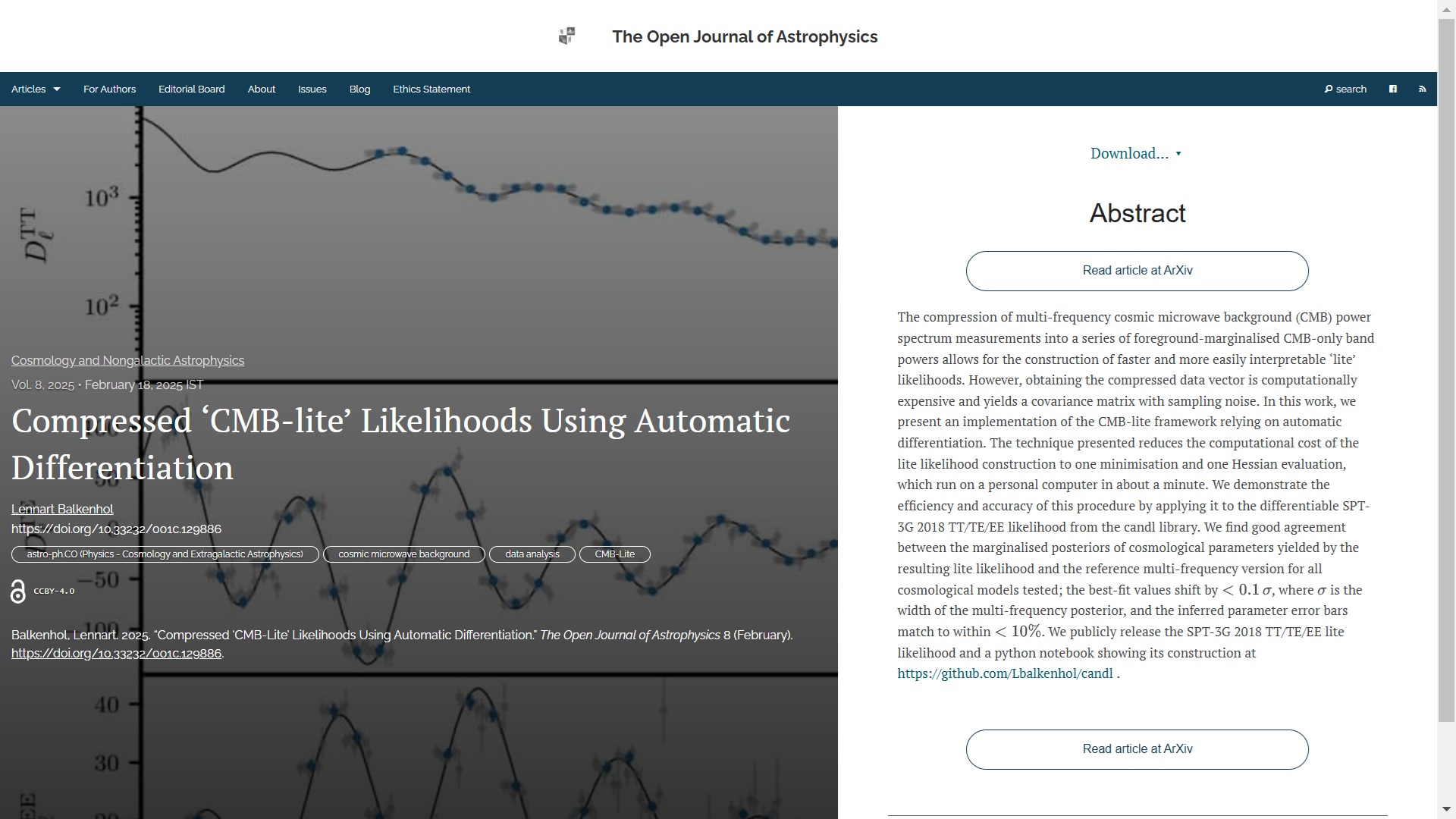
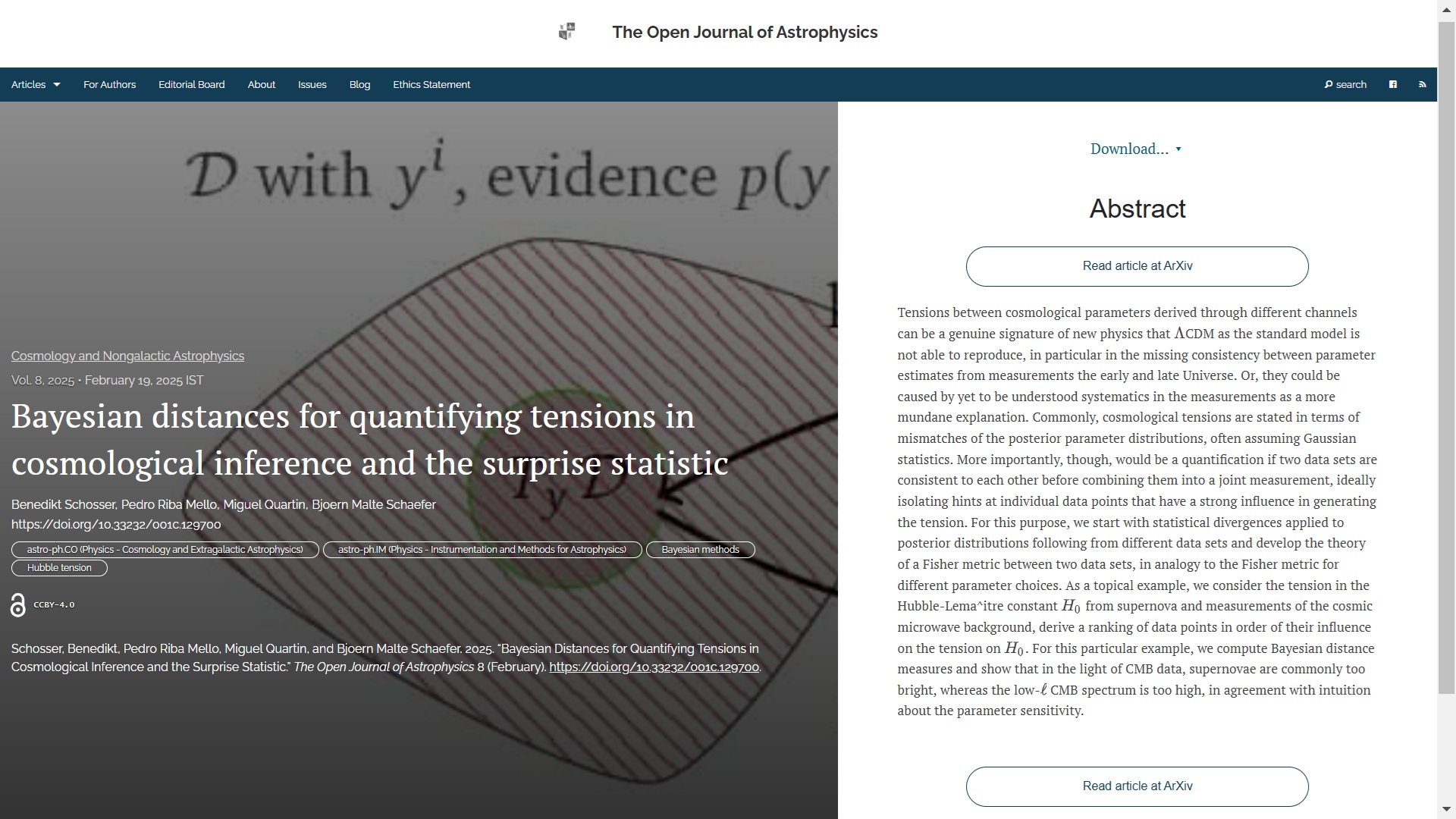
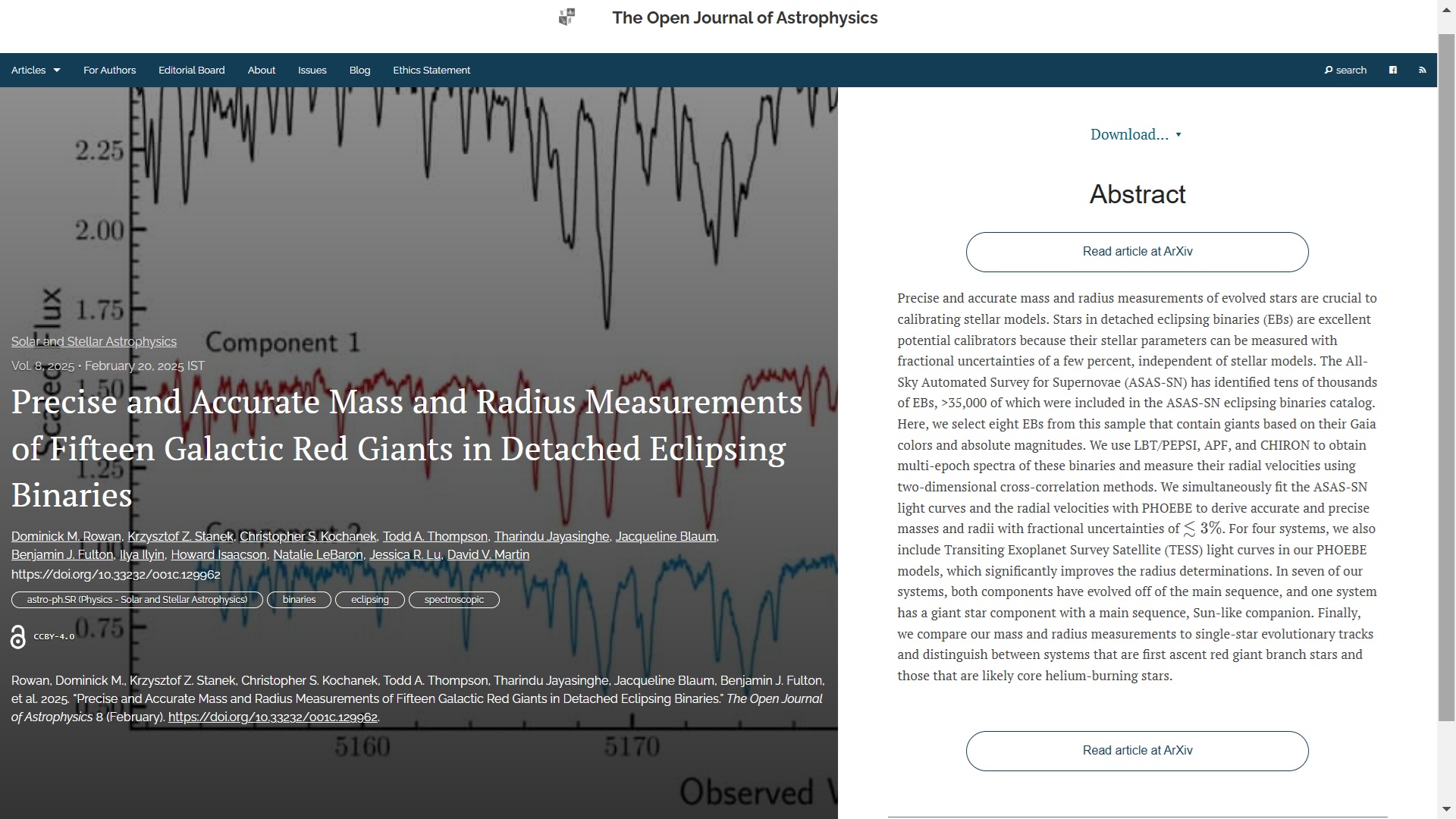
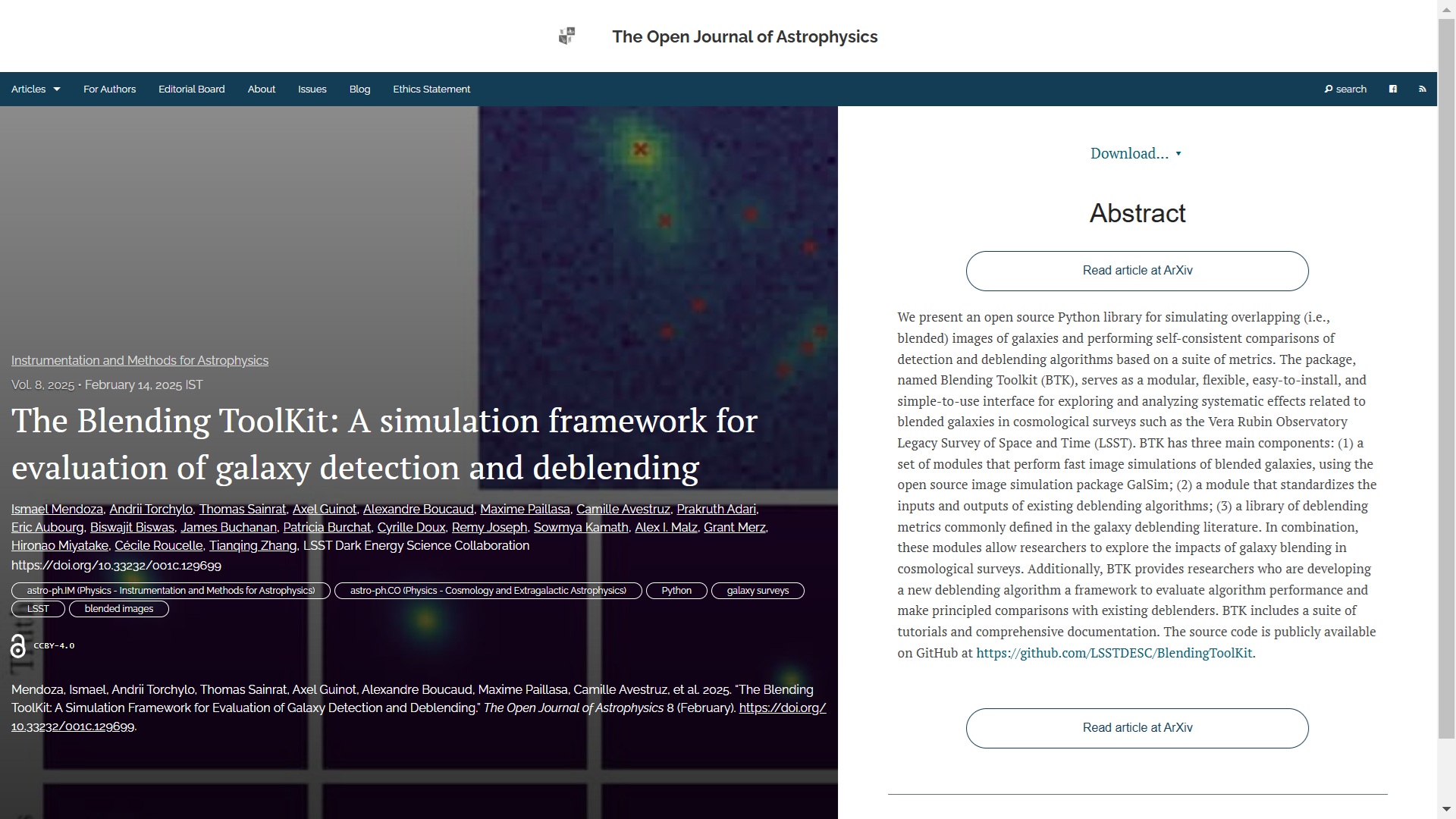
In chronological order of publication, the three papers published this week, with their overlays, are as follows. You can click on the images of the overlays to make them larger should you wish to do so.

First one up is “Potential-density pairs for Galaxy discs with exponential or sech^2 vertical profile” by Walter Dehnen and Shera Jafaritabar (Heidelberg, Germany). This paper was published on Tuesday 14th January 2025 in the folder marked Astrophysics of Galaxies. It presents a new set of analytic models for the structure of disc galaxies. The overlay, which includes the abstract, is here:

You can find the officially accepted version of this paper on arXiv here.

The second paper, which was published on Thursday 17th January 2025 also in the folder Astrophysics of Galaxies, is “Quantifying Bursty Star Formation in Dwarf Galaxies” by Yuan-Sen Ting (Ohio State University) and Alexander Ji (U. Chicago). This paper describes an application of Gaussian mixture models to distinguish between discontinuous and continuous star formation histories in dwarf galaxies.

Here is a screen grab of the overlay, which includes the abstract:You can find the officially accepted version of the paper on the arXiv here.

The third paper to announce, also published on 17th January 2025 but in the folder Cosmology and NonGalactic Astrophysics, is “Fast Projected Bispectra: the filter-square approach” by Lea Harscouet, Jessica A. Cowel, Julia Ereza & David Alonso (Oxford U., UK), Hugo Camacho (Brookhaven National Laboratory, USA), Andrina Nicola (Bonn, Germany) and Anže Slosar (Brookhaven). This paper presents Presenting the filtered-squared bispectrum (FSB), a fast and robust estimator of the projected bispectrum for use on cosmological data sets.

You can see the overlay here:

The accepted version of this paper can be found on the arXiv here.

That’s all for this week. I’ll do another update next Saturday.

Weekly Update from the Open Journal of Astrophysics – 11/01/2025

Posted in OJAp Papers, Open Access, The Universe and Stuff with tags , , , , , , , , , , , , on January 11, 2025 by telescoper

Welcome to the first update of 2025 from the Open Journal of Astrophysics. For the new year we have started Volume 8. Since the last update of 2024 we have published four new papers which brings the total so far published by OJAp up to 239.

In chronological order of publication, the four papers published this week, with their overlays, are as follows. You can click on the images of the overlays to make them larger should you wish to do so.

First one up is “Weak-Lensing Shear-Selected Galaxy Clusters from the Hyper Suprime-Cam Subaru Strategic Program: I. Cluster Catalog, Selection Function and Mass–Observable Relation” by Kai-Feng Chen (MIT, USA), I-Non Chiu (National Cheng University, Taiwan), Masamune Oguri (Chiba University, Japan), Yen-Ting Lin (IAAAS, Taiwan), Hironao Miyatake (Nagoya, Japan), Satoshi Miyazaki (Nat. Astr. Obs. Japan), Surhud More (IUCAA, India), Takashi Hamana (Nat. Astr. Obs. Japan), Markus M. Rau Carnegie Mellon University, USA), Tomomi Sunayama (Steward Obs., USA), Sunao Sugiyama (U. Penn, USA), Masahiro Takada (U. Tokyo, Japan).

This paper, which was published on Monday 6th January 2025 is in the folder Cosmology and NonGalactic Astrophysics, discusses steps towards towards the extraction of cosmogical constraints from a sample of galaxy clusters selected via weak gravitational lensing

Here is a screen grab of the overlay, which includes the abstract:

You can find the officially accepted version of the paper on the arXiv here.

The second paper to announce, published on 7th January 2025 and also in the folder Cosmology and NonGalactic Astrophysics, is “Cosmology on point: modelling spectroscopic tracer one-point statistics” by Beth McCarthy Gould (Newcastle U., UK), Lina Castiblanco (Bielefeld, Germany), Cora Uhlemann (Bielefeld, Germany), and Oliver Friedrich (LMU, Germany).

You can see the overlay here:

The accepted version of this paper can be found on the arXiv here.

The third paper, published on 9th January 2025, also in the folder Cosmology and NonGalactic Astrophysics, is “Probing Environmental Dependence of High-Redshift Galaxy Properties with the Marked Correlation Function” by Emy Mons and Charles Jose (Cochin University of Science and Technology, India). This paper uses the marked two-point correlation function to measure the environmental dependence of galaxy clustering at high redshift.

Here is the overlay:

The final version accepted on arXiv is here.

Last of this quartet, also published on 9th January 2025, but in the folder Astrophysics of Galaxies is “The infrared luminosity of retired and post-starburst galaxies: A cautionary tale for star formation rate measurements” by Vivienne Wild (St Andrews, UK), Natalia Vale Asari (Universidade Federal de Santa Catarina, Brazil), Kate Rowlands (STScI, Sara L. Ellison (U. Victoria, Canada), Ho-Hin Leung (St Andrews), Christy Tremonti (U. Wisconsin-Madison, USA).

The paper proposes an extension of the semi-analytic formalism to weak lensing and thermal Sunyaev-Zeldovich (tSZ) fields directly on the full-sky, with an emphasis on higher-order correlations. The overlay is here:

You can find the official accepted version on the arXiv here.

That’s all for this week. I’ll do another update next Saturday.

Timescape versus Dark Energy?

Posted in Astrohype, Open Access, The Universe and Stuff with tags , , , , , , , on January 2, 2025 by telescoper

Just before the Christmas break I noticed a considerable amount of press coverage claiming that Dark Energy doesn’t exist. Much of the media discussion is closely based on a press release produced by the Royal Astronomical Society. Despite the excessive hype, and consequent initial scepticism, I think the paper has some merit and raises some interesting issues.

The main focus of the discussion is a paper (available on arXiv here) by Seifert et al. with the title Supernovae evidence for foundational change to cosmological models. This paper is accompanied by a longer article called Cosmological foundations revisited with Pantheon+ (also available on arXiv) by a permutation of the same authors, which goes into more detail about the analysis of supernova observations. If you want some background, the “standard” Pantheon+ supernova analysis is described in this paper. The reanalysis presented in the recent papers is motivated an idea called the Timescape model, which is not new. It was discussed by David Wiltshire (one of the authors of the recent papers) in 2007 here and in a number of subsequent papers; there’s also a long review article by Wiltshire here (dated 2013).

So what’s all the fuss about?

Simulation of the Cosmic Web

In the standard cosmological model we assume that, when sufficiently coarse-grained, the Universe obeys the Cosmological Principle, i.e. that it is homogeneous and isotropic. This implies that the space-time is described by a Friedmann–Lemaître–Robertson–Walker metric (FLRW) metric. Of course we know that the Universe is not exactly smooth. There is a complex cosmic web of galaxies, filaments, clusters, and giant voids which comprise the large-scale structure of the Universe. In the standard cosmological model these fluctuations are treated as small perturbations on a smooth background which evolve linearly on large scales and don’t have a significant effect on the global evolution of the Universe.

This standard model is very successful in accounting for many things but only at the expense of introducing dark energy whose origin is uncertain but which accounts for about 70% of the energy density of the Universe. Among other things, this accounts for the apparent acceleration of the Universe inferred from supernovae measurements.

The standard cosmology’s energy budget

The approach taken in the Timescape model is to dispense with the FLRW metric, and the idea of separating the global evolution from the inhomogeneities. The idea instead is that the cosmic structure is essentially non-linear so there is no “background metric”. In this model, cosmological observations can not be analysed within the standard framework which relies on the FLRW assumption. Hence the need to reanalyse the supernova data. The name Timescape refers to the presence of significant gravitational time-dilation effects in this model as distinct from the standard model.

I wrote before in the context of a different paper:

….the supernovae measurements do not directly measure cosmic acceleration. If one tries to account for them with a model based on Einstein’s general relativity and the assumption that the Universe is on large-scales is homogeneous and isotropic and with certain kinds of matter and energy then the observations do imply a universe that accelerates. Any or all of those assumptions may be violated (though some possibilities are quite heavily constrained). In short we could, at least in principle, simply be interpreting these measurements within the wrong framework…

So what to make of the latest papers? I have to admit that I didn’t follow all the steps of the supernova reanalysis. I hope an expert can comment on this! I will therefore restrict myself to some general comments.

  • My attitude to the standard cosmological model is that it is simply a working hypothesis and we should not elevate it to a status any higher than that. It is based not only on the Cosmological Principle (which could be false), but on the universal applicability of general relativity (which might not be true), and on a number of other assumptions that might not be true either.
  • It is important to recognize that one of the reasons that the standard cosmology is the front-runner is that it provides a framework that enables relatively straightforward prediction and interpretation of cosmological measurements. That goes not only for supernova measurements but also for the cosmic microwave background, galaxy clustering, gravitational lensing, and so on. This is much harder to do accurately in the Timescape model simply because the equations involved are much more complex; there are few exact solutions of Einstein’s equations that can help. It is important that people work on alternatives such as this.
  • Second, the idea that inhomogeneities might be much more important than assumed in the standard model has been discussed extensively in the literature over the last twenty years or so under the heading “backreaction”. My interpretation of the current state of play is that there are many unresolved questions, largely because of technical difficulties. See, for example, work by Thomas Buchert (here and, with many other collaborators here) and papers by Green & Wald (here and here). Nick Kasiser also wrote about it here.
  • The new papers under discussion focus entirely on supernovae measurements. It must be recognized that these provide just one of the pillars supporting the standard cosmology. Over the years, many alternative models have been suggested that claim to “fix” some alleged problem with cosmology only to find that it makes other issues worse. That’s not a reason to ignore departures from the standard framework, but it is an indication that we have a huge amount of data and we’re not allowed to cherry-pick what we want. We have to fit it all. The strongest evidence in favour of the FLRW framework actually comes from the cosmic microwave background (CMB) with the supernovae provide corroboration. I would need to see a detailed prediction of the anisotropy of the CMB before being convinced.
  • The Timescape model is largely based on the non-linear expansion of cosmic voids. These are undoubtedly important, and there has been considerable observational and theoretical activity in understanding them and their evolution in the standard model. It is not at all obvious to me that the voids invoked to explain the apparent acceleration of the Universe are consistent with what we actually see in our surveys. That is something else to test.
  • Finally, the standard cosmology includes a prescription for the initial conditions from which the present inhomogeneities grew. Where does the cosmic web come from in the Timescape model?

Anyway, I’m sure there’ll be a lot of discussion of this in the next few weeks as cosmologists return to the Universe from their Christmas holidays!

Comments are welcome through the box below, especially from people who have managed to understand the cos.

New Publication at the Open Journal of Astrophysics

Posted in OJAp Papers, Open Access, The Universe and Stuff with tags , , , , , on December 28, 2024 by telescoper

I wasn’t planning to do the usual weekly update of activity at the Open Journal of Astrophysics this morning as I thought we wouldn’t publish any more papers between last week’s update and the Christmas break. However, one final version did hit the arXiv on Christmas Eve so I decided to publish it straight away. This brings the total for Volume 7 (2024) to 120 – a neat average of ten a month – and the overall total to 235.

Here’s a table showing the sequence of papers published over the last six years and the series formed from the aforementioned sequence:

Year201920202021202220232024
Papers1215171750120
Total16314865115235

Anyway, the new paper is “Galaxy evolution in the post-merger regime. II – Post-merger quenching peaks within 500 Myr of coalescence” by Sara Ellison (U. Victoria, Canada), Leonardo Ferreira (U. Victoria), Vivienne Wild, (St Andrews, UK), Scott Wilkinson (U. Victoria), Kate Rowlands, (STScI, USA) & David R. Patton (Trent U., Canada). It was published on 24th December 2024 in the folder marked Astrophysics of Galaxies. It comprises an investigation of the possibility that quenching of star formation is a consequence of galaxy-galaxy interactions and mergers. The overlay is here:

You can find the officially accepted version on arXiv here.

Well, that definitely concludes the updates for 2024. I’ll be back on January 4th with the first update of 2025.

Pay-to-Publish Academic Vanity Publishing

Posted in Open Access with tags , , , on December 22, 2024 by telescoper

I’m not very good at keeping New Year’s resolutions, which is why I tend not to make many. I have however decided to make one for 2025. In future I will refer to any form of publishing in which the authors pay a fee as the ‘Pay-to-Publish’ model. This is much more descriptive of the reality of this form of the academic journal racket than terms such as “Gold Open Access”.

Many academic journals have switched to ‘Pay-to-Publish’ mode to maintain profit margines in response to demands that research outputs should be made freely available to read. This usually involves the payment of an Article Processing Charge, which is typically a four-figure sum in euros, pounds or dollars for each article.

Apart from the obvious danger with this model that the pressure to increase income by publishing more and more papers will lower editorial standards., the term ‘Open Access’ is inappropriate because, although the papers are free for anyone to read, authors are excluded if they cannot pay the fee. It seems to me that APC-driven publishers are therefore indistinguishable from what is usually called the Vanity Press. According to the Wikipedia page I just linked to,

[Vanity Publication]… has been described as a scam,[2] though, as the book does get printed, it does not necessarily rise to the level of fraud.[4] 

I’ll leave it to readers to decide whether it is fraudulent to charge an “Article Processing Charge” has nothing to do with the real cost of processing an article. I couldn’t possibly comment on that. It is, however, beyond question that it is a scam. I’m not the only person to think this. It is, without doubt, unethical.

I would argue that academic vanity is one of the main reasons for the very perpetuation of a publishing system that is so palpably absurd. There is among many academics and, especially, managers an unjustified reliance on journal brand-name or even impact factor as a proxy for the quality of a paper. This is despite the fact that we can easily measure impact for individual articles so there’s no need to rely on such things.

In any case I do think that it would be quite reasonable to warn potential readers of an article that its authors paid to have it published. How would you react if you saw the statement ‘The authors of this article paid to have it published’ at the start of an article? At least it might make you think about the reliability of the accompanying hype.

Five New Publications at the Open Journal of Astrophysics

Posted in OJAp Papers, Open Access, The Universe and Stuff with tags , , , , , , , , , , , , , on December 21, 2024 by telescoper

Time for the usual Saturday summary of papers at the Open Journal of Astrophysics. We have published five more papers since the last update a week ago. The count in Volume 7 (2024) is now up to 119 and the total altogether to 234. As I mentioned in a post last week this means we have published more papers this year (2024) than in all previous years put together.

In chronological order, the five papers published this week, with their overlays, are as follows. You can click on the images of the overlays to make them larger should you wish to do so.

First one up, published on Wednesday 18th December 2024 is “The picasso gas model: Painting intracluster gas on gravity-only simulations” byby Florian Kéruzoré, L. E. Bleem, N. Frontiere, N. Krishnan, M. Buehlmann, J. D. Emberson, S. Habib, and P. Larsen all of the Argonne National Laboratory, USA.  The paper, which is in the folder marked Cosmology and NonGalactic Astrophysics describes a method using machine learning based on an analytical gas model to predict properties of the intracluster medium.

Here is a screen grab of the overlay, which includes the abstract:


You can find the officially accepted version of the paper on the arXiv here.

The second paper to announce, and the first of four published on Wednesday 19th December 2024, “maria: A novel simulator for forecasting (sub-)mm observations” by J. van Marrewijk (ESO, Garching, Germany) and 10 others based in Germany, USA, Norway, France and Italy. This paper describes a multi-purpose telescope simulator that optimizes scanning strategies and instrument designs, produces synthetic time-ordered data, time streams, and maps from hydrodynamical simulations, thereby enabling comparison between theory and observations. This one is in the folder marked Instrumentation and Methods for Astrophysics.

You can see the overlay here:

The accepted version of this paper can be found on the arXiv here.

The third paper  is “Detached Circumstellar Matter as an Explanation for Slowly-Rising Interacting Type Ibc Supernovae” by Yuki Takei (Kyoto U., Japan) & Daichi Tsuna (Caltech, USA). This one was also published on 19th December and is in the folder marked High-Energy Astrophysical Phenomena. The overlay is here:


The officially accepted version can be found on arXiv here.

The fourth paper, also published on 19th December 2024, is called “On the dark matter content of ultra-diffuse galaxies” and was written by Andrey Kravtsov (U. Chicago, USA).  The article discusses the implications of measured velocity dispersions of ultra-diffuse galaxies for models of galaxy formation and is in the folder marked Astrophysics of Galaxies.

The overlay is here


You can find the officially accepted version of this paper here.

The fifth paper in this batch is “Estimating Exoplanet Mass using Machine Learning on Incomplete Datasets” by Florian Lalande (Okinawa Institute of Science and Technology), Elizabeth Tasker (Institute of Space and Astronautical Science, Kanagawa) and Kenji Doya (Okinawa); all based in Japan. This one was published on 10th October 2024 in the folder marked Earth and Planetary Astrophysics. It compares different methods for inferring exoplanet masses in catalogues with missing data


You can find the official accepted version on the arXiv here.

Finally for this week we have “A new non-parametric method to infer galaxy cluster masses from weak lensing” by Tobias Mistele (Case Western Reserve University, USA) and Amel Durakovic (Czech Academy of Sciences, Czechia). This one was also published on 19th December and is in the folder Cosmology and NonGalactic Astrophysics.  The overlay is here


You can find the officially-accepted version on arXiv here.

That’s in for this week. I will do another update next Saturday only if we have any new papers on Monday. I will be taking a break over Christmas and also preparing Volume 8 (2025) for the new year, so publishing will be suspended from 24th December until 2nd January (inclusive). If you want your paper to be published in 2024 the final version must be on arXiv by Monday 23rd December at the latest, otherwise it will be held over until 2025.


Extrapolation of the Open Journal of Astrophysics

Posted in Open Access with tags , , on December 18, 2024 by telescoper

This morning I published another paper at the Open Journal of Astrophysics, taking the total number of publications for this year to 115 and the total altogether to 230. This means that we have now published as many papers this year as we have in all previous years combined. Here’s a table showing the sequence of papers published over the last six years and the series formed from the aforementioned sequence:

Year201920202021202220232024
Papers1215171750115*
Total16314865115230

(*=not out)

We’ll probably publish a few more by the end of the year – there seems to be a bit of a rush right now of people submitting papers before the break – so the final column may change. Anyway, the bigger question is I wonder what will happen next year? Extrapolating from the last two years using a simple model, we will publish about 230 papers next year, 460 the year after that, then 920, 1820, etc. Even at that optimistic rate it will take us several years to catch up to the big astronomical publishers, who publish thousands of papers per year.

As Niels Bohr once said “Prediction is very difficult, especially about the future” but I wonder if anyone would like to make a guess as to how many papers we will publish in 2025. This time next year we’ll see who was closest. The prize will be a year’s free subscription to the Open Journal of Astrophysics.

Still, after a slow start it’s very gratifying to be accelerating. I’m certainly glad that I managed to use some of my sabbatical time automating the publishing side of the OJAp operation otherwise I’d definitely be struggling to keep up!

Anyway, this gives me the opportunity to make a small announcement about the forthcoming Christmas break. The site will remain open for submissions throughout the festive season, but please be aware that our volunteer Editors all deserve a bit of rest – as do referees – so progress may be slow at this time.

You may or may not know that the Scholastica platform we use is actually two distinct websites: one for peer review (used by all editors and authors); and the other for publishing (to which I, as Managing Editor, have sole access). I will be taking a break over Christmas and also preparing Volume 8 (2025) for the new year, so publishing will be suspended from 24th December until 2nd January (inclusive). If you want your paper to be published in 2024 the final version must be on arXiv by Monday 23rd December at the latest, otherwise it will be held over until 2025.

Qeios and the Nature of a Journal

Posted in Open Access with tags , , , on December 15, 2024 by telescoper

Last week I encountered, for the first time, a website called Qeios.com. This is a platform that does peer review of preprints and then posts those approved with Open Access. It also issues a DOI for approved articles. Qeios is also a member of Crossref so presumably the metadata for these articles is deposited there too.

You might think this is the same as what the Open Journal of Astrophysics does, but it is a bit different. For one thing, it is not an arXiv overlay journal so the preprints actually appear on the Qeios platform, though I suppose there’s nothing to stop authors posting on arXiv either before or after Qeios. Since most astrophysicists find their research on arXiv, the overlay concept seems more efficient than the Qeios one.

Anyway, my attention was drawn to Qeios by an astrophysicist who had been asked to review an article for Qeios that is already under consideration by OJAp. In our For Authors page there is this:

No paper should be submitted to The Open Journal of Astrophysics that is already published elsewhere or is being considered for publication by another journal.

This rule is adopted by many journals and has in the past led to authors being banned for breaking it. Apart from anything else it means that the community is not bombarded with multiple review requests for the same paper (as in the case above). There is an issue of research misconduct, the definition of which varies from one institution to another. For reference here is what it says in Maynooth University’s Research Integrity Policy statement:

Publication of multiplier papers based on the same set(s) or sub-set(s) of data is not acceptable, except where there is full cross-referencing within the papers. An author who submits substantially similar work to more than one publisher must disclose this to the publishers at the time of submission.

The document also specifically refers to “artificially proliferating publications” as an example of research misconduct. Authors whose papers do end up in multiple journals could thus find themselves in very hot water with their employers as a consequence.

Getting back to the specifics of Qeios and OJAp, however, there two questions about whether this rule applicable in this situation. One is that the preprint may have been submitted to Qeios after submission to OJAp, which means the rule as written is not violated. Authors of papers published by OJAp retain full copyright of their work so we can’t control what they do after publication, but if they try to publish it again in another journal they will fall foul of the rule there.

The other is whether Qeios counts as a “another journal” in the first place. Instead of going into the definition of what a journal is, I’ll refer you to an old post of mine in which I wrote this:

I’d say that, at least in my discipline, traditional journals are simply no longer necessary for communicating scientific research. I find all the  papers I need to do my research on the arXiv and most of my colleagues do the same. We simply don’t need old-fashioned journals anymore.  Yet we keep paying for them. It’s time for those of us who believe that  we should spend as much of our funding as we can on research instead of throwing it away on expensive and outdated methods of publication to put an end to this absurd system. We academics need to get the academic publishing industry off our backs.

The point that I have made many times is that the only thing that journals do of any importance is to organize peer-review. The publishing side of the business is simply unnecessary. Journals do not add value to an article, they just add cost. The one thing they do – peer review – is not done by them but by members of the academic community.

There is a thread on Bluesky by Ethan Vishniac (Editor-in-Chief of the Astrophysical Journal) about Qeios. There are six parts so please bear with me if I include them all to show context:

This thread is for authors of scientific papers, and particularly astronomers. I struggled a bit with how explicit I had to be, but I think including a name is important. We (meaning all the major journals) have rules against submitting a manuscript to more than one journal at a time. 1/6

Ethan Vishniac (@ethan-vishniac.bsky.social) 2024-12-06T21:27:57.368Z

People who ignore this rule can find themselves banned from submitting papers for years. Recently we had a case where a potential referee noted that he had just been asked to review the same paper by someone else. 2/6

Ethan Vishniac (@ethan-vishniac.bsky.social) 2024-12-06T21:27:57.369Z

I wrote the author, who was startled and explained that he had been asked to allow his preprint to be posted at Qeios.com and that he had agreed – the issue of peer review was never raised and posting a preprint is not an ethical violation. It’s a normal part of the process. 3/6

Ethan Vishniac (@ethan-vishniac.bsky.social) 2024-12-06T21:27:57.370Z

He cc'd me the emails and I would have read it the same way. Qeios.com takes the position that they are not a journal, but a website that vets papers through peer review. The AAS journals (and as far as I know, all other professional journals) does not regard this as a meaningful distinction. 4/6

Ethan Vishniac (@ethan-vishniac.bsky.social) 2024-12-06T21:27:57.371Z


We ban this kind of simultaneous submission in order to avoid over-burdening the community with review requests and because we do not want to encourage people to shop for a referee who will not give significant feedback. The task of reviewing a paper is time-consuming but important service. 5/6

Ethan Vishniac (@ethan-vishniac.bsky.social) 2024-12-06T21:27:57.372Z

There is no point in participating in a process which makes this work meaningless. TDLR submit to the AAS journals, or submit to Qeios.com , or any other journal of your choice, but remember that it is a choice. Also, you can post to the ArXiv as well. It's fine. 6/6

Ethan Vishniac (@ethan-vishniac.bsky.social) 2024-12-06T21:27:57.373Z

This thread repeats much of what I’ve said already, but I’d like to draw your attention to the 4th of these messages, which contains

Qeios.com takes the position that they are not a journal, but a website that vets papers through peer review. The AAS journals (and as far as I know, all other professional journals) does not regard this as a meaningful distinction.

I’m not sure what a journal actually is, as I think it is an outmoded concept, but I agree with Ethan Vishniac that to all intents and purposes Qeios is a journal. It has an ISSN that says as much too. On the other hand, this quote seems to me to contain a tacit acceptance that the only thing that defines a journal is that it vets papers by peer review, which is the point I made above.

Four New Publications at the Open Journal of Astrophysics

Posted in OJAp Papers, Open Access, The Universe and Stuff with tags , , , , , , , , , , , , , on December 14, 2024 by telescoper

It’s Saturday morning once again so here’s another quick update of activity at the Open Journal of Astrophysics. Since the last update a week ago we have published  four papers, which takes the count in Volume 7 (2024) up to 114 and the total published altogether by OJAp up to 229. If we publish just one more paper between now and the end of the year, we will have published as many papers in 2024 as we have in all previous years.

Anyway, in chronological order of publication, the four papers published this week, with their overlays, are as follows. You can click on the images of the overlays to make them larger should you wish to do so.

First one up is “Star formation beyond galaxies: widespread in-situ formation of intra-cluster stars” by Niusha Ahvazi & Laura V. Sales (UC Riverside, USA), Julio F. Navarro (U. Victoria, Canada), Andrew Benson (Carnegie Obs. USA), Alessandro Boselli (Aix Marseille U., France) and Richard D’Souza (Vatican Obs.). The paper, which is in the folder marked Astrophysics of Galaxies, The paper presents a simulation-based analysis of a diffuse star forming component in galaxy clusters extending for hundreds of kiloparsecs and tracing the distribution of neutral gas in the cluster host halo.

Here is a screen grab of the overlay, which includes the abstract:

You can find the officially accepted version of the paper on the arXiv here.

The second paper to announce, published on 10th December 2024 in the folder Cosmology and NonGalactic Astrophysics, is “Cosmological Constraints from Combining Photometric Galaxy Surveys and Gravitational Wave Observatories” by E.L. Gagnon, D. Anbajagane, J. Prat, C. Chang, and J. Frieman (all of U. Chicago, USA). This article quantifies the expected cosmological information gain from combining the forecast LSST 3x2pt analysis with the large-scale auto-correlation of GW sources from proposed next-generation GW experiments.

You can see the overlay here:

The accepted version of this paper can be found on the arXiv here.

The third paper, also published on 10th December 2024, but in the folder marked Earth and Planetary Astrophysics, has the title “A potential exomoon from the predicted planet obliquity of β Pictoris b” and is written by Michael Poon, Hanno Rein, and Dang Pham all of the University of Toronto, Canada. It presents discussion, based on the β Pictoris system, of the idea that the presence of exomoons can excite misalignment between the spin and orbit axis (obliquity) in exoplanet systems

Here is the overlay

The final version accepted on arXiv is here.

Last of this quartet, published on 11th December 2024, and in the folder Cosmology and NonGalactic Astrophysics is “Map-level baryonification: Efficient modelling of higher-order correlations in the weak lensing and thermal Sunyaev-Zeldovich fields” and is by Dhayaa Anbajagane & Shivam Pandey (U. Chicago) and Chihway Chang (Columbia U.), all based in the USA.

The paper proposes an extension of the semi-analytic formalism to weak lensing and thermal Sunyaev-Zeldovich (tSZ) fields directly on the full-sky, with an emphasis on higher-order correlations. The overlay is here:

You can find the official accepted version on the arXiv here.

That’s all for this week. I’ll do another update next Saturday, and that will probably be the last one of the year. If we publish just one more paper between now and 31st December, we will have published as many papers in 2024 as we have in all previous years put together!

The Journal of Universal Rejection

Posted in Open Access on December 10, 2024 by telescoper

As (both) my regular readers know I have a strong interest in innovative publication methods, I thought I would share a very intriguing one I have just found out about:

I think this approach might help us at the Open Journal of Astrophysics cut our running costs still further. Gold Open Access journals have an incentive to publish as many papers as possible to increase revenue from Article Processing Charges, whereas we Diamond journals have an incentive in the opposite direction. This journal would appear to take that to its logical conclusion.

I think I’ll apply to be on the Editorial Board. It must be a very prestigious to bea member of the Editorial Board of a journal with such a high rejection rate!