Archive for the The Universe and Stuff Category

Crisis at NASA

Posted in Euclid, Politics, The Universe and Stuff with tags , , , on April 23, 2025 by telescoper

The scientific community has been waiting for several weeks to find out precisely how heavily the Trump/Musk axe would fall on the National Aeronautics and Space Administration (NASA); this article reveals the shocking scale of the proposed cuts.

Under the proposal, NASA’s Science Mission Directorate (SMD) would receive almost a 50% reduction in its Budget. Within the individual SMD Divisions:

  • Planetary Science would have its budget cut from the current level of $2,717 Million to $1,929 Million;
  • Earth Science would see a cut from the current budget level of $2,195 Million to $1,033 Million;
  • Astrophysics would decrease from its current level of $1,530 Million to $487 Million;
  • Heliophysics budget would decrease from its current level of $805 M to $455 M.

It’s very bad news all round for NASA science, but the worst hit is Astrophysics (which includes cosmology) where the proposed cut is about two-thirds, which would be truly devastating. According to the American Astronomical Society,

The proposed cut to the astrophysics budget is likely to result in the cancellation of the Nancy Grace Roman Space Telescope, a Great Observatory that would revolutionize our understanding of dark matter and dark energy while also detecting hundreds of thousands of planets in other solar systems. As the Roman Space Telescope is already fully assembled and on budget for a launch in two years, a cancellation of the mission would be a significant waste of taxpayer dollars. 

The Nancy Grace Roman Space Telescope (formerly known as WFIRST) is in many ways complementary to Euclid, though it will survey a smaller area of sky it has an telescope twice the diameter of Euclid so will reach fainter magnitudes. It has been threatened before, in Trump’s previous administration, but it survived. It is not clear that it will do so again as the current composition of Congress is not weighted favourably.

Those of us outside the United States can do little, but in case anyone reading this is in America the AAS has an Action Alert for you to contact your representative(s) to vote against the proposal.

Weekly Update from the Open Journal of Astrophysics – 19/04/2025

Posted in OJAp Papers, Open Access, The Universe and Stuff with tags , , , , , , , , , , , , , , , , , , , on April 19, 2025 by telescoper

It may be the Easter holiday weekend, but it’s still time for the weekly Saturday morning update of papers published at the Open Journal of Astrophysics. Since the last update we have published five new papers, which brings the number in Volume 8 (2025) up to 42 and the total so far published by OJAp up to 277.

In chronological order of publication, the five papers published this week, with their overlays, are as follows. You can click on the images of the overlays to make them larger should you wish to do so.

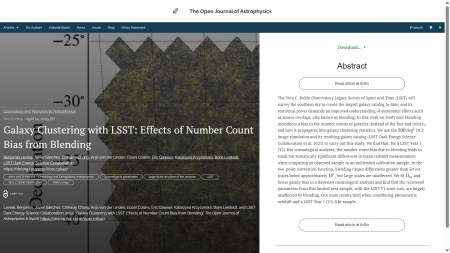
The first paper to report is “Galaxy Clustering with LSST: Effects of Number Count Bias from Blending” by Benjamin Levine (Stony Brook, NY), Javier Sánchez (STScI, MD), Chihway Chang (Chicago, IL) Anja von der Linden (Stony Brook), Eboni Collins (Dillard, LA), Eric Gawiser (Rutgers, NJ), Katarzyna Krzyżańska (Cornell, NY), Boris Leistedt (Imperial College, UK) on behalf of the LSST Dark Energy Science Collaboration.

This presents a simulation-based study of the effect of source overlaps (blending) on galaxy counts expected for the Vera C. Rubin Legacy Survey of Space and Time (LSST). The paper is in the folder Cosmology and NonGalactic Astrophysics and was published on Monday 14th April 2025. The overlay is here:
 

You can find the officially-accepted version of the paper on arXiv here.

The second paper to announce, published onTuesday 15th April 2025,  “Rapid, strongly magnetized accretion in the zero-net-vertical-flux shearing box” by Jonathan Squire (Otago, New Zealand), Eliot Quataert (Princeton, USA) & Philip F. Hopkins (Caltech, USA). This  paper presents a numerical study of turbulence in a flux shearing box, with discussion of the implications of the results for global accretion disk models and simulations thereof. It was published in the folder High-Energy Astrophysical Phenomena and the overlay is here:


You can read the officially accepted version of this paper on arXiv here.

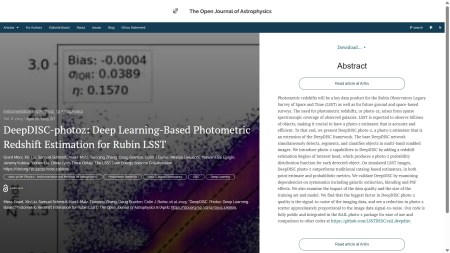
The third paper of the week, published on Wednesday April 16th 2025,   is “DeepDISC-photoz: Deep Learning-Based Photometric Redshift Estimation for Rubin LSST” by Grant Merz (University of Illinois at Urbana-Champaign, USA) and 13 others (all based in the USA) on behalf of the LSST Dark Energy Science Collaboration. This paper describes adding photometric redshift estimation to the DeepDISC framework for classification objects in co-added images for use with the Vera C. Rubin LSST survey. It can be found in the folder Instrumentation and Methods for Astrophysics.

Here is the overlay:
 

You can find the officially accepted version of this paper on arXiv here.

The next one to report is “Multidimensional Nova Simulations with an Extended Buffer and Lower Initial Mixing Temperatures” by Alexander Smith Clark and Michael Zingale (Stony Brook University, NY, USA). This paper presents new computer models of classical novae with improved ability to follow nucleosynthesis in the thermonuclear outburst and better treatment of convective transport. This one was also published on Wednesday 16th April 2025 but in the folder Solar and Stellar Astrophysics.

Here is the overlay:


The official published version can be found on the arXiv here.

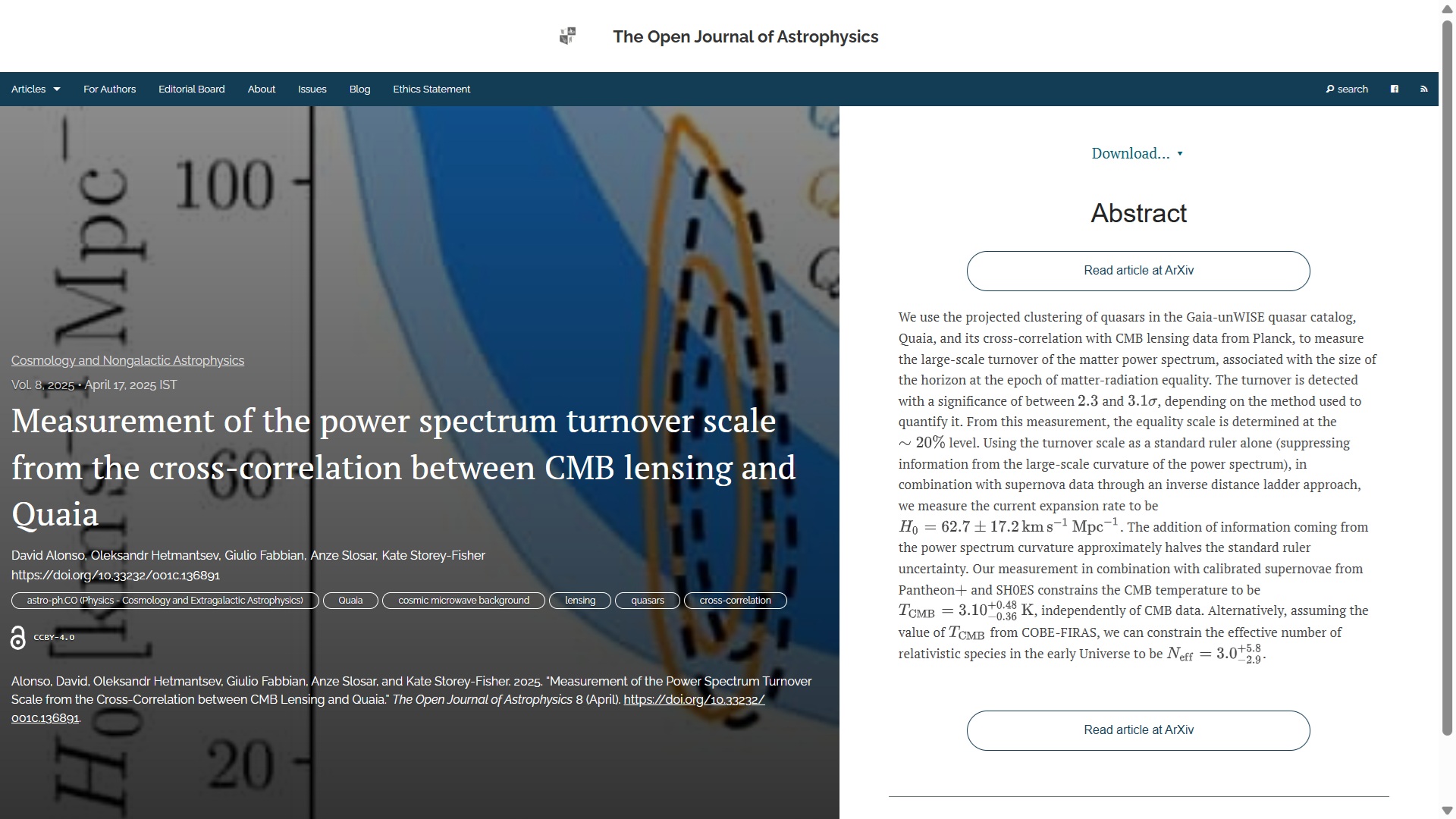
The last paper of the five published this week is “Measurement of the power spectrum turnover scale from the cross-correlation between CMB lensing and Quaia” by David Alonso (Oxford, UK), Oleksandr Hetmantsev (Kyiv, Ukraine), Giulio Fabbian (Cambridge, UK), Anze Slosar (Brookhaven National Laboratory, USA) and Kate Storey-Fisher (Stanford, USA). This is a discussion of using the spatial correlations of quasars and their cross-correlations with cosmic microwave background lensing data to measure a feature corresponding to the matter-radiation equality scale with consequences for cosmological parameter estimation. It was published on Thursday 17th April 2025 in the folder Cosmology and NonGalactic Astrophysics.

The overlay is here:

You can find the officially accepted version on arXiv here.

That’s all the papers for this week. I’ll just add a couple of things.

One is that, although there have been weeks before in which we have published five or more papers, we still haven’t managed to have a week on which we’ve published a paper on every weekday. This week we had two on Wednesday 16th but didn’t have any yesterday (Friday).

The second is that tt has been a while since I last posted a breakdown of the running costs here at the Open Journal of Astrophysics. Today I received an email from Scholastica, our service provider, reminding me our costs will go up shortly (from 22nd April). In the interest of transparency I am passing this information on here.

The new prices will be as follows:

  • Peer Review System annual cost will be $425/year (was $350/year) plus $10 per submission (no change)
  • OA Publishing Platform annual cost will be $1,499/year (was $1,399/year)

Last year we published 120 papers with about 250 submissions. We’re a bit ahead of that this year, so I estimate that our next year’s costs will be a bit less than $5000. That’s still less than the typical APC for a single paper at many journals.

I hope this clarifies the situation.

Biosignature Hype

Posted in Astrohype, Bad Statistics, The Universe and Stuff with tags , , , , on April 17, 2025 by telescoper

I was thinking just the other day that I haven’t posted much in either the Astrohype or the Bad Statistics folders on this blog. Well today I found an item that belongs in both categories. Many people will have seen the widespread press coverage of a misleading claim of the discovery of alien life; see, e.g., here. This misleading press coverage is based on a misleading press release from the University of Cambridge which you can find here.

The story is based on a paper in the pay-to-publish Astrophysical Journal Letters with the title “New Constraints on DMS and DMDS in the Atmosphere of K2-18 b from JWST MIRI“. The DMS and DMDS in the title refer to Dimethyl Sulphide and Dimethyl Disulphide respectively. These are interpreted by the authors as biosignatures.

There are two main problems with this claim. One is that DMS and DMDS are not necessarily biosignatures in the first place; see here for the reasons. The other is that there isn’t even any evidence for the detection of DMS or DMDS anyway. Here is the spectrum of which the lead author of the paper, Prof. Nikku Madhusudhan, has claimed “the signal came through loud and clear”.

Yeah, right. In statistical terms this is a non-detection. The Bayes Factor used in the paper to quantify the evidence for a model with DMS and/or DMDS over one without is just 2.62 in the logarithm. That’s not a detection by any stretch of the imagination; to be anywhere near convincing a Bayes Factor has to be at least 100. The subsequent cherry-picking of the data to improve the apparent probability of a detection is just statistical flummery.

Notice that the use of the phrase “Constraints on” in the title of the paper does not indicate that the article presents evidence that a detection has been made. That the claim has somehow morphed into the “the strongest evidence for life beyond our solar system” is absurd. The most charitable thing I can say is that Prof. Madhusudhan must have been carried away by enthusiasm. This doesn’t reflect very well on Cambridge University either.

This episode worries me greatly. This is a time of increasing hostility towards science and this sort of thing can only make matters worse. Scientists need to be much more careful in communicating the uncertainties in their results.

UPDATE: There’s a now paper on arXiv here that argues that a straight line is a better fit to the data, in other words that there is no strong statistical evidence for spectral features at all.

That was the Dean’s Lecture that was..

Posted in Biographical, Maynooth, The Universe and Stuff with tags , , on April 15, 2025 by telescoper

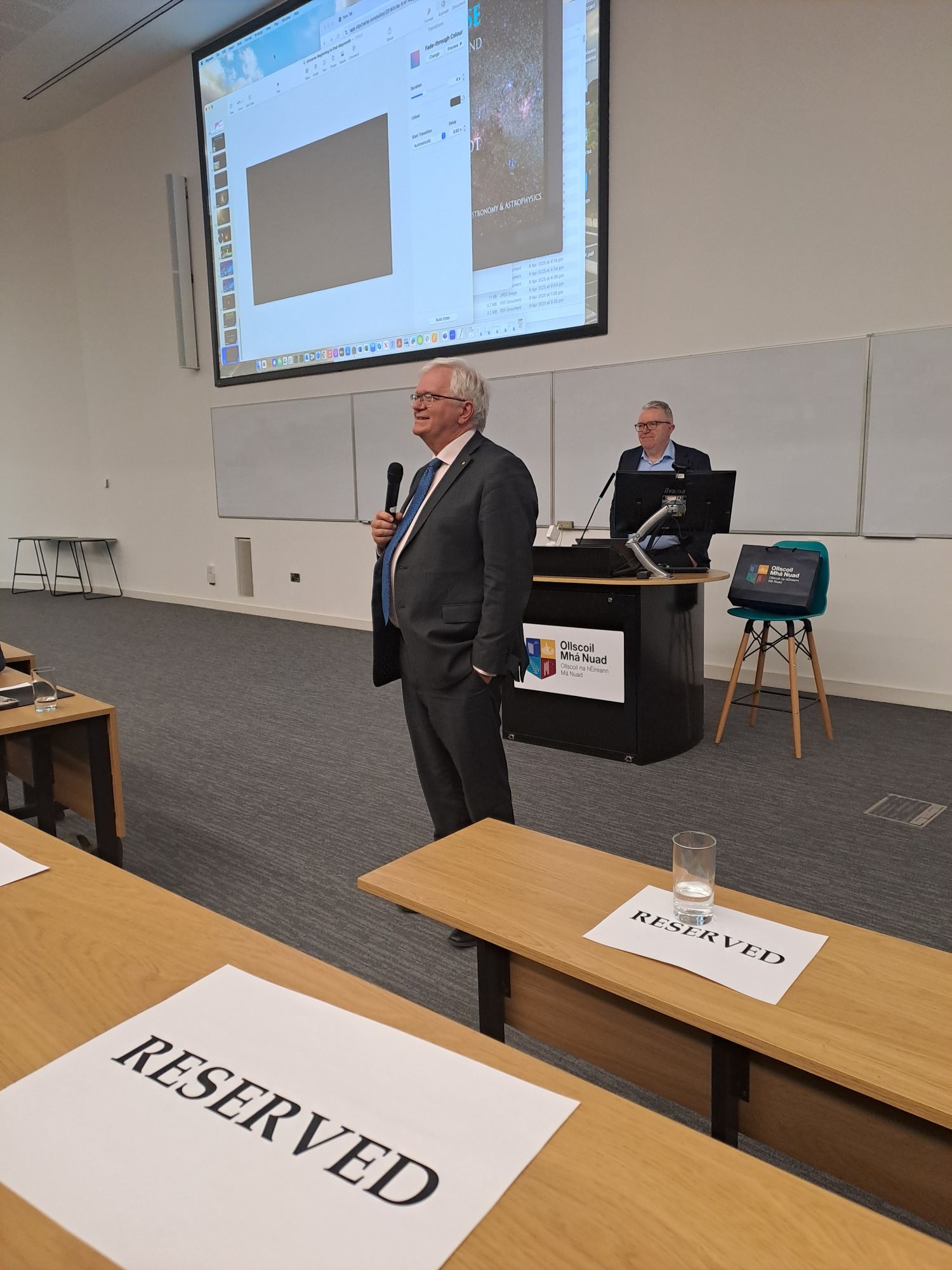
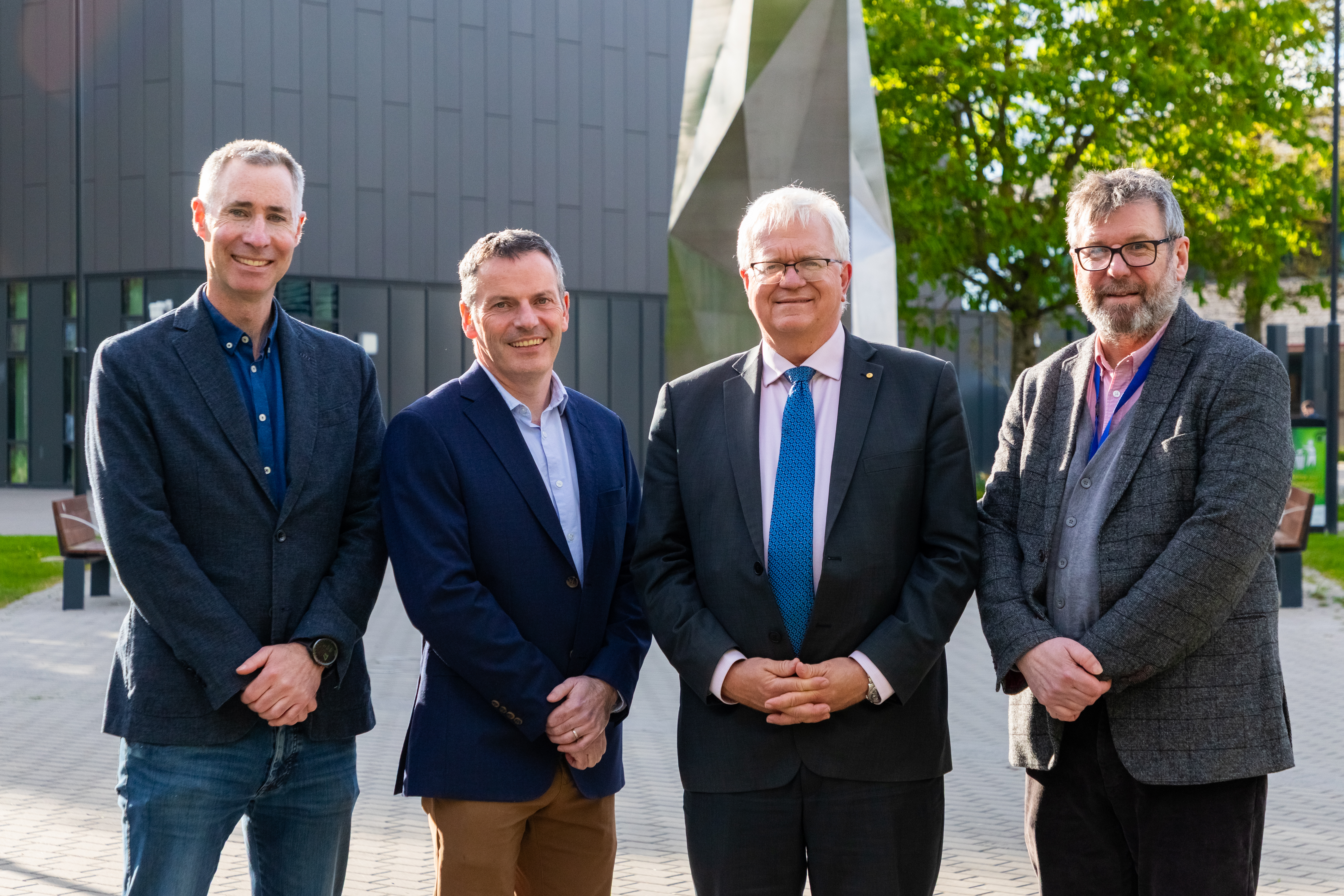
As it was foretold, last night we had a very special event in Maynooth in the form of a public lecture with the title The Universe from Beginning to End by Nobel Laureate Prof. Brian Schmidt. Brian actually arrived on Sunday and is still here today; he will be returning to Australia from Dublin this evening. It was really great of him to take the time to visit us here in Maynooth not just for the lecture but to chat informally with staff and students. He also did some interviews with the media, e.g. here and here.

The talk, which was for a lay audience, was extremely well attended. In fact we had to move it to a larger venue than we originally intended. I don’t know the official attendance figures but I would guess somewhere between 400 and 500 people came. The talk was excellent, and there were lots of very good questions from the audience afterwards which Brian dealt with very engagingly. The talk was recorded and if it becomes available publicly I will provide a link.

At the end I even found myself on the list to have dinner with Brian in a local restaurant. All in all, it was an excellent day.

Weekly Update from the Open Journal of Astrophysics – 12/04/2025

Posted in OJAp Papers, Open Access, The Universe and Stuff with tags , , , , , , , , , , , , , , , , on April 12, 2025 by telescoper

Time for the weekly Saturday morning update of papers published at the Open Journal of Astrophysics. Since the last update we have published four new papers, which brings the number in Volume 8 (2025) up to 37 and the total so far published by OJAp up to 272.

In chronological order of publication, the four papers published this week, with their overlays, are as follows. You can click on the images of the overlays to make them larger should you wish to do so.

The first paper to report is “Searching for new physics using high precision absorption spectroscopy; continuum placement uncertainties and the fine structure constant in strong gravity” by Chung-Chi Lee (Big Questions Institute (BQI), Sydney, Australia), John K. Webb (Cambridge, UK), Darren Dougan (BQI), Vladimir A. Dzuba & Victor V. Flambaum (UNSW, Australia) and Dinko Milaković (Trieste, Italy).

This presents a discussion of the problem of continuum placement in high-resolution spectroscopy, which impacts significantly on fine structure constant measurements, and a method for mitigating its effects. The paper is in the folder Solar and Stellar Astrophysics and was published on Tuesday 8th April 2025. The overlay is here:

You can find the officially-accepted version of the paper on arXiv here.

The second paper to announce, also published on 8th April 2025,  is “Deciphering Spatially Resolved Lyman-Alpha Profiles in Reionization Analogs: The Sunburst Arc at Cosmic Noon” by Erik Solhaug (Chicago, USA), Hsiao-Wen Chen (Chicago), Mandy C. Chen (Chicago),  Fakhri Zahedy (University of North Texas),  Max Gronke (MPA Garching, Germany),  Magdalena J. Hamel-Bravo (Swinburne, Australia), Matthew B. Bayliss (U. Cincinatti), Michael D. Gladders  (Chicago), Sebastián López (Universidad de Chile), Nicolás Tejos (Universidad Católica de Valparaíso, Chile).

This paper, which presents a study of the Lyman-alpha emission properties of a gravitationally-lensed galaxy at redshift z=2.37, appears in the folder Astrophysics of Galaxies. It was published


You can read the officially accepted version of this paper on arXiv here.

The third paper of the week  is “On the progenitor of the type Ia supernova remnant 0509-67.5” by Noam Soker (Technion, Haifa, Israel). This one was published on Wednesday 9th April 2025 in the folder High-Energy Astrophysical Phenomena. The author discusses possible ideas for the origin of a supernova that exploded inside a planetary nebula.

Here is the overlay:


You can find the officially accepted version of this paper on arXiv here.

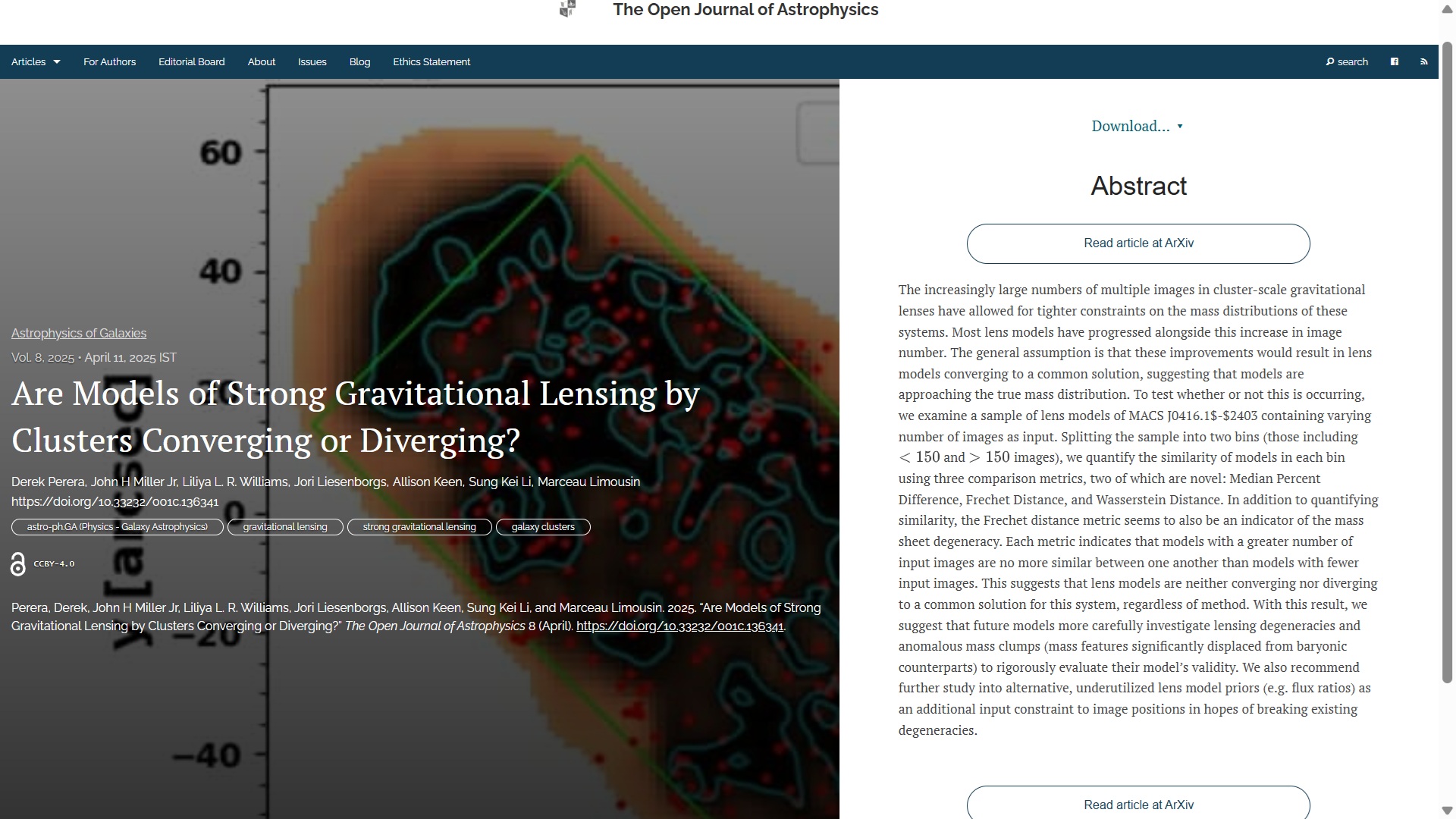
Last (but certainly) not least for this week, published on April 11th 2025, we have “Are Models of Strong Gravitational Lensing by Clusters Converging or Diverging?” by Derek Perera (U. Minnesota), John H Miller Jr & Liliya L. R. Williams (U. Minnesota, USA), Jori Liesenborgs (Hasselt U., Belgium), Allison Keen (U. Minnesota), Sung Kei Li (Hong Kong University), Marceau Limousin (Aix Marseille Univ., France).  This papers study various models of a strong gravitational lensing system, the results suggesting that lens models are neither converging to nor diverging from a common solution for this system, regardless of method.

Here is the overlay:


The official published version can be found on the arXiv here.


That’s all the papers for this week. By way of a postscript I’ll just mention that the gremlins that have affected submissions to Crossref (which we rely on for registering the article metadata) have now been resolved and normal services have been restored.

R.I.P. Jerry Ostriker (1937-2025)

Posted in R.I.P., The Universe and Stuff with tags , , , , , , on April 9, 2025 by telescoper

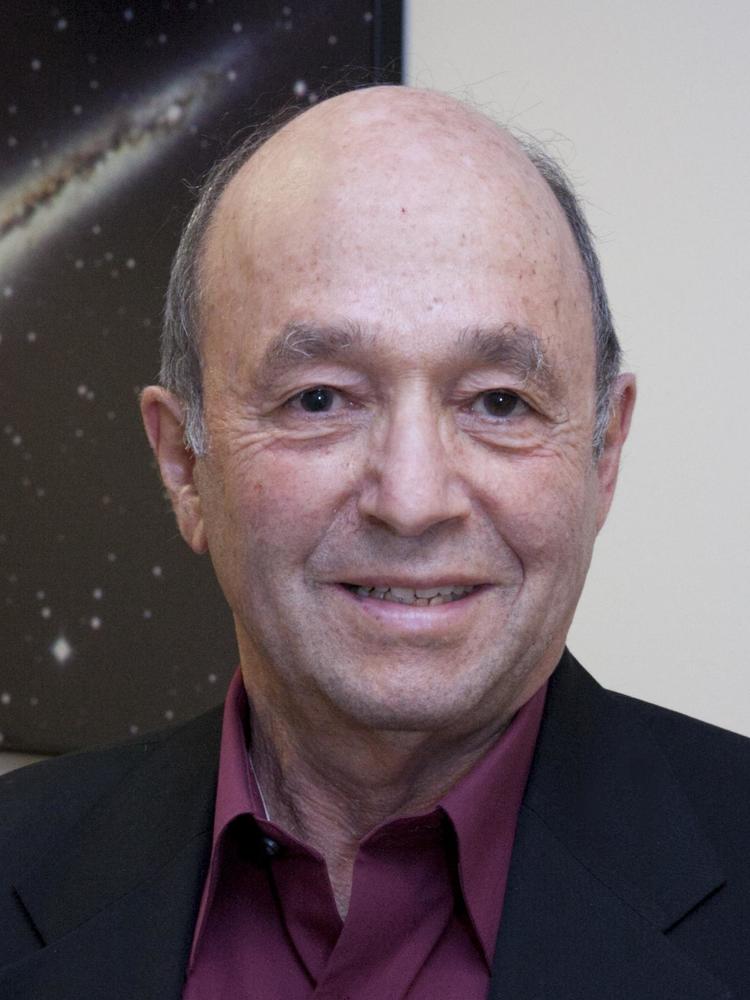
Once again I find myself using this blog to pass on sad news. This time it is of the death of renowned astrophysicist Jerry Ostriker (pictured left in 2012), who passed away on Monday 6th April 2025 just a week before his 88th birthday.

Jeremiah Paul Ostriker (to give his full name) was an extremely energetic, versatile and influential theorist who worked on a wide range of problems in diverse areas of astrophysics and produced a number of classic papers. Close to my own specialism I would quote two in particular: one written with Jim Peebles in 1973 about the stability of galactic disks; and the other with Martin Rees in 1977 about the role of gas cooling and fragmentation in determining the size of galaxies and clusters. He also did much to establish the use of hydrodynamic simulations in cosmology and was an early adopter of the current standard cosmological model, including a cosmological constant. He worked on many other things too, including pulsars and galactic nuclei.

I only met Jerry Ostriker a few times, mainly at conferences – where he was never shy to contribute to discussions after talks – but also once back in the 1990s when I was a visitor Princeton (where he was Professor). I didn’t have much time to talk to him then as he always seemed to be on the go, so I never really got to know him personally. After spending most of his career in Princeton, including a spell as Provost, in 2001 Ostriker moved to Cambridge for a short stint as Plumian Professor, before returning to Princeton.

There is a very nice obituary of Jerry Ostriker by Dennis Overbye in the New York Times.

Rest in peace, Jerry Ostriker

Weekly Update from the Open Journal of Astrophysics – 05/04/2025

Posted in OJAp Papers, Open Access, The Universe and Stuff with tags , , , , , on April 5, 2025 by telescoper

It’s time once more for the regular Saturday morning update of papers published at the Open Journal of Astrophysics. Since the last update we have published one new paper. The number of articles in Volume 8 (2025) is now up to 33 and the total so far published by OJAp up to 268.

The paper concerned, published on 2nd April 2025, is “The molecular gas content throughout the low-z merger sequence” by Mark T. Sargent (ISSI, Bern), S. L. Ellison (U. Victoria, Canada), J. T. Mendel (ANU), A. Saintonge (UCL), D. Cs. Molnár & T. Schwandt (U. Sussex), J. M. Scudder (Oberlin College, USA) and G. Violino (U. Hertfordshire). It is published in the folder Astrophysics of Galaxies and it discusses the observed properties of molecular gas in post-merger galaxies and interacting pairs and the physical origin of these properties.

Here is the overlay:

You can read the officially accepted version of this paper on arXiv here.

That’s all for this week. I’ll do another update next Saturday.

The Universe from Beginning to End

Posted in Maynooth, The Universe and Stuff with tags , , , on April 2, 2025 by telescoper

It’s not every day that you get the chance to attend a lecture by a Nobel Laureate, but 14th April 2025 will be such a day in Maynooth because the annual Dean’s Lecture for the Faculty of Science and Engineering at Maynooth University will be given by Professor Brian Schmidt who was one of the three winners of the 2011 Nobel Prize for Physics.

The description of his lecture is as follows:

Astronomers have pieced together the story of our Universe that begins more than 13 Billion years ago in a Big Bang. In the 2025 Dean’s Lecture, Nobel Prize Winner Prof Brian Schmidt will describe the journey that science has thus far taken to understand our Universe, describing what we know about the Cosmos and how we know it, as well as reflecting on some of the mysteries that remain. A chance to learn a bit about everything from Dark Energy to Black Holes, and an opportunity for the audience to ask questions at the end of the lecture.

The lecture is intended to be accessible to a wide audience and will be in person. It is free to attend but you need to register because space in the lecture venue is limited. To register and also find out more about the event please visit Eventbrite below:

I am delighted that Brian is taking time out of his busy schedule to visit us in Maynooth and am looking forward not only to his lecture but also for the chance for him to meet and talk to our students.

Last Chance to apply for the Professorial Position in Observational Astrophysics or Cosmology at Maynooth University!

Posted in Maynooth, The Universe and Stuff with tags , , , , on March 31, 2025 by telescoper

A couple of months ago I announced here a vacancy for a Professor of Observational Astrophysics or Cosmology at Maynooth. The position is on the AAS Jobs Register here. The deadline is 31st March 2025 which is today so if you were thinking of applying then this is your last chance! Applications close at 23.30 Irish Time; the clocks went forward yesterday so it’s actually 00.30 tomorrow CEST so you still have time. The application portal is here.

The strategic case for this Chair revolves around broader developments in the area of astrophysics and cosmology at Maynooth. Currently there are two groups active in research in these areas, one in the former Department of Experimental Physics (which is largely focussed on astronomical instrumentation) and the other, in the former Department of Theoretical Physics, which is theoretical and computational. We want to promote closer collaboration between these research strands. The idea with the new position is that the holder will nucleate and lead a research programme in the area between these existing groups as well as getting involved in outreach and public engagement.

It is intended that the position to appeal not only to people undertaking observational programmes using ground-based facilities (e.g. those provided by ESO, which Ireland recently joined), or those exploiting data from space-based experiments, such as Euclid, as well as people working on multi-messenger astrophysics, gravitational waves, and so on.

P. S. For those of you reading this from outside Ireland the job is tenured and includes a defined benefit pension way better than the equivalent UK system.

The KiDS Legacy

Posted in The Universe and Stuff with tags , , , , , , , , on March 30, 2025 by telescoper

What with all the cosmological goings-on of the past couple of weeks – see here, here and here – I quite forgot to mention another important set of results. These are from the final data release Kilo-Degree Survey known as KiDS for short and represent a final analysis of the complete dataset. For those of you not in the know, KiDs is a weak lensing shear tomography survey and its core science drivers are to map the large scale matter distribution in the Universe and constrain the equation of state of Dark Energy. The results can be found in three papers on arXiv, which you can add to your reading list:

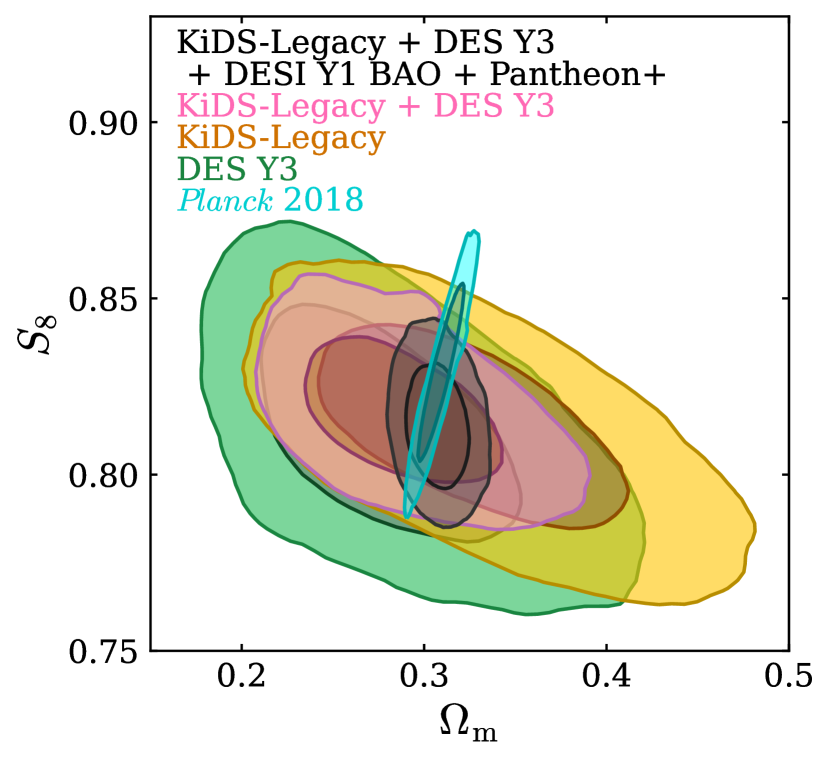
As far as I’m concerned, the main result to leap out from the cosmological analysis, which primarily constrains the clumpiness of matter in the universe, expressed by the density parameter Ωm and a fluctuation amplitude σ8 in the combined parameter “S8“, which is constrained almost independently from Ωm. The value obtained for this parameter by KiDS has previously been “in tension” with values from other experiments (notably Planck) ; see here for a discussion. The new results, however, seem consistent with the standard cosmological model. Here is a figure from the last paper in the above list that illustrates the point:

As is often the case, there’s also one of those nice Cosmology Talks videos that discusses this and other aspects of the KiDS Legacy results to which I refer you for more details!