
Cartoon stolen without proper permission from Strange Matter.
Follow @telescoperAs autumn turns to winter the thoughts of many an undergraduate turn to the task of applying for PhDs. Nowadays this involves a lot of trawling through webpages looking for interesting projects and suitable funding opportunities.
In order to help prospective postgraduates this year, the Astronomy Centre at the University of Sussex has produced a number of videos to give some information about the available projects. To start with, here are four examples, covering topics in theoretical, computational and observational astrophysics:
For information, we’re expecting to offer at least six PhD studentships in Astronomy for September 2014 entry. Also there’s a University-wide postgraduate open day coming up on December 4th..
Follow @telescoperHere’s a challenge for cosmologists and aspiring science communicators out there. Most of you will know the standard cosmological model involves a thing, called Dark Energy, whose existence is inferred from observations that suggest that the expansion of the Universe appears to be accelerating.
That these observations require something a bit weird can be quickly seen by looking at the equation that governs the dynamics of the cosmic scale factor 
The terms in brackets relate to the density and pressure of the fluid, respectively. If the pressure is negligible (as is the case for “dust”), then the expansion is always decelerating because the density of matter is always positive quantity; we don’t know of anything that has a negative mass.
The only way to make the expansion of such a universe actually accelerate is to fill it with some sort of stuff that has
In the lingo this means that the strong energy condition must be violated; this is what the hypothetical dark energy component is introduced to do. Note that this requires the dark energy to exert negative pressure, ie it has to be, in some sense, in tension.
However, there’s something about this that seems very paradoxical. Pressure generates a force that pushes, tension corresponds to a force that pulls. In the cosmological setting, though, increasing positive pressure causes a greater deceleration while to make the universe accelerate requires tension. Why should a bigger pushing force cause the universe to slow down, while a pull causes it to speed up?
The lazy answer is to point at the equation and say “that’s what the mathematics says”, but that’s no use at all when you want to explain this to Joe Public.
Your mission, should you choose to accept it, is to explain in language appropriate to a non-expert, why a pull seems to cause a push…
Your attempts through the comments box please!
Follow @telescoperThis morning I was glancing through an old book called Science since 1500, which was written by H.T. Pledge and published in 1939 by Her Majesty’s Stationery Office on behalf of the Ministry of Education.
The map shows the distribution of birthplaces of famous British scientists (from about 1800 to about 1900). This map is restricted to the “exact” sciences, and I’m not exactly sure what that means, but judging by the names, it includes physics, astronomy and chemistry. Clustering is apparent, especially in Edinburgh and Glasgow but also in Ireland.
Note, however, the relative dearth of such scientists from the North of England. In fact there is only one (appropriately enough labelled ‘1’), though there are several born in the Midlands, especially near Manchester..
I have scanned the legend which reveals the names, and will post it in due course, but I thought it would be fun to have a small competition to see who knows the identity of the Number 1 Scientist from the North.
If you’d like to guess any of the others please feel free too. Just to give an example, No. 7 is Arthur Stanley Eddington (who was born in 1882 in Kendal, in what is now Cumbria).
Answers through the comments box please!
Follow @telescoper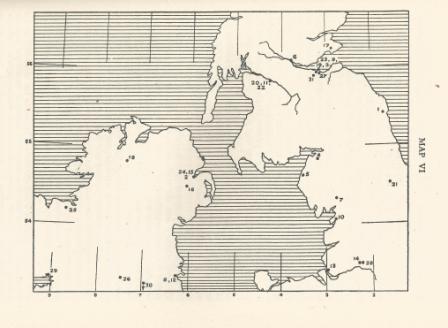
Yesterday I overheard some Electrodynamics students talking about the fact that all the famous names attached to pioneering laws or theorems in that subject seem to be either French (Biot-Savart, Laplace, Poisson..) or German (Gauss, Helmholtz…). Why are there no British names in this list?
Well, there was Faraday, of course. But Michael Faraday was primarily an experimentalist rather than a theorist, which sets him apart from the others already mentioned. So why is it that British theoretical was behind continental Europe in the early part of the 19th Century when all this important work on electricity and magnetism was being done.
There was also Maxwell, but he came along a bit later; he published his theory of electromagnetism in 1861/2. So why were the British so slow to enter this field?
Well, my theory of this is that it’s all the fault of Isaac Newton. I came to this conclusion when reading about the work of British mathematician and physicist George Green, who lived from 1793 until 1841, and who left a substantial legacy for modern theoretical physicists, in Green’s theorems and Green’s functions. George Green is also credited as being the first person to use the word “potential” in electrostatics. Green was the son of a Nottingham miller who, amazingly, taught himself mathematics and did most of his best work, especially his remarkable Essay on the Application of mathematical Analysis to the theories of Electricity and Magnetism (1828) before starting his studies as an undergraduate at the University of Cambridge (which he did at the age of 30, after his father died, and he leased out the mill he consequently inherited, to pay for his studies).
Extremely unusually for British mathematicians of his time, Green taught himself from books that were published in France. This gave him a huge advantage over his national contemporaries in that he learned the form of differential calculus that originated with Leibniz, which was far more elegant than that devised by Isaac Newton (which was called the method of fluxions).
Great scientist though he was, Newton’s influence on the development of physics in Britain was not entirely positive. Newton was held in such awe, especially in Cambridge, that his inferior mathematical approach was deemed to be the “right” way to do calculus and generations of scholars were forced to use it. This held back British science until the use of fluxions was phased out. Green himself was forced to learn fluxions when he went as an undergraduate to Cambridge despite having already learned the better method.
Unfortunately, Green’s great pre-Cambridge work on mathematical physics didn’t reach wide circulation in the United Kingdom until after his death. William Thomson, later Lord Kelvin, found a copy of Green’s Essay in 1845 and promoted it widely as a work of fundamental importance. This contributed to the eventual emergence of British theoretical physics from the shadow cast by Isaac Newton which reached one of its heights just a few years later with the publication a fully unified theory of electricity and magnetism by James Clerk Maxwell.
Follow @telescoperThere’s an interesting and unusual article on the arXiv today entitled Why is Astronomy Important? Here is the abstract:
For a long time astronomers and other scientists believed that the importance of their work was evident to society. But in these difficult days of financial austerity, even the most obvious benefits of science have to undergo careful scrutiny. Eradicating poverty and hunger is a worldwide priority, and activities that do not directly attempt to resolve these issues can be hard to justify and support. However, several studies have told us that investing in science education, research and technology provides a great return not only economically, but culturally and indirectly for the population in general and has helped countries to face and overcome crises. The scientific and technological development of a country or region is closely linked to its human development index a statistic that is a measure of life expectancy, education and income.
The full text of the paper can be found on the IAU website here.
The article focusses on matters relating to the transfer of technology between astronomy and, e.g. industry, aerospace, and medicine, its effect on technology we are familiar with in everyday life, on astronomy as an exemplar of international collaboration and on its wider cultural and philosophical impact. Many of the points made in this article can also be found in the Royal Astronomical Society‘s free publication Beyond the Stars: Why Astronomy Matters which is available for free online here.
I recommend you read the full article and make your own mind up about why astronomy is important. I have just two comments, which are partly questions. The first is that I’ve always had a bit of a problem with the interpretation of correlations like that mentioned in the last sentence of the abstract (between technological development and the human development index). The issue is the basic one that correlation of two phenomena does not necessarily imply that one causes the other. Is it really possible to establish rigorously a causal link between spending money on astronomy and wider societal benefits? I’m not saying that there isn’t such a link, just that it’s difficult to interpret evidence which is dependent on so many factors. Could one not argue instead that more developed countries spend more money on astronomy because they can afford to?
The other thing that troubles me with arguments of the type presented in the paper is that there is a danger that emphasizing the transfer of knowledge to other disciplines as the rationale for funding astronomy implicitly negates the argument that astronomy has intrinsic worth of its own. In other words, answering the question “Why is Astronomy important?” seems to accept at the outset that it isn’t. If it is indeed the case that we can only justify astronomy because it has produced spin-offs in, e.g., medicine, why not just spend more money on medicine and forget the astronomy?
I’m not saying that the technology transfer arguments carry no weight, just that they are definitely double-edged and should be used with caution. For the record, I think we should fund Astronomy (and other sciences) primarily because they are an essential part of the fabric of our culture and civilization; all the rest is icing on the cake. In other words, I support state funding for the sciences for very much the same reasons as for the arts. I’m fully aware, however, that this unlikely to persuade the powers that be as effectively as an appeal to economic benefits; that’s why science funding has fared so much better than arts funding in this age of austerity.
Follow @telescoperHere’s a fascinating little bit of history for you. The other day I discovered the old Visitor’s Book in which staff of the Astronomy Centre at the University of Sussex used to record the names of distinguished guests who appeared here to give seminars. There are many illustrious names in the book, including for example at the bottom of this page (from 1968), Ed Salpeter.

However, the name to which I’d like to draw your attention is in the middle of this page. On 17th August 1968 the Astronomy Centre played host to two Russian visitors, an astrophysicist called Dr G.S. Khromov from the Sternberg Astronomical Institute in Moscow and a chap from the state-run Novosti Press Agency by the name of Gennadi I. Gerasimov.
I know little of Khromov’s work in astrophysics, but it is significant that he was permitted to visit the United Kingdom during the Cold War period, long before Glasnost and the eventual break-up of the Soviet Union. The second name is much more famous. Gennadi Ivanovich Gerasimov rose through the ranks of the Soviet System and eventually during the 1980s became Foreign Affairs spokesman for Mikhail Gorbachev and press spokesman for Eduard Shevardnadze.
So what was he doing in Sussex in 1968 attending an astronomy seminar? Well, the answer to that is that during the 1960s Russian scientists were generally only allowed to visit the West if they were accompanied by a “minder”, usually some form of KGB operative whose job was to ensure the scientist did not defect; the use of a press agency as cover story was pretty standard in such cases. I’ve heard similar stories from Russian colleagues who travelled to the west under similar constraints during this period, and even some in which the scientist was the cover story for the agent!
So Gennadi Gerasimov was almost certainly at one time a KGB agent. Given the career of the current President of Russia, this should come as no surprise…
Follow @telescoperDuring the late afternoon twilight of November 1st 1941, 72 years ago today, renowned American photographer and environmentalist Ansel Adams took this wonderful photograph of the moon over Hernandez, New Mexico. It’s such a celebrated image that it even has its own wikipedia page, but because it seems to fit the theme of this blog I couldn’t resist sharing it here:
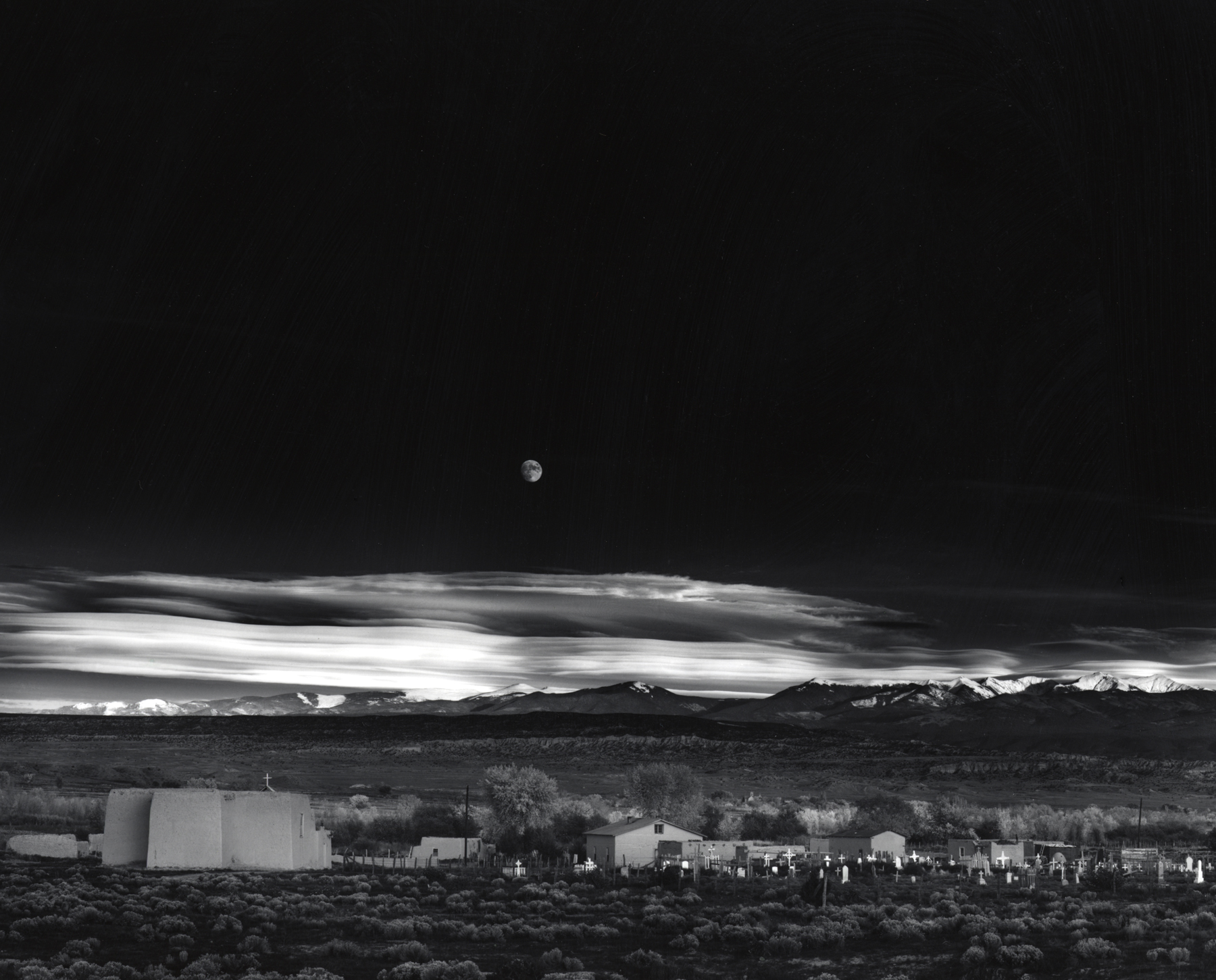
Click on the image for higher resolution
Follow @telescoperThere’s an important and interesting paper just out on the arxiv by the Lux Dark Matter Collaboration. Here is the abstract:
The Large Underground Xenon (LUX) experiment, a dual-phase xenon time-projection chamber operating at the Sanford Underground Research Facility (Lead, South Dakota), was cooled and filled in February 2013. We report results of the first WIMP search dataset, taken during the period April to August 2013, presenting the analysis of 85.3 live-days of data with a fiducial volume of 118 kg. A profile-likelihood analysis technique shows our data to be consistent with the background-only hypothesis, allowing 90% confidence limits to be set on spin-independent WIMP-nucleon elastic scattering with a minimum upper limit on the cross section of 7.6×10−46 cm2 at a WIMP mass of 33 GeV/c2. We find that the LUX data are in strong disagreement with low-mass WIMP signal interpretations of the results from several recent direct detection experiments.
For those of you not up with the lingo, a WIMP in this context is a Weakly Interacting Massive Particle, one of the preferred candidates for the dark matter that most cosmologists think pervades the Universe.
The most important thing about the LUX results is that they pretty much exclude results from previous experiments, especially DAMA/LIBRA, that have claimed evidence for dark matter particles at low mass (i.e. 6-10 GeV WIMPS): LUX had expected 1550 dark matter events if the other detections were valid, but could not claim any events that were not consistent with background. They also set new limits on higher mass dark matter, which is 20 times better than previous limits. These new limits are from 85 days of running the experiment; further results will be reported after an additional 300 days in 2014/2015, when the results will increase the sensitivity by a factor of five or so.
So the question is, if LUX is correct, what on Earth is going on at DAMA? Answers on a postcard, or through the comments box, please!
Follow @telescoperI noticed this abstract (of a paper by Rest et al.) on the arXiv the other day:
We present griz light curves of 146 spectroscopically confirmed Type Ia Supernovae (0.03<z<0.65) discovered during the first 1.5 years of the Pan-STARRS1 Medium Deep Survey. The Pan-STARRS1 natural photometric system is determined by a combination of on-site measurements of the instrument response function and observations of spectrophotometric standard stars. We have investigated spatial and time variations in the photometry, and we find that the systematic uncertainties in the photometric system are currently 1.2% without accounting for the uncertainty in the HST Calspec definition of the AB system. We discuss our efforts to minimize the systematic uncertainties in the photometry. A Hubble diagram is constructed with a subset of 112 SNe Ia (out of the 146) that pass our light curve quality cuts. The cosmological fit to 313 SNe Ia (112 PS1 SNe Ia + 201 low-z SNe Ia), using only SNe and assuming a constant dark energy equation of state and flatness, yields w = -1.015^{+0.319}_{-0.201}(Stat)+{0.164}_{-0.122}(Sys). When combined with BAO+CMB(Planck)+H0, the analysis yields \Omega_M = 0.277^{+0.010}_{-0.012} and w = -1.186^{+0.076}_{-0.065} including all identified systematics, as spelled out in the companion paper by Scolnic et al. (2013a). The value of w is inconsistent with the cosmological constant value of -1 at the 2.4 sigma level. This tension has been seen in other high-z SN surveys and endures after removing either the BAO or the H0 constraint. If we include WMAP9 CMB constraints instead of those from Planck, we find w = -1.142^{+0.076}_{-0.087}, which diminishes the discord to <2 sigma. We cannot conclude whether the tension with flat CDM is a feature of dark energy, new physics, or a combination of chance and systematic errors. The full Pan-STARRS1 supernova sample will be 3 times as large as this initial sample, which should provide more conclusive results.
The mysterious Pan-STARRS stands for the Panoramic Survey Telescope and Rapid Response System, a set of telescopes cameras and related computing hardware that monitors the sky from its base in Hawaii. One of the many things this system can do is detect and measure distant supernovae, hence the particular application to cosmology described in the paper. The abstract mentions a preliminary measurement of the parameter w, which for those of you who are not experts in cosmology is usually called the “equation of state” parameter for the dark energy component involved in the standard model. What it describes is the relationship between the pressure P and the energy density ρc2 of this mysterious stuff, via the relation P=wρc2. The particularly interesting case is w=-1 which corresponds to a cosmological constant term; see here for a technical discussion. However, we don’t know how to explain this dark energy from first principles so really w is a parameter that describes our ignorance of what is actually going on. In other words, the cosmological constant provides the simplest model of dark energy but even in that case we don’t know where it comes from so it might well be something different; estimating w from surveys can therefore tell us whether we’re on the right track or not.
The abstract explains that, within the errors, the Pan-STARRS data on their own are consistent with w=-1. More interestingly, though, combining the supernovae observations with others, the best-fit value of w shifts towards a value a bit less than -1 (although still with quite a large uncertainty). Incidentally value of w less than -1 is generally described as a “phantom” dark energy component. I’ve never really understood why…
So far estimates of cosmological parameters from different data sets have broadly agreed with each other, hence the application of the word “concordance” to the standard cosmological model. However, it does seem to be the case that supernova measurements do generally seem to push cosmological parameter estimates away from the comfort zone established by other types of observation. Could this apparent discordance be signalling that our ideas are wrong?
That’s the line pursued by a Scientific American article on this paper entitled “Leading Dark Energy Theory Incompatible with New Measurement”. This could be true, but I think it’s a bit early to be taking this line when there are still questions to be answered about the photometric accuracy of the Pan-Starrs survey. The headline I would have picked would be more like “New Measurement (Possibly) Incompatible With Other Measurements of Dark Energy”.
But that would have been boring…
Follow @telescoper


 In the Dark