Archive for the The Universe and Stuff Category

Free Atkins!

Posted in Biographical, Education, The Universe and Stuff with tags , , , , , , on May 26, 2024 by telescoper

I took my first degree in the Natural Sciences Tripos at the University of Cambridge. This involved doing a very general first year comprising four different elements that could be chosen flexibly. I quickly settled on Physics, Chemistry and  Mathematics for Natural Sciences to reflect my A-level results but was struggling for the fourth. In the end I picked the one that seemed most like Physics, a course called Crystalline Materials. I didn’t like that at all, and wish I’d done some Biology instead – Biology of Cells and Biology of Organisms were both options – or even Geology, but I stuck with it for the first year.

Having to do such a wide range of subjects was very challenging. The timetable was densely packed and the pace was considerable. In the second year, however, I was able to focus on Mathematics and Physics and although it was still intense it was a bit more focussed. I ended up doing Theoretical Physics in my final year, including a theory project.

My best teacher at School, Dr Geoeff Swinden,  was a chemist (he had a doctorate in organic chemistry from Oxford University) and when I went to Cambridge I fully expected to specialisze in Chemistry rather than Physics. I loved the curly arrows and all that. But two things changed. One was that I found the Physics content of the first year far more interesting – and the lecturers and tutors far more inspiring – than Chemistry, and the other was that my considerable ineptitude at practical work made me doubt that I had a future in a chemistry laboratory. And so it came to pass that I switched allegiance to Physics, a decision I am very glad I made.

(It was only towards the end of my degree that I started to take Astrophysics seriously as a possible specialism, but that’s another story…)

Anyway, when I turned up at Cambridge over 40 years ago to begin my course, and having Chemistry as a probable end point, I bought all the recommended text books, one of which was Physical Chemistry by P.W. Atkins. I found a picture (above) of the 1982 edition which may well be the one I bought (although I vaguely remember the one I had being in paperback). I thought it was a very good book, and it has gone into many subsequent editions. I also found the Physical part of Chemistry quite straightforward because it is basically Physics. I even got higher marks in Chemistry in the first year than I did in Physics but that didn’t alter my decision to drop Chemistry after the first year. When I did so, I followed tradition and sold my copy to a new undergraduate along with the other books relating to courses that I dropped.

Yesterday I found out that Peter Atkins has decided to make one of his books available to download. The book concerned is however not the compendious tome I bought, but a shorter summary called Concepts in Physical Chemistry, which was published in 1995. This is no doubt a very useful text for beginning Chemistry students so I thought I’d pass on this information. You can download it here, although you have to do it chapter by chapter in PDF files.

P.S. Chemistry in Spanish is ‘Química’. Since Physics and Chemistry share the same building in the University of Barcelona, where I am currently working, I frequently walk past rooms with doors marked ‘Quim’ (but I have never taken the opportunity to enter one).

Three New Publications at the Open Journal of Astrophysics

Posted in OJAp Papers, Open Access, The Universe and Stuff with tags , , , , , , , , on May 25, 2024 by telescoper

After a very busy and unusual week, it’s time to get back to normal with the usual  Saturday roundup of business at the  Open Journal of Astrophysics. If you want to know how many papers we have published so far this year (Vol. 7), the answer is 42. The total published by OJAp is now 157. We’re still on track to publish around 100 papers this year, possibly more, compared to last year’s 50.

All the members of this week’s trio are in the folder marked Cosmology and Nongalactic Astrophysics, and indeed all three relate in one way or another to the topic of weak gravitational lensing.  All three were published on Wednesday 22nd May 2024.

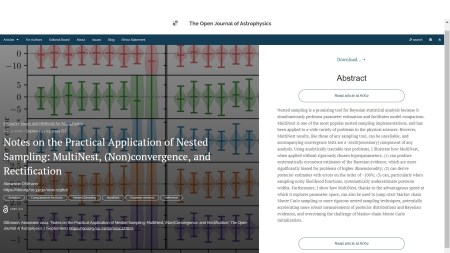
First one up is “Joint constraints from cosmic shear, galaxy-galaxy lensing and galaxy clustering: internal tension as an indicator of intrinsic alignment modelling error” which is by Simon Samuroff (Northeastern U., USA), Andresa Campos (Carnegie Mellon U., USA), Anna Porredon (Bochum, Germany) and Jonathan Blazek (Edinburgh, UK).   A combined statistical approach to the identification of errors arising in cosmic shear analysis due to intrinsic alignments.

Here is a screen grab of the overlay, which includes the abstract:
You can read the paper directly on arXiv here.

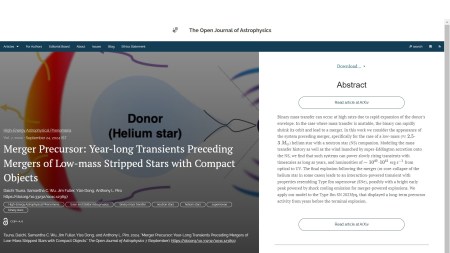
The second paper to present is “A unified linear intrinsic alignment model for elliptical and disc galaxies and the resulting ellipticity spectra” by Basundhara Ghosh (Bangalore, India), with Kai Nussbaumer, Eileen Sophie Giesel & Björn Malte Schäfer (Heidelberg, Germany). It presents a discussion of the physical origin of intrinsic alignments of both elliptical and disk galaxies and the implications for cosmological studies

The overlay looks like this:


You can read this paper directly on the arXiv here.

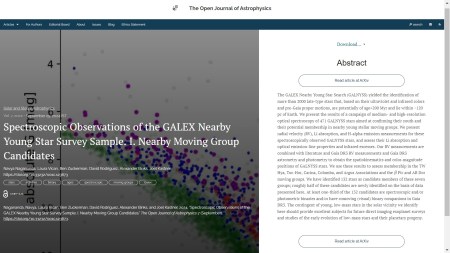
The last paper of this batch is entitled “Neural style transfer of weak lensing mass maps”  and proposes a generative model for the mass-production of weak-lensing maps. The authors are Masato Shirasaki and Shiro Ikeda (both of the University of Tokyo, Japan)

Here is a screengrab of the overlay:


To read the accepted version of this on the arXiv please go here.
That’s all for now. I will do another update next week.


Searching for Luminous High-Redshift Galaxies with Euclid’s Early Release Observations

Posted in Euclid, The Universe and Stuff on May 24, 2024 by telescoper

As it’s Friday afternoon I thought I would share one of the little videos I mentioned in the previous post. It’s only just over a minute long but it is worth listening to, not least for the dulcet tones of Henry Joy McCracken as he explains the science.

The Euclid preprint related to this work can be found here.

Euclid Paper Day!

Posted in Barcelona, Euclid, Maynooth, The Universe and Stuff with tags , , , , , , , , on May 24, 2024 by telescoper

This morning’s arXiv update brought the expected deluge of preprints from Euclid. You can find details of all fifteen of the new articles here. Ten of them relate to the Early Release Observations of which five were announced yesterday and five last November. These are essentially byproducts of the testing and calibration phase of the Euclid mission rather than the main cosmological survey. ESA is making a series of short videos about these results which I will share on here from time to time.

Of more direct relevance to cosmologists such as myself are the following five reference papers:

The overview paper, led by Yannick Mellier (Euclid Consortium Lead), giving a general description of the mission capabilities and science goals, will be the main reference paper and just about every active member of the Euclid Consortium is on the author list (including myself). That’s over a thousand people, not quite at the level of the Large Hadron Collider but getting there. I do think we need to find a better way of giving credit to work in large collaborations than through authorship, but until someone comes up with a workable scheme, and people responsible for hiring researchers adopt it, we’re stuck with what we’ve got. At least I can say that I’ve read that paper (which is 94 pages long, including the author list)

Papers II-IV are technical articles relating to Euclid’s instruments and their calibration, which will also be important references for the survey part of the Euclid mission. Paper V is about the Flagship simulations and the mock catalogues produced therefrom; I discussed these a while ago here. It is led by Francisco Castander of Institut de Ciencies de l’Espai, who organized the meeting I attended recently here in Barcelona.

These papers now now be peer-reviewed and, assuming they are accepted, published in a special issue of Astronomy & Astrophysics (A&A).

New Results from Euclid

Posted in Euclid, Maynooth, The Universe and Stuff with tags , , , , on May 23, 2024 by telescoper

As it was foretold, exciting new results from the European Space Agency’s Euclid mission have now been released.

You can read more about these images here.

Together with the five images released last November that makes a total of ten Early Release Observations from the pre-survey phase of Euclid. It’s not all about the pictures, however. Today also saw the release of ten scientific papers to go with these images, as well as five reference papers for the main survey. You can find them all, with accompanying information here. They will be announced on arXiv tomorrow.

You might also be interested to read my Euclid piece on RTÉ Brainstorm which has just appeared. This is not just about the new images, but gives an update on what Euclid has been up to since launch, and what we can expect in the future. There’s also a version adapted for Maynooth University PR purposes here. It includes this quote:

Today’s release of new data and technical papers from Euclid is exciting in itself but also marks the start, after months of painstaking calibration and testing of the instruments, of Euclid’s main cosmological survey. We are on the threshold of a new era in cosmology. Maynooth is the only University in Ireland to be involved in this mission and it is very exciting to be at the forefront of such an important scientific development.

I’m also quoted in a piece in the Irish Times. You’ll probably find the article blocked by a paywall but my bit is:

Gearing up for Thursday’s Euclid News

Posted in Euclid, Maynooth, The Universe and Stuff with tags , , , , , , , on May 21, 2024 by telescoper

It’s a hectic time ahead of a Big Event on Thursday 23rd May, which will include the publication of five new Early Release Observations (EROs). I’m not at liberty to say what they are until after 12 noon (CEST) on Thursday except that they’re very pretty. You can watch the live stream here:

Including the five released on November 7th 2023 that will bring the total to ten. All the ERO pictures will be available on the ESA archive here.

Thursday will also see the release of ten scientific papers related to the EROs; they will appear on arXiv on Friday 24th May. These will be the first science results from the Euclid mission.

But that’s not all! Thursday will also see the publication of five papers from the Euclid Consortium (of which I am the sole member based in Ireland). These will be the principal technical reference papers aimed at the astronomical community about the Euclid mission, covering the instruments, cosmology and other astronomy science possibilities, as well as the cosmological simulations used to assist the analysis of the mission. One of these, the main overview paper for the mission, has over a thousand authors (one of whom is your truly).

Thursday’s announcements are likely to significant level of press interest. That’s not only due to the European Space Agency’s own social media feeds and the like, but also local activities in Ireland. For example, there’s this from Science Foundation Ireland using this, from the Little Book of Irish Research:

I have also written a piece for RTÉ Brainstorm, as a kind of update on the one I wrote last year on the occasion of the launch; this will go live after the embargo is lifted on Thursday.

Three New Publications at the Open Journal of Astrophysics

Posted in OJAp Papers, Open Access, The Universe and Stuff with tags , , , , , , , , , on May 18, 2024 by telescoper

It’s time once more for the usual  Saturday roundup of business at the  Open Journal of Astrophysics. The latest batch of publications consists of three papers, taking the count in Volume 7 (2024) up to 39 and the total published by OJAp up to 154. We’re still on track to publish around 100 papers this year, compared to last year’s 50.

All three of this week’s papers involve use of data from the European Space Agency’s Gaia mission, which is proving an immensely rich resource for astrophysics.

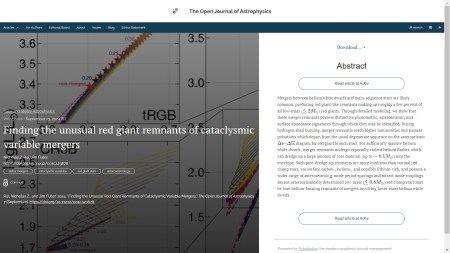
First one up is “Asymmetric Drift Map of the Milky Way Disk Populations between 8 -16 kpc with LAMOST and Gaia datasets” which is by  Xin Li (Nanchong, China), Peng Yang (Chengdu, China) , Hai-Feng Wang (Nanchong, China), Qing Li (Jiangmen, China), Yang-Ping Luo (Nanchong, China), Zhi-Quan Luo (Nanchong, China), Guan-Yu Wang (Nanchong, China). This is a study  of the asymmetric drift, the difference of the local circular speed and the mean rotational speed of the stellar population, for various stellar populations in the Milky Way. It is in the folder marked Astrophysics of Galaxies and was published on Tuesday 14th May 2024.

Here is a screen grab of the overlay, which includes the abstract:


You can read the paper directly on arXiv here.

The second paper to announce is “On the formation of a 33 solar-mass black hole in a low-metallicity binary” by Kareem El-Badry (Caltech, USA). It discusses theoretical models for the formation of a black hole in a particular binary system discovered in Gaia data.

This one is in the folder Solar and Stellar Astrophysics and was published on 16th May 2024. The overlay looks like this:


You can read this paper directly on the arXiv here.

The last paper of this batch, also in the in the folder Solar and Stellar Astrophysics, is entitled “Compact Binary Formation in Open Star Clusters II: Difficulty of Gaia NS formation in low-mass star clusters”  and it presents a discussion of the formation of binary neutron stars and black holes found in Gaia data based on their orbital properties. It was published on Friday May 17th 2024 (i.e. yesterday). The authors are Ataru Tanikawa (Fukui University, Japan), Long Wang (Sun-yat Sen University, China) and  Michiko S. Fujii (Tokyo University, Japan).

Here is a screengrab of the overlay:


To read the accepted version of this on the arXiv please go here.
That’s all for now. Another update next week!


Examination Time in Maynooth

Posted in Barcelona, Education, Maynooth, The Universe and Stuff with tags , , on May 17, 2024 by telescoper

Today ( Friday 17th May) is the first day of the Summer Examination Period in Maynooth. Although I’m not there right now I thought I’d take the opportunity to wish all students the best for their examinations:

You shouldn’t really be relying on luck of course, so here are some tips for the examination period (especially for physics students, but applicable elsewhere).

  1. Try to get a good night’s sleep before the examination and arrive in plenty of time before the start. Spending all night cramming is unlikely to help you do well.
  2. Prepare well in advance so you’re relaxed when the time comes.
  3. Read the entire paper before starting to answer any questions. In particular, make sure you are aware of any supplementary information, formulae, etc, given in the rubric or at the end.
  4. Start off by tackling the question you are most confident about answering, even if it’s not Question 1. This will help settle any nerves. You’re under no obligation to answer the questions in the order they are asked.
  5. Don’t rush! Students often lose marks by making careless errors. In particular, check all your numerical results on your calculator at least twice
  6. Please remember the units!
  7. Don’t panic! You’re not expected to answer everything perfectly. A first-class mark is anything over 70%, so don’t worry if there are bits you can’t do. If you get stuck on a part of a question, don’t waste too much time on it (especially if it’s just a few marks). Just leave it and move on. You can always come back to it later if you have time.

Meanwhile, in Barcelona, Monday is a public holiday (Pentecost) so I am faced with the prospect of having to endure a long weekend break. Such is life…

The Radio and Microwave Sky from Juno

Posted in The Universe and Stuff with tags , , , , , , , on May 16, 2024 by telescoper

I found out about an interesting paper by Anderson et al. at a discussion group this morning. The abstract reads:

We present six nearly full-sky maps made from data taken by radiometers on the Juno satellite during its 5-year flight to Jupiter. The maps represent integrated emission over ∼4% passbands spaced approximately in octaves between 600 MHz and 21.9 GHz. Long time-scale offset drifts are removed in all bands, and, for the two lowest frequency bands, gain drifts are also removed from the maps via a self-calibration algorithm similar to the NPIPE pipeline used by the Planck collaboration. We show that, after this solution is applied, residual noise in the maps is consistent with thermal radiometer noise. We verify our map solutions with several consistency tests and end-to-end simulations. We also estimate the level of pixelization noise and polarization leakage via simulations.

arXiv:2405.08388

For those of you unaware about Juno, it is a NASA space mission (launched in 2011) intended to study the planet Jupiter (which it is still doing). On the way there, however, this spacecraft made continuous measurements of the radiation field around it, at radio and microwave frequencies. The work described by Anderson et al. involved turning these observations into maps at a range of frequency; they also studied the polarization properties of the radiation.

The full maps and other relevant data can be downloaded here. Here are some pretty pictures (the grey bits represent the parts of the sky that were not covered; radio emission from our own Galaxy is the most obvious component at low frequencies, but it looks more complicated at higher frequencies).

It’s always fun when data sets are used for something so different from the purpose originally intended, and what has come out of this analysis are rather nice maps of the emission from the Milky Way. These might turn out to be useful for many things, such as foreground removal for extragalactic surveys or studies of our own Galaxy.

R.I.P. Jim Simons (1938-2024)

Posted in R.I.P., The Universe and Stuff with tags , , , , , on May 13, 2024 by telescoper

I heard yesterday of the death, at the age of 86, of Jim Simons. Jim Simons started out as an academic in the fields of mathematics and mathematical physics. Together with Shiing-Shen Chern he developed the Chern–Simons form, which has been of interest recently in the context of cosmology because of the potential for parity violation, and also contributed to the development of a theoretical framework to combine geometry and topology with quantum field theory. He then moved to into the world of hedge funds, and became a highly successful investor on Wall Street, amassing a huge personal fortune. In later life he turned back to his first loves, however, and set up the Simons Foundation which supports, among many other things, the Simons Observatory and the Flatiron Institute both of which have had, and will no doubt continue to have, an enormous impact in the fields of cosmology and astrophysics. The Simons Foundation has also made large donations to the arXiv.

R.I.P. Jim Simons (1938-2024)