Archive for the The Universe and Stuff Category

New Publication at the Open Journal of Astrophysics

Posted in OJAp Papers, Open Access, The Universe and Stuff with tags , , , , , , , , , on August 24, 2022 by telescoper

It’s time once again for me to announce another new paper at the Open Journal of Astrophysics. The new paper, published yesterday, is the 12th paper in Volume 5 (2022) and the 60th in all. The latest publication is entitled “Minkowski Functionals in Joint Galaxy Clustering & Weak Lensing Analyses” and the authors are Nisha Grewal, Joe Zuntz and Tilman Tröster of the Institute for Astronomy in Edinburgh and Alexandra Amon of the Institute of Astronomy in Cambridge. The paper is in the folder marked Cosmology and Non-Galactic Astrophysics.

Incidentally, Dr Alexandra Amon is the winner of this year’s Caroline Herschel Lectureship in Astronomy, so congratulations to her for that too!

The new paper is about the application of topological characteristics known as Minkowski Functionals to cosmological data. This approach has been used in the past to study the pattern cosmic microwave background temperature fluctuations; see e.g. here for one of my forays into this way back in 2008. Now there are more high-quality datasets besides the CMB so there are more opportunities to use this elegant approach. Perhaps I should do a blog post about Minkowski Functionals? Somewhat to my surprise I can’t find anything on that topic in my back catalogue here In The Dark

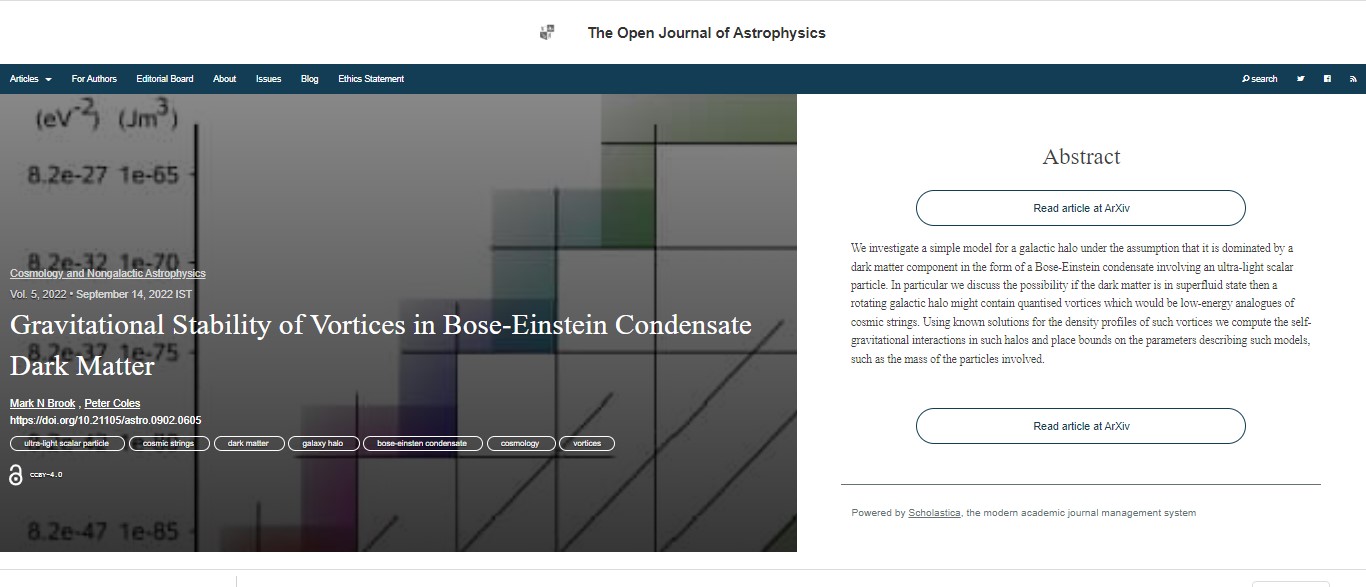
Anyway, here is a screen grab of the overlay which includes the  abstract:


You can click on the image to make it larger should you wish to do so. You can find the accepted version of the paper on the arXiv here.

How big were the biggest galaxies in the early Universe?

Posted in Biographical, Cardiff, The Universe and Stuff with tags , , , , , , , on August 23, 2022 by telescoper

Once upon a time (over a decade ago when I was still in Cardiff), I wrote a paper with PhD student Ian Harrison on the biggest (most massive) galaxy clusters. I even wrote a blog post about it. It was based on an interesting branch of statistical theory called extreme value statistics which I posted about in general terms here.

Well now the recent spate of observations of high-redshift galaxies by the James Webb Space Telescope has inspired Chris Lovell (who was a student at Cardiff back in the day then moved to Sussex to do his PhD and is now at the University of Hertfordshire) and Ian Harrison (who is back in Cardiff as a postdoc after a spell in the Midlands), and others at Cambridge and Sussex, to apply the extreme value statistics idea not to clusters but to galaxies. Here is the abstract:

The basic idea of galaxy formation in the standard ΛCDM cosmological model is that galaxies form in dark matter haloes that grow hierarchically so that the typical size of galaxies increases with time. The most massive haloes at high redshift should therefore be less massive than the most massive haloes at low redshift, as neatly illustrated by this figure, which shows the theoretical halo mass function (solid lines) and the predicted distribution of the most massive halo (dashed lines) at a number of redshifts, for a fixed volume of 100 Mpc3.

The colour-coding is with redshift as per the legend, with light blue the highest (z=16).

Of course we don’t observe the halo mass directly and the connection between this mass and the luminosity of a galaxy sitting in it is likely to be complicated because the formation of the stars that produce the light is a rather messy process; the ratio of mass to light is consequently hard to predict. Moreover we don’t even have overwhelmingly convincing measurements of the redshifts yet. A brief summary of the conclusions of this paper, however, is that is some of the big early galaxies recently observed by JWST seem to be a big too big for comfort if we take their observed properties at face value. A lot more observational work will be needed, however, before we can draw definite conclusions about whether the standard model is consistent with these new observations.

Anomalies in Physical Cosmology

Posted in The Universe and Stuff with tags , , , on August 12, 2022 by telescoper

Just a quick note to mention that there’s an interesting review article on the arXiv by elder statesman of cosmology Jim Peebles with the abstract:

The ΛCDM cosmology passes demanding tests that establish it as a good approximation to reality. The theory is incomplete, of course, and open issues are being examined in active research programs. I offer a review of less widely discussed anomalies that might also point to hints to a still better cosmological theory if more closely examined.

Here is Figure 4 from the paper, which I’ve picked because it is pretty. It shows the distribution of bright (red) and faint (blue) galaxies within 9Mpc of the Milky Way.

Recalibration of Ultra-High-Redshift Galaxies

Posted in Astrohype, The Universe and Stuff with tags , , , , on August 10, 2022 by telescoper

Remember all the recent excitement about the extremely high redshift galaxies (such as this and this; the two examples shown above) “identified” in early-release JWST observations? Well, a new paper on the arXiv by Adams et al using post-launch calibration of the JWST photometry suggests that we should be cautious about the interpretation of these objects. The key message of this study is that the preliminary calibration that has been in widespread use for these studies is wrong by up to 30% and that can have a huge impact on inferred redshifts.

The new study does indeed identify some good candidates for ultra-high-redshift galaxies, but it also casts doubt on many of the previous claims. Here is a table of some previous estimates alongside those using the newly recalibrated data:

You will see that in most – but not all – cases the recalibration results in a substantial lowering of the estimated redshift; one example decreases from z>20 to 0.7! The two candidates mentioned at the start of this post are not included in this table but one should probably reserve judgement on them too.

The conclusive measurements for these objects will however include spectroscopy, and the identification of spectral lines, rather than photometry and model fits to the spectra energy distribution. Only with such data will we really know how many of these sources are actually at very high redshift. As the philosopher Hegel famously remarked

The Owl of Minerva only spreads its wings with the coming of spectroscopy.

Megalithic Mystery Solved!

Posted in Biographical, History, The Universe and Stuff with tags , , , , on August 8, 2022 by telescoper

This morning I realized that almost exactly four years ago I visited the megalithic passage tomb at Knowth. In my post about that visit I mentioned the extraordinary stone carvings found outside the tomb and their possible connection with astronomy. Following on from ChorizoGate I can finally reveal that the solution to this ancient mystery is in fact gastronomical.

Reach for the Stars!

Posted in The Universe and Stuff with tags , , on August 7, 2022 by telescoper

After all the nonsense in the past few days about ChorizoGate I thought I’d pass on news of some really wonderful and wonderfully real astronomical images featured in this year’s ‘Reach for the Stars’ astrophotography competition run by Dublin Institute for Advanced Studies (DIAS). You can find a full gallery and learn more about the competition here, but here is just one beautiful image as a taster. It was taken by Aisling McGuire and it shows the Twelve Bens mountain range in Connemara, with the Milky Way above.

Picture Credit: Aisling McGuire

Do look at the rest of the gallery!

ChorizoGate: an Accidental Hoax

Posted in Biographical, The Universe and Stuff with tags , , , on August 3, 2022 by telescoper

My Twitter account is usually a quiet backwater of social media, and that’s the way I like it, but there was an unexpected burst of activity and interest in it over the weekend. To amuse myself on Saturday morning I decided to post this on Twitter:

(I deleted my Twitter account some time ago, so have replaced the link with a screenshot.)

I thought a few people might find it funny, but it took off beyond my expectations. By my standards over 5000 likes counts as “going viral” (as you young people say). Most people saw the joke immediately – if you don’t get it, the image is of a slice of chorizo not an astronomical object – and some even joined in with puns and other jokes. Even funnier, some respondents earnestly shared their devastating insight that it was chorizo (or some variant thereof). I honestly didn’t think anyone would think that I was seriously trying to pass it off as a JWST picture; it was just meant to be silly. But there you go. That’s Twitter. I should also report that some people looked at the rainbow flags in my profile and proceeded to indulge in some casual homophobia. That’s Twitter too. Those people all got blocked.

Anyway, the day after I posted the image it seems a prominent French physicist called Etienne Klein who has many times more Twitter followers than I do, posted this embellished version. TRIGGER WARNING – it’s in FRENCH:

Notice the picture is exactly the same. What a coincidence! You might consider this plagiarism; I couldn’t possibly comment. I always regard anything I put on social media as being in the public domain so I’m not really bothered if other people “borrow” it. There’s quite a lot of plagiarism of stuff I’ve written on this blog out there, but life’s too short to get upset about it. Credit would be courteous, but one one learns that it isn’t generally to be expected.

As a matter of fact it’s not a new joke anyway. I didn’t make the picture and don’t remember where I got it from, though it was probably here.

Anyway, the funny thing is that this then got picked up by various other people:

and organisations:

There are others, e.g. here, here, here and here. Also here.

ChorizoGate all took off in a very surprising way. I’m not sure what the moral of this story is, other than if you make a joke no matter how obvious it is there will always be people who take it seriously…

R.I.P. James Lovelock (1919-2022)

Posted in Literature, The Universe and Stuff with tags , , on July 28, 2022 by telescoper

I heard this week of the death, on his 103rd birthday, of scientist and writer James Lovelock. He started out as a chemist but became what is now called an “independent scientist” and “futurist”. These terms are often applied to people who are simply cranks, but he wasn’t just that. Unorthodox he was, certainly, but there was depth to his thinking that mere cranks never reach.

James Lovelock was best known to me – and I suspect to many others – for his work on the Gaia Hypothesis, which is roughly speaking the idea that the system of life on Earth functions as a single organism that defines and maintains the conditions necessary for its own survival.

I’ve just had a rummage around my bookshelves and found my copy of his famous book on this topic, which I bought and read back in the 80s. The first edition was published in 1979, but the one I bought was the version published in 1987 after the topic had been featured on the BBC TV programme, Horizon:

The Gaia hypothesis has been widely criticized by biologists and ecologists but I remember finding it a very thought-provoking book, though I interpreted more as a metaphor than a mechanism. At any rate it seems to me to be a useful counter to the extreme reductionism of many prominent life scientists. It’s also very well written and definitely worth reading over 40 years after it was written. James Lovelock was as inventive and ingenious a thinker as he was unorthodox.

Rest in peace, James Ephraim Lovelock (1919-2022).

A pretty simple thing…

Posted in History, The Universe and Stuff with tags , , , on July 27, 2022 by telescoper

In a state of not inconsiderable excitement, I showed the above picture (which appears in yesterday’s post) to a friend who shrugged and said “It doesn’t look like much..”. My response was “Well, you wouldn’t look like much at z=16.7…”

That reply was of course inspired by a famous exchange between Fred Hoyle and R.O. Redman recounted here:

Fred once started a talk by saying, ‘Oh, Ooh, basically a star is a pretty simple thing.’ And from the back of the room was heard the voice of R. O. Redman, saying, ‘Well, Fred, you’d look pretty simple too, from ten parsecs!

I’ve heard this story told by many people in different versions involving different characters, including Eddington, but I think it is generally accepted to have been between Hoyle and Redman, though this may well not have been the first comment of its type. If anyone knows any more please let me know!

Now a Galaxy at z>16?

Posted in The Universe and Stuff with tags , , , , , , on July 26, 2022 by telescoper

It’s less than a week since I posted an item about an object which is possibly the highest redshift galaxy ever observed (with z ~13) and now along comes a paper describing an object that may be of even higher redshift (with z~16.7). The abstract of the new paper – lead author of which is Callum Donnan of the University of Edinburgh – is here:

As with the previous object the redshift of this one is not obtained via spectroscopy (which usually involves the identification of spectral lines) but via fitting a spectral profile to photometric imaging data seen in different bands. The process for this galaxy is illustrated by this diagram from the paper:

There are 7 images along the top showing the source through various broad band filters. Suitably calibrated these can be converted to the flux measurements shown on the graph. Notice the first three images are significantly fainter than the others, so the first three points on the left of the graph are lower.

If this is a galaxy its spectrum is expected to possess a Lyman Break resulting from the fact that radiation of shorter wavelength than the Lyman Limit (912 Å) is absorbed by neutral gas surrounding the regions where stars are formed in the galaxy. In the rest frame of a galaxy this break is the ultraviolet region of the spectrum but because of the cosmological redshift it is observed in the infrared part of the spectrum for very distant galaxies. In this case the best fit is obtained if the break is positioned as shown, with the first three fainter points to the left of the break and the rest to the right. The break itself is straddled by two observational bands. Employing a number of different estimates the authors conclude that the redshift of this galaxy is z=16.7 or thereabouts.

There is no direct evidence for the sharp edge associated with the Lyman Break – and no spectral lines are observed either – so this all depends on the object being correctly identified as a high-redshift galaxy and not some other object at lower redshift. You have to assume this to get a redshift, but then all inferences are based on assumed models so there’s nothing unusual about this approach. The authors discuss other possibilities and conclude that there is no plausible alternative source. Take away the green template spectrum and you just see a spectrum that rises to a peak and falls again. The authors claim that there is no plausible low-redshift source with such a spectrum.

Anyway, here is a composite colour image of the source:

So is this now the earliest galaxy ever observed? And what object will I be asking this question about next week? One thing I can predict is that there are going to be many more such objects in the very near future!