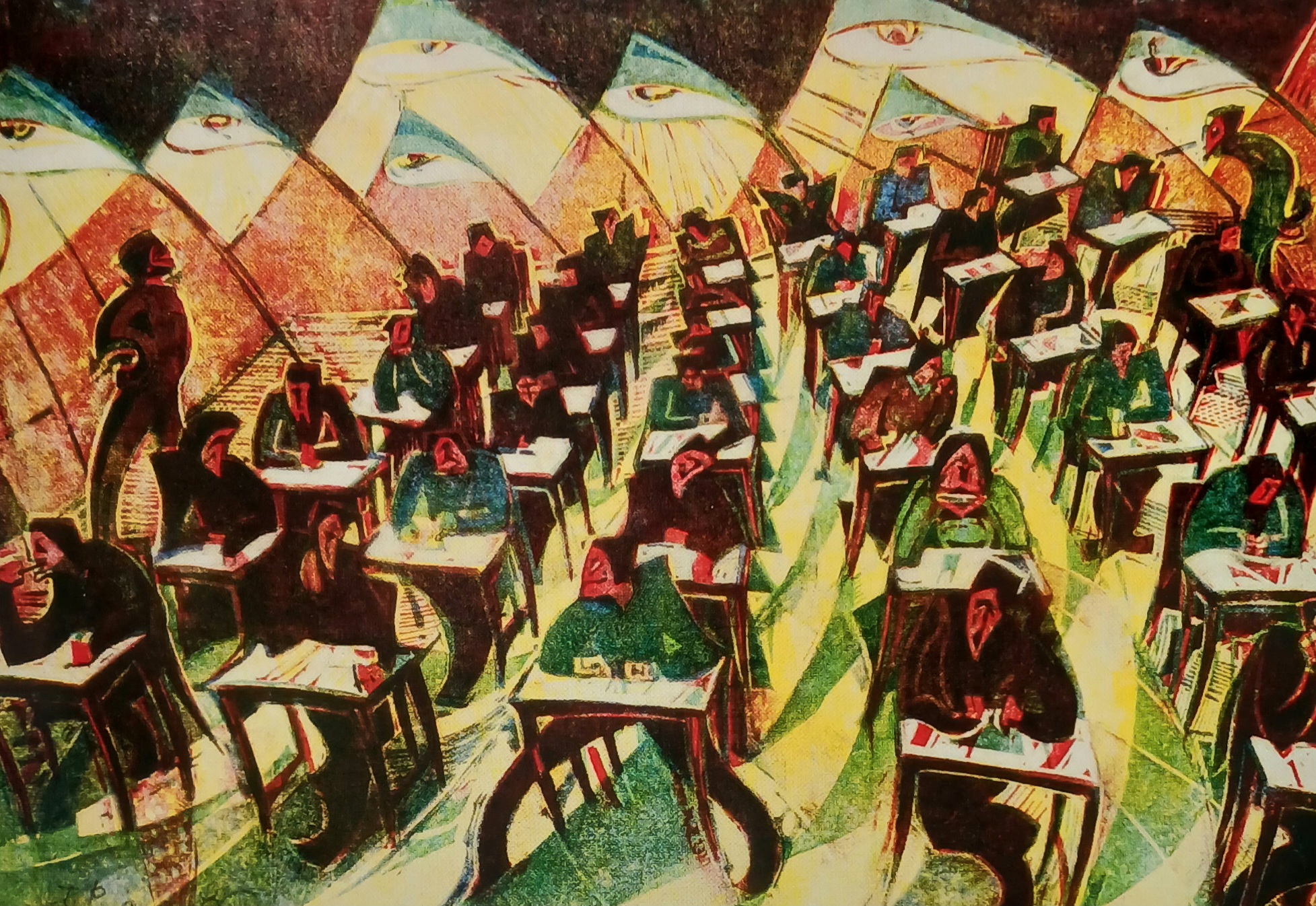
The Exam Room by Cyril E. Power (c. 1934, linocut, 26.6 x 38.2 cm, Metropolitan Museum of Art, New York; not on display)
The Exam Room by Cyril E. Power (c. 1934, linocut, 26.6 x 38.2 cm, Metropolitan Museum of Art, New York; not on display)
I’m in the middle of marking examinations so I will only do a brief post, while I take a short break, to follow up on the one about Hampton Hawes I did a couple of days ago. When I wrote that one it struck me that there are rather a lot of great musicians, especially pianists like Hampton Hawes, who were never appreciated as much as they should have been. Another that springs to mind is Elmo Hope, for whom Thelonious Monk seems to have been a great influence and who therefore provides an interesting contrast with Hampton Hawes who was perhaps more influenced by Bud Powell. Elmo Hope died young, largely because of a bad heroin habit, which also affected his career through his erratic behaviour and the criminal record he acquired for narcotics offences. He was a really fine musician and composer, though, with a very original voice and idiosyncratic sense of time. This track was recorded in 1953 with Paul Chambers on bass and Philly Joe Jones on drums, both of whom were to find fame with Miles Davis a few years later.
Lecturers at Maynooth University are supposed to be available on the telephone to deal with queries from students concerning their examinations. And so it came to pass that yesterday I was “on call”. Since I live in Maynooth, I decided to come into campus in case of a query so I could go to the examination venue l to deal with it if required. In the event, however, the examination passed off without incident and nobody called.
I wasn’t twiddling my thumbs all morning though. It seemed a good opportunity to go through the accumulated coursework for this module, applying various exemptions for medical or other reasons, so that when I’ve marked the scripts I can immediately combine the results with the CA component.
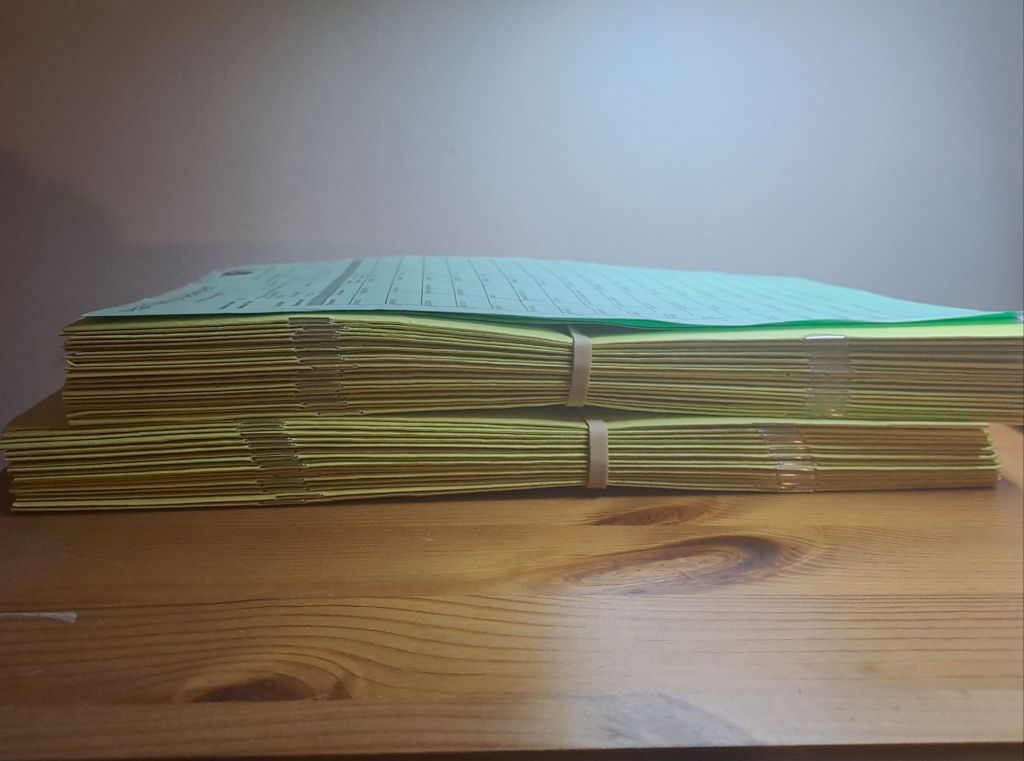
The examination venue, incidentally, was not on campus but in the Glenroyal Hotel in Maynooth. The Sports Hall on campus is usually one of the places for examinations to be sat, but it is not available this year due to refurbishment. The other day I was in one of the shops in the shopping centre next to the hotel and there were some complaints about the lack of available car parking spaces owing to so many students parking there for their exams. Anyway, the exam scripts found their way to my office this morning and here I am again, back home with a stack of an examination scripts to mark. The picture shows about 40 papers from my module on Differential Equations and Transform Methods. I want to get them out of the way as quickly as possible as I have another paper coming up on Thursday and have a lot of other things to do before term starts at the beginning of February. All the usual displacement activities having been exahusted, I’ve already made a start. With a bit of luck I’ll complete this task by Thursday.
I’ve often discussed the process of marking examinations with my colleagues and they all have different techniques. What I do is mark one question at a time rather than one script at a time. What I mean by that is that I go through every script marking all the attempts at Question 1, then I start again and do Question 2, etc. I find that this is much quicker and more efficient than marking all the questions in each script then moving onto the next script. The reason for this is that I can upload into my mind the model answer for Question 1 so that it stays there while I mark dozens of attempts at it so I don’t have to keep referring to the marking scheme. Other advantages are that it’s easier to be consistent in giving partial credit when you’re doing the same question over and over again, and that also you spot what the common mistakes are more easily.
Anyway, I’ve decided to take a break for today. I’ll start again tomorrow.
News of the death of the notorious charlatan Erich von Däniken reminded me that at one time, when I was about 11 years old, I borrowed his book Chariots of the Gods from the public library. Even at that age I thought it was a load of nonsense, but I have to admit that I was fascinated by the origin of the Nazca Lines in Southern Peru, most of which were created between 500 BC and 500 AD but were probably based on even older structures. An example, depicting a humming bird, is shown here:

Von Däniken claimed that these were landing strips for ancient spacecraft piloted by extraterrestrials, an explanation that can easily be refuted. The actual purpose of these structures is yet to be discerned. I thought it was likely that they had some astronomical significance, but if they do then it has yet to be elucidated. How they were made is less difficult to explain: almost certainly they were made by scaling up smaller drawings. This would have required some mathematical understanding, and perhaps the use of coordinates, but there’s no reason to suppose that the people who created them lacked such knowledge. What they mean is indeed an unsolved mystery.
The other unsolved mystery is why people fall for the sort of nonsense peddled by von Däniken. It seems to me that part of the answer is that modern humans have an almost irresistible tendency to assume that earlier human beings were much less intelligent than us. This is clearly not true. In fact human intelligence has evolved very little over the past few millennia. What has evolved is knowledge (passed on cumulatively through the generations) and the technology created using that knowledge. Erich von Däniken promoted the idea that only extraterrestrials could have created the Nazca lines; he and others have suggested that the pyramids of ancient Egypt were built by aliens too. It’s part of our desire to think of ourselves as being much smarter than our ancestors. You only have to look at the world today to realize that humans aren’t as clever as they think they are. In fact we’re just as dumb as humans have always been; we just have better gadgets (including, unfortunately, weapons).
Another book I got out of the public library at about the same time was Worlds in Collision by Immanuel Velikovsky. As far as I can remember, this book propounded a new theory of the solar system in which the planet Venus was ejected from Jupiter and then went rattling around encountering other planets and causing various catastrophes. This was supposed to have happened around 1500 BC which “explains” various historical events, including many described in the Bible. It is nonsense of course, but some people lapped it up, as some continue to believe that the Earth is flat.
I find it hard to understand why some people persist in denying scientific advances for which there is considerable empirical evidence and prefer instead to believe in nonsense peddled by the likes of Erich von Däniken. If anyone can solve that mystery they will be doing the human race a very big favour.
Welcome to the first proper update for 2026 from the Open Journal of Astrophysics. The New Year brings us to Volume 9. In many countries, especially in Europe, Christmas is celebrated on January 6th so this week was also affected by the holiday season. Nevertheless, since the last update we have published four papers, bringing the number in Volume 9 (2026) to 4 and the total so far published by OJAp up to 452.
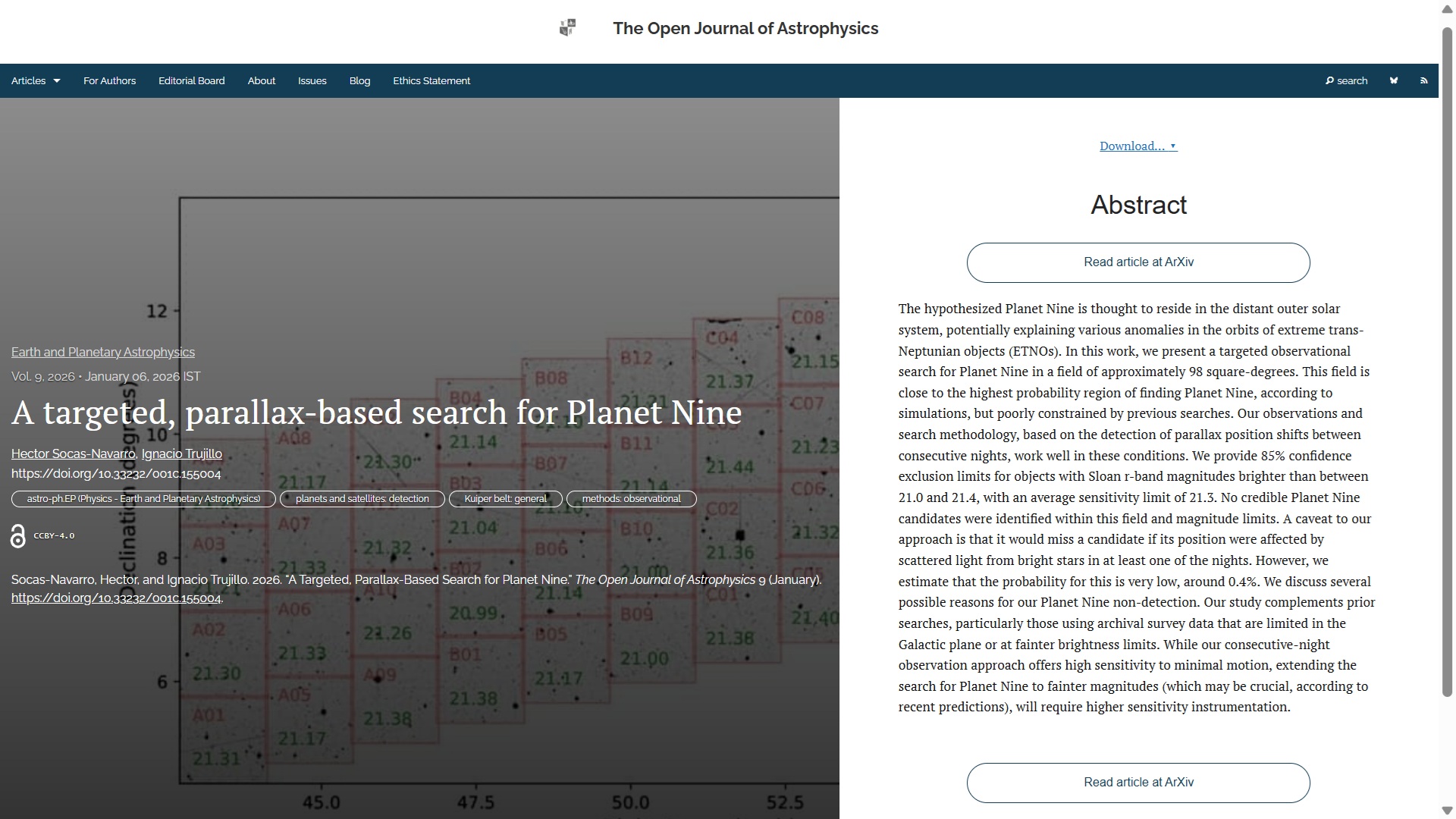
The first paper this week (and of course the first of 2026) is “A targeted, parallax-based search for Planet Nine” by Hector Socas-Navarro and Ignacio Trujillo (both of the Instituto de Astrofísica de Canaria, Spain). This article describes a targeted search for the hypothesized Planet Nine in the outer solar system, using parallax position shifts. No credible candidates were found within the observed field. It was published on Tuesday January 6th in the folder Earth and Planetary Astrophysics. The overlay is here:
You can find the officially accepted version on arXiv here and the announcement on Fediverse here:
The second paper is “Going beyond S8: fast inference of the matter power spectrum from weak-lensing surveys” by Cyrille Doux (Université Grenoble Alpes, France) and Tanvi Karwal (U. Chicago, USA). This was published on Wednesday January 7th in the folder Cosmology and Nongalactic Astrophysics and it presents a new framework to extract the scale-dependent matter power spectrum from cosmic shear and CMB lensing measurements, revealing a consistent suppression in the matter power spectrum in galaxy-lensing. The overlay is here:

The official version of the paper can be found on arXiv here and the Fediverse announcement here:
Next we have “Constraining the Stellar-to-Halo Mass Relation with Galaxy Clustering and Weak Lensing from DES Year 3 Data” which is led by G. Zacharegkas et al. (Argonne National Laboratory, USA) and has 102 other authors too numerous to list by name from many institutions around the world again too numerous to list by name. It presents a framework to analyze the relationship between a galaxy’s stellar mass and its dark matter halo mass, using data from the Dark Energy Survey. The findings align with previous results. This paper was published on Thursday January 8th in the folder Astrophysics of Galaxies. The overlay is here:

The official version can be found on arXiv here and the Fediverse announcement is here:
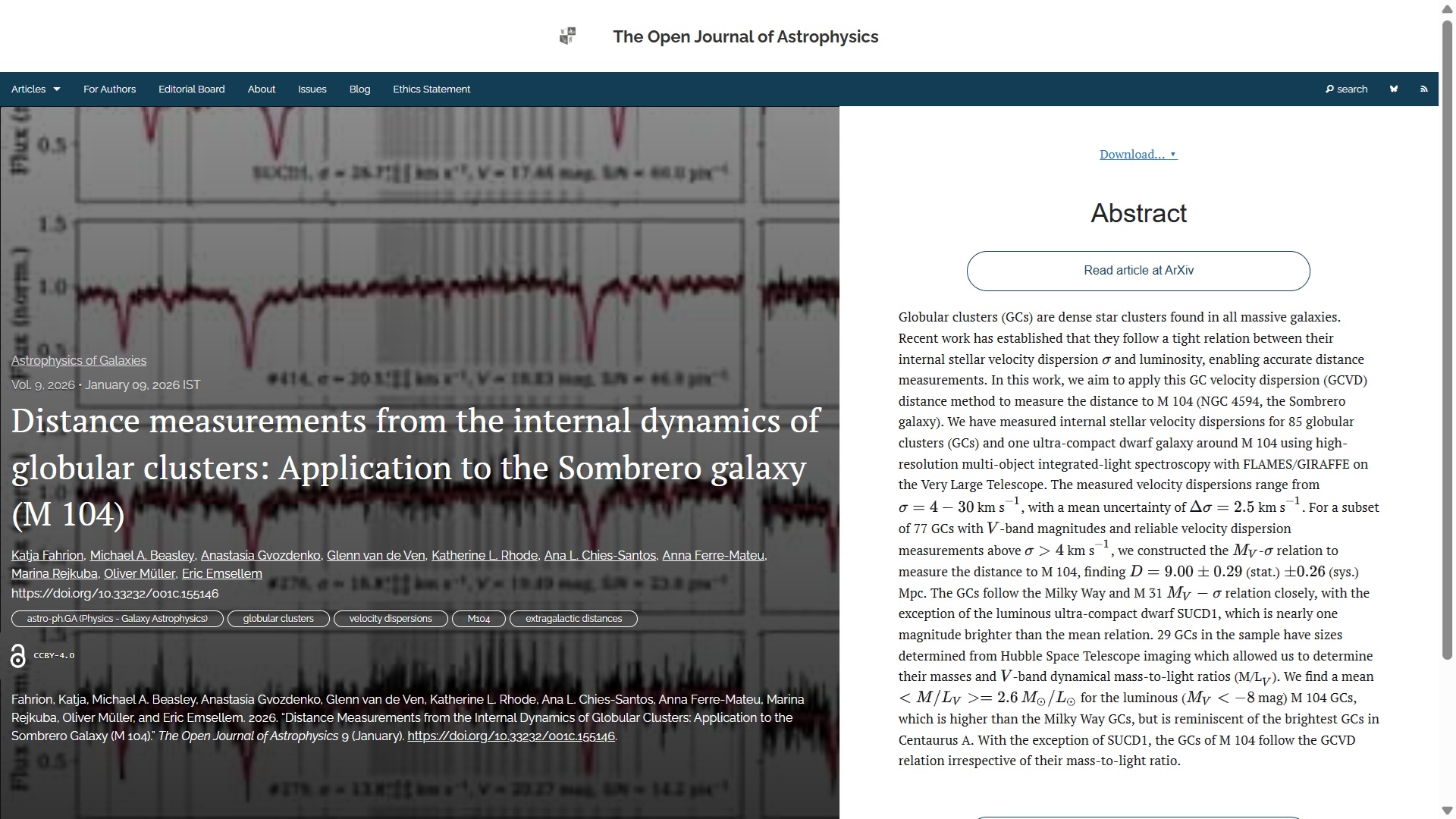
Finally for this week we have “Distance measurements from the internal dynamics of globular clusters: Application to the Sombrero galaxy (M 104)” by Katja Fahrion (University of Vienna, Austria) and 9 others based in Spain, Australia, UK, USA, Brazil, Germany and Switzerland. This was published on Friday 9th January (yesterday) in the folder Astrophysics of Galaxies. This study uses the globular cluster velocity dispersion method to measure the distance to the Sombrero galaxy, finding it to be approximately 9.0 Mpc away. The overlay is here:
The officially accepted version can be found on arXiv here and the Fediverse announcement here:
That concludes the update for this week. I will do another next Saturday.

Greenland's icy mountains are fascinating and grand,
And wondrously created by the Almighty's command;
And the works of the Almighty there's few can understand:
Who knows but it might be a part of Fairyland?

Because there are churches of ice, and houses glittering like glass,
And for scenic grandeur there's nothing can it surpass,
Besides there's monuments and spires, also ruins,
Which serve for a safe retreat from the wild bruins.

And there's icy crags and precipices, also beautiful waterfalls,
And as the stranger gazes thereon, his heart it appals
With a mixture of wonder, fear, and delight,
Till at last he exclaims, Oh! what a wonderful sight!

The icy mountains they're higher than a brig's topmast,
And the stranger in amazement stands aghast
As he beholds the water flowing off the melted ice
Adown the mountain sides, that he cries out, Oh! how nice!

Such sights as these are truly magnificent to be seen,
Only that the mountain tops are white instead of green,
And rents and caverns in them, the same as on a rugged mountain side,
And suitable places, in my opinion, for mermaids to reside.

Sometimes these icy mountains suddenly topple o'er
With a wild and rumbling hollow-starting roar;
And new peaks and cliffs rise up out of the sea,
While great cataracts of uplifted brine pour down furiously.

And those that can witness such an awful sight
Can only gaze thereon in solemn silence and delight,
And the most Godfearless man that hath this region trod
Would be forced to recognise the power and majesty of God.

Oh! how awful and grand it must be on a sunshiny day
To see one of these icy mountains in pieces give way!
While, crack after crack, it falls with a mighty crash
Flat upon the sea with a fearful splash.

And in the breaking up of these mountains they roar like thunder,
Which causes the stranger no doubt to wonder;
Also the Esquimaux of Greenland betimes will stand
And gaze on the wondrous work of the Almighty so grand.

When these icy mountains are falling, the report is like big guns,
And the glittering brilliancy of them causes mock-suns,
And around them there's connected a beautiful ring of light,
And as the stranger looks thereon, it fills his heart with delight.

Oh! think on the danger of seafaring men
If any of these mighty mountains where falling on them;
Alas! they would be killed ere the hand of man could them save
And, poor creatures, very likely find a watery grave!

'Tis most beautiful to see and hear the whales whistling and blowing,
And the sailors in their small boats quickly after them rowing,
While the whales keep lashing the water all their might
With their mighty tails, left and right.

In winter there's no sunlight there night or day,
Which, no doubt, will cause the time to pass tediously away,
And cause the Esquimaux to long for the light of day,
So as they will get basking themselves in the sun's bright array.

In summer there is perpetual sunlight,
Which fill the Esquimaux's hearts with delight;
And is seen every day and night in the blue sky,
Which makes the scenery appear most beautiful to the eye.

During summer and winter there the land is covered with snow,
Which sometimes must fill the Esquimaux' hearts with woe
As they traverse fields of ice, ten or fifteen feet thick,
And with cold, no doubt, their hearts will be touched to the quick.

And let those that read or hear this feel thankful to God
That the icy fields of Greenland they have never trod;
Especially while seated around the fireside on a cold winter night,
Let them think of the cold and hardships Greenland sailors have to fight.
by William Topaz McGonagall (1825-1902)

The January examination period at Maynooth starts tomorrow (Friday 9th January), so I thought I’d do a quick post on the topic of examinations. First of all let me wish the very best of luck to everyone at Maynooth or elsewhere taking examinations in the next few weeks. I hope at least that the exam halls are nice and warm! Actually, owing to the Sport Hall being unavailable for this examination period owing to building work, some exams will be off campus; my first exam paper is actually being sat in the GlenRoyal hotel.
Here’s a video produced by Maynooth University to remind those taking exams of some general points about preparation and, most importantly, to look after themselves before during the examination period. It’s directed at Maynooth students but students from elsewhere may find useful tips in it.
I completed the last of my revision sessions today but, as the first examination for which I have responsibility is not until Monday 12th, I’ll have to wait to find out how any of my own students have done but let me take this opportunity to pass on a few of my own tips more aimed at students in Physics:
Readers of this blog are welcome to add other tips through the comments box below!
I woke up this quite early this morning but when I checked the cricket scores I discovered that the Fifth Ashes Test between Australia and England at Sydney had already finished. Australia wobbled a bit chasing a modest target, but won in the end by 5 wickets and thereby won the series 4-1. I think that result is a fair reflection of the performance of the two teams and Australia thoroughly deserved to retain the Ashes. England’s victory in Melbourne, on a difficult batting surface, prevented a whitewash and gave them a Test win for the first time since 2010, but none of the other matches were particularly close run. In terms of attendances it was a very successful series – the five days at Sydney broke the record – but the quality of the cricket was very variable, and Australia taking a 3-0 lead after three games made the last two Tests feel rather irrelevant.
It was a particularly disappointing series for England, who must have thought they had a better chance of winning than for a long time. Australia were without key players, especially Josh Hazlewood and captain Pat Cummins (the latter only played one Test). On top of that, England captain Ben Stokes won four of the five tosses. Winning the toss at Sydney, as Stoke did, could have set up an interesting contest had England scored enough runs when they batted first (although they lacked a world-class spinner who could have won the match). Call me old-fashioned, but one of the things I enjoy best about cricket is seeing a high-quality spinner in action. Australia didn’t have one at Sydney either, Lyons having been injured.
England of course had their own injury difficulties during the tour, losing two fast bowlers in Mark Wood and Jofra Archer early in the tour. Of the replacement bowlers, Josh Tongue looked the best – and most likely to take wickets in Australian conditions – but Stokes seemed reluctant to let him open the bowling.
As it turned out, Mitchell Starc (Man of the Series) led the second-string of Austalian bowlers extremely well. It is also worth mentioning Michael Neser, a bowling all-rounder who has played for Glamorgan, who stepped into the breach and doing well with the ball. Other Glamorgan Australians Marnus Labuschagne and Usman Khawaja did not have such a successful series; the latter has now retired from Test cricket.
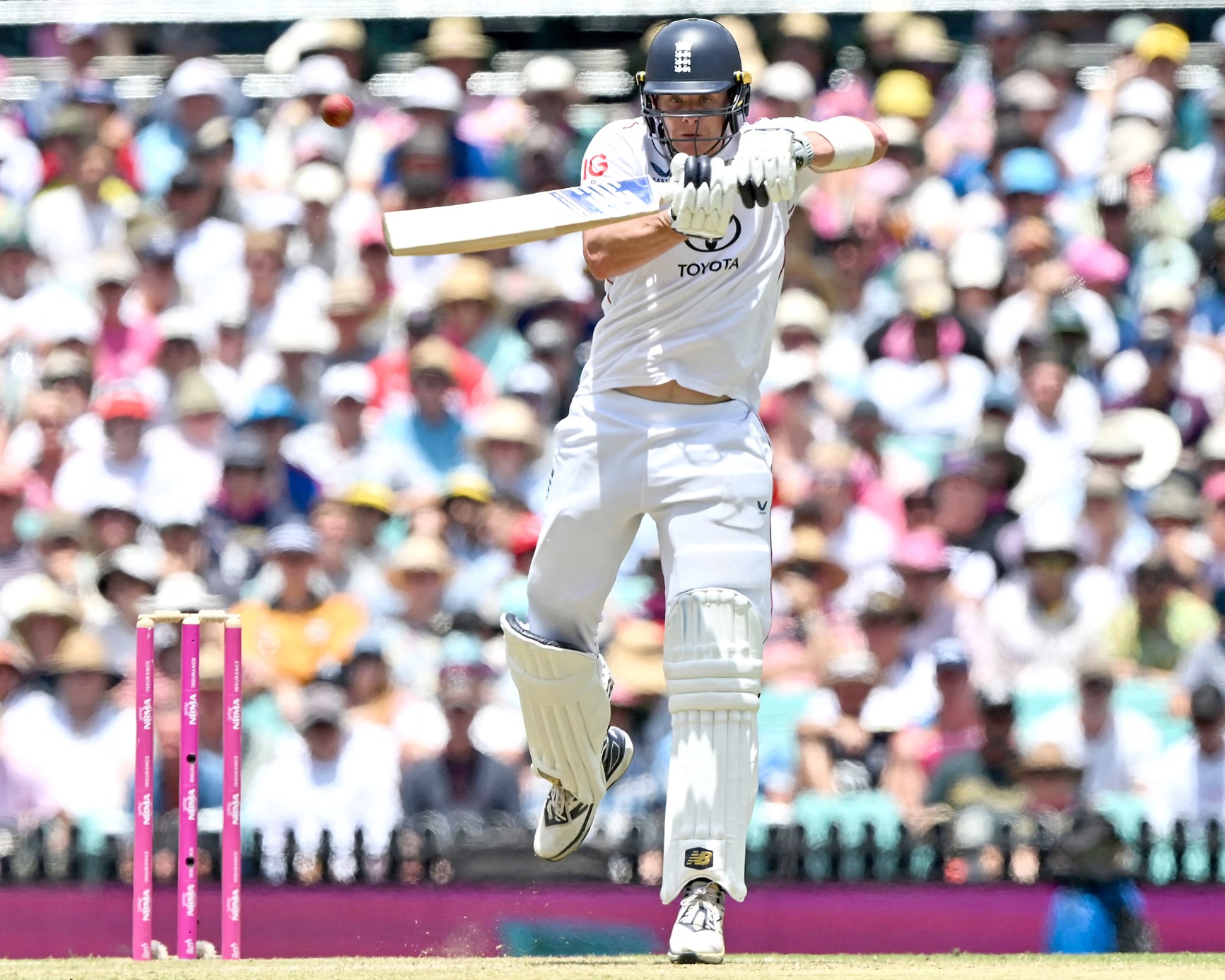
I didn’t see much of the cricket – only highlights – but it seems to me there was a crucial difference in the fielding. England dropped far too many catches, including easy ones, while Australia held onto some stunners. England’s batters also had a tendency to play stupid shots at important times. I’m thinking primarly of Jamie Smith’s dismissal off the innocuous bowling of Marnus Labuschagne, which was calamitous, but there were others. Above all, though, I think the first few matches revealed England’s preparation to have been completely inadequate. Questions should be asked not only of the squad selection but also of the management of the tour, especially the lack of practice matches.
On the bright side (for England), Joe Root scored his first Test century in Australia and then scored his second. Jacob Bethell who is only 22, scored a fine century in the final Test at Sydney. I’ve read articles praising him, but didn’t see much evidence in the stats to justify their opinion. Now he’s shown what he can do in the Test arena, I wonder if he will turn out to be a successor to Root?
Anyway, that’s the Ashes done and dusted (so to speak). By the time of the next Ashes series Australia (2029/2030) I will have retired. Although I’ve been to Sydney, I’ve never visited Brisbane, Perth, Adelaide or Melbourne. Now there’s an idea…
P.S. I was slightly surprised that Mitchell Starc was Man of the Series. Travis Head scored 629 runs, which was to my mind even more impressive. Still, this award is ample compensation:

I have written many times (e.g. here) about the reasons I left the social media platform X, formerly known as Twitter. I quit Twitter in August 2023 and have no regrets for doing so. I have more followers and better engagement on Bluesky and Mastodon than I ever had on Twitter, and far less abuse. Unfortunately, my employer, along with most public institutions, still maintains an account there, a position I find ethically indefensible. Not to put to fine a point on it, I find it outrageous that Maynooth University persists in using Xitter. Touting for trade in a far-right propaganda channel is no way for a institution of higher education to behave. I’m very disappointed that I have only heard of a few organizations that have taken the principled decision to leave. You can read more about my views on this matter here.
My opinion on this has hardened considerably with the revelation that the AI bot known as Grok, which is integrated with X/Twitter, has developed a facility for creating nonconsensual and sexually explicit deepfake images, including pictures of children, for circulation on the platform. Grok/X not only condones this activity, which by the way is against the law, nor merely facilitates it, but actively encourages it.
If you don’t leave a social media platform when you find out that it endorses and encourages abusive exploitation of children then you are supporting that behaviour and helping to promote it. There is no grey area here in this. If you don’t draw the line here, when will you draw it? Staying on X is morally indefensible. It is the Epstein Island of social media.
Moreover, any institution or organisation that maintains a presence on X must be content to endorse the promotion of child abuse. I would like to hear an explanation from my employer why they think it’s appropriate for them to operate an official account on the Twitter/X that built a machine for generating images of child pornography. Perhaps readers could ask their employers the same question?
My preferred resolution of this matter would be to ban X entirely.


 In the Dark