Yet more high-z galaxies from JWST…
Posted in The Universe and Stuff with tags arXiv:2312.10033, Big Bang, galaxies, galaxy formation, high-z, High-z Galaxies, JADES, JWST on December 19, 2023 by telescoperI noticed a paper on arXiv yesterday, by Robertson et al., with the abstract:

You can click on this to make it larger if you find it difficult to read.
This is the latest in a number of studies by the JWST Advanced Deep Extragalactic Survey (JADES), which is aiming to detect galaxies that formed in the very early Universe; for a previous example see here. The latest batch can be seen in this figure:

There is an important caveat here, which is that these are photometric redshifts, based on the overall shape of the spectrum of the galaxy rather than on spectral lines which give a more accurate result. Follow-up spectroscopy is needed to firmly identify the redshift of the sources. Past experience suggests that some of these candidates may not actually be at as high a redshift as is claimed. If confirmed, however, the existence of large galaxies at redshifts of order 15 will put greater pressure on models of galaxy formation. A recent OJAp publication has shown that galaxies at redshift 10 are consistent with current theoretical ideas, but much larger will increase the tension on theorists. I can imagine quite a few people around the world replotting their graphs right now!
IOAP Diamond Open Access Awards 2024
Posted in Open Access with tags Diamond Open Access, Directory of Open Access Journals, Irish Open Access Publishers, journals, Open Access, Open Journal of Astrophysics, Publishing, research, scholarly-communication on December 18, 2023 by telescoperLast week I found out about a new organization called Irish Open Access Publishers whose mission statement is as follows:
Irish Open Access Publishers (IOAP) is a community of practice driven by Irish open access publishers for Irish open access publishers. The IOAP promotes engagement with the Diamond Open Access publishing model (free to publish and free to read) as well as indexing on the Directory of Open Access Journals and the Directory of Open Access Books. The aim of this dynamic community of practice is to promote publishing activity that is free of pay walls and publication embargoes to further the dissemination of high quality scholarly output to all in society.
These aims are laudable and I support them wholeheartedly. I should also mention that the Open Journal of Astrophysics is listed in the Directory of Open Access Journals here, where you will find details of all the papers we have published so far. This index is all part of the service.
The reason I found out about the existence of IOAP is that they are offering a new set of awards, for which nominations are now open:
(Unfortunately the links in the above image are not clickable, but you can the award details here…)
Nominations for the first three categories are by self-nomination only. I will of course, on behalf of Maynooth Academic Publishing, the Editorial Board, the authors, and everyone who has helped behind the scenes, be nominating the Open Journal of Astrophysics.
Nominations for the final category, Outstanding Contribution to the OA Field are described thus:
Category 4 welcomes third party as well as self nominations from academics, students, librarians, research managers, academic leaders, publishers and other stakeholders across further and higher education for an individual who has made an outstanding contribution to open access publishing in Ireland. Nominations from scholarly societies and other scholarly organisations are also welcome. Nominations for individuals based in Northern Ireland are also invited.
Self nominations are restricted to individuals based in Ireland including Northern Ireland. Third party nominations are invited from individuals based in Ireland including Northern Ireland as well as individuals based overseas. All third party nominations must be for individuals practising in the field of open access publishing in Ireland including Northern Ireland solely.
Notice that nominations are not restricted to individuals based in Ireland. So, wherever you are, if you can think of any individual based in Ireland who has done enough to merit being described as having made an “outstanding contribution”, perhaps not only for being a long-term advocate of Diamond Open Access but also for setting up and being Managing Editor of a successful Diamond Open Access journal in the field of astrophysics, then please feel free to nominate me them. I hope you get the message. If you want subtle, you’ve come to the wrong place!
The nomination form is here. The closing date for nominations is 1st February 2024.
Spanish Key – Miles Davis
Posted in Jazz with tags Bitches Brew, Flamenco Sketches, Miles Davis, Spanish Key on December 17, 2023 by telescoperAs I am still in Spain for a for more days before the Christmas break I thought I would share a vaguely relevant piece of music, Spanish Key from the 1970 album Bitches Brew by Miles Davis. This I don’t have time to write a long piece about this album, but I will say that of all the abrupt changes of musical direction during the career of Miles Davis, this album is probably the most startling and many jazz fans – even ardent admirers of Miles Davis – don’t like it at all. Anyway, des goûts et des couleurs on ne discute pas…
This track is particularly interesting to me because I’ve long wondered about the title and the musical structure. I’m not at all sure, but it seems likely to me that the title indicates the relationship of this piece to the track Flamenco Sketches from the classic album Kind of Blue recorded over a decade earlier. In that album, Miles was experimenting with jazz based not on traditional keys and scales, but on modes. In Flamenco Sketches there is a section based on a major phrygian mode which is commonly used in flamenco music. Spanish Key is in a very different style – much faster for one thing – but it has a similar pattern involving changes from E to D to D (phrygian) to E (phrygian) and G (mixolydian). Apparently Miles gave minimal instruction to his musicians about what to play, but did have prearranged signals to shift from one mode to another, such as happens about 3:15 in the recording when he ushers in a guitar solo by John McLaughlin, and around 12:46 when the mood abruptly changes as Miles introduces a new theme. I also think it was a stroke of genius to include a bass clarinet on this album; on this track it adds a Moorish element to the Spanish tinge.
Anyway, there’s so much going on in this track that it’s more instructive to listen to it than write about it, so here you are. Enjoy!
Retractions and Resignations
Posted in Open Access with tags academic publishing, Gold Open Access, Hindawi, Journal of Geometric Mechanics, journals, Open Access, Peer Review, Publishing, Retractions on December 16, 2023 by telescoperI saw an article this week in Nature that revealed that more than 10,000 research papers have been retracted so far 2023. The actual number is probably much higher than that, as this is just the fraudulent papers that have been found out. Over 80% of the papers mentioned in the article were published by Hindawi, a known predatory publisher that specializes in Gold Open Access journals that charge Article Processing Charges. Hindawi is owned by Wiley but the brand has become so toxic that Wiley no longer wants to use the name. Presumably it still wants the profits.
(Another bit of news this week makes me think that Hindawi might be the academic publishing equivalent of Tesla…)
Here’s a figure showing how the number of retracted research articles has increased over time:
It has always seemed to me that the shift to “Gold” Open Access in which authors pay to have their work published would lead to a decrease in editorial standards. Since the publisher’s income comes from APCs, the more papers they publish the more money they get. This is another reason Diamond Open Access run on a not-for-profit basis with no fees for either authors or readers is a much better model.
At least some academics are taking a stand. Retraction Watch maintains a list of journals whose editors who have resigned – sometimes en masse from the same journal – in response to the imposition of dodgy practices by their publishers. Take the Journal of Geometric Mechanics, for example. The entire Editorial Board of this journal resigned because of pressure from above to increase “output” (i.e. profits) by lowering academic standards.
This is just a start, of course, but I don’t think it will take long for academic community to accept that the this publishing model is rotten to the core and embraces the only really viable and sustainable alternative.
Two New Publications at the Open Journal of Astrophysics
Posted in OJAp Papers, Open Access, The Universe and Stuff with tags arXiv:2307.00052v3, arXiv:2308.01505v3, Astrophysics of Galaxies, Milliquas, quasars, Star Clusters on December 14, 2023 by telescoperAs anticipated a couple of days ago, it’s now possible to announce another couple of new papers at the Open Journal of Astrophysics. These papers take us up to a total of 49 in Volume 6 (2023) and 114 in total since we started publishing.
It would be nice if we could make it to 50 in Volume 6 (2023), but I have already decided to close the publishing platform from 22nd December until 5th January (inclusive), so there there isn’t much time to get the single needed for our half-century. While we will not be publishing new papers during this closure, the peer review platform will remain open for submission of new and revised manuscripts and the editorial processes will continue.
Whether or not we make 50 this year, it is worth remarking that 49 is already a significant figure, as it corresponds to the total number of papers we published in the previous three years: 15 (2020); 17 (2021); and 17 (2022). Things are definitely looking up!
Anyway, the first paper of the most recent pair – published on December 8th – is “The Million Quasars (Milliquas) Catalogue, v8”; its primary classification is Astrophysics of Galaxies and the author is Eric Wim Flesch from New Zealand. The Milliquas catalogue includes quasars from the literature to 30 June 2023, including quasars from the DESI-EDR and SDSS-DR18Q surveys.
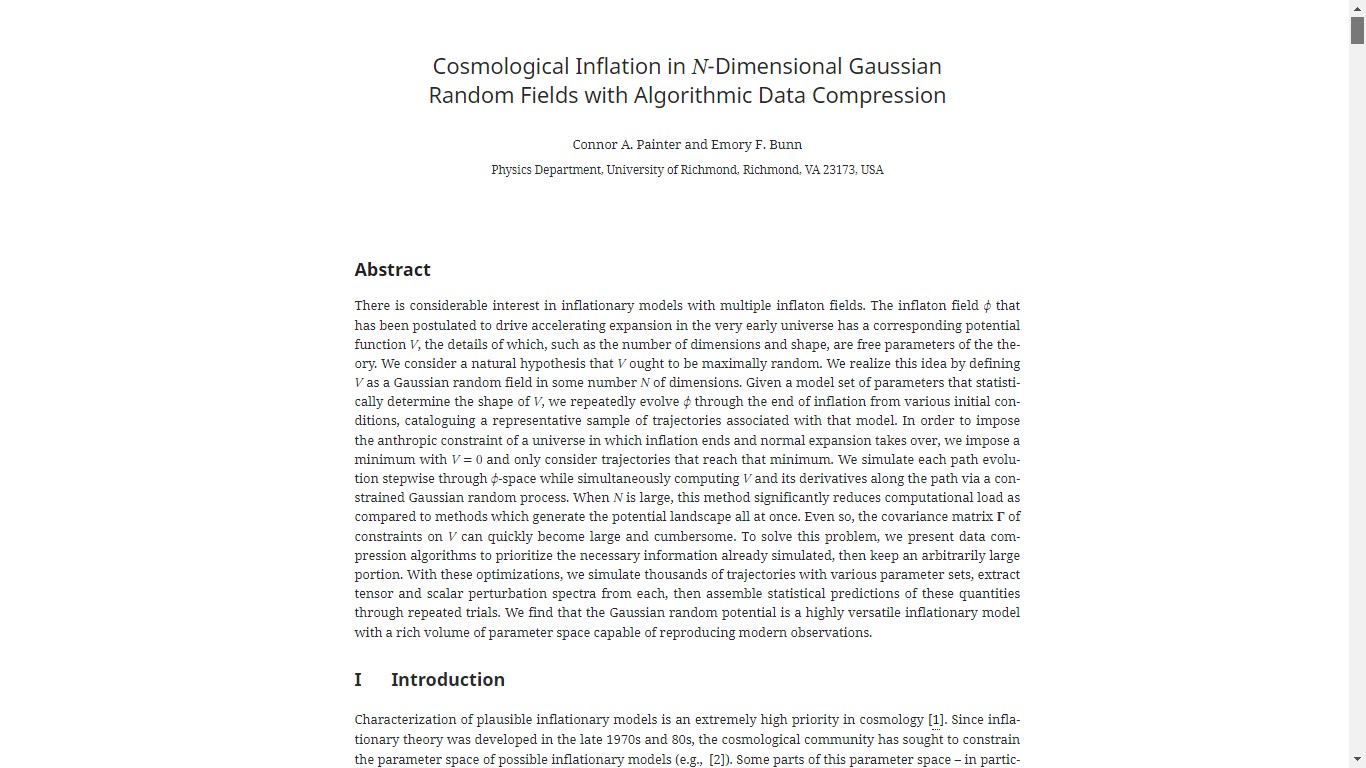
Here is a screen grab of the overlay which includes the abstract:
You can click on the image of the overlay to make it larger should you wish to do so. You can find the officially accepted version of the paper on the arXiv here.
The second paper was published on 11th December 2023 and is also in the folder marked Astrophysics of Galaxies.
The authors are all from various institutions in the USA: Michael Grudić (Carnegie Observatories), Stella Offner (University of Texas at Austin); Dávid Guszejnov (Harvard); Claude-André Faucher-Giguère (Northwestern University); and Philip F. Hopkins (Caltech). The paper presents a comparison of full radiative magnetohydrodynamics simulations of the formation of star clusters with simple stochastic modelling showing the limitations of the latter.
Here is a screen grab of the overlay which includes the abstract:
You can click on the image of the overlay to make it larger should you wish to do so. You can find the officially accepted version of the paper on the arXiv here.
New Publication at the Open Journal of Astrophysics
Posted in OJAp Papers, Open Access, The Universe and Stuff with tags arXiv:2309.03269v2, Astrophysics of Galaxies, galaxies, JWST, The Open Journal of Astrophysics on December 12, 2023 by telescoperI was doing some work on the Open Journal of Astrophysics site and realized that there is a paper we published last week that I haven’t advertised on here yet, so I’m remedying that now.
The paper in question is the 47th so far in Volume 6 (2023) and it’s the 112th altogether. This one was actually published on Tuesday December 5th. Two further papers are imminent; I’m just waiting for their metadata to be registered with Crossref.
The title of this one is “The SPHINX Public Data Release: Forward Modelling High-Redshift JWST Observations with Cosmological Radiation Hydrodynamics Simulations” and it represents public data release of Sphinx20, a full box cosmological radiation-hydrodynamics simulation that provides a statistical sample of galaxies for comparison with those observed by JWST. It is in the folder marked Astrophysics of Galaxies.
There are 10 authors: Harley Katz (Oxford, UK); Joki Rosdahl (Lyon, France); Taysun Kimm (Seoul, Korea); Jeremy Blaizot (Lyon, France); Nicholas Choustikov (Oxford, UK); Marion Farcy and Thibault Garel (Geneva, Switzerland); Martin G. Haehnelt (Cambridge, UK); Leo Michel-Dansac (Lyon, France); and Pierre Ocvirk (Strasbourg, France).
Here is the overlay of the paper containing the abstract:
You can click on the image of the overlay to make it larger should you wish to do so. You can find the officially accepted version of the paper on the arXiv here.
The Return of Halley’s Comet…
Posted in Art, Literature, The Universe and Stuff with tags Aphelion, Halley's Comet, Horace, Quintus Horatius Flaccus on December 11, 2023 by telescoperI was reminded at the weekend that Halley’s Comet has just passed its aphelion (furthest distance from the Sun) and is now falling back into the Solar System towards its next perihelion (closest distance to the Sun) in 2061, by which time I will almost certainly be retired.
Halley’s Comet last visited us in 1986 when I was 23 and living in Brighton. It will next appear in 2061, when I shall be 98 and lucky to be living at all.
This reminded me of a rather poignant cartoon I found a while ago on Facebook. I don’t know the name of the artist. If anyone does please let me know.

The comet’s orbital period of 75 years or so is brief by astronomical standards, as is the duration of a human life. As Quintus Horatius Flaccus (Horace to you and me) put it in one of his Odes (Book I, Ode 4, line 15):
Vitae summa brevis spem nos vetat incohare longam