As well as being International Workers Day, today, 1st May, is Beltane (Bealtaine in Irish) is an old Celtic festival. The month of May is called Bealtaine in Irish and May Day is called Lá Bealtaine, which is one of the so-called Cross-Quarter Days that lie (roughly) halfway between the equinoxes and solstices, in this case the Spring Equinox and the Summer Solstice. The upshot of all this is that today is a Bank Holiday, so I have the day off.
If the weather holds I shall spend a bit of time in the garden. Yesterday was quite warm but very showery. I tried three times to hang out my washing to dry in broad sunshine only to have to bring it in again when a torrential downpour arrived. Eventually I gave up.
On the corresponding days last year, the year before and the year before that I was wondering about how the pandemic would pan out. Back on May 1st 2020 I didn’t think it would last until May 2021 and back in 2021 I did not forecast that we would still have over a thousand new infections every day in May 2022. Fortunately the pandemic seems to be dying down, though the consequences will be with us for some time.
After toady’s holiday we have four days left of teaching term at Maynooth University, then there’s a study week for the students and then the exams begin. I’ve more-or-less managed to keep on track so my remaining classes will be mainly revision. It will be quite a busy week though. Friday 5th May is the deadline for this year’s Computational Physics projects, so I’m anticipating last-minute queries all week. As well as this, and revision lectures and tutorials, I will be attending the annual Dean’s Lecture on Wednesday and attending a concert performance by members of Irish National Opera in the Aula Maxima on campus on Thursday as part of the Arts and Minds Festival.
Taking the opportunity of the Bank Holiday weekend to catch up on some other blogs, I found this video on Peter Woit’s Not Even Wrong. It’s by Angela Collier. It’s a bit long for what it says, and I find the silly game going on while the speaker talks very irritating, but the speaker makes some very good points and it’s well worth watching all the way through. The most important message it conveys, I think, is how the hype surrounding string theory contributed to increasing public distrust of science and the media.
If I were a string theorist I probably wouldn’t appreciate this video, but I’m not and I do!
I know it’s the Bank Holiday weekend but I could resist a quick post about a new paper that hit the arXiv yesterday (where all new astrophysics papers worth reading can be found). It is led by Joe McCaffrey who is a PhD student in the Department of Theoretical Physics at Maynooth University. The paper has been submitted to the Open Journal of Astrophysics, but obviously I am conflicted so have assigned it to another editor.
As many of you will be aware, there’s been a considerable to-do not to mention a hoo-hah about the detections by JWST of some galaxies at high redshift. Some of these have been shown not to be galaxies at high redshift after all, but some around z=10 seem to be genuine.
Anyway, the abstract of Joe’s paper is this:
Recent observations by JWST have uncovered galaxies in the very early universe via the JADES and CEERS surveys. These galaxies have been measured to have very high stellar masses with substantial star formation rates. There are concerns that these observations are in tension with the ΛCDM model of the universe, as the stellar masses of the galaxies are relatively high for their respective redshifts. Recent studies have compared the JWST observations with large-scale cosmological simulations. While they were successful in reproducing the galaxies seen in JADES and CEERS, the mass and spatial resolution of these simulations were insufficient to fully capture the early assembly history of the simulated galaxies. In this study, we use results from the Renaissance simulations, which are a suite of high resolution simulations designed to model galaxy formation in the early universe. We find that the most massive galaxies in Renaissance have stellar masses and star formation rates that are entirely consistent with the observations from the JADES and CEERS surveys. The exquisite resolution afforded by Renaissance allows us to model the build-up of early galaxies from stellar masses as low as 104 M⊙ up to a maximum stellar mass of a few times 107 M⊙. Within this galaxy formation paradigm, we find excellent agreement with JADES and CEERS. We find no tension between the ΛCDM model and current JWST measurements. As JWST continues to explore the high redshift universe, high resolution simulations, such as Renaissance, will continue to be crucial in understanding the formation history of early embryonic galaxies.
arXiv:2304.13755
The key figure is this one:
The solid curves show the number of galaxies of a given mass one would expect to see as a function of redshift in fields comparable to those observed with estimated values from observations (star-shaped symbols). As you can see the observed points are consistent with the predictions. There’s no tension, so you can all relax.
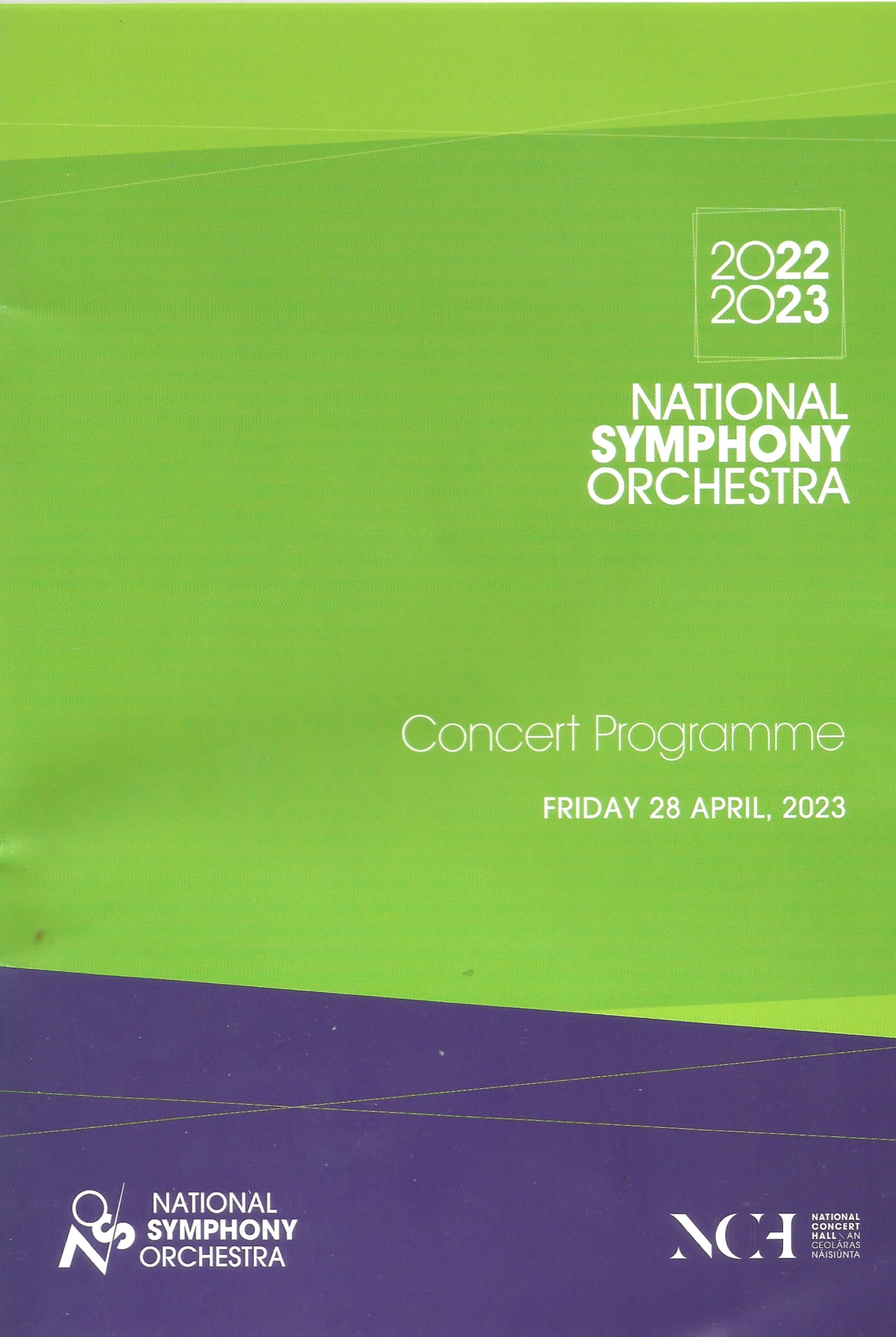
Looking back through my old blog posts, I find that the last time I went to a concert at the National Concert Hall was 10th February 2023. Owing to pressure of work I’ve had neither the time nor the energy to make the trip into Dublin since then, but last night I finally managed to get there for the excellent programme shown above, which was also broadcast live on RTÉ Lyric FM.
On this occasion the National Symphony Orchestra was conducted by Ruth Reinhardt, who last conducted the Orchestra during the pandemic in one of those weird occasions for which most of the musicians were masked, as was she. Anyway, for tonight’s performance she was unmasked long with the rest of the band.
Anton Webern’s Passacaglia(his Opus 1) was a new one on me. It’s not in the 12-tone style he adopted later as a member of the 2nd Viennese School, and can properly be regarded as a (very) late Romantic piece. It’s an intriguing variation of the Passacaglia form (originally a stately dance in triple time built on a bass theme) in that it’s not really a dance and it’s not in triple time, but it is introduced by a theme of eight notes played pizzicato on the strings, which is then followed by a set of variations. The piece only runs about 12 minutes but it packs a lot in. I found it very absorbing and enjoyed it enormously.
The Four Last Songs were published after his death, so Richard Strauss never heard them performed. The very first time they were performed was in 1950 at the Royal Albert Hall, by the London Philharmonia. One can only imagine what it must have been like for the orchestra making this music live for the very first time. Apparently the first time any of them had seen the score was when they turned up for the rehearsal. I’m sure they knew as soon as they started playing that it was a masterpiece.
Last night we heard these songs sung by Amanda Majeski, who arrived on stage resplendent in a black evening gown. I was somewhat surprised to see her using a score for this performance. I would have thought that this was such a standard component of the repertoire that all sopranos would know all the songs off by heart. Perhaps it was just nerves, but I thought the first song, Frühling, lacked warmth but as the concert went on Amanda Majeski got into her stride and by the time she got to Im Abendrot (my favourite) she reached the right level of intensity.
I must single out the leader of the National Symphony Orchestra Elaine Clark for her gorgeous playing of the lovely violin solo in the third song, Beim Schlafengehen. I don’t mind admitting that it brought a tear to my eye.
Incidentally, as far as I know the Four Last Songs were not specifically intended to be performed together as they inevitably are these days. Although the last is my favourite, I think the first three (all based on poems by Herman Hesse) have much more in common with each other than Im Abendrot (which is a poem by Joseph von Eichendorff).
After the wine break we had Symphony No. 3 (“Scottish”) by Felix Mendelssohn. Inspired by a visit to Scotland in 1829 – the first movement was actually composed that year in Edinburgh – it wasn’t completed until over a decade later and should probably be No. 5, but who’s counting? It’s a piece on four movements, with little or no break between them. The first movement starts with a slow theme, like a hymn, but then becomes much more reminiscent of the Hebrides Overture composed in 1830. The landscape of the other three movements is very varied, sometimes cheery, sometimes lush, sometimes tempestuous. The final movement Allegro Vivacissimo has a marking guerriro (“warlike”), which in parts it is, but it also has calmer and more reflective passages before the rumbustious finale.
I always enjoy watching the musicians in these concerts, and could see last night that they were all enjoying themselves hugely. Well done to Ruth Reinhardt and the National Symphony Orchestra for an excellent performance. The hall was by no means full, which was a shame, but the concert was warmly appreciated by those of us there in the audience and no doubt by those listening on the radio.
Now there’s only a month or so to the finale of this concert season so I must try to make the most of the few remaining performances before the summer break…
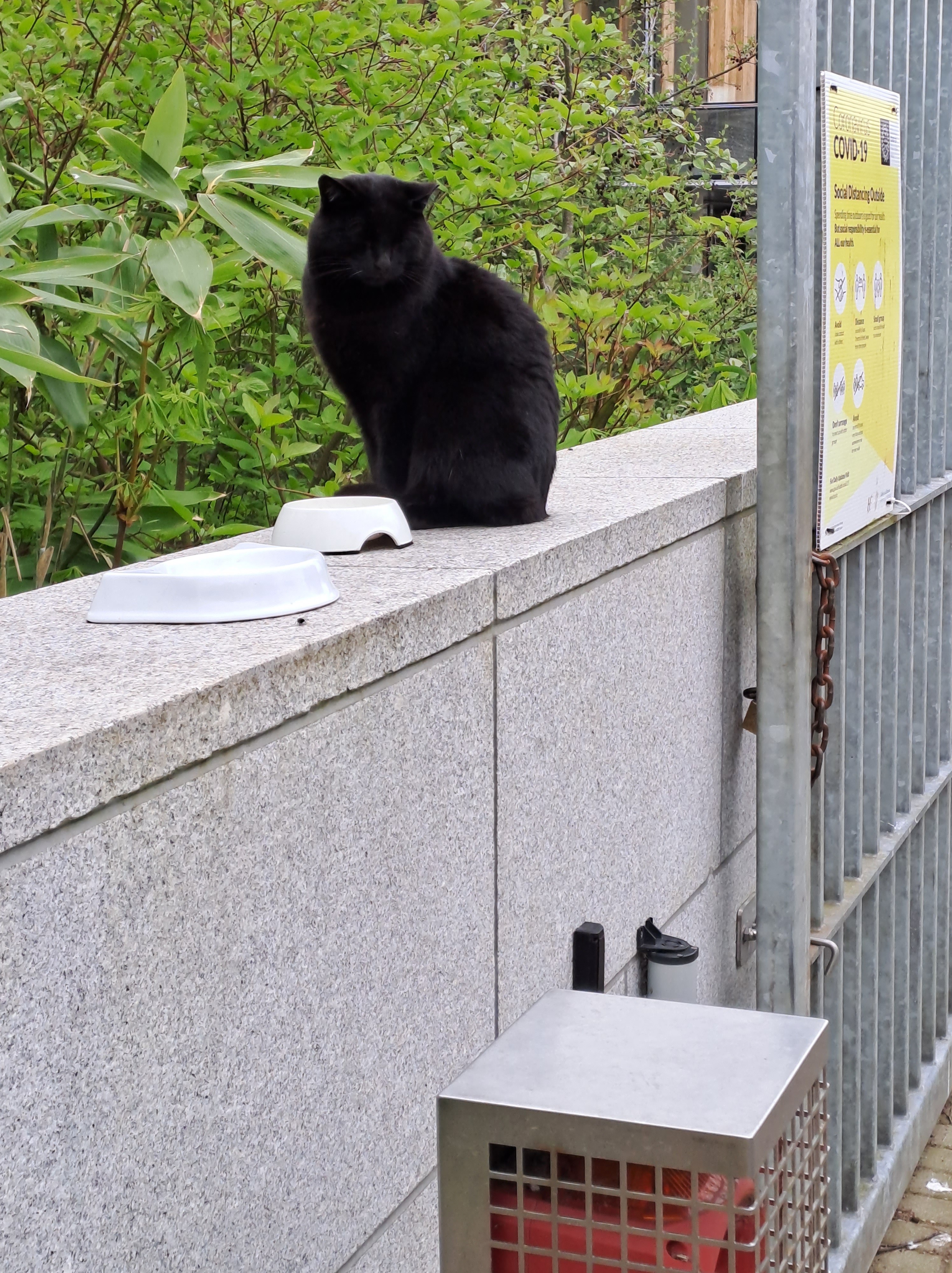
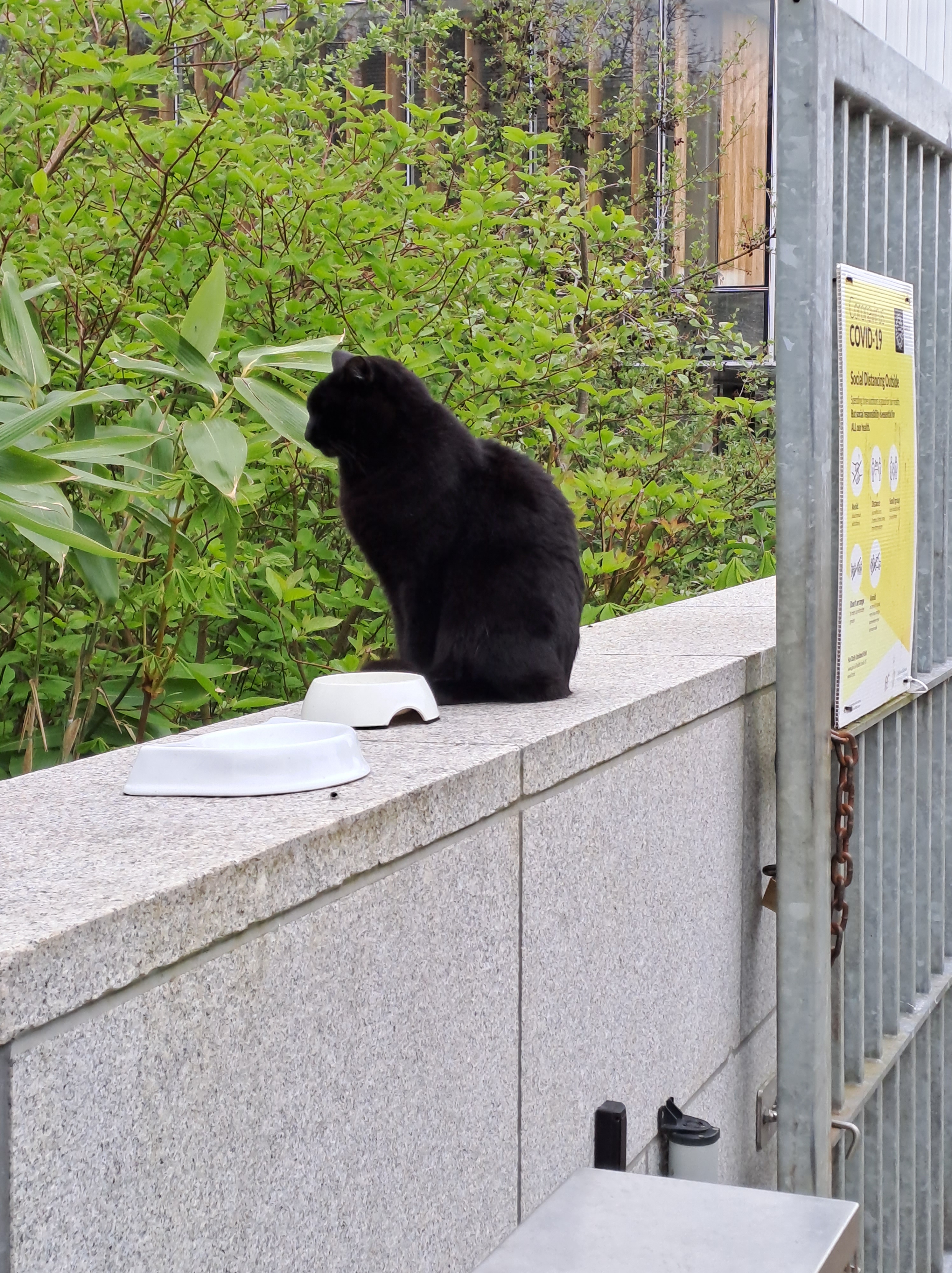
It’s the Friday of the penultimate week of teaching term at Maynooth University, and it’s also a long weekend with the May Bank Holiday on Monday. I thought I would just give an update on our resident feline before I go to a seminar and then head into Dublin for a concert. I passed by Maynooth University Library Cat yesterday on my way back to the Department after lunch, and although he seemed well he wasn’t very sociable. I think he generally gets a bit sleepy after lunch. At any rate he seemed reluctant to open his eyes!
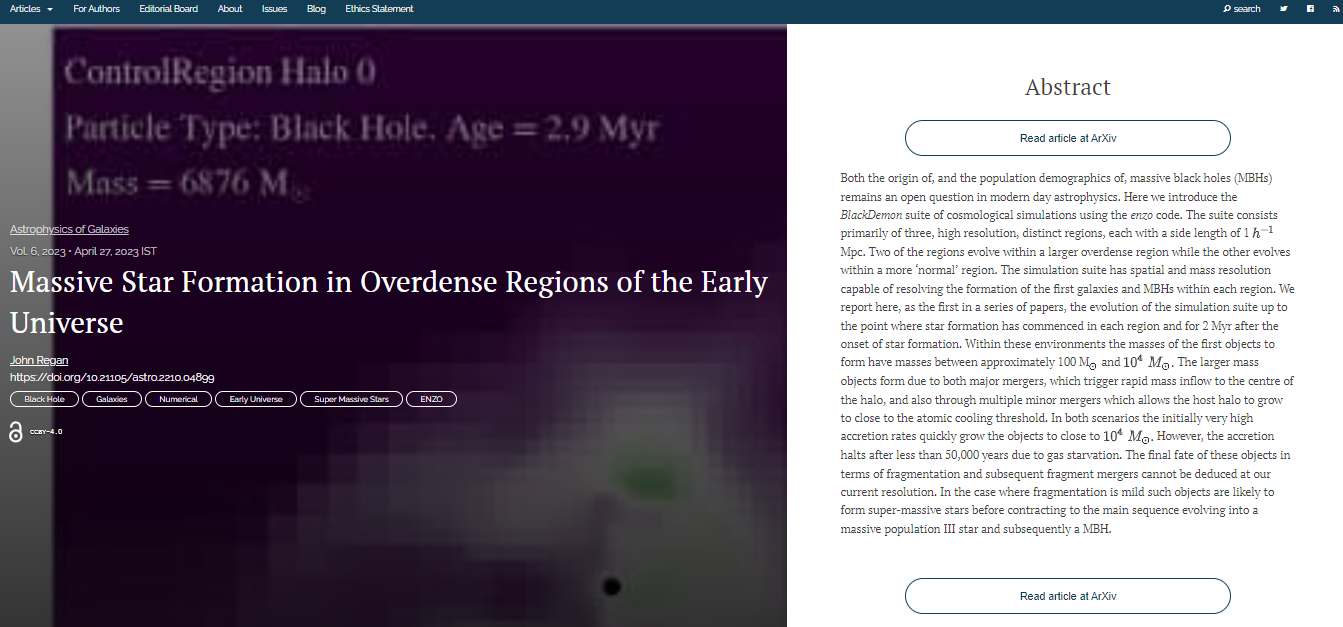
Time for the announcement of yet another new paper at the Open Journal of Astrophysics. The latest paper is the 14th paper so far in Volume 6 (2023) and the 79th in all. This one is in the folder marked Astrophysics of Galaxies and its title is “Massive Star Formation in Overdense Regions of the Early Universe”. The early Universe aspect does of course imply considerable overlap with cosmology.
The (sole) author is our very own John Regan of the Department of Theoretical Physics at Maynooth University.
Here is a screen grab of the overlay which includes the abstract:
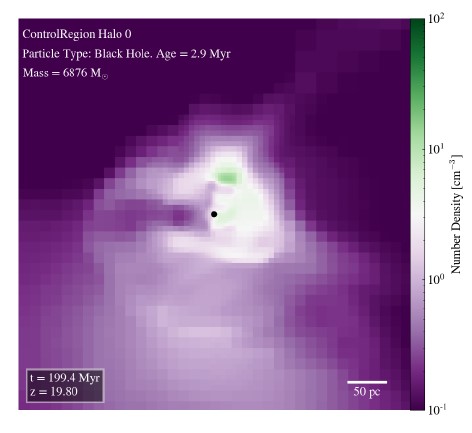
Here’s a bigger version of the image I chose for the overlay:
You can click on the image of the overlay to make it larger should you wish to do so. You can find the officially accepted version of the paper on the arXiv here.
The current state of play with regard to Open Access publishing is very disappointing. The academic publishing industry seems to have persuaded the powers that be to allow them to charge exorbitant article processing charges (APCs) to replace revenues lost from subscriptions when they publish a paper free to readers. This simply transfers the cost from reader to author, and excludes those authors who can’t afford to pay.
This current system of ‘Gold’ Open Access is a scam, and it’s a terrible shame we have ended up having it foisted upon us. Fortunately, being forced to pay APCs of many thousands of euros to publish their papers, researchers are at last starting to realize that they are being ripped off. Recently, the entire Editorial Board of Neuroimage and its sister journal Neuroimage: Reportsresigned in protest at the `extreme’ APC levels imposed by the publisher, Elsevier. I’m sure other academics will follow this example, as it becomes more and more obvious that the current arrangements are unsustainable. Previously the profits of the big publishers were hidden in library budgets. Now they are hitting researchers and their grants directly, as authors now have to pay, and people who previously hadn’t thought much about the absurdity of it all are now realizing what a racket academic publishing really is.
The people at the top have been slow to grasp this reality, but there are signs that this is at last happening, In the USA there has been the Nelson Memorandum (see discussion here). Now there is movement in the European Union, with member states apparently set on agreeing a text to be published next month (May 2023) that calls for immediate open access the default, with no author fees. This is clearly how Open Access should be, though I am still worried that the sizeable publishing lobby will try to persuade research agencies and institutions to pay the existing fees on behalf of authors, which does not solve the problem but merely hides it.
I know I’m not alone in thinking that the current publishing ecosystem is doomed and will die a natural death soon enough. The replacement should be a worldwide network of institutional and/or subject-based repositories that share research literature freely for the common good. Universities and research centres should simply bypass the grotesque parasite that is the publishing industry. Indeed, I would be in favour of hastening the demise of the Academic Journal Racket by having institutions make it a disciplinary offence for any researcher to pay an APC.
We are lucky in physics and astronomy because arXiv has already done the hard work for us. Indeed, it is now a truth universally acknowledged* that every new research paper worth reading in these disciplines can be found on arXiv. Old-style journals are no longer necessary. It is great that arXiv is being joined by similar ventures in other fields, such as BiorXiv and EarthArxiv. A list of existing repositories can be found here. I’m sure many more will follow. What is needed is a global effort to link these repositories to each other and to peer review mechanisms. One way is through overlays as demonstrated by the Open Journal of Astrophysics, there being no reason why the idea can’t be extended beyond arXiv. Other routes are possible, of course, and I would love to see different models developed. I think the next few years are going to be very exciting.
*It is also a truth universally acknowledged that anyone who doesn’t understand the reference to “a truth university acknowledged” has not read Pride and Prejudice by Jane Austen…
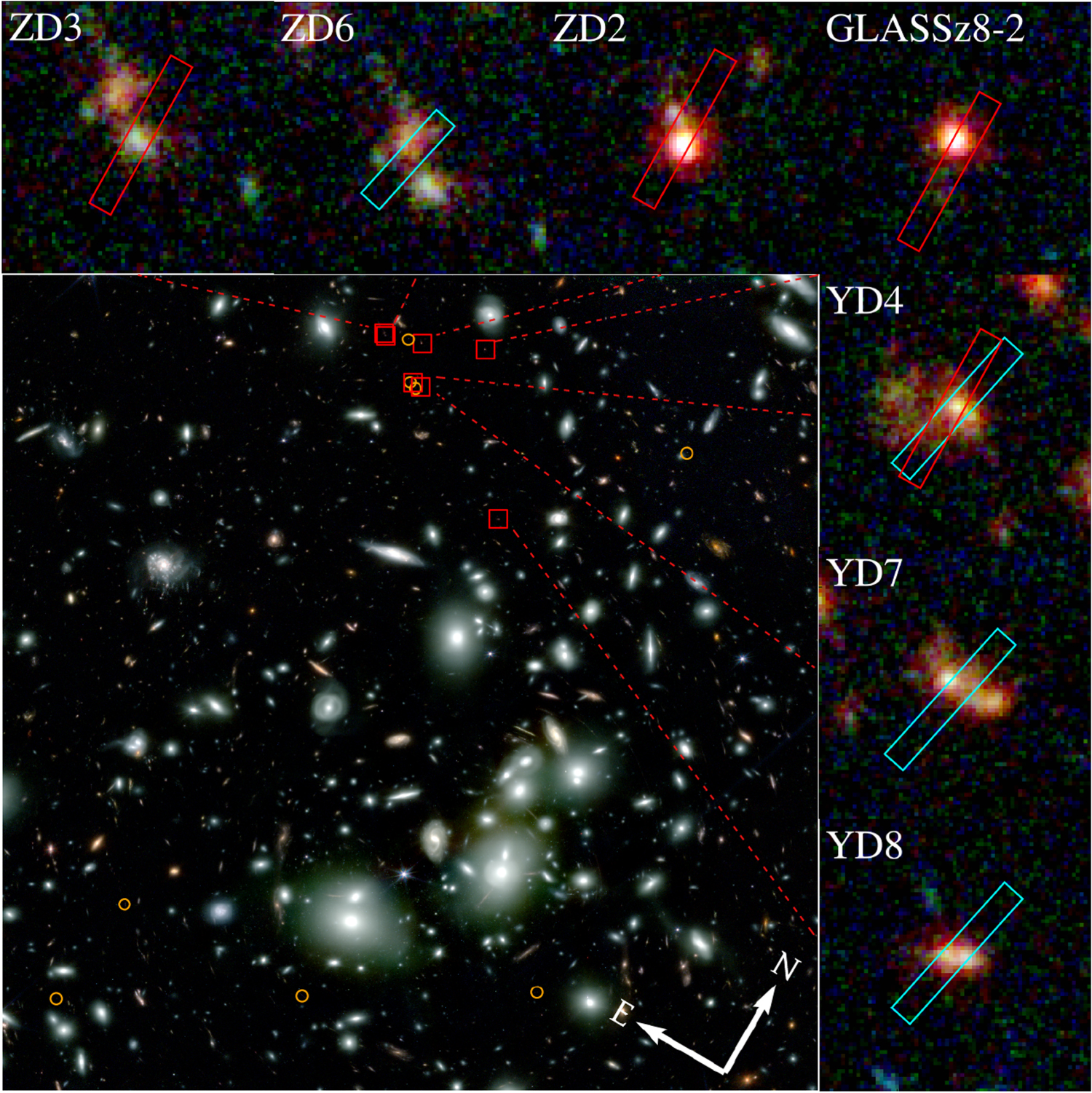
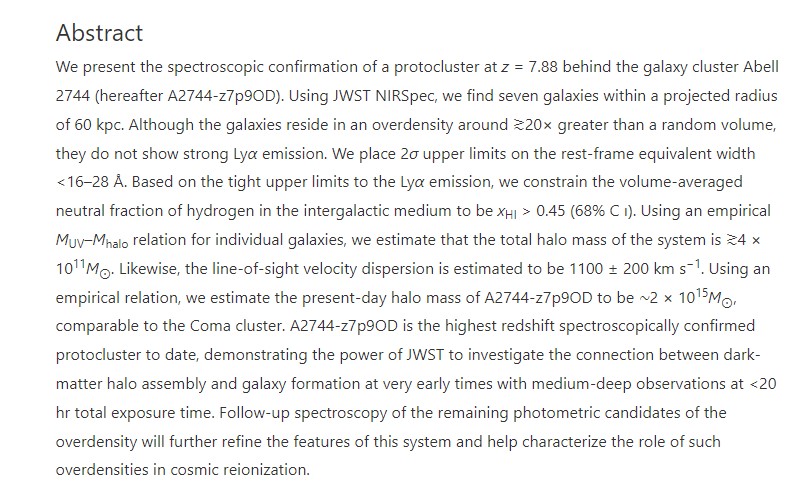
The article concerned, with lead author Takahiro Morishita of the California Institute of Technology (Caltech) et al. describes the detection using JWST of an apparent proto-cluster – seven galaxies in close proximity – at redshift z = 7.88. Here is the abstract:
Although only seven galaxies are identified, this does look like the very early stages of formation of an object that will grow into a giant galaxy cluster by the present epoch. The redshift of this progenitor corresponds to a stage of the Universe just 650 million years or so after the Big Bang, compared with the current age of about 14 billion years. As the abstract says, we would need to know more about other possible constituent galaxies and their motions to be sure, but it looks like a baby destined to grow into a monster…
(The Euclid spacecraft will be launched via SpaceX on a Falcon 9 rocket from Cape Canaveral in July 2023, but no further details are publicly available right now.)
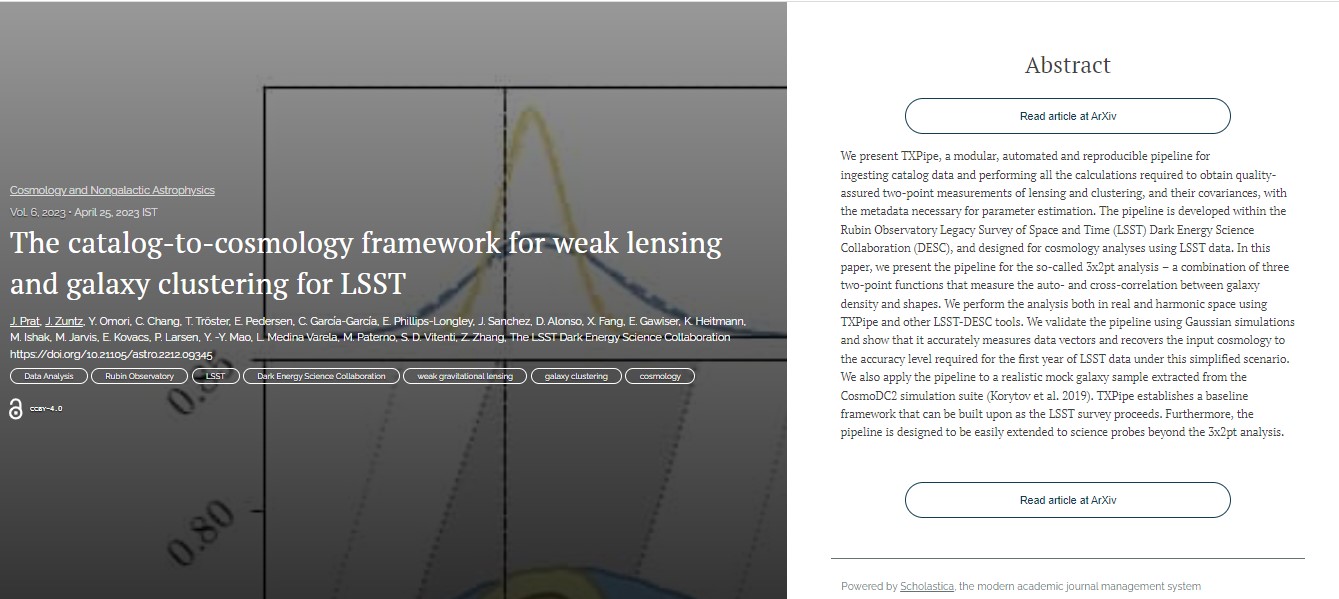
It’s time once more to announce a new paper at the Open Journal of Astrophysics. The latest paper is the 13th paper so far in Volume 6 (2023) and the 78th in all. This one is another for the folder marked Cosmology and NonGalactic Astrophysics and its title is “The catalog-to-cosmology framework for weak lensing and galaxy clustering for LSST”.
The lead author is Judit Prat of the University of Chicago (Illinois, USA) and there are 21 co-authors from elsewhere in the USA and in the UK. The paper is written on behalf of the LSST Dark Energy Science Collaboration (LSST DESC), which is the international science collaboration that will make high accuracy measurements of fundamental cosmological parameters using data from the Rubin Observatory Legacy Survey of Space and Time (LSST). The OJAp has published a number of papers involving LSST DESC, and I’m very happy that such an important consortium has chosen to publish with us.
Here is a screen grab of the overlay which includes the abstract:
You can click on the image of the overlay to make it larger should you wish to do so. You can find the officially accepted version of the paper on the arXiv here.
The views presented here are personal and not necessarily those of my employer (or anyone else for that matter).
Feel free to comment on any of the posts on this blog but comments may be moderated; anonymous comments and any considered by me to be vexatious and/or abusive and/or defamatory will not be accepted. I do not necessarily endorse, support, sanction, encourage, verify or agree with the opinions or statements of any information or other content in the comments on this site and do not in any way guarantee their accuracy or reliability.





 In the Dark