R.I.P. Jon Davies

Posted in Biographical, Cardiff, The Universe and Stuff on December 1, 2021 by telescoper

Once again I find myself having to pass on some bad news. I was shocked and saddened last night to hear of the death of former colleague at Cardiff University, astronomer Prof. Jonathan Davies (shown left).  I understand he had been ill for some time, but had preferred to keep his illness private.

Jon followed an interesting route into astronomy. He left school at 16 to become an apprentice car mechanic and did a few other jobs before deciding to study for a degree in Physics at the University of Bristol in 1986, following that up with a PhD at Cardiff University where he spent the rest of his academic career teaching and doing research in extragalactic astronomy.

Jon’s main research interests involved low surface brightness galaxies and cosmic dust which he studied using observations at a range of wavelengths, using radio and infra-red as well as optical facilities.

Jon was always helpful and supportive to other staff in the School of Physics & Astronomy, especially new arrivals. For example, when I was arrived in Cardiff in 2007 I inherited a part of a module from Jon (the “Nuclear” part of “Nuclear and Particle Physics”) and he was very helpful in getting me started on it. I remember also having interesting discussions with him about the physics of the hyperfine transition in atomic hydrogen which produces the 21cm much exploited by astronomers but for some reason not covered in much detail by many quantum mechanics texts.

Jon Davies was a fine colleague and an excellent astronomer who will be greatly missed in Cardiff and beyond. I send my heartfelt condolences to his wife Anne and their family on their loss.


Four Years in Maynooth

Posted in Biographical, Maynooth, Politics, Science Politics with tags , , on December 1, 2021 by telescoper


In recent times I’ve found myself remarking quite frequently on this blog how much the Covid-19 pandemic has played havoc with my perception of the passage of time, and I come to reflect on that again now that today (1st December 2021) marks four years since I started work at Maynooth University. So much has happened in that period it seems very much longer since I first arrived here.

I started off working part-time here in Maynooth and part-time in Cardiff, commuting once a week to and fro across the Irish Sea until July 2018. That was a very tiring experience that brought it home very forcefully that I don’t have anywhere near as much energy as I did when I was younger.

I won’t deny that the past four years have had their frustrations. The teaching and administrative workload, especially since I became Head of Department in 2019, and even more so since the start of the Covid-19 pandemic in 2020, has been very heavy and has made it difficult to be very active in research. That’s not helped by the lack of opportunities for funding in basic science, thanks to what I believe to be a very short-sighted policy on research funding by the Irish government.

On the other hand, I have great colleagues and the students are very engaged. There are few things in life more rewarding than teaching people who really want to learn.

I hadn’t realized when I arrived in Ireland that it would take the best part of three years to find somewhere permanent to live, but I managed to buy a house in the summer of 2020. I am very happy here despite the continuing restrictions due to the pandemic.

The thing I’m probably most proud of over the past four years is, with the huge help of staff at Maynooth University Library, getting the Open Journal of Astrophysics off the ground and attracting some excellent papers. Hopefully that will continue to grow next year.

I am also proud of having played a part in the successful application for a new SALI Chair which we will be advertising formally in the new year. That is just one of many new developments on the horizon here at Maynooth, which suggest the next few years should be very exciting for physics and astronomy at Maynooth.

So, after a few years of hard and at times dispiriting slog, things are definitely looking up. Meanwhile, in Brexit Britain, events have turned out exactly as I predicted:

The referendum campaign, followed by the callous and contemptuous attitude of the current UK Government towards EU nationals living in Britain, unleashed a sickening level of xenophobia that has made me feel like a stranger in my own country. Not everyone who voted `Leave’ is a bigot, of course, but every bigot voted for Brexit and the bigots are now calling all the shots. There are many on the far right of UK politics who won’t be satisfied until we have ethnic cleansing. Even if Brexit is stopped the genie of intolerance is out of the bottle and I don’t think it well ever be put back. Brexit will also doom the National Health Service and the UK university system, and clear the way for the destruction of workers’ rights and environmental protection. The poor and the sick will suffer, while only the rich swindlers who bought the referendum result will prosper. The country in which I was born, and in which I have lived for the best part of 54 years, is no longer something of which I want to be a part.

In other words I don’t regret for one minute my decision to leave Britain.

P.S. After I finish my term as Head of Department next year I am eligible for a sabbatical, so if anyone fancies playing host to an old cosmologist please let me know!

P.P.S. Solidarity to all my colleagues in UK universities who are, from today, taking part in strike action against pension cuts and deteriorating working conditions.

The Omicron Variant

Posted in Covid-19, Crosswords, mathematics on November 30, 2021 by telescoper

As a theoretical physicist I use Greek characters all the time in mathematical work but, being very slow on the uptake, I only just realized a few days ago that the name of the Greek letter ‘omicron’ (ο) is derived from the Greek meaning ‘little-o’ while the name ‘omega’ means ‘big o’.

More recently still a Greek friend of mine pointed out that the lower-case symbol for omega (ω) was originally formed as ‘oo’, i.e. double-o.

In modern Greek ο and ω are pronounced the same but in ancient Greek the vocalisation of ω was longer than that of ο, suggesting that οmicron is more like short ‘o’ than little ‘o’ while omega is long `o’ rather than big ‘o’.

Incidentally, I was brought up to pronounce π like “pie” but in most of Europe (including Greece) it is pronounced “pee”. It is in fact the Greek letter ‘p’. I feel I’ve been delta very weak hand when it comes to Greek pronunciation and I’ll beta majority of theoretical physicists feel the same. I think we need to take a nu approach in schools, and rho back from the old ways. Anyway I’m going home now to eta bit of curry for supper…

On Fourier Series

Posted in mathematics, Maynooth, The Universe and Stuff with tags , , , , , , on November 30, 2021 by telescoper

So here we are, in the antepenultimate week of the Autumn Semester, and once again I find myself limbering up for the “and” bit of my second-year module on Vector Calculus and Fourier Series, i.e. Fourier Series.

As I have observed periodically, I don’t like to present the two topics mentioned in the title of this module as completely disconnected, so I linked them in a lecture in which I used the divergence theorem of vector calculus to derive the heat equation, the solution of which led Joseph Fourier to devise his series in Mémoire sur la propagation de la chaleur dans les corps solides (1807), a truly remarkable work for its time that inspired so many subsequent developments.


Anyway I was looking for nice demonstrations of Fourier series to help my class get to grips with them when I remembered this little video recommended to me some time ago by esteemed Professor George Ellis. It’s a nice illustration of the principles of Fourier series, by which any periodic function can be decomposed into a series of sine and cosine functions.

This reminds me of a point I’ve made a few times in popular talks about astronomy. It’s a common view that Kepler’s laws of planetary motion according to which which the planets move in elliptical motion around the Sun, is a completely different formulation from the previous Ptolemaic system which involved epicycles and deferents and which is generally held to have been much more complicated.

The video demonstrates however that epicycles and deferents can be viewed as the elements used in the construction of a Fourier series. Since elliptical orbits are periodic, it is perfectly valid to present them in the form a Fourier series. Therefore, in a sense, there’s nothing so very wrong with epicycles. I admit, however, that a closed-form expression for such an orbit is considerably more compact and elegant than a Fourier representation, and also encapsulates a deeper level of physical understanding.

Great News for Astrophysics & Cosmology at Maynooth!

Posted in Education, Maynooth, Science Politics, The Universe and Stuff with tags , , , on November 29, 2021 by telescoper

I couldn’t resist a quick post in reaction to the announcement by the Irish Government of ten new senior professorial positions under the Strategic Academic Leadership Initiative (SALI). I blogged about this scheme here. Among the positions just announced is a new Chair in Observational Astrophysics or Cosmology at Maynooth University. You can find Maynooth University’s official response to the announcement here.

The pandemic has played havoc with my sense of the passage of time so I had to check my documents folder to see when we completed the application. It turns out to have been January this year; the deadline was 29th January 2021. It has taken much longer than expected to for the outcome of this, the second, round to emerge but I suppose it’s better late than never!

The key rationale for these SALI positions is clear from the statement from Simon Harris, the Minister responsible for Third Level education in Ireland:

“Championing equality and diversity is one of the key goals of my department. The Senior Academic Leadership Initiative (SALI) is an important initiative aimed at advancing gender equality and the representation of women at the highest levels in our higher education institutions.

We have a particular problem with gender balance among the staff in Physics in Maynooth, especially un Theoretical Physics where all the permanent staff are male, and the lack of role models has a clear effect on our ability to encourage more female students to study with us.

The wider strategic case for this Chair revolves around broader developments in the area of astrophysics and cosmology at Maynooth. Currently there are two groups active in research in these areas, one in the Department of Experimental Physics (which is largely focussed on astronomical instrumentation) and the other, in the Department of Theoretical Physics, which is theoretical and computational. We want to promote closer collaboration between these research strands. The idea with the new position is that the holder will nucleate and lead a new research programme in the area between these existing groups as well as getting involved in outreach and public engagement.

The next step will be to launch a recruitment campaign, and more details will be available when the position is formally advertised. Let me just say for now that we intend the position to appeal not only to people who have their own observational programmes (e.g. using facilities provided by ESO, which Ireland recently joined) but also working on data from space missions, multi-messenger astrophysics, gravitational waves, and so on.

A Pembrokeshire Dangler

Posted in Biographical, Maynooth, The Universe and Stuff on November 28, 2021 by telescoper

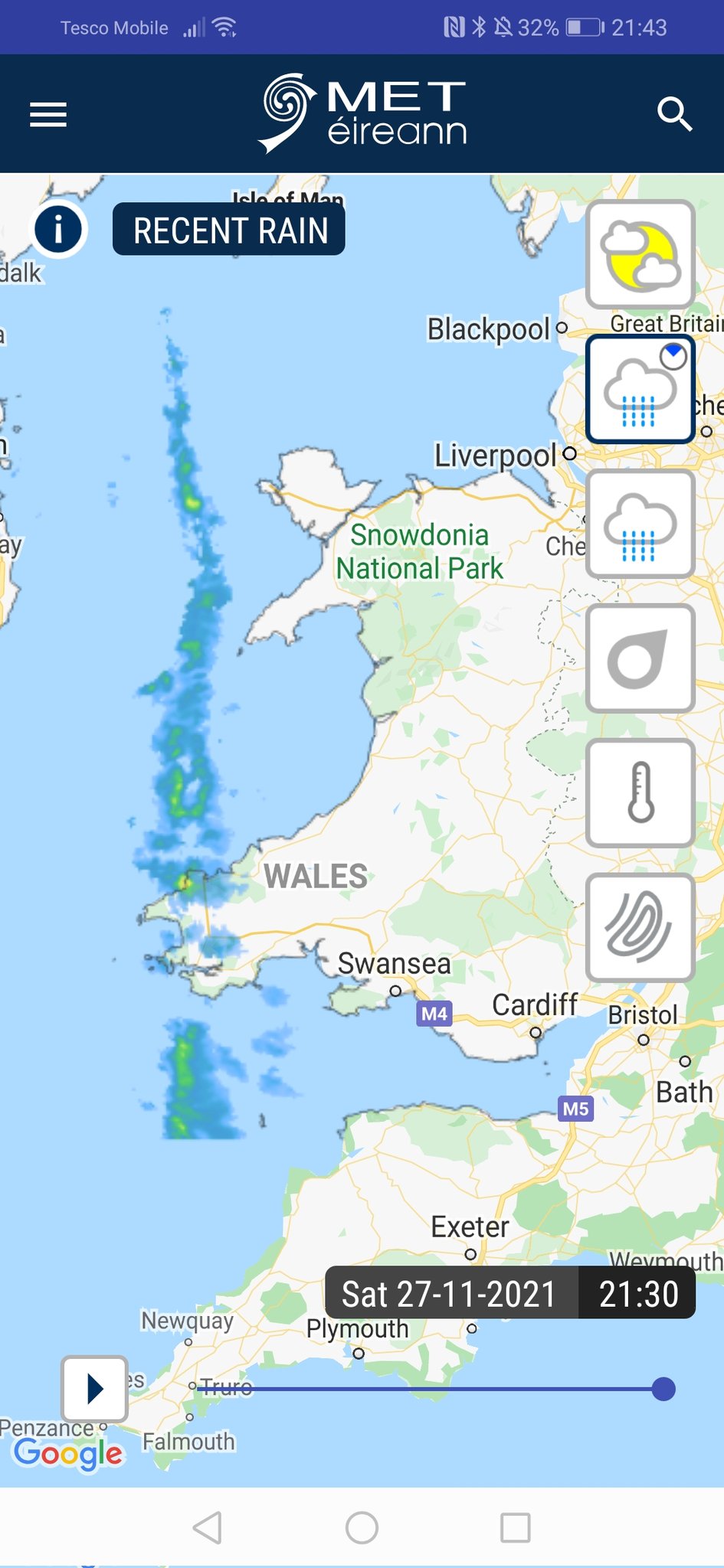
I checked the weather app on my phone last night and noticed the unmistakable cloud formation over the Irish Sea known as a Pembrokshire Dangler:

The Dangler is the strip of rain  over the Irish Sea extending North from the Pembrokeshire coast in Wales. I knew I had mentioned this phenomenon before on this blog and when I check it turns out to have been almost exactly four years ago. That’s not very surprising as winter is definitely the season for dangling. There has been a northerly airflow over Ireland for a few days now, which is why it has been so cold here, though in relatively sheltered Maynooth we have been spared the worst of the effects of Storm Arwen.

The situation required for the formation of a Pembrokeshire Dangler (which quite often involves snow rather than rain) is a cold northerly airflow down into the Irish Sea from the Arctic. This combines with slightly warmer air in the form of land breezes from the Irish coast to the North West and the Scottish coast to the North East, funneling the airflow into a narrow channel over the Irish Sea in which convection cells form, leading to precipitation. The configuration is quite stable as long as the dominant northerly airflow continues so although the strip of cloud tends to persist for some time once it has formed.

Jazz Quiz – Name that Trumpeter

Posted in Jazz on November 27, 2021 by telescoper

It’s difficult to post a quiz that can be answered easily by the use of Google, but I thought I’d try because this track from Youtube doesn’t have any personnel information or recording date on it.
It’s a big band arrangement by Benny Carter of the standard Just You Just Me. Carter himself solos on this live performance along with other members of the band, but can you put a name to the trumpeter who comes at about 43 seconds, after Carter’s opening solo?

Read on for the answer:

Continue reading

Back to Online Examinations Again

Posted in Biographical, Covid-19, Education, Maynooth with tags , , , on November 26, 2021 by telescoper

This afternoon teaching staff at Maynooth University were informed of changes to the plans for the January examination session: all examinations will now be held remotely, apart possibly from those for some final-year modules; for the latter the lecturer will decide whether they should be on campus or remote.

It’s worth mentioning that a petition set up recently by the Maynooth University Students Union urging the University to switch exams online attractive over 4,000 signatures.

As I said a while ago I think this is a very sensible move. I was chatting to some students before a lecture earlier today and I think they will all be relieved that a decision has been taken and they can make sensible plans for the Examination Period. I am teaching one module for first-year students and one for second-years this semester so both of these will definitely be going online.

We now have done three full cycles of online examinations since the pandemic started: May 2020, January 2021 and May 2021, plus two sets of repeats. I think we have a pretty good idea what we are doing with them and have got three weeks before the end of term to make any changes to the papers we have written for January. Since the online examinations are effectively open-book tests we tend to exclude bookwork – stating results which the students could easily look up – and concentrate instead on problem-solving tasks. Online examinations done this way are certainly no easier than in-person papers, and emphasize what is probably the most useful skill we try to develop.

I am glad we have some clarity on the examinations. We still have three weeks of teaching to finish before the end of term, though, and no changes have been announced to plans for lectures and tutorials. I told my class this afternoon however that as of Wednesday 8th December I will have exceeded 6 months since my second Pfizer dose. There is very little chance I will get a booster dose by then so I will be working from home from that date until the end of term. That means I’ll be doing three first-year lectures and three second-year lectures from home using my famous blackboard. I explained this decision to my second-year class today and they were supportive.

A Free Online Course in Cosmology from SISSA

Posted in Education, The Universe and Stuff with tags , , , , on November 25, 2021 by telescoper

The nice people at the Scuola Internazionale Superiore di Studi Avanzati (known to its friends as SISSA for short) have made available a free online course in cosmology. You can get all of it on Youtube.

The course comprises 16 professionally edited video-lectures delivered by lecturers of the SISSA Astrophysical and Cosmology and Astroparticle PhD Programs and some of their collaborators. I know some of the participants personally, including Paulo Salucci (who introduces the course though I haven’t met him in person for ages so it was nice to see him on camera.

Cosmology is a big subject, of course, and a short-ish course can’t cover everything so there is an emphasis on the research topics covered by SISSA scientists. I haven’t watched all the videos but those I have seen are pretty good. There are actually 17 videos in the playlist below but that includes a very short prelude to introduce the series. The others are between about 25 and 45 minutes in length so you probably don’t want to watch them all in one sitting!

Maynooth University Library Cat Update

Posted in Maynooth with tags , on November 24, 2021 by telescoper

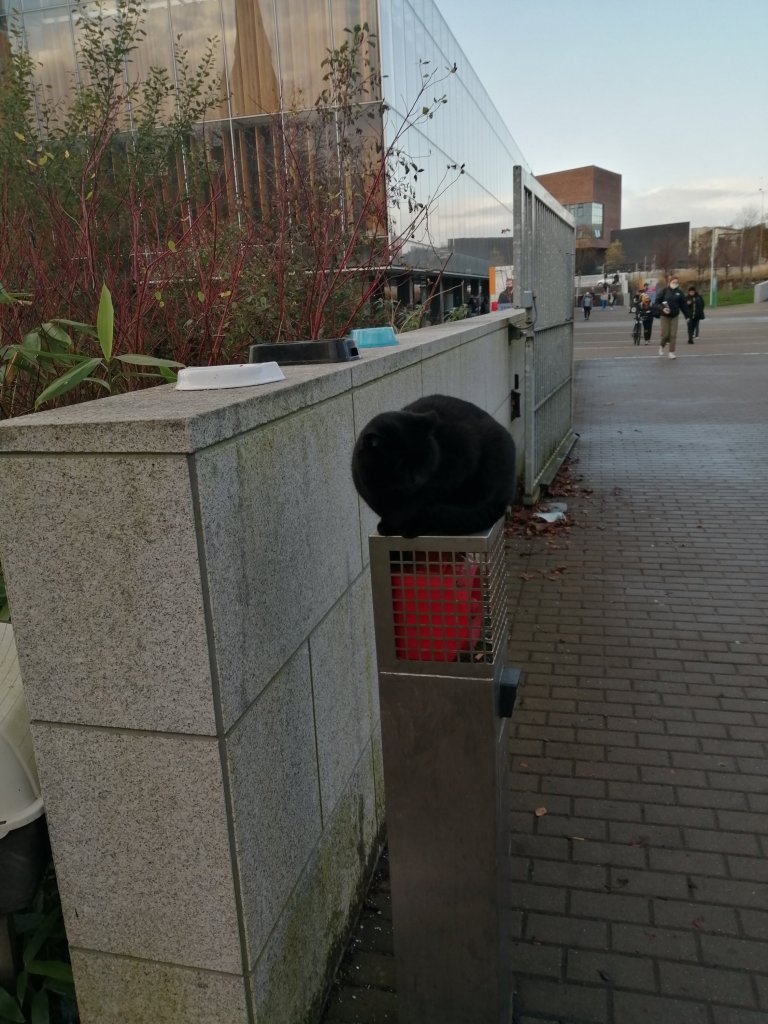
It has been some time since I last posted an update about Maynooth University Library Cat. It’s been rather chilly recently and he’s probably been keeping out of the cold somewhere snug. I’m not sure exactly where he goes to stay warm but I’m sure he has some favourite places here and there around campus. He lives outdoors but I’m sure he’s prepared from time to time to venture inside for warmth. On his own terms, of course. He is, after all, a cat.

I did however see him on the way to my 2pm lecture today and he was still on post when I returned an hour or so later. He was looking fluffier than usual, a normal reaction against the cold, but was his usual friendly self when I stopped to give him a stroke. He only sits in the location shown on the picture when he wants a bit of a fuss and/or to be fed. When he’s not in the mood he makes himself scarce!

Incidentally, in the distance, past the Library on the left you can see the new building on the North campus which is nearing completion…