Negative Mass, Phlogiston and the State of Modern Cosmology

Posted in Astrohype, The Universe and Stuff with tags , , on December 7, 2018 by telescoper

A graphical representation of something or other.

I’ve noticed a modest amount of hype – much of it gibberish – going around about a paper published in Astronomy & Astrophysics but available on the arXiv here which entails a suggestion that material with negative mass might account for dark energy and/or dark matter. Here is the abstract of the paper:

Dark energy and dark matter constitute 95% of the observable Universe. Yet the physical nature of these two phenomena remains a mystery. Einstein suggested a long-forgotten solution: gravitationally repulsive negative masses, which drive cosmic expansion and cannot coalesce into light-emitting structures. However, contemporary cosmological results are derived upon the reasonable assumption that the Universe only contains positive masses. By reconsidering this assumption, I have constructed a toy model which suggests that both dark phenomena can be unified into a single negative mass fluid. The model is a modified ΛCDM cosmology, and indicates that continuously-created negative masses can resemble the cosmological constant and can flatten the rotation curves of galaxies. The model leads to a cyclic universe with a time-variable Hubble parameter, potentially providing compatibility with the current tension that is emerging in cosmological measurements. In the first three-dimensional N-body simulations of negative mass matter in the scientific literature, this exotic material naturally forms haloes around galaxies that extend to several galactic radii. These haloes are not cuspy. The proposed cosmological model is therefore able to predict the observed distribution of dark matter in galaxies from first principles. The model makes several testable predictions and seems to have the potential to be consistent with observational evidence from distant supernovae, the cosmic microwave background, and galaxy clusters. These findings may imply that negative masses are a real and physical aspect of our Universe, or alternatively may imply the existence of a superseding theory that in some limit can be modelled by effective negative masses. Both cases lead to the surprising conclusion that the compelling puzzle of the dark Universe may have been due to a simple sign error.

For a skeptical commentary on this work, see here.

The idea of negative mass is no by no means new, of course. If you had asked a seventeenth century scientist the question “what happens when something burns?”  the chances are the answer would  have involved the word phlogiston, a name derived from the Greek  φλογιστόν, meaning “burning up”. This “fiery principle” or “element” was supposed to be present in all combustible materials and the idea was that it was released into air whenever any such stuff was ignited. The act of burning separated the phlogiston from the dephlogisticated “true” form of the material, also known as calx.

The phlogiston theory held sway until  the late 18th Century, when Antoine Lavoisier demonstrated that combustion results in an increase in weight implying an increase in mass of the material being burned. This poses a serious problem if burning also involves the loss of phlogiston unless phlogiston has negative mass. However, many serious scientists of the 18th Century, such as Georg Ernst Stahl, had already suggested that phlogiston might have negative weight or, as he put it, `levity’. Nowadays we would probably say `anti-gravity.

Eventually, Joseph Priestley discovered what actually combines with materials during combustion:  oxygen. Instead of becoming dephlogisticated, things become oxidised by fixing oxygen from air, which is why their weight increases. It’s worth mentioning, though, the name that Priestley used for oxygen was in fact “dephlogisticated air” (because it was capable of combining more extensively with phlogiston than ordinary air). He  remained a phlogistonian longer after making the discovery that should have killed the theory.

The standard cosmological model involves the hypothesis that about 75% of the energy budget of the Universe is in the form of “dark energy”. We don’t know much about what this is, except that in order to make our current understanding work out it has to act like a source of anti-gravity. It does this by violating the strong energy condition of general relativity.

Dark energy is needed to reconcile three basic measurements: (i) the brightness distant supernovae that seem to indicate the Universe is accelerating (which is where the anti-gravity comes in); (ii) the cosmic microwave background that suggests the Universe has flat spatial sections; and (iii) the direct estimates of the mass associated with galaxy clusters that accounts for about 25% of the mass needed to close the Universe.

A universe without dark energy appears not to be able to account for these three observations simultaneously within our current understanding of gravity as obtained from Einstein’s theory of general relativity.

I’ve blogged before, with some levity of my own, about how uncomfortable this dark energy makes me feel. It makes me even more uncomfortable that such an enormous  industry has grown up around it and that its existence is accepted unquestioningly by so many modern cosmologists.

Isn’t there a chance that, with the benefit of hindsight, future generations will look back on dark energy in the same way that we now see the phlogiston theory?

Or maybe, as the paper that prompted this piece might be taken to suggest, the dark energy really is something like phlogiston. At least I prefer the name to quintessence. However, I think the author has missed a trick. I think to create a properly trendy cosmological theory he should include the concept of supersymmetry, according to which there should be a Fermionic counterpart of phlogiston called the phlogistino..

R.I.P. Pete Shelley (1955-2018)

Posted in Biographical, LGBTQ+, Music with tags , , on December 7, 2018 by telescoper

I heard the news late last night of the passing of Pete Shelley, best known as the lead singer of the Buzzcocks. Another iconic figure from my youth has gone. I was never really interested in the 70s punk movement in the UK, but the Buzzcocks managed to combine some of the energy and directness of punk rock with more conventional pop melodies. Above all, though, there was Pete Shelley’s style of delivery, head tilted to one side, a unique mixture of queer camp and unapologetic defiance. That had a big effect on me in my teenage years. In particular, I remember watching watching this performance on Top of the Pops in 1978 (forty years ago, when I was 15) and understanding exactly what the song was about. Ever Fallen In Love only got to number 12 in the charts, but in my memory it was a far bigger hit than that.

Rest in peace, Pete Shelley (1955-2018).

P.S. The answer to the question posed in the song is, of course, `yes’..

Fintan O’Toole on “Heroic Failure: Brexit and the Politics of Pain”

Posted in Literature, Maynooth, Politics with tags , , , on December 6, 2018 by telescoper

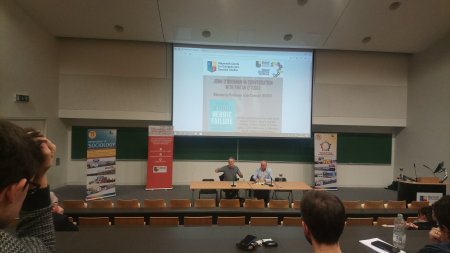
Time for a tea break and a quick post about a very interesting event this afternoon at Maynooth featuring renowned Irish journalist and author Fintan O’Toole (whose regular columns in the Irish Times I read with great interest).

This event saw John O’Brennan, Director of the Centre for European and Eurasian Studies in Maynooth in conversation with Fintan on his new book, Heroic Failure: Brexit and the Politics of Pain. The book deals with the Brexit referendum, the chaos it unleashed in British politics and the challenges posed to the island of Ireland by a ‘No Deal Brexit’. In particular the book examines how a country that once had colonies is redefining itself as an oppressed nation requiring liberation; the dreams of revolutionary deregulation and privatization that drive Arron Banks, Nigel Farage and Jacob Rees-Mogg; and the silent rise of English nationalism, the force that dare not speak its name. He also discusses the fatal attraction of heroic failure, once a self-deprecating cult in a hugely successful empire that could well afford the occasional disaster: the Charge of the Light Brigade, or Franklin lost in the Arctic. Now failure is no longer heroic – it is just failure, and its terrible costs will be paid by the most vulnerable of Brexit’s supporters, and by those who may suffer the consequences of a hard border in Ireland and the breakdown of a fragile peace.

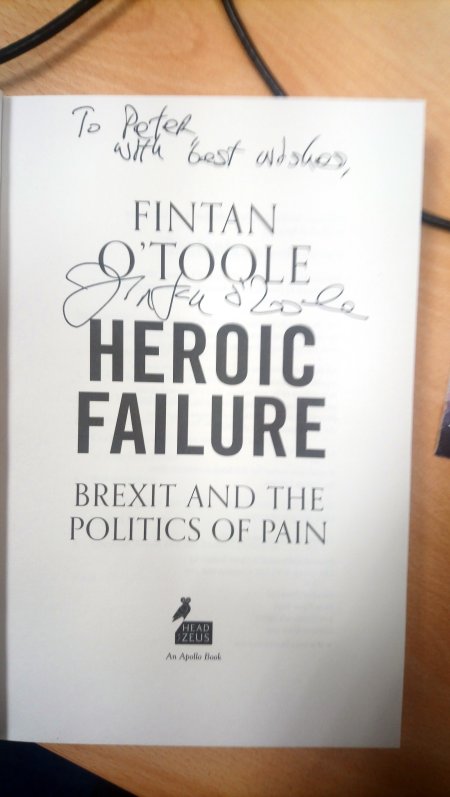
The discussion was so interesting – and Fintan O’Toole was so eloquent and amusing –  that I bought the book. The author was kind enough to sign it for me too!

There’s an extract printed on the cover that will give you a taste, but if you want more you’ll have to buy the book:

Of all the pleasurable emotions, self-pity is the one that most makes us want to be on our own…Only alone can we surrender completely to it and immerse ourselves in the steaming bath of hurt, outrage and tender regard for our terribly wronged selves. Brexit therefore makes sense of a nation that feels sorry for itself. The mystery, though, is how Britain, or more precisely England, came not to just experience this delightful sentiment but to define itself through it.

I only bought the book today so haven’t read it yet, but I will endeavour to write a review when I have.

Now back to the writing of lecture notes…

The Final Shootout

Posted in Film, Music, Politics with tags , , , , on December 6, 2018 by telescoper

“Only connect” they say so I thought I’d connect two topical items with this video clip of one of my favourite movie scenes.

The first item is that on 15th February next year the legendary composer Ennio Morricone will be conducting a concert of his music in Dublin. Moricone’s 90th birthday was on 10th November 2018.

The other thing is that the UK Parliament is currently debating the terms of Brexit. It seems that there are now only three options: accept Theresa May’s ugly Withdrawal Agreement, reject it and suffer a bad `No Deal’ Brexit or take the sensible, good choice of withdrawing Article 50, admitting it was all a terrible idea in the first place, and remaining in the European Union.

So here we are then, the climactic final shoot-out from Sergio Leone’s famous Spaghetti Western The Good The Bad And The Ugly, featuring Clint Eastwood, Eli Wallach and Lee Van Cleef respectively, together with superb (and very complex) music on the soundtrack from Morricone. We all know who wins in the end, at least in the film.

P.S. Hats off to the guitarist Alessandro Alessandroni (who also did the whistling on the soundtrack) producing that unforgettable twangy sound with a hint of scordatura

A LIGO Orrery

Posted in The Universe and Stuff with tags , , , , on December 5, 2018 by telescoper

Following yesterday’s post here is a nice video visualization of all the black hole binary mergers so far claimed to have been detected by Advanced LIGO. They’re computer simulations, of course, not actual black holes (which you wouldn’t be able to see). I always thought an Orrery was a clockwork device, rather than a digital computer, but there you go. Poetic license!

I can’t say I’m very keen on the music.

The New Wave of Gravitational Waves

Posted in The Universe and Stuff with tags , , , , on December 4, 2018 by telescoper

I think it’s very sneaky of the LIGO Scientific Collaboration and the Virgo Collaboration to have released two new gravitational wave papers while I was out of circulation fora  couple of days, so I’m a bit late on this, but here are links to the new results on the arXiv.

You can click on all the excerpts below to make them bigger.

First there is GWTC-1: A Gravitational-Wave Transient Catalog of Compact Binary Mergers Observed by LIGO and Virgo during the First and Second Observing Runs with this abstract:

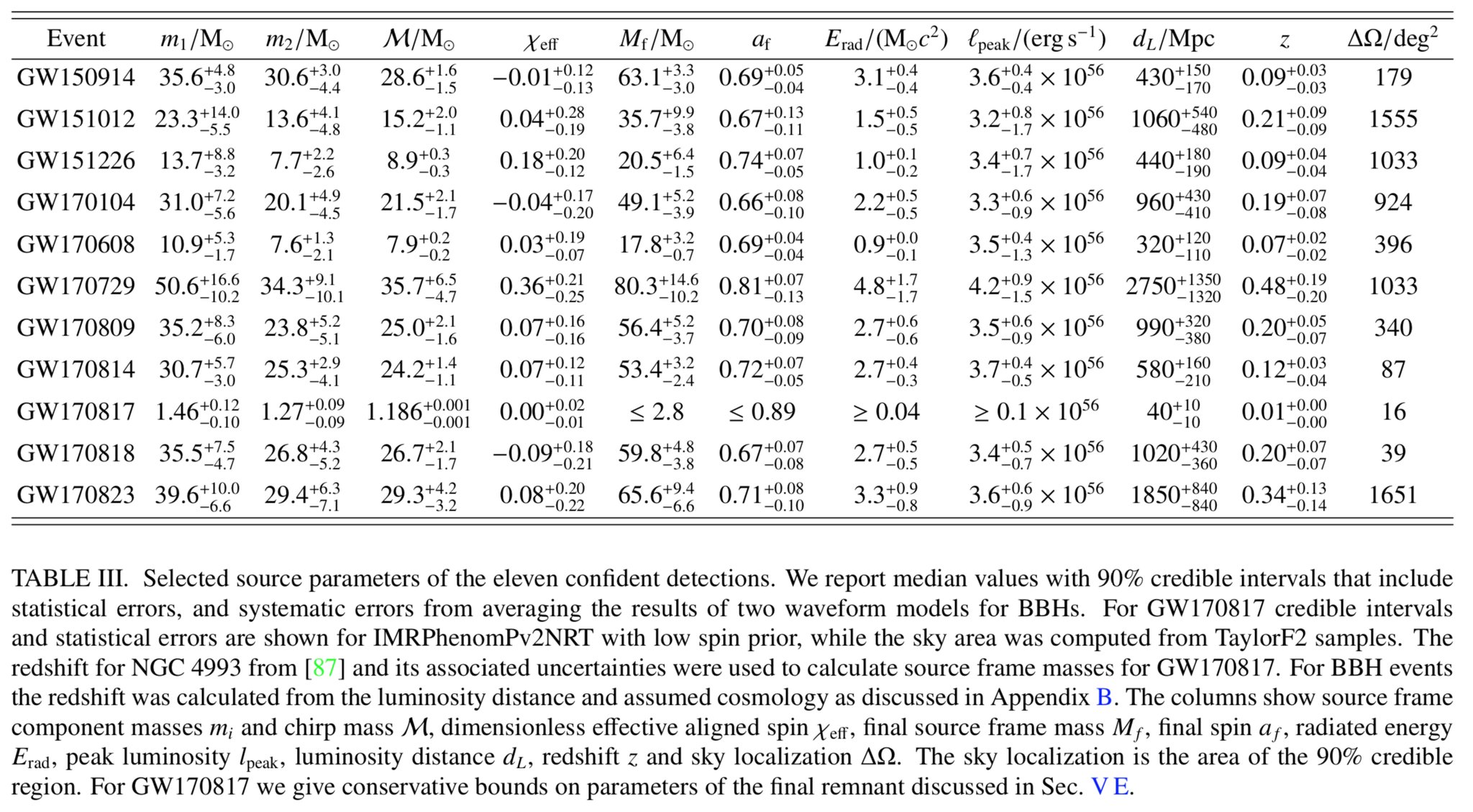
Here is a summary of the properties of the binary systems involved in the events listed in the above paper:

There are several (four) events in this catalogue that have not previously been announced (or, for that matter, subjected to peer review) despite having been seen in the data some time ago (as far back as 2015). I’m also intrigued by the footnote on the first page which contains the following:

…all candidate events with an estimated false alarm rate (FAR) less than 1 per 30 days
and probability > 0.5 of being of astrophysical origin (see Eq. (10) for the definition) are henceforth denoted with the GW prefix.

The use of false discovery rates is discussed at length here as a corrective to relying on p-values for detections. The criteria adopted here don’t seem all that strong to me.

The second paper is Binary Black Hole Population Properties Inferred from the First and Second Observing Runs of Advanced LIGO and Advanced Virgo which has this abstract:

I’ve been teaching and/or preparing lectures all day today, so I haven’t yet had time to read these papers in detail. I will try to read them over the next few days. In the meantime I would welcome comments through the box about these new results. I wonder if there’ll be any opinions from the direction of Copenhagen?

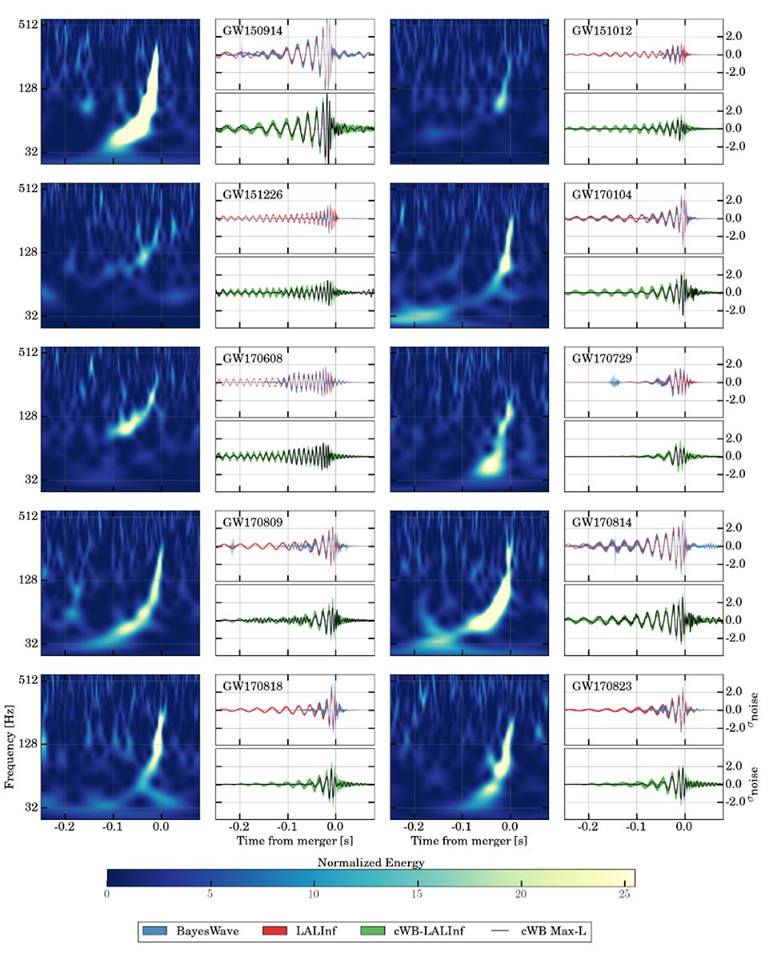
UPDATE: Here’s a montage of all 10 binary black hole mergers `detected’ so far…

I think it’s safe to say that if GW151266 had been the first to be announced, the news would have been greeted with considerable skepticism!

Acute Geometry Problem

Posted in Cute Problems, mathematics on December 3, 2018 by telescoper

I saw a plea for help on Twitter from Astronomer Bryan Gaensler who is stuck with his son’s homework.

So please give him a hand by solving this to find a, b and c.

Your time starts now.

Una Grande Vociaccia

Posted in Music, Opera with tags , , , , , , , on December 2, 2018 by telescoper

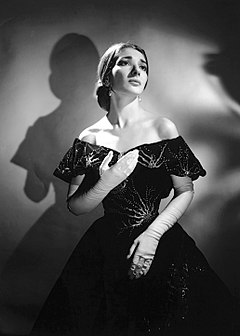
Had she still been alive, December 2nd 2018 would have been the 95th birthday of the most renowned opera singer of her time, Maria Callas.

She was born in 1923 in New York city of Greek parents who had moved there the previous year, and christened Maria Anna Sofia Cecilia Kalogeropoulou. Her mother, disenchanted with her deteriorating marriage, abandoned her husband (Maria’s father) and took Maria and her sister back to Athens in 1937. Maria enrolled at the National Conservatoire of Greece the same year after winning a scholarship with the quality of her voice, which

was warm, lyrical, intense; it swirled and flared like a flame and filled the air with melodious reverberations.

At this age, Maria was a rather plump young lady with a rather deep voice. Initially, she aspired to be a contralto but at the Conservatoire she was encouraged instead to become a dramatic soprano. Accordingly, she underwent special training to raise her natural pitch (or tessitura) and learned how to control her remarkable voice more accurately so she could sing in a sufficiently disciplined fashion that she could take on the dazzling coloratura passages that she would perform in later years with such success. She also worked on her chest tones to broaden the scope of her voice in the mezzo region. Although she became more technically refined as a singer during this period, there were some things that didn’t change. One was the sheer power of her voice, which is something that we tend to notice less in these days of microphones and studio recordings. People who heard her sing live confess to being shocked at the sheer scale of sound she could deliver without amplification. Perhaps more tellingly, she eschewed many of the devices sopranos tended to use to control the highest notes, usually involving some alteration of the throat to produce accuracy at the expense of a thinner and more constricted tone. When Callas went for a high note, she always did so in a full-throated manner. This often produced a piercing sound that could be intensely dramatic, even to the extent of almost knocking you out of your seat, but it was a very risky approach for a live performance. Audiences simply weren’t used to hearing a coloratura sing with such volume and in such a whole-hearted way. It wasn’t always pretty, but it was certainly remarkable and often very moving. It was this aspect of her voice that led her friend Tito Gobbi (who sang with her in Tosca) to call it una grande vociaccia, which I translate in my schoolboy Italian as meaning something like “a big ugly voice”. That isn’t meant to be as disparaging as it sounds (Gobbi was a great admirer of Callas’ singing).

Having listened to lots of recordings of Maria Callas I have to admit that they are certainly not all good. Sometimes the voice didn’t come off at all. Unkindly, one colleague said that she “sang with her ovaries”. When she talked about her own noice, Callas herself often referred to it as if it were some independent creature over which she had very little control. Anyway, whatever the reason, when she was bad she was definitely bad. But I adopt the philosophy that one should judge artists (and scientists, for that matter) by their best work rather than their worst, and when Callas was good she was simply phenomenal, like a sublime and irresistible force of nature. That’s why they called her La Divina.

Although her talent was very raw in the beginning there was no question that she always had a voice of exceptional power and dramatic intensity. When she started singing professionally she immediately attracted lavish praise from the critics not just for her voice but also for her acting. As a young soprano she sang in an astonishing variety of operas, including Wagner‘s Tristan und Isolde and Die Walküre, neither of which one would now associate with Callas.

It was in the late 194os that Callas began to take an interest in the type of opera that would really make her name. Bel canto opera was rather unfashionable at that time, probably because audiences preferred the grittier and more realistic verismo style. Virtually single-handed, Callas resurrected the bel canto canon by injecting a true sense of drama into works which had previously just been seen as vehicles for the singers to demonstrate their art. Callas brought an entirely new dimension to the great operas by Bellini (Norma, I Puritani, La Somnambula…) and Donizetti (Lucia di Lammermoor, Anna Bolena), although she was sufficiently versatile to also perform brilliantly in the verismo syle of Verdi and Puccini as well as lesser known composers such as Giordano (Andrea Chenier). Recordings of many of these performances are available, but it is sad that this glorious period of her singing career happened just a bit before high quality equipment was available so the true glory of her voice isn’t always evident.

In 1953, Callas decided that she wanted to change her appearance, perhaps so she would look more appropriate for the parts she was playing on stage. At the time she weighed almost 200lbs. In order to lose weight as quickly as possible, she followed the barbarous but highly effective expedient of swallowing a tapeworm. She lost 80lbs in a matter of months. The dramatic loss of weight changed her body and her face, emphasizing her high angular cheekbones and giving her a striking look very well suited to the opera stage. But it also affected her voice somewhat, especially at the upper end where she seems to have found it more difficult to avoid the dreaded “wobble” which was one of the alleged imperfections that critics tended to dwell upon.

Callas also had very poor eyesight which required her to wear very thick spectacles in order to see at all, a thing she refused to do onstage with the result that she was virtually blind during performances. In fact, during a performance of Tosca at Covent Garden she leant too far over a candle and her hair caught fire. Improvising magnificently, Tito Gobbi, as the loathsome Scarpia, extinguished the fire by throwing water at her before the audience had noticed. Although they weren’t much use for seeing with, her eyes were a great asset for her acting, in turns flashing like a demon then shining like an angel.

After her weight loss, Callas was suddenly no longer just a wonderful singer but also a strikingly beautiful woman. Her career took a back seat as she started to revel in the glamorous lifestyle that opened up in front of her. Her voice deteriorated and she performed rather less frequently. Eventually she embarked on a love affair with Aristotle Onassis, a notorious serial collector of trophy women. She hoped to marry him but he abandoned her to marry Jackie Kennedy, widow of John F. Kennedy.

She never really recovered from the failure of this affair, retired from singing and lived out the last years of her life as a virtual recluse in her apartment in Paris. She died in 1977.

I had heard a lot about Maria Callas when I was younger, but the recordings that I listened to (generally from the 1960s) were really not very good as her voice was undoubtedly much diminished by then. I just assumed that, as is the case with many artists, the legend of Callas was all mere hype. Then, about fifteen years ago, I was listening to BBC Radio 3 and they played the final scenes of the great 1954 recording of Norma with Callas in the title role, conducted by Tullio Serafin. I was completely overwhelmed by it and tears flowed freely from my eyes. I’ve always had a tendency to blub when I hear really beautiful music, but as I’ve got older I’ve learned not to be embarrassed by it. At least I don’t cry at football matches.

In England, Callas is probably best remembered for her performances in Tosca in Covent Garden. I have recordings of her in that role and they are really wonderful. But there are many fine recordings of Tosca by other singers, some of which are almost as good. In the case of Norma, though, there isn’t any other performance that comes within a mile of the Callas version. Or if there is, I’ve yet to hear it.

Now I know that there are some people, even opera lovers, who just don’t get Callas at all (just look at the comment boards on Youtube). I grant that she wasn’t always the most accurate singer, and I don’t think you could say her voice had a purely classical beauty. But even if you don’t like her voice you have to admit that she revitalized the opera stage and brought a new public into the theatres. I can’t imagine what the state of opera would be now, if there hadn’t been a Callas and you can’t argue that she is now an iconic figure. What I admire most about her is that, like it or loath it, her voice is instantly recognisable. In this sense, she always puts me in mind of a kind of operatic version of Billie Holliday. She’s a far cry from the many bland mediocrities that pass themselves off as opera singers nowadays.

I’m going to end with the obligatory clips from Youtube. There’s a lot of Callas on there, not all of it good. I’ve chosen a couple of items, although neither of them has a proper video. The first was performed live in 1955 in front of the notoriously difficult audience at La Scala in Milan and recorded from a radio broadcast so that the sound quality is quite poor. A studio recording of this aria, from Andrea Chenier, features most movingly in the film Philadelphia. This live version, however, is notable for a number of reasons. One is that you get some idea of the power of the Callas voice in the way she pushes aside the entire orchestra and is even able to cut through the distortions introduced by the rather primitive recording technology. The second thing is that she sings it so beautifully, with such feeling, lovely phrasing, and so much colour and vitality. Listen to the way the texture of her voice matches perfectly her changing emotions as she tells her story. The shattering, climactic high C that occurs near the end is a perfect example of what I was saying above. She stabs this note out like her life depended on it. It sends shivers down my spine and clearly had the same effect on the audience. The thunderous applause that follows the end of this aria is quite frightening in its intensity, but gives a good idea how much her public adored her. If you can put up with the lo-fi recording, this is certainly a better performance than the studio version.

The final piece has to be from Norma. I think Bellini is a wonderful composer of opera, but he doesn’t make life easy for the singers. There’s never any doubling of the vocal line by the orchestra so the singer is very exposed. This doesn’t bother Maria Callas. This is the famous aria Casta Diva, which has become a kind of signature tune for her and it’s one of the pieces that she always seemed to perform beautifully. It might be a bit hackneyed but I love it and, after all, it’s my blog. There’s also a nice compilation of pictures.

I’d be interested to hear what the general opinion of Callas is based on a sample of the two or three people who read my blog, so please feel free to add your comments!

Jeremy Corbyn faces Harry Kane: Beard of the Year 2018 shortlist revealed

Posted in Uncategorized on December 2, 2018 by telescoper

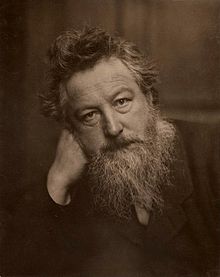
Owing no doubt to some form of administrative error I have made it onto the shortlist of Beard of the Year 2018.

Other contenders include Jeremy Corbyn, Moeen Ali, Idris Elba, Harry Kane, Prince Harry, Lenny Henry and some people I’ve never heard of. Still, I bet none of them has ever heard of me!

I know that many would consider it inappropriate for me to use this blog for gratuitous self-promotion and all I can say in response to that opinion is Vote for me!

P. S. I of course voted for Moeen Ali.

kmflett's avatarKmflett's Blog

Beard Liberation Front

Media Release 1st December

Contact Keith Flett 07803 16726

Jeremy Corbyn faces Harry Kane: Beard of the Year 2018 shortlist revealed

The Beard Liberation Front the informal network of beard wearers, has said that after a public ballot the shortlist for the 2018 Beard of the Year Award has now been decided.

The public poll determined the top beard wearers who go through to the final Beard of the Year poll which opens on 1st December with the winner announced on 28th December.

The campaigners say that the shortlist comprises those whose beard has had a positive impact in the public eye during the year rather than the style or the length of the beard or the views of the beard wearer.

BLF Organiser Keith Flett said, we expect the result to be a close shave

For the first time this year the result…

View original post 122 more words

The Meaning of Advent

Posted in Uncategorized on December 2, 2018 by telescoper

This morning I noticed that today is Advent Sunday.

For those of you not familiar with the terms used in the liturgical calendar, the word ‘advent’ is derived from the words ‘ad’ and ‘vent’, and it thus describes the season of the year in which people loudly express strong opinions about television commercials. For examples, see here.

There is, however, much more to this time of year than venting about ads. To my mind nothing sums up the true spirit of Christmas than this unicorn in pink lederhosen: