The Lunar Eclipse

Posted in Politics, The Universe and Stuff with tags , , on July 27, 2018 by telescoper

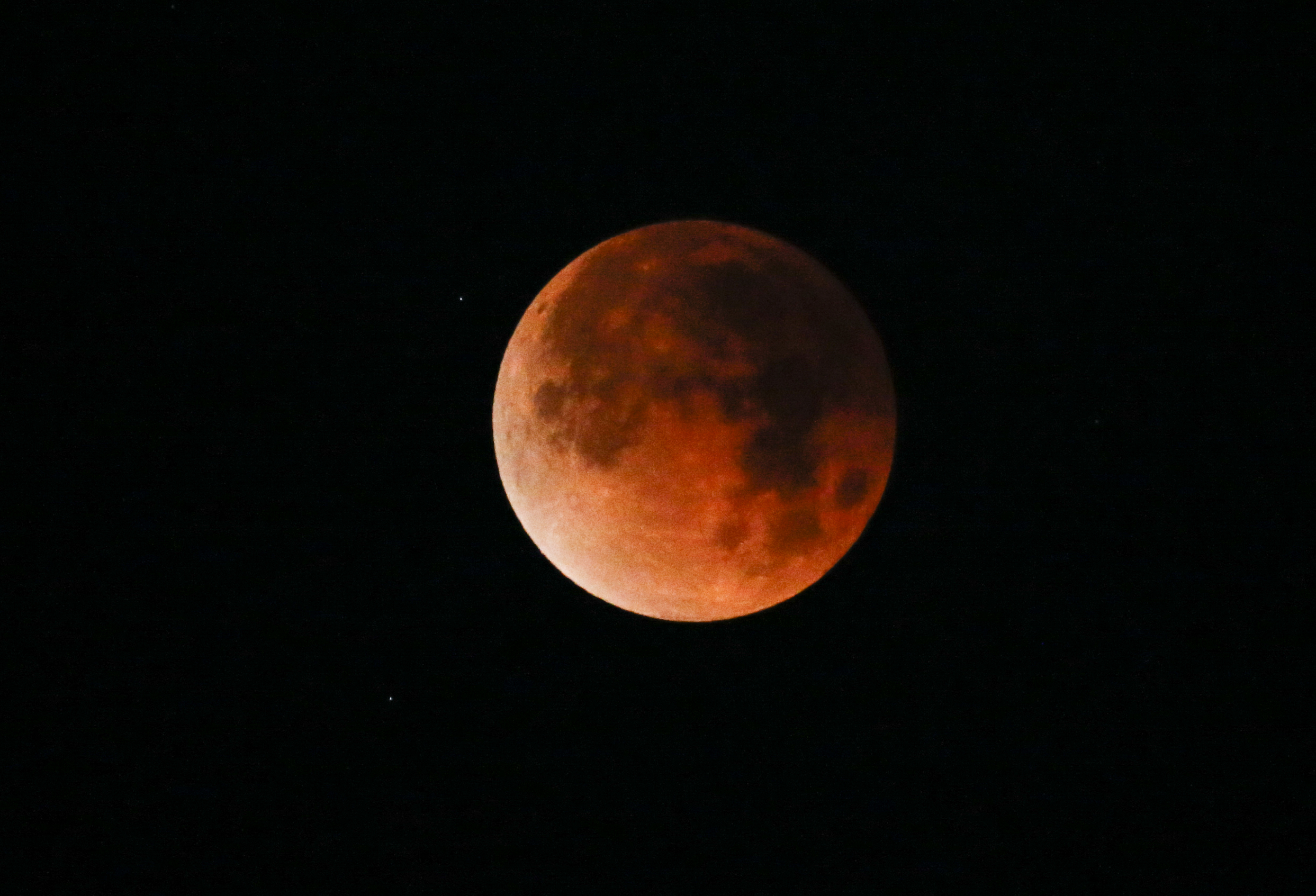
Just a reminder that there will be lunar eclipse tonight. The so-called `blood Moon’ will be visible across Ireland and the United Kingdom (as well as much of the rest of world tonight) although there is rain forecast, and its very overcast as I write this, so it’s possible that all I from Maynooth will see is clouds. That’s a shame as this will be the longest total lunar eclipse of the 21st century, lasting one hour, 42 minutes and 57 seconds.

Observers in Ireland will not be able to see the start of the eclipse as the moon will still be below the horizon when the Earth passes between the Sun and the Moon. However, in the Dublin area it will be seen (clouds permitting) from 9.30pm to 10.15pm low in the sky to the South East. Then from 10.15pm to 11.20pm, the moon will be seen coming out of Earth’s shadow. The partial eclipse will last around four hours. Oh, and you should be able to see Mars which will be very bright tonight, down a bit and to the left from the Moon.

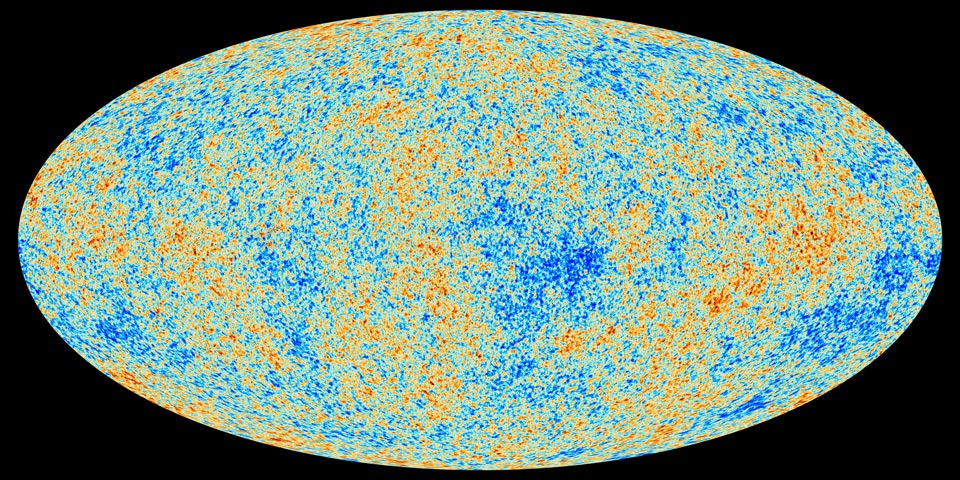
The photograph above is of a lunar eclipse taken earlier this year, on 31st January. Lunar eclipses tend to be seen in pairs, like low comedians.

Update:

P.S. It’s worth also giving advanced notice that next year, on March 29th 2019, there will be a total eclipse of the United Kingdom visible from Ireland and all the rest of the world…

Gravitational Redshift around the Black Hole at the Centre of the Milky Way

Posted in The Universe and Stuff with tags , , , , , , on July 26, 2018 by telescoper

I’ve just been catching up on the arXiv, and found this very exciting paper by the GRAVITY collaboration (see herefor background on the relevant instrumentation). The abstract of the new paper reads:

The highly elliptical, 16-year-period orbit of the star S2 around the massive black hole candidate Sgr A* is a sensitive probe of the gravitational field in the Galactic centre. Near pericentre at 120 AU, ~1400 Schwarzschild radii, the star has an orbital speed of ~7650 km/s, such that the first-order effects of Special and General Relativity have now become detectable with current capabilities. Over the past 26 years, we have monitored the radial velocity and motion on the sky of S2, mainly with the SINFONI and NACO adaptive optics instruments on the ESO Very Large Telescope, and since 2016 and leading up to the pericentre approach in May 2018, with the four-telescope interferometric beam-combiner instrument GRAVITY. From data up to and including pericentre, we robustly detect the combined gravitational redshift and relativistic transverse Doppler effect for S2 of z ~ 200 km/s / c with different statistical analysis methods. When parameterising the post-Newtonian contribution from these effects by a factor f, with f = 0 and f = 1 corresponding to the Newtonian and general relativistic limits, respectively, we find from posterior fitting with different weighting schemes f = 0.90 +/- 0.09 (stat) +\- 0.15 (sys). The S2 data are inconsistent with pure Newtonian dynamics.

Note the sentence beginning `Over the past 26 years…’!. Anyway, this remarkable study seems to have demonstrated that, although the star S2 has a perihelion over a thousand times the Schwarzschild radius of the central black hole, the extremely accurate measurements demonstrate departures from Newtonian gravity.

The European Southern Observatory has called a press conference at 14.00 CEST (13.00 in Ireland and UK) today to discuss this result.

The New Henge at Newgrange

Posted in History with tags , , , , on July 26, 2018 by telescoper

Following on from a post last week, and thanks to this website, here is an amazing aerial video, shot from a drone, of a new archaeological discovery at the Newgrange site in County Meath that has been revealed through parch marks in the ground following the recent period of very dry weather.

Newgrange is already established as major prehistoric site, most famous for a neolithic burial mound (which means that it was built before Stonehenge or the pyramids at Giza in Egypt). More recent studies, including a passage tomb found at Dowth, also in County Meath, show that the area around Newgrange, in the Boyne valley near Drogheda, was of major importance in the neolithic era.

You can read much more about the new henge at Newgrange and its place in Irish prehistory here.

Sidney Bechet’s Blue Horizon

Posted in Jazz with tags , , , , on July 25, 2018 by telescoper

Having moved some of my CD & record collection to Ireland, I was listening to some music last night including this track that I blogged about many moons ago. Looking at that old post this morning, I noticed that the Youtube link was defunct so decided to update it. More importantly, I realized that I’d made a few mistakes which I thought I should correct, as well as some other edits.

This slow blues features an extended clarinet solo by the great Sidney Bechet. I’ve loved Blue Horizon ever since I was a kid, and think it has a good claim to be the finest instrumental blues ever recorded.  I also heard it more recently at the funeral of one of my Dad’s old jazz friends. Listening to in that context, it struck me that it’s not just one of the greatest blues performances, but must also be one of the greatest laments that has ever been produced in music of any kind. It’s absolutely pure sadness – there’s no bitterness, anger or resentment about it – and it develops through the stately choruses into a sense of great pride and even, ultimately, of triumph.

Many years I blogged about the thrill of high-speed jazz. This performance is at the other end of the scale in terms of tempo, but you can still feel pull of the harmonic progression underlying the tune which in this case is basically the standard 12-bar blues, but with a few substitute chords thrown in.  The last set of four bars in the 12-bar blues ends with the familiar  V-IV-I cadential pattern (often known as the blues cadence) leading back to the root at the end of each chorus. Although Bechet plays quite a lot across the bar lines, the gravitational pull of that sequence of chords is very strong and it tells you very clearly that one chapter of the story has finished and another is about to start.

Bechet builds his solo over this relatively simple structure in  six choruses in a slow and stately fashion, but makes telling use of searing  blue notes of heart-rending emotional power as the intensity builds. If you don’t know what a blue note is then listen, from about 2.12 onwards, to a chorus that always makes the hairs stand up on the back of my neck.

I should also mention that the fine piano accompaniment on this all-time classic piece (recorded in December 1944) is provided by Art Hodes and the mournful response from the trombone is supplied by Vic Dickenson. Bechet’s raw power and very broad vibrato probably won’t suit scholars of the classical clarinet, but I think this is absolutely wonderful. If I ever had to compile a list of my all-time favourite records, this would definitely be on it.

Nature After Planck…

Posted in Maynooth, The Universe and Stuff with tags , , , , , , on July 24, 2018 by telescoper

After last week’s short update about the last tranche of papers from the European Space Agency’s Planck Mission it’s time for another short update about a piece in Nature (by David Castelvecchi) that explains how researchers are moving to smaller projects studying different aspects of the cosmic microwave background.

In the spirit of gratuitous self-promotion I should also mention that there’s a little quote from me in that piece. My comment was hardly profound, but at least it gets Maynooth University a name check…

Much of Davide’s piece echoes discussions that were going on at the meeting I attended in India  last October, but things have moved on quite a bit since then at least as far as space experiments are concerned. In particular, the proposed Japanese mission Litebird has been shortlisted for consideration, though we will have to wait until next year (2019) at the earliest to see if it will be selected. An Indian mission, CMB-Bharat, has also emerged as a contender.

While the end of Planck closes one chapter on CMB research, several others will open. These are likely to focus on polarization, gravitational lensing and on cosmic reionization rather than refining the basic cosmological parameters still further.

Farewell to Brexit Britain

Posted in Biographical, Politics with tags , , on July 23, 2018 by telescoper

I popped into the office at Cardiff University today to finish off one piece of outstanding business I didn’t have time to complete on Friday and to collect the last of my possessions – including a number of bottles of wine! – before flying to Ireland tomorrow morning.

I couldn’t resist doing a quick post about the chaotic state of UK politics towards Brexit. For all the turmoil of the past two weeks, In a sense nothing has changed since I wrote about this almost exactly a year ago. The so-called `Chequers Plan’ was greeted with predictable disdain by the EU negotiators who must be exasperated that Theresa May seems not to have understood anything that’s said about the European Single Market for the last two years, as well as signalling that she wanted to renege on agreements already reached in December. And then we had the new Brexit Secretary, Dominic Raab, announcing that he intended that the UK would not pay its outstanding bills if a Trade Deal were not agreed, despite the UK having agreed to this months ago too.

All this is consistent with what I have always felt would be this government’s approach to the Brexit negotiations, which is not to negotiate at all. Their plan, as it has always been, is just to go through the motions until they able to find some pretext to storm out, blaming the EU for trying to bully them. The staged walkout will probably happen in October, after a summer media offensive against the EU supported by propaganda pieces in the Daily Express, Mail and Telegraph. That is, I believe, the Government’s plan. The new Foreign Secretary more or less said so today. It is why Theresa May called a snap election, hoping to build up a larger majority and a full parliamentary term to withstand the inevitable backlash. That gamble backfired, but the Conservatives are still in power and the plan remains in place.

This strategy might just allow the Tories to cling onto power while the economy suffers as we crash out of the EU in the most disorderly fashion possible. This will not only cause chaos for trade and commerce but will also be awful for for EU residents in the UK and UK residents in the EU. Above all, it will show that the UK government has not been acting in good faith at all throughout the process, and will ensure for generations to come that the United Government is entirely untrustworthy. And that’s before you even consider the fact that the 2016 referendum has now been demonstrated beyond all reasonable doubt to have been crooked, due to unlawfully excessive spending by both Leave campaigns, and other dirty tricks such as illegal use of personal data.

So why has the Government decided to adopt this position? Simple. It does not have the wherewithal even to formulate a negotiating position, let alone deliver a successful outcome., because no possible end result can deliver the economic and political benefits of remaining in the European Union. If we’re going to make people suffer, the reasoning goes, we might as well find a scapegoat to deflect criticism away from our poor choices.

And what about the EU position? Well, they hold all the cards so they won’t be worried. Their priority will be to take over all the business opportunities that we have decided we no longer want. Whatever happens with the negotiations, the UK leaves the EU in March 2019. That’s plenty of time for EU companies to relocate their operations to mainland Europe, to write British producers out of their supply chains, and to expand its portfolio of trade agreements to the further disadvantage of the UK economy, like it has recently done with Japan.

The UK government views my new home, Ireland, as the Achilles Heel of the European Union. Things could get very tough in the Republic when the UK crashes out of the EU, no doubt to the delight of the Tory party’s henchmen in the DUP. But even if that is the case I’d much rather be living in Ireland than in Brexit Britain. Just as a xenophobic backward-looking insular and authoritarian agenda grips the UK, Ireland is moving in the opposite direction, towards a modern outward-looking progressive liberal democracy.

Oh, and if you’re an academic who is as fed up with the UK as I am, take a look at Science Foundation Ireland’s Future Research Leaders scheme. Maynooth University is particularly keen to welcome applicants to the Scheme!
On Bendy Thumbs

Posted in Biographical with tags , , on July 22, 2018 by telescoper

My thumbs can bend backwards about 90 degrees, a property known as distal hyperextensibility or, less formally, ‘hitchhiker’s thumb’.

I don’t know of any particular advantage or disadvantage of having bendy thumbs, although it does make holding a clarinet or soprano saxophone a little awkward, as the thumbs are used to support the instrument when it is played. The only useful thing I can think of is the comedy value of seeing people freak out when they see the bendy thumbs in action.

I don’t think this ‘condition’ has been studied very much, but I am given to understand that somewhere between 15 and 30% of the population has bendy thumbs. The property is inherited and is commonly believed to be controlled by a single gene with two alleles, one for ‘straight’ and one for ‘bendy’ ; the one expressing bendiness being recessive explains why straight thumbs are more common. I now realise, however, that this is not the case. For one thing, it seems that thumb bendiness is not a simple binary property. That also makes it difficult to define it for statistical purposes: what angle of bend do you choose to classify a thumb as bendy?

I also have blue eyes, which is another recessive trait, but it has been known for some time that eye colour is not controlled by a single gene.

Glamorgan versus Somerset: Vitality Blast Twenty20

Posted in Cardiff, Cricket, Uncategorized on July 20, 2018 by telescoper

After a little drinks reception in the School of Physics and Astronomy (at which I was given a very nice gift of wine) I joined the staff outing to Sophia Gardens to watch this evening’s Twenty20 cruise cricket between Glamorgan and Somerset.

The start was delayed by rain so we lingered in a pub on the way only to be caught on the hop when play actually started and missing the first few overs. Somerset batted well to reach 190 off their 20 overs, with Anderson hitting four big sixes in his 59.

Without Shaun Marsh, who will miss the rest of the season, the Glamorgan batting lineup seemed to have a very long tail and a lot rested on Khawaja and Ingram. Both scored runs quickly while they were in but neither could build a big score. Once those two were out, the Glamorgan innings faltered and they never looked like reaching Somerset’s total. The finished on 160 for 9, losing by 30 runs.

After Graduation

Posted in Biographical with tags , on July 20, 2018 by telescoper

I didn’t get time to blog yesterday as I was involved with various festivities to with the graduation of students from the School of Physics & Astronomy at Cardiff University who, for some reason, shared a ceremony with students from the School of History, Archaeology and Religion. The ceremony was more-or-less my last official duty here at Cardiff. This morning I backed up my computer, returned my keys and removed my boxes of books and other stuff from the office of the Data Innovation Research Institute back to my house. This afternoon I gather there’ll be a small event to celebrate my departure, after which there’s a staff trip to see the cricket at Sophia Gardens (Glamorgan versus Somerset in the Vitality Blast).

Yesterday’s ceremony started at 12 noon and, as usual, was in St David’s Hall in Cardiff. When it was over we adjourned to the Main Building for a reception at which we were informed there would be `unlimited Prosecco’. This turned out to be untrue, as the Prosecco ran out by about 5pm, at which point we moved to a local pub and thence for a late-night curry. It was all a bit excessive and I had a not inconsiderable hangover this morning. I suspect that was the case for many of the graduands too!

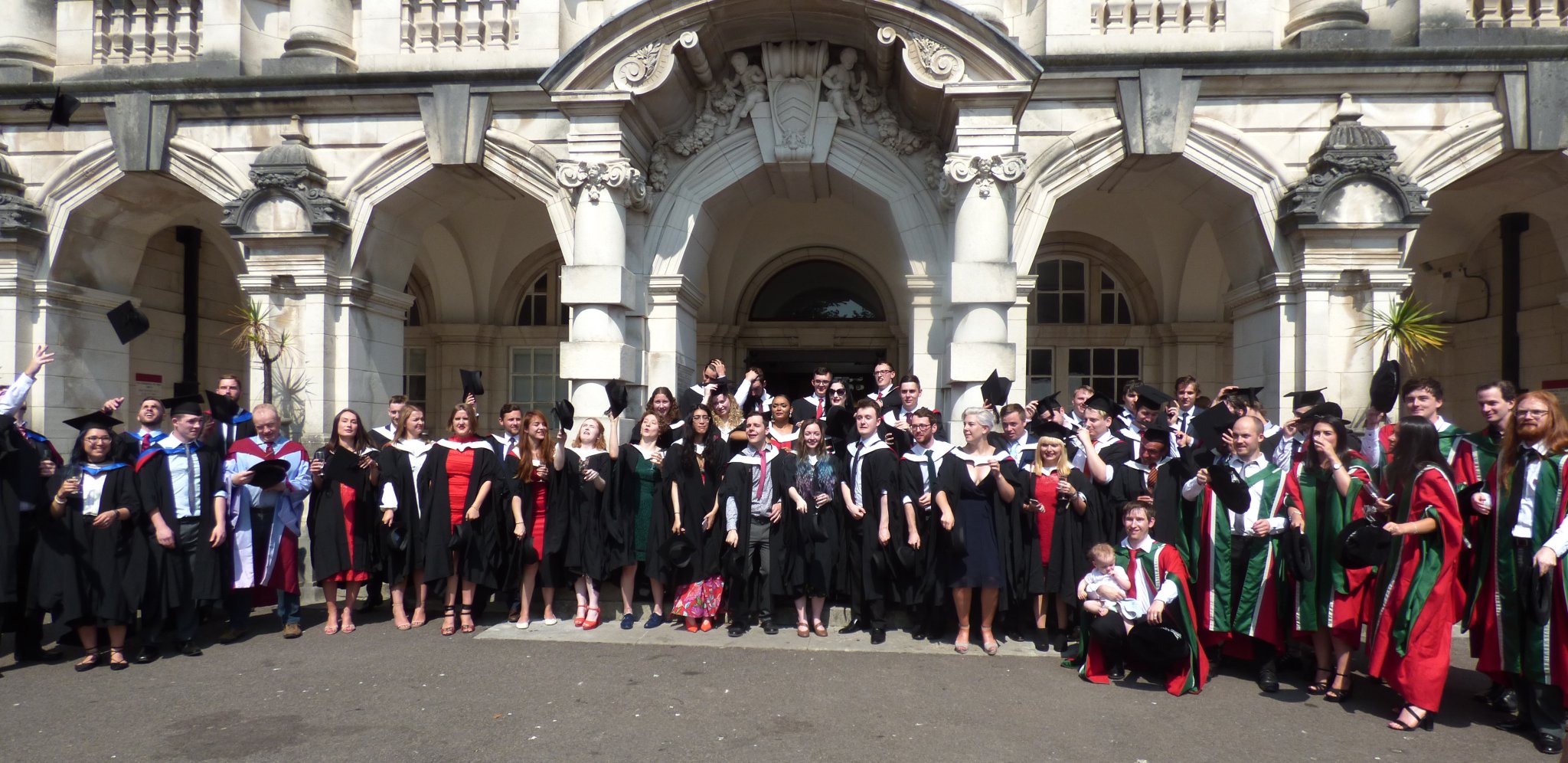
It was a very hot with all the graduation clobber, which is no doubt why such a large volume of liquid refreshment was consumed. The drinks were dispensed in a marquee which was sweltering inside. Anyway, here’s a pic of some of those students who received their degrees yesterday. I was actually there, but just out of shot to the right.

Graduation ceremonies are funny things. With all their costumes and weird traditions, they even seem a bit absurd. On the other hand, even in these modern times, we live with all kinds of rituals and I don’t see why we shouldn’t celebrate academic achievement in this way. I love graduation ceremonies, actually. As the graduands go across the stage you realize that every one of them has a unique story to tell and a whole universe of possibilities in front of them. How their lives will unfold no-one can tell, but it’s a privilege to be there for one important milestone on their journey.

I always find graduation a bittersweet occasion. There’s joy and celebration, of course, but tempered by the realisation that many of the young people who you’ve seen around for three or for years, and whose faces you have grown accustomed to, will disappear into the big wide world never to be seen again.

Graduation of course isn’t just about dressing up. Nor is it only about recognising academic achievement. It’s also a rite of passage on the way to adulthood and independence, so the presence of the parents at the ceremony adds another emotional dimension to the goings-on. Although everyone is rightly proud of the achievement – either their own in the case of the graduands or that of others in the case of the guests – there’s also a bit of sadness to go with the goodbyes. It always seems that as a lecturer you are only just getting to know students by the time they graduate, but that’s enough to miss them when they go.

Anyway, all this is a roundabout way of saying congratulations once more to everyone who graduated yesterday, and I wish you all the very best for the future!

Ongoing Hubble Constant Poll

Posted in The Universe and Stuff with tags , , , , on July 18, 2018 by telescoper

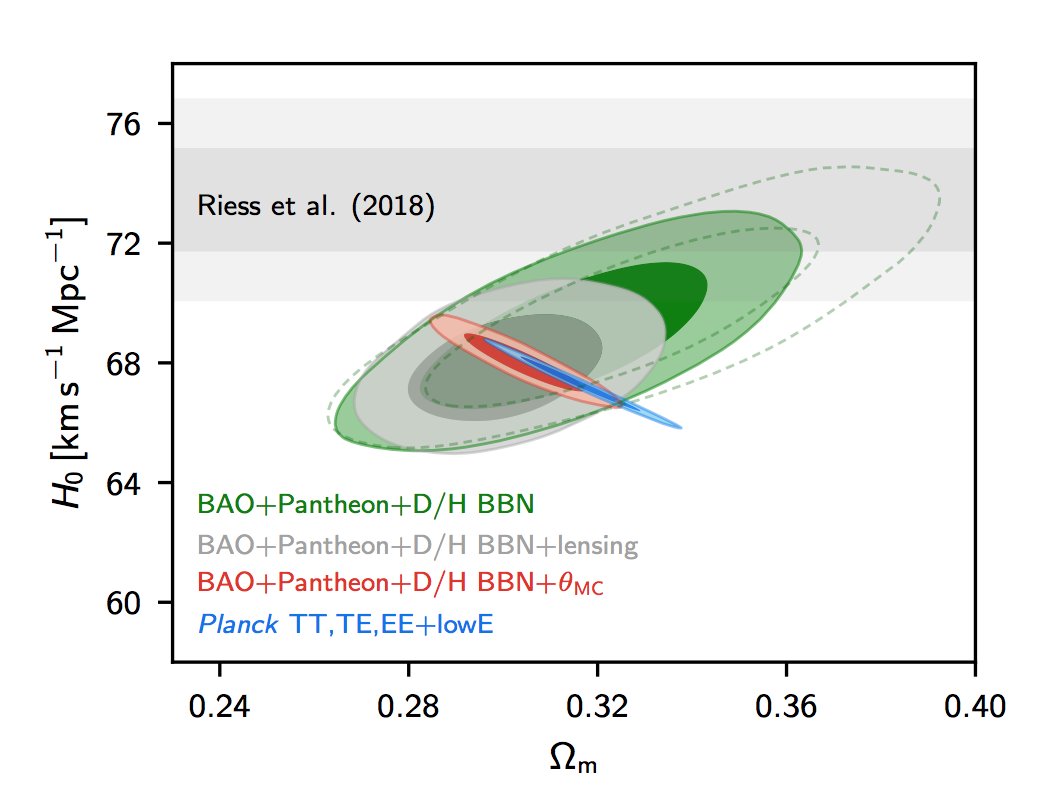
Here are two interesting plots that I got via Renée Hložek on Twitter from the recent swathe of papers from Planck The first shows the `tension’ between Planck’s parameter estimates `direct’ measurements of the Hubble Constant (as exemplified by Riess et al. 2018); see my recent post for a discussion of the latter. Planck actually produces joint estimates for a set of half-a-dozen basic parameters from which estimates of others, including the Hubble constant, can be derived. The plot  below shows the two-dimensional region that is allowed by Planck if both the Hubble constant (H0) and the matter density parameter (ΩM) are allowed to vary within the limits allowed by various observations. The tightest contours come from Planck but other cosmological probes provide useful constraints that are looser but consistent; `BAO’ refers to `Baryon Acoustic Oscillations‘, and `Pantheon’ is a sample of Type Ia supernovae.

You can see that the Planck measurements (blue) mean that a high value of the Hubble constant requires a low matter density but the allowed contour does not really overlap with the grey shaded horizontal regions. For those of you who like such things, the discrepancy is about 3.5σ..

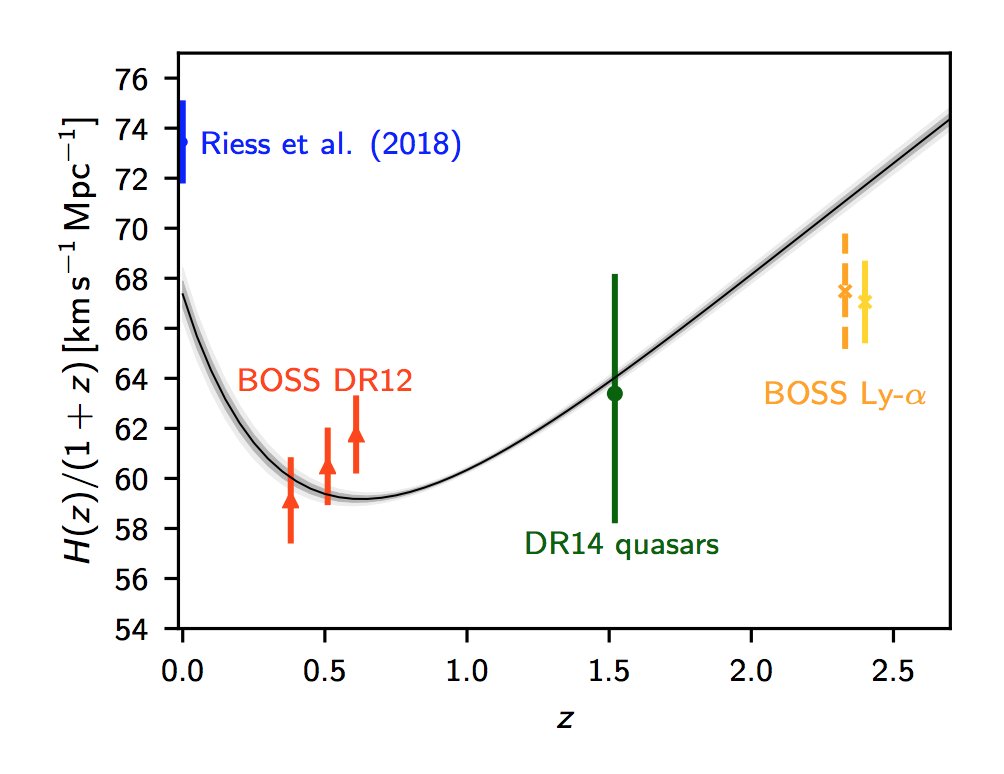
Another plot you might find interesting is this one:

The solid line shows how the Hubble `constant’ varies with redshift in the standard cosmological model; H0 is the present value of a redshift-dependent parameter H(z) that measures the rate at which the Universe is expanding. You will see that the Hubble parameter is larger at high redshift, but decreases as the expansion of the Universe slows down, until a redshift of around 0.5 and then it increases, indicating that the expansion of the Universe is accelerating.  Direct determinations of the expansion rate at high redshift are difficult, hence the large error bars, but the important feature is the gap between the direct determination at z=0 and what the standard model predicts. If the Riess et al. 2018 measurements are right, the expansion of the Universe seems to have been accelerating more rapidly than the standard model predicts.

So after that little update here’s a little poll I’ve been running for a while on whether people think this apparent discrepancy is serious or not. I’m interested to see whether these latest findings change the voting!