Euclid on Sky

Posted in Euclid, The Universe and Stuff with tags , , , on May 2, 2025 by telescoper

I haven’t posted much recently about the European Space Agency’s Euclid Mission but I’ve got an excuse to remedy that today as I’ve just seen that the Special Issue of Astronomy & Astrophysics called Euclid on Sky has at last been published (with a date of 30th April 2025). This contains the main mission and instrument overview papers as well as scientific papers relating to the Early Release Observations. All the individual papers have been on arXiv for some time already.

You can access the Special Issue here.

The main mission overview paper has 1139 authors (including yours truly); that’s definitely the longest author list I’ve ever been on! The arXiv version has been available for almost a year and has already got 254 citations. Here is the abstract:

The current standard model of cosmology successfully describes a variety of measurements, but the nature of its main ingredients, dark matter and dark energy, remains unknown. Euclid is a medium-class mission in the Cosmic Vision 2015-2025 programme of the European Space Agency (ESA) that will provide high-resolution optical imaging, as well as near-infrared imaging and spectroscopy, over about 14,000 deg^2 of extragalactic sky. In addition to accurate weak lensing and clustering measurements that probe structure formation over half of the age of the Universe, its primary probes for cosmology, these exquisite data will enable a wide range of science. This paper provides a high-level overview of the mission, summarising the survey characteristics, the various data-processing steps, and data products. We also highlight the main science objectives and expected performance.

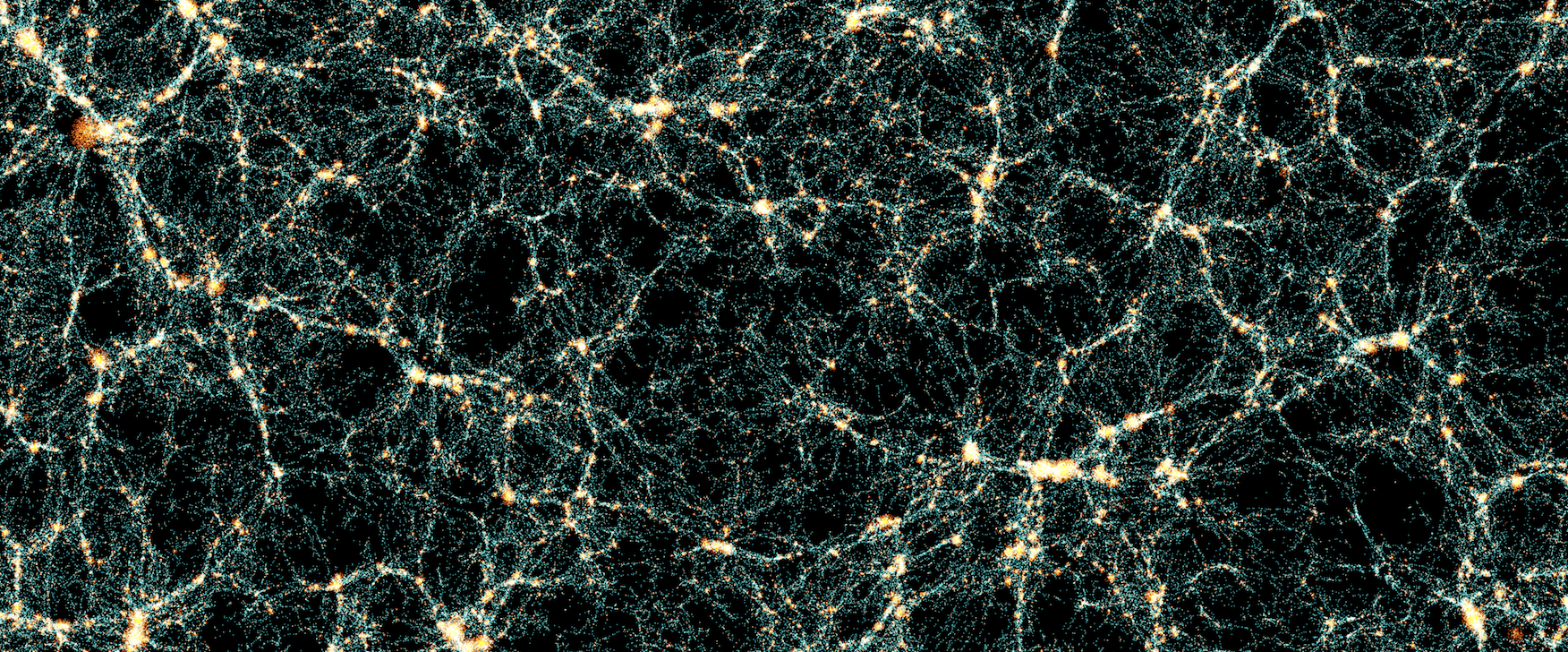
Here’s Figure 1.

May and the Poets – Leigh Hunt

Posted in Poetry with tags , , , , on May 1, 2025 by telescoper

I almost forgot that today is Poetry Day Ireland which this year has a theme of “May Day” so here’s a romantic yet whimsical offering that seems tailor-made to mark the start of the month of May.

There is May in books forever;
May will part from Spenser never;
May's in Milton, May's in Prior,
May's in Chaucer, Thomson, Dyer;
May's in all the Italian books:—
She has old and modern nooks,
Where she sleeps with nymphs and elves,
In happy places they call shelves,
And will rise and dress your rooms
With a drapery thick with blooms.
Come, ye rains, then if ye will,
May's at home, and with me still;
But come rather, thou, good weather,
And find us in the fields together.

by James Henry Leigh Hunt (1784-1859)

Darkness into Light

Posted in Maynooth, Mental Health with tags , , on May 1, 2025 by telescoper

Just a quick note to advertise that I’m taking part in Darkness Into Light in Maynooth on Saturday, 10th May, from 4.15am, to raise vital funds for Pieta and people affected by suicide and self-harm.

You can help keep Pieta’s essential services FREE and available to anyone who needs them by donating now to help me reach my fundraising goal. Every euro counts. Even a small donation can make a big impact. You can contribute to my fundraiser here.

Together, we can light up the darkness and create a brighter future for everyone.

Thank you so much for your support

Corroding Ireland’s Public Institutions

Posted in Education, Maynooth, Politics with tags , , on April 30, 2025 by telescoper

There’s an article in yesterday’s Irish Times with the headline Irish universities take millions of euro from big business. Are they too close for comfort? and the lede Many higher education institutions now rely on industry-sponsored professorships, research and scholarships to plug State funding gaps. The piece is behind a paywall, but it is based on public policy document by colleagues at Maynooth university that isn’t. In fact you can read it here. The abstract is

This policy paper explores private sector funding of higher education institutions in Ireland. Large corporations are providing financial support to Irish universities in multiple ways including supporting research projects and research centres, establishing professorships in the company name, funding physical infrastructure, and providing scholarships and other supports for students. A lack of publicly available data about the scale and scope of industry funding of Irish universities constrains a comprehensive understanding of how the private sector is engaging with and influencing Irish universities. While industry funding of higher education is often framed as a benefit to Irish society, the risks associated with private sector funding of higher education appear not yet widely considered in the Irish context. International research on industry funding of universities shows that these risks include: (1) an erosion of support for academic endeavours that may not be perceived as having commercial value, (2) corporate capture of the public-good mission of universities to legitimise profit-seeking priorities in policy discourse, and (3) the distraction of academic attention away from social and economic policies that prioritise human health and ecological health. This paper warns of the challenges of preserving the integrity and independence of academia in a higher education landscape increasingly shaped by profit-seeking objectives and market-driven priorities. Policy recommendations include a renewed commitment to strong public investment in universities and greater transparency about the scale and scope of industry funding of higher education in Ireland including a publicly accessible database of all private sector funding. 

This article elucidates many of the worries that I’ve had for some time about the corrosion of Ireland’s public universities. It’s not just that going cap-in-hand to the private sector inevitably means a focus on applied research but also that our lords and masters seem to think university teaching is simply about preparing graduates to go and work for Google. There is much more to university education than skills training.

It also occurred to me reading the piece that what it says about universities is also true about other public institutions. The one that sprang first to mind is the Irish public service broadcaster Raidió Teilifís Éireann (RTÉ). This is funded by a license fee, as is the BBC. Unlike the BBC, however, its TV broadcasts also carry advertisements to supplement the income generated by the fee. To attract advertising it has broadcast content that is more like what you would expect from a commercial channel, including imported soap operas and the like. The management of RTÉ has also been involved in a number of dodgy practices, including sponsorship deals and secret payments, that have led to a corrosion of trust in the organization.

I think RTÉ would be far better off concentrating on the current affairs, documentaries, culture and sports programming that it does well than try to compete with other channels for advertising revenue. Then it would truly be a public service broadcaster, funded by the public to serve the public. Universities should be like that too, funded by the public to serve the public, rather than commercia,l interests or the vanity of those in charge.

Spring Undergrowth – Joan González

Posted in Art, Barcelona with tags , , , on April 29, 2025 by telescoper
by Joan González (c. 1901/2, gouache on paper, 648 x 502 mm, Tate Gallery, London).

The artist Joan González was born in Barcelona, and lived from 1868 to 1908; the title of this work in Catalan is Sous-bois Printanier.

The Spanish Power Outage

Posted in Barcelona, Biographical, Euclid with tags , , on April 28, 2025 by telescoper

The first I knew about today’s massive failure of electricy grids across the Iberian peninsula was at 4 o’clock this afternoon, when I tuned in to a regular Euclid telecon and found that the expected speaker wasn’t able to give their presentation because there was no power in Spain. I was subsequently shocked to discover the scale of the outage, the cause of which remains unknown (at least to me). I’ve often thought that Ireland’s power grid was a bit unstable but I’ve never known the whole country to be shut down!

It all reminded me of the 2003 power blackout in the North-Eastern USA and Canada.

There has been speculation about an “unusual atmospheric phenomenon” being the cause, but that seems somewhat implausible. Indeed, nothing I’ve read so far about the cause of this event makes much sense.

This time last year I was in Barcelona, and today’s events got me thinking what it would have been like to be there without any power. The apartment I was living in was all-electric so there would have been little I could do – no light, no cooking, no air conditioning, no internet, no TV, no radio. I was on the top floor and the lift was powered by electricity so I would have had to use the stairs to get in or out. It would have been an interesting experience to see the city in total darkness from my balcony.

Had I been in the Department of Physics when the power went off I probably would have had to walk home, as the Metro would not have been running and with all the traffic lights off the roads would be even more chaotic than usual. That would have meant a walk of an hour or so, which would have been annoying, but feasible. Come to think of it, people actually on the Metro when the failure happened would have been stuck in a tunnel which must have been very unpleasant.

Anyway I hope all my friends and colleagues in Spain are not too badly inconvenienced and that this very weird event doesn’t lead to any serious issues. I understand the power supply to hospitals is secure, which is a relief. I must admit though I am very curious to learn the cause of this catastrophic failure. Was it human error? Deliberate sabotage? Or was it really an “unusual atmospheric phenomenon”? No doubt there will be a full investigation and we’ll find out in due course.

Quasimodo Sunday

Posted in Biographical, Education, Maynooth with tags , , , , on April 27, 2025 by telescoper

One of the useless facts stored in the increasingly inaccessible recesses of my memory is that the first Sunday after Easter is sometimes called Quasimodo Sunday, not for Hunchback of Notre Dame, but from the start of the traditional introit to the roman liturgy for this day: Quasi modo géniti infántes… (“in the manner of newborn babes”).

This year in Maynooth University Quasimodo Sunday is the last day before the students return after a short Easter break for the remaining two weeks of teaching of the Spring Semester. It’s just less than two weeks of teaching, actually, because Monday 5th May is a public holiday. This will be a very busy period as we have not only to finish teaching our modules, but also to complete grading any remaining assessments ahead of the examinations that start on 16th May. I have just four lectures and two tutorials remaining in Particle Physics but I have one assignment still to correct (which I intend to do this afternoon) and there will be one more due in at the end of term (Friday 9th May). In Computational Physics the only item on the agenda for students is the project work also due in on 9th May, at which point I will have reports from 32 students to grade. Then there’s the examinations…

I also have another important job to do over the next couple of weeks, which I can’t write about here. I had hoped to start on it a few weeks ago but that plan was stymied by a bureaucratic delay, so I actually only got started last Friday. It looks like I’ll have to do it alongside everything else during the next two weeks. I won’t post about it until it’s finished, but I’m optimistic that it will turn out well.

Oh, and I’m giving a Colloquium in the Department of Physics on 9th May too. It’s all go.

The weather was mostly rather grim over the Easter break but has improved today and the forecast for the next few days is good. I propose to mow the lawn before starting on my grading tasks. I have let the grass grow for a while, resulting in a splendid crop of dandelions which, among other things, are good for the bees. Dandelions are generally thought of as weeds but the I find the splashes of yellow colour all around very easy on the eye and do not share the desire that some people have to destroy them on sight. In fact there seem to be more around than I’ve noticed in previous years. I’ll let the ones at the back of my house carry on for a while, but I’m sure others will soon grow in the front after I mow the lawn.

Update: mowing was hard work because the grass was still rather wet.  I gave it a rough cut and will go over it again in a couple of days when what’s left will hopefully be dry.

As well as dandelions, there are quite a few cowslips here and there:

Weekly Update from the Open Journal of Astrophysics – 26/04/2025

Posted in OJAp Papers, Open Access, The Universe and Stuff with tags , , , , , , , , , , , on April 26, 2025 by telescoper

It’s Satuday morning once again, and time for another update of papers published at the Open Journal of Astrophysics. Since the last update we have published two papers, which brings the number in Volume 8 (2025) up to 44 and the total so far published by OJAp up to 279.

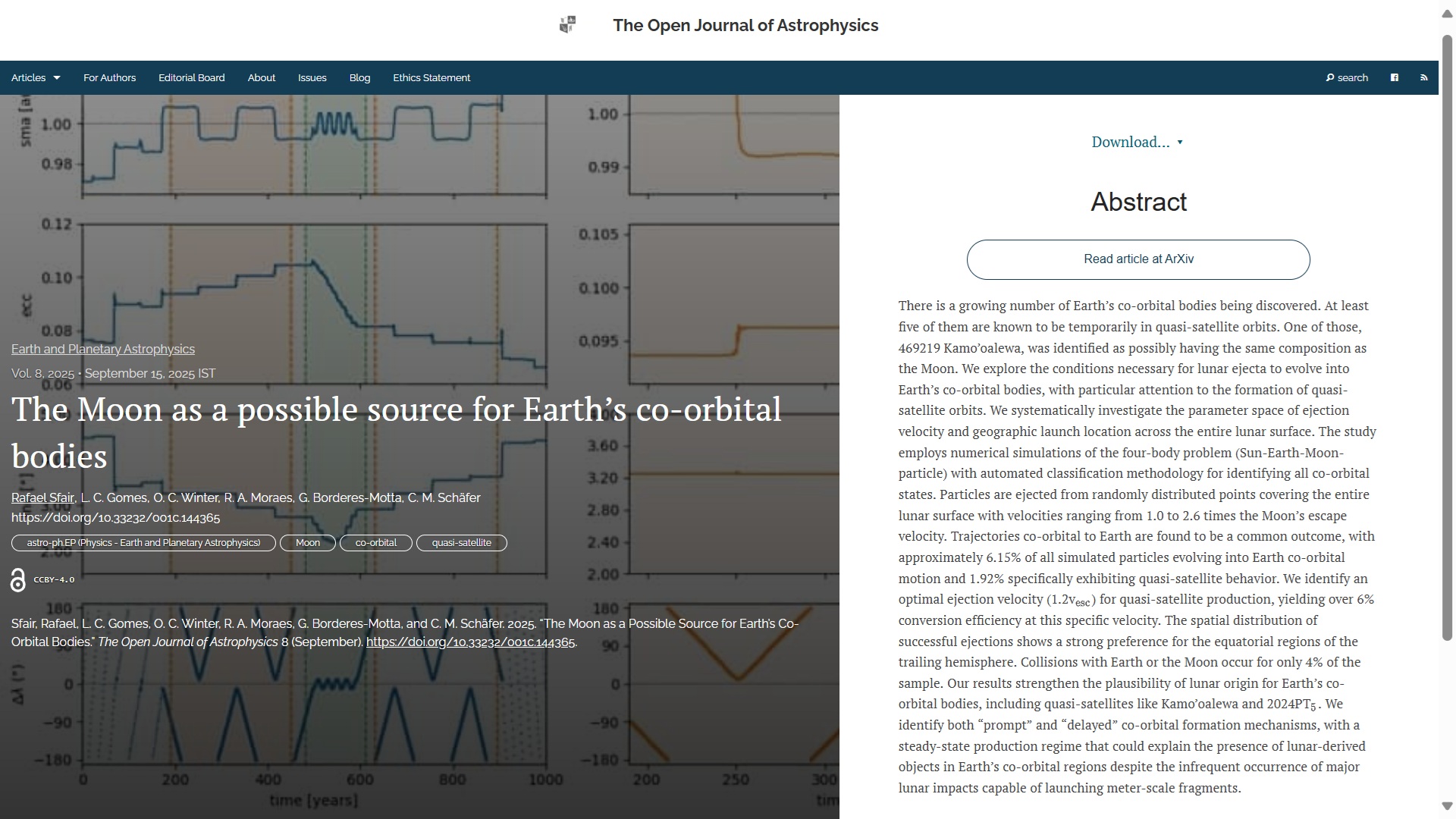
The first paper to report is “Approximating non-Gaussian Bayesian partitions with normalising flows: statistics, inference and application to cosmology” by Tobias Röspel, Adrian Schlosser & Björn Malte Schäfer (Universität Heidelberg, Germany) which was published on April 23rd 2025 in the folder Cosmology and NonGalactic Astrophysics. It is an introduction to normalizing flows – a machine learning technique for transforming distributions – and its application to the extraction of cosmological parameters from supernova data.

The overlay is here:

You can find the officially accepted version on arXiv here.

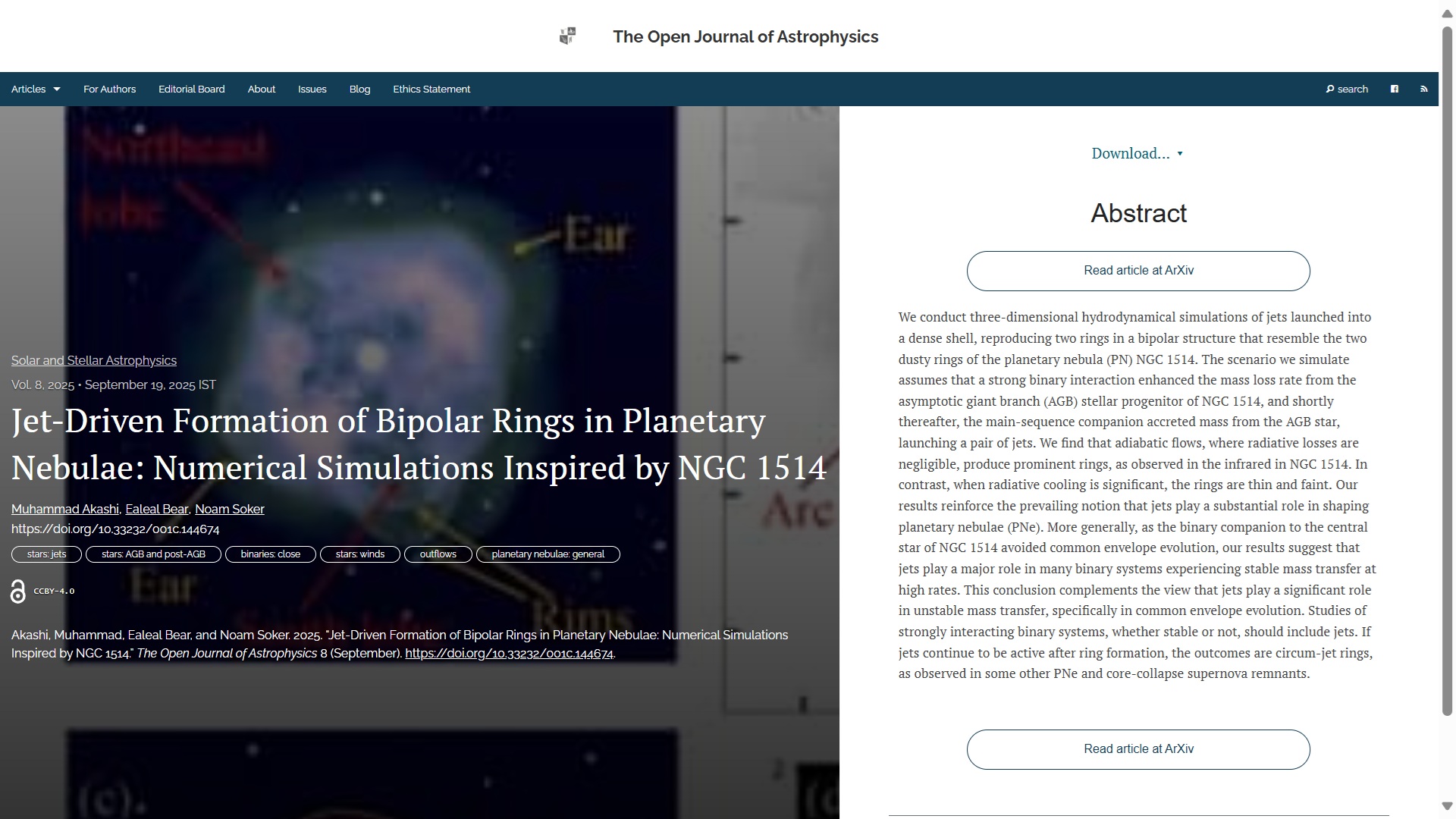
The other paper this week is “Dwarf Galaxies in the TNG50 Field: connecting their Star-formation Rates with their Environments” by Joy Bhattacharyya & Annika H.G. Peter (Ohio State University, USA) and Alexie Leauthaud (UC Santa Cruz, USA).  This one was published on 24th April 2025 in the older Astrophysics of Galaxies and it studies dwarf galaxies with properties similar to the Large and Small Magellanic Clouds that form in different environments in the TNG50 simulation of the IllustrisTNG project.

The overlay is here:


and you can find the final accepted version on arXiv here.


That’s all for this week. I’ll have another update next Saturday.

An Event at the Museum

Posted in Biographical, Maynooth with tags , , , , , on April 25, 2025 by telescoper

I forgot to mention in my post about Brian Schmidt’s lecture that the following day (on Tuesday 15th April) there was an event in the National Museum at Maynooth in which he met some of our graduate students and talked to them about their work.

I wasn’t able to attend owing to teaching commitments but I gather it was a very enjoyable occasion. There is a news item with some nice pictures here.

It’s worth mentioning that the National Museum – part of St Patrick’s Pontifical University which shares the Maynooth campus with Maynooth University – has a very interesting Science collection, including a large group of scientific instruments mostly associated with Nicholas Callan. The museum now has the largest collection of scientific instruments on public display in Ireland, most of which were manufactured in Ireland between 1880 and 1920. It also contains a collection of ecclesiastical artifacts from the past three centuries. It’s quite strange to see the juxtaposition of microscopes, electrical devices and surveying instruments with rosaries and religious vestments! You can find the opening hours of the museum here.

More importantly, outside the Museum, staff took the opportunity of his visit to teach Brian the rudiments of hurling, a sport which transcends both science and religion:

I’m told they didn’t put any windows out.

ArXiv, the Cloud and Backups

Posted in Open Access with tags , , , on April 24, 2025 by telescoper

Hidden in a job advertisement on the arXiv website for software developers is the news that

arXiv is in the midst of technological modernization to ensure longevity and scalability, and to improve our ability to support the scientific community. We are currently hiring software engineers and developers to work on the arXiv CE (“Cloud Edition”) project and our tech modernization efforts.

It seems that arXiv is going to be moved from local infrastructure at Cornell University to some sort of Google Cloud Platform. I’m not sure what to make of this move. For one thing, I’m deeply suspicious of Google so I hope that measures will be taken to ensure that arXiv remains freely accessible to the global scientific community. I suspect too that Google will use arXiv submissions as it uses everything placed in its control, to train AI. On the other hand, everything on arXiv is currently in the public domain anyway, and there has been evidence of attempts by bots to scrape its content already, causing a (temporary) degradation of service.

What all this means for the Open Journal of Astrophysics, I don’t know. I have however over the past several weeks been setting up several backups of all the papers published by OJAp in various repositories. We are an arXiv-overlay journal, but there’s no reason at all why the overlay model cannot be used with other repositories.

The decision to take these precautions was not motivated by arXiv’s move to the Cloud but by more general worries about the state of affairs in the USA right now. American universities are facing a number of attacks, as the current “Government” pursues an explicitly anti-scientific agenda, so I think it’s wise to consider the risk to Cornell being non-negligible. Obviously we can’t back up the entire arXiv repository, but I think we’ve made all OJAp papers as safe as possible in the event that anything happens to arXiv. I still think it’s unlikely we will need to use them so we’ll continue with arXiv for the forseeable future. Better safe than sorry!