Taking a stand against Musk (or not)

Posted in Maynooth, Politics with tags , , , , , , on December 29, 2024 by telescoper

This morning I saw an announcement (dated 19th December 2024) that the Université Paris-Saclay has, to its credit, ceased its activity on the social media platform formerly known as Twitter and now known as Elon Musk’s personal mouthpiece. I have written about why individuals and institutions should leave Twitter several times before, e.g. here.

According to the Saclay announcement:

It comes following changes to the platform’s content policy, which is no longer in compliance with the European Union’s Code of Practice on Disinformation, making the platform incompatible with the universal values that the university and its community share.

Bravo!

But why are so many other universities still supporting Twitter/X? I suppose it may be because many of them have specifically employed staff to broadcast news about themselves on this platform and without it they’d have nothing to do. That’s not a very good argument, in my opinion. I’m sure other bullshit jobs can be found. Another possibility, of course, is that they just don’t care. Given the prevalence of toxic management in higher education these days, this may well be the real reason. Whatever the motivation I find it deeply shaming to be working for an institution that is still happy to tout for trade in a neo-Nazi chatroom.

I very much doubt my own institution’s management will take the correct ethical course. The Maynooth University leadership doesn’t even follow the institution’s own Statutes, so I doubt that a mere EU Code of Conduct will have any influence on them. I do hope, however, the decision by the mega-University Saclay – one of the world’s top research institutions may influence others to do the right thing. As well all known, University “leadership” these days largely involves copying what others do.

It’s not only universities, and not only via Xitter, that institutions are being degraded by their association with Elon Musk. The venerable Royal Society still counts him as a Fellow, despite his overtly antiscientific dissemination of false information and his support for far-right extremism. I don’t know how Musk was elected an FRS in 2018, perhaps before the worst of his character became widely known, but the fact that he remains a Fellow tarnishes the reputation of that organization.

P.S. I had the opportunity to visit Saclay about 13 months ago.

New Publication at the Open Journal of Astrophysics

Posted in OJAp Papers, Open Access, The Universe and Stuff with tags , , , , , on December 28, 2024 by telescoper

I wasn’t planning to do the usual weekly update of activity at the Open Journal of Astrophysics this morning as I thought we wouldn’t publish any more papers between last week’s update and the Christmas break. However, one final version did hit the arXiv on Christmas Eve so I decided to publish it straight away. This brings the total for Volume 7 (2024) to 120 – a neat average of ten a month – and the overall total to 235.

Here’s a table showing the sequence of papers published over the last six years and the series formed from the aforementioned sequence:

Year201920202021202220232024
Papers1215171750120
Total16314865115235

Anyway, the new paper is “Galaxy evolution in the post-merger regime. II – Post-merger quenching peaks within 500 Myr of coalescence” by Sara Ellison (U. Victoria, Canada), Leonardo Ferreira (U. Victoria), Vivienne Wild, (St Andrews, UK), Scott Wilkinson (U. Victoria), Kate Rowlands, (STScI, USA) & David R. Patton (Trent U., Canada). It was published on 24th December 2024 in the folder marked Astrophysics of Galaxies. It comprises an investigation of the possibility that quenching of star formation is a consequence of galaxy-galaxy interactions and mergers. The overlay is here:

You can find the officially accepted version on arXiv here.

Well, that definitely concludes the updates for 2024. I’ll be back on January 4th with the first update of 2025.

An Cailín Ciúin 

Posted in Film, Irish Language, Television with tags , on December 27, 2024 by telescoper

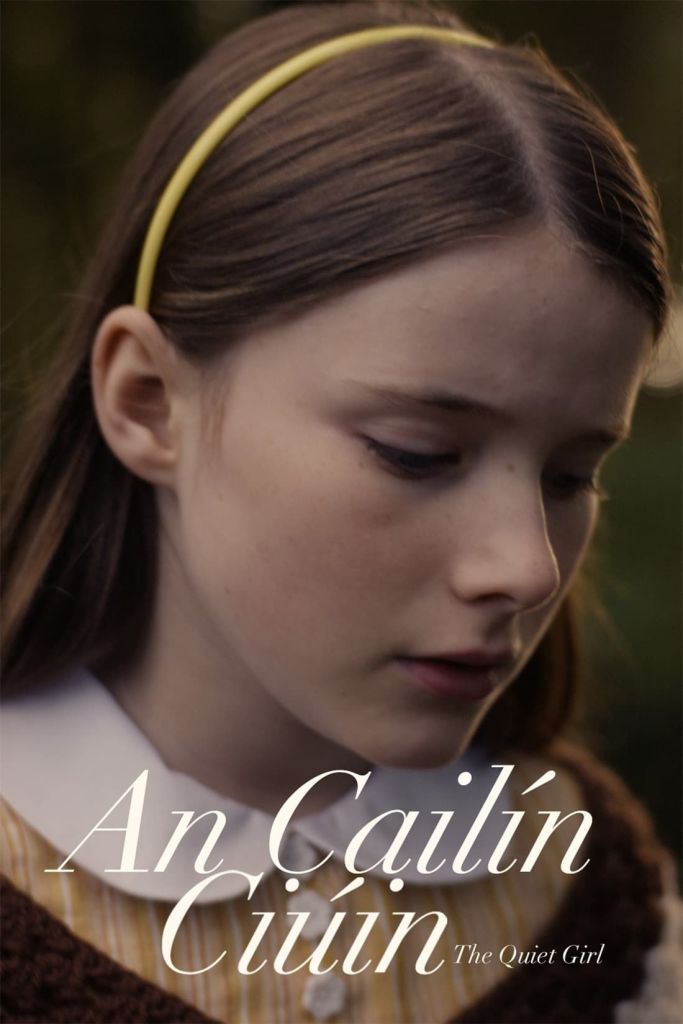
Now that the Christmas dinner and follow-up leftovers are done, I thought I’d just mention a very beautiful film I watched on the TV late on Christmas Day – An Cailín Ciúin (in English: The Quiet Girl). I was quite surprised to see it scheduled then, but TG4 is known for bold and imaginative programming.

It’s (mostly) in the Irish language, but don’t let that put you off; there are subtitles. It’s gentle, poignant and wonderfully observed. A little gem, in fact. I’d encourage you to see it if you can. It’s a fine film all round, but I can’t resist pointing out Catherine Clinch in the central role of Cáit, the quiet girl herself. She had never acted in front of a camera before this film, which makes her subtly expressiven performance all the more remarkable.

Donate to Wikipedia!

Posted in Biographical with tags , on December 26, 2024 by telescoper

It seems that Donald Trump’s owner, Elon Musk, does not approve of Wikipedia. Apparently he particularly dislikes the fact that the organizers are dedicated to Diversity, Equity and Inclusion whereas white supremacists like Musk prefer prefer Monotony, Unfairness and Exclusion of everyone who is not like them. I would imagine if he were in charge it would turn into another Conservapedia. Anything that Musk hates has to be worth supporting so today I made a donation to Wikipedia, which is a non-profit organization.

I don’t remember the launch of Wikipedia in January 2001, but I do recall when students started using Wikipedia links in project reports and the like. Unfortunately, at the beginning, many of the articles on scientific topics were very poor – often laughably so – and I discouraged students from using them. Now, over twenty years and the efforts of many volunteer editors later, they are generally very good. I now encourage students to use Wikipedia as a resource, but I still discourage them from including references to it in formal reports. The best way to use it is to get an overview but then dig down into the references which most articles lists.

I find Wikipedia an excellent resource for things outside science of course, especially music, and link to articles there very often from this blog.

Somewhere along the line somebody even set up a Wikipedia page about me. It began as “just a stub” but has been updated from time to time. I don’t know who set it up or who has updated it. I just looked and it still says I am Fellow of the Institute of Physics and the Royal Astronomical Society, when I resigned from both organizations earlier this year. I’ve edited a few articles there myself, actually, mostly on cosmology but also on jazz. Some of my blog posts are linked from there too but it would seem inappropriate for me to edit my own Wikipedia page.

Anyway, if you’re a fan of Wikipedia and/or despise Elon Musk then please consider making a donation.

Nollaig shona daoibh go léir!

Posted in Uncategorized on December 25, 2024 by telescoper

Here we are then, Christmas Day. I thought I’d do a quick yule blog in between finishing a rather late breakfast and starting the preparations for dinner*.

Let me just wish you all a Merry Christmas, Nollaig Shona, Nadolig Llawen, Fröhliche Weihnachten, Joyeux Noël, Buon Natale, Feliz Navidad, Feliç Nadal, Glædelig Jul, etc…

And in the words of a traditional Irish toast:

Go mbeirimid beo ar an am seo arís!

(“May we live to see this time next year”)

*Roast duck, with a port and redcurrant sauce, braised red cabbage, honey-roast carrots and parsnips, and roast potatoes.

Midnight Mass

Posted in Maynooth, Television with tags , , , on December 24, 2024 by telescoper

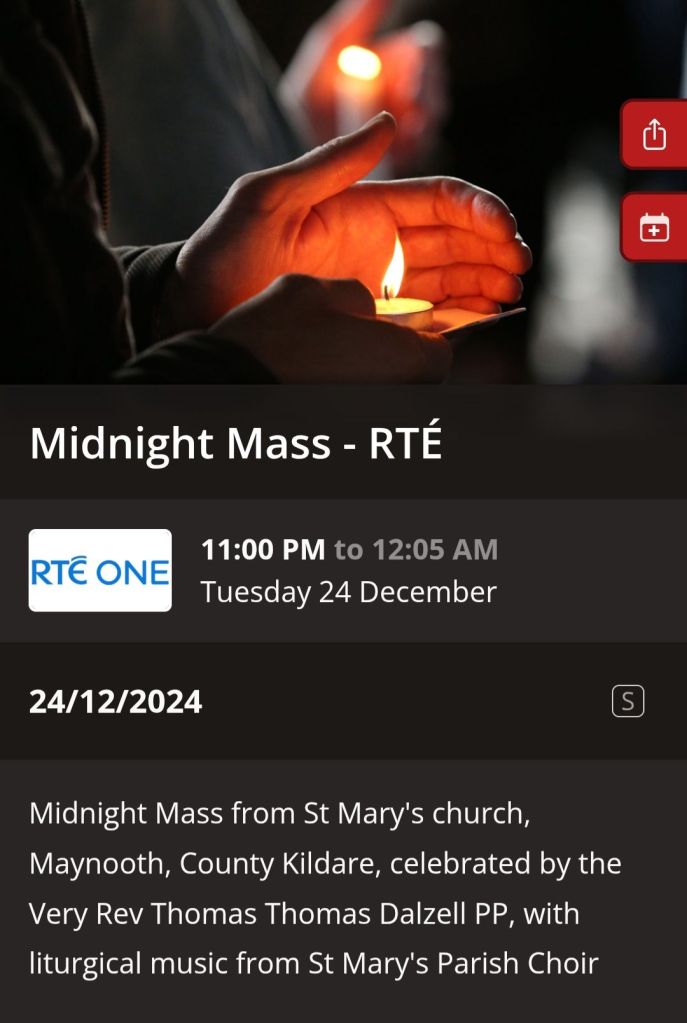
I noticed on tonight’s TV schedule that there’s a live broadcast on RTÉ One of Midnight Mass from St Mary’s Church, Maynooth.

Unfortunately, it clashes with another Christmas tradition, Die Hard, on TG4.

A Childhood Christmas – Patrick Kavanagh

Posted in Poetry with tags , , on December 24, 2024 by telescoper
One side of the potato-pits was white with frost -
How wonderful that was, how wonderful!
And when we put our ears to the paling-post
The music that came out was magical.

The light between the ricks of hay and straw
Was a hole in Heaven's gable. An apple tree
With its December-glinting fruit we saw -
O you, Eve, were the world that tempted me.

To eat the knowledge that grew in clay
And death the germ within it! Now and then
I can remember something of the gay
Garden that was childhood's. Again.

The tracks of cattle to a drinking-place,
A green stone lying sideways in a ditch,
Or any common sight, the transfigured face
Of a beauty that the world did not touch.

My father played the melodion
Outside at our gate;
There were stars in the morning east
And they danced to his music.

Across the wild bogs his melodion called
To Lennons and Callans.
As I pulled on my trousers in a hurry
I knew some strange thing had happened.

Outside in the cow-house my mother
Made the music of milking;
The light of her stable-lamp was a star
And the frost of Bethlehem made it twinkle.

A water-hen screeched in the bog,
Mass-going feet
Crunched the wafer-ice on the pot-holes,
Somebody wistfully twisted the bellows wheel.

My child poet picked out the letters
On the grey stone,
In silver the wonder of a Christmas townland,
The winking glitter of a frosty dawn.

Cassiopeia was over
Cassidy's hanging hill,
I looked and three whin bushes rode across
The horizon — the Three Wise Kings.

And old man passing said:
‘Can't he make it talk -
The melodion.' I hid in the doorway
And tightened the belt of my box-pleated coat.

I nicked six nicks on the door-post
With my penknife's big blade -
there was a little one for cutting tobacco.
And I was six Christmases of age.

My father played the melodion,
My mother milked the cows,
And I had a prayer like a white rose pinned
On the Virgin Mary's blouse.

by Patrick Kavanagh (1904-1967)

Here is the poem, beautifully read by Stephen Rea:

Rétglu etir rind

Posted in Maynooth, Music with tags , , , , on December 23, 2024 by telescoper

Since Christmas is approaching rapidly, I thought I’d share this video of the first ever public performance of Christmas setting for Chamber Choir, Gallery Schola and Organ from Dr Ryan Molloy, based on a newly-composed text by Maynooth University Professor of Old Irish, David Stifter. It was recorded in the impressive chapel of St Patrick’s Pontifical University during the annual carol service at Maynooth which took place this year on 17th December. The Irish title Rétglu etir rind means “a star among constellations”.

Pay-to-Publish Academic Vanity Publishing

Posted in Open Access with tags , , , on December 22, 2024 by telescoper

I’m not very good at keeping New Year’s resolutions, which is why I tend not to make many. I have however decided to make one for 2025. In future I will refer to any form of publishing in which the authors pay a fee as the ‘Pay-to-Publish’ model. This is much more descriptive of the reality of this form of the academic journal racket than terms such as “Gold Open Access”.

Many academic journals have switched to ‘Pay-to-Publish’ mode to maintain profit margines in response to demands that research outputs should be made freely available to read. This usually involves the payment of an Article Processing Charge, which is typically a four-figure sum in euros, pounds or dollars for each article.

Apart from the obvious danger with this model that the pressure to increase income by publishing more and more papers will lower editorial standards., the term ‘Open Access’ is inappropriate because, although the papers are free for anyone to read, authors are excluded if they cannot pay the fee. It seems to me that APC-driven publishers are therefore indistinguishable from what is usually called the Vanity Press. According to the Wikipedia page I just linked to,

[Vanity Publication]… has been described as a scam,[2] though, as the book does get printed, it does not necessarily rise to the level of fraud.[4] 

I’ll leave it to readers to decide whether it is fraudulent to charge an “Article Processing Charge” has nothing to do with the real cost of processing an article. I couldn’t possibly comment on that. It is, however, beyond question that it is a scam. I’m not the only person to think this. It is, without doubt, unethical.

I would argue that academic vanity is one of the main reasons for the very perpetuation of a publishing system that is so palpably absurd. There is among many academics and, especially, managers an unjustified reliance on journal brand-name or even impact factor as a proxy for the quality of a paper. This is despite the fact that we can easily measure impact for individual articles so there’s no need to rely on such things.

In any case I do think that it would be quite reasonable to warn potential readers of an article that its authors paid to have it published. How would you react if you saw the statement ‘The authors of this article paid to have it published’ at the start of an article? At least it might make you think about the reliability of the accompanying hype.

Five New Publications at the Open Journal of Astrophysics

Posted in OJAp Papers, Open Access, The Universe and Stuff with tags , , , , , , , , , , , , , on December 21, 2024 by telescoper

Time for the usual Saturday summary of papers at the Open Journal of Astrophysics. We have published five more papers since the last update a week ago. The count in Volume 7 (2024) is now up to 119 and the total altogether to 234. As I mentioned in a post last week this means we have published more papers this year (2024) than in all previous years put together.

In chronological order, the five papers published this week, with their overlays, are as follows. You can click on the images of the overlays to make them larger should you wish to do so.

First one up, published on Wednesday 18th December 2024 is “The picasso gas model: Painting intracluster gas on gravity-only simulations” byby Florian Kéruzoré, L. E. Bleem, N. Frontiere, N. Krishnan, M. Buehlmann, J. D. Emberson, S. Habib, and P. Larsen all of the Argonne National Laboratory, USA.  The paper, which is in the folder marked Cosmology and NonGalactic Astrophysics describes a method using machine learning based on an analytical gas model to predict properties of the intracluster medium.

Here is a screen grab of the overlay, which includes the abstract:


You can find the officially accepted version of the paper on the arXiv here.

The second paper to announce, and the first of four published on Wednesday 19th December 2024, “maria: A novel simulator for forecasting (sub-)mm observations” by J. van Marrewijk (ESO, Garching, Germany) and 10 others based in Germany, USA, Norway, France and Italy. This paper describes a multi-purpose telescope simulator that optimizes scanning strategies and instrument designs, produces synthetic time-ordered data, time streams, and maps from hydrodynamical simulations, thereby enabling comparison between theory and observations. This one is in the folder marked Instrumentation and Methods for Astrophysics.

You can see the overlay here:

The accepted version of this paper can be found on the arXiv here.

The third paper  is “Detached Circumstellar Matter as an Explanation for Slowly-Rising Interacting Type Ibc Supernovae” by Yuki Takei (Kyoto U., Japan) & Daichi Tsuna (Caltech, USA). This one was also published on 19th December and is in the folder marked High-Energy Astrophysical Phenomena. The overlay is here:


The officially accepted version can be found on arXiv here.

The fourth paper, also published on 19th December 2024, is called “On the dark matter content of ultra-diffuse galaxies” and was written by Andrey Kravtsov (U. Chicago, USA).  The article discusses the implications of measured velocity dispersions of ultra-diffuse galaxies for models of galaxy formation and is in the folder marked Astrophysics of Galaxies.

The overlay is here


You can find the officially accepted version of this paper here.

The fifth paper in this batch is “Estimating Exoplanet Mass using Machine Learning on Incomplete Datasets” by Florian Lalande (Okinawa Institute of Science and Technology), Elizabeth Tasker (Institute of Space and Astronautical Science, Kanagawa) and Kenji Doya (Okinawa); all based in Japan. This one was published on 10th October 2024 in the folder marked Earth and Planetary Astrophysics. It compares different methods for inferring exoplanet masses in catalogues with missing data


You can find the official accepted version on the arXiv here.

Finally for this week we have “A new non-parametric method to infer galaxy cluster masses from weak lensing” by Tobias Mistele (Case Western Reserve University, USA) and Amel Durakovic (Czech Academy of Sciences, Czechia). This one was also published on 19th December and is in the folder Cosmology and NonGalactic Astrophysics.  The overlay is here


You can find the officially-accepted version on arXiv here.

That’s in for this week. I will do another update next Saturday only if we have any new papers on Monday. I will be taking a break over Christmas and also preparing Volume 8 (2025) for the new year, so publishing will be suspended from 24th December until 2nd January (inclusive). If you want your paper to be published in 2024 the final version must be on arXiv by Monday 23rd December at the latest, otherwise it will be held over until 2025.