Recommendation Letters in Astronomy

Posted in Uncategorized with tags , , , , , , on December 16, 2024 by telescoper

There’s an interesting paper on arXiv with the title On the Use of Letters of Recommendation in Astronomy and Astrophysics Graduate Admissions and the abstract

Letters of recommendation are a common tool used in graduate admissions. Most admissions systems require three letters for each applicant, burdening both letter writers and admissions committees with a heavy work load that may not be time well-spent. Most applicants do not have three research advisors who can comment meaningfully on research readiness, adding a large number of letters that are not useful. Ideally, letters of recommendation will showcase the students’ promise for a research career, but in practice, the letters often do not fulfill this purpose. As a group of early and mid-career faculty who write dozens of letters every year for promising undergraduates, we are concerned and overburdened by the inefficiencies of the current system. In this open letter to the AAS Graduate Admissions Task Force, we offer an alternative to the current use of letters of recommendation: a portfolio submitted by the student, which highlights e.g., a paper, plot, or presentation that represents their past work and readiness for grad school, uploaded to a centralized system used by astronomy and astrophysics PhD programs. While we argue that we could eliminate letters in this new paradigm, it may instead be advisable to limit the number of letters of recommendation to one per applicant.

Barron et al, arXiv:2412.0871

This reminds me of an old post (from 2009) on the topic of recommendation letters or testimonials that proved quite controversial at the time. I’ll rehash part of it now because my views have changed, though the situation is similar to the UK where I was based when I wrote the original post.

In my view, the role a reference letter should be as factual as possible, and probably the most important thing it contains is confirmation that the information given by a student in their application is accurate. This could be done in a simple pro forma, and referees are often asked to complete such things nowadays. I think this is reasonable, but the questionnaires concerned are frequently so poorly designed as to be useless.

The principal bone of contention with my earlier post was whether a Professor should ever write critical or even negative comments when asked to recommend a student for a place on a graduate course. In most of my career I haven’t really thought of these letters as much “recommendations” as “references” or “testimonials” which are supposed to describe the candidate’s character and abilities in a manner that is useful to those doing the recruitment. They are not meant to be written in absurdly hyperbolic terms nor are they meant to ignore any demonstrable shortcomings of the applicant. They are supposed to advise the people doing the recruitment of the suitability of the candidate in a sober, balanced and objective way. Fortunately, most students applying to graduate schools are actually very good so there are many more positives than negatives, but if there are weaknesses in my view these must be mentioned. Hype should not be involved. The point is that the referee is not only providing a service for the student but also for the recruiting school. On this basis, it is, I think, perfectly valid to include negative points as long as they can be justified objectively. I – and I’m sure others on this side of the pond – have been criticized by our transatlantic colleagues for writing very reserved recommendation letters, but having one year received references from a US institution on behalf of 4 different students all of whom were apparently the best student that institution had ever had in physics, I think I prefer the understated style.

However, references transcripts and other paperwork can only establish whether a student has reached the threshold level of technical competence that is needed to commence a research degree. That’s a necessary but not sufficient condition for their success as a scientist. The other factors – drive, imagination, commitment, diligence, etc – are much harder to assess. I think this part has to be done at interview. You can’t just rely on examination results because it’s by no means true that the best students at passing examinations necessarily evolve into the best graduate students.

A big change in the 15 years since I wrote my original post is that undergraduate programmes now often include some form of research project and students often have access to internships of various kinds. The performance of a student on such programmes is clearly important in determining their likely performance as a graduate student, so comments on these could be invaluable to a selection committee.

To respond to the paper above, therefore, I would say there is a case for reducing the number of reference letters to one, factual letter, and to base most of the selection on interviews. This would I think make the system fairer, but would not reduce workload as the interviews would take longer to organize and carry out.


Qeios and the Nature of a Journal

Posted in Open Access with tags , , , on December 15, 2024 by telescoper

Last week I encountered, for the first time, a website called Qeios.com. This is a platform that does peer review of preprints and then posts those approved with Open Access. It also issues a DOI for approved articles. Qeios is also a member of Crossref so presumably the metadata for these articles is deposited there too.

You might think this is the same as what the Open Journal of Astrophysics does, but it is a bit different. For one thing, it is not an arXiv overlay journal so the preprints actually appear on the Qeios platform, though I suppose there’s nothing to stop authors posting on arXiv either before or after Qeios. Since most astrophysicists find their research on arXiv, the overlay concept seems more efficient than the Qeios one.

Anyway, my attention was drawn to Qeios by an astrophysicist who had been asked to review an article for Qeios that is already under consideration by OJAp. In our For Authors page there is this:

No paper should be submitted to The Open Journal of Astrophysics that is already published elsewhere or is being considered for publication by another journal.

This rule is adopted by many journals and has in the past led to authors being banned for breaking it. Apart from anything else it means that the community is not bombarded with multiple review requests for the same paper (as in the case above). There is an issue of research misconduct, the definition of which varies from one institution to another. For reference here is what it says in Maynooth University’s Research Integrity Policy statement:

Publication of multiplier papers based on the same set(s) or sub-set(s) of data is not acceptable, except where there is full cross-referencing within the papers. An author who submits substantially similar work to more than one publisher must disclose this to the publishers at the time of submission.

The document also specifically refers to “artificially proliferating publications” as an example of research misconduct. Authors whose papers do end up in multiple journals could thus find themselves in very hot water with their employers as a consequence.

Getting back to the specifics of Qeios and OJAp, however, there two questions about whether this rule applicable in this situation. One is that the preprint may have been submitted to Qeios after submission to OJAp, which means the rule as written is not violated. Authors of papers published by OJAp retain full copyright of their work so we can’t control what they do after publication, but if they try to publish it again in another journal they will fall foul of the rule there.

The other is whether Qeios counts as a “another journal” in the first place. Instead of going into the definition of what a journal is, I’ll refer you to an old post of mine in which I wrote this:

I’d say that, at least in my discipline, traditional journals are simply no longer necessary for communicating scientific research. I find all the  papers I need to do my research on the arXiv and most of my colleagues do the same. We simply don’t need old-fashioned journals anymore.  Yet we keep paying for them. It’s time for those of us who believe that  we should spend as much of our funding as we can on research instead of throwing it away on expensive and outdated methods of publication to put an end to this absurd system. We academics need to get the academic publishing industry off our backs.

The point that I have made many times is that the only thing that journals do of any importance is to organize peer-review. The publishing side of the business is simply unnecessary. Journals do not add value to an article, they just add cost. The one thing they do – peer review – is not done by them but by members of the academic community.

There is a thread on Bluesky by Ethan Vishniac (Editor-in-Chief of the Astrophysical Journal) about Qeios. There are six parts so please bear with me if I include them all to show context:

This thread is for authors of scientific papers, and particularly astronomers. I struggled a bit with how explicit I had to be, but I think including a name is important. We (meaning all the major journals) have rules against submitting a manuscript to more than one journal at a time. 1/6

Ethan Vishniac (@ethan-vishniac.bsky.social) 2024-12-06T21:27:57.368Z

People who ignore this rule can find themselves banned from submitting papers for years. Recently we had a case where a potential referee noted that he had just been asked to review the same paper by someone else. 2/6

Ethan Vishniac (@ethan-vishniac.bsky.social) 2024-12-06T21:27:57.369Z

I wrote the author, who was startled and explained that he had been asked to allow his preprint to be posted at Qeios.com and that he had agreed – the issue of peer review was never raised and posting a preprint is not an ethical violation. It’s a normal part of the process. 3/6

Ethan Vishniac (@ethan-vishniac.bsky.social) 2024-12-06T21:27:57.370Z

He cc'd me the emails and I would have read it the same way. Qeios.com takes the position that they are not a journal, but a website that vets papers through peer review. The AAS journals (and as far as I know, all other professional journals) does not regard this as a meaningful distinction. 4/6

Ethan Vishniac (@ethan-vishniac.bsky.social) 2024-12-06T21:27:57.371Z


We ban this kind of simultaneous submission in order to avoid over-burdening the community with review requests and because we do not want to encourage people to shop for a referee who will not give significant feedback. The task of reviewing a paper is time-consuming but important service. 5/6

Ethan Vishniac (@ethan-vishniac.bsky.social) 2024-12-06T21:27:57.372Z

There is no point in participating in a process which makes this work meaningless. TDLR submit to the AAS journals, or submit to Qeios.com , or any other journal of your choice, but remember that it is a choice. Also, you can post to the ArXiv as well. It's fine. 6/6

Ethan Vishniac (@ethan-vishniac.bsky.social) 2024-12-06T21:27:57.373Z

This thread repeats much of what I’ve said already, but I’d like to draw your attention to the 4th of these messages, which contains

Qeios.com takes the position that they are not a journal, but a website that vets papers through peer review. The AAS journals (and as far as I know, all other professional journals) does not regard this as a meaningful distinction.

I’m not sure what a journal actually is, as I think it is an outmoded concept, but I agree with Ethan Vishniac that to all intents and purposes Qeios is a journal. It has an ISSN that says as much too. On the other hand, this quote seems to me to contain a tacit acceptance that the only thing that defines a journal is that it vets papers by peer review, which is the point I made above.

Four New Publications at the Open Journal of Astrophysics

Posted in OJAp Papers, Open Access, The Universe and Stuff with tags , , , , , , , , , , , , , on December 14, 2024 by telescoper

It’s Saturday morning once again so here’s another quick update of activity at the Open Journal of Astrophysics. Since the last update a week ago we have published  four papers, which takes the count in Volume 7 (2024) up to 114 and the total published altogether by OJAp up to 229. If we publish just one more paper between now and the end of the year, we will have published as many papers in 2024 as we have in all previous years.

Anyway, in chronological order of publication, the four papers published this week, with their overlays, are as follows. You can click on the images of the overlays to make them larger should you wish to do so.

First one up is “Star formation beyond galaxies: widespread in-situ formation of intra-cluster stars” by Niusha Ahvazi & Laura V. Sales (UC Riverside, USA), Julio F. Navarro (U. Victoria, Canada), Andrew Benson (Carnegie Obs. USA), Alessandro Boselli (Aix Marseille U., France) and Richard D’Souza (Vatican Obs.). The paper, which is in the folder marked Astrophysics of Galaxies, The paper presents a simulation-based analysis of a diffuse star forming component in galaxy clusters extending for hundreds of kiloparsecs and tracing the distribution of neutral gas in the cluster host halo.

Here is a screen grab of the overlay, which includes the abstract:

You can find the officially accepted version of the paper on the arXiv here.

The second paper to announce, published on 10th December 2024 in the folder Cosmology and NonGalactic Astrophysics, is “Cosmological Constraints from Combining Photometric Galaxy Surveys and Gravitational Wave Observatories” by E.L. Gagnon, D. Anbajagane, J. Prat, C. Chang, and J. Frieman (all of U. Chicago, USA). This article quantifies the expected cosmological information gain from combining the forecast LSST 3x2pt analysis with the large-scale auto-correlation of GW sources from proposed next-generation GW experiments.

You can see the overlay here:

The accepted version of this paper can be found on the arXiv here.

The third paper, also published on 10th December 2024, but in the folder marked Earth and Planetary Astrophysics, has the title “A potential exomoon from the predicted planet obliquity of β Pictoris b” and is written by Michael Poon, Hanno Rein, and Dang Pham all of the University of Toronto, Canada. It presents discussion, based on the β Pictoris system, of the idea that the presence of exomoons can excite misalignment between the spin and orbit axis (obliquity) in exoplanet systems

Here is the overlay

The final version accepted on arXiv is here.

Last of this quartet, published on 11th December 2024, and in the folder Cosmology and NonGalactic Astrophysics is “Map-level baryonification: Efficient modelling of higher-order correlations in the weak lensing and thermal Sunyaev-Zeldovich fields” and is by Dhayaa Anbajagane & Shivam Pandey (U. Chicago) and Chihway Chang (Columbia U.), all based in the USA.

The paper proposes an extension of the semi-analytic formalism to weak lensing and thermal Sunyaev-Zeldovich (tSZ) fields directly on the full-sky, with an emphasis on higher-order correlations. The overlay is here:

You can find the official accepted version on the arXiv here.

That’s all for this week. I’ll do another update next Saturday, and that will probably be the last one of the year. If we publish just one more paper between now and 31st December, we will have published as many papers in 2024 as we have in all previous years put together!

Santa Claus is Coming to Town – Bill Evans

Posted in Jazz with tags , , , on December 13, 2024 by telescoper

Well, just back from the Department Christmas dinner, I find myself filled with the festive spirit (or more, accurately, wine) so I thought I’d share a seasonal piece of music. As regular readers of this blog (both of them) will know, I listen to quite a lot of jazz. In the course of doing that it has often struck me that there can hardly be a tune that’s ever been written – however unpromising – that some jazz musician somewhere hasn’t taken a fancy to and done their own version. Louis Armstrong turned any amount of base metal into gold during his long career, but here’s a record I could scarcely imagine before hearing it. It’s Santa Claus is coming Town recorded in 1964 by the great Bill Evans on piano in a trio with Gary Peacock on bass and Paul Motian on drums. As far as I know this is the only Christmas tune that Bill Evans ever recorded, but I think it’s great. Enjoy!

Cosmology Talks: Recent DESI Power Spectrum Results

Posted in The Universe and Stuff with tags , , , , , on December 12, 2024 by telescoper

Some weeks ago I posted an item about recent results that have emerged from the DESI (Dark Energy Spectroscopic Instrument) Collaboration. I have been a bit busy since then but I just saw that there is one of those Cosmology Talks about these results which I thought I would pass on. The contributors are Arnaud de Mattia, Hector Gil-Marín and Pauline Zarrouk and they are talking about the analsysis they have done using the “full shape” of the galaxy power spectrum. It’s quite a long video, but very illuminating.

Pride Soc

Posted in Biographical, LGBTQ+ on December 11, 2024 by telescoper

(I’m not sure whether the above link will show properly, as I haven’t quite got the hang of this instant gramophone thing that young people use.)

It’s been a very busy day so I’ve just got time for a quick post to mention that this afternoon I gave a talk to Maynooth University’s Pride Society, which was a much less formal reprise of the talks I gave last month at Trinity College Dublin and at Oxford University in June. The talk was originally intended to mark LGBTQIA+ STEM Day on November 18th but it proved impossible to find a convenient time on that day or even near it. Anyway, it was nice talking to the students in this forum, and I would like to use the medium of this blog to say a bit “Thank You” for inviting me!

The Journal of Universal Rejection

Posted in Open Access on December 10, 2024 by telescoper

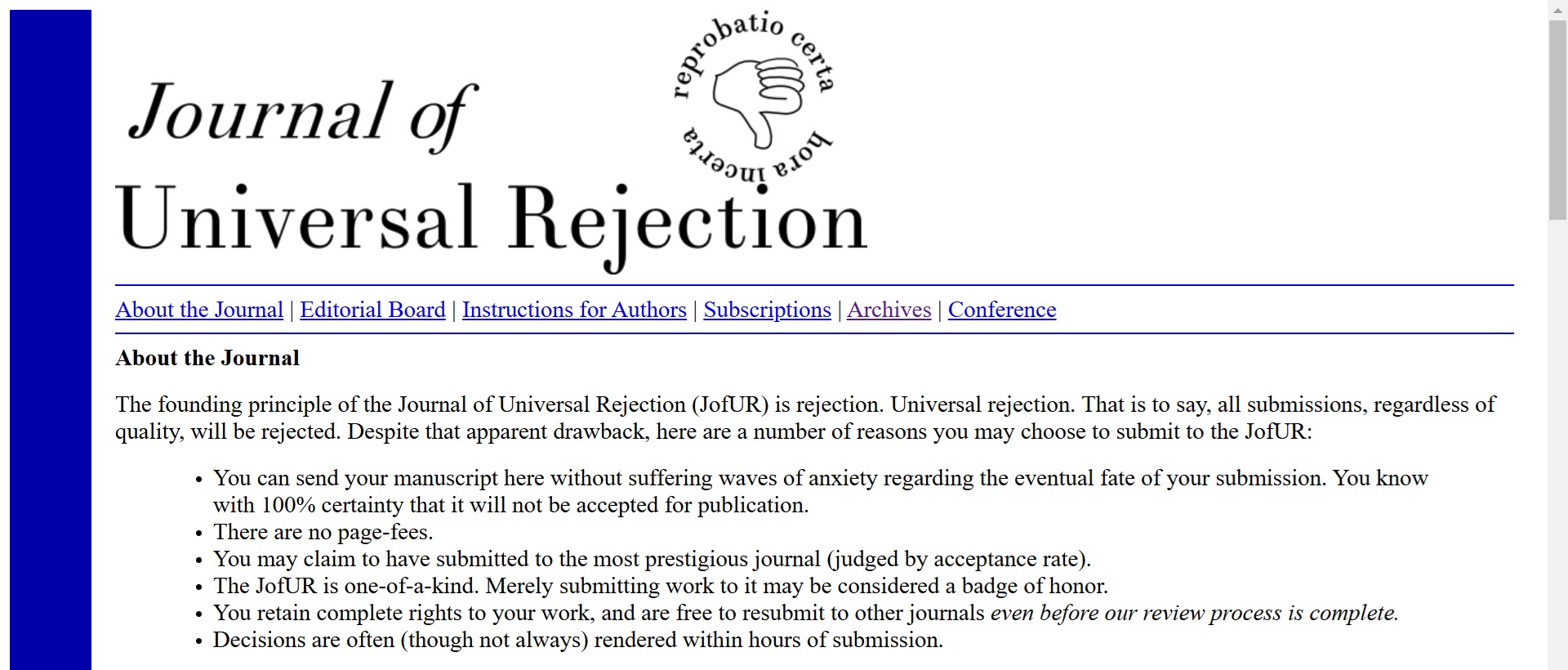
As (both) my regular readers know I have a strong interest in innovative publication methods, I thought I would share a very intriguing one I have just found out about:

I think this approach might help us at the Open Journal of Astrophysics cut our running costs still further. Gold Open Access journals have an incentive to publish as many papers as possible to increase revenue from Article Processing Charges, whereas we Diamond journals have an incentive in the opposite direction. This journal would appear to take that to its logical conclusion.

I think I’ll apply to be on the Editorial Board. It must be a very prestigious to bea member of the Editorial Board of a journal with such a high rejection rate!

Sixty Years of A Love Supreme

Posted in Jazz with tags , , , , , , , , , on December 9, 2024 by telescoper

On 9th December 1964 – exactly 60 years ago to the day – John Coltrane (ts), McCoy Tyner (p), Jimmy Garrison (b) and Elvin Jones (d) got together to record at Rudy Van Gelder’s Studio in New Jersey. In a single session they created what is probably Coltrane’s masterpiece, A Love Supreme, an album that proved immediately popular and influential when it was released in 1965.

A Love Supreme represents a sort of musical culmination of everything this quartet had achieved and it’s not surprising that they abruptly changed direction soon after making this record. They had said everything they could say in this format. Coltrane’s next great album, Meditations, recorded in 1965, features the same musicians (with the addition of Pharaoh Sanders on tenor sax and a second drummer, Rashied Ali), but it’s much freer in style.

A Love Supreme consists of four sections: Acknowledgement, Resolution, Pursuance and Psalm. As you might imagine from the titles, it’s a deeply spiritual piece. Acknowledgement is based on an 8-bar theme underpinned by a four-note phrase played on the bass that fits the phrase “a love supreme”. Coltrane impovises rather meditatively on this theme, then the group chants “a love supreme” in unison while Elvin Jones elaborates the rhythm in complex double-time. The second movement, Resolution, is based on a different 8-bar theme and Coltrane’s playing and interplay with Jones is much more agitated but it’s in Pursuance that he pulls out all the stops. Harmonically, Pursuance is a blues but it’s taken at a fast tempo and Coltrane plays with the harsh, strangulated tone he had developed by this time. After all this frantic activity he imbues the final section, Psalm, with a radiant solemnity, as he pours out an incredibly beautiful solo, with Elvin Jones providing a perfectly judged accompaniment, the rise and fall of his drum rolls showing wonderful control.

Anyway, these are just words. It’s much better just to listen to the music, as I have done twice already this evening. Enjoy!

Reaching Nelson

Posted in Cricket, History, OJAp Papers with tags , , , , , on December 9, 2024 by telescoper

This morning I published another paper at the Open Journal of Astrophysics and in the process I noticed that took us to a total 111 articles this year. I got to thinking about the significance of that number in cricket, where it goes by the name of Nelson

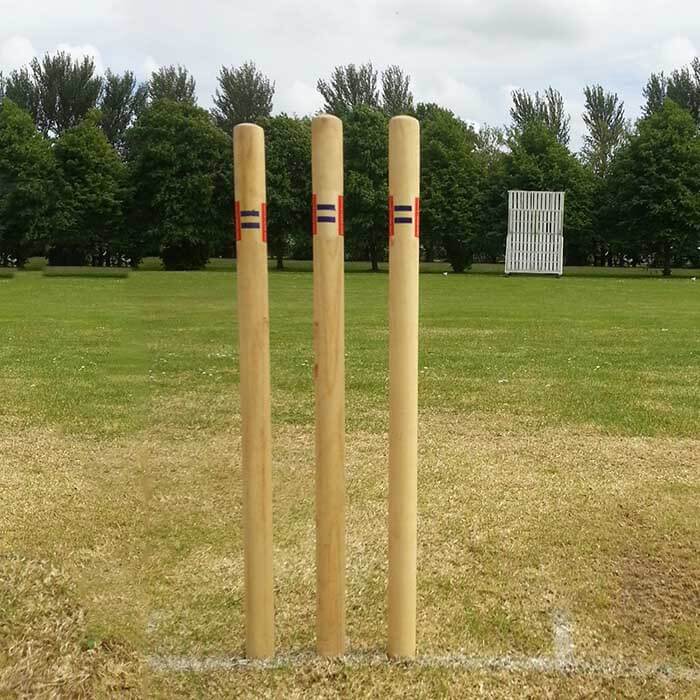
In cricket – at least in England – Nelson is supposed to be an unlucky number. The reason for this could well be that the number 111 looks like a set of stumps without the bails (see left). (For those of you not up with the lingo, the bails are two smaller bits of wood that sit on top of the stumps. ) The absence of the bails could mean that they have been dislodged, signifying that a batter is out. Also umpires remove the bails at close of play, so it could indicate that the match is over.

What’s less clear is the connection with Horatio, Lord Nelson (right). The version I was told at school was that Nelson had “one eye, one arm, and one Trafalgar”. Some also say “Destiny” instead of “Trafalgar”. Those are polite versions. Others say the third one refers to a part of the male anatomy. Bill Frindall used to say “one eye, one arm, and one et cetera“. Who knows which, if any, of these is right?

In any case this does give me the chance to point out that, contrary to popular myth, Nelson didn’t lose an eye anyway. In 1794, Nelson was in action at the Siege of Calvi during the Invasion of Corsica when a cannonball struck a nearby sandbag and sprayed him with sand and gravel. Nelson’s right eye was damaged by this, but he didn’t lose it although he had little effective vision through it thereafter.

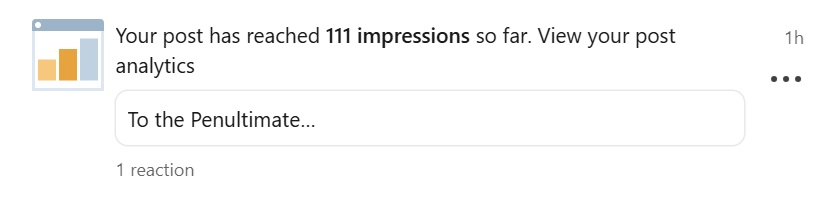
Meanwhile, I just saw this notification on LinkedIn about yesterday’s post:

To the Penultimate…

Posted in Education, LGBTQ+, Maynooth with tags , , on December 8, 2024 by telescoper

The forthcoming week is the second-to-last week of teaching term at Maynooth and, as usual at this stage of the Semester, we’re getting busier and busier.

The examinations for January have been sent off for printing and are (presumably) ready to go, so that’s one item crossed off the to-do list. I’m still behind on the coursework grading for one of my two modules, but should be able to catch up in the next few days. Other than that, I am miraculously on schedule as far as teaching is concerned. I should finish covering the respective syllabuses by Friday 13th, which means the following week will be devoted to revision. I expect attendance on campus will be fairly sparse in the last week of term, especially later on. I’ll be there until the bitter end, however, as I have a lecture scheduled on Friday 20th and have to attend final-year student presentations that afternoon. After that I will probably collapse in a state of exhaustion into the welcoming arms of the Christmas break.

While the week ahead will be fairly normal from the point of view of teaching itself, there are quite a few extra things in my calendar, as people try to get various things done before the break. Extra items for next week including a meeting about a staff recruitment (of which, hopefully, more anon) and another about the possible reorganization of teaching in the light of the merger of the Departments of Theoretical and Experimental Physics. Rationalization of teaching could lead to an improvement in the courses offered and also, by removing duplication, reduce our very heavy teaching workloads. Whether it will actually be possible to achieve either or both of these aims remains to be seen. In any case I’m not sure if any significant changes to teaching will be implemented before I retire, but I’ll probably go along to the meeting anyway in case there’s anything I can contribute.

I’ve also agreed to give a talk on Wednesday to the student Pride Society which I am looking forward to, although such events invariably make me feel very old!

As it happens, Friday 13th December is the date for the first Christmas dinner of the newly formed Department of Physics; previously, the Departments of Theoretical Physics and Experimental Physics held separate celebrations. It will be a much bigger group this time and, it being on a Friday evening we’ll have the weekend to recover before the last week of term.

Anyway, although it’s a Sunday I’ll be working all afternoon as I have a task to finish that is due tomorrow so I had better sign off. When I was younger I used to look forward to Christmas as a time for feasts and parties and socialising. Now that I’m older I look forward to it more than anything as a time for the sense of relaxation that comes from the lack of deadlines.