Six New Publications at the Open Journal of Astrophysics

Posted in OJAp Papers, Open Access, The Universe and Stuff with tags , , , , , , , , , , , , , , , , , , , , , , , , , on October 12, 2024 by telescoper

Regular readers of this blog (both of them) will have noticed that I didn’t post an update of activity at the Open Journal of Astrophysics last weekend. Despite having accepted several papers for publication in the preceding week, no final versions had made it onto the arXiv. We can’t published a paper until the authors post the final version, so that meant a bit of a backlog developed. This week included one day with no arXiv update (owing to a US holiday on Tuesday 8th October) and a major glitch on Crossref on Thursday which delayed a couple, but even so we’ve published six papers which is the most we’ve ever managed in a week. This week saw the publication of our 200th article; the total as of today is 202.  The count in Volume 7 (2024) is now up to 87; we have four papers in the queue for publication so we should pass 90 next week if all goes well.

In chronological order, the six papers published this week, with their overlays, are as follows. You can click on the images of the overlays to make them larger should you wish to do so.

First one up, published on Monday 7th October 2024 is “z~2 dual AGN host galaxies are disky: stellar kinematics in the ASTRID Simulation” by Ekaterina Dadiani (CMU; Carnegie Mellon U.) Tiziana di Matteo (CMU), Nianyi Chen (CMU), Patrick Lachance (CMU), Yue Shen (U. Illinois at Urbana-Champaign), Yu-Ching Chen (Johns Hopkins U.), Rupert Croft (CMU), Yueying Ni (CfA Harvard) and Simeon Bird (U. California Riverside) – all based in the USA. The paper, which is in the folder marked Astrophysics of Galaxies describes a numerical study of the morphology of AGN host galaxies containing close pairs of black holes.

Here is a screen grab of the overlay, which includes the abstract:


You can find the officially accepted version of the paper on the arXiv here.

The second paper to announce, published on 8th October 2024, is “Origin of LAMOST J1010+2358 Revisited” by S.K. Jeena and Projjwal Banerjee of the Indian Institute of Technology Palakkad, Kerala, India. This paper discusses  the possible formation mechanisms for Very Metal Poor (VMP) stars and the implications for the origin of LAMOST J1010+2358 and is in the folder marked Solar and Stellar Astrophysics.

You can see the overlay here:

The accepted version of this paper can be found on the arXiv here.

The third paper is very different in both style and content: “Assessing your Observatory’s Impact: Best Practices in Establishing and Maintaining Observatory Bibliographies” by Raffaele D’Abrusco (Harvard CfA and 14 others; the Observatory Bibliographers Collaboration) and is in the folder marked Instrumentation and Methods for Astrophysics. It presents discussion of the methods used by astronomical observatories to construct and analyze bibliographic databases. The overlay is here:

(This one gave me a rare opportunity to use the library of stock images that comes with the Scholastica platform!) The officially accepted version can be found on arXiv here.

The fourth paper, also published on 8th October 2024, and our 200th publication, is in the folder marked Cosmology and NonGalactic Astrophysics, and is called “CombineHarvesterFlow: Joint Probe Analysis Made Easy with Normalizing Flows“. The authors are Peter L. Taylor, Andrei Cuceu, Chun-Hao To, and Erik A. Zaborowski of Ohio State University, USA. The article presents a new method that speeds up the sampling of joint posterior distributions in the context of inference using combinations of data sets. The overlay is here

You can find the officially accepted version of this paper here.

The fifth paper in this batch is “Estimating Exoplanet Mass using Machine Learning on Incomplete Datasets” by Florian Lalande (Okinawa Institute of Science and Technology), Elizabeth Tasker (Institute of Space and Astronautical Science, Kanagawa) and Kenji Doya (Okinawa); all based in Japan. This one was published on 10th October 2024 in the folder marked Earth and Planetary Astrophysics. It compares different methods for inferring exoplanet masses in catalogues with missing data


You can find the official accepted version on the arXiv here.

Finally for this week we have “Forecasting the accuracy of velocity-field reconstruction” by Chris Blake and Ryan Turner of Swinburne University of Technology, Melbourne, Australia. This was also published on 10th October 2024 and is in the folder marked Cosmology and NonGalactic Astrophysics. The paper describes a numerical study of the reliability and precision of different methods of velocity-density reconstruction. The overlay is here

You can find the officially-accepted version on arXiv here.

That’s it for now. We have published six papers, with a very wide geographical spread of authors, and in five of the six astro-ph categories we cover. I think it’s been a good week!
Predicting the Future of Publishing from the Past

Posted in Open Access, The Universe and Stuff with tags , , , , on October 11, 2024 by telescoper

I was intrigued by an editorial piece from 20 years ago that was sent to me by Prof. Peter Schneider (who, among many other things, is Chair of the Euclid Consortium Editorial Board) who happens to be one of the authors. The article gives an interesting insight into the processes involved in being an Editor for the journal Astronomy and Astrophysics (A&A) at the time, and is worth reading all the way through, but I was particularly struck by Section 6.2, which makes some predictions about the future.

Here’s an excerpt:

We can even go a step further and ask the provocative question of whether we will need a peer-reviewed journal like A&A in the future. After all, in some communities, astro-ph has taken over the role of communicating new results. Is astro-ph not sufficient? A few aspects of a potentially very long answer to that question are as follows: many authors submit their manuscript to astro-ph, but only after it has been peer-reviewed, which shows that most researchers consider the peer-reviewing essential. People’s achievements are often judged by their refereed papers. Certainly at present, peer-reviewing is seen as a kind of quality stamp on manuscripts, and we are here to witness that papers are improved in the course of the refereeing process.


But what if astro-ph is supplemented by a refereeing process, essentially in the same way as the major journals do today, so that a manuscript gets a “green tick-mark” after successfully passing the reviewing stage and being “frozen”, i.e., cannot be replaced with an updated version anymore. We suspect that this is possible, although it would require a fairly large board of Editors to cope with the numbers of submissions to astro-ph, accompanied by costs that would have to be covered by someone. If this system were to replace the current journals, then one would end up with a single electronic-only astronomy journal and preprint service system. What if a paper is not passing through the refereeing stage? At present, a paper rejected by one journal can still be submitted to a second one, thus getting another chance to be published. We consider this second-chance opportunity a necessary feature for a fair peer-reviewed information flow. Hence, we would need more than one “astro-ph”-like system with different boards of editors, and this brings us back closely to a system of several electronic-only journals.

This is basically the idea behind the Open Journal of Astrophysics, which I didn’t really start thinking about until about 2010. In fact, when we were talking about setting up OJAp – about a decade after this paper was written – we did discuss the possibility of just having a “green tick-mark” on the arXiv entry. We rejected this idea in favour of the overlay concept primarily because of security concerns about who writes the tick mark into the arXiv field. I do agree with the point about having multiple platforms for such publications, however, and I have frequently argued that there should be alternatives to OJAp.

Here is another extract, from the very end of the paper:

We have taken here the role of devil’s advocate to demonstrate that issues in going electronic-only are far from being as simple and clear-cut as some open-access gurus would like us to believe. Obviously, electronic publishing is a timely and controversial issue that we will continue to consider in the coming years. The future of publication will be decided less by Boards of Directors and Editors, or by publishers, than by the community at large. With the availability of electronic-only journals, authors make their own decision on where to submit a manuscript. At present, this vote is clearly in favor of traditional journals, but as that may change we will remain open and ready to adapt.

I would hesitate to call myself a “guru” but I do think that the issues are clearer now than perhaps they were in 2004. Twenty years on, the balance is still in favour of traditional journals at least in terms of numbers of papers being published. Judging by the activity at OJAp, it may be that things may be changing…

Maynooth University Library Cat Update

Posted in Maynooth with tags on October 11, 2024 by telescoper

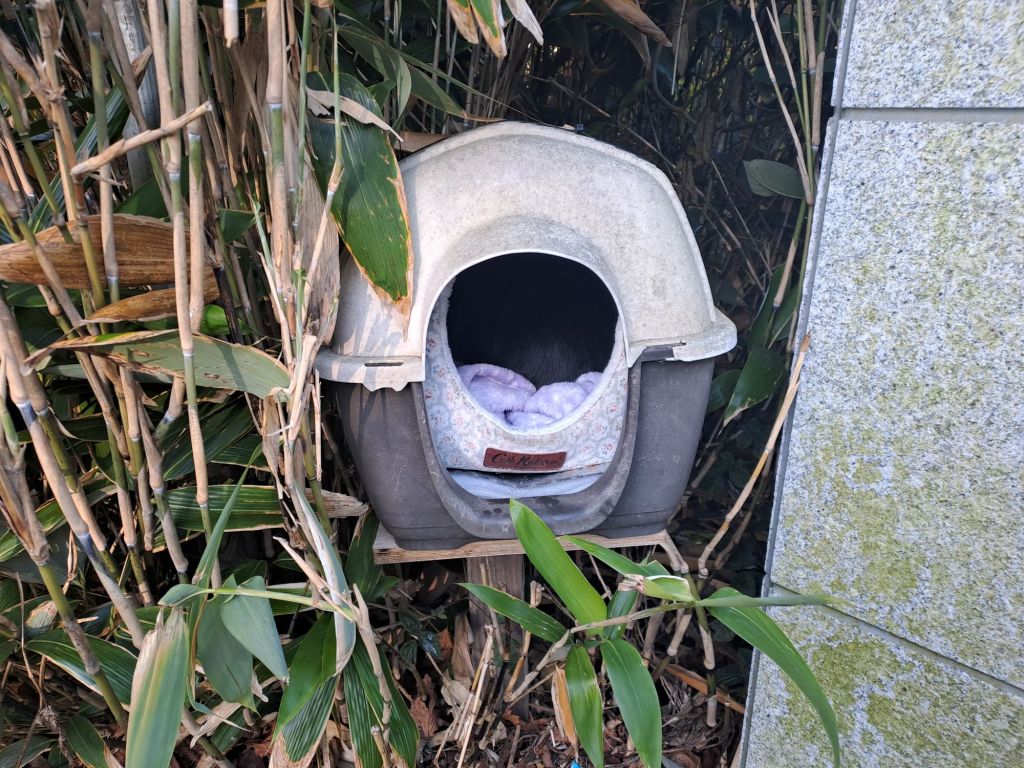
It is rather cold this morning…

…he is in there!

Space Week 2024: The Universe according to Euclid

Posted in Biographical, Books, Talks and Reviews, Euclid, The Universe and Stuff with tags , , , , , on October 10, 2024 by telescoper

I had a very busy day yesterday culminating in the Space Week event I blogged about a few weeks ago. There was a good attendance – lots of young kids as well as adults – and the lecture room was very full. We could probably have filled a much bigger room, actually, but had been moved to a smaller venue and had to close registrations very early to avoid having too many people. I’d guess we had about 350. My talk was the last one, and didn’t finish until 8.30 by which time I was definitely ready for a pint.

You can find the slides I used for my presentation, The Universe according to Euclid, here.

There was an official photographer there who took quite a few pictures but I haven’t seen any of them yet. I’ll post a selection if and when I get them.

The 200th Publication at the Open Journal of Astrophysics

Posted in OJAp Papers, Open Access, The Universe and Stuff with tags , , on October 8, 2024 by telescoper

It was on September 11th last year that we published the 100th paper at the Open Journal of Astrophysics. Today, on 8th October 2024, just over a year later we have reached the 200 mark with this paper:

In fact this looks like being a record-breaking week for OJAp as we have published four papers already and its only Tuesday. To be fair, most of these were accepted last week but were slow appearing on the arXiv – I think partly due to glitches on arXiv – but still it’s nice to be this active. I’ll do a regular post at the weekend with details of how many we published in total by then. I’m very confident that we will reach 100 for the calendar year.

52 Weeks of Euclid in Space

Posted in Euclid with tags , , on October 7, 2024 by telescoper

The Euclid Consortium is celebrating the first year of the journey of the European Space Agency’s Euclid Mission into space! Over the past 52 weeks, Euclid has been scanning the cosmos, uncovering new insights into dark matter, dark energy, and the structure of the universe. The Euclid Consortium has produced a slideshow, showcasing the key moments and discoveries from the first year in space.

The slideshow can be seen on YouTube here:

Here is a poster:

This can also found in interactive form here where you can click on each of the 52 images to see what it’s about.

P.S. The subtitle of the poster is “first year of a big journey to new physics”. There’s no guarantee that Euclid will find any new physics, rather than confirming our existing ideas, but it might.

Nobel Prize for Physics Speculation

Posted in Biographical, Science Politics, The Universe and Stuff with tags , on October 6, 2024 by telescoper

Just  to mention that that Tuesday (October 8th 2024) will see the announcement of this year’s Nobel Prize for Physics. I must remember to make sure my mobile phone is fully charged so I can be easily reached.

The announcement of the Nobel Prize for Physics is preceded tomorrow (Monday) by the announcement of the Prize for Applications of Physics to Physiology or Medicine, and on Wednesday by the Prize for Applications of Physics to Chemistry. You can find links to all the announcements here.

I do, of course, already have a Nobel Prize Medal of my own already, dating from 2006, when I was lucky enough to attend the prize-giving ceremony and banquet.

I was, however, a guest of the Nobel Foundation rather than a prizewinner, so my medal is made of chocolate rather than gold. I think after 17 years the chocolate is now inedible, but it serves as a souvenir of a very nice weekend in Stockholm!

Regular readers of this blog may recall that I called it correctly in 2022 when Alain Aspect, John F. Clauser and Anton Zeilinger won the Nobel Prize for Physics that year. I had, however, predicted them every year for many years until they won, and they won’t win it again. I really have no idea who will win it this year, but I’ll suggest that there’s still an outside chance for Michael Berry and Yakir Aharonov for their work on the geometric phase, although if they were going to win they probably would have done so by now.

Feel free to make your predictions through the comments box below!

To find out you’ll have to wait for the announcement, around about 10.45 (UK/Irish time) on Tuesday morning. I’ll update this post when the wavefunction has collapsed.

P.S. My own claim for the 2023 Physics Nobel Prize is based on the discovery of the Coles Law.

P.P.S. I’ve just realized this was my 7000th blog post.

UPDATE: The 2024 Nobel Prize for Physics goes to was awarded to John J. Hopfield and Geoffrey E. Hinton “for foundational discoveries and inventions that enable machine learning with artificial neural networks”. Odd. Not really physics, IMHO.

Grieg and Elgar at the National Concert Hall

Posted in Music with tags , , , , , , , , , , on October 5, 2024 by telescoper

Yesterday I once again headed off after work into Dublin by train to attend a concert by the National Symphony Orchestra this time under the direction of guest conductor Dinis Sousa (whose name is new to me). The programme consisted of two very familiar works, Grieg’s Piano Concerto in A Minor by Grieg and Elgar’s Enigma Variations by Elgar.

To start with, however, we heard a very interesting short piece by Anna Clyne called Masquerade which I enjoyed very much. This is only about five minutes long in performance, but full of energy and dynamics, and was a very suitable appetizer for the courses to follow.

The soloist for the Grieg Piano Concerto was Louis Schwizgebel who played it very well indeed. His articulation was crisp where necessary but also flowing when called for in the more romantic sections. The performance was very well received by the audience and by me. Actually I think that was the best performance of this work that I’ve heard live. Incidentally, I’m told the piano on which he performed was a brand new Steinway. Also incidentally, Edvard Grieg was only 24 when he wrote this piece.

During the second movement a member of the viola section of the orchestra had to leave the stage. I don’t know if she had broken a string or was just feeling unwell. I suppose both of these most happen from time to time in concerts, but I’d never seen it before. Thankfully she was back for the second half.

The Enigma Variations is another piece that is performed quite frequently. I’m not a huge fan of Elgar but this work definitely has its moments and I think anyone who doesn’t find Variation IX (“Nimrod”) uplifting must have something wrong with them. That said, that part is often played too slowly for my taste and can sound funereal rather than inspirational. Anyway, I hadn’t heard this in live performance for a long time so it was very pleasant to hear it again. I had forgotten that there is an organ part to this, actually, and it was good to hear the splendid NCH instrument used especially in the finale.

Overall it was a short (just 66 minutes playing time) but enjoyable concert. I’ll certainly be looking out for Louis Schwizgebel’s name on recordings in future as I think he is a fine soloist.

Sturm und Liouville

Posted in Biographical, Education, mathematics with tags , , , , , on October 4, 2024 by telescoper

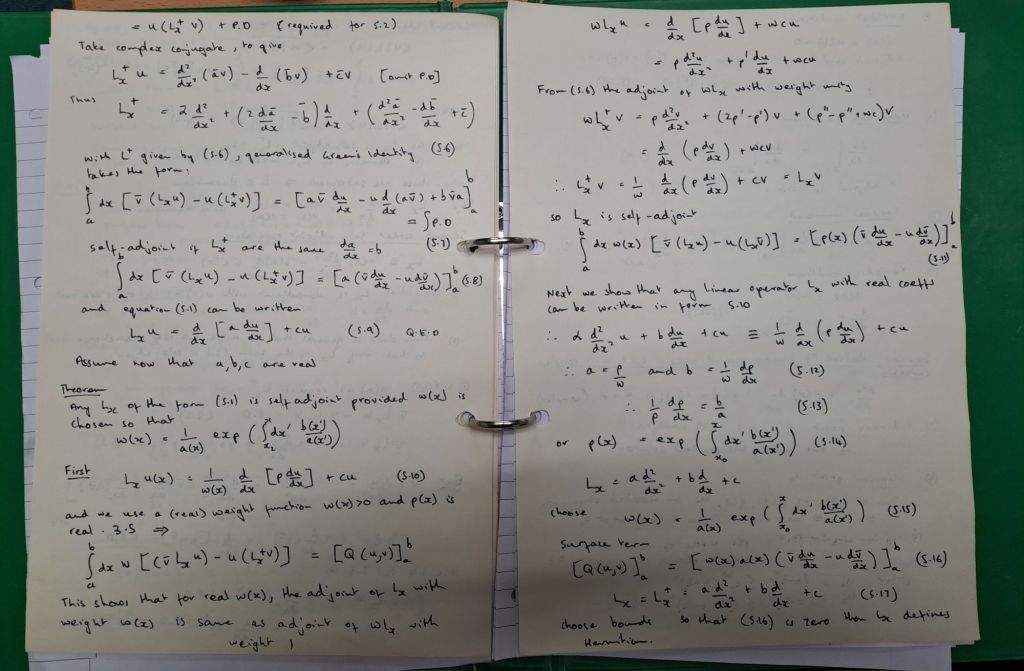
It’s Friday afternoon at the end of Week 2 here at Maynooth so I’ve now completed the 4th lecture of my 4th-year module Differential Equations and Complex Analysis. We’ve now in the section of Sturm-Liouville Theory. I’ve never taught this module before and, as always, teaching a new thing reminds me of all the things I had forgotten since I was a student. In this particular case, I still have the notes I took when I was studying this topic as an undergraduate. It’s scary to think the notes shown above were written by me 40 years ago!

Anyway, as I like to know something about the people behind the names, Sturm-Liouville Theory is named after Jacques Charles François Sturm (1803–1855)* and Joseph Liouville (1809–1882). Contrary to what I’d always assumed, Sturm was not German but was born in Geneva, which is now in Switzerland but which had been annexed by revolutionary France in 1798 so technically speaking he was born in France. Liouville was born in Saint-Omer, near Calais, which to my knowledge has never been part of Switzerland but has been part of the Spanish Netherlands.

*Given the dates, Sturm must have collaborated with Liouville after his earlier work with Drang

Mental Health and Graduate Studies

Posted in Biographical, Mental Health with tags , , , , , , , , on October 3, 2024 by telescoper

There has been a lot of comment on social media about a recent article in Nature about the mental health of graduate students and the numbers looking for treatment. There are many sources of stress that can have a negative effect on mental health, including financial pressures and poor accommodation to name but two. These aren’t really specific to graduate studies. One that is is the pressure to produce results. That actually continues throughout an academic career – burnout is a very real phenomenon – but it’s probably worse during the “apprenticeship” phase when one is inexperienced and still learning the trade.

“Productivity” is indeed important but should not be interpreted as having to work ridiculously long hours. I remember many years ago commenting on an article that claimed 80-100 hours a week was not unusual. There are people who can sit at their desks for 12 hours a day without producing anything very much at all. It’s not the hours that matter, but what you do with them. In no way will indulging your outside interests (sporting, cultural, political, or “other”…),  or simply relaxing, detract from your ability to do research. As a matter of fact, I think such diversions actually improve your work, as well as (of course) your general well-being.

I think it is fair to say that you have to work hard to do a PhD. I worked hard on mine back in the day. But don’t think that means it has to be a grim slog. I can only speak for myself, but I greatly enjoyed my time as a graduate student. I think this was at least in part because when I was doing my PhD I had plenty of outside interests (including music, sport and (ahem) “nightlife”)  and took time out regularly to indulge them. I did experience mental health problems later during my PhD, but these were not caused by being a research student.

I can think of many times during my graduate studies when I was completely stuck on a problem – to the extent that it was seriously bothering me. On such occasions I learned to take a break. I often found that going for a walk, doing a crossword, or just trying to think about something else for a while, allowed me to return to the problem fresher and with new ideas. I think the brain gets into a rut if you try to make it work in one mode all the time.

There were indeed many times during my time as a research student – and have been since – that I worked extremely long hours – all night sometimes. I wouldn’t say exactly that was because I “enjoyed” it, but that I wanted to know an answer and couldn’t get the problem out of my head.  I’ve stayed up into the early hours of the morning trying to finish a crossword too. Not because I had to, but because I couldn’t put it down unfinished. I know that makes me a saddo in many minds, but I think that’s the sort of obsessiveness and tenacity a researcher needs: becoming so absorbed by the task in hand that you don’t notice the passage of time.

I don’t think anyone should try to infer too much from these personal reflections, but I do think there’s one important point that I try to point to every graduate student I advise and that is to look after your mental health. Perhaps the Nature article has a positive side, in that at least graduate students are seeking help. Recognizing that you might have a problem is a very important first step.