
The artist Joan González was born in Barcelona, and lived from 1868 to 1908; the title of this work in Catalan is Sous-bois Printanier.
The artist Joan González was born in Barcelona, and lived from 1868 to 1908; the title of this work in Catalan is Sous-bois Printanier.
One of the useless facts stored in the increasingly inaccessible recesses of my memory is that the first Sunday after Easter is sometimes called Quasimodo Sunday, not for Hunchback of Notre Dame, but from the start of the traditional introit to the roman liturgy for this day: Quasi modo géniti infántes… (“in the manner of newborn babes”).
This year in Maynooth University Quasimodo Sunday is the last day before the students return after a short Easter break for the remaining two weeks of teaching of the Spring Semester. It’s just less than two weeks of teaching, actually, because Monday 5th May is a public holiday. This will be a very busy period as we have not only to finish teaching our modules, but also to complete grading any remaining assessments ahead of the examinations that start on 16th May. I have just four lectures and two tutorials remaining in Particle Physics but I have one assignment still to correct (which I intend to do this afternoon) and there will be one more due in at the end of term (Friday 9th May). In Computational Physics the only item on the agenda for students is the project work also due in on 9th May, at which point I will have reports from 32 students to grade. Then there’s the examinations…
I also have another important job to do over the next couple of weeks, which I can’t write about here. I had hoped to start on it a few weeks ago but that plan was stymied by a bureaucratic delay, so I actually only got started last Friday. It looks like I’ll have to do it alongside everything else during the next two weeks. I won’t post about it until it’s finished, but I’m optimistic that it will turn out well.
Oh, and I’m giving a Colloquium in the Department of Physics on 9th May too. It’s all go.

The weather was mostly rather grim over the Easter break but has improved today and the forecast for the next few days is good. I propose to mow the lawn before starting on my grading tasks. I have let the grass grow for a while, resulting in a splendid crop of dandelions which, among other things, are good for the bees. Dandelions are generally thought of as weeds but the I find the splashes of yellow colour all around very easy on the eye and do not share the desire that some people have to destroy them on sight. In fact there seem to be more around than I’ve noticed in previous years. I’ll let the ones at the back of my house carry on for a while, but I’m sure others will soon grow in the front after I mow the lawn.
Update: mowing was hard work because the grass was still rather wet. I gave it a rough cut and will go over it again in a couple of days when what’s left will hopefully be dry.
As well as dandelions, there are quite a few cowslips here and there:

It’s Satuday morning once again, and time for another update of papers published at the Open Journal of Astrophysics. Since the last update we have published two papers, which brings the number in Volume 8 (2025) up to 44 and the total so far published by OJAp up to 279.
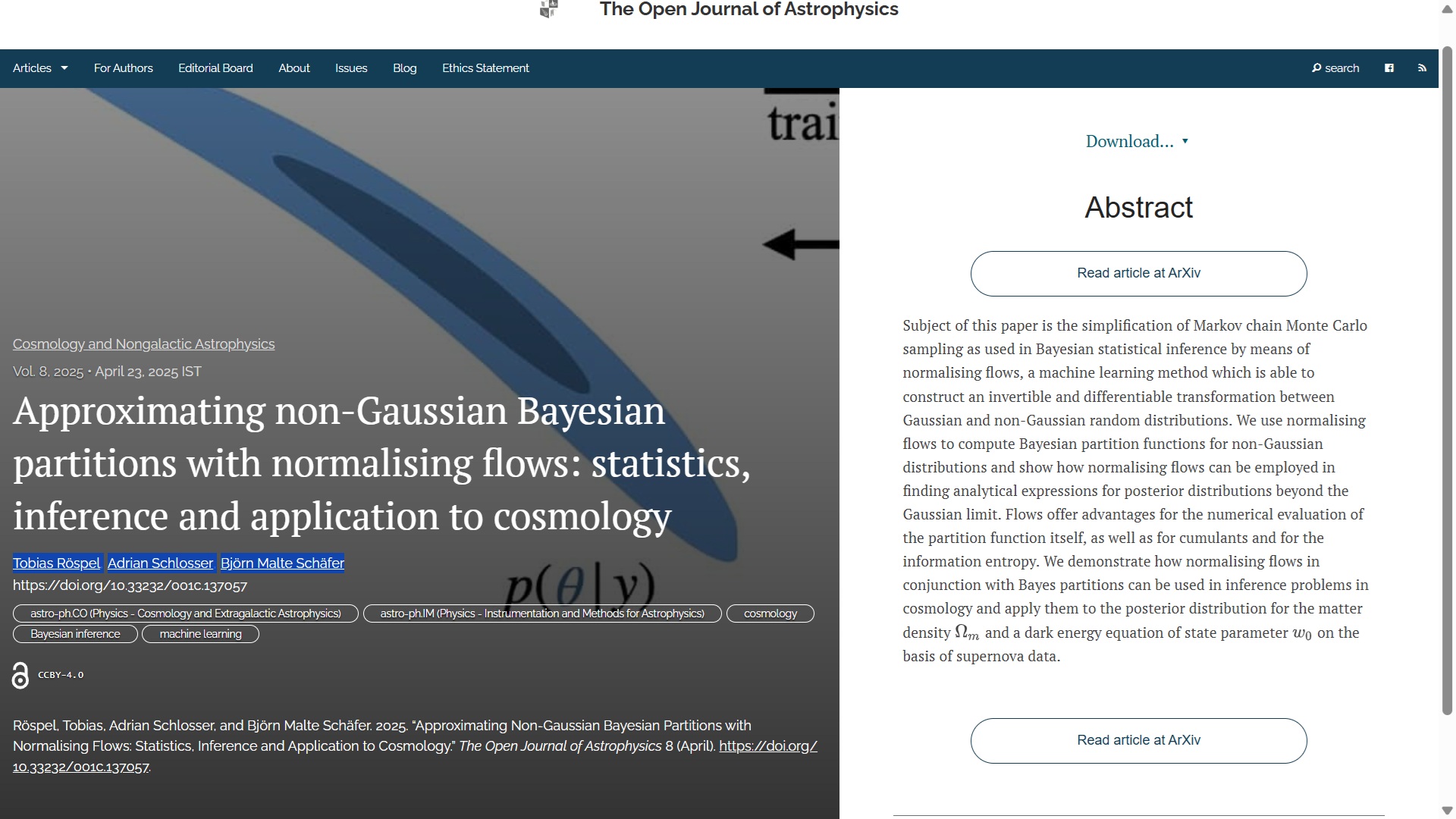
The first paper to report is “Approximating non-Gaussian Bayesian partitions with normalising flows: statistics, inference and application to cosmology” by Tobias Röspel, Adrian Schlosser & Björn Malte Schäfer (Universität Heidelberg, Germany) which was published on April 23rd 2025 in the folder Cosmology and NonGalactic Astrophysics. It is an introduction to normalizing flows – a machine learning technique for transforming distributions – and its application to the extraction of cosmological parameters from supernova data.
The overlay is here:
You can find the officially accepted version on arXiv here.
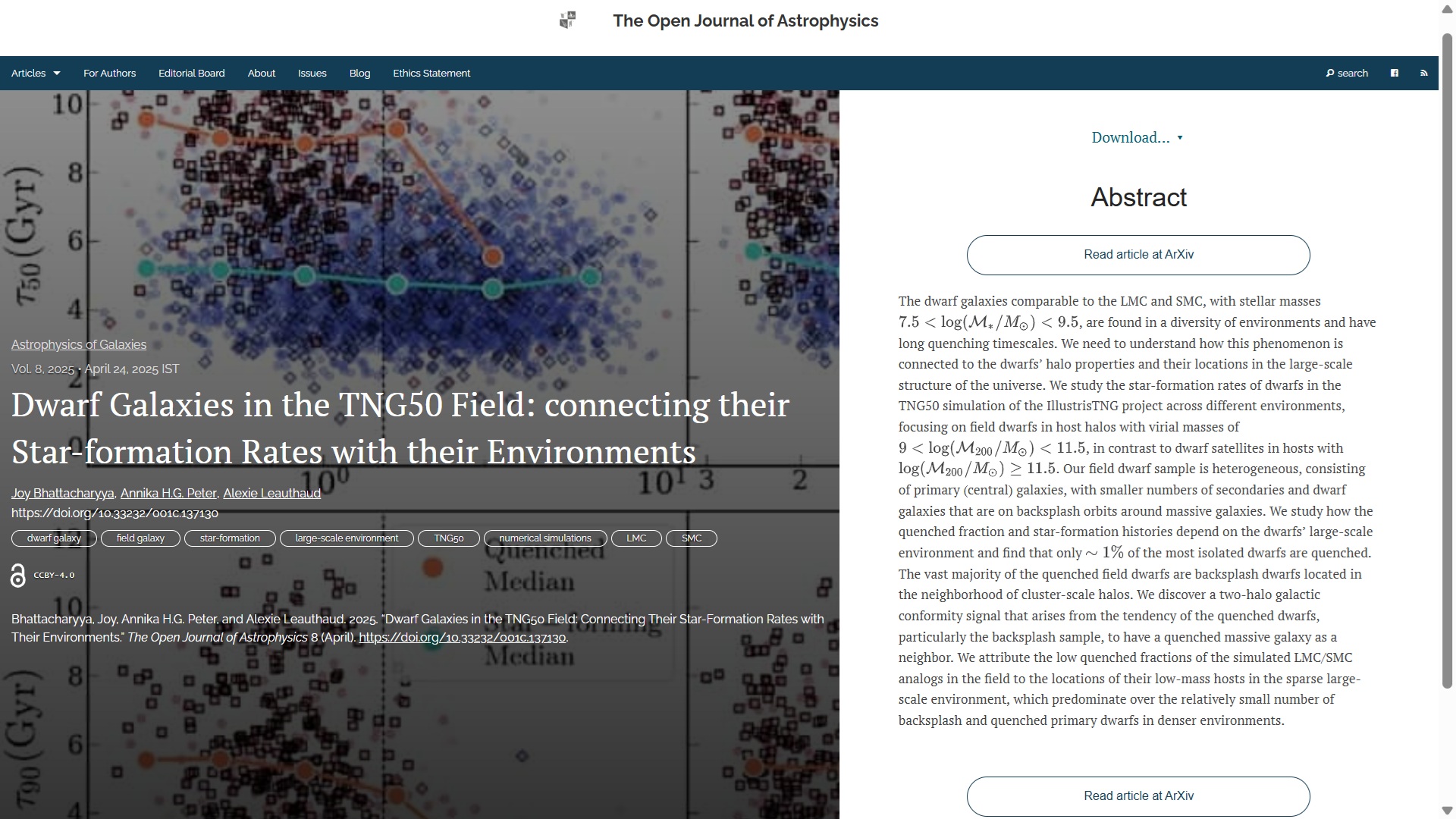
The other paper this week is “Dwarf Galaxies in the TNG50 Field: connecting their Star-formation Rates with their Environments” by Joy Bhattacharyya & Annika H.G. Peter (Ohio State University, USA) and Alexie Leauthaud (UC Santa Cruz, USA). This one was published on 24th April 2025 in the older Astrophysics of Galaxies and it studies dwarf galaxies with properties similar to the Large and Small Magellanic Clouds that form in different environments in the TNG50 simulation of the IllustrisTNG project.
The overlay is here:
and you can find the final accepted version on arXiv here.
That’s all for this week. I’ll have another update next Saturday.
I forgot to mention in my post about Brian Schmidt’s lecture that the following day (on Tuesday 15th April) there was an event in the National Museum at Maynooth in which he met some of our graduate students and talked to them about their work.
I wasn’t able to attend owing to teaching commitments but I gather it was a very enjoyable occasion. There is a news item with some nice pictures here.
It’s worth mentioning that the National Museum – part of St Patrick’s Pontifical University which shares the Maynooth campus with Maynooth University – has a very interesting Science collection, including a large group of scientific instruments mostly associated with Nicholas Callan. The museum now has the largest collection of scientific instruments on public display in Ireland, most of which were manufactured in Ireland between 1880 and 1920. It also contains a collection of ecclesiastical artifacts from the past three centuries. It’s quite strange to see the juxtaposition of microscopes, electrical devices and surveying instruments with rosaries and religious vestments! You can find the opening hours of the museum here.
More importantly, outside the Museum, staff took the opportunity of his visit to teach Brian the rudiments of hurling, a sport which transcends both science and religion:

I’m told they didn’t put any windows out.
Hidden in a job advertisement on the arXiv website for software developers is the news that
arXiv is in the midst of technological modernization to ensure longevity and scalability, and to improve our ability to support the scientific community. We are currently hiring software engineers and developers to work on the arXiv CE (“Cloud Edition”) project and our tech modernization efforts.
It seems that arXiv is going to be moved from local infrastructure at Cornell University to some sort of Google Cloud Platform. I’m not sure what to make of this move. For one thing, I’m deeply suspicious of Google so I hope that measures will be taken to ensure that arXiv remains freely accessible to the global scientific community. I suspect too that Google will use arXiv submissions as it uses everything placed in its control, to train AI. On the other hand, everything on arXiv is currently in the public domain anyway, and there has been evidence of attempts by bots to scrape its content already, causing a (temporary) degradation of service.
What all this means for the Open Journal of Astrophysics, I don’t know. I have however over the past several weeks been setting up several backups of all the papers published by OJAp in various repositories. We are an arXiv-overlay journal, but there’s no reason at all why the overlay model cannot be used with other repositories.
The decision to take these precautions was not motivated by arXiv’s move to the Cloud but by more general worries about the state of affairs in the USA right now. American universities are facing a number of attacks, as the current “Government” pursues an explicitly anti-scientific agenda, so I think it’s wise to consider the risk to Cornell being non-negligible. Obviously we can’t back up the entire arXiv repository, but I think we’ve made all OJAp papers as safe as possible in the event that anything happens to arXiv. I still think it’s unlikely we will need to use them so we’ll continue with arXiv for the forseeable future. Better safe than sorry!

The scientific community has been waiting for several weeks to find out precisely how heavily the Trump/Musk axe would fall on the National Aeronautics and Space Administration (NASA); this article reveals the shocking scale of the proposed cuts.
Under the proposal, NASA’s Science Mission Directorate (SMD) would receive almost a 50% reduction in its Budget. Within the individual SMD Divisions:
It’s very bad news all round for NASA science, but the worst hit is Astrophysics (which includes cosmology) where the proposed cut is about two-thirds, which would be truly devastating. According to the American Astronomical Society,
The proposed cut to the astrophysics budget is likely to result in the cancellation of the Nancy Grace Roman Space Telescope, a Great Observatory that would revolutionize our understanding of dark matter and dark energy while also detecting hundreds of thousands of planets in other solar systems. As the Roman Space Telescope is already fully assembled and on budget for a launch in two years, a cancellation of the mission would be a significant waste of taxpayer dollars.
The Nancy Grace Roman Space Telescope (formerly known as WFIRST) is in many ways complementary to Euclid, though it will survey a smaller area of sky it has an telescope twice the diameter of Euclid so will reach fainter magnitudes. It has been threatened before, in Trump’s previous administration, but it survived. It is not clear that it will do so again as the current composition of Congress is not weighted favourably.
Those of us outside the United States can do little, but in case anyone reading this is in America the AAS has an Action Alert for you to contact your representative(s) to vote against the proposal.
I’ve been hearing and reading lots of stories over the last month or so of people being denied entry to the United States like this one in the Guardian about a French researcher who was travelling to a conference. It seems that immigration officials are likely to confiscate and search phones and laptops for evidence of unacceptable opinions. And that’s just the start – you’re liable to be detained and deported if the goons at the border don’t like the cut of your jib.
Ireland is one of several countries (including France, Germany and Denmark) officially advising those travelling to the USA to use a burner phone instead of their usual mobile and leave their normal laptop behind. That goes for tourists just as much as people on business or travelling to meetings.
A more sensible alternative (for those of us who have the choice) is not to go there. It’s worth neither the hassle nor the risk. You can probably give your talk remotely anyway. For the indefinite future, this will be my response if I’m invited to travel to a conference in the USA:
In the last letter that I had from France
You thanked me for the silver Easter egg
Which I had hidden in the box of apples
You liked to munch beyond all other fruit.
You found the egg the Monday before Easter,
And said, 'I will praise Easter Monday now -
It was such a lovely morning'. Then you spoke
Of the coming battle and said, 'This is the eve.
Good-bye. And may I have a letter soon.'

That Easter Monday was a day for praise,
It was such a lovely morning. In our garden
We sowed our earliest seeds, and in the orchard
The apple-bud was ripe. It was the eve.
There are three letters that you will not get.
by Eleanor Farjeon (1881-1965)
Eleanor Farjeon, who is probably best known for having written the words to the hymn Morning has Broken, wrote this poem shortly after she heard news of the death of her close friend the poet Edward Thomas (the E.T. in the title) who was killed in action at the Battle of Arras on Easter Monday, 9th April 1917.
This just appeared on Youtube a couple of days ago and I couldn’t resist sharing it here. It is from a BBC programme in the series Jazz 625 and is presented by a chap called Humphrey Lyttelton, himself a trumpeter and bandleader. Although Humph is best known as a musician on the traditional side of jazz, he was very broadminded about music and extremely knowledgeable about more modern forms, as he demonstrated on his long-running radio show The Best of Jazz, which I listened to avidly as a teenager and which introduced open my eyes and ears to lots of new things including “hard bop“, which is the genre to which this belongs.
This programme was broadcast in 1965, at which time the BBC Television programmes were all in black-and-white so the recording has been “colourized”, and think the sound has been remastered too. It sounds great.
Anyway, the band featured here is Art Blakey and the Jazz Messengers. I was lucky enough to hear a couple of later incarnations of this group play live in the 1980s. There’s no need to run through the personnel or tunes because Humph does so in the recording. I will just add that the intro and outro are Thelonious Monk’s 52nd Street Theme.


