16 Years In The Dark

Posted in Biographical, The Universe and Stuff with tags , , , on September 15, 2024 by telescoper

I just received the following message from WordPress.com reminding me that today is the 16th anniversary of my registration with them, which is when I took my first step into the blogosphere. That was way back on 15th September 2008…

I actually wrote my first post on the day I registered but, unfortunately, I didn’t really know what I was doing on my first day at blogging – no change there, then – and I didn’t actually manage to figure out how to publish this earth-shattering piece. It was only after I’d written my second post that I realized that the first one wasn’t actually visible to the general public because I hadn’t pressed the right buttons, so the two appear in the wrong order in my archive. Such was the inauspicious beginning of this “shitty WordPress blog”!

Since then I have published 6,974 blog posts posts which have altogether received over 5.5M page views. That doesn’t include the 2000+ subscribers who receive posts by email. The largest number of hits I have received in a single day is still 8,864 (in 2014, at the peak of the BICEP2 controversy). The most popular post in the last year was this one.

P.S. Blog traffic had been slow recently, but has increased dramatically in the past few days, perhaps because of the ban on access to it from Maynooth University campus

What is Weak Gravitational Lensing?

Posted in Euclid, The Universe and Stuff with tags , , , , , , on September 15, 2024 by telescoper

I haven’t posted anything about the European Space Agency’s Euclid mission recently but I can remedy that today by sharing a new video that describes one of the methods that Euclid will use to map the dark Universe. Here’s the video:

Here are the credits

Credit: ESA/Euclid Consortium/Cacao Cinema

License: ESA Standard Licence

And here’s the explainer that goes with it:

ESA’s Euclid mission is surveying the sky to explore the composition and evolution of the dark Universe. But how can Euclid see the invisible? Watch this video to learn about the light-bending effect that enables scientists to trace how dark matter is distributed in the Universe.

By making use of Euclid’s flagship simulation, the video illustrates how dark-matter filaments subtly alter the shape of galaxies. Light travelling to us from vastly distant galaxies is bent and distorted by concentrations of matter along its way. The effect is called gravitational lensing because matter (both ‘normal’ and dark matter) acts as a kind of magnifying glass.

Scientists distinguish between strong and weak gravitational lensing. In strong gravitational lensing distortions of background galaxies or other light sources are very apparent, resulting in arcs, multiple images or so-called Einstein rings. In weak lensing, background sources appear only mildly stretched or displaced. This means we can only detect this effect by analysing large numbers of sources in a statistical way.

The further we look, the more prominent the distortions from weak gravitational lensing are, because there are more dark-matter structures acting as lenses between us and the light sources.

Euclid will measure the distorted shapes of billions of galaxies over 10 billion years of cosmic history, providing a 3D view of the dark matter distribution in our Universe. This will shed light on the nature of this mysterious component.

The map of the distribution of galaxies over cosmic time will also teach us about dark energy, which affects how quickly the Universe expands. By charting the Universe’s large-scale structure in unprecedented detail, Euclid will enable scientists to trace how the expansion has changed over time.

Four New Publications at the Open Journal of Astrophysics

Posted in OJAp Papers, Open Access, The Universe and Stuff with tags , , , , , , , , , , , , , , , , , , , on September 14, 2024 by telescoper

Once again, it’s time for a quick update of activity at the Open Journal of Astrophysics. This week we have published another batch of four papers which takes the count in Volume 7 (2024) up to 77 and the total published altogether by OJAp up to 192. Things are picking up again after the summer lull, and we’re moving towards a double century. If we keep up a steady average of four per week we’ll be at 200 per year.

In chronological order, the four papers published this week, with their overlays, are as follows. You can click on the images of the overlays to make them larger should you wish to do so.

First one up is “Quasi-two-dimensionality of three-dimensional, magnetically dominated, decaying turbulence” by Shreya Dwivedi, Chandranathan Anandavijayan, and Pallavi Bhat of TIFR, Bangalore, India. The paper presents an analysis of numerical simulations of MHD turbulence using Minkowski Functionals, with implications for local anisotropies revealed therein. It was published on 9th September 2024 and is in the folder marked High-Energy Astrophysical Phenomena.

Here is a screen grab of the overlay, which includes the abstract:


You can find the officially accepted version of the paper on the arXiv here.

The second paper to announce, also published on 9th September 2024, is “mochi_class: Modelling Optimisation to Compute Horndeski In class” by  Matteo Cataneo (Universität Bonn, Germany) and Emilio Bellini (SISSA, Trieste, Italy). This article presents a cosmological Einstein-Boltzmann solver adapted to work with Horndeski gravity, together with validation tests. It is in the folder Cosmology and NonGalactic Astrophysics.

You can see the overlay here:


The accepted version of this paper can be found on the arXiv here.

The third paper, published on 11th September 2024 in the folder marked High-Energy Astrophysical Phenomena, is by Jonathan Katz of Washington University, St Louis, USA. The title is “The Sources of Fast Radio Bursts” and it presents a discussion of the possible physical origin of Fast Radio Bursts, arguing that they fall into two distinct groups.
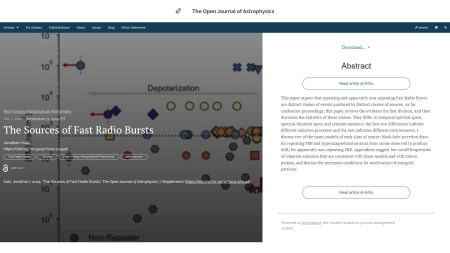
 

The final version accepted on arXiv is here.

Last in this batch, but by no means least, is “RMS asymmetry: a robust metric of galaxy shapes in images with varied depth and resolution” by Elizaveta Sazonova (U. Waterloo, Canada) with 15 other authors spread around the world (in Canada, USA, Australia, Italy, Chile, UK, Poland, Mexico, Germany, and Spain). This paper presents a method of quantifying distortion of galaxy images connected with mergers or other instabilities. It is in the folder marked Astrophysics of Galaxies and was published on September 12th 2024 with this overlay:
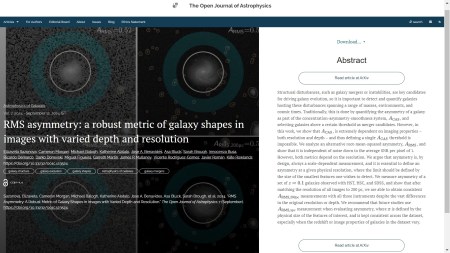
 

You can find the official accepted version on the arXiv here.

That’s all for now. I will post another update in a week.

A New Season at the National Concert Hall

Posted in Biographical, Music with tags , , , , , , , , on September 14, 2024 by telescoper

It was just over a year ago that I last went to the National Concert Hall in Dublin. That occasion was the opening of a new season of concerts for 2023-4 by the National Symphony Orchestra. After a year away on sabbatical, last night I went to the season opening of the next year of concerts by the National Symphony Orchestra, this time under the direction of Mihhail Gerts. I’m hoping to see more of the forthcoming season than I did the last!

The programme for the concert is shown in the picture. The first half was dominated by legendary mezzo-soprano Dame Sarah Connolly, resplendent in a turquoise frock, who sang six songs by Alma Mahler (born Alma Schindler) who was of course the wife of Gustav Mahler whose 1st Symphony we heard in the second half. Gustav famously (and reprehensibly) told Alma that she had to give up composing music when they married (which they did in 1902). Until then she had written not only songs but also piano music. Few of her compositions survive, however. Apparently she destroyed many of the manuscripts herself in later life. Of the fifty or so songs she is thought to have written, only 17 (including the 6 we heard last night) still exist on paper. She at least responded by outliving him by more than 50 years: Gustav died in 1911 and Alma Mahler passed away in 1964.

It’s very unfair to compare Alma Mahler’s settings with those of Gustav Mahler, who was a master of the orchestral song cycle. The compositions we heard all all quite short, three or four minutes, and are definitely influenced by Wagner. The first song, for example, deploys the famous Tristan Chord and there are passages that are clearly influenced by the Wesendonck Lieder. None of the manuscripts are dated, but in terms of style they do sound like late Romantic works from around 1900 when she was very young. Overall these works not at the same level of achievement of either Richard Wagner or Gustav Mahler but, with Sarah Connolly in fine voice, there was much to enjoy. I had never heard any of these songs before this evening, and it left me wondering what Alma Mahler might have achieved musically had she continued to compose. We’ll never know.

Before these songs we heard the concert overture In Nature’s Realm by Antonín Dvořák. This is also a piece that feels very late-19th Century (it was composed in 1891). It’s a sort of homage to the beauty of the composer’s native Bohemia with distinct echoes of Beethoven’s Pastoral Symphony, I thought.

After the interval wine break we returned for the second half which consisted of (Gustav) Mahler’s Symphony No. 1 in D Major. This is a very familiar concert work nowadays, but it’s worth remembering that it didn’t exactly set the world on fire when it was first performed in 1889 and Mahler revised it extensively before it arrived at the form now usually performed. Like all Mahler symphonies it covers a vast territory. One of the most famous Mahler quotations is “the symphony is a world”, but in the case of his own symphonies each movement is a world. The first movement begins in hesitant and fragmentary fashion before bursting into life with a metaphorical evocation of daybreak. The second movement is earthier and more forceful, quoting from folk songs and country dances. The third is my favourite, with its humorously up-beat references to Klezmer music before ending in a kind of funeral march. The final movement is tempestuous at first, then calm, then erupts into a glorious finale.

Last night’s performance was broadcast live on RTÉ Lyric FM but what radio listeners won’t have got was the thrilling sight of a symphony orchestra in full flood. At the end of the last movement, members of brass section stood up to give extra power to the climactic resolution of the piece. Mahler does “loud” very well indeed, but I was impressed by the spectacle too: the lights gleaming off the array of trombones and horns as they blasted out the final phrases (in another context I would call them “riffs”). Great stuff, and very well received by the audience.

P.S. On the way into Dublin to see last night’s concert I realized that the Irish Rail timetable had changed while I was away so, instead of terminating at Connolly (the station, not the mezzo-soprano), the train I was on went all the way through to Pearse, thereby saving me a bit of time walking. It only takes about 20 minutes (for me) to walk from Pearse to the NCH, in case you’re wondering, and I do like a bit of a walk to stretch my legs before sitting down for a couple of hours at a concert.

Farewell to the Hume Doctoral Scholarships

Posted in Maynooth with tags , , , on September 13, 2024 by telescoper

If you are a final year student and were thinking of applying for one of the John and Pat Hume Doctoral Scholarships in order to fund a PhD at Maynooth University, then don’t bother. University Management – as usual in the case of anything without consultation or discussion – has decided to scrap the scheme. How this squares with the ambition to increase PhD numbers stated clearly in the Strategic Plan is anyone’s guess. Why it has been decided to aim a wrecking ball at Maynooth’s research activity is another question. Clearly it’s not shortage of funds: the University accounts reveal huge surpluses and just this week yet another administrative position with a six-digit salary (enough to fund at least 5 PhD students) was advertised. We can’t expect to have research students and a legion of overpaid bureaucrats, can we?

John Hume (a Maynooth alumnus and co-winner of the Nobel Peace Prize) died in 2020 and Pat Hume (John’s wife), who died in 2021; the John and Pat Hume Scholarships were created in their honour. The decision to extinguish that honour just a few year after their deaths is just crass. Let’s hope the inevitable backlash will bring about a change of mind. This blog may be banned on campus, but word will spread.

Space Week in Maynooth!

Posted in Maynooth, The Universe and Stuff with tags , on September 12, 2024 by telescoper
Euclid View of the Perseus Cluster

The annual Space Week in Ireland is from October 4th – 10th this year. As we have done for the previous couple of years, we will be putting on an event at Maynooth University. When I say “we”, I mean the Department of Physics collectively – I was away in Barcelona at the time of last year’s event so couldn’t give a talk, but I did one the year before. I’ll be doing a talk this year too. The description of my talk reads:

Two of the greatest mysteries in modern science concern the nature of the dark matter and dark energy we think dominate the Universe. In this talk I will explain how the European Space Agency’s Euclid mission, launched last year, is designed to shed light on the “dark side” of the cosmos, present some of the early results, and show how you can get involved in analyzing Euclid data.

Anyway, this year’s event will be on Wednesday 9th October. The event is open is open to all and will be held in the picturesque surroundings of the TSI building. Tickets are free but must be reserved in advance. You can do that here. The event has sold out for both the last two years – with over 400 attendees – so it’s best to book early!

You can find more details about the programme here. It may change so I’ll post the final programme nearer the event.

An Anniversary of a Century

Posted in Open Access, The Universe and Stuff with tags on September 11, 2024 by telescoper

While I remember, here is a quick post to mark the fact that the 100th paper at the Open Journal of Astrophysics was published a year ago today (on 11th September 2023).

In the year that has passed since that milestone we have published a further 91 papers. I expect we will pass the 200 mark sometime next month. It’s an accelerating Universe!

A Room with a View

Posted in Biographical, Maynooth with tags , on September 11, 2024 by telescoper

I thought I’d share with readers – at least those off campus, as access to this blog remains banned by Maynooth University – the view from the window of my new office:

Well, what did you expect to see from a Maynooth University office window? Sydney Opera House perhaps? The Hanging Gardens of Babylon? Herds of wildebeest sweeping majestically across …

The Big Four and Your Work

Posted in Open Access with tags , , , , on September 10, 2024 by telescoper

In Agatha Christie’s novel The Big Four (left) the great detective Hercule Poirot tries to identify the members of sinister group of unscrupulous individuals bent on world domination.

When it comes to the world of academic publishing, the members of the The Big Four are somewhat easier to identify, though no less unscrupulous. They are Elsevier, Spring-Nature, Taylor & Francis, and John Wiley & Sons who have cornered almost 50% of the lucrative market in scholarly books and journals and the eye-watering profits that go with that territory.

Recently, however, these companies have found a new way of boosting their profits still further. This involves selling their “content” to tech companies in order to train the generative AI algorithms known as Large Language Models. The latest to do this is Wiley, which has already cashed in to the tune of $44 million. Wiley has not given its authors the right to opt out of this deal nor will authors be remunerated. Others outside the Big Four are also cashing in. Oxford University Press, for example, which publishes Monthly Notices of the Royal Astronomical Society, has done similar deals.

This sort of arrangement provides yet another reason to avoid the commercial publishing sector. Do we become academic researchers in order to be mere “content creators” for Wiley and the rest?

Maynooth University’s Privatized Network

Posted in Maynooth with tags , , , on September 9, 2024 by telescoper

Quite a few people have contacted me to ask why my access to this blog is banned on Maynooth University campus, as indicated at the top of yesterday’s post. As far as I can see, the block applies not only to this site (telescoper.wordpress.com aka telescoper.blog) but every site with an IP address or addresses (a pair in my case) hosted on the WordPress.com domain. I don’t know how many sites that is, but it’s a lot.

When I asked IT Services at Maynooth why I could neither read no write to my own blog via the campus network, it was explained to me that at some point one of the sites hosted on WordPress was involved in a phishing operation so the whole domain was blocked by the “external provider” as it is deemed a security risk. Actually WordPress.com has very strict control of its security, so this allegation is potentially defamatory and damaging to WordPress business. I wouldn’t be surprised if they take legal action. It doesn’t damage my business of course, as I make no money from this blog, but I nevertheless find it extremely annoying. In any case it seems to me an unreasonable and disproportionate restriction.

It was in February 2024 (while I was away in Australia) that Maynooth University privatized its computer network, handing over control of it to a company called Agile Networks. Apparently, this “external provider” now has complete control over web access from Maynooth University and is not accountable to the University for its actions. It, not the University, decides what websites can be accessed by staff and students. So much for academic freedom.

I might add that there has been a plethora of network service outages recently, so I was amused by the self-congratulatory tone of Agile Networks represented by its takeover of Maynooth’s internet access, e.g.

It has revolutionised the campus. It has made every outdoor area of the campus a viable classroom.

That may be true, but it merely reflects the fact that Maynooth does not have anywhere near enough indoor teaching or student study spaces. I’m sure students will be delighted that it is now deemed acceptable for them to study in the “viable classroom” of the great outdoors, complete with freezing cold and pouring rain!

Anyway, I contacted WordPress to tell them of the problem and they confirmed that nobody from either Maynooth University or Agile Networks has contacted them about the alleged security breach. They said

The ideal situation would be that the service provider reviews our documentation and whitelists the IP…

The situation is obviously not ideal…