With thoughts turning to the new academic year I noticed an Open Letter to Universities in the Netherlands, which I have signed. You can read the letter yourself but here is a summary of the main calls to action:
• Resist the introduction of AI in our own software systems, from Microsoft to OpenAI to Apple. It is not in our interests to let our processes be corrupted and give away our data to be used to train models that are not only useless to us, but also harmful.
• Ban AI use in the classroom for student assignments, in the same way we ban essay mills and other forms of plagiarism. Students must be protected from de-skilling and allowed space and time to perform their assignments themselves.
• Cease normalising the AI hype and the lies which are prevalent in the technology industry’s framing of these technologies. The technologies do not have the advertised capacities and their adoption puts students and academics at risk of violating ethical, legal, scholarly, and scientific standards of reliability, sustainability, and safety.
• Fortify our academic freedom as university staff to enforce these principles and standards in our classrooms and our research as well as on the computer systems we are obliged to use as part of our work. We as academics have the right to our own spaces.
• Sustain critical thinking on AI and promote critical engagement with technology on a firm academic footing. Scholarly discussion must be free from the conflicts of interest caused by industry funding, and reasoned resistance must always be an option.
I agree with all of these. I don’t think The Management does though.
In Maynooth University there has been a total absence of leadership from the Management about the academic threats posed by the uncritical adoption of “AI” . I’ve put “AI” in quotes because most of what is being described as AI nowadays (e.g. LLMs) is not is in no way Artifical Intelligence. There is a place for such things as Machine Learning. Indeed, much of the data-driven research in my own field of cosmology would be impossible without them. The key, however, is not whether you insist on calling it AI or not, but the word uncritical. Much of what I have heard from our “Leadership” is simple-minded boosterism. And yes, that word is in quotes for the same reason as “AI”.
In planning my teaching for next term, which starts in two weeks, I have taken a hard line on assignments. I allow no assignment to contribute to a module grade unless it is supervised in such a way as to prevent “AI” being used. Both modules I will be teaching next semester are mathematical in nature, and the summative assessments will consist of four (unseen) in-class tests and a written exam. Phones, laptops and tablets are banned from all these.
I believe that this is the only way to maintain the integrity of these assessments and that to do anything else will result in a lowering of academic standards. I believe this is the case across a great many disciplines, so there should be university-wide regulations to manage it. I find the absence of any “Leadership” on this scandalous (but I’m afraid not surprising).
This is not to say that I will band the use of LLMs etc entirely. Students will be free to use ChatGPT or CoPilot or whatever to check their answers to the formative assessments I hand out, if they think that will help, but these will not contribute to their module mark.
I’ve been listening to a radio programme about the centenary of RTÉ, it being a hundred years since the first radio broadcast by Raidió Éireann in 1926 (before television existed). One of the things included was a discussion of the fierce campaign against Jazz in Ireland during the 1930s. On New Year’s Day 1934, a Fr. Conefrey led a march through Mohill, County Leitrim, in which demonstrators shouted “down with jazz” and “out with paganism” and called on the government to close the dance halls and ban all foreign dances in Ireland. Jazz, the campaign argued, was “abominable” music that originated in central Africa and was exported to the West by “a gang of wealthy Bolshevists in the USSR to strike at church civilisation throughout the world.” Jazz was an “engine of hell” deployed to do the devil’s work. The Gaelic League weighed in on the day with an attack on then-Minister of Finance Seán MacEntee, who, in allowing jazz to be broadcast on Radio Eireann, was “selling the musical soul of the nation for the dividends of sponsored jazz programmes”.
It seems absurd nowadays that people could take such tripe seriously but it was a significant movement supported, amongst others, by Éamon de Valera. Here are some extracts of a speech which is both hilarious and sinister, not to mention deeply racist, by Fr. Conefrey, to give you an idea. Honestly. I know some people don’t like jazz, but this is just ridiculous!
–0–
Let me tell you why this campaign is the most important step taken by the Gaelic League for many years.
While the Irish music has died out it is being replaced by a foreign system of music introduced from savage Africa by people out to kill religion and destroy morality. This ‘jazz’ represents the sin of impurity and young people leave their homes every night to go to dances where jazz is practised.
All night jazz dancing is one of the greatest evils Ireland has ever seen. Jazz is an even greater evil than both intemperance and landlordism combined. It is a menace to religion and nationality and its objective is nothing less than to destroy virtue in the human soul.
The reason it has been tolerated and indulged in so far is because the public in Ireland do not understand its meaning and do not see the danger.
Now we still have some people asking what is jazz? Some have asked in good faith if it excludes waltzes and barn dances? My answer to that is that the ‘anti-jazz campaign’ excludes no dance that is in keeping with public Christian decency. But no-one could make anything out of the jazz dancing, and there was no music in the jazz tin squealing.
A professor in Oxford University tells us that the word ‘jazz’ is a Central African word and means the acting in public of something that St Paul says should not be so much as named amongst us.
The dance and the music with its abominable rhythm was borrowed from Central Africa by a gang of wealthy International Bolshevists in America. Their aim is to strike at Christian civilization throughout the world and to steer Roman civilization inro the dust: they employed this jazz – this engine of hell – to do this devil’s work.
They laid their plans carefully. They employed mass suggestion. In the music they knew they had something that would appeal to debased sexual instinct. Its superlative, savagely extreme use of syncopation, allied with the copulative beat, beat, beat of the drum, stirred up forces all over the world.
To counter this abomination, the only answer is to revive Irish dancing and music. I appeal to you to support Irish music and Irish dancing: as far as I’m concerned it is a question of defending Christian religion and faith while we have it.
No other nation has the same music as we have. The Irish nation was famous for its music, but all the old violinists and flautists are gone, and it is only amongst the peasantry of Ireland that the real traditional music and dance is to be found.
When I was at the Royal Dublin Society exhibition we had a great show of our local cottage traditions of spinning and weaving and all sorts of knitted goods. But we also had Irish music and dance at our stand. I was congratulated and told by many that never was such music played on the show grounds, and it was one of the greatest treats of the whole show.
Music and dancing are among the arts of the nation and if the nation is to be rebuilt then we must get all the constituent parts reconstructed. I’ve had an idea in my mind for a long time, that we should have a National Reconstruction League to take charge of the language, music, and dance, and for cottage industries and the arts. If we could organise competitions and concerts to play our old tunes on traditional instruments and bring on new pipe bands, we could stop the spread of immorality and irreligion.
There is great musical-talent in Co. Leitrim and it is undeveloped.
We need to see that Irish music is fostered and not despised. But there are certain classes in this country who consider our Irish music is not genteel enough for them, and they look down on it and are out to destroy its spirit. Those Dublin people need to come down to the country where they’ll learn step dancing and how to distinguish one step from another and get the names of the steps. I would like to know what the Leinster School of Music was doing for Irish music: nothing; they are only teaching classical music. Even at the Sligo Feis Ceoil all the music was from Continental authors, and it was only the poor Irish farmers were left to play the Irish music.
Action is needed to be taken by the church and state. First, the government should compel the closing of dance halls at 11 o‘clock. Young teachers should be trained to teach Irish dancing and music, and they should have Irish dancing taught in the Depot amongst the members of the Guards.
One of the greatest offenders at the present time are the Civic Guards. The Minister for Justice should take action and have good Irish céilidh organised in every barracks every week or month, and not allow the Guards to be carrying on their pagan dances until hours in the morning. It is a well-known fact that in most cases there are bars open at these all-night dances, and people attending them are blinded with drink. This is a disgrace, and President de Valera should be ashamed of his face to stand by and allow this conduct to be carried on. It is time for the Government to open its eyes and see to it that this abuse should end.
I appeal to political parties to give up their disputes and unite on this question and put down this jazz.
While I speak to the Government I also speak to the Church, and say that the priests will want to waken up and see that this terrible and abusive jazz dancing ceases. I know that the majority of the priests know that jazz is wrong, but many of them will not speak out. There are others who don’t understand this monster and their idea is to let the people have what they want, which is the jazz.
I fear that if this is to continue and the generation of old people die out, we will have a different type of people in the future. It is up to the people to rise against this ]azz dance and music as it is necessary to save their traditions and faith. It is unworthy of Catholics to support jazz and no one is associated with jazz but shoneens. If people were worthy of their race and traditions they would blow up every hall, where jazz is practised.
More condemnation of jazz is worse than useless, as Henry Ford realised.
Young folk, will dance, but let them dance to rhythms of beauty and in a manner that will scatter morbidity and make for fun and jollity.
–0–
Coincidentally, it was also in 1926 that Louis Armstrong and His Hot Five recorded “The Irish Black Bottom” which I here present to you in the hope of destroying the virtue in your soul.
After a very busy week, it’s time once more for another Saturday update of activity at the Open Journal of Astrophysics. Since the last update we have published a further five papers, bringing the number in Volume 9 (2026) to 194 and the total so far published by OJAp up to 642. As explained at the end of this post, one of the five publications is a correction of an earlier paper.
I continue to include the posts made on our Mastodon account (on Fediscience); these announcements also show the DOI for each paper. The Mastodon account has regular updates and other announcements from OJAp too.
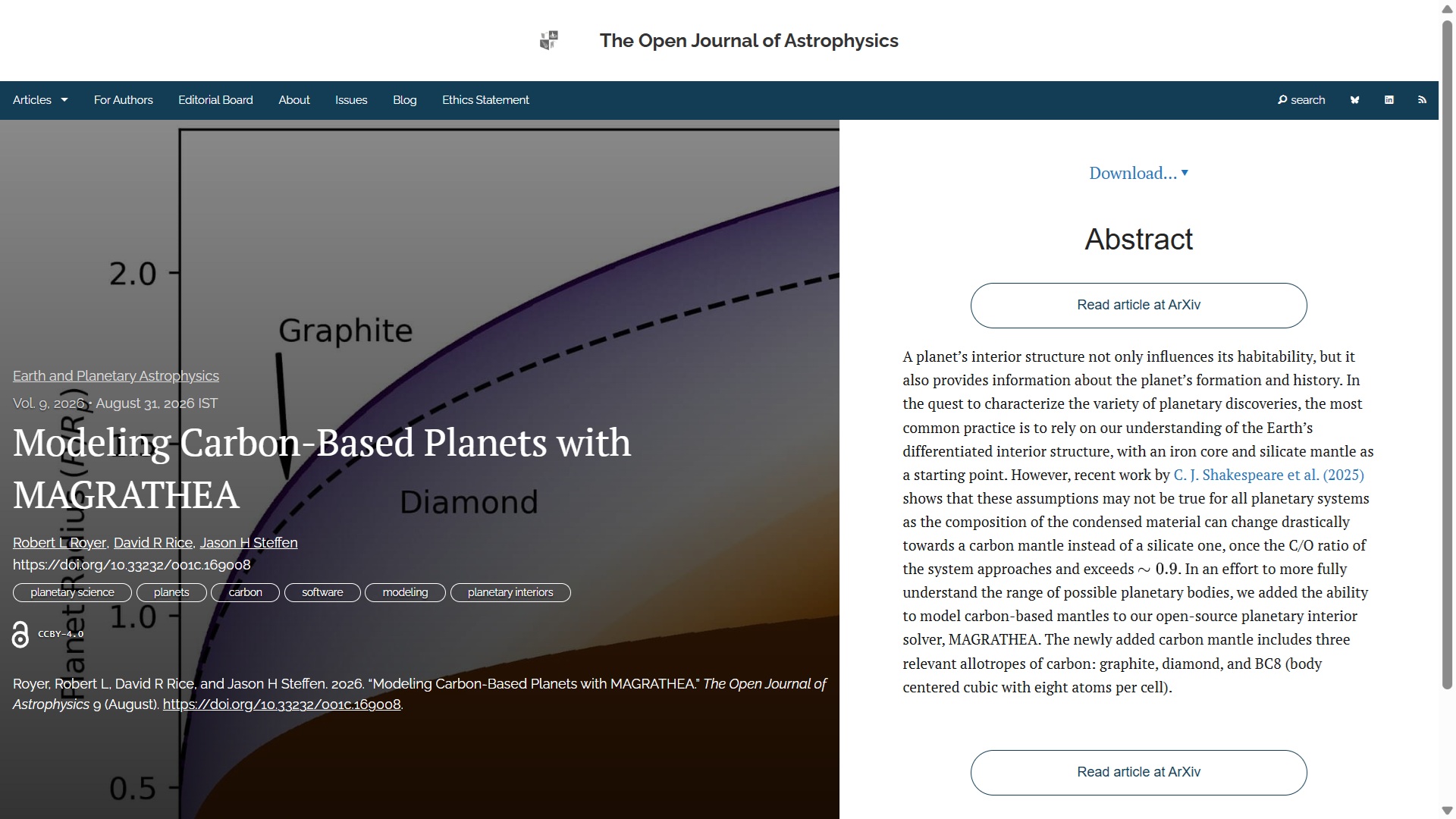
The first paper this week was published on Monday 31st August 2026 in the folder Earth and Planetary Astrophysics: “Modeling Carbon-Based Planets with MAGRATHEA” by Robert L Royer (U. Nevada, USA), David R Rice (U. Wisconsin-Madison, USA) and Jason H Steffen (U. Nevada, USA). This describes a modification of the planetary interior solver MAGRATHEA to include Carbon-based mantles to enable it to understand more fully the range of possible planet structures.
The overlay is here:
You can find the officially accepted version on arXiv here and the announcement on Fediverse here:
New Publication at the Open Journal of Astrophysics: "Modeling Carbon-Based Planets with MAGRATHEA" by Robert L Royer (U. Nevada, USA), David R Rice (U. Wisconsin-Madison, USA) and Jason H Steffen (U. Nevada, USA)
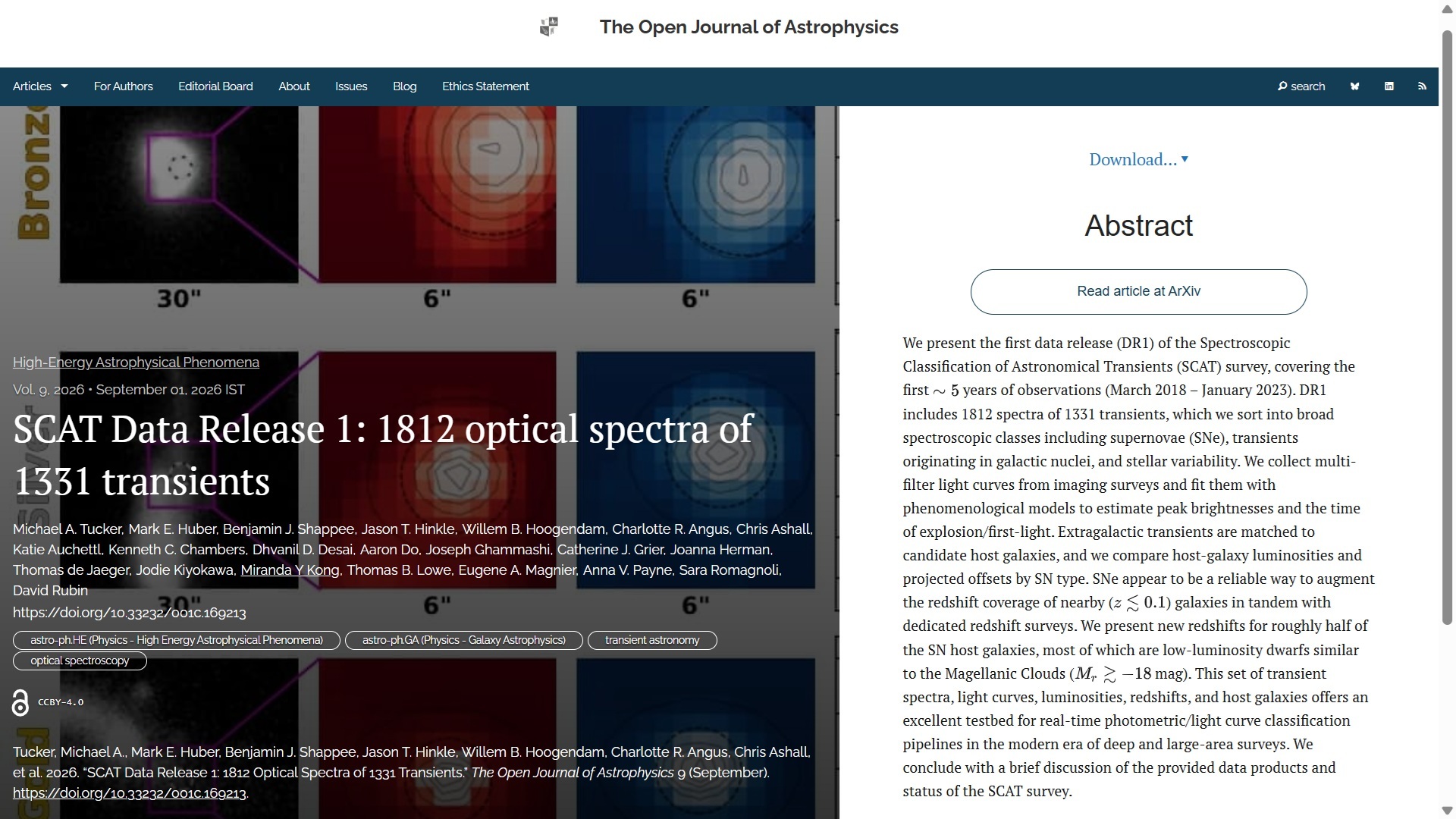
The second paper for this week, published on Tuesday 1st September in the folder High-Energy Astrophysical Phenomena is “SCAT Data Release 1: 1812 optical spectra of 1331 transients” by Michael A Tucker (Ohio State University, USA) and 21 others from around the world. This is the first data release of the Spectroscopic Classification of Astronomical Transients survey includes 1812 spectra of 1331 transients, offering valuable insights for photometric/light curve classification pipelines.
The overlay looks like this:
The official version of the paper can be found on arXiv here and the Fediverse announcement here:
New Publication at the Open Journal of Astrophysics: "SCAT Data Release 1: 1812 optical spectra of 1331 transients" by Michael A Tucker (Ohio State University, USA) and 21 others from around the world.
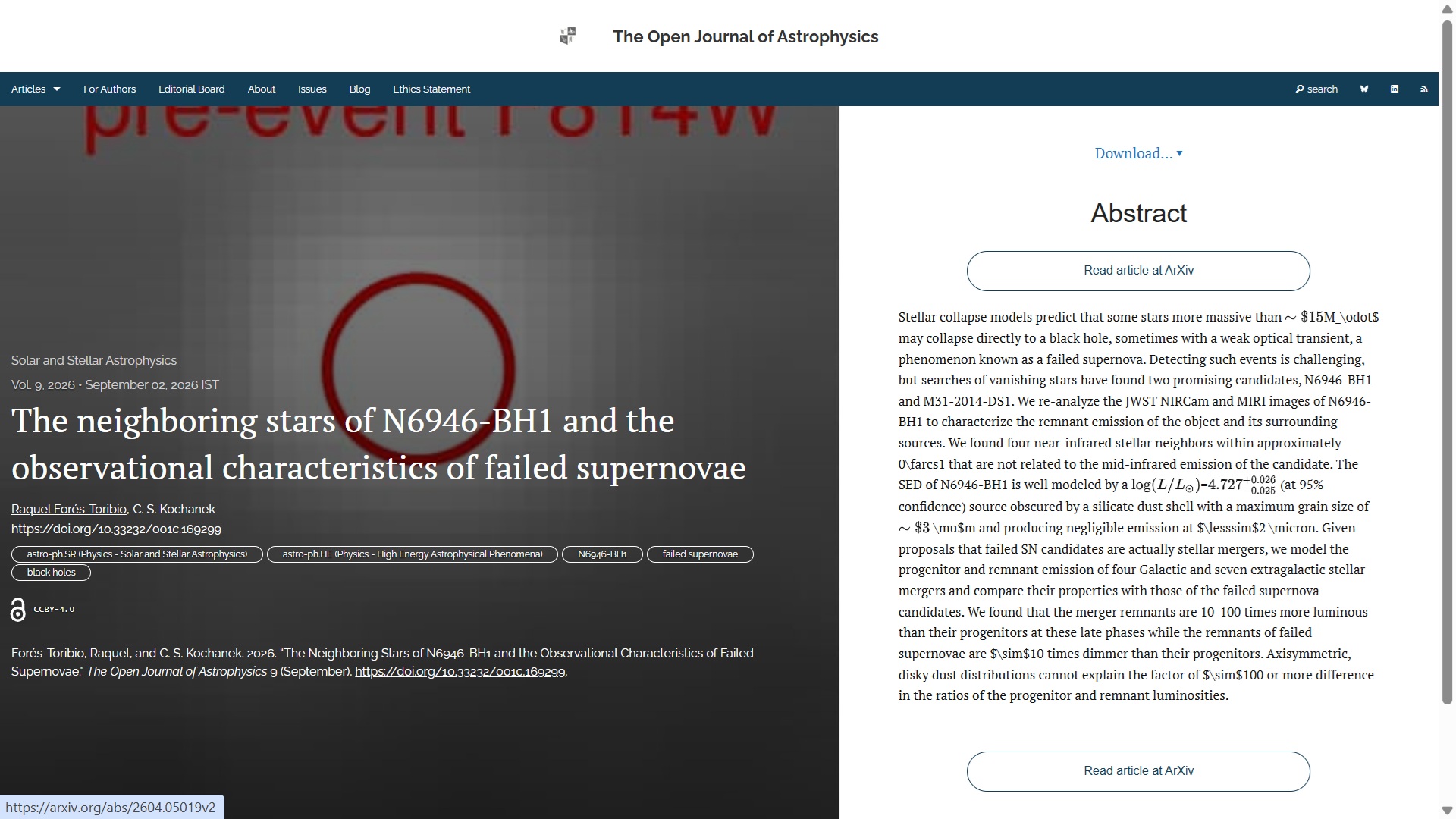
The third paper of the week is “The neighboring stars of N6946-BH1 and the observational characteristics of failed supernovae” by Raquel Forés-Toribio and C. S. Kochanek (Ohio State University, USA). This study, published on Wednesday 2nd September 2026 in the folder Solar and Stellar Astrophysics, re-analyzes images of potential failed supernova N6946-BH1, finding four unrelated near-infrared neighbors. It also compares the luminosity of failed supernova remnants to stellar merger remnants, noting significant differences.
The overlay is here:
The official version of the paper can be found on arXiv here and the Fediverse announcement here:
New Publication at the Open Journal of Astrophysics: "The neighboring stars of N6946-BH1 and the observational characteristics of failed supernovae" by Raquel Forés-Toribio and C. S. Kochanek (Ohio State University, USA)
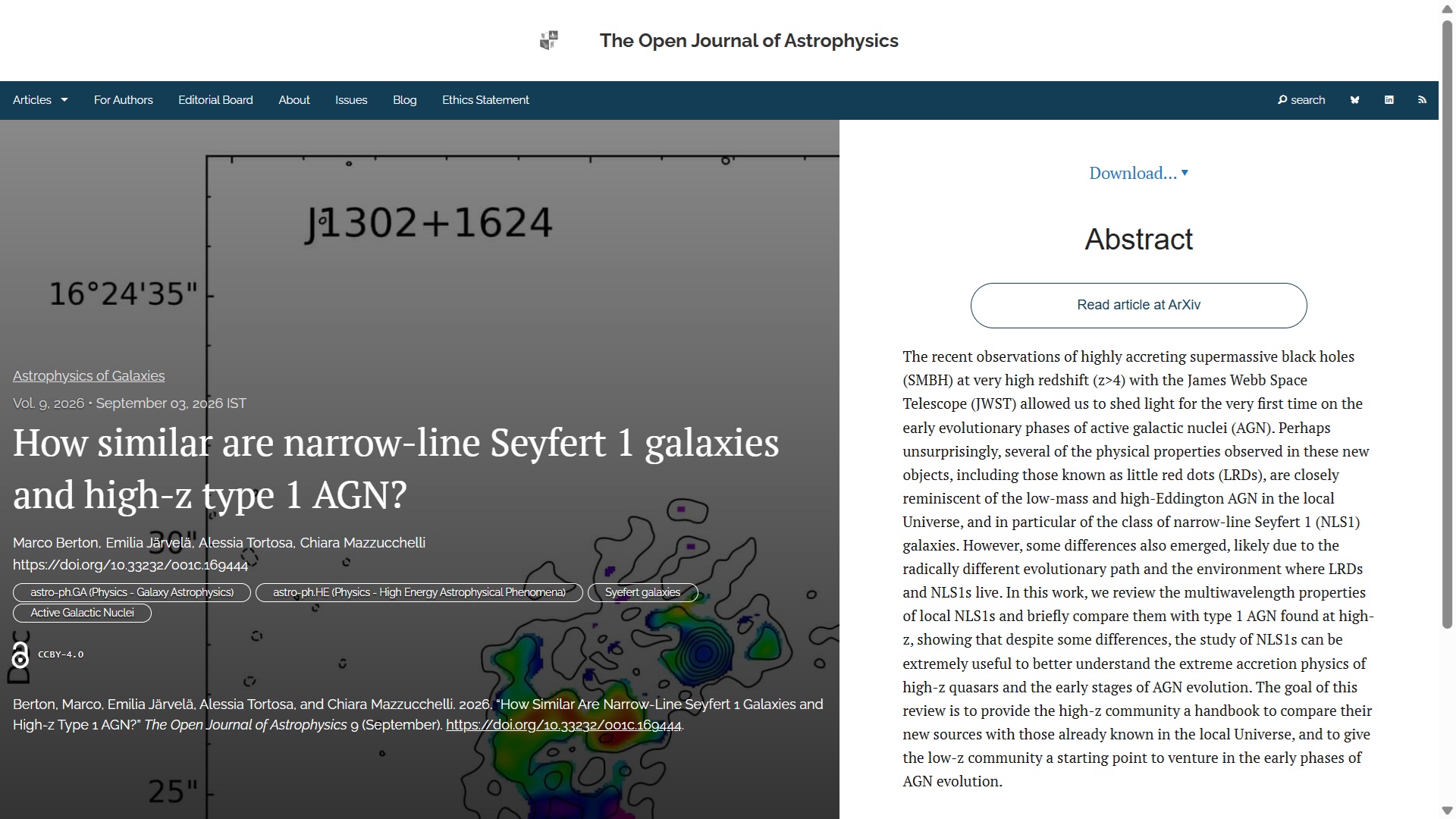
The fourth paper of the week is “How similar are narrow-line Seyfert 1 galaxies and high-z type 1 AGN?” by Marco Berton (ESO, Chile), Emilia Järvelä (Texas Tech. U., USA), Alessia Tortosa (INAF – Osservatorio Astronomico di Roma, Italy) and Chiara Mazzucchelli (Universidad Diego Portales, Chile). This was published on Thursday 3rd September 2026 in the folder Astrophysics of Galaxies. This paper reviews the properties of local narrow-line Seyfert 1 galaxies and compares them with high-redshift active galactic nuclei, aiding understanding of early black hole evolution.
The overlay is here:
The officially-accepted version of the paper can be found on arXiv here and the Fediverse announcement here:
New Publication at the Open Journal of Astrophysics: "How similar are narrow-line Seyfert 1 galaxies and high-z type 1 AGN?" by Marco Berton (ESO, Chile), Emilia Järvelä (Texas Tech. U., USA), Alessia Tortosa (INAF – Osservatorio Astronomico di Roma, Italy) and Chiara Mazzucchelli (Universidad Diego Portales, Chile)
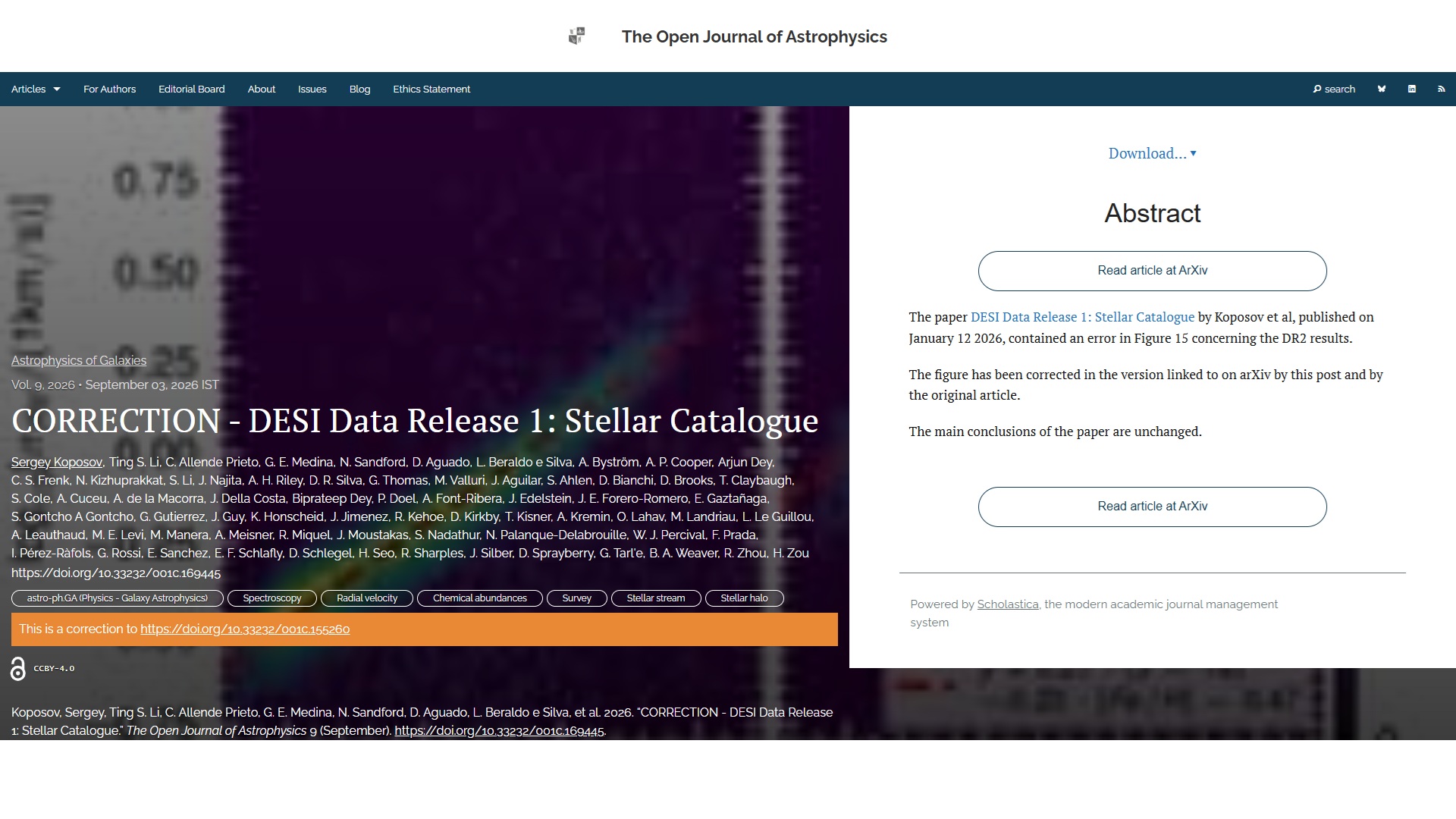
CORRECTION issued at the Open Journal of Astrophysics: "CORRECTION – DESI Data Release 1: Stellar Catalogue" by Koposov et al. (2026) (DOI:10.33232/001c.155260)
In the past when we have had minor correctionsto make we have simply asked the authors to create a new version, then when it has been checked, to place it on arXiv with a comment on the correction made. We then change the overlay to point to the new version with a comment on the change. I was recently advised, however, that best practice is to create a specific entry in Crossref for the corrected version, linked to the old one. Our Scholastica platform now has a mechanism to do this so from now on we will adopt this approach.
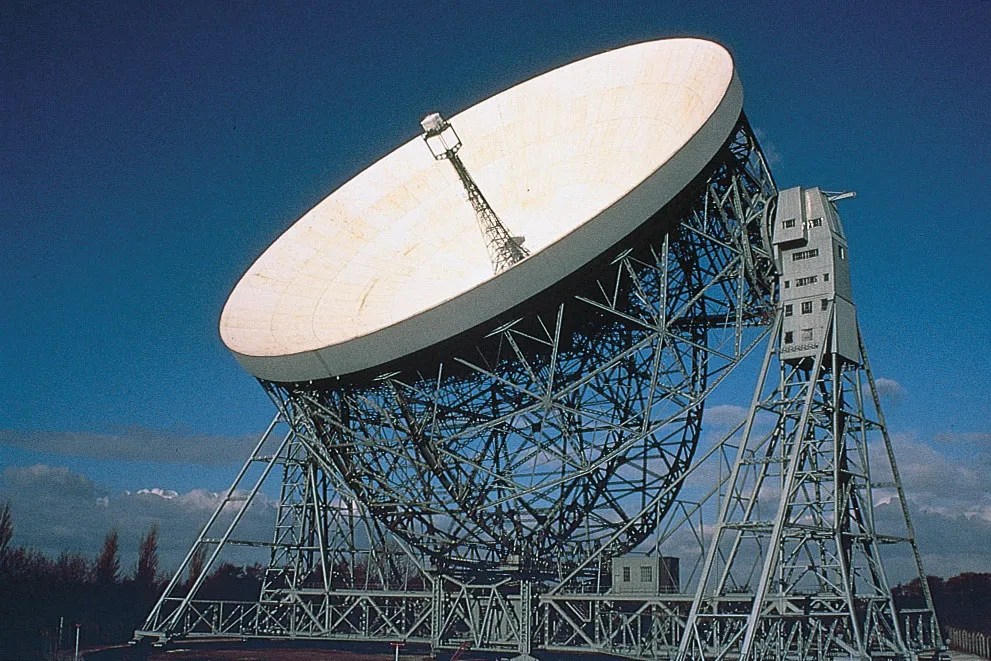
The last time STFC had a financial crisis was in 2009 and e-Merlin might well have been cut then but survived thanks to political intervention at the highest level. I suppose that could happen again, but I wouldn’t bet on it.
It looks like it has indeed happened again. The exact quote from Andy Burnham is:
There must be a way to save Jodrell Bank, and I give a commitment today, at this despatch box, we will find it.
That sounds like an unequivocal commitment, but it raises quite a few questions. One of these is that STFC was actually planning to cut funding to the e-MERLIN project and it is by no means clear that the £2.8 million needed for e-MERLIN will actually be reinstated in the STFC budget. It may transpire that Jodrell Bank Observatory emerges as more of a heritage site than a world-class research facility, which is what it will be if e-MERLIN disappears.
And if £2.8M is found to keep e-MERLIN going without changing the overall STFC budget, then the axe will just fall elsewhere in STFC. Jodrell Bank is a special site with special arguments for keeping it open, but other targets can no doubt be found that are equally excellent from a scientific point of view, but can’t mobilize political forces to mount such a strong defence. This is no way to perform a scientific prioritization exercise. In any case it is important to remember that there are cuts and cancellations elsewhere too; see here for a full list.
I think that there needs to be a complete review of funding across all the UKRI agencies. It is deeply unfair that physics and astronomy have to bear the brunt of cost overruns at facilities which are largely used by researchers in other scientific areas. Surely their funding councils should contribute. I can accept that belts might need to be tightened, but that shouldn’t just apply to STFC.
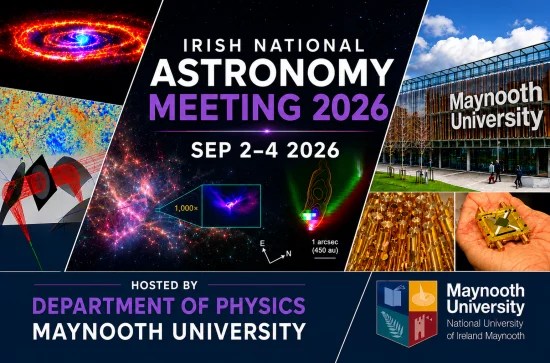
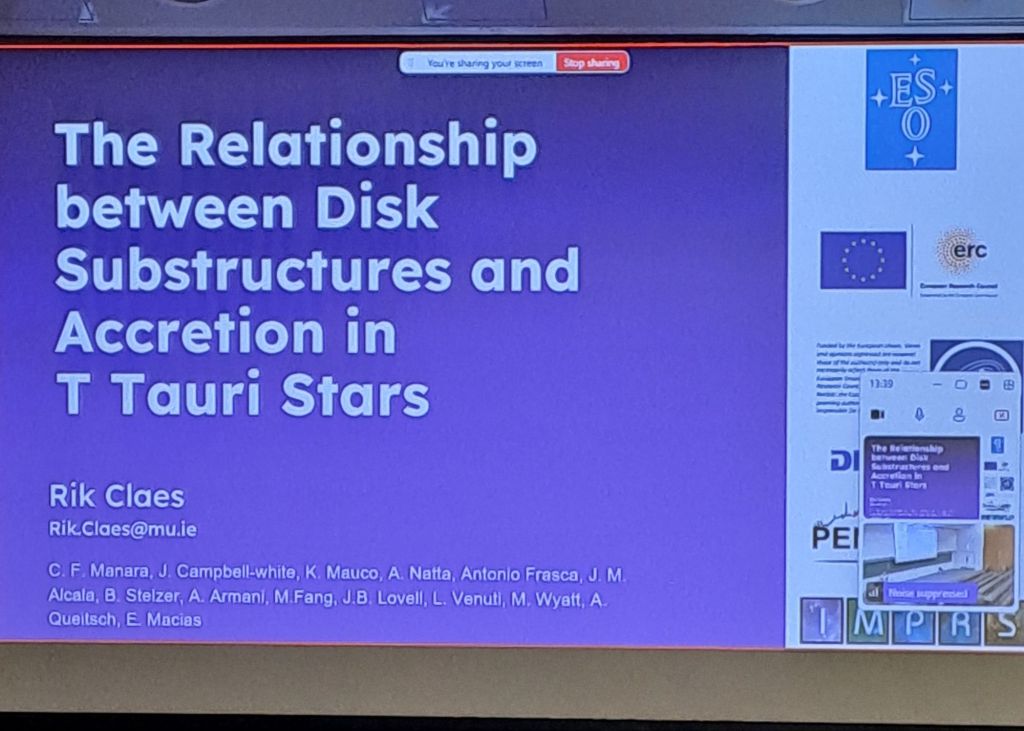
Today’s the start of this year’s Irish National Astronomy Meeting (INAM), which is being held in Maynooth. There’ll be a series of talks over the next three days covering all areas of astronomy. I’ll be chairing a session tomorrow but will generally popping in and out because I have various other commitments that clash with some of the sessions, but I’ll post updates whenever I can.
To start with, though, let me welcome all the participants who are arriving this morning!
One of the candidates for the dark matter that seems to pervade the cosmos is a Weakly Interacting Massive Particle (WIMP, for short). Such particles are hypothetical but, if they exist they could have been produced in large numbers in the early Universe. Among the possible WIMPs are supersymmetric particles, but there are alternative candidates. Whatever their nature it is possible that they could be directed directly in collisions with regular matter but, because they are weakly interacting, the cross-section for such events is low and potentially masked by background events caused by radioactive decays. So far these experiments have drawn a collective blank (and a number of false alarms).
One experiment trying to detect dark matter directly is LUX-ZEPLIN (LZ for short) which is based at the Sanford Underground Research Facility in South Dakota in the USA but is a collaboration of 30 institutions worldwide, including the the UK, Portugal and South Korea as well as the USA. This experiment tries to detect WIMPs using an ultra-sensitive detector made of 7 tonnes of liquid xenon to hunt for signals of their interactions with atomic nuclei.
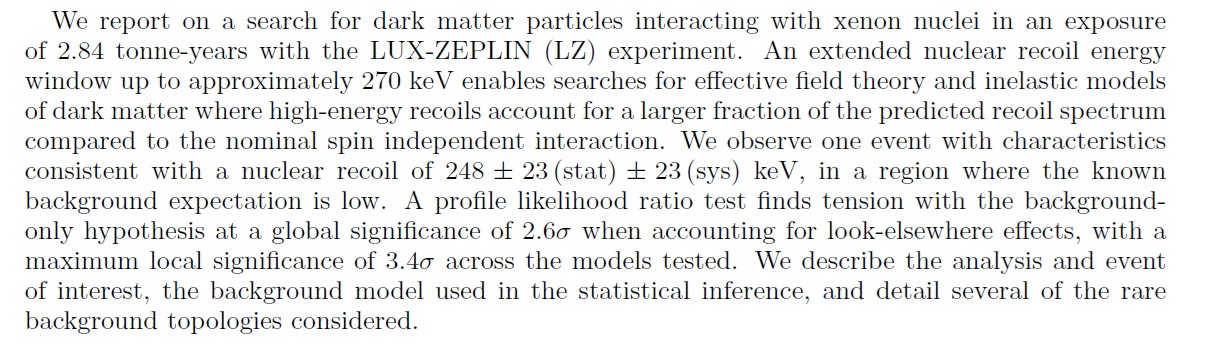
Today there was a potentially exciting announcement that LZ may have seen a WIMP, in a preprint with the following abstract:
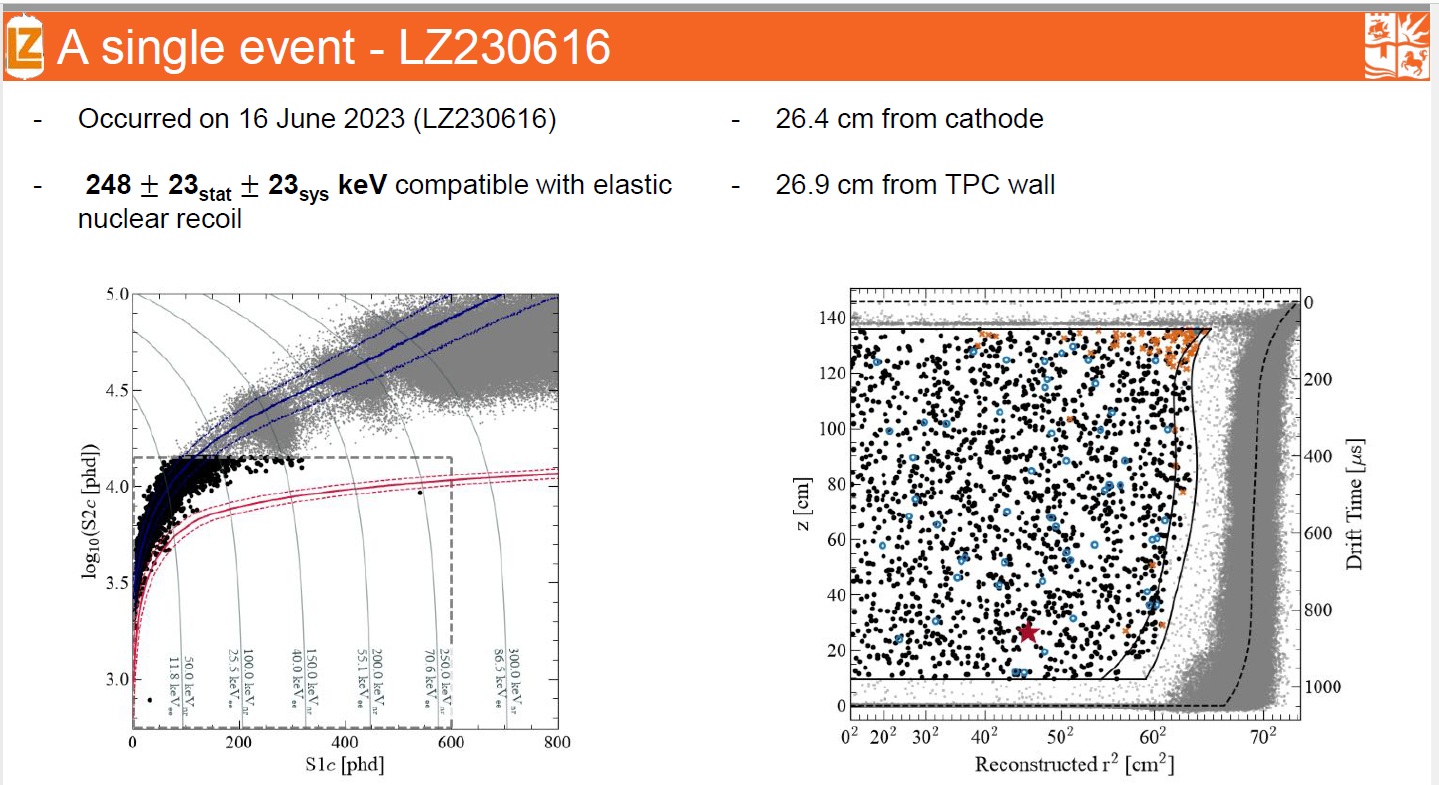
There is also a scientific presentation by Sam Eriksen from which I have extracted the crucial figure(s):
The event causing the excitement was detected over three years ago, on 16th June 2023. You can see it as the little black dot towards the upper right of the dashed square in the left hand panel. The LZ signal does appear unlikely to have been generated by known background events, but that does not necessarily mean that it is likely to be WIMP. The statistical significance quoted is not sufficiently high for it to be regarded as a clear detection; the implied odds are roughly the same as the odds that you, the reader, have a birthday on 16th June…
I mentioned a couple of weeks ago that the Irish Federation of University Teachers (IFUT), of which I am a member, was planning a ballot on industrial action. The reason for the ballot is that the Public Service Agreement, covering pay and working conditions for all public service workers in Ireland, lapsed at the end of June this year (2026) and there is currently no pay settlement for the second half of this year or next year. Salaries have fallen behind inflation under the existing Agreement and some important commitment have not yet been implemented. The Government does not give the impression of being serious about negotiations on these matters.
The ballot opened today, September 1st 2026, and as soon as the link for the electronic vote arrived in my inbox I clicked it and voted ‘YES’, i.e. in favour of industrial action.
Similar ballots are taking place across all the public service unions. Yesterday, it was revealed that Ireland’s largest public sector union, SIPTU, has voted 98% in favour of industrial action. Today it was announced that 96 per cent of the union Fórsa had voted similarly. I hope the IFUT result – and results from the other relevant unions – is as strong.
If it comes to industrial action – which I hope it does not – then such action will be coordinated across the public sector.
P.S. Solidarity to former colleagues at Nottingham University as they take industrial action over job losses resulting from its proposed “restructuring”.
Today has been a Bank Holiday in England and Wales but not here in Ireland; we had our August Bank Holiday at the start of the month of August. In fact this week sees school students of various ages returning to the classroom. That reminded me of this, from a while back:
I had three hours of telecons this afternoon which I decided to do at home, so I left work a little earlier than usual. On my way home I passed a group of boys who were obviously going home after their first day back at school. Their uniforms look very new and in pristine condition. I bet that won’t last!
Three weeks from today, on September 21st, we resume lectures at Maynooth University. We don’t yet know how many students will be taking our various modules but I checked just now and noticed that one or two postgraduate and exchange students have already started enrolling…
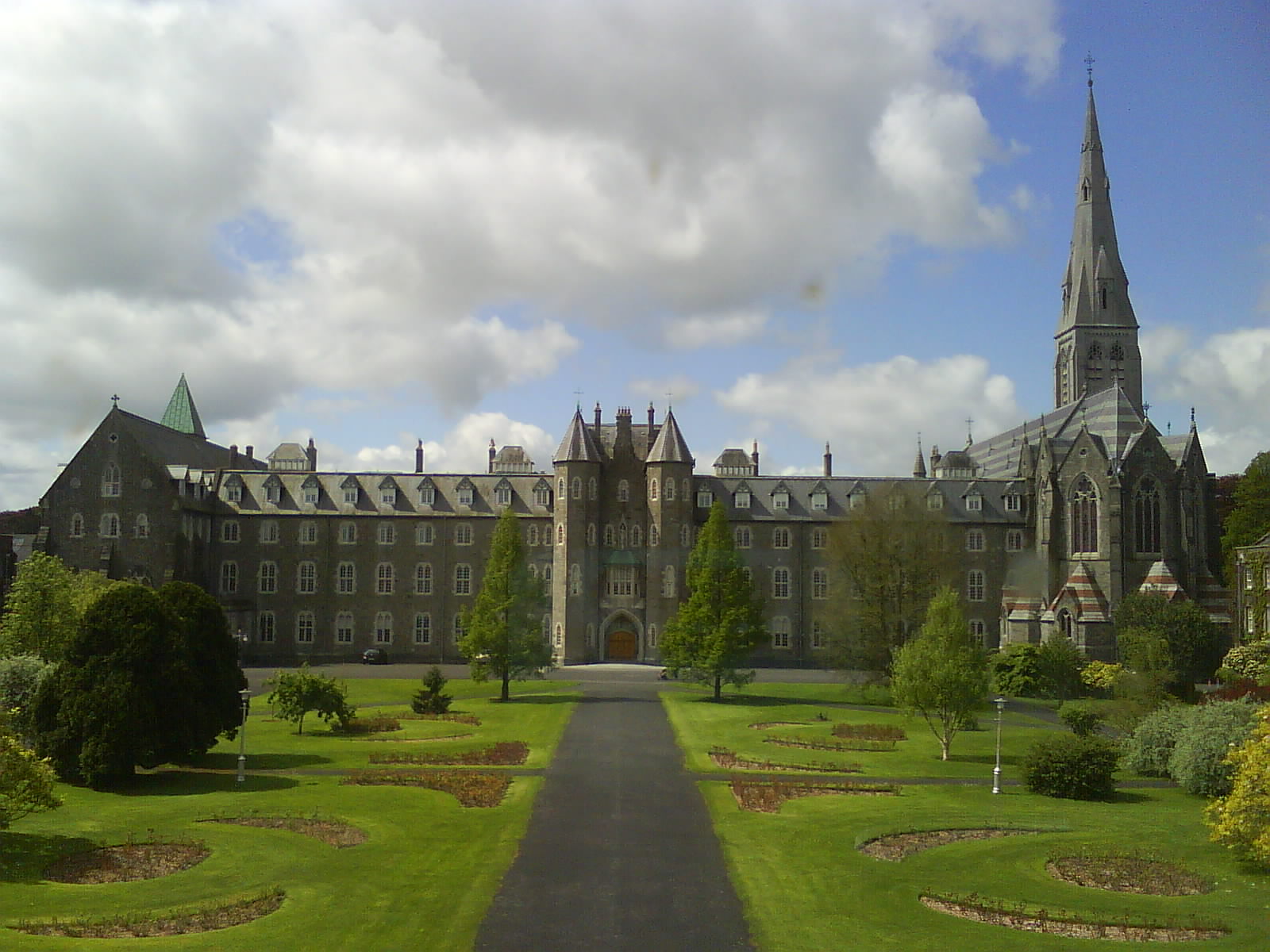
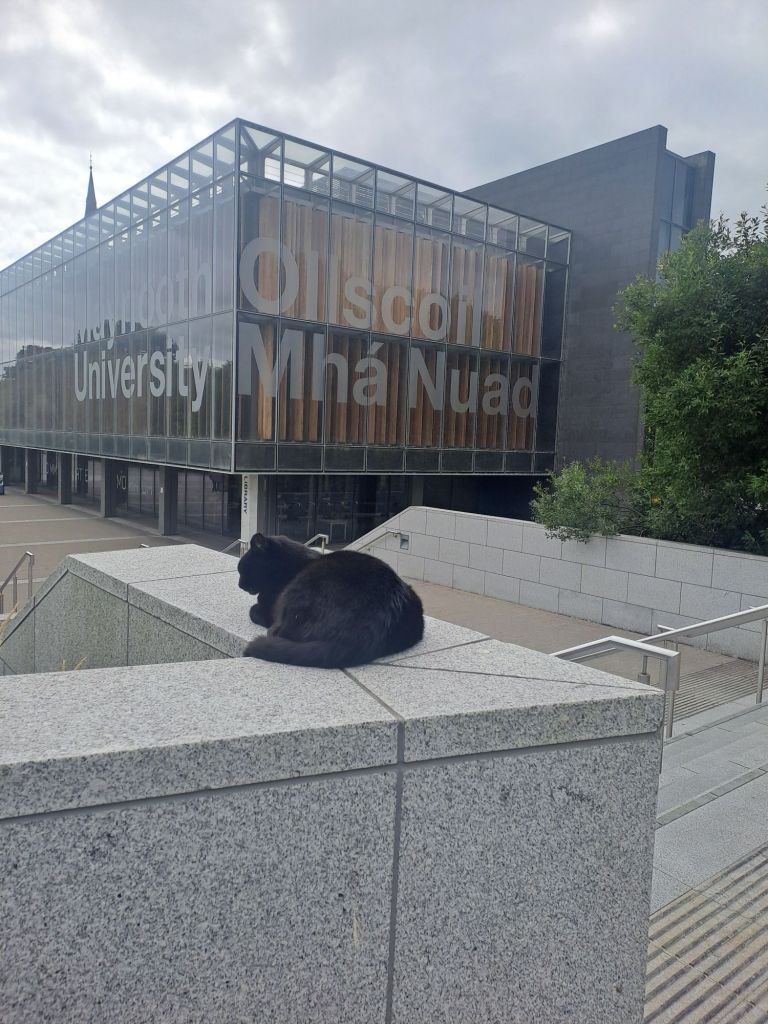
I saw Maynooth University Library Cat in a different location today so I thought I’d take the opportunity to share a picture of him with his Library in view.
The views presented here are personal and not necessarily those of my employer (or anyone else for that matter).
Feel free to comment on any of the posts on this blog but comments may be moderated; anonymous comments and any considered by me to be vexatious and/or abusive and/or defamatory will not be accepted. I do not necessarily endorse, support, sanction, encourage, verify or agree with the opinions or statements of any information or other content in the comments on this site and do not in any way guarantee their accuracy or reliability.