The Vital Question by Nick Lane

Posted in Biographical, The Universe and Stuff with tags , , , on August 5, 2024 by telescoper

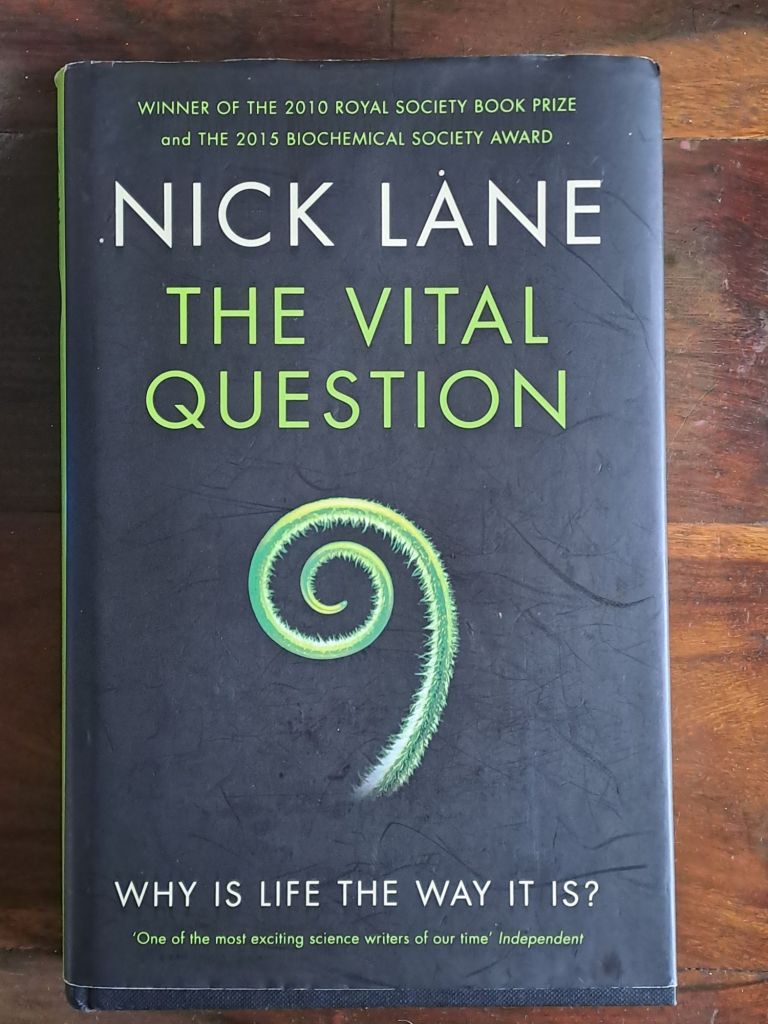
I’ve managed to cross another one off the list of books I’ve had for ages but never read, in the form of biochemist Nick Lane‘s The Vital Question I bought this book several years ago and have no idea why I took so long to get around to it. Given how quickly things are moving in the biosciences these days, it may even be a bit out of date now, but as far as I’m concerned it’s better late than never.

I haven’t studied biology since O-level (1979) but did chemistry as one of four subjects in the first year year of Natural Sciences at Cambridge and I remember some organic chemistry. I wish I had done Biology of Cells then, though, not because I would have carried on with it but because it’s much more interesting than the subject I did take, Crystalline Materials. Probably much of what I would have learnt in 1982-3 is out of date now.

The Vital Question doesn’t ask a single big question but tackles a number of interrelated questions that together comprise a big mystery in the origin of life, basically the apparently sudden appearance of eukaryotic life (i.e. organisms with complex cells, including plants and animals) as distinct from simpler the forms, archaea and bacteria. Among the fascinating issues are how eukaryotes evolved, why there is no missing link, and why eukaryotic cells are all built on a similar model, what made reproductive sex the way it is, and why in the midst of life there has to be death.

One of the great advances in biosciences since the time I didn’t study it is a revolution in the understanding and practical application of genetics, especially through fast DNA sequencing, not only in biology but also in other fields such as medicine, archaeology and forensic science. One of the valuable points that Lane makes is that the success of genetics led to an emphasis on the role of information – because that’s what genes represent – to the detriment of other essential factors in living cells, especially energy. The book points to the relationship, familiar to physicists, that information relates to entropy, but makes it clear that entropy on its own is not sufficient to understand the thermodynamics of, e.g., respiration and reproduction.

This is a recurrent theme in the history of science, actually, that the success of one particular way of looking at phenomenon often seems to convince people that it provides the complete picture, when some subsequent study demonstrates that usually turns out not to be the case. None of this is to argue that genes are unimportant. They undoubtedly are, but so are other factors including reaction kinetics and environment.

Anyway, to address this big question, Lane gives us a tour of the processes involved at a significant level of complexity but the book is so well-written that it’s actually a bit of a page-turner. As I explained at the beginning I haven’t studies any biology for over 40 years so I struggled at first with some of the technical words, but there is a full glossary to help. The rather dreary pictures are less helpful, but altogether is a superb introduction.

One of the aspects of this book I enjoyed greatly is the number of digressions. That might put some people off, but I thought it helped to paint a true picture of the richness of life in all its forms as well the constraints imposed on it. I didn’t know for example that while most mammals (including humans) have X or Y chromosomes, birds are different: they have W and Z (note to physicists: not to be confused with the gauge bosons). Moreover, while the reproductive sex usually indicated by XX is female (homomorphic) and XY is male (heteromorphic), the opposite is true for birds and some reptiles: females are heteromorphic (ZW) and males are homomorphic (ZZ). Why this difference arose I have no idea, but Lane makes some interesting observations about how it may be behind how some male birds develop exaggerated pigmentation and plumage.

Another question that struck me reading this book is why the human genome is so small. Or rather, why so many other genomes are much bigger. For reasons I described in a post a few years ago, I actually have a CD with my own genome on it. Come to think of it, I no longer have a CD drive so have no way of reading it. Anyway, the human comprises about 3 billion base pairs. Some apparently much simpler organisms have genomes much larger than that. We humans are much simpler than we tend to think! Why is that?

Obviously it has been my turn to digress…

I thoroughly recommend this book for a number of reasons, including the excellent explanations of biochemical processes and the fact that it’s written with such obvious enthusiasm and desire to communicated. Above all, though, Lane does what a scientist should do, i.e. he’s honest about the huge gaps in our knowledge. He doesn’t pretend to answer all the questions he asks, but demonstrates the importance of tackling the big issues head on and acknowledging what is known, what is unknown, and what is speculation. That’s a lesson for all science communicators!

Lá Saoire i mí Lúnasa

Posted in Biographical, Education, mathematics, Maynooth with tags , , , on August 5, 2024 by telescoper

Today, Monday 5th August 2024, being the first Monday in August, is a Bank Holiday in Ireland. This holiday was created by the Bank Holiday Act of 1871 when Ireland was under British rule. While the August Bank holiday was subsequently moved to the end of August in England and Wales, it has remained at the start of August in Ireland. Today is also a Bank Holiday in Scotland, though the Scots have the best of both worlds and have a holiday at the end of August too.

The first day of August marks the old pagan festival of Lughnasadh, named after the God Lugh, on which is celebrated the beginning of the harvest season. This coincides with the English Lammas Day one of many Christian festivals with pagan origins. Traditionally this marks the start of the harvest season and is celebrated accordingly, with rites involving the first fruit and bread baked from flour obtained from the first corn. It is also one of the cross-quarter days, lying roughly half-way between the Summer Solstice and the Autumnal Equinox (in the Northern Hemisphere).

It seems to be a tradition in Maynooth that the Bank Holidays in May and August are are adjacent to examinations. This year they start on Wednesday (7th August). I am, however, still on sabbatical so I don’t have any correcting duties. That doesn’t mean I can’t wish all the students taking repeat examinations all the best in their endeavours.

This month is the last of my sabbatical. I officially return to normal duties on 1st September, but that is a Sunday so I won’t return to the office until Monday 2nd September. That is if I have an office. There’s a lot of reorganization going on and currently I don’t know where I’ll be based. At least I know what I’ll be teaching in Semester 1 though: a fourth-year Mathematical physics course on Differential Equations and Complex Analysis and a second-year Engineering Mathematics course. These are not what I would have chosen if I had a free hand (I’d rather teach physics than mathematical methods) but I’ve had it excessively easy for the last year so can’t complain. With a bit of luck I might get a project student or two as well, if the students haven’t forgotten who I am!

Imane Khelif: a Manufactured Scandal

Posted in Politics, Sport with tags , , , , , , on August 4, 2024 by telescoper

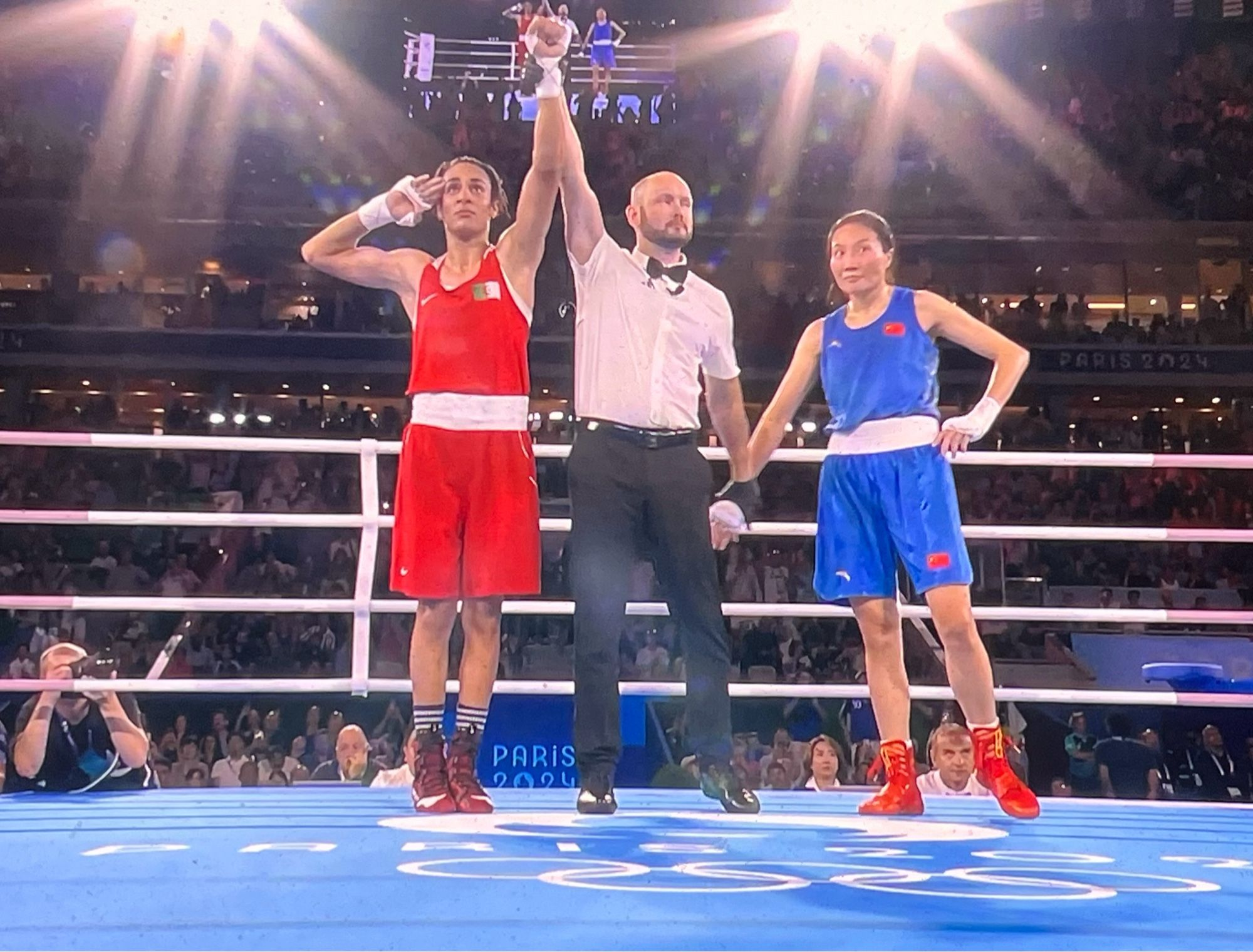
Last week’s news from the 2024 Olympics was dominated by the story of Algerian boxer Imane Khelif who defeated her Italian opponent Angela Carini in the Women’s 66kg (Welterweight) division. Carini quit after 46 seconds saying that she was hit so hard that it hurt. It is surprising that she would even enter the Hitting Each Other In The Face event if she were going to complain that her opponent hit her in the face, Anyway, Khelife subsequently won her next bout against Hungarian Luca Hamori to proceed to the semi-finals and is thereby guaranteed a medal. I hope she wins the Gold for all she’s had to put up, not only for the past few days. She seems to have had a tough life generally.

Khelif’s deserved success has ignited what has been called a “gender row”, based on the fact that she and Taiwanese boxer Lin Yu-ting (who is also competing in the 2024 Olympics, in the 57kg category) were disqualified from the IBA World Championships allegedly for failing “gender eligibility tests”. This decision was made suddenly by the Secretary General of the IBA without any due process and the only documentation available is a message on the dodgy social media platform Telegram. The IOC has commented on these so-called “tests”, see here. Here’s an excerpt:

Those tests are not legitimate tests. The tests themselves, the process of the tests, the ad hoc nature of the tests are not legitimate…

There is a thorough piece by Reuters, which links to the IBA’s own statements here (PDF).

You can draw your own inferences about the motivation for the deliberate manufacture of a scandal by the International Boxing Association, but my own view is that it reeks of sour grapes: the IBA, which has been mired in corruption scandals for decades, is no longer recognized by the International Olympic Committee. I think this whole row was deliberately manufactured.

Such are the levels of ignorance and prejudice about anything to do with gender these days that the usual bigots lined up to condemn Khelif and the IOC on the basis of no evidence whatsoever. Widely circulated claims that Khelif has XY chromosomes and/or high levels of testosterone are neither documented nor verified, but that doesn’t seem to matter to the haters.

I’ve seen posts and comments all over the place asserting that women don’t produce testosterone at all. They do. Men produce oestrogen, too. In both cases it’s a question of quantity. Some women have higher testosterone levels than others. So what? If that makes them better at boxing then so be it.

(I even saw a photograph on social media showing that Khelif wears a groin guard under her boxing shorts. Indeed she does: that’s actually mandatory in both men’s and women’s boxing. The person who posted the image however said that wearing a groin guard is something only men do. Clearly he is unaware that a women’s private parts are also sensitive. I guess he’s never had the opportunity to find out.)

It has been argued that “biological factors” have given Imane Khelif an unfair intrinsic biological advantage over competitors. If that were the case then you would expect her to have been an outstanding boxer from the outset. She wasn’t. In fact she had a poor start to her boxing career, losing her first two competitive bouts; she has lost to other women 9 times altogether. Hardly the performance of some kind of superhuman monster as she is being portrayed. She has improved because she has worked hard on her fitness and technique. She is quite tall for her weight division – 1.78 m (5 ft 10 in) –  and has learnt to make use of her long reach, but how is that unfair? I think she might well struggle against an opponent who can get inside and fight at close range. Tall and rangy versus short and powerful is a contrast you often find in these mid-range weight divisions, which is one of the things that make such contests so interesting.

In any case, don’t all athletes have some sort of intrinsic advantage over the rest of us? Michael Phelps certainly did. People who excel at sports often have extreme physical characteristics, whether physical size, muscular strength, cardio-vascular endurance or whatever. Usain Bolt certainly had the advantage of being born Usain Bolt rather than someone else. Which is not to say that he didn’t have to work on making the most of his physique.

There being no documentary evidence to support their claims that Khelif is a man, others have resorted to crude stereotypes based on her looks. I’ve seen the same sort of comments about black female athletes who are accused of looking like men because they don’t conform to white ideals of femininity. A summary of this type of argument is “women should be banned from boxing if they display masculine characteristics, such as being good at boxing”.

None of this alters the fact that Imane Khelif is a woman and indeed a woman who deserves to be celebrated not only her success in her chosen sport, but also for the dignified way she has braved the abuse she has received. I hope she wins Gold and sends the haters into a state of apoplexy.

UPDATE: Imane Khelif did indeed win Olympic Gold by a unanimous decision. Congratulations to her!

 J. K. Rowling is 59.

Open Access Updates & Announcements

Posted in Open Access with tags , , , on August 3, 2024 by telescoper

When I wrote last week’s update on papers published at the Open Journal of Astrophysics, I was a little surprised that our publishing activity had not tailed off because of the summer vacations. Well, it has now because we haven’t publish any papers this week! Rather than not post an update at all, however, I thought I’d point out a few interesting things that have happened in the world of open access.

First. I draw your attention to an article in C&EN (Chemical & Engineering News) reflecting on the fact that the Gates Foundation (one of the largest research charities in the world) announced in March 2024 that, starting from Jan. 1, 2025, it would no longer cover publishing costs. I actually wrote about this decision here. The article is largely about the threat this poses to the Gold Open Access model, which in my opinion thoroughly deserves to be threatened. It does, however, talk briefly about Diamond Open Access which commercial publishers don’t like as it removes – or should do – their source of profits:

Another alternative model is diamond OA, in which all research papers and their associated peer-reviewed reports are published without fees for the author or the reader and are also freely available to read and reuse. 

It goes on to say:

Under diamond OA, publishers are no longer gatekeepers of research. Instead, they become service providers that handle manuscript submissions, typesetting, and copyediting. This is in contrast to the current publishing system, in which the publisher controls everything from the copyright to the production process.

I don’t really agree with even the limited role of “service providers” mentioned here, as much of what that role entails just involves a decent reviewing platform. Elsewhere the article says that moving to Diamond OA would entail a significant cost. That may be but, as I’ve said over and over again, the actual cost of online publishing is low compared to the level of profit extracted by commercial publishers. The cost to academia of moving to Diamond OA would be much less than not moving to Diamond OA.

The second item I’d like to draw your attention is called Choosing a publisher? It’s not all about the impact factor and is by Antigoni Messaritaki, a senior publisher at IOP Publishing,  When I saw the title I thought that it might be about the uselessness of Journal Impact Factors and a commitment by IOP Publishing to stop using them. Sadly it’s nothing of the sort. It tries to entice authors to look beyond journal impact factors when choosing a publisher, pushing Open Access as an important factor to consider. It admits that APCs are expensive, but never even mentions Diamond OA. It’s an entirely self-serving piece. I find the IOP’s stance on publishing, and the disingenuous way they try to excuse their own profiteering, unethical and unacceptable. That’s why I resigned my fellowship of the IOP.

Last, and by all means least, I should draw your attention that the 32nd General Assembly of the International Astronomical Union takes place next week in Cape Town. I’m not attending in person – I’ve done enough travelling this year! – but I have accepted an invitation to give a remote talk at a side event called Open Access Encounters on Wednesday 7th August:

Swan Back

Posted in Biographical, Maynooth with tags , , on August 2, 2024 by telescoper

As we enter a Bank Holiday long weekend here in Maynooth I thought I’d pass on a bit of news and a clarification about the swan(s). Some time ago I described the sad events that led to the death of one of the pair of swans that had nested on the Royal Canal for many years, along with all their cygnets. In that post I explained that one of the swans had died and the other had been taken away by the  Kildare Wildlife Rescue (KWR) team. All I know is that both seemed to have been suffering from some sort of be “infection” which may or may not be the same thing that cause of death as the cygnets.

At the time I had been told that it was the female swan (the pen) that had died and the male that had been taken away to be treated. It turns out that this was the wrong way round: it was the male swan that had died and the female (the cob) that had been removed by Kildare Wildlife Rescue.

The good news, however, is that she has recovered and has now been returned to the Canal:

Picture Credit: Caroline Connolly of Kildare Wildlife Rescue

Of course she’s on her own now, having lost her partner and all her cygnets. I don’t know if she’ll find another and start breeding again. I do hope so. A lone juvenile male has been spotted on the canal recently. Might they get together?

Euclid Galaxy Zoo

Posted in Euclid, The Universe and Stuff with tags , , , , , , on August 1, 2024 by telescoper

Today sees the launch of a new initiative between Galaxy Zoo (part of the Zooniverse conglomerate) and the Euclid Consortium which I am delighted to be able to promote on this blog. What follows the graphic is the text of the announcement which is being promoted across social media today. I’ll start with a little factoid which might surprise you: already in November 2023, before science operations even began, Euclid had sent back to Earth more data than the Hubble Space Telescope has done in in its entire lifetime.

Thanks to a new Galaxy Zoo project launched today, you can help identify the shapes of thousands of galaxies in images taken by ESA’s Euclid space telescope. These classifications will help scientists answer questions about how the shapes of galaxies have changed over time, and what caused these changes and why. 

In its mission to map out the Universe, Euclid will image hundreds of thousands of distant galaxies. In November 2023 and May 2024, the world got its first glimpse at the quality of Euclid’s images, which included a variety of sources, from nearby nebulas to distant clusters of galaxies. In the background of each of these images are hundreds of thousands of distant galaxies. 

This square astronomical image shows thousands of galaxies across the black expanse of space. The closest thousand or so galaxies belong to the Perseus Cluster.

For the next six years, the spacecraft is expected to send around 100 GB of data back to Earth every day. That’s a lot of data, and labelling that through human effort alone is incredibly difficult.  

That’s why ESA and Euclid consortium scientists have partnered with Galaxy Zoo. This is a citizen science project on the Zooniverse platform, where members of the public can help classify the shapes of galaxies.  

Euclid will release its first catalogues of data to the scientific community starting in 2025, but in the meantime any volunteer on the Galaxy Zoo project can have a glimpse at previously unseen images from the telescope. 

You could be the first person to lay eyes on a galaxy 

The first set of data, which contains tens of thousands of galaxies selected from more than 800 000 images, has been made available on the platform, and is waiting for you to help classify them. 

If you partake in the project, you could be the first to lay eyes on Euclid’s latest images. Not only that, you could also be the first human ever to see the galaxy in the image.  

The Galaxy Zoo project was first launched in 2007, and asked members of the public to help classify the shapes of a million galaxies from images taken by the Sloan Digital Sky Survey. In the past 17 years, Galaxy Zoo has remained operational, with more than 400 000 people classifying the shapes of galaxies from other projects and telescopes, including the the NASA/ESA Hubble Space Telescope and the NASA/ESA/CSA James Webb Space Telescope.  

Humans and AI working together 

These classifications are not only useful for their immediate scientific potential, but also as a training set for Artificial Intelligence (AI) algorithms. Without being taught what to look for by humans, AI algorithms struggle to classify galaxies. But together, humans and AI can accurately classify limitless numbers of galaxies. 

At Zooniverse, the team has developed an AI algorithm called ZooBot, which will sift through the Euclid images first and label the ‘easier ones’ of which a lot of examples already exist in previous galaxy surveys. When ZooBot is not confident on the classification of a galaxy, perhaps due to complex or faint structures, it will show it to users on Galaxy Zoo to get their human classifications, which will then help ZooBot to learn more.  

On the platform, volunteers will be presented with images of galaxies and will then be asked several questions, such as “Is the galaxy round?”, or “Are there signs of spiral arms?”. 

After being trained on these human classifications, ZooBot will be integrated in the Euclid catalogues to provide detailed classifications for hundreds of millions of galaxies, making it the largest scientific catalogue to date, and enabling groundbreaking new science.  

This project makes use of the ESA Datalabs digital platform to generate a large number of cutouts of galaxies imaged by Euclid. 

Thanks to a new Galaxy Zoo project launched today, you can help identify the shapes of thousands of galaxies in images taken by ESA’s Euclid space telescope. These classifications will help scientists answer questions about how the shapes of galaxies have changed over time, and what caused these changes and why. 

The first set of data, which contains tens of thousands of galaxies selected from more than 800 000 images, has been made available on the platform, and is waiting for you to help classify them.  

Examples of Euclid galaxies to classify are shown in this image.  

Euclid Galaxy Zoo galaxies to classify. Forty galaxies are shown against a black background. The galaxies are all different in shape, some look like spirals, some look barred, or smooth. Image credit: ESA/Euclid/Euclid Consortium/NASA, CC BY-SA 3.0 IGO or ESA Standard Licence 

About Euclid 

Euclid was launched in July 2023 and started its routine science observations on 14 February 2024. The goal of the mission is to reveal the hidden influence of dark matter and dark energy on the visible Universe. Over a period of six years, Euclid will observe the shapes, distances and motions of billions of galaxies out to 10 billion light-years.  

Euclid is a European mission, built and operated by ESA, with contributions from NASA. The Euclid Consortium – consisting of more than 2000 scientists from 300 institutes in 15 European countries, the USA, Canada and Japan – is responsible for providing the scientific instruments and scientific data analysis. ESA selected Thales Alenia Space as prime contractor for the construction of the satellite and its service module, with Airbus Defence and Space chosen to develop the payload module, including the telescope. NASA provided the detectors of the Near-Infrared Spectrometer and Photometer, NISP. Euclid is a medium-class mission in ESA’s Cosmic Vision Programme. 

Taighde Éireann

Posted in Maynooth, Open Access, Science Politics with tags , , , , , , , , , , on July 31, 2024 by telescoper

On 1st August 2024, i.e. tomorrow, a new funding organization comes into existence in Ireland, formed by the merger of SFI with the Irish Research Council. The new outfit is called Taighde ÉireannResearch Ireland and many of us working in Irish academia were optimistic that it might improve the funding environment in Ireland, especially with regard to basic research.

Taighde Éireann has not got off to a very promising start. In particular, the long-running saga of who would be Chief Executive Officer of the new organization does not inspire confidence. Professor Philip Nolan, former Director-General of Science Foundation Ireland was originally intended to take the helm, but then he was dismissed from his position at SFI which made the prospect of him taking over the new organization seem less likely. Indeed, more recently, it was announced that a new temporary CEO would be appointed “pending the recruitment of a new CEO on a permanent basis”.

Starting with a caretaker manager is far from ideal, although it probably just means that the interim CEO will just look after transferring activity from IRC and SFI to the new organization without actually changing much. I just hope that in the long run a person is appointed who actually understands research rather than a generic management type. Otherwise the only change that will actually happen will be purely administrative rather than the systemic overhaul of attitudes and culture that Ireland really needs. As an outsider, one way of reading the controversy of the CEO the current SFI establishment resisting any possibility of change.

From my own perspective, the fundamental problem is that research funding for fundamental science in Ireland is so limited as to be virtually non-existent by a matter of policy at Science Foundation Ireland, which basically only funds applied research. This is a short-sighted and damaging policy that is causing, among other things, a significant exodus of talented young researchers to opportunities elsewhere (especially in the EU).

I know there will be many competing calls for changes in practice for the new Council but I thought I would add a few suggestions that will probably be ignored but which I’ll make anyway.

  1. A funding stream should be set up to enable scientific exploitation of Ireland’s current memberships of the European Southern Observatory (ESO), European Space Agency (ESA) and future membership of CERN. Ireland’s membership of ESO provides a cautionary tale. The Irish astronomical community was very happy about the decision to join ESO, but that decision was not accompanied by significant funding to exploit the telescopes. Few astronomers have therefore been able to benefit from ESO membership. While there are other benefits of course, the return to science has been extremely limited. The phrase “to spoil a ship for a ha’porth of tar” springs to mind. Even a few PDRA and PhD positions would provide an enormous boost.
  2. There should be far less emphasis on top-down funding ventures, such as the research “Centres”. These lock up a huge amount of money which makes it much more difficult to provide support to exciting curiosity-driven research, which is often where real innovation occurs. Let’s have much more responsive-modem grants, including areas of basic research currently excluded by SFI policy. This could be done by simply expanding the remit of the SFI Frontiers programme.
  3. The current IRC Laureate programme is inadequate. This currently has one call every four years. It should be annual, even if fewer positions are funded in each round, to allow it to be more responsive.
  4. Ban the use of any funds from the new organization being wasted on Gold Open Access, but invest in Diamond Open Access activities across all disciplines (i.e. Arts and Humanities as well as Science).
  5. Work with Government to provide a much more coherent system of funding research infrastructure, including if necessary requiring HEIs to commit a share of their surpluses to capital projects. In the UK, for example, capital projects funded by research councils usually require 50% institutional contribution.

That’s just five off the top of my head. I’m sure others will have suggestions. If so, please feel free to make suggestions through the comments box below.

The Scale of Intensity – Don Paterson

Posted in Poetry with tags , , , on July 30, 2024 by telescoper

1) Not felt. Smoke still rises vertically. In sensitive individuals, déjà vu, mild amnesia. Sea like a mirror.

2) Detected by persons at rest or favourably placed, i.e. in upper floors, hammocks, cathedrals, etc. Leaves rustle.

3) Light sleepers wake. Glasses chink. Hairpins, paperclips display slight magnetic properties. Irritability. Vibration like passing of light trucks.

4) Small bells ring. Small increase in surface tension and viscosity of certain liquids. Domestic violence. Furniture overturned.

5) Heavy sleepers wake. Public demonstrations. Large flags fly. Vibration like passing of heavy trucks.

6) Large bells ring. Bookburning. Aurora visible in daylight hours. Unprovoked assaults on strangers. Glassware broken. Loose tiles fly from roof.

7) Weak chimneys broken off at roofline. Waves on small ponds, water turbid with mud. Unprovoked assaults on neighbors. Large static charges built up on windows, mirrors, television screens.

8) Perceptible increase in weight of stationary objects: books, cups, pens heavy to lift. Fall of stucco and some masonry. Systemic rape of women and young girls. Sand craters. Cracks in wet ground.

9) Small trees uprooted. Bathwater drains in reverse vortex. Wholesale slaughter of religious and ethnic minorities. Conspicuous cracks in ground. Damage to reservoirs and underground pipelines.

10) Large trees uprooted. Measurable tide in puddles, teacups, etc. Torture and rape of small children. Irreparable damage to foundations. Rails bend. Sand shifts horizontally on beaches.

11) Standing impossible. Widespread self-mutilation. Corposant visible on pylons, lampposts, metal railings. Most bridges destroyed.

12) Damage total. Movement of hour hand perceptible. Large rack masses displaced. Sea white.

by Don Paterson (b. 1963)

Gravitational Waves from Failing Warp Drives

Posted in OJAp Papers, The Universe and Stuff with tags , , , , , on July 29, 2024 by telescoper

In Saturday’s roundup of the week’s publications at the Open Journal of Astrophysics I mentioned a paper entitled “What no one has seen before: gravitational waveforms from warp drive collapse” by Katy Clough (QMUL, UK), Tim Dietrich (Potsdam, Germany) and Sebastian Khan (Cardiff, UK). 

Looking at the title of this paper you might be tempted to dismiss it on the grounds that warp drives are the stuff of science fiction (which they are), but this paper is really a rigorous technical study of the dynamical evolution and stability of spacetimes that violate the null energy condition, inspired by the idea of a warp drive. As soon as I announced this paper on social media it started to get attention. That will probably increase because there is now a press release to accompany the paper. I’ve taken the liberty of reproducing the text of the press release here:

–o–

Imagine a spaceship driven not by engines, but by compressing the spacetime in front of it. That’s the realm of science fiction, right? Well, not entirely. Physicists have been exploring the theoretical possibility of “warp drives” for decades, and a new study published in the Open Journal of Astrophysics takes things a step further – simulating the gravitational waves such a drive might emit if it broke down. 

Warp drives are staples of science fiction, and in principle could propel spaceships faster than the speed of light. Unfortunately, there are many problems with constructing them in practice, such as the requirement for an exotic type of matter with negative energy. Other issues with the warp drive metric include the potential to use it to create closed time-like curves that violate causality and, from a more practical perspective, the difficulties for those in the ship in actually controlling and deactivating the bubble. 

This new research is the result of a collaboration between specialists in gravitational physics at Queen Mary University of London, the University of Potsdam, the Max Planck Institute (MPI) for Gravitational Physics in Potsdam and Cardiff University. Whilst it doesn’t claim to have cracked the warp drive code, it explores the theoretical consequences of a warp drive “containment failure” using numerical simulations.

Dr Katy Clough of Queen Mary University of London, the first author of the study explains: “Even though warp drives are purely theoretical, they have a well-defined description in Einstein’s theory of General Relativity, and so numerical simulations allow us to explore the impact they might have on spacetime in the form of gravitational waves.” 

Co-author Dr Sebastian Khan, from Cardiff University’s School of Physics and Astronomy, adds: “Miguel Alcubierre created the first  warp drive solution during his PhD at Cardiff University in 1994, and subsequently worked at the MPI in Potsdam. So it’s only natural that we  carry on the tradition of warp drive research in the era of gravitational wave astronomy .”

The results are fascinating. The collapsing warp drive generates a distinct burst of gravitational waves, a ripple in spacetime that could be detectable by gravitational wave detectors that normally target black hole and neutron star mergers. Unlike the chirps from merging astrophysical objects, this signal would be a short, high-frequency burst, and so current detectors wouldn’t pick it up. However, future higher-frequency instruments might, and although no such instruments have yet been funded, the technology to build them exists. This raises the possibility of using these signals to search for evidence of warp drive technology, even if we can’t build it ourselves. 

Dr Khan cautions “In our study, the initial shape of the spacetime is the warp bubble described by Alcubierre. While we were able to demonstrate that an observable signal could in principle be found by future detectors, given the speculative nature of the work this isn’t sufficient to drive instrument development.”

The study also delves into the energy dynamics of the collapsing warp drive. The process emits a wave of negative energy matter, followed by alternating positive and negative waves. This complex dance results in a net increase in the overall energy of the system, and in principle could provide another signature of the collapse if the outgoing waves interacted with normal matter. 

This research pushes the boundaries of our understanding of exotic spacetimes and gravitational waves. Prof Dietrich comments: “For me, the most important aspect of the study is the novelty of accurately modelling the dynamics of negative energy spacetimes, and the possibility of extending the techniques to physical situations that can help us better understand the evolution and origin of our universe, or the avoidance of singularities at the centre of black holes.”

Dr Clough adds: “It’s a reminder that theoretical ideas can push us to explore the universe in new ways. Even though we are sceptical about the likelihood of seeing anything, I do think it is sufficiently interesting to be worth looking!” 

The researchers plan to investigate how the signal changes with different warp drive models and explore the collapse of bubbles travelling at speeds exceeding the speed of light itself. Warp speed may be a long way off, but the quest to understand the universe’s secrets continues, one simulated crash at a time.

Fear of Falling

Posted in Biographical, Brighton, Mental Health with tags , , , on July 28, 2024 by telescoper

The other day I slipped in the garden and fell into a flowerbed. It wasn’t serious as it was a raised bed so I didn’t fall far, though I did get a bit of a gash on my leg where I hit the little wall around it. It had been raining so everything was wet and I needed to clean myself up as well as clean my wound. I think it’s fair to say, though, that only my dignity really suffered (and a few plants got a bit squashed).

When I was safely back inside the house I got thinking about the difference between “to fall” and “to have a fall”. It seems to me that when someone is young you would say that they fell, but for an older person it would be that they “had a fall”. I’m not sure at what age the transition occurs, but I insist that I fell. I didn’t have a fall.

Thinking a bit more about it, perhaps it’s not the age of the person falling per se but the seriousness of the event. The likelihood of injury  of course increases with age. If you fall you get up reasonably quickly afterwards. If you have a fall then you would probably be injured, possibly seriously, and might need assistance.  If you have a great fall, of course, not even all the King’s horses and all the King’s men could help you.

All of which nonsense leads me to reflect on one of my phobias. I often say that I’m scared of heights, but it’s really not as simple as that. I have a fear of edges, i.e. sudden drops, even if they’re not particularly high. It gets worse with height – I had problems on my terrace in Barcelona, for example. This fear is irrational because I know I’m at no risk of falling, but there you go. Curiously, I don’t think I ever had this when I was a child.

Years ago when I was having therapy, this subject came up. The therapist guessed that it started when I got beaten up in Brighton back in the 1980s. During that event, I fell and, I think, hit my head on the edge of the pavement which knocked me out and scrambled my wits for some time afterwards. It’s possible being near a visible edge triggers some sort of flashback to this event.

I hope my more recent tumble doesn’t leave me with a fear of flower beds.