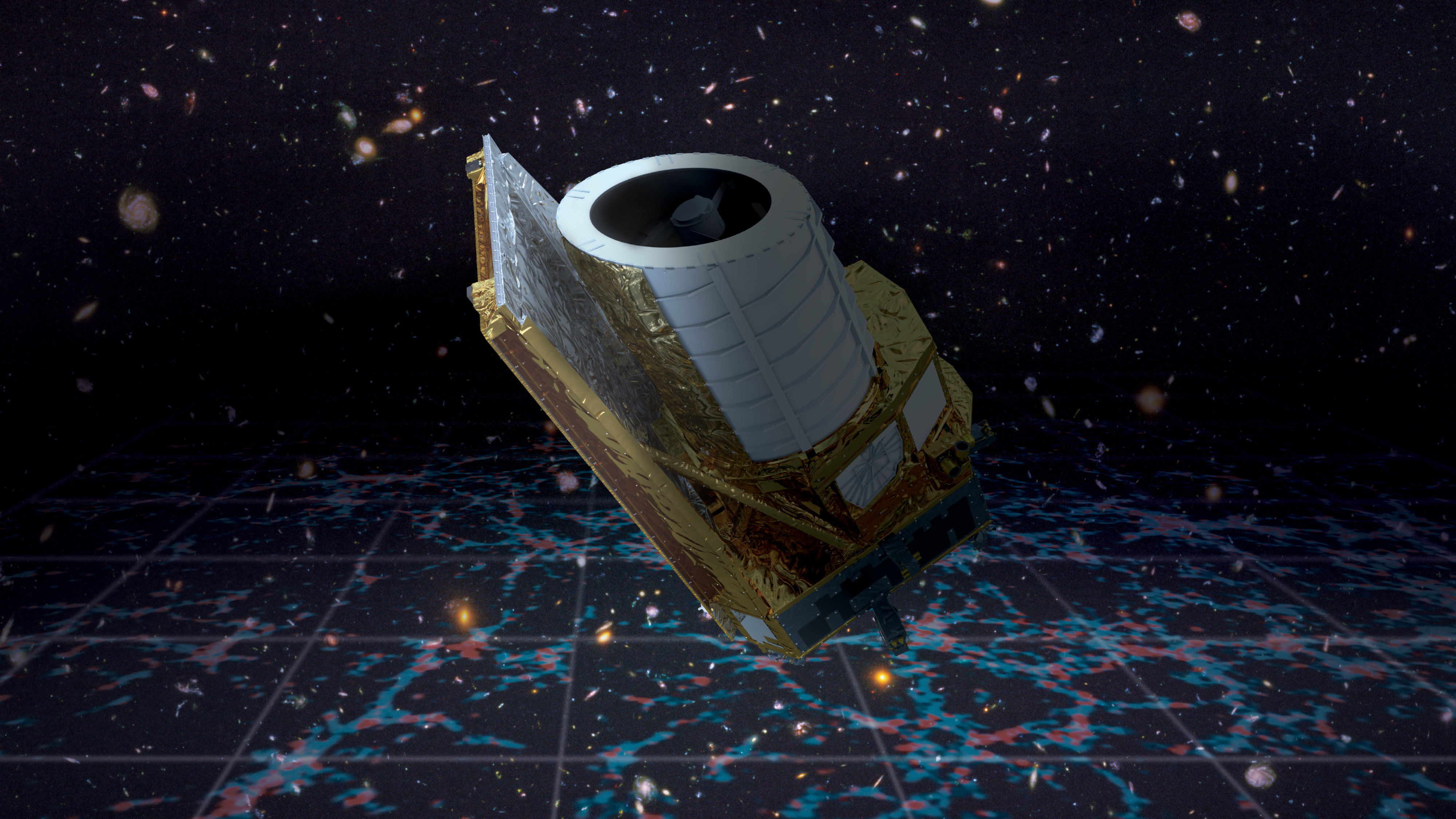
I thought it would be appropriate to add a little update about the European Space Agency’s Euclid mission. I’ll keep it brief here because you can read the full story on the official website here.
You may have seen in the news that the Euclid telescope has been having an issue with ice forming on surfaces in its optical systems, especially the VIS instrument. This is a common problem with telescopes in space, but the extent of it is not something that can be predicted very accurately in advance so a detailed strategy for dealing with it had to be developed on the go.
The layers of ice that form are very thin – just tens of nanometres thick – but that is enough to blur the images and also reduce the throughput of the instruments. Given that the objects we want Euclid to see are faint, and we need very sharp images then this is an issue that must be dealt with.
Soon after launch, the telescope was heated up for a while in order to evaporate as much ice as possible, but it was not known how quickly the ice would return and to what parts of the optical system. After months in the cold of space the instrument scientists now understand the behaviour of the pesky ice a lot better, and have devised a strategy for dealing with it.
The approach is fairly simple in principle: heat the affected instruments up every now and again, and then let them cool down again so they operate; repeat as necessary as ice forms again. This involves an interruption in observations, it is known to work pretty well, but exactly how frequently this de-icing cycle should be implemented and what parts of the optical system require this treatment are questions that need to be answered in practical experimentation. The hope is that after a number of operations of this kind, the amount of ice returning each time will gradually reduce. I am not an expert in these things but I gather from colleagues that the signs are encouraging.
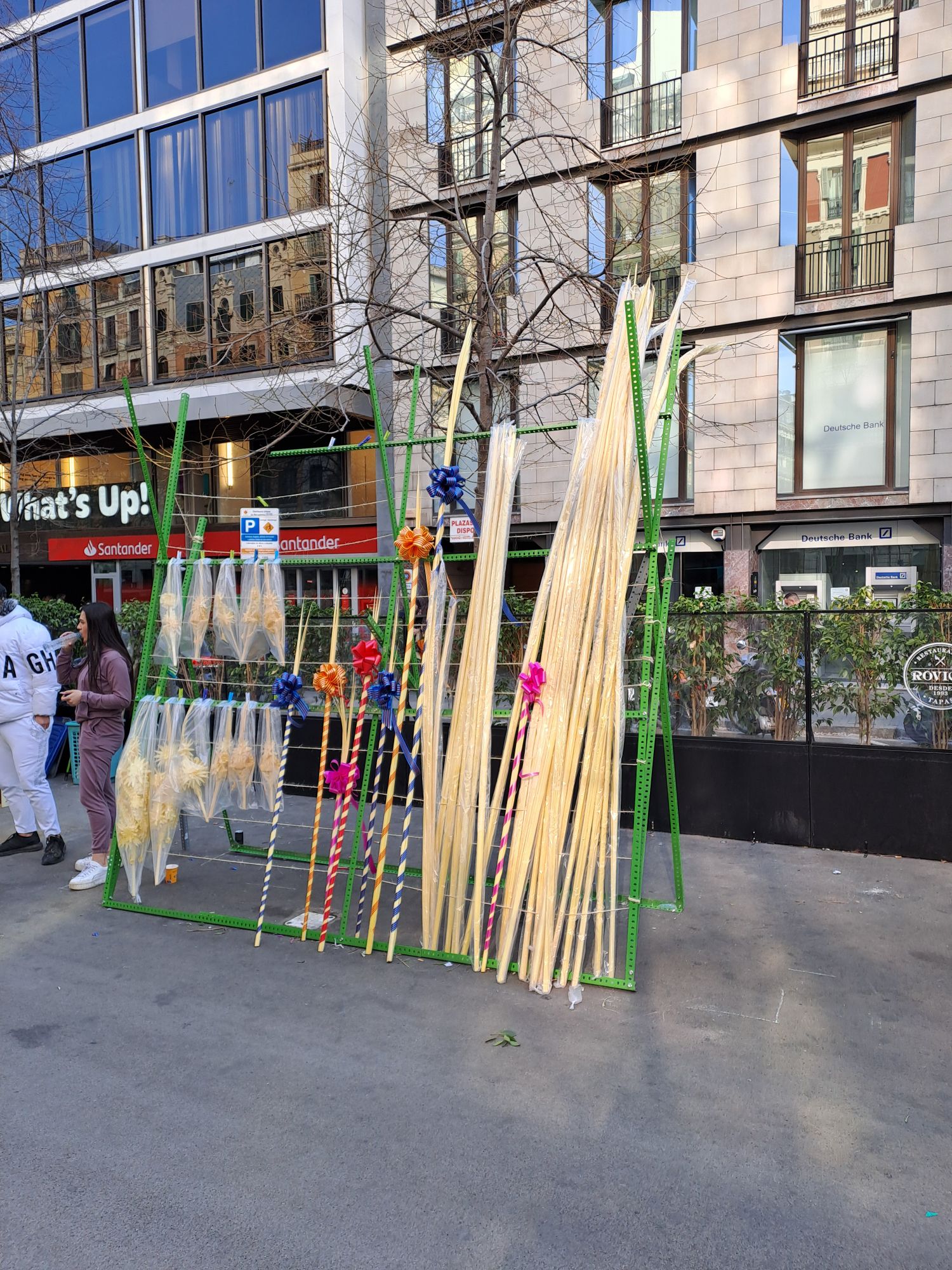
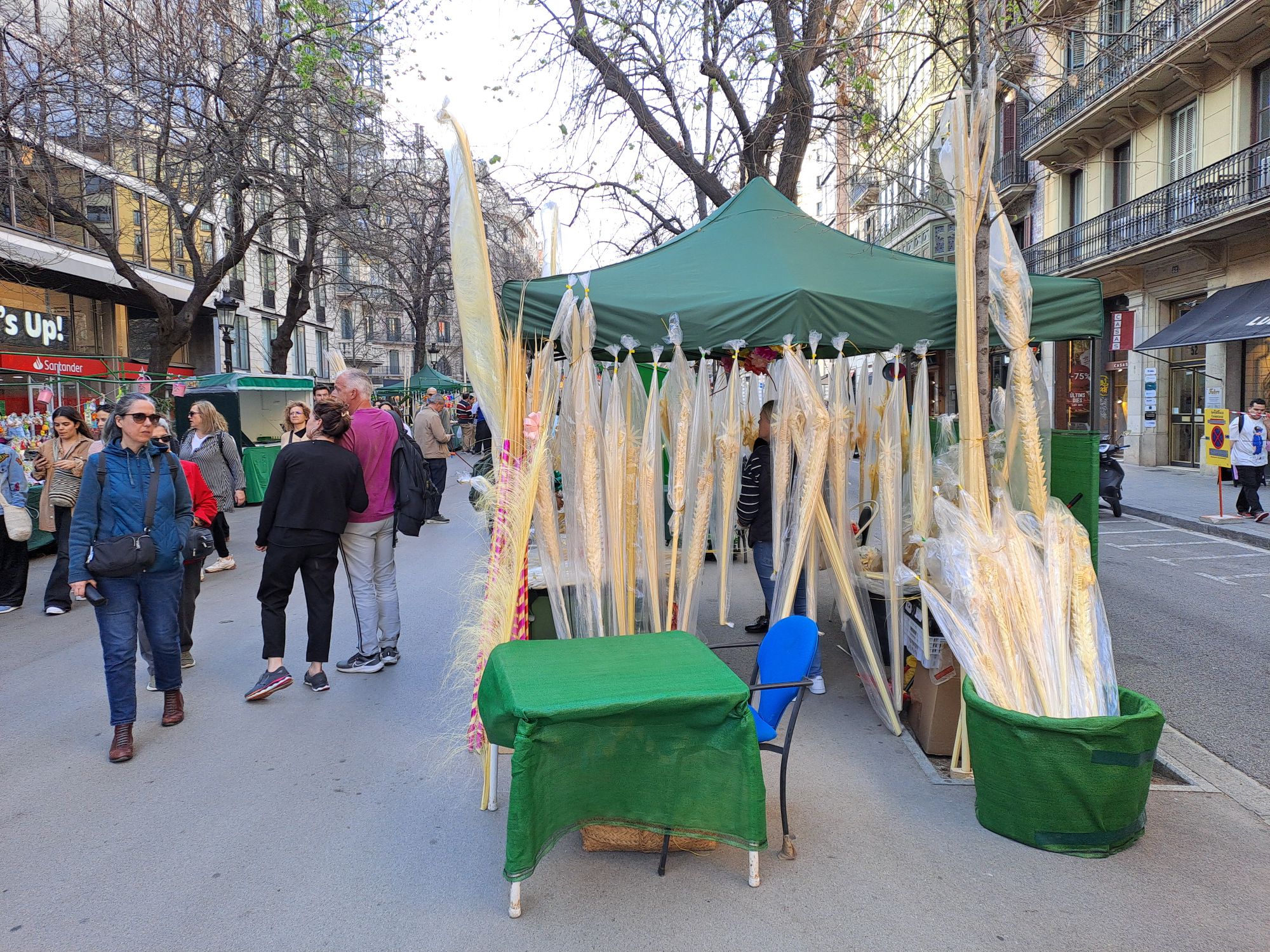
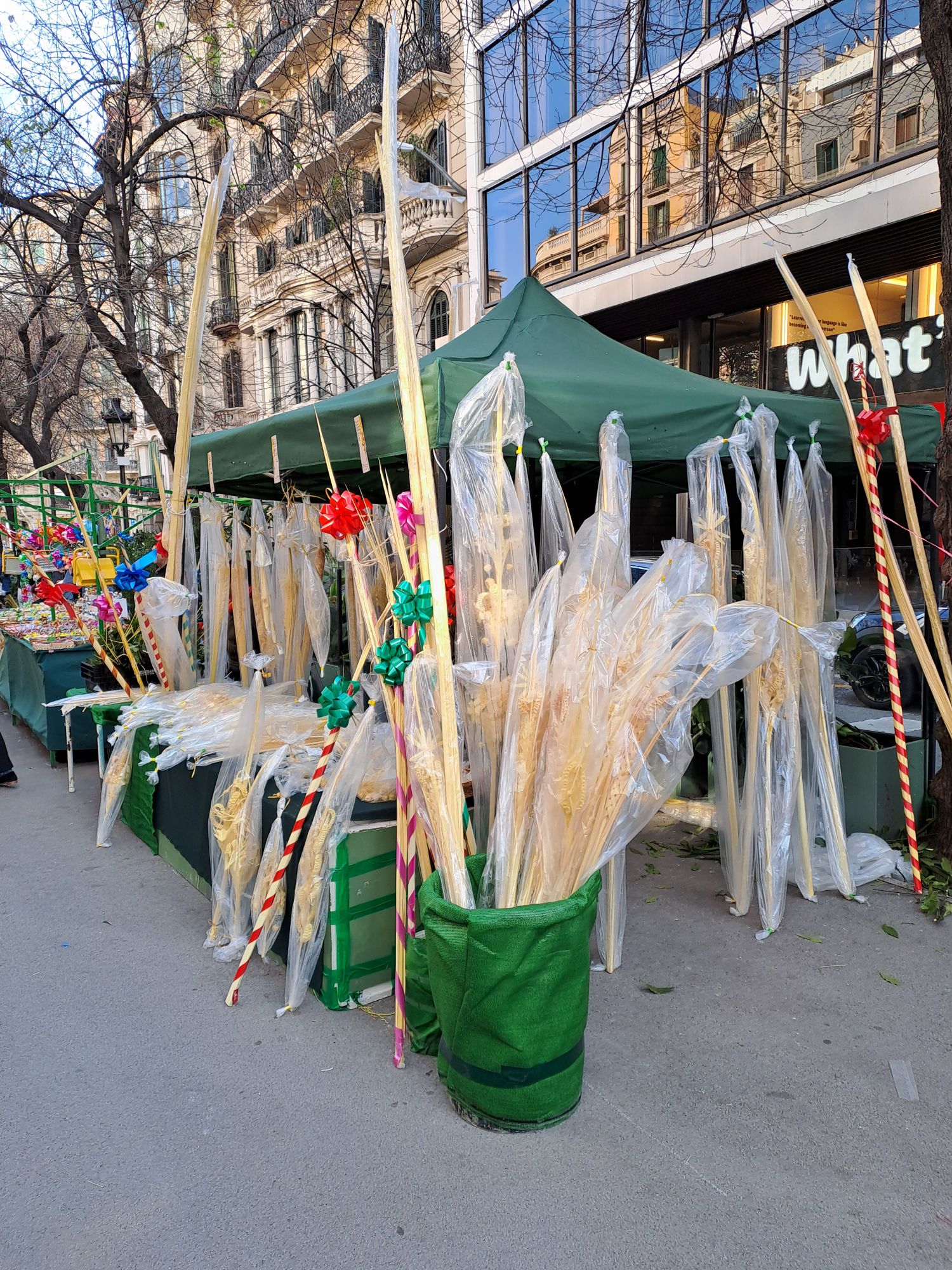
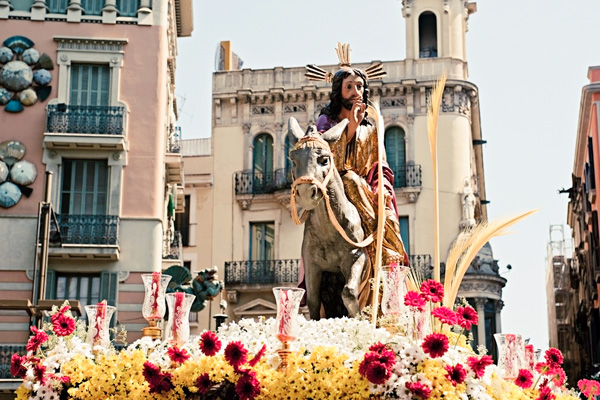
Walking about yesterday I noticed that, not far from my apartment, on the Rambla de Catalunya, there was a street market offering a variety of curious merch. I was a bit confused until I realized that today is Palm Sunday, which is Domingo de Ramos in Spanish or Diumenge de Rams in Catalan; both mean “Sunday of Branches”. The long branches, some festooned with sweets and/or ribbons, are meant to be held by boys, while girls carry the smaller stems with intricate woven crosses. There is a procession called La Borriquita (“The Little Donkey”) which goes around the town today. It involves a statue rather than a real donkey, in case you were wondering.
Palm Sunday marks the start of Holy Week (Semana Santa), leading up to Easter Sunday, which lies on March 31st this year. There are no lectures for students next week at the University of Barcelona, though I believe the Faculty of Physics will remain open up to Thursday; Good Friday (Viernes Santa) is a public holiday, as is Monday. I think these holidays are more strictly observed here than in Ireland; most stores are closed on Sundays anyway, and this will be even more the case on Easter Sunday. Having said that, Barcelona is by no means the most religious Spanish city. I have been in Spain at Easter a few times before, and the ceremonies vary considerably from place to place, some sombre and some celebratory.
In practical terms this all means that I have to remember to get some serious shopping in on Thursday. Although stores will be open on Saturday, I think they will be very busy!
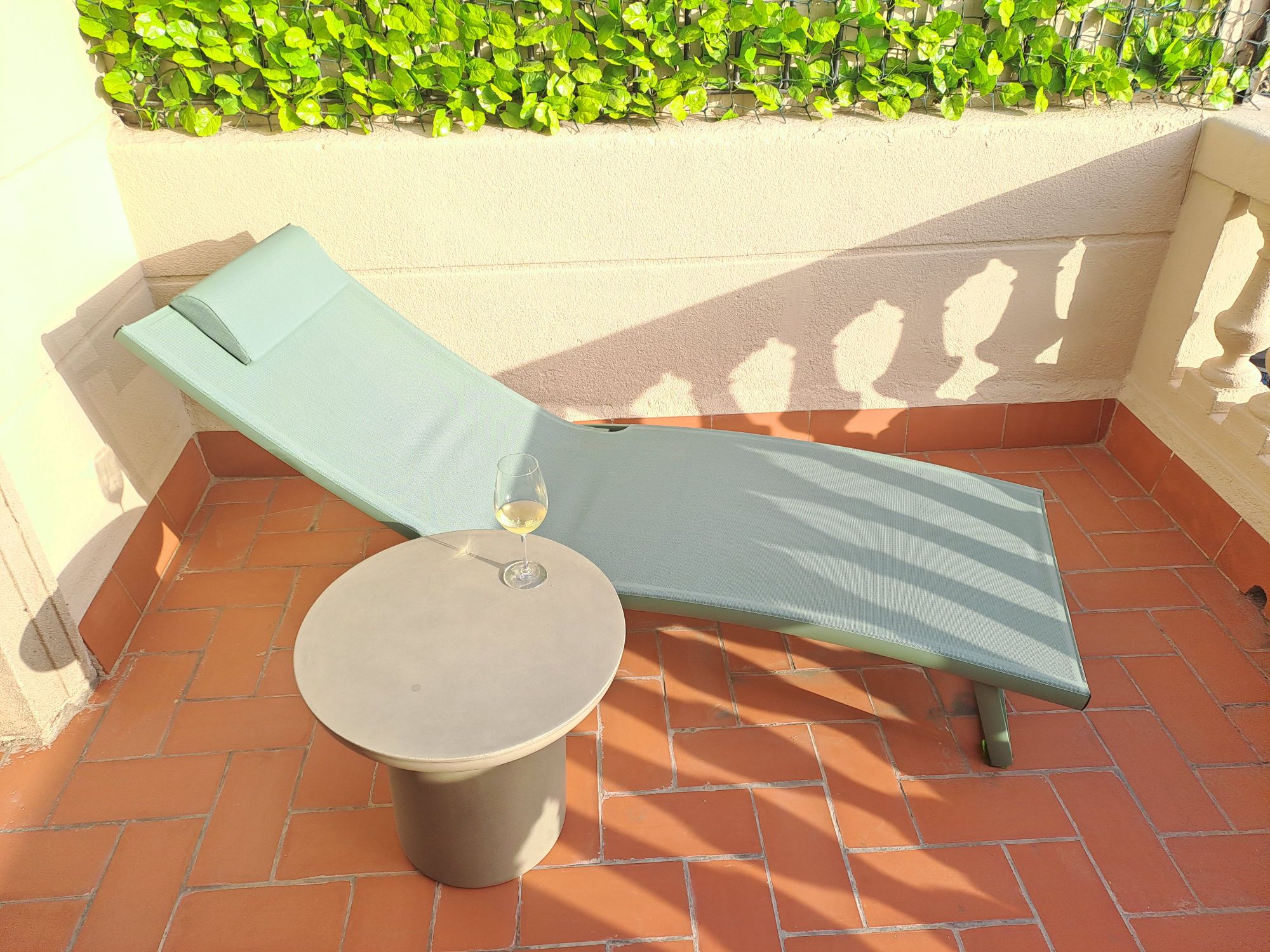
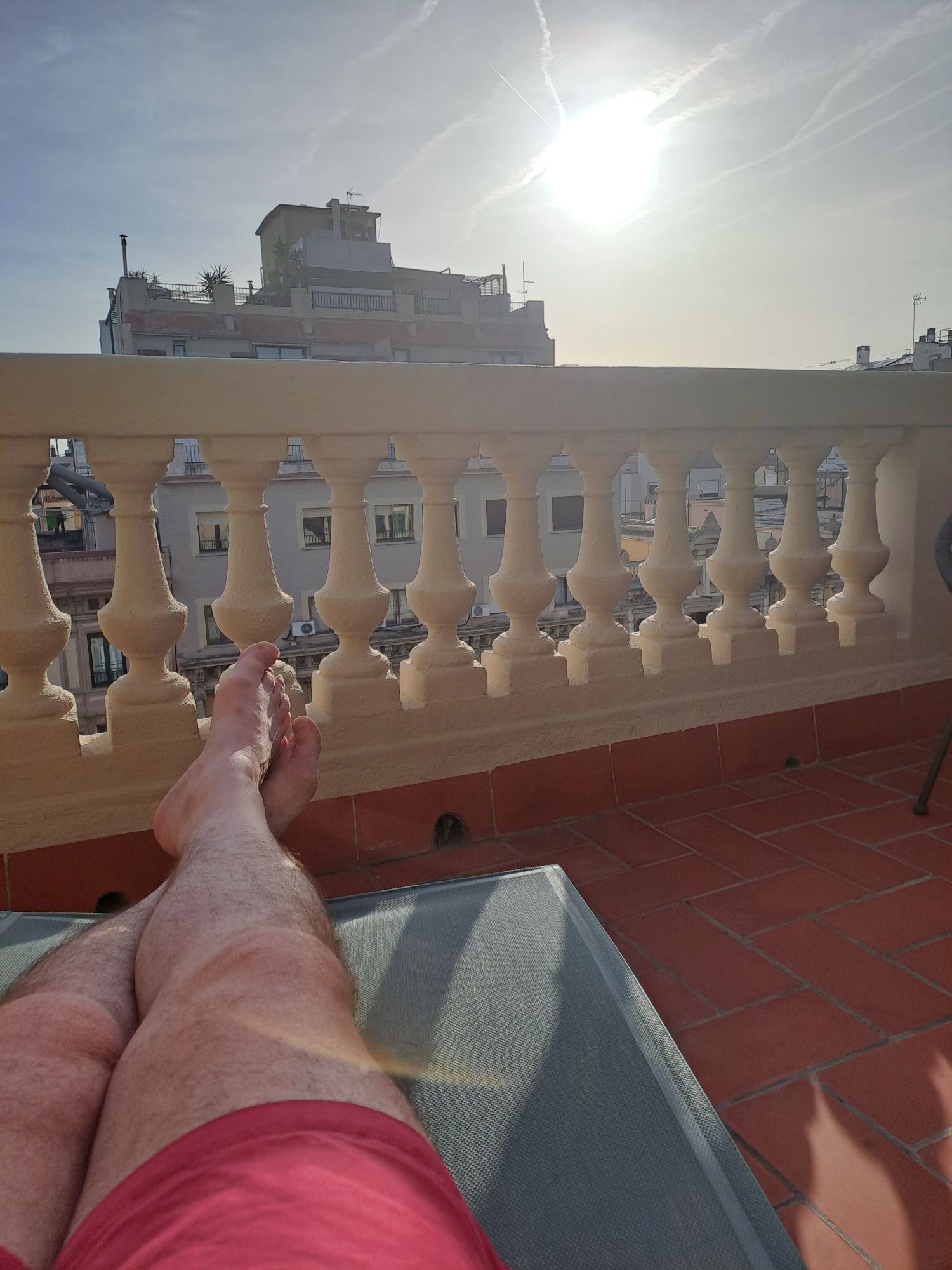
It’s Saturday morning, and this week has been very busy and stressful, mostly for reasons that I can’t blog about, but it helped yesterday to come back to my very pleasant top-floor apartment on the Rambla de Catalunya to have a glass or several of wine on the terrace and enjoy the lovely weather. It reached 22°C yesterday afternoon, and my flat gets the sun most of the day.
I chose the angle for the second pic carefully, as a lady on the side of the street had obviously done her laundry recently and hung the smalls out to dry. I thought it would be indelicate to photograph them.
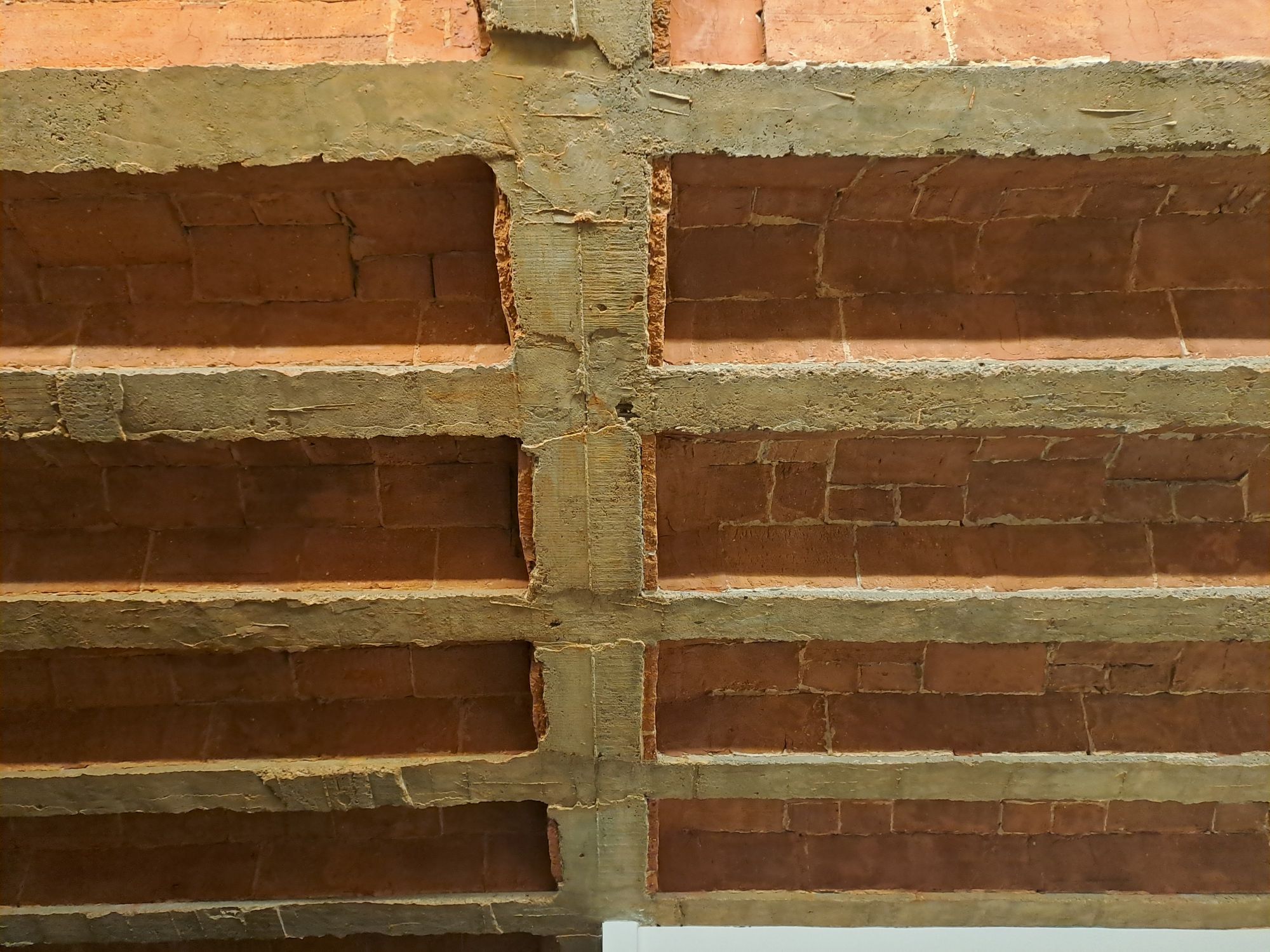
When the apartment was refurbished recently they took down the ceiling to reveal some interesting brickwork with the distinctive red clay that features in many buildings; the bricks are often covered with decorative ceramic tiles in a style called Bóveda Catalana in Spanish (Volta Catalana in Catalan), but along with the bare brickwork on the wall, this is a much plainer look.
You can see the mortar which attached the false ceiling removed during the refurbishment.
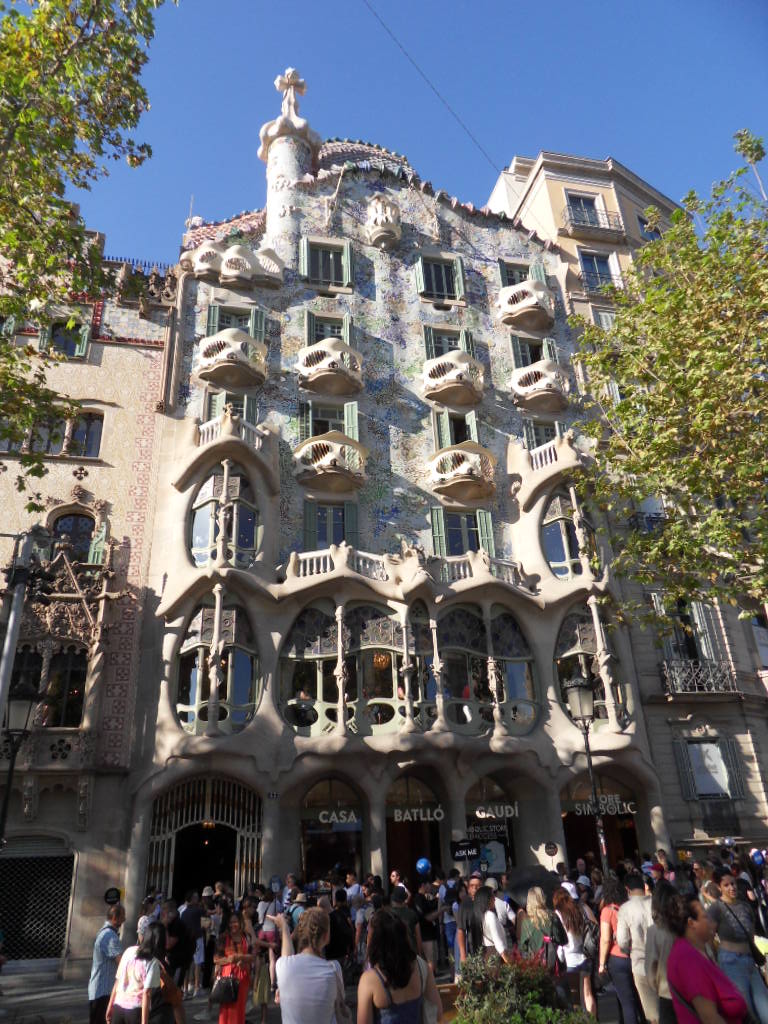
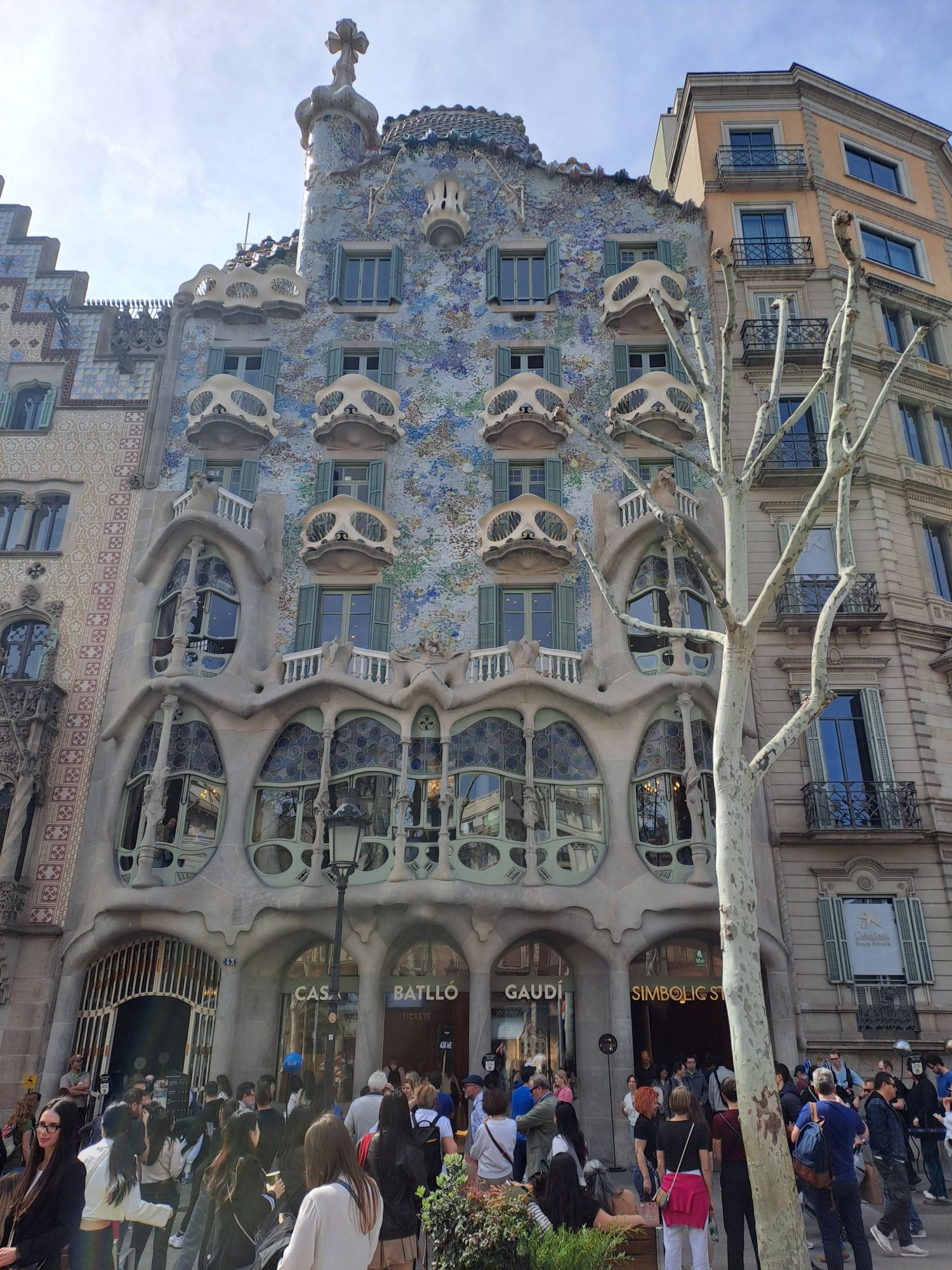
Anyway, if you want to know roughly where I am, it is just one block away from the Casa Batlló. I took the picture on the left last September but the crowds outside queuing to get in are apparently a perennial feature as you can see from the picture on the right I took today.
Casa Batlló from outside, September 30th 2023Today, March 23rd 2024
Anyway, I’m determined to relax today so will now go for a stroll, and do some shopping in preparation for cooking dinner tonight.
Lay your sleeping head, my love, Human on my faithless arm; Time and fevers burn away Individual beauty from Thoughtful children, and the grave Proves the child ephemeral: But in my arms till break of day Let the living creature lie, Mortal, guilty, but to me The entirely beautiful.
Soul and body have no bounds: To lovers as they lie upon Her tolerant enchanted slope In their ordinary swoon, Grave the vision Venus sends Of supernatural sympathy, Universal love and hope; While an abstract insight wakes Among the glaciers and the rocks The hermit’s carnal ecstasy.
Certainty, fidelity On the stroke of midnight pass Like vibrations of a bell, And fashionable madmen raise Their pedantic boring cry: Every farthing of the cost, All the dreaded cards foretell, Shall be paid, but from this night Not a whisper, not a thought, Not a kiss nor look be lost.
Beauty, midnight, vision dies: Let the winds of dawn that blow Softly round your dreaming head Such a day of welcome show Eye and knocking heart may bless, Find the mortal world enough; Noons of dryness find you fed By the involuntary powers, Nights of insult let you pass Watched by every human love.
I will decide in the next few days whether or not to resign also from the Royal Astronomical Society for the same reason.
After giving the matter a lot of thought, I have indeed now decided to resign my Fellowship of the Royal Astronomical Society, of which I have been a Fellow since 1990. The main reason for this decision is that I feel it would be inconsistent to remain FRAS after resigning as FInstP when I have the same problem with both institutions, i.e. the way they fund themselves through exploitative publishing practices.
Here is the email I sent to the Royal Astronomical Society earlier today.
Dear Membership Officer,
After much deliberation about the new policy of the Royal Astronomical Society to charge exorbitant fees for publishing in its journals (especially Monthly Notices of the Royal Astronomical Society), I have decided that I cannot in good conscience remain a member of a society that funds itself this way. I therefore resign my Fellowship of the Royal Astronomical Society with immediate effect. Kindly remove me from your membership list. I have cancelled the Direct Debit relating to my subscription.
Regards,
Peter Coles
Other, subsidiary, reasons for resignation include the expense, and the fact that Astronomy & Geophysics, the house magazine of the RAS, one of the few direct benefits of membership, even if it doesn’t have a crossword, only ever arrives in Ireland 6-8 weeks late (if it arrives at all). In any case, since I now live in Ireland, it is much more appropriate for me to participate in the activities of the Astronomical Society of Ireland than the Royal Astronomical Society, which is a UK institution.
As I am no longer a Fellow of the Royal Astronomical Society, I am no longer eligible to remain a member of the RAS Dining Club, of which I have been a member for 15 years, so I have resigned from that too. It has been in any case difficult and expensive for me to attend the dinners since I moved to Ireland. No more dinners at the Athenaeum for me!
I almost forgot that it is World Poetry Day (March 21st). I’ve posted this before, but it seems apt for March: it is by Stevie Smith and is called Black March.
I have a friend At the end Of the world. His name is a breath
Of fresh air. He is dressed in Grey chiffon. At least I think it is chiffon. It has a Peculiar look, like smoke.
It wraps him round It blows out of place It conceals him I have not seen his face.
But I have seen his eyes, they are As pretty and bright As raindrops on black twigs In March, and heard him say:
I am a breath Of fresh air for you, a change By and by.
Black March I call him Because of his eyes Being like March raindrops On black twigs.
(Such a pretty time when the sky Behind black twigs can be seen Stretched out in one Uninterrupted Cambridge blue as cold as snow.)
But this friend Whatever new names I give him Is an old friend. He says:
Whatever names you give me I am A breath of fresh air, A change for you.
Before Christmas on this blog I mentioned the Irish Open Access Publishers inaugural Diamond Open Access awards. I nominated the Open Journal of Astrophysics in the 1st Category – Best Peer Reviewed Open Access Journal. I was also nominated in the 4th Category – Outstanding Contribution to the Open Access Publishing Field in Ireland. Neither nomination was successful.
In fact I was on my way back to Ireland from Arizona when the awards were announced at webinar on March 12th which I couldn’t attend because I was on my way back from Arizona then. The rules for the competition stated that “Nominees including winners notified by email on the 1st March, 2024”. Since I heard nothing at all by then (or indeed until the weekend before the official announcement) I made the (correct) inference that I was not in contention* and my presence was not required. I subsequently forgot about the awards until I was coincidentally reminded yesterday.
*Update: although I wasn’t informed by the organizers, and only found out indirectly on Saturday 23rd March, it seems I was given an honourable mention.
Anyway, here are the lucky winners:
The winner in Category 1 was Alphaville, a journal “about all aspects of film and screen media history, theory and criticism through multiple research methodologies and perspectives” which is based at University College Cork. This journal was founded in 2011, so has been going for far longer than the Open Journal of Astrophysics! Congratulations to them!
There was no winner in Category 2, Best Peer Reviewed Open Access Monograph.
The winner in Category 3, Best Open Educational Resource was the MTU Assignment Toolkit.
There were joint winners in Category 4: Yvonne Desmond of TU Dublin, and the team behind the journal SCENARIO, based at University College Cork. The latter journal is a trilingual journal “in the area of performative teaching, learning and research” which was founded in 2007, so has been going for even longer than the Category 1 Winner!
Congratulations to all the winners!
P.S. At least I had some consolation when I got back from the USA, in the form the Times Literary Supplement Crossword prize!
Here’s an interestingly different talk in the series of Cosmology Talks curated by Shaun Hotchkiss. The speaker, Sylvia Wenmackers, is a philosopher of science. According to the blurb on Youtube:
Her focus is probability and she has worked on a few theories that aim to extend and modify the standard axioms of probability in order to tackle paradoxes related to infinite spaces. In particular there is a paradox of the “infinite fair lottery” where within standard probability it seems impossible to write down a “fair” probability function on the integers. If you give the integers any non-zero probability, the total probability of all integers is unbounded, so the function is not normalisable. If you give the integers zero probability, the total probability of all integers is also zero. No other option seems viable for a fair distribution. This paradox arises in a number of places within cosmology, especially in the context of eternal inflation and a possible multiverse of big bangs bubbling off. If every bubble is to be treated fairly, and there will ultimately be an unbounded number of them, how do we assign probability? The proposed solutions involve hyper-real numbers, such as infinitesimals and infinities with different relative sizes, (reflecting how quickly things converge or diverge respectively). The multiverse has other problems, and other areas of cosmology where this issue arises also have their own problems (e.g. the initial conditions of inflation); however this could very well be part of the way towards fixing the cosmological multiverse.
The paper referred to in the presentation can be found here. There is a lot to digest in this thought-provoking talk, from the starting point on Kolmogorov’s axioms to the application to the multiverse, but this video gives me an excuse to repeat my thoughts on infinities in cosmology.
Most of us – whether scientists or not – have an uncomfortable time coping with the concept of infinity. Physicists have had a particularly difficult relationship with the notion of boundlessness, as various kinds of pesky infinities keep cropping up in calculations. In most cases this this symptomatic of deficiencies in the theoretical foundations of the subject. Think of the ‘ultraviolet catastrophe‘ of classical statistical mechanics, in which the electromagnetic radiation produced by a black body at a finite temperature is calculated to be infinitely intense at infinitely short wavelengths; this signalled the failure of classical statistical mechanics and ushered in the era of quantum mechanics about a hundred years ago. Quantum field theories have other forms of pathological behaviour, with mathematical components of the theory tending to run out of control to infinity unless they are healed using the technique of renormalization. The general theory of relativity predicts that singularities in which physical properties become infinite occur in the centre of black holes and in the Big Bang that kicked our Universe into existence. But even these are regarded as indications that we are missing a piece of the puzzle, rather than implying that somehow infinity is a part of nature itself.
The exception to this rule is the field of cosmology. Somehow it seems natural at least to consider the possibility that our cosmos might be infinite, either in extent or duration, or both, or perhaps even be a multiverse comprising an infinite collection of sub-universes. If the Universe is defined as everything that exists, why should it necessarily be finite? Why should there be some underlying principle that restricts it to a size our human brains can cope with?
On the other hand, there are cosmologists who won’t allow infinity into their view of the Universe. A prominent example is George Ellis, a strong critic of the multiverse idea in particular, who frequently quotes David Hilbert
The final result then is: nowhere is the infinite realized; it is neither present in nature nor admissible as a foundation in our rational thinking—a remarkable harmony between being and thought
But to every Hilbert there’s an equal and opposite Leibniz
I am so in favor of the actual infinite that instead of admitting that Nature abhors it, as is commonly said, I hold that Nature makes frequent use of it everywhere, in order to show more effectively the perfections of its Author.
You see that it’s an argument with quite a long pedigree!
Many years ago I attended a lecture by Alex Vilenkin, entitled The Principle of Mediocrity. This was a talk based on some ideas from his book Many Worlds in One: The Search for Other Universes, in which he discusses some of the consequences of the so-called eternal inflation scenario, which leads to a variation of the multiverse idea in which the universe comprises an infinite collection of causally-disconnected “bubbles” with different laws of low-energy physics applying in each. Indeed, in Vilenkin’s vision, all possible configurations of all possible things are realised somewhere in this ensemble of mini-universes.
One of the features of this scenario is that it brings the anthropic principle into play as a potential “explanation” for the apparent fine-tuning of our Universe that enables life to be sustained within it. We can only live in a domain wherein the laws of physics are compatible with life so it should be no surprise that’s what we find. There is an infinity of dead universes, but we don’t live there.
I’m not going to go on about the anthropic principle here, although it’s a subject that’s quite fun to write or, better still, give a talk about, especially if you enjoy winding people up! What I did want to say mention, though, is that Vilenkin correctly pointed out that three ingredients are needed to make this work:
An infinite ensemble of realizations
A discretizer
A randomizer
Item 2 involves some sort of principle that ensures that the number of possible states of the system we’re talking about is not infinite. A very simple example from quantum physics might be the two spin states of an electron, up (↑) or down(↓). No “in-between” states are allowed, according to our tried-and-tested theories of quantum physics, so the state space is discrete. In the more general context required for cosmology, the states are the allowed “laws of physics” ( i.e. possible false vacuum configurations). The space of possible states is very much larger here, of course, and the theory that makes it discrete much less secure. In string theory, the number of false vacua is estimated at 10500. That’s certainly a very big number, but it’s not infinite so will do the job needed.
Item 3 requires a process that realizes every possible configuration across the ensemble in a “random” fashion. The word “random” is a bit problematic for me because I don’t really know what it’s supposed to mean. It’s a word that far too many scientists are content to hide behind, in my opinion. In this context, however, “random” really means that the assigning of states to elements in the ensemble must be ergodic, meaning that it must visit the entire state space with some probability. This is the kind of process that’s needed if an infinite collection of monkeys is indeed to type the (large but finite) complete works of shakespeare. It’s not enough that there be an infinite number and that the works of shakespeare be finite. The process of typing must also be ergodic.
Now it’s by no means obvious that monkeys would type ergodically. If, for example, they always hit two adjoining keys at the same time then the process would not be ergodic. Likewise it is by no means clear to me that the process of realizing the ensemble is ergodic. In fact I’m not even sure that there’s any process at all that “realizes” the string landscape. There’s a long and dangerous road from the (hypothetical) ensembles that exist even in standard quantum field theory to an actually existing “random” collection of observed things…
More generally, the mere fact that a mathematical solution of an equation can be derived does not mean that that equation describes anything that actually exists in nature. In this respect I agree with Alfred North Whitehead:
There is no more common error than to assume that, because prolonged and accurate mathematical calculations have been made, the application of the result to some fact of nature is absolutely certain.
It’s a quote I think some string theorists might benefit from reading!
Items 1, 2 and 3 are all needed to ensure that each particular configuration of the system is actually realized in nature. If we had an infinite number of realizations but with either infinite number of possible configurations or a non-ergodic selection mechanism then there’s no guarantee each possibility would actually happen. The success of this explanation consequently rests on quite stringent assumptions.
I’m a sceptic about this whole scheme for many reasons. First, I’m uncomfortable with infinity – that’s what you get for working with George Ellis, I guess. Second, and more importantly, I don’t understand string theory and am in any case unsure of the ontological status of the string landscape. Finally, although a large number of prominent cosmologists have waved their hands with commendable vigour, I have never seen anything even approaching a rigorous proof that eternal inflation does lead to realized infinity of false vacua. If such a thing exists, I’d really like to hear about it!
Loughcrew (County Meath, Ireland), near Newgrange, an ancient burial site and traditional place to observe the sunrise at the Equinox
Just a quick note to mention that the Vernal Equinox, or Spring Equinox, (in the Northern hemisphere) took place today, Wednesday 20th March 2024, at 3.06 UTC (which was 4.06am CET, where I am at, though I was sound asleep at the time). Many people in the Northern hemisphere regard the Vernal Equinox as the first day of spring; of course in the Southern hemisphere, this is the Autumnal Equinox.
The date of the Vernal Equinox is often given as 21st March, but in fact it has only been on 21st March twice this century so far (2003 and 2007); it was on 20th March in 2008, has been on 20th March every spring from then until now, and will be until 2044 (when it will be on March 19th). This year the equinox happened before dawn, so sunrise this morning could be taken to be the first sunrise of spring. It felt more like summer, sipping coffee on my terrace in Barcelona:
This reminds me of a strange conversation I had on a plane recently. I was chatting to the person sitting next to me, who happened to be British. When he asked what I did for a living, I replied that I was an astrophysicist. He then complained that he preferred the old days when the Spring Equinox was on March 21st, and that now that Britain was out of the European Union he hoped it would change back…
Anyway, people sometimes ask me how one can define the `equinox’ so precisely when surely it just refers to a day on which day and night are of equal length, implying that it’s a day not a specific time?
The answer is that the equinox is defined by a specific event, the event in question being when the plane defined by Earth’s equator passes through the centre of the Sun’s disk (or, if you prefer, when the centre of the Sun passes through the plane defined by Earth’s equator). Day and night are not necessarily exactly equal on the equinox, but they’re the closest they get. From now until the Autumnal Equinox, days in the Northern hemisphere will be longer than nights, and they’ll get longer until the Summer Solstice before beginning to shorten again.
Now that I’m safely back in Barcelona it’s a time for a roundup of the latest business at the Open Journal of Astrophysics. The latest batch of publications consists of three papers, taking the count in Volume 7 (2024) up to 20 and the total published by OJAp up to 135.
This time the papers are all related, have many authors in common, and have the same first author, Philip F. Hopkins of Caltech. In fact the second and third papers in this batch were accepted well before the first one, but it seemed to make much more sense to publish them together so I held those two back a bit and published all three on 14th March.
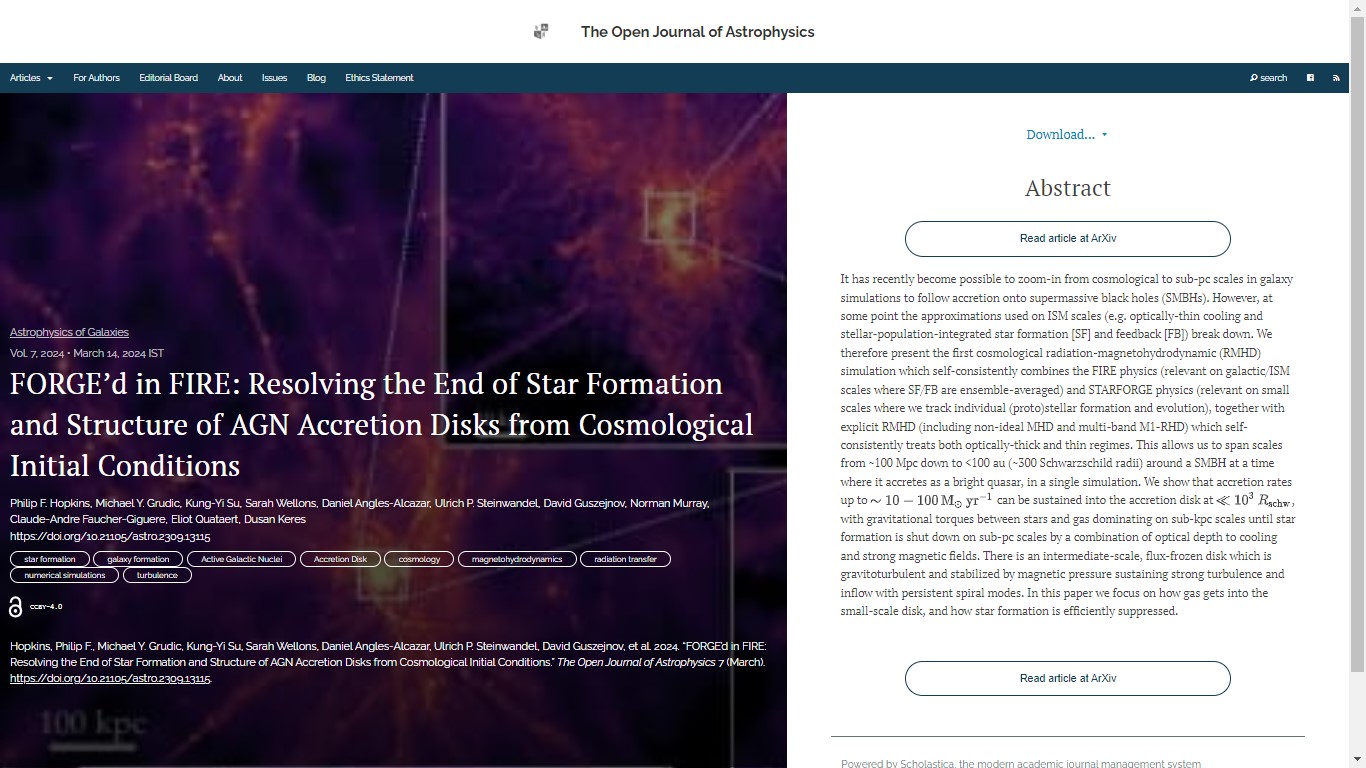
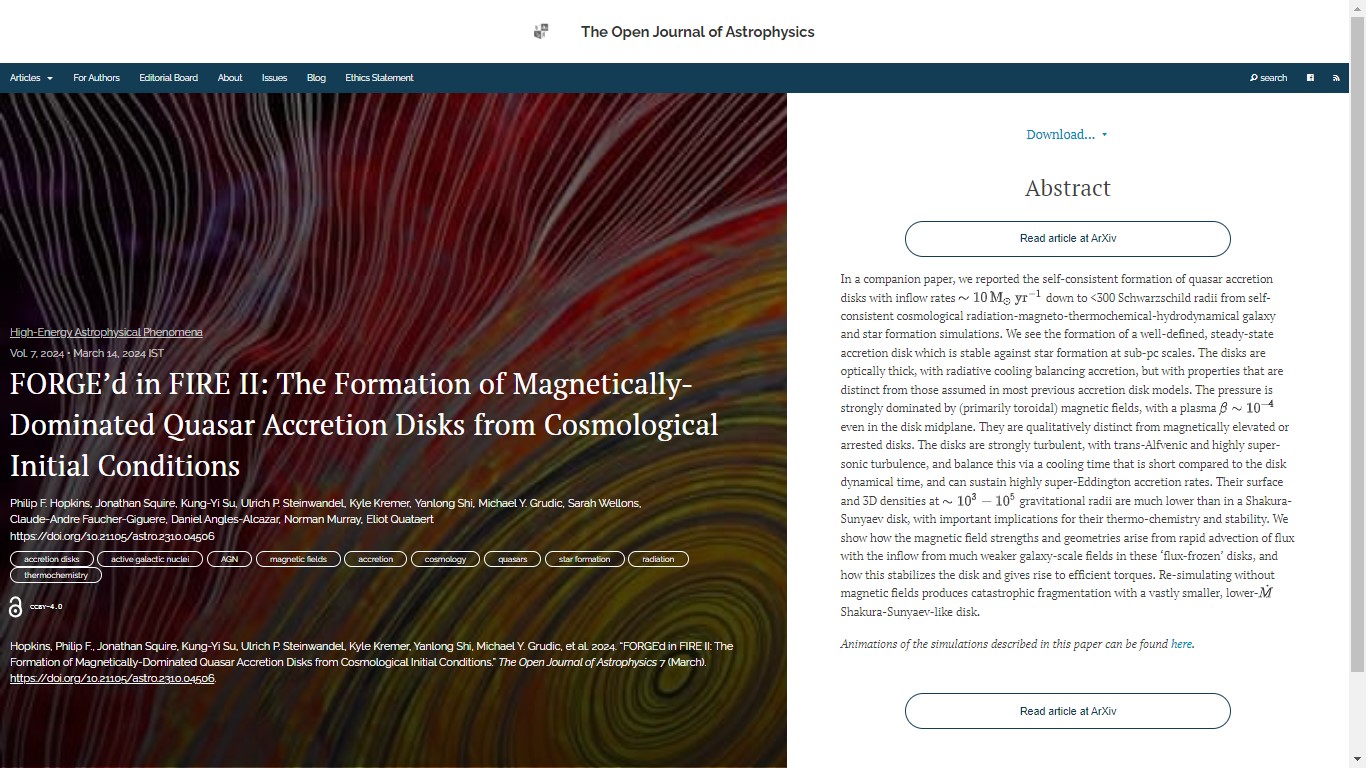
The three papers published, with their overlays, are as follows. You can click on the images of the overlays to make them larger should you wish to do so. You can read these publications directly on arXiv if you wish; you will find them here, here and here.
The authors (ten from the USA and one from Canada) are Philip F. Hopkins (Caltech), Michael Y. Grudic (Carnegie Observatories), Kung-Yi Su (Harvard), Sarah Wellons (Wesleyan University), Daniel Angles-Alcazar (University of Connecticut & Flatiron Institute), Ulrich P. Steinwandel (Flatiron Institute), David Guszejnov (University of Texas at Austin), Norman Murray (CITA, Toronto, Canada), Claude-Andre Faucher-Giguere (Northwestern University), Eliot Quataert (Princeton), and Dusan Keres (University of California, San Diego or UCSD for short).
Here is a screen grab of the overlay, which includes the abstract:
This one is in the folder High-Energy Astrophysical Phenomena. The authors (ten based in the USA, one fin Canada, and one in New Zealand) are Philip F. Hopkins, Jonathan Squire (University of Dunedin, New Zealand), Kung-Yi Su (Harvard), Ulrich P. Steinwandel (Flatiron Institute), Kyle Kremer (Caltech), Yanlong Shi (Caltech), Michael Y. Grudic (Carnegie Observatories), Sarah Wellons (Wesleyan University), Claude-Andre Faucher-Giguere (Northwestern University), Daniel Angles-Alcazar (University of Connecticut & Flatiron Institute), Norman Murray (CITA, Toronto), and Eliot Quataert (Princeton).
The last paper of this batch, also in the folder High-Energy Astrophysical Phenomena, is entitled “An Analytic Model For Magnetically-Dominated Accretion Disks” and is closely related to the previous one; this particular paper presents an analytic similarity model for accretion disks that agrees remarkably well with the simulations in the previous one. Animations of the simulations referred to in both papers can be found here.
Here is the overlay:
The authors of this one are Philip F. Hopkins, Jonathan Squire, Eliot Quataert, Norman Murray, Kung-Yi Su, Ulrich P. Steinwandel, Kyle Kremer, Claude-Andre Faucher-Giguere, and Sarah Wellons. You can find all their affiliations above.
The views presented here are personal and not necessarily those of my employer (or anyone else for that matter).
Feel free to comment on any of the posts on this blog but comments may be moderated; anonymous comments and any considered by me to be vexatious and/or abusive and/or defamatory will not be accepted. I do not necessarily endorse, support, sanction, encourage, verify or agree with the opinions or statements of any information or other content in the comments on this site and do not in any way guarantee their accuracy or reliability.








 In the Dark