It’s Saturday once again, so it’s time for another update of activity at the Open Journal of Astrophysics. Since the last update we have published a further four papers, bringing the number in Volume 9 (2026) to 114 and the total so far published by OJAp up to 562.
I will continue to include the posts made on our Mastodon account (on Fediscience); these announcements also show the DOI for each paper.
The first paper to report this week, published on Monday 25th May is “Little Red Dot – Host Galaxy = Black Hole Star: A Gas-Enshrouded Heart at the Center of Every Little Red Dot” by Wendy Q. Sun (MIT, USA) and 32 others from around the world. This study presents evidence that “black hole stars” (BH*), early stages of black hole growth, power Little Red Dots (LRDs) and every massive black hole may have been a BH*.
The overlay for this paper is here
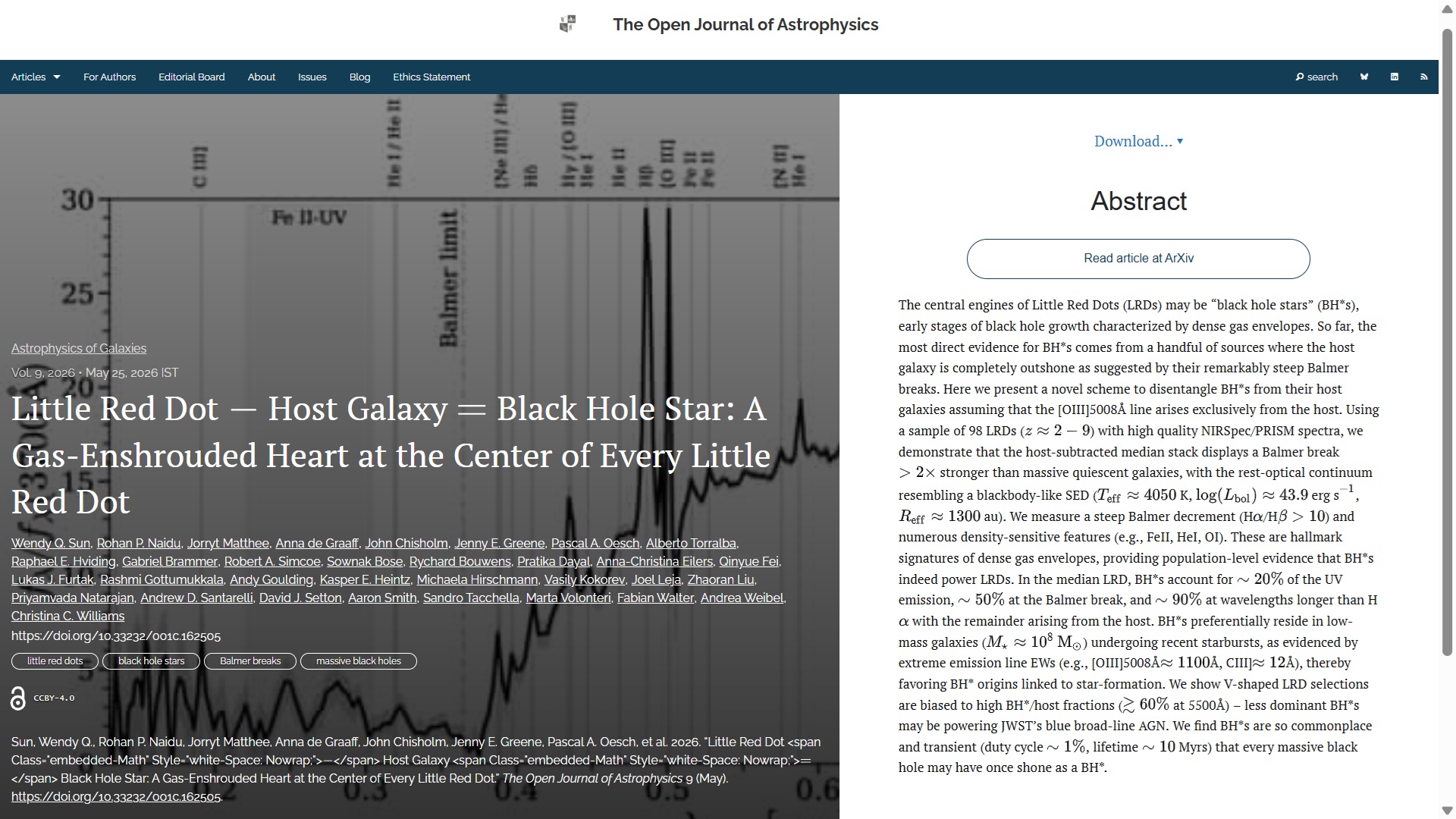
You can find the officially accepted version on arXiv here and the announcement on Fediverse here:

The second paper for this week, also published on Monday 25th May but in the folder Cosmology and Nongalactic Astrophysics, is “Catalog-based detection of unrecognized blends in deep optical ground based imaging” by Shuang Liang (Stanford U., USA) and Prakruth Adari & Anja von der Linden (Stony Brook U., USA) on behalf of the LSST Dark Energy Science Collaboration. The study uses machine learning to detect unrecognized blends in deep ground-based imaging, improving sample purity and potentially enhancing accuracy in future cosmological surveys.
The overlay for this one is here:
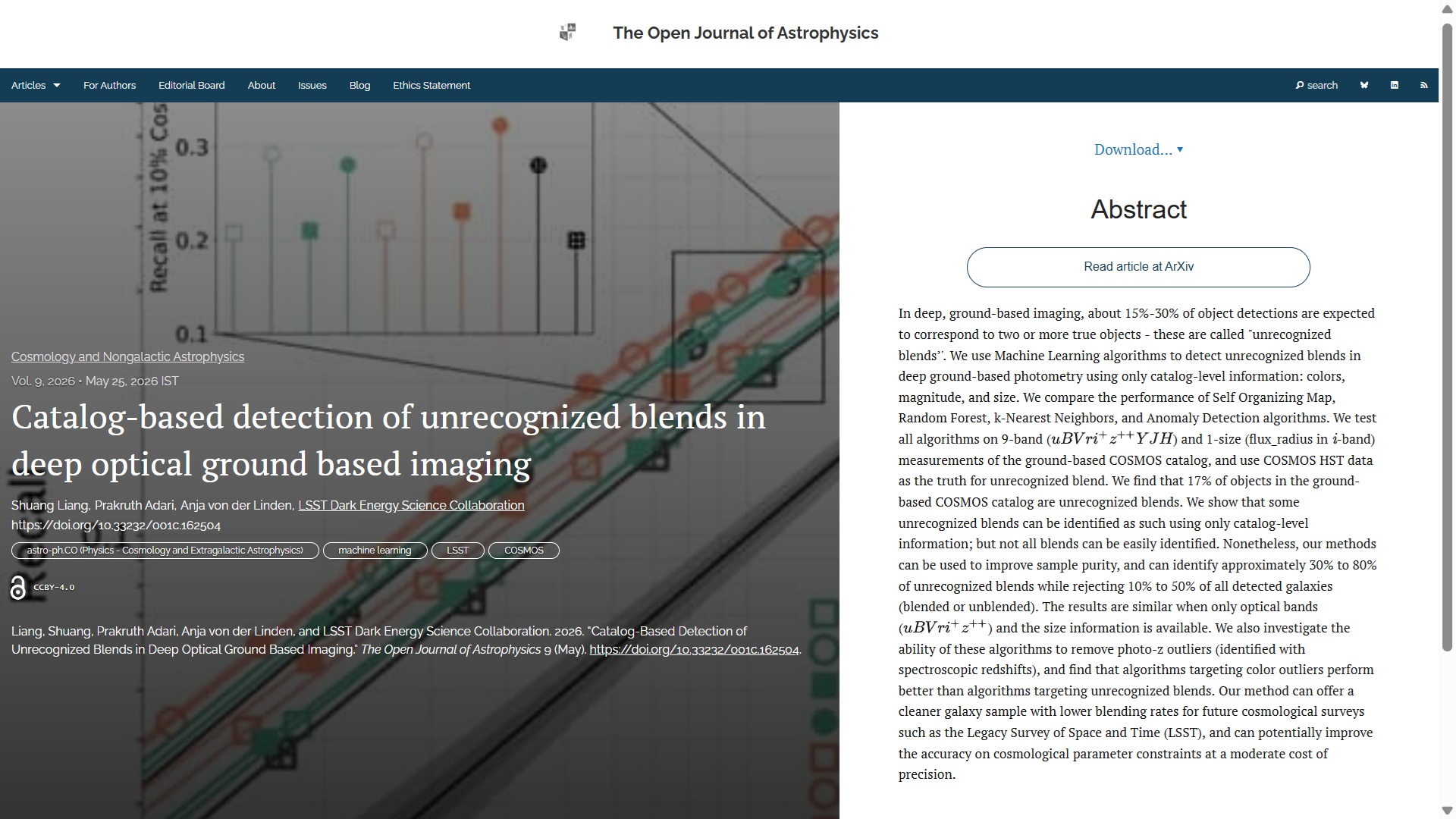
The official version of the paper can be found on arXiv here and the Fediverse announcement here:
Next one up, the third paper of the week, published on Tuesday 26th May in the folder Cosmology and Nongalactic Astrophysics is “Control variates from Eulerian and Lagrangian perturbation theory: Application to the bispectrum” by Nickolas Kokron and Shi-Fan Chen (Institute for Advanced Study, Princeton, USA). This paper hexplores the use of control variates in cosmological simulations, introducing a new ‘shifted control variate’ that improves precision and enables accurate bispectrum emulators, aiding in cosmology modeling.
The overlay for this one is here:
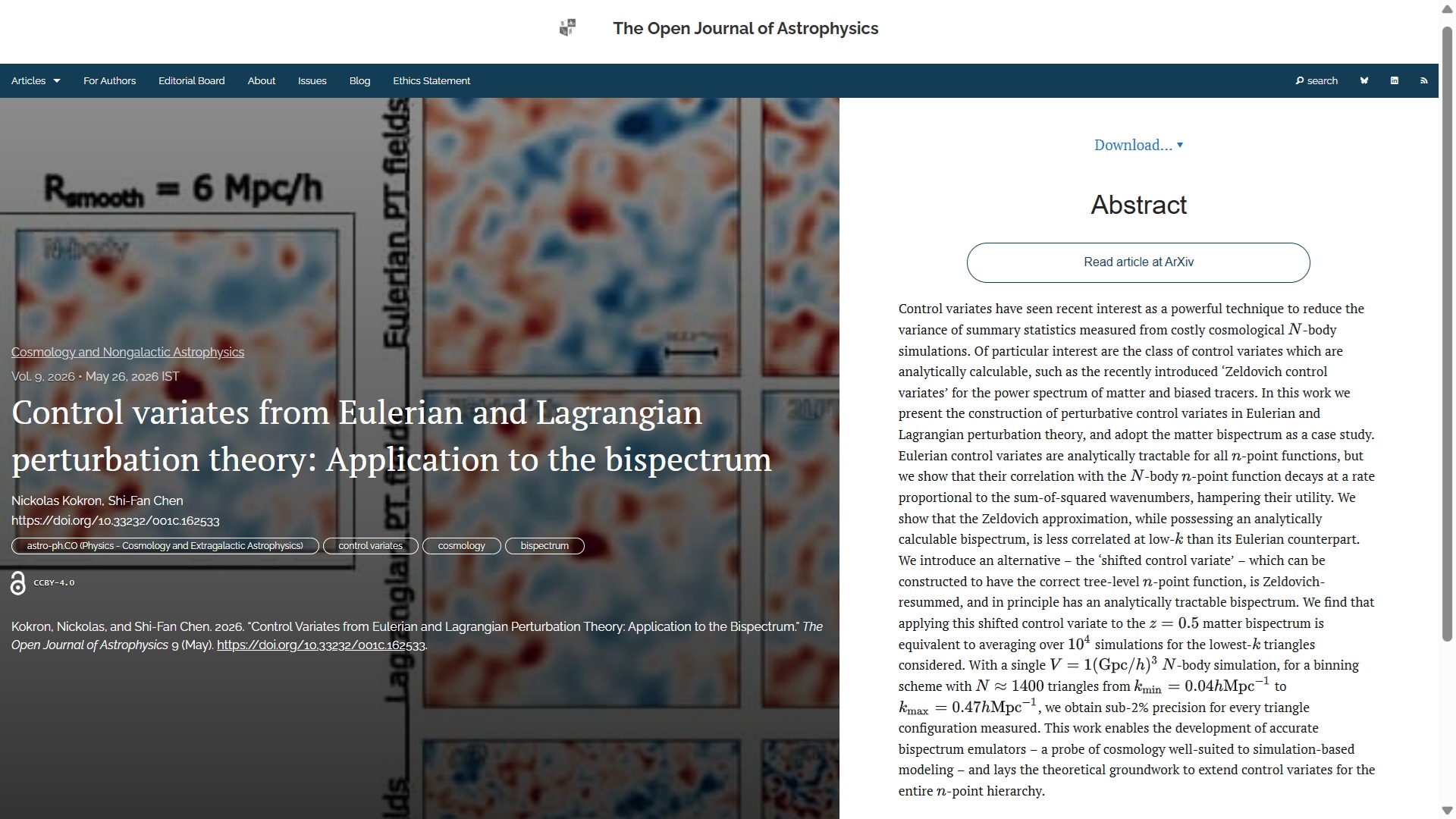
The final, accepted version can be found on arXiv here and the Mastodon announcement is here:
The fourth and final paper this week, also published on Tuesday 26th May is “How precisely can we measure the ages of subgiant and giant stars?” by Cheyanne Shariat, Kareem El-Badry and Soumyadeep Bhattacharjee (California Institute of Technology, USA). This article, published in the folder Solar and Stellar Astrophysics, is about testing the accuracy of stellar age estimates from recent catalogs, finding that spectroscopic metallicities provide reliable subgiant ages, while photometric ages underestimate uncertainties. Accurate chemical abundance measurements are essential.
The overlay is here:
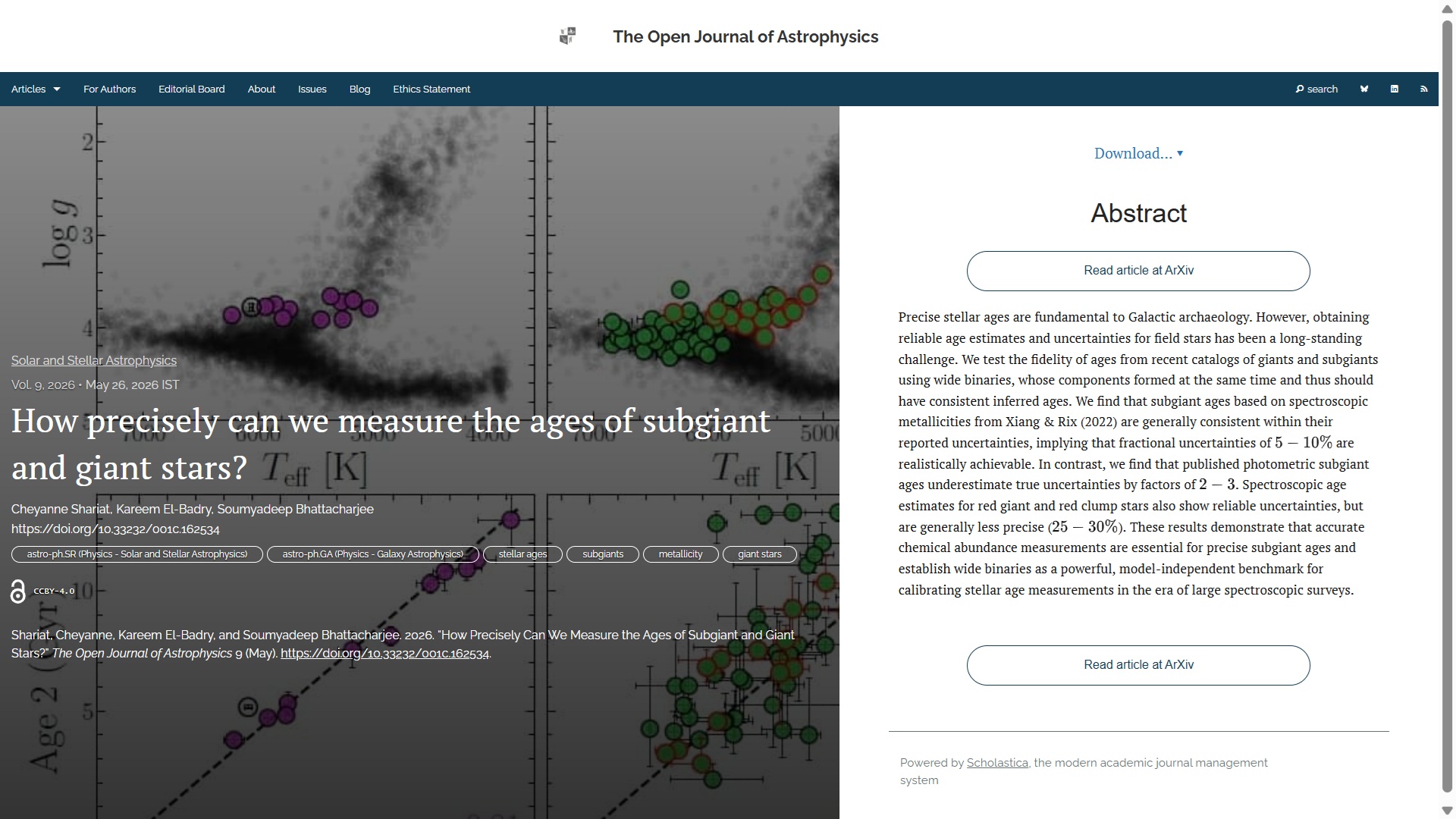
The officially accepted version can be found on arXiv here and here is the Mastodon announcement:
And that concludes this week’s update. I’ll do another one next Saturday.


