Archive for black holes

Black Holes, Hawking Radiation (and AI…)

Posted in Artificial Intelligence, The Universe and Stuff with tags , , , , , on December 7, 2025 by telescoper

It seems to be a common misapprehension that the energy released by the supermassive black holes in, for example, active galactic nuclei is in the form of Hawking radiation. It isn’t. Hawking radiation is only significant for black holes of very low mass. The radiation produced around supermassive black holes is due to the extremely high density and temperate of matter falling into the black hole through an accretion disk not due to the evaporation of the black hole itself. Hawking radiation has never been experimentally detected.

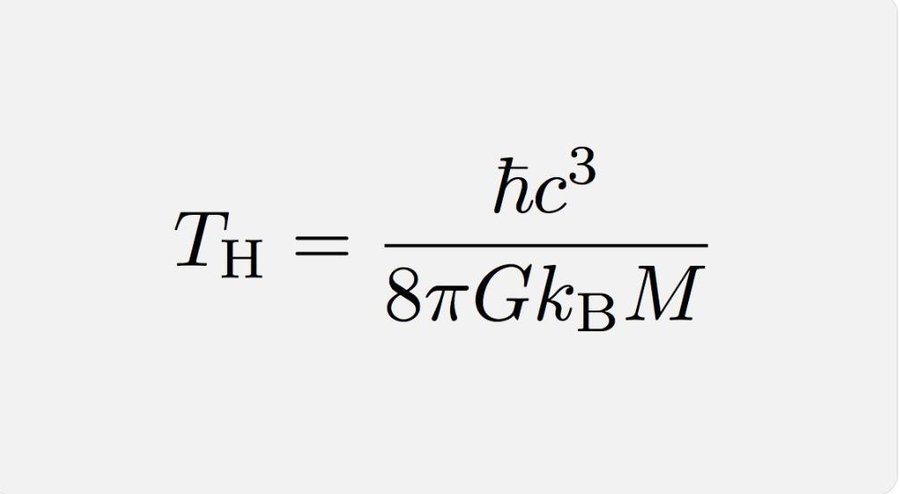
Hawking showed that the a black hole will produce black-body radiation with a temperature, the Hawking Temperature, given by TH in a beautiful formula below that brings together constants relating to gravity, statistical mechanics, quantum theory and relativity:

You can see that the Hawking Temperature is inversely proportional to the mass of the black hole M so is largest for very small black holes. In fact for a black hole with mass of order that of the Moon, the Hawking Temperature is just 3 Kelvin. Since the Universe is bathed in cosmic radiation with this temperature, such a black hole would not evaporate at all because it would absorb as much radiation as it emits by the Hawking mechanism as would any black hole of mass greater than this. The Hawking temperature for a supermassive black hole is many orders of magnitude lower than this, so Hawking radiation is completely irrelevant.

Notice that if a black hole does start to evaporate then its mass begins to decrease. Its Hawking temperature therefore increases so its mass decreases even more quickly. In the end the mass gets so low and the temperature so high that the black hole effectively explodes. Nobody really knows how to describe the final stage as it relies on physics we don’t understand.

Anyway, this all reminds that years ago I set an examination question that involved applying the Hawking formula above to calculate the lifetime of a black hole of mass M. It’s not too hard to show that it scales as M-3. Another part of the question asked: what is the mass of a black hole whose Hawking Temperature is room temperature (say 300 K), what would be the Schwarzschild radius of such a black hole, and what would be its lifetime?

I’ll leave it to my readers to plug the numbers into the Hawking formula above to derive the mass, etc. Please submit your answers through the comments box below. The first correct entry does not win a prize, not even a joke Peace Prize.

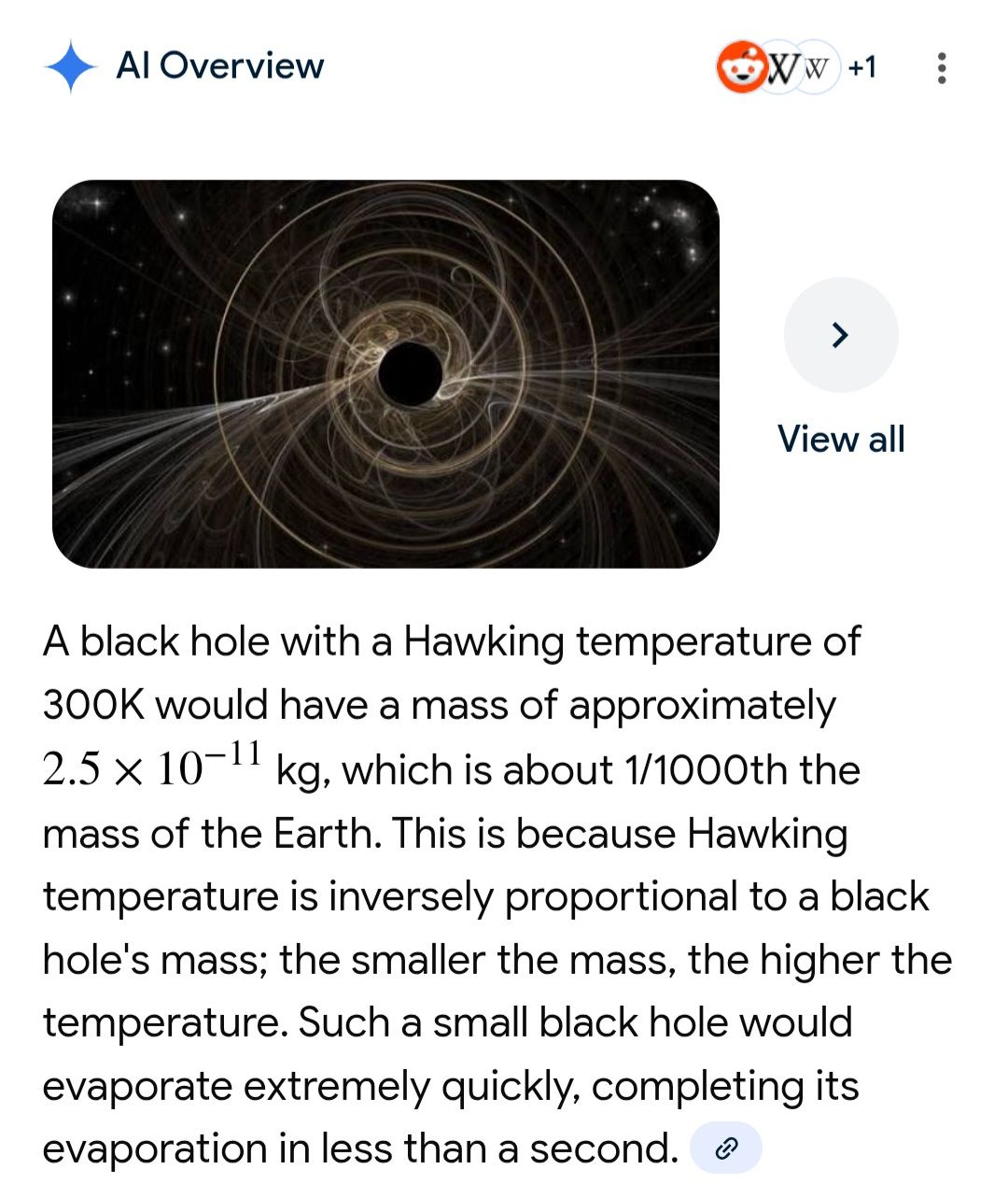
For a laugh I asked Google for the answer. Here is the AI summary:

Bonus marks for pointing out everything that’s wrong in this summary.

In-Tray

Posted in Biographical with tags , , on November 25, 2025 by telescoper

Yesterday I came across the old cartoon shown above and shared it on Bluesky. It seemed to cause some amusement so I thought I’d share it here too.

The in-tray reminds me of when I (briefly) worked in industry during the 80s. There was a guy in our large open-plan office who had two trays on his desk, one with a sign marked “IN” and the other with a sign marked “OUT”. Things were delivered on Mondays to the in-trays and collected from out-trays at the end of the day on Fridays. This guy never touched the stuff in his in-tray but just before he left work on Fridays he would swap the signs on the two trays…

Weekly Update from the Open Journal of Astrophysics – 15/11/2025

Posted in OJAp Papers, Open Access, The Universe and Stuff with tags , , , , , , , , , , , , , , , , , , , , , , , , , , , , , on November 15, 2025 by telescoper

It’s Saturday again, so it’s time for the usual update of the week’s new papers at the Open Journal of Astrophysics. It has been quite a busy week. Since the last update we have published another seven papers, which brings the number in Volume 8 (2025) up to 175, and the total so far published by OJAp up to 410.

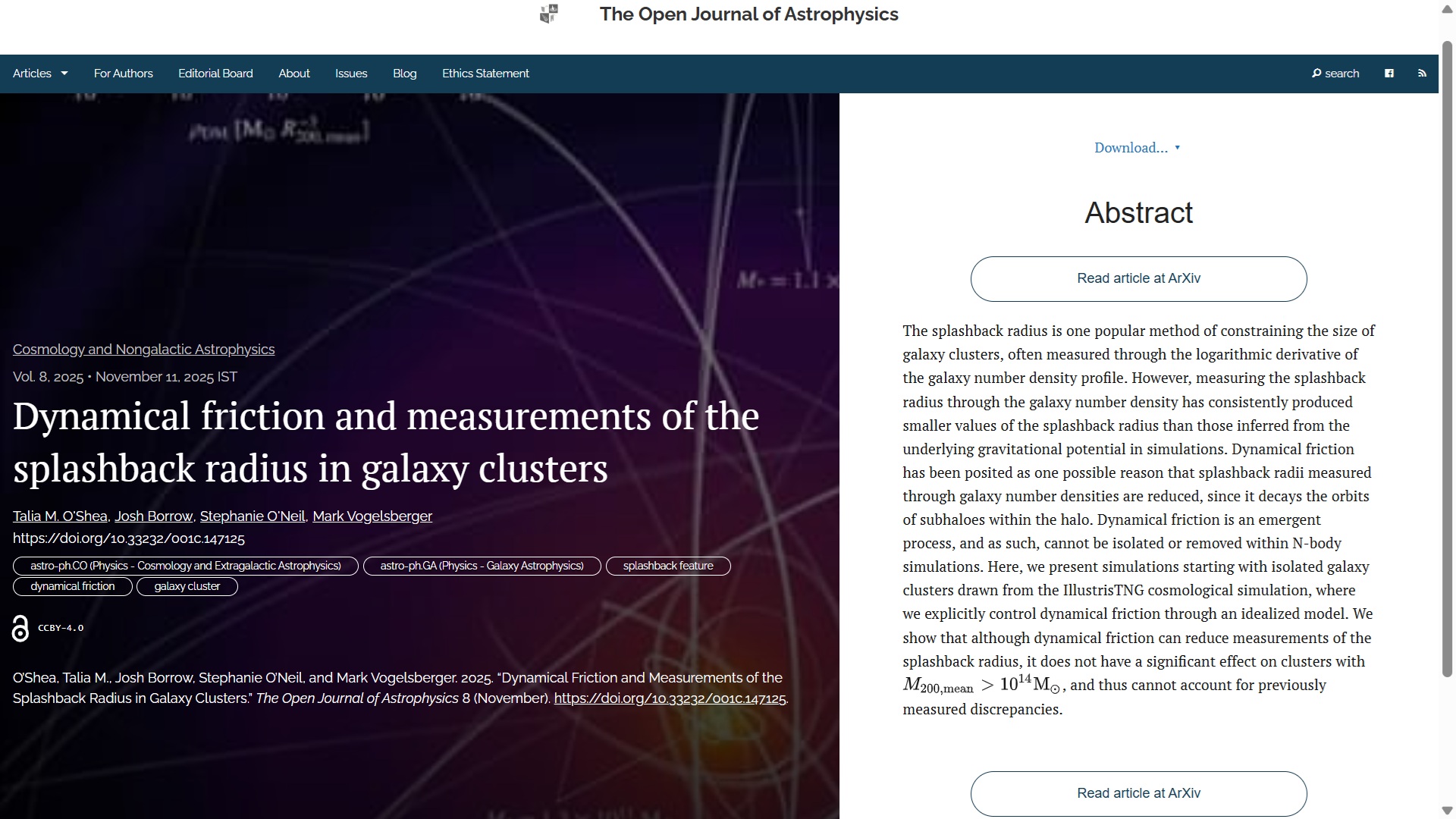
First on the menu for this week is “Dynamical friction and measurements of the splashback radius in galaxy clusters” by Talia M. O’Shea (U. Wisconsin-Madison, USA), Josh Borrow & Stephanie O’Neil (U. Pennsylvania, USA) and Mark Vogelsberger (MIT, USA). Published on Tuesday 11th November in the folder Cosmology and NonGalactic Astrophysics, this one presents a study suggesting that dynamical friction does not play a major role in reducing the radius of the splashback feature in real data compared to numerical simulations.

The overlay is here:

You can find the officially accepted version on arXiv here.

The Fediverse announcement is here:

Open Journal of Astrophysics

New Publication at the Open Journal of Astrophysics: "Dynamical friction and measurements of the splashback radius in galaxy clusters" by Talia M. O'Shea (U. Wisconsin-Madison, USA), Josh Borrow & Stephanie O'Neil (U. Pennsylvania, USA) and Mark Vogelsberger (MIT, USA)

doi.org/10.33232/001c.147125

November 11, 2025, 8:36 am 3 boosts 1 favorites


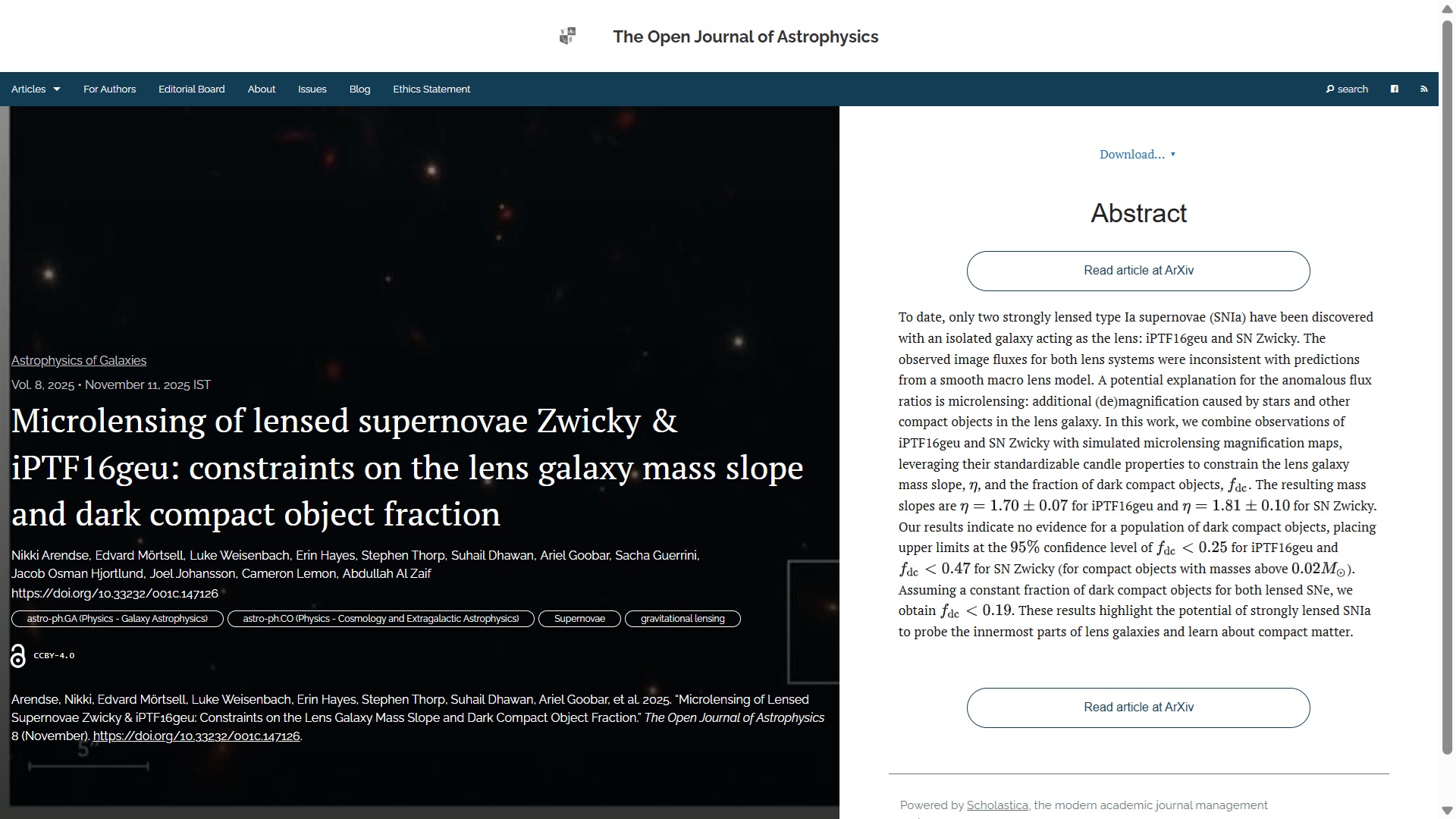
The second paper of the week is “Microlensing of lensed supernovae Zwicky & iPTF16geu: constraints on the lens galaxy mass slope and dark compact object fraction” by Nikki Arendse (Stockholm University, Sweden) and and international cast of 11 others based in Sweden, UK and France. This one was published on 11th November 2025 in the folder Astrophysics of Galaxies. It is about combining observations of two supernovae, iPTF16geu and SN Zwicky, with microlensing magnification maps to probe the properties of the lens galaxy.

The overlay is here:


You can find the official version of this one on arXiv here. The federated announcement on Mastodon is here:

Open Journal of Astrophysics

New Publication at the Open Journal of Astrophysics: "Microlensing of lensed supernovae Zwicky & iPTF16geu: constraints on the lens galaxy mass slope and dark compact object fraction" by Nikki Arendse (Stockholm University, Sweden) and 11 others based in Sweden, UK and France

doi.org/10.33232/001c.147126

November 11, 2025, 8:53 am 1 boosts 1 favorites


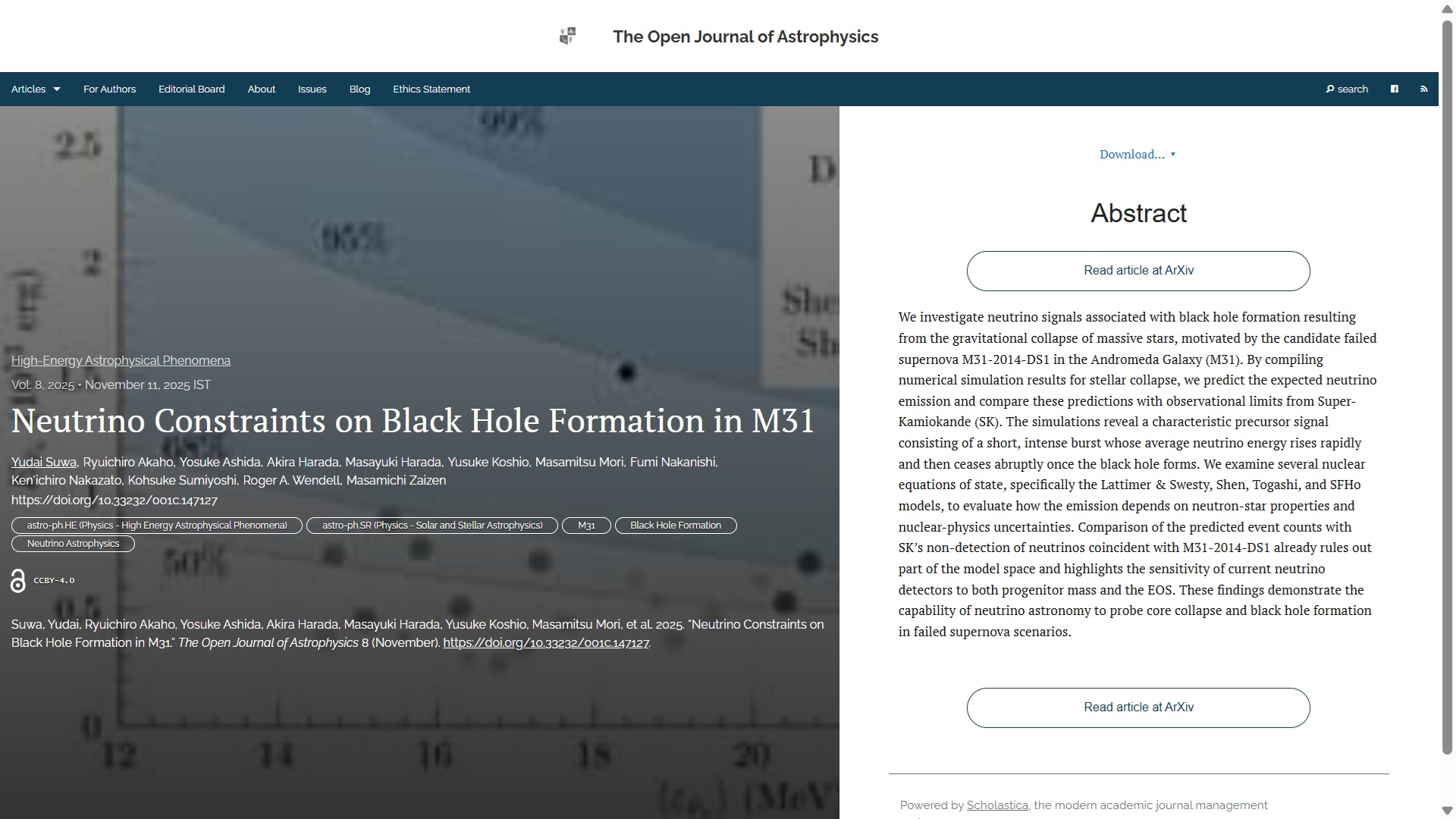
Next one up is “Neutrino Constraints on Black Hole Formation in M31” by Yudai Sawa (U. Tokyo, Japan) and 11 others all based in Japan. This was published on Tuesday 11th November in the folder High-Energy Astrophysical Phenomena. It presents a calculation of the neutrino emission expected from the collapse of massive stars and its use in constraining black hole formation using neutrino detectors.


The overlay is here:

You can find the official accepted version on arXiv here. The fediverse announcement is here:

Open Journal of Astrophysics

New Publication at the Open Journal of Astrophysics: "Neutrino Constraints on Black Hole Formation in M31" by Yudai Sawa (U. Tokyo, Japan) and 11 others all based in Japan

doi.org/10.33232/001c.147127

November 11, 2025, 9:04 am 0 boosts 1 favorites

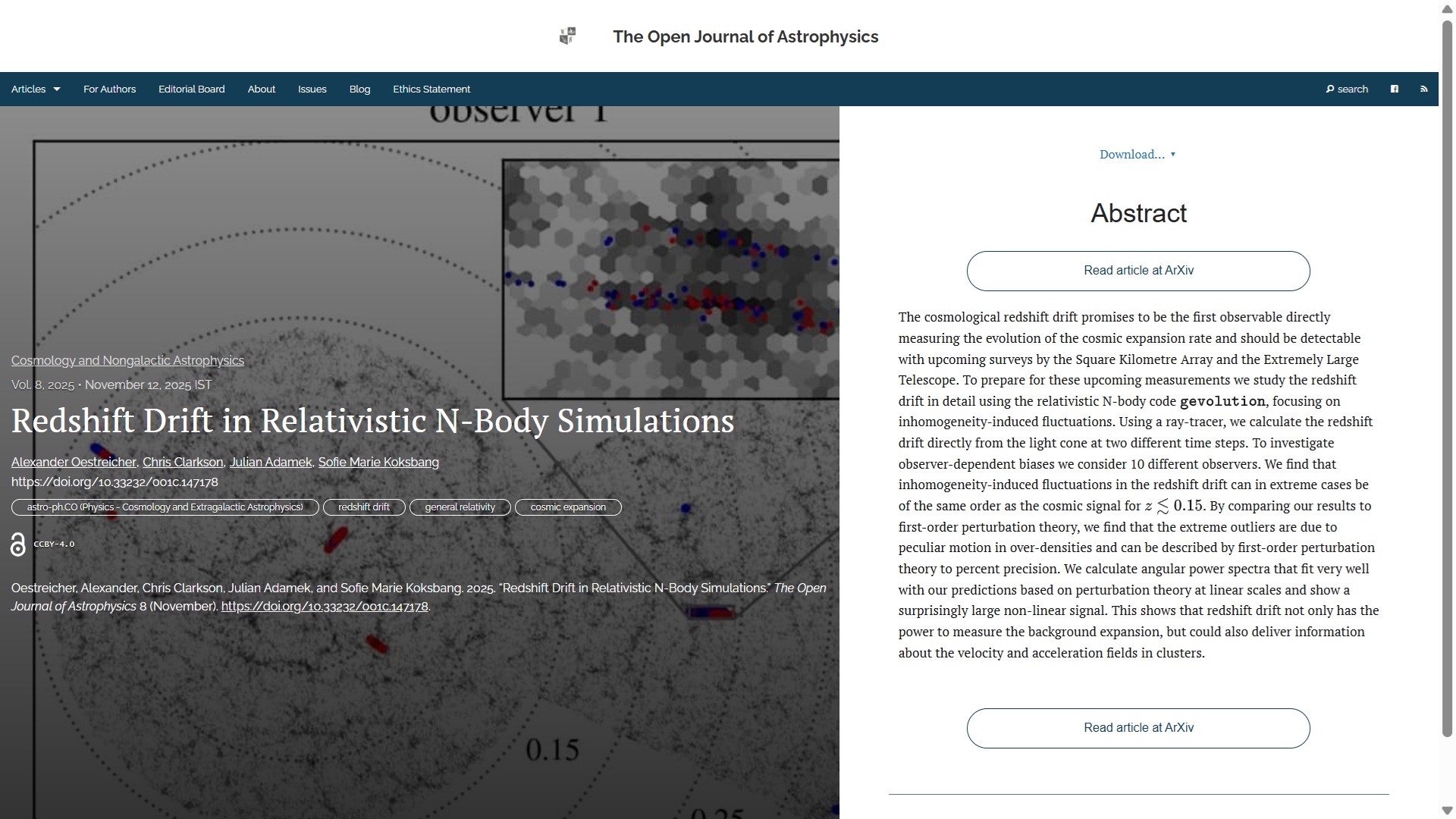
The fourth paper this week is “Redshift Drift in Relativistic N-Body Simulations” by Alexander Oestreicher (U. Southern Denmark, DK), Chris Clarkson (QMUL, UK), Julian Adamek (U. Zürich, CH) and Sofie Marie Koksbang (U. Southern Denmark, DK). This one was published on Wednesday 12th November in the folder marked Cosmology and NonGalactic Astrophysics. It presents numerical calculations of the cosmological redshift drift effect for comparison with future surveys.

The overlay is here:


You can find the official published version on arXiv here. The Fediverse announcement follows:

Open Journal of Astrophysics

New Publication at the Open Journal of Astrophysics: "Redshift Drift in Relativistic N-Body Simulations" by Alexander Oestreicher (U. Southern Denmark, DK), Chris Clarkson (QMUL, UK), Julian Adamek (U. Zürich, CH) and Sofie Marie Koksbang (U. Southern Denmark, DK)

doi.org/10.33232/001c.147178

November 12, 2025, 8:35 am 1 boosts 0 favorites


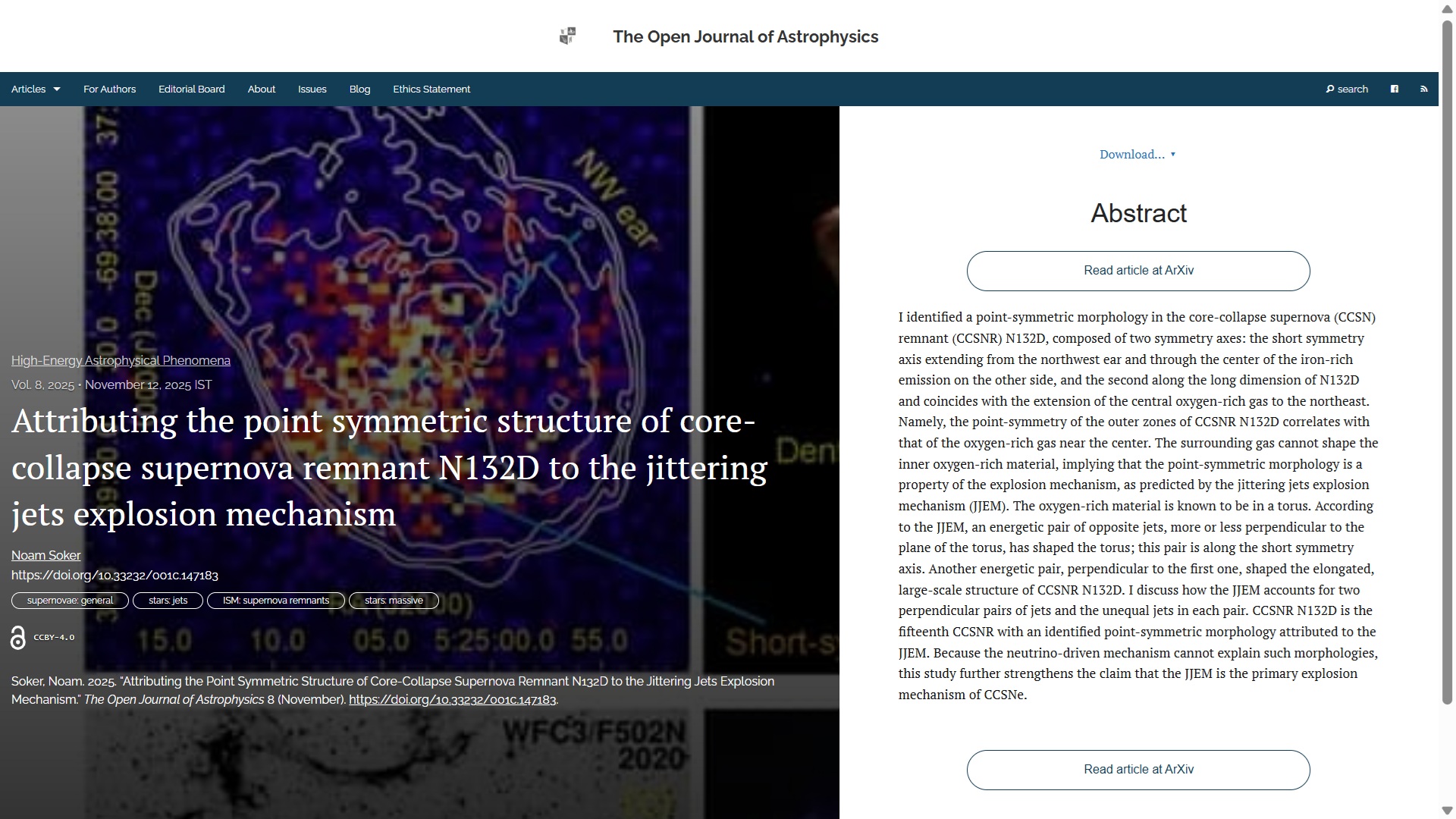
The fifth paper for this week is “Attributing the point symmetric structure of core-collapse supernova remnant N132D to the jittering jets explosion mechanism” by Noam Soker (Technion, Haifa, Israel). This one, published on Wednesday November 12th in the folder High-Energy Astrophysical Phenomena, presents a discussion of the morphology of a supernova remnant and possible explanation for it in terms of the explosion mechanism.

The overlay is here:


The officially accepted version can be found on arXiv here. The Fediverse announcement is here:

Open Journal of Astrophysics

New Publication at the Open Journal of Astrophysics: "Attributing the point symmetric structure of core-collapse supernova remnant N132D to the jittering jets explosion mechanism" by Noam Soker (Technion, Haifa, Israel)

doi.org/10.33232/001c.147183

November 12, 2025, 8:46 am 1 boosts 0 favorites

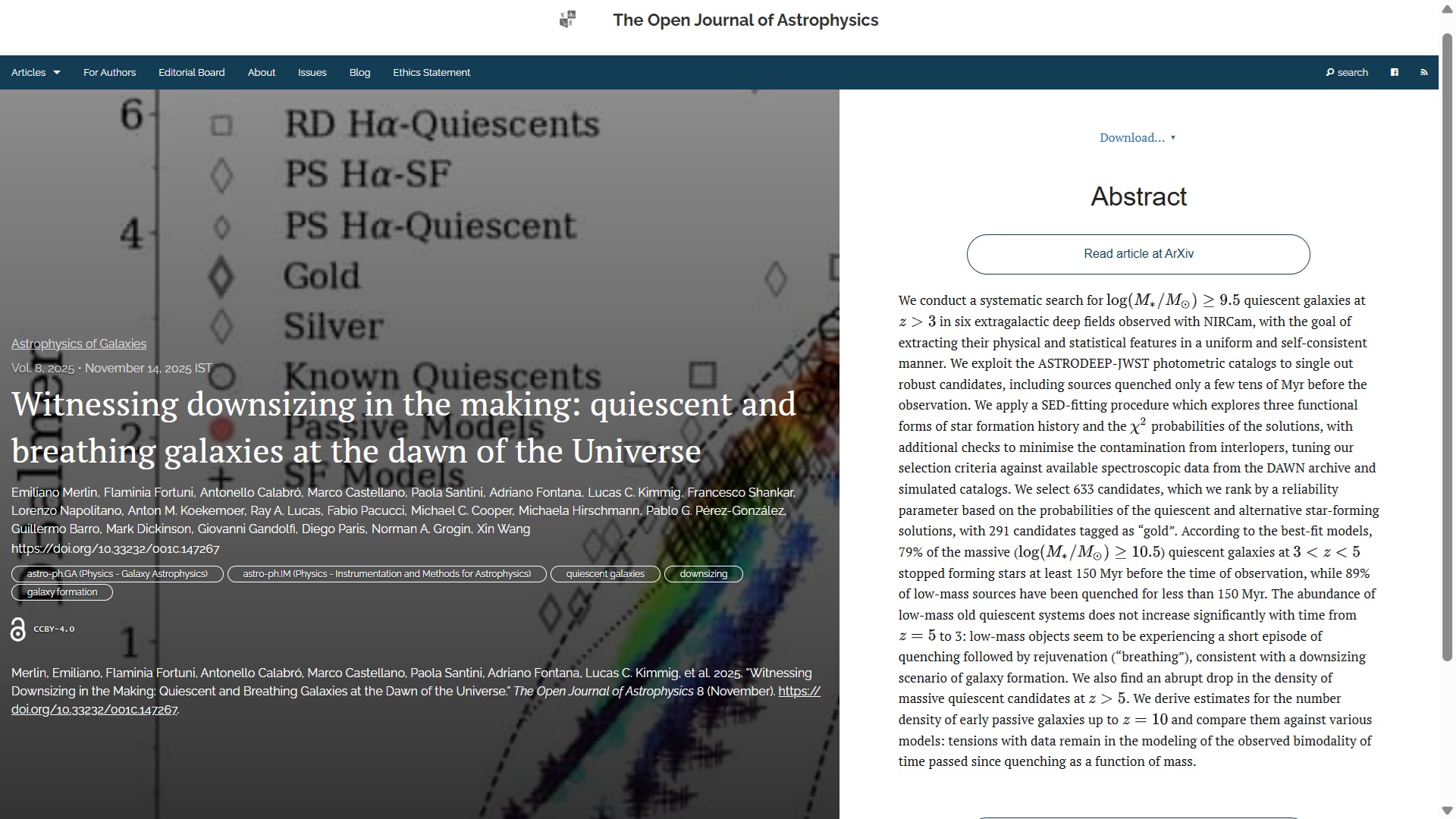
The sixth paper to report this week is “Witnessing downsizing in the making: quiescent and breathing galaxies at the dawn of the Universe” by Emiliano Merlin (Osservatorio Astronomico di Roma, Italy) and an international cast of 20 others based in Italy, Germany, UK, USA, Switzerland, Spain and China. This one was published on Friday November 14th in the folder Astrophysics of Galaxies.

You can find the officially-accepted version on arXiv here. The fediverse announcement is here:

Open Journal of Astrophysics

New Publication at the Open Journal of Astrophysics: "Witnessing downsizing in the making: quiescent and breathing galaxies at the dawn of the Universe" by Emiliano Merlin (Osservatorio Astronomico di Roma, Italy) and 20 others based in Italy, Germany, UK, USA, Switzerland, Spain and China

doi.org/10.33232/001c.147267

November 14, 2025, 8:38 am 1 boosts 1 favorites

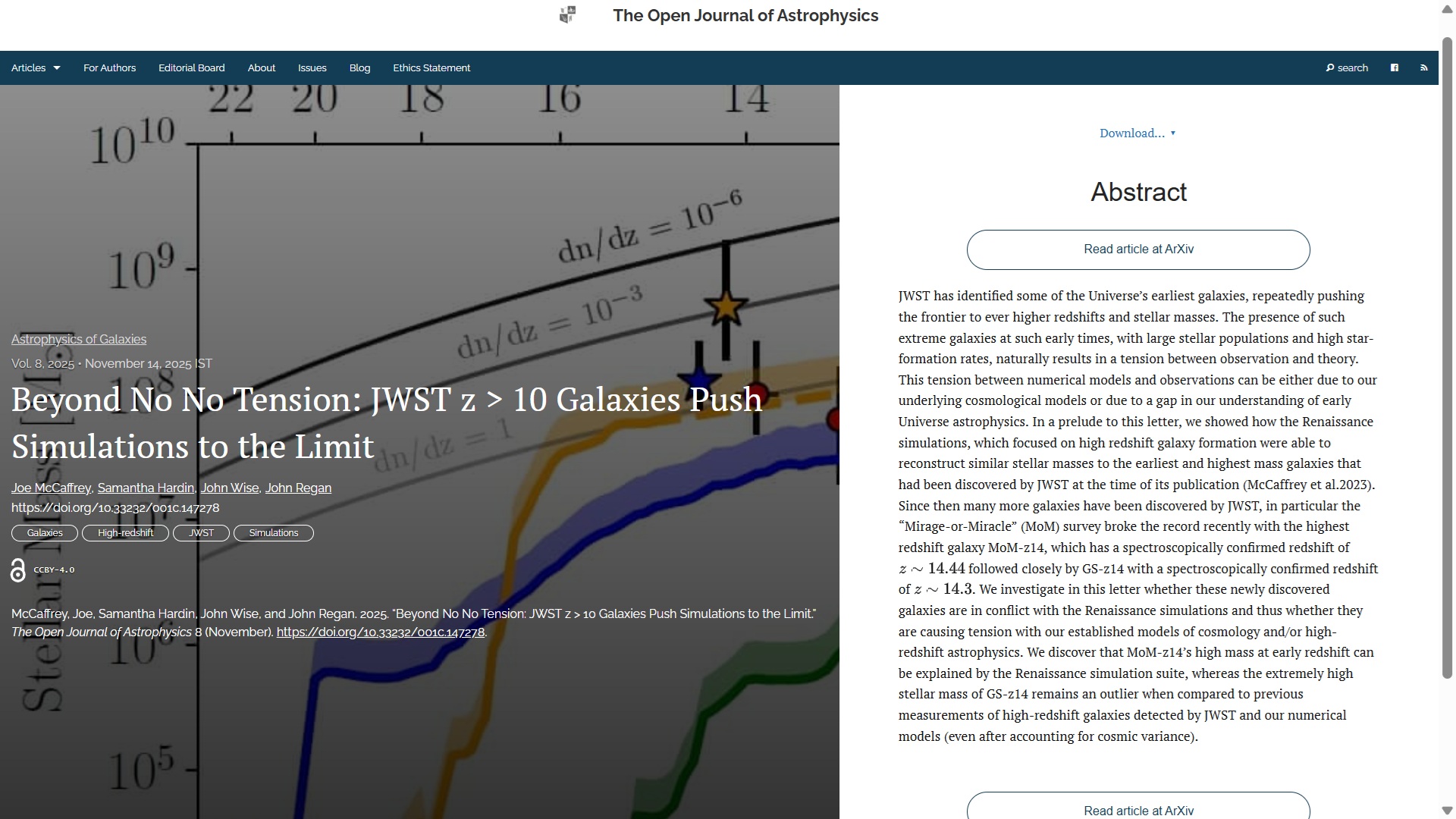
And finally (for this week) we have “Beyond No No Tension: JWST z > 10 Galaxies Push Simulations to the Limit” by Joe McCaffrey (NUI Maynooth, Ireland), Samantha Hardin & John Wise (Georgia Institute of Technology, USA) and John Regan (Maynooth). This one was also published on Friday 14th November, in the folder marked Astrophysics of Galaxies. It asks the question whether newly-discovered high redshift galaxies are consistent with simulations of galaxy formation. The overlay is here:

You can find the officially acceopted version on arXiv here. The fediverse announcement is here:

Open Journal of Astrophysics

New Publication at the Open Journal of Astrophysics: "Beyond No No Tension: JWST z > 10 Galaxies Push Simulations to the Limit" by Joe McCaffrey (NUI Maynooth, Ireland), Samantha Hardin & John Wise (Georgia Institute of Technology, USA) and John Regan (Maynooth)

doi.org/10.33232/001c.147278

November 14, 2025, 9:02 am 2 boosts 0 favorites

And that concludes the update for this week. There will be another next Saturday.

A Decade of Gravitational Waves

Posted in Biographical, The Universe and Stuff with tags , , , , , , on September 14, 2025 by telescoper

This is just a quick post to mark the fact that it is now ten years to the day since the first detection of gravitational waves by Advanced LIGO. The acronym LIGO stands for Laser Interferometer Gravitational-wave Observatory, by the way. It wasn’t until February 11th 2016 that the result was announced at a press conference (which I blogged about here), but the signal itself arrived on 14th September 2015, exactly a decade ago; the name given to the event was GW150914.

Here are the plots for that first one:

LIGO

That first signal corresponded to the coalescence of two black holes, of masses 29 and 36 times the mass of the Sun and produced a large response in the detectors very soon after Advanced LIGO was switched on. There’s synchronicity for you! The LIGO collaboration have done wondrous things getting their sensitivity down to such a level that they can measure such a tiny effect, but there still has to be an event producing a signal to measure. Collisions of two such massive black holes are probably extremely rare so it’s a bit of good fortune that one happened just at the right time. Actually it was during an engineering test.

There have been many subsequent detections and even more candidates waiting to be confirmed- here’s a full list. The official LIGO site states there are 90 confirmed detections, the 4th observational run (O4) (which is due to end in November 2025) has already found 200 candidates. The latest compilation of gravitational-wave transient sources can be found here.

Most of the detections have been binary black hole mergers, but I particularly remember the excitement in 2017 surrounding the first merger of a neutron star with a black hole. It was fun that rumours started to spread via this blog as people outside the LIGO/transient source community used a comments thread here to share information of what various telescopes were looking at. That was in August 2017, just over 8 years ago.

Anyway, here’s to the next decade. Assuming NSF does not follow Trump’s plan to slash the LIGO budget.

Galaxies and Black Holes in the First Billion Years

Posted in Biographical, The Universe and Stuff with tags , , , , , on September 1, 2025 by telescoper

Trying to catch up on recent developments in galaxy formation? I can heartily recommend an excellent review article on the subject by Richard Ellis which you can find on the arXiv here. The abstract reads:

 I present written notes from three lectures given at the 54th Saas-Fee Advanced Course of the Swiss Society of Astrophysics and Astronomy in January 2025 entitled “Galaxies and Black Holes in the First Billion Years as seen by the JWST”. I focused my lectures on progress in studies of cosmic reionisation, the properties of galaxies in the reionisation era, topics related to the redshift frontier and the search for Population III stars. The lectures were given to graduate students in astrophysics and cover both pedagogical material as well as observational results from the first two and half years of JWST science operations. The pace of discovery with JWST is, of course, rapid and so my lectures discuss long-term goals, analysis methods and their assumptions and limitations in the hope that the underlying material will retain value in the near future. In this written version, the visual material is that presented at Saas-Fee in January 2025 but I have provided updates on progress from the literature up to August 2025. The material is aimed at early career researchers and should not be considered as a scholarly review of the entire JWST literature on high redshift galaxies.

It’s quite a long article (65 pages) but nicely written and well worth reading, as it is full of information about recent advances as well as historical insights. Talking of which, there’s a picture on page 41 taken at a meeting in Durham in 1988 called The Epoch of Galaxy Formation that I attended while I was still a graduate student:

Richard Ellis himself is in the front row, left of centre with light-coloured trousers, checked shirt and hands in pockets. I’m in the picture too, but I’ll leave it up to you to find me!

A poll was held among the delegates at that meeting about various questions to do with galaxy formation. The majority opinions revealed by these votes nearly all turned out to be utterly wrong! That’s progress, I guess…

Primordial Black Holes in Cosmological Simulations – Update

Posted in Maynooth, The Universe and Stuff with tags , , on August 28, 2025 by telescoper

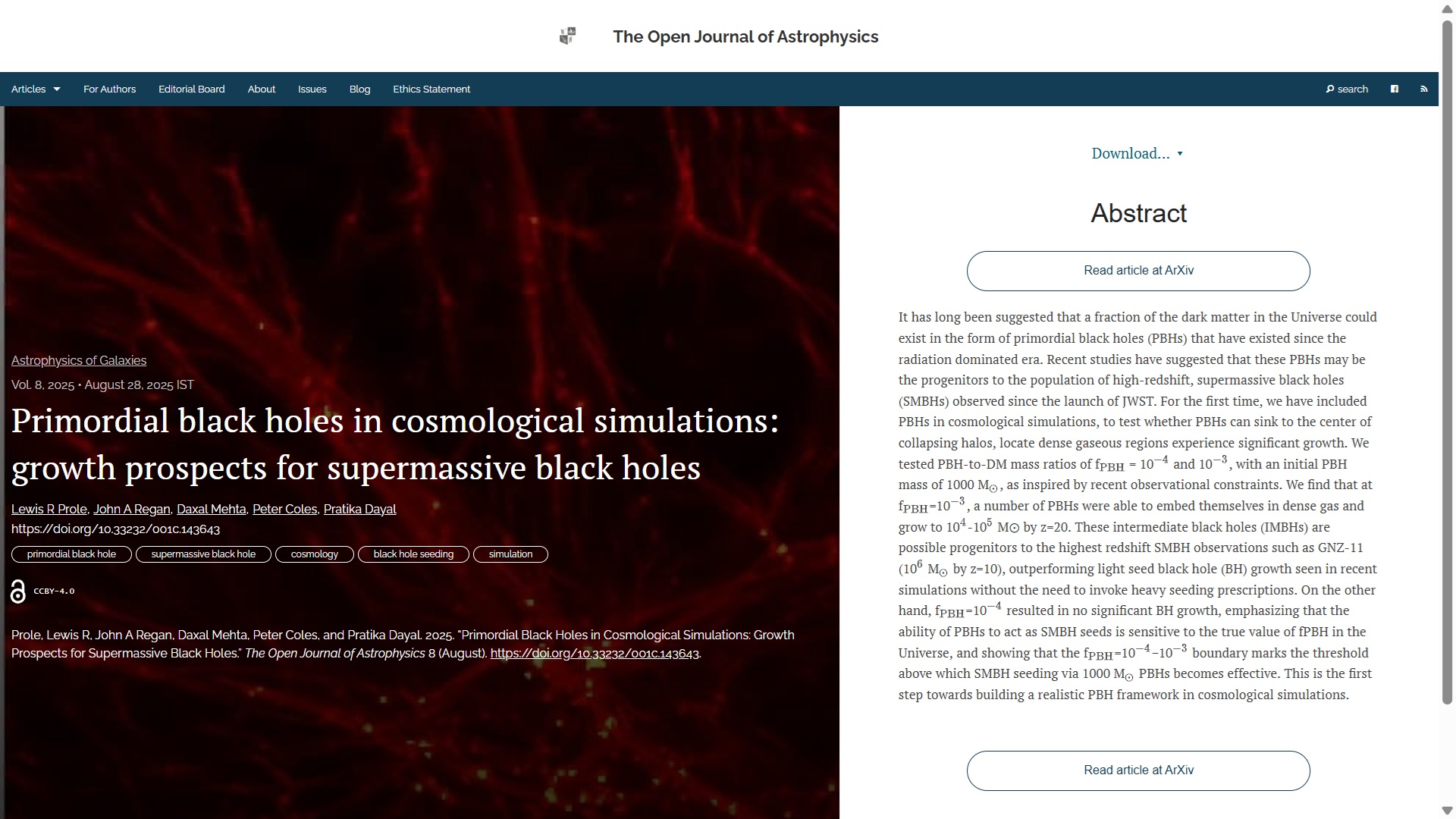
Just time for a quick update about a paper that I posted about at the start of the summer, when it appeared on arXiv. At that time it had already gained a bit of traction in the media, e.g. here. Well, the paper is now published in the Open Journal of Astrophysics. Obviously, as an author I was conflicted so not involved in the editorial process.

Here is the overlay:

For those of you not in the field, there is currently a big mystery about how galaxies we have found at high redshift with JWST managed to acquire massive black holes so early in the Universe’s evolution. Black holes can grow quickly in a dense environment by accreting mass onto an initial seed, but what are the seeds? In this paper we investigate the possibility that they were primordial black holes. These form directly from fluctuations in the early Universe, as opposed to astrophysical black holes which form from stellar collapse. We don’t know exactly what mass primordial black holes would have nor how numerous they would be, but this paper uses high-resolution numerical experiments to investigate their effects if they do exist.

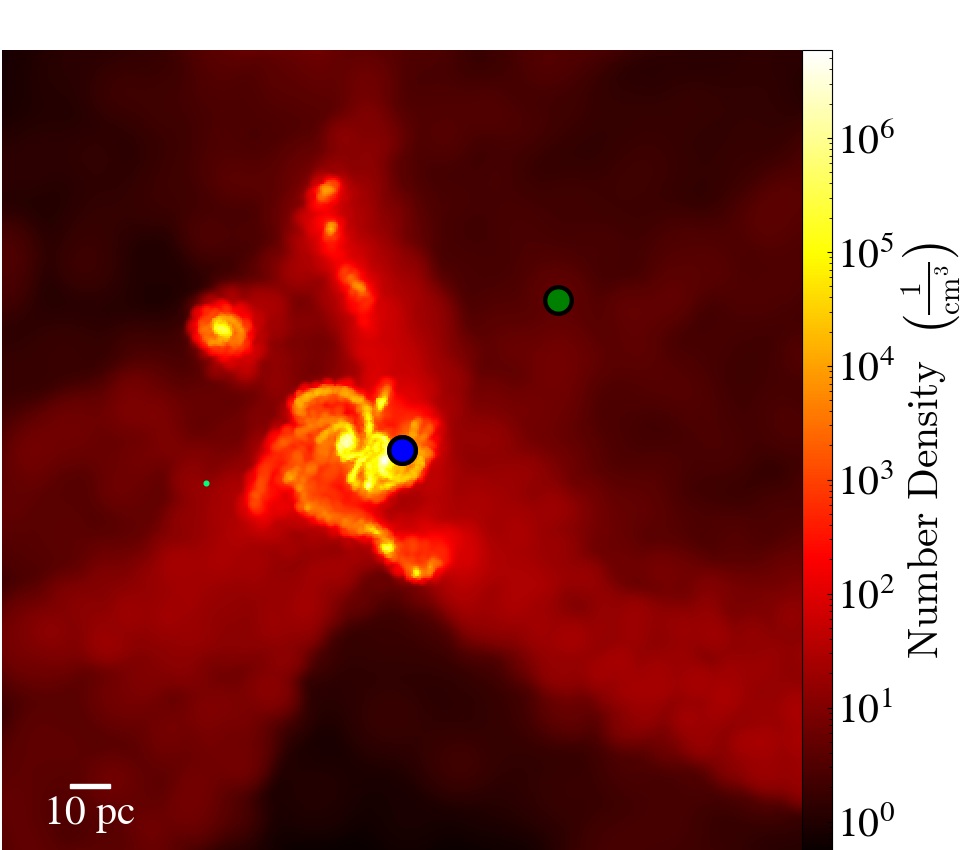
Here’s a pretty picture which is a zoom into 200 pc of the full simulation. I think 10pc counts as high resolution for a cosmological simulation! The blue circle shows the most massive PBH in the simulation, the green circle shows its nearest neighbour. The colour scale represents the number-density of dark matter particles.

For more details, read the paper!

Weekly Update from the Open Journal of Astrophysics – 12/07/2025

Posted in OJAp Papers, Open Access, The Universe and Stuff with tags , , , , , , , , , , , , , , , , , , , , , , , , , on July 12, 2025 by telescoper

It’s Saturday morning again, so it’s time again for an update of papers published at the Open Journal of Astrophysics. Since the last update we have published seven new papers, which brings the number in Volume 8 (2025) up to 92, and the total so far published by OJAp  up to 327.

This was a slightly strange week, starting with the fact that there were no new arXiv announcements on Monday 7th July because of the 4th July holiday in the USA on Friday so no papers were published that day. We were not able to publish any papers on Wednesday 9th July either because Crossref was offline for 24 hours that day while its data was migrated into the cloud. Our publishing process requires a live connection with Crossref to deposit metadata upon publication so we can’t publish while that service is down. Fortunately the update seems to have gone well and normal services resumed the following day. That partially accounts for the fact that four of this week’s papers were published on 10th July.

Anyway, The papers published this week, with their overlays, are as follows.  You can click on the images of the overlays to make them larger should you wish to do so.

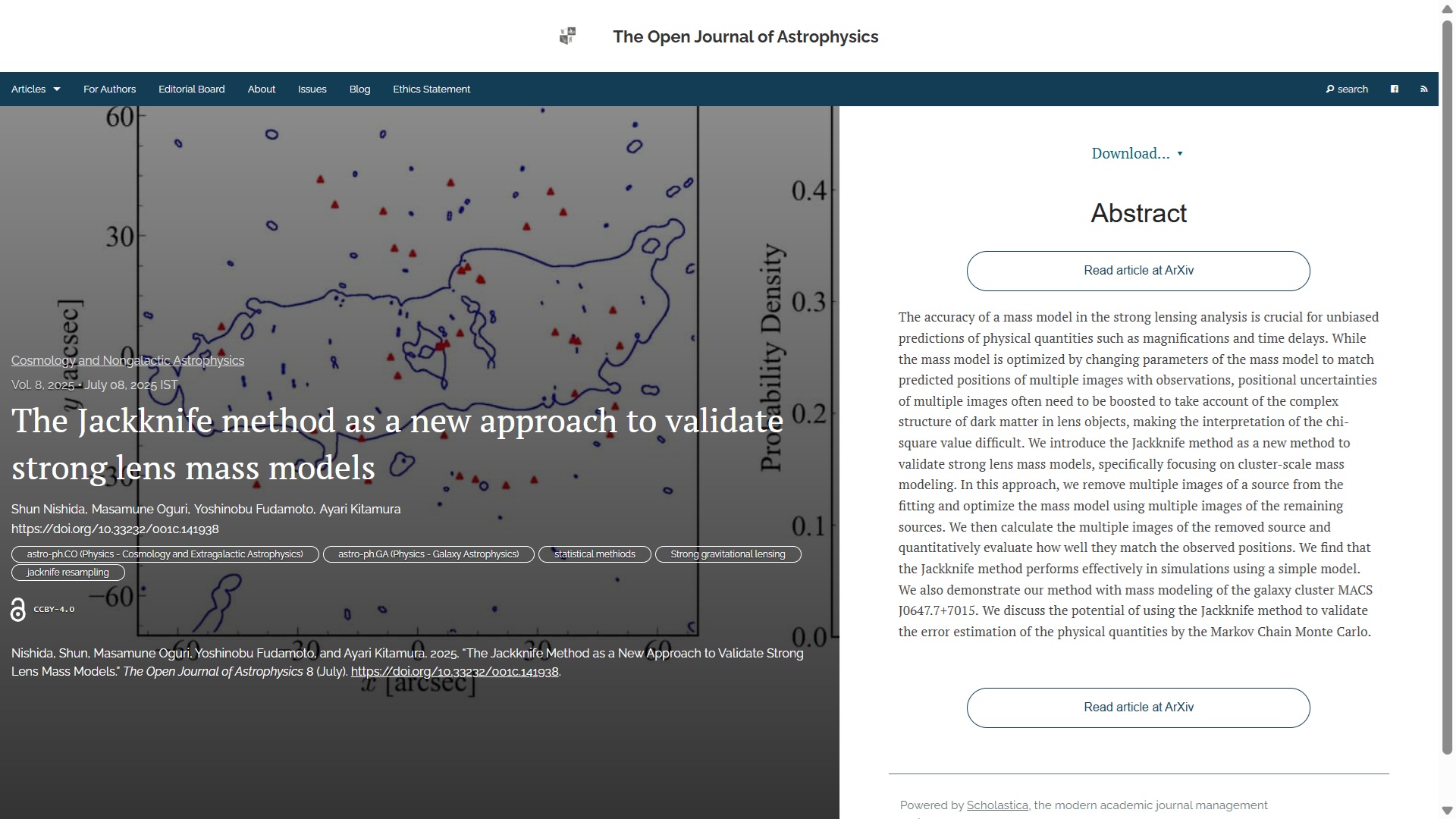
The first paper to report is “The Jackknife method as a new approach to validate strong lens mass models” by Shun Nishida & Masamune Oguri (Chiba University, Japan) , Yoshinobu Fudamoto (Steward Observatory, USA) and Ayari Kitamura (Tohoku University, Japan). This article, which is in the folder marked Cosmology and NonGalactic Astrophysics,  describes and application of the Jackknife statistical resampling techique to gravitational lensing by removing lensed images and recalcualting the mass modelIt was published on Tuesday 8th July 2025. The overlay is here:


The officially-accepted version can be found on arXiv here.

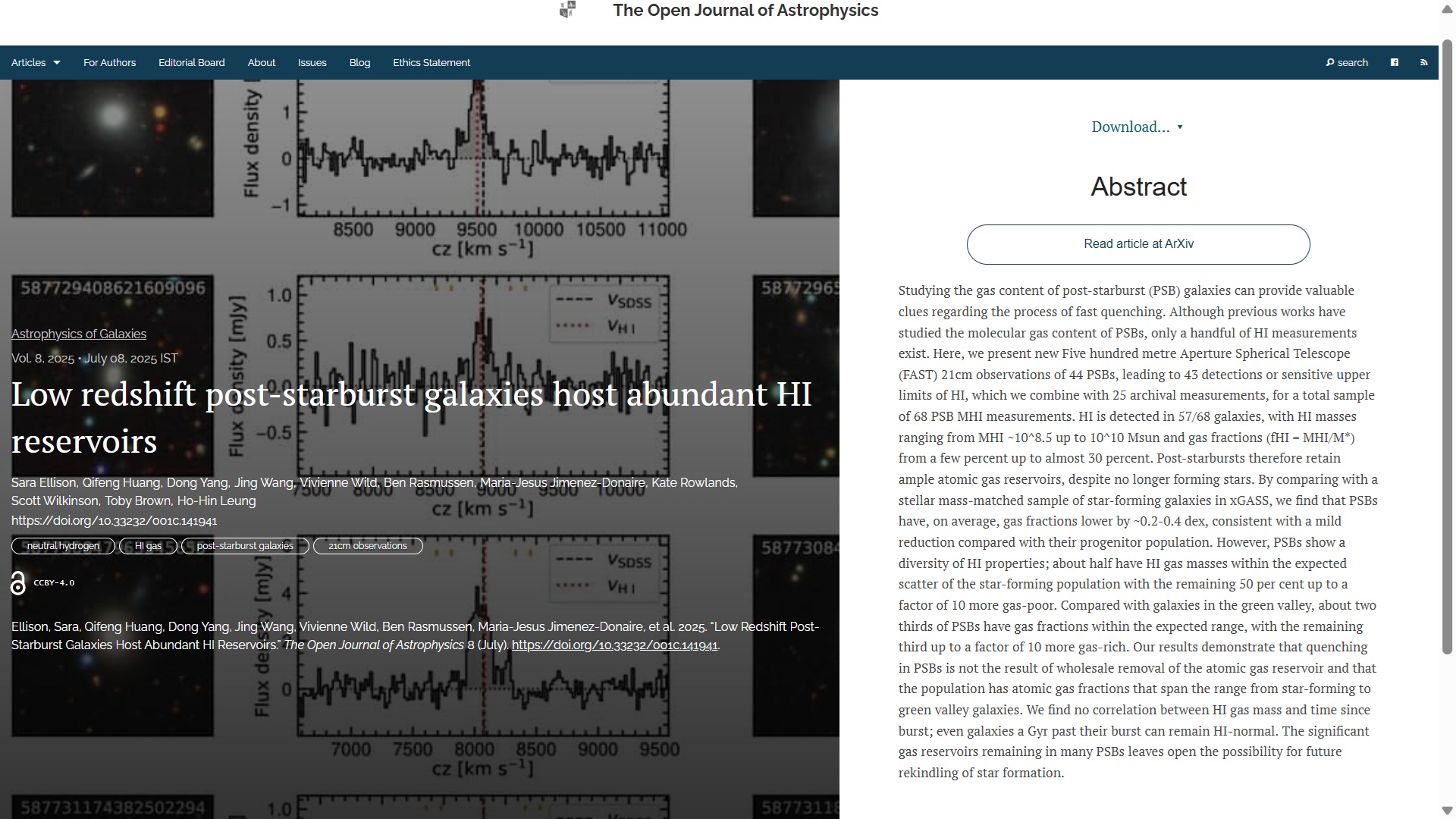
The second paper is “Low redshift post-starburst galaxies host abundant HI reservoirs” by Sara Ellison (U. Victoria, Canada) and 10 others based in China, UK, Spain, USA and Canada.  This one was also published oon Tuesday 8th July but in the folder Astrophysics of Galaxies. This paper uses 21cm observations of a sample of post-starburst galaxies, to show  that they contain large reservoirs of neutral hydrogen. Here is the overlay:

You can find the final version of the manuscript on arXiv here.

Next one up, one of four published on Thursday 10th July, is “Predicting the number density of heavy seed massive black holes due to an intense Lyman-Werner field” by Hannah O’Brennan (Maynooth University, Ireland) and 7 others based in Ireland, USA and Italy. This paper presents an exploration of the scenario for black hole formation driven by Lyman-Werner photons (i.e. ultraviolet radiation in the range 11.2 to 13.6 eV). It is in the folder marked Cosmology and NonGalactic Astrophysics, and the overlay is here:
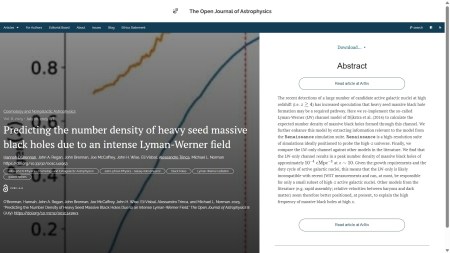
 

You can read the final accepted version on arXiv here.

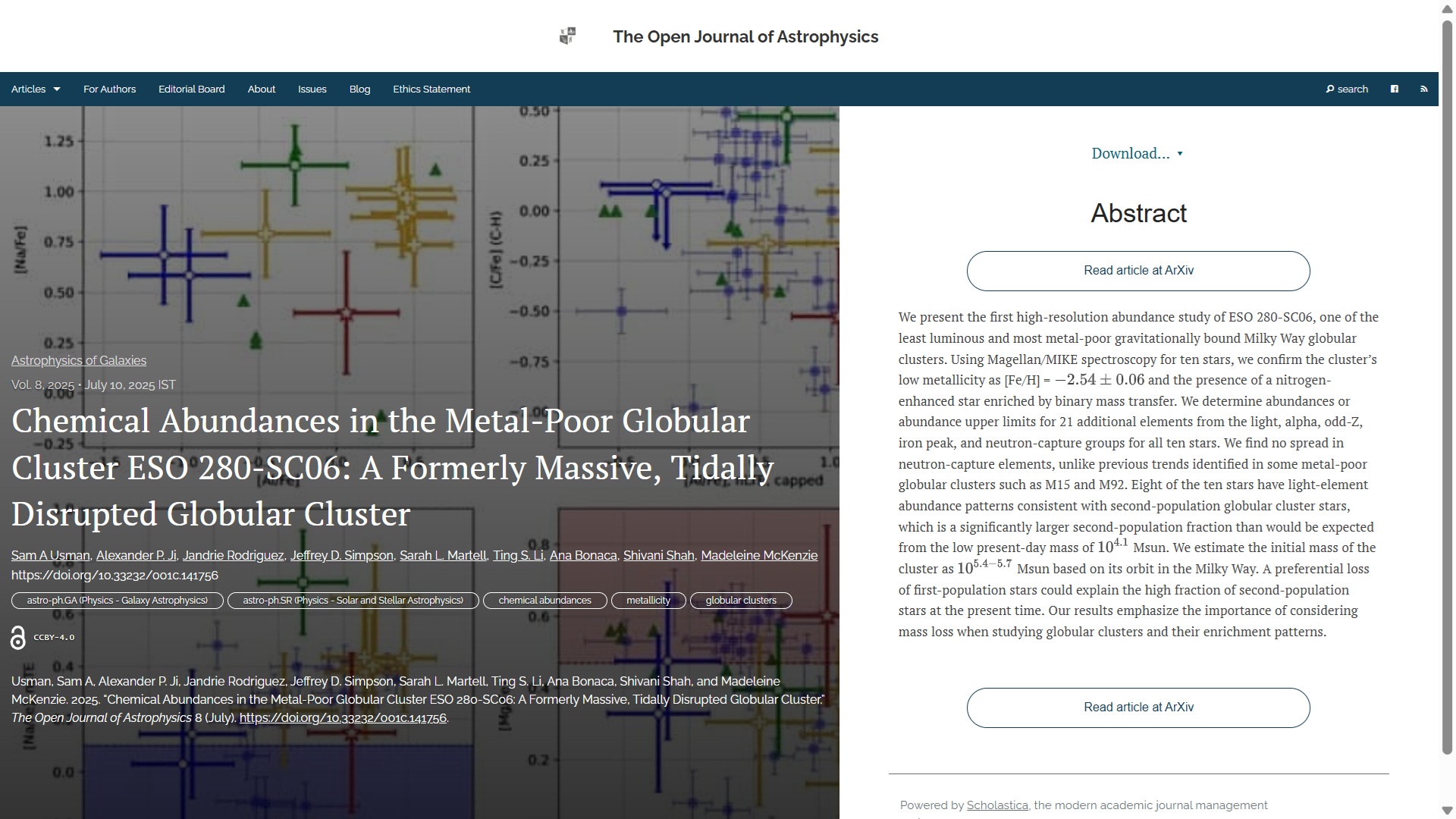
The fourth paper this week, and the second published on 10th July, is “Chemical Abundances in the Metal-Poor Globular Cluster ESO 280-SC06: A Formerly Massive, Tidally Disrupted Globular Cluster” by Sam A. Usman (U. Chicago, USA) and 8 others based in the USA, Canada and Australia. This paper, which is in the folder Astrophysics of Galaxies, presents a detailed spectroscopic study of the chemical abundances in a Milky Way globular cluster ESO 280-SC06. The overlay is here:

The officially accepted version of the paper can be read here.

Next one up, also published on 10th July and also in the folder marked Astrophysics of Galaxies is “Predictions for the Detectability of Milky Way Satellite Galaxies and Outer-Halo Star Clusters with the Vera C. Rubin Observatory” by Kabelo Tsiane (U. Michigan) and 9 others on behalf of the LSST Dark Energy Science Collaboration.

The overlay is here:


You can find the officially-accepted version of the paper on arXiv here.

The penultimate paper for this week, and the last of the batch published on 10th July,  is “Systematically Measuring Ultra-Diffuse Galaxies. VIII. Misfits, Miscasts, and Miscreants” by Dennis Zaritsky, Richard Donnerstein, and Donghyeon J. Khim (Steward Observatory, U. Arizona, USA). This paper presents a morphological study of weird and wonderful galaxies as part of an effort to Systematically Measure Ultra-Diffuse Galaxies (the SMUDGes survey). It is in the folder marked Astrophysics of Galaxies. The overlay is here:
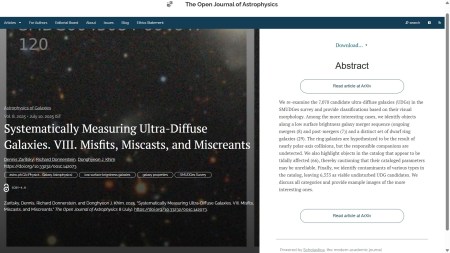
 

You can find the officially-accepted version of the paper on arXiv here.

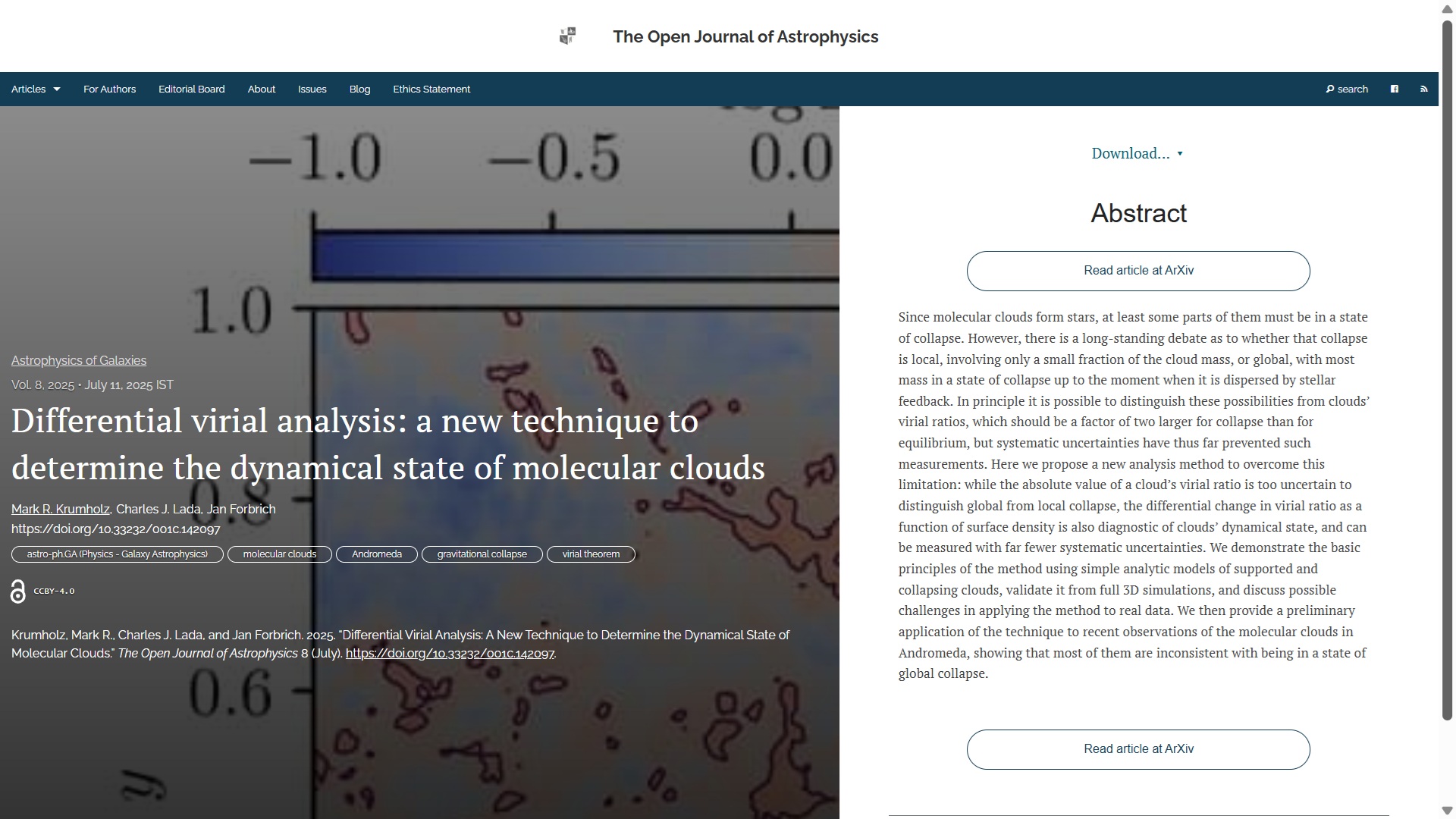
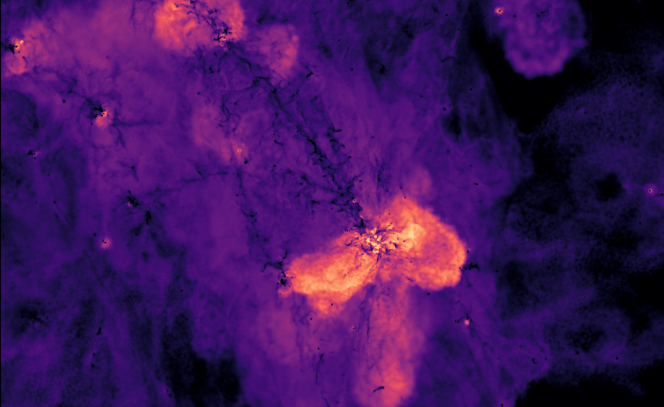
The last article published this week is “Differential virial analysis: a new technique to determine the dynamical state of molecular clouds” by Mark R. Krumholz (ANU, Australia), Charles J. Lada (Harvard, USA) & Jan Forbrich (U. Herts, UK). This paper presents simple analytic models of supported and collapsing molecular clouds, tested using full 3D simulations and applied to observed clouds in Andromeda. It is in the folder marked Astrophysics of Galaxies and was published yesterday, i.e on Friday 11th July 2025. Here is the overlay


You can find the officially-accepted version on arXiv here.

And that’s all the papers for this week. I will, however, take this opportunity to mention that a while ago I was interviewed about the Open Journal of Astrophysics by Colin Stuart on behalf of the Foundational Questions Institute; the write-up of the interview can be found here.

Primordial Black Holes in Cosmological Simulations

Posted in Maynooth, The Universe and Stuff with tags , , on June 29, 2025 by telescoper

Being so busy for the last couple of weeks I omitted to engage in the gratuitous self-promotion that one would expect from a blogger, so I’m remedying that today by pointing out that I’m co-author of a new paper that is now on arXiv. This has already gained a bit of traction in the media, e.g. here.

Here is the abstract, which also shows the author list:

(I’ve just noticed that it says “The Netherland”, instead of “The Netherlands”. Oops!)

For those of you not in the field, there is currently a big mystery about how galaxies we have found at high redshift with JWST managed to acquire massive black holes so early in the Universe’s evolution. Black holes can grow quickly in a dense environment by accreting mass onto an initial seed, but what are the seeds? In this paper we investigate the possibility that they were primordial black holes. These form directly from fluctuations in the early Universe, as opposed to astrophysical black holes which form from stellar collapse. We don’t know exactly what mass primordial black holes would have nor how numerous they would be, but this paper uses high-resolution numerical experiments to investigate their effects if they do exist.

Here’s a pretty picture which is a zoom into 200 pc of the full simulation. I think 10pc counts as high resolution for a cosmological simulation! The blue circle shows the most massive PBH in the simulation, the green circle shows its nearest neighbour. The colour scale represents the number-density of dark matter particles.

For more details, read the paper!

P.S. This article has been submitted to the Open Journal of Astrophysics and is currently under review. As an author I am not involved in the editorial process.

Roger Penrose: Discoverer of Black Holes?

Posted in History, The Universe and Stuff with tags , , , , , , , , , on February 27, 2025 by telescoper

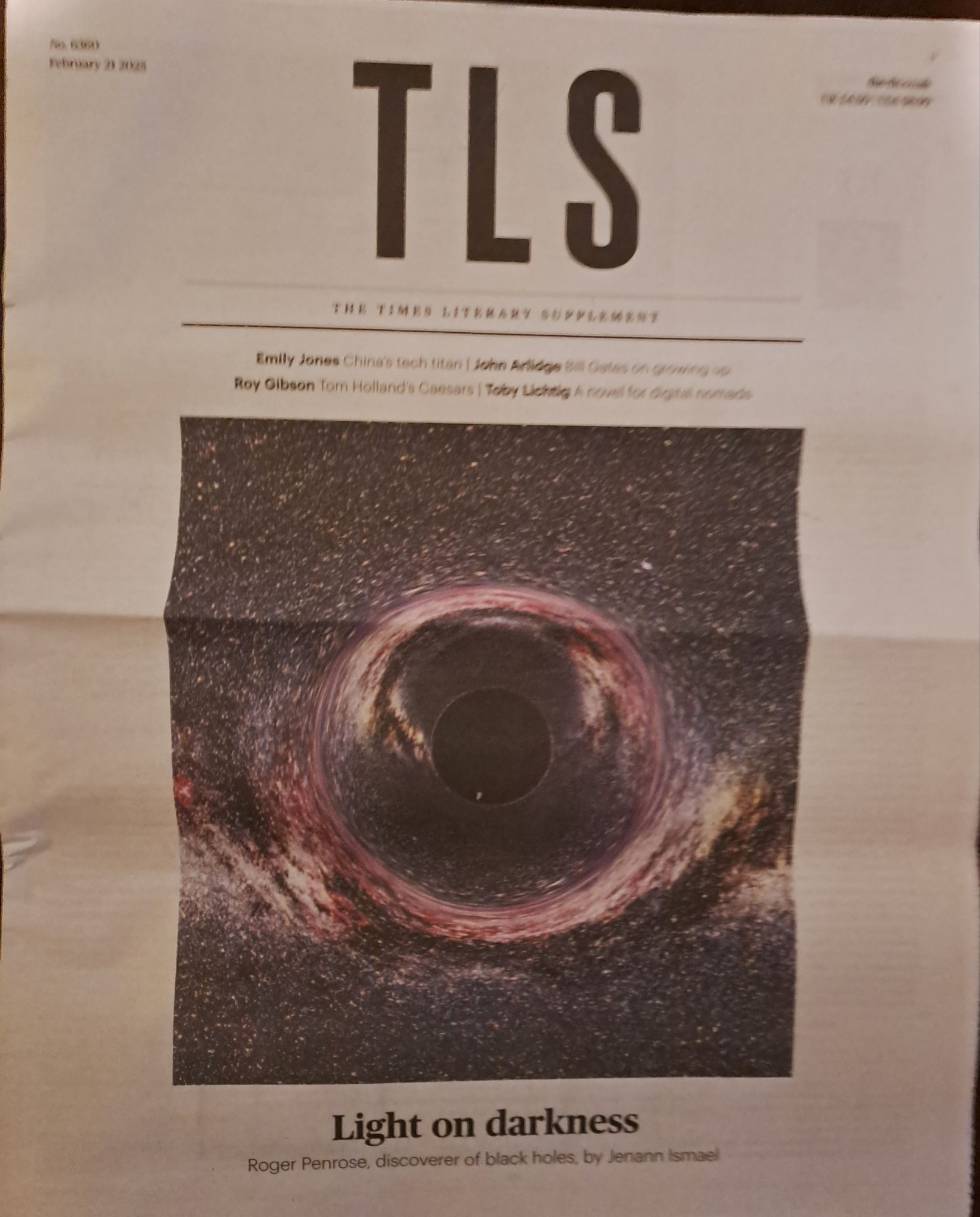
I got home from a busy day on campus to find the 21st February issue of the Times Literary Supplement had landed on my doormat having arrived today, 27th February. It used to take a couple of weeks for my subscription copy to reach Ireland but recently the service has improved. Intriguingly, the envelope it comes in is postmarked Bratislava…

But I digress. This is the cover:

The text below the title “Light on darkness” under the graphic reads “Roger Penrose, discoverer of black holes, by Jennan Ismael”. Nice though it is to see science featured in the Times Literary Supplement for a change and much as I admire Roger Penrose, it is unreasonable to describe him as “the discoverer of black holes”.

A black hole represents a region of space-time where the action of gravity is sufficiently strong that light cannot escape. The idea that such a phenomenon might exist dates back to John Michell, an English clergyman, in 1783, and later by Pierre-Simon Laplace but black holes are most commonly associated with Einstein’s theory of general relativity.  Indeed, one of the first exact solutions of Einstein’s equations to be found describes such an object. The famous Schwarzschild solution was obtained in 1915 by Karl Schwarzschild, who died soon after on the Eastern front in the First World War. The solution corresponds to a spherically-symmetric distribution of matter, and it was originally intended that it could form the basis of a mathematical model for a star. It was soon realised, however that for an object of any mass M there is a critical radius (Rs, the Schwarzschild radius) such that if all the mass is squashed inside Rs then no light can escape.  In terms of the mass M, velocity of light c, and Newton’s constant G, the critical radius is given by Rs = 2GM/c2 . For the mass of the Earth, the critical radius is only 1cm, whereas for the Sun it is about 3km.

Since the pioneering work of Schwarzschild, research on black holes has been intense and other kinds of mathematical solutions have been obtained. For example, the Kerr solution describes a rotating black hole and  the Reissner -Nordstrom solution corresponds to  a black hole with an electric charge.  Various theorems have also been demonstrated relating to the so-called `no-hair’ conjecture: that black holes give very little outward sign of what is inside.

Some people felt that the Schwarzschild solution was physically unrealistic as it required a completely spherical object, but Roger Penrose showed mathematically that the existence of a trapped surface was a generic consequence of gravitational collapse, the result that won him the Nobel Prize in 2020. His work did much to convince scientists of the physical reality of black holes, and he deserved his Nobel Prize, but I don’t think it is fair to say he “discovered” them.

I would say that, as is the case for discoveries in many branches of science, there isn’t just one “discoverer” of black holes: there were important contributions by many people along the way.

P.S. If you want to limit the application of the word “discovery” to observations then I think that the discovery of black holes is down to Paul Murdin and Louise Webster who identified the first really plausible candidate for a black hole in Cygnus X-1, way back in 1971…

P.P.S. The term “Black Hole” was, as far as I know, coined by John Wheeler in 1967.

Roger Penrose is 93.

New Publication at the Open Journal of Astrophysics

Posted in Maynooth, OJAp Papers, Open Access, The Universe and Stuff with tags , , , , , on November 30, 2024 by telescoper

It’s Saturday morning once again so it’s time for the usual weekly update of publications at the Open Journal of Astrophysics. This week’s report will be short because, like last week, there is only one paper to report this week, being  the 106th paper in Volume 7 (2024)  and the 221st  altogether. It was published on Thursday 28th November 2024. We have some more papers in the publishing pipeline, which I thought might appear, but they didn’t come out this week possibily because of the Thanksgiving holiday in the USA.

Anyway, The title of the latest paper is “Growth of Light-Seed Black Holes in Gas-Rich Galaxies at High Redshift” by Daxal Mehta, John Regan and Lewis Prole (all of the National University of Ireland, Maynooth*. This paper presents a discussion of the rate of growth of black holes in the early Universe on the basis of simulations run using the Arepo code.

Here is the overlay of the paper containing the abstract:


You can click on the image of the overlay to make it larger should you wish to do so. You can also find the officially accepted version of the paper on the arXiv here.

That’s all for this week – tune in next Saturday for next week’s update!

*The authors being from Maynooth, I of course recused myself from the editorial process for this article.