Archive for massive black holes

Weekly Update from the Open Journal of Astrophysics 27/06/2026

Posted in OJAp Papers, Open Access, The Universe and Stuff with tags , , , , , , , , , , , , , , , , , on June 27, 2026 by telescoper

It’s Saturday again so it’s time for another update of activity at the Open Journal of Astrophysics. Since the last update we have published a further three papers, bringing the number in Volume 9 (2026) to 129 and the total so far published by OJAp up to 577.

I will continue to include the posts made on our Mastodon account (on Fediscience); these announcements also show the DOI for each paper.

The first paper to report this week, published on Tuesday 23rd June, is “Interpretable machine learning of halo gas density profiles: a sensitivity analysis of cosmological hydrodynamical simulations” by Daniele Sorini & Sownak Bose (Durham University, UK), Mathilda Denison (U. Penn., USA) and Romeel Davé (University of Edinburgh, UK). This study uses cosmological hydrodynamical simulations and a random forest algorithm to understand how feedback processes affect the gas distribution in galaxies by predicting gas density profiles in various models. It is published in the folder Astrophysics of Galaxies.

The overlay for this paper is here
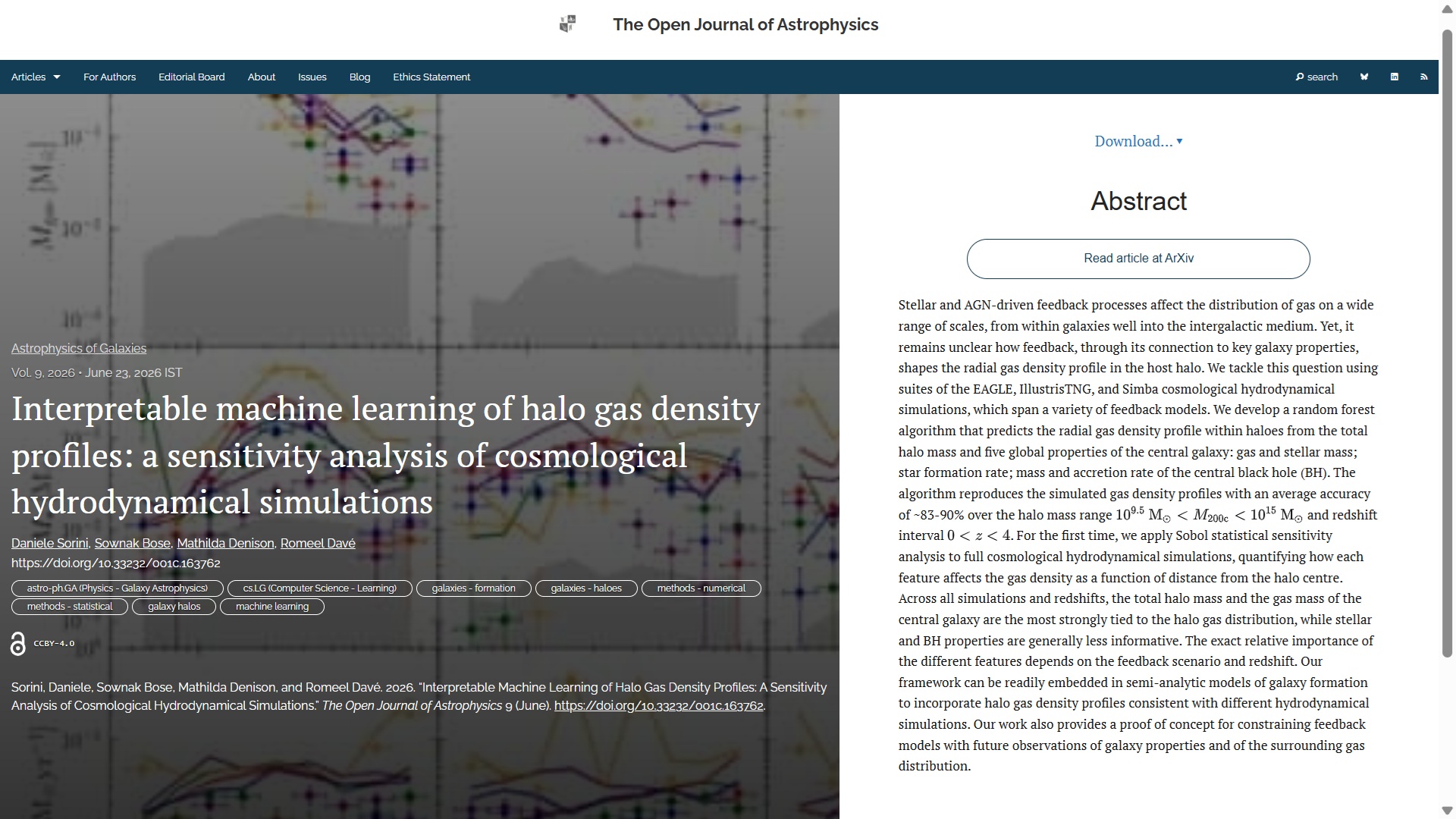
You can find the officially accepted version on arXiv here and the announcement on Fediverse here:

Open Journal of Astrophysics

New Publication atthe Open Journal of Astrophysics: "Interpretable machine learning of halo gas density profiles: a sensitivity analysis of cosmological hydrodynamical simulations" by Daniele Sorini & Sownak Bose (Durham U., UK), Mathilda Denison (U. Penn., USA) and Romeel Davé (U. Edinburgh, UK)

doi.org/10.33232/001c.163762

June 23, 2026, 7:15 am 1 boosts 0 favorites

The second paper for this week, published on Wednesday June 24th in the folder Astrophysics of Galaxies is “Dual-disk galaxies and thermal states of circumgalactic medium” by Masafumi Noguchi (Tohoku University, Japan). This paper explores the suggestion that the transition from thick to dual-disk galaxies is influenced by thermal changes in the circumgalactic medium (CGM), which also affects star formation.

The overlay looks like this:
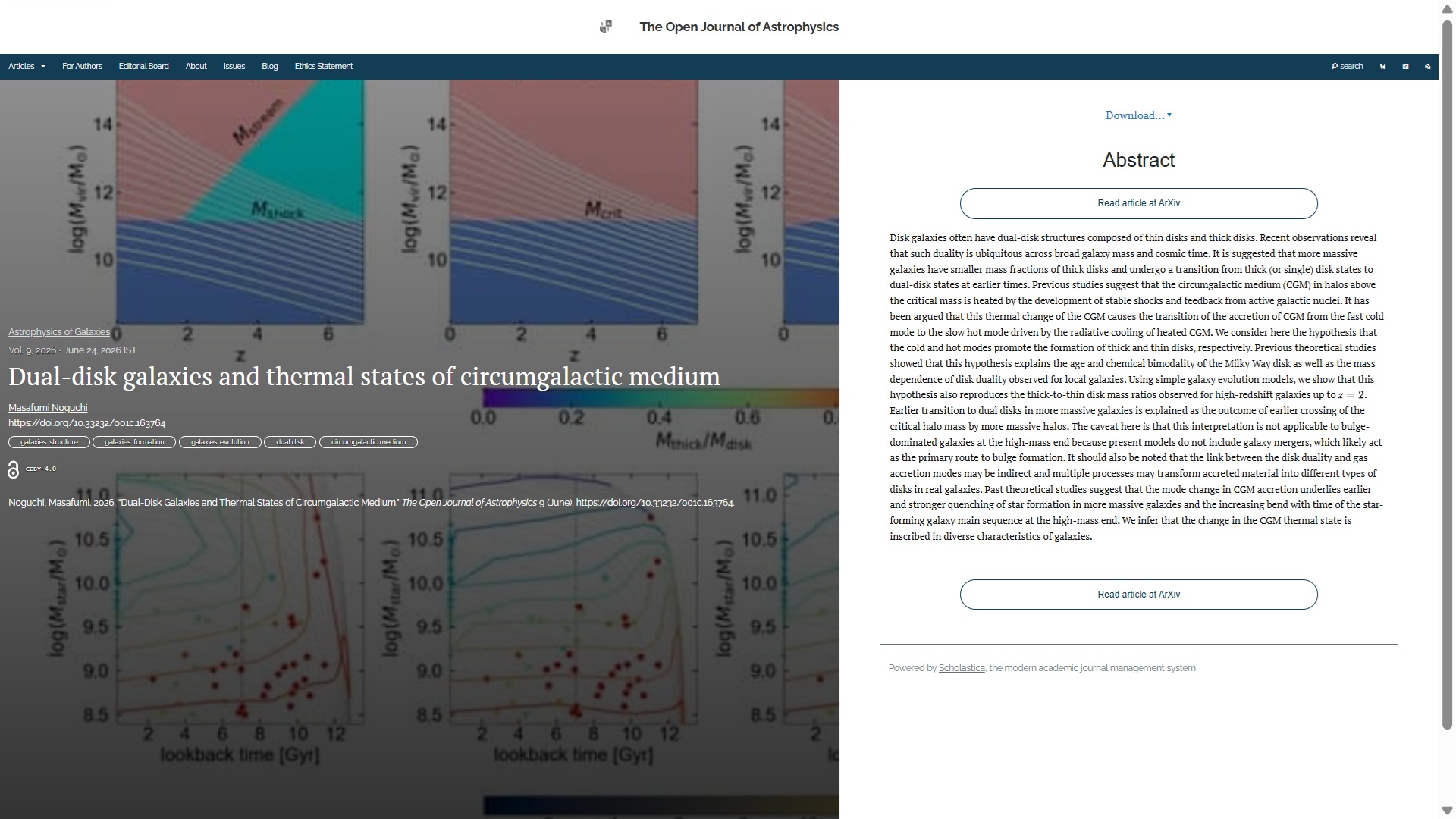
The official version of the paper can be found on arXiv here and the Fediverse announcement here:

Open Journal of Astrophysics

New Publication at the Open Journal of Astrophysics: "Dual-disk galaxies and thermal states of circumgalactic medium" by Masafumi Noguchi (Tohoku University, Japan).

doi.org/10.33232/001c.163764

June 24, 2026, 7:22 am 1 boosts 0 favorites

The third and finnal paper of the week, published on Friday 26th June in the folder High-Energy Astrophysical Phenomena, is “Mass Transfer in Tidally Heated Stars Orbiting Massive Black Holes and Implications for Repeating Nuclear Transients” by Philippe Z. Yao and Eliot Quataert (Princeton University, USA). This paper discusses how tidal heating alters the structure of stars near supermassive black holes, affecting mass transfer rates and potentially leading to low-luminosity active galactic nuclei and transient stellar phenomena.

The overlay for this one is here:
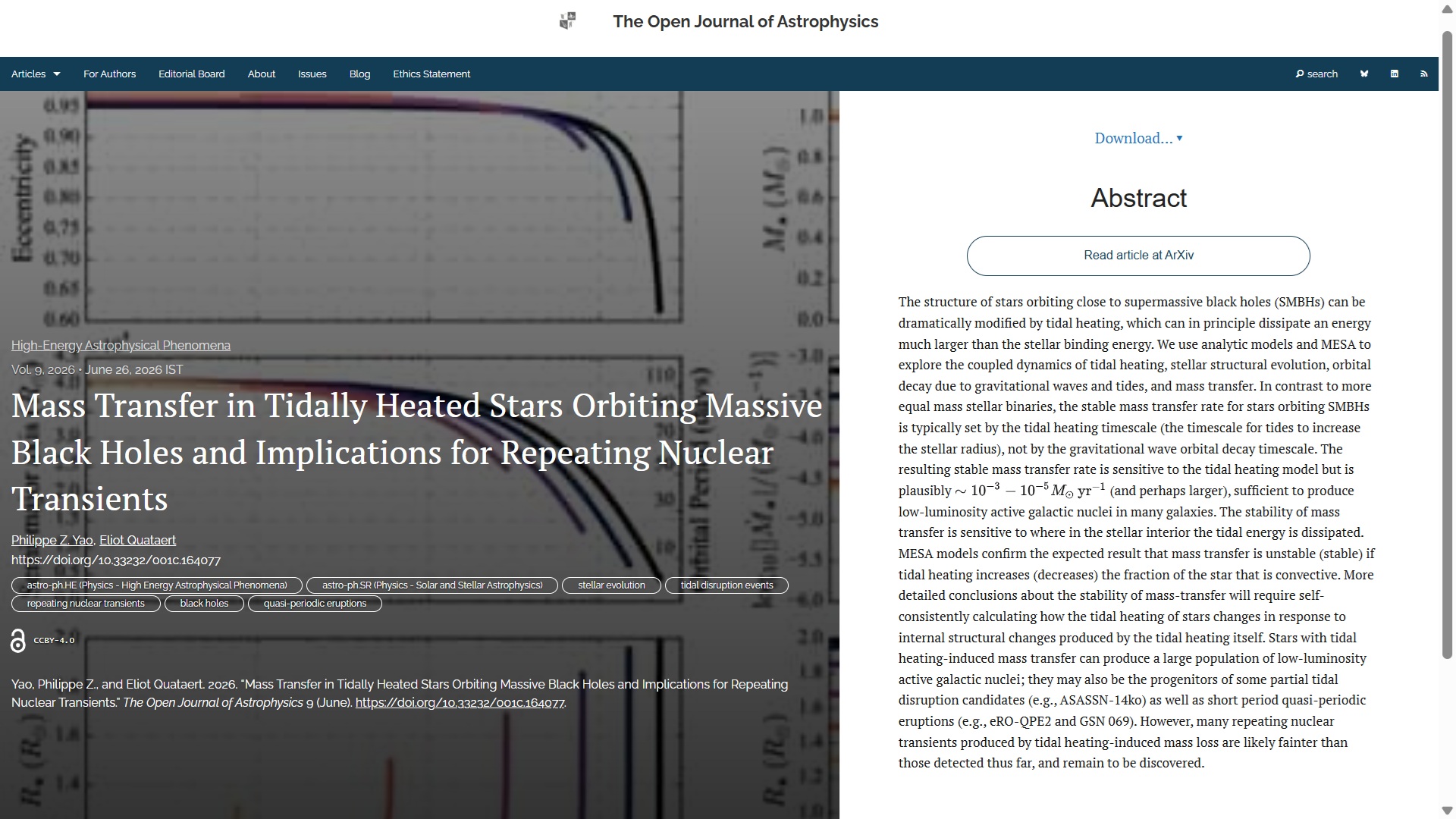
The final, accepted version can be found on arXiv here and the Mastodon announcement is here:

Open Journal of Astrophysics

New Publication at the Open Journal of Astrophysics: "Mass Transfer in Tidally Heated Stars Orbiting Massive Black Holes and Implications for Repeating Nuclear Transients" by Philippe Z. Yao and Eliot Quataert (Princeton University, USA)

doi.org/10.33232/001c.164077

June 26, 2026, 7:55 am 1 boosts 0 favorites

And that concludes this week’s update. It has been another slow week on the publishing front. We have a steadily growing backlog of papers accepted for publication but with final versions yet to appear on arXiv. I suppose it’s the holidays…

P.S. The other day I checked the stats for the Open Journal of Astrophysics and saw that we’ve passed 8,000 citations. The average number of citations per paper is 14.0, which is not bad when you consider that over half the papers were published under a year ago…
Weekly Update from the Open Journal of Astrophysics – 30/08/2025

Posted in OJAp Papers, Open Access, The Universe and Stuff with tags , , , , , , , , , , , , , , , on August 30, 2025 by telescoper

Once again it’s time for a summary of the week’s new papers at the Open Journal of Astrophysics. Since the last update we have published three new papers, which brings the number in Volume 8 (2025) up to 125, and the total so far published by OJAp up to 360.

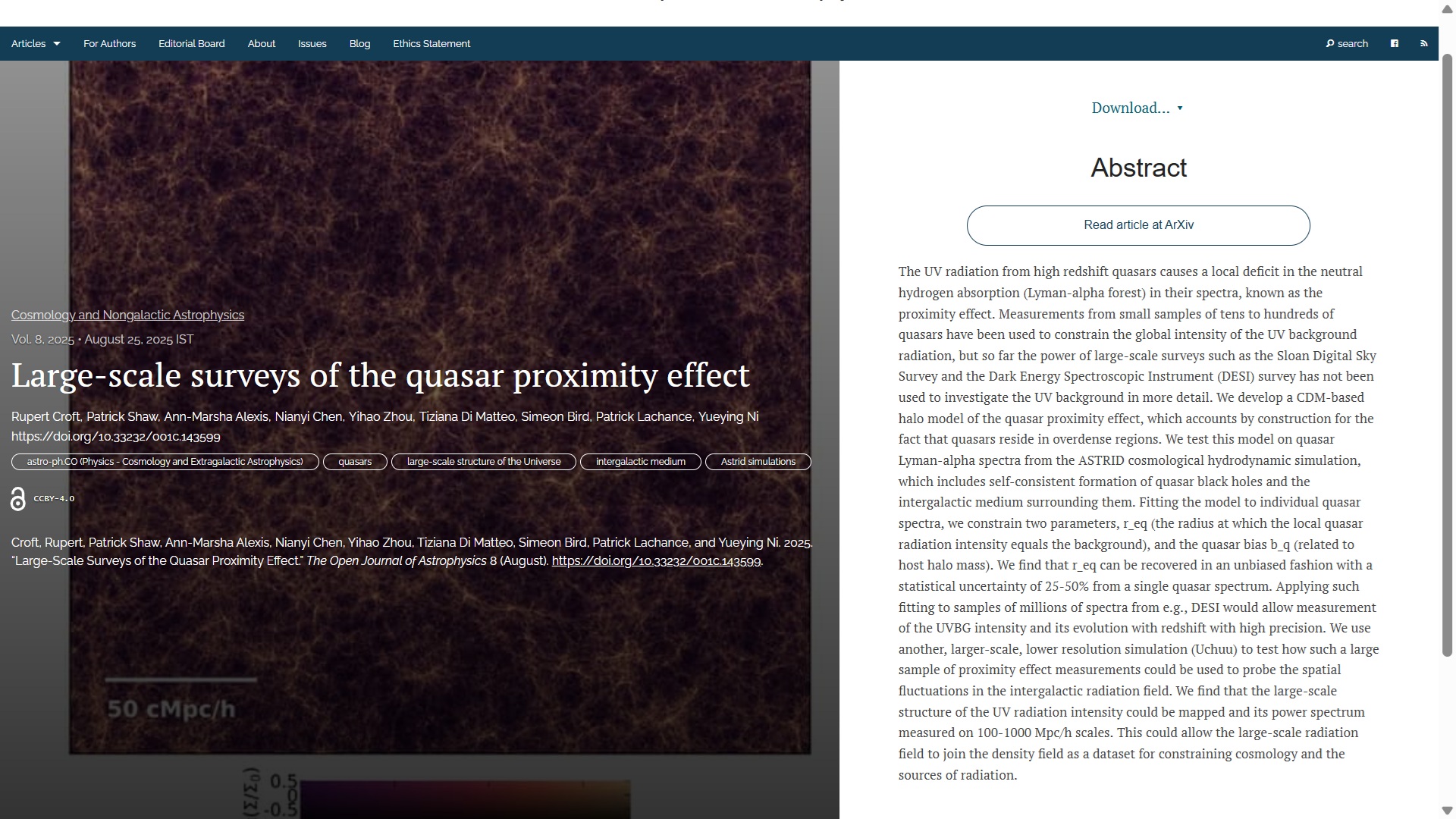
The first paper to report this week is “Large-scale surveys of the quasar proximity effect” by Rupert Croft, Patrick Shaw & Ann-Marsha Alexis (Carnegie Mellon University; CMU), Nianyi Chen (Princeton), Yihao Zhou & Tiziana Di Matteo (CMU), Simeon Bird (UC Riverside), Patrick Lachance (CMU), and Yueying Ni (Harvard). This paper was published on Monday 25th August in the folder Cosmology and NonGalactic Astrophysics. It presents a CDM-based halo model of the quasar proximity effect, tested on quasar Lyman-alpha spectra from the ASTRID cosmological simulation, including self-consistent formation of quasar black holes and the intergalactic medium.

The overlay is here:


You can make this larger by clicking on it, as you can with all the overlays below. The officially accepted version of this paper can be found on the arXiv here.

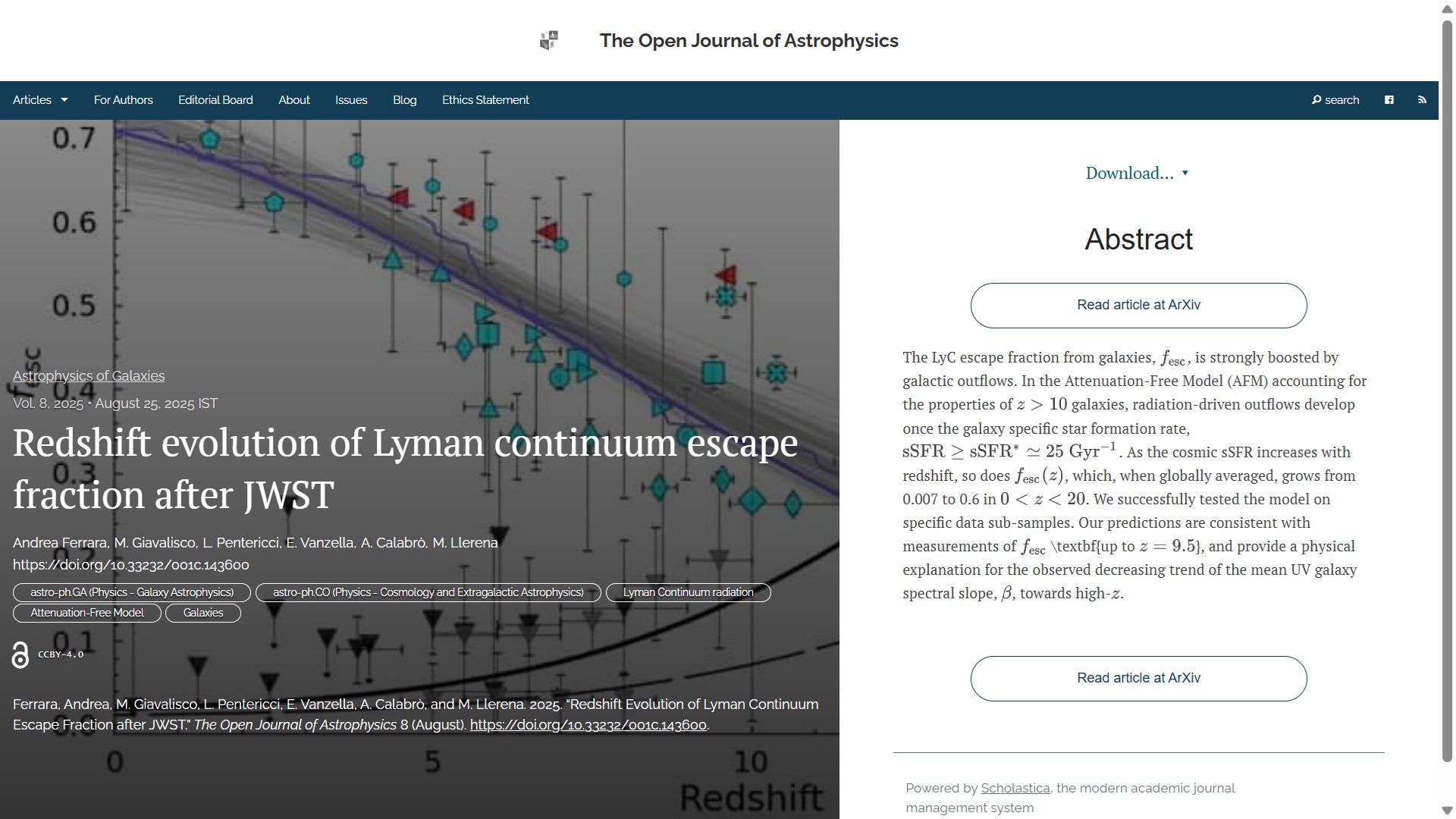
The second paper this week, also published on Monday 25th August, but in the folder Astrophysics of Galaxies, is “Redshift evolution of Lyman continuum escape fraction after JWST” by Andrea Ferrara (Pisa), M. Giavalisco (UMass Amherst), L. Pentericci (Rome), E. Vanzella (Bologna), A. Calabrò (Rome) and M. Llerena (Rome). This paper is about the Attenuation-Free Model (AFM) for galaxies, in which radiation-driven outflows develop once the galaxy specific star formation rate exceeds a certain level, which is tested on data with positive results. The overlay is here:

You can find the officially accepted version on arXiv here.

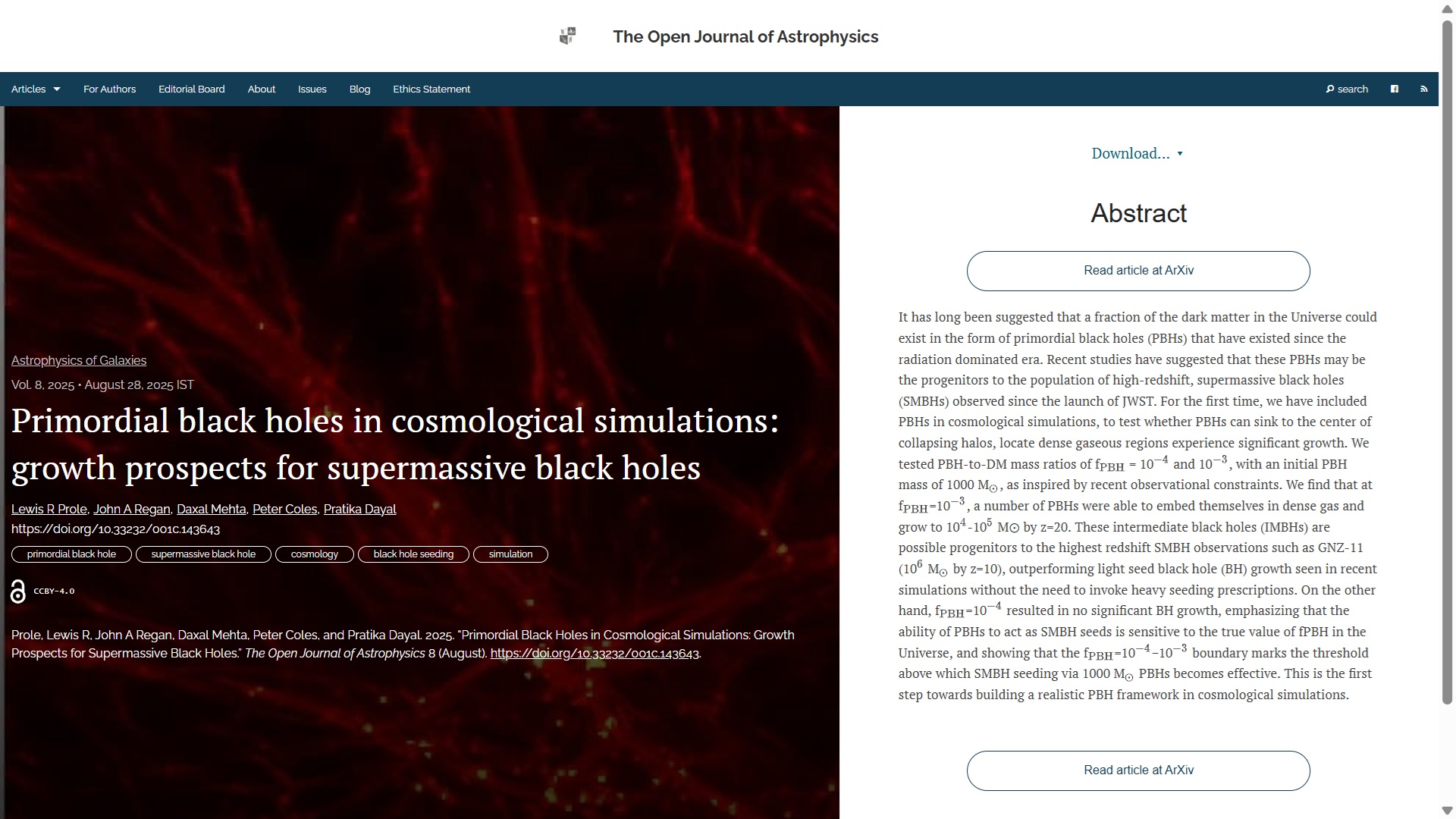
The third and final paper this week is “Primordial black holes in cosmological simulations: growth prospects for supermassive black holes” by Lewis R Prole, John A Regan, Daxal Mehta & Peter Coles (National University of Ireland, Maynooth) and Pratika Dayal (Groningen, NL). This one was published in Astrophysics of Galaxies folder on Thursday 28th August 2025. You can read more about this paper here: basically it studies the growth of primordial black holes in the early Universe using numerical simulations, with implications for the subsequent formation of massive black holes.

The overlay is here:

You can find the officially accepted version of this one on arXiv here.

And that’s all the papers for this week. It’s still a bit slow as we emerge from the summer vacations, but I expect things will start to pick up from now on.

Weekly Update from the Open Journal of Astrophysics – 12/07/2025

Posted in OJAp Papers, Open Access, The Universe and Stuff with tags , , , , , , , , , , , , , , , , , , , , , , , , , on July 12, 2025 by telescoper

It’s Saturday morning again, so it’s time again for an update of papers published at the Open Journal of Astrophysics. Since the last update we have published seven new papers, which brings the number in Volume 8 (2025) up to 92, and the total so far published by OJAp  up to 327.

This was a slightly strange week, starting with the fact that there were no new arXiv announcements on Monday 7th July because of the 4th July holiday in the USA on Friday so no papers were published that day. We were not able to publish any papers on Wednesday 9th July either because Crossref was offline for 24 hours that day while its data was migrated into the cloud. Our publishing process requires a live connection with Crossref to deposit metadata upon publication so we can’t publish while that service is down. Fortunately the update seems to have gone well and normal services resumed the following day. That partially accounts for the fact that four of this week’s papers were published on 10th July.

Anyway, The papers published this week, with their overlays, are as follows.  You can click on the images of the overlays to make them larger should you wish to do so.

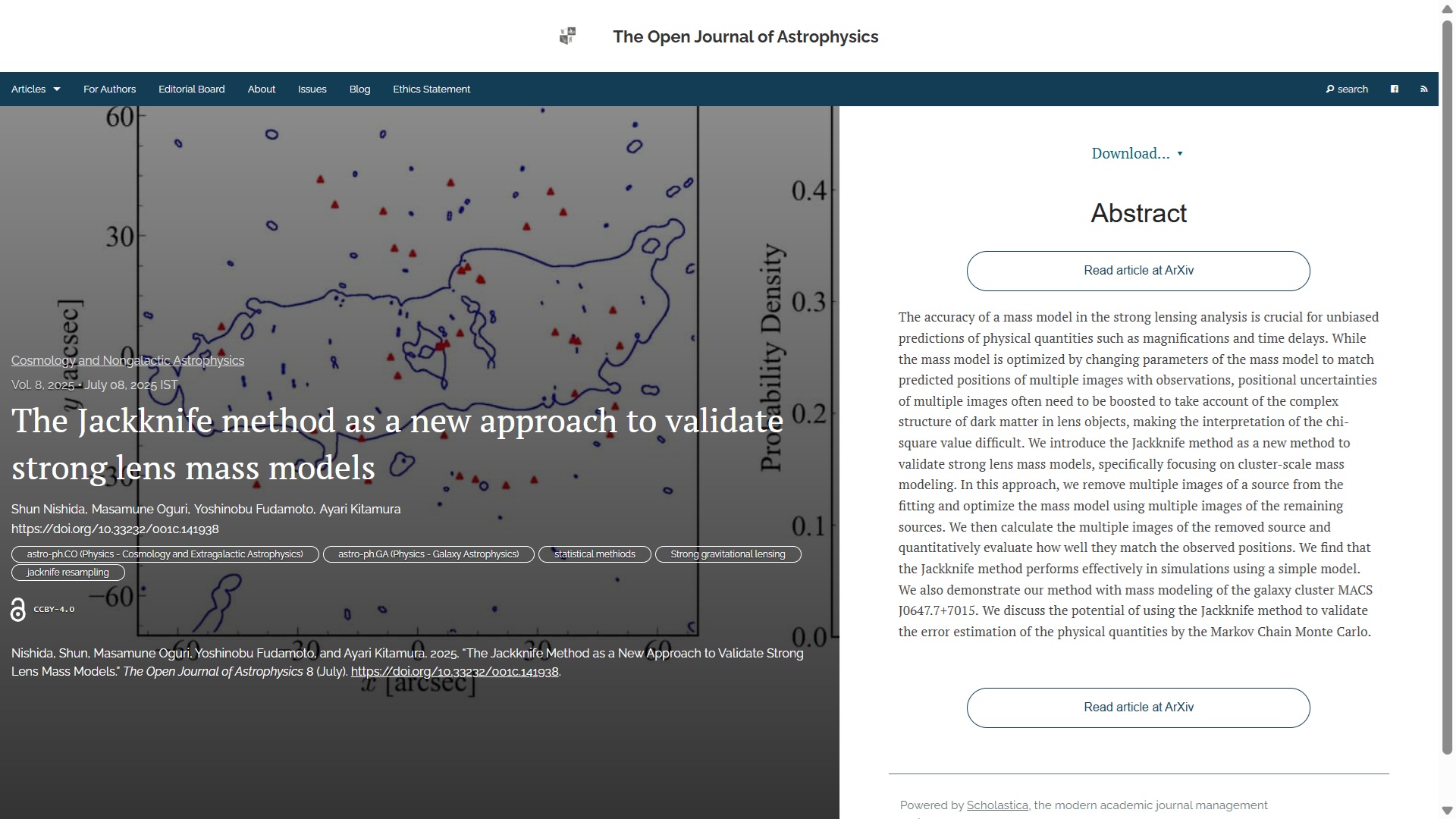
The first paper to report is “The Jackknife method as a new approach to validate strong lens mass models” by Shun Nishida & Masamune Oguri (Chiba University, Japan) , Yoshinobu Fudamoto (Steward Observatory, USA) and Ayari Kitamura (Tohoku University, Japan). This article, which is in the folder marked Cosmology and NonGalactic Astrophysics,  describes and application of the Jackknife statistical resampling techique to gravitational lensing by removing lensed images and recalcualting the mass modelIt was published on Tuesday 8th July 2025. The overlay is here:


The officially-accepted version can be found on arXiv here.

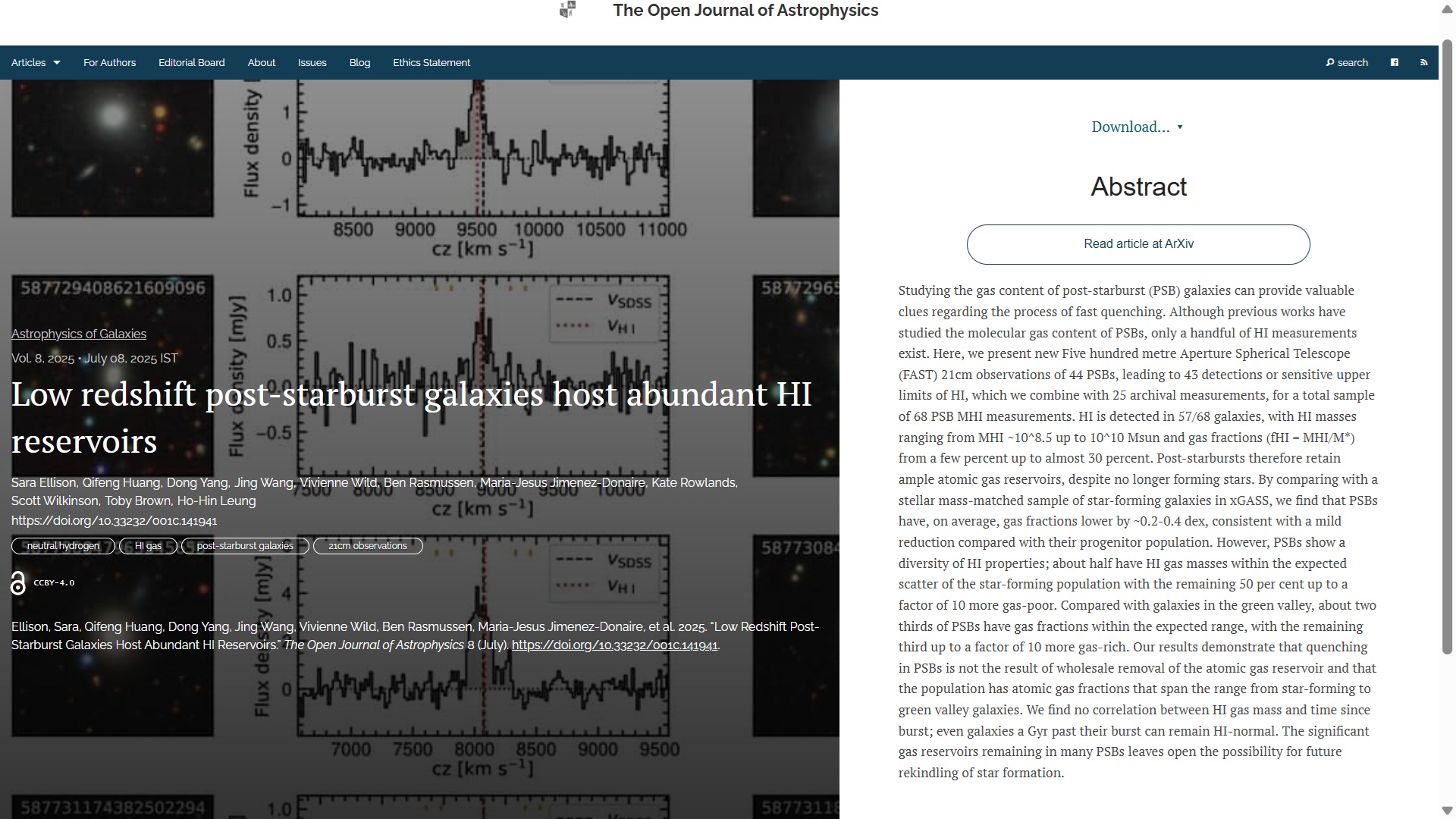
The second paper is “Low redshift post-starburst galaxies host abundant HI reservoirs” by Sara Ellison (U. Victoria, Canada) and 10 others based in China, UK, Spain, USA and Canada.  This one was also published oon Tuesday 8th July but in the folder Astrophysics of Galaxies. This paper uses 21cm observations of a sample of post-starburst galaxies, to show  that they contain large reservoirs of neutral hydrogen. Here is the overlay:

You can find the final version of the manuscript on arXiv here.

Next one up, one of four published on Thursday 10th July, is “Predicting the number density of heavy seed massive black holes due to an intense Lyman-Werner field” by Hannah O’Brennan (Maynooth University, Ireland) and 7 others based in Ireland, USA and Italy. This paper presents an exploration of the scenario for black hole formation driven by Lyman-Werner photons (i.e. ultraviolet radiation in the range 11.2 to 13.6 eV). It is in the folder marked Cosmology and NonGalactic Astrophysics, and the overlay is here:


You can read the final accepted version on arXiv here.

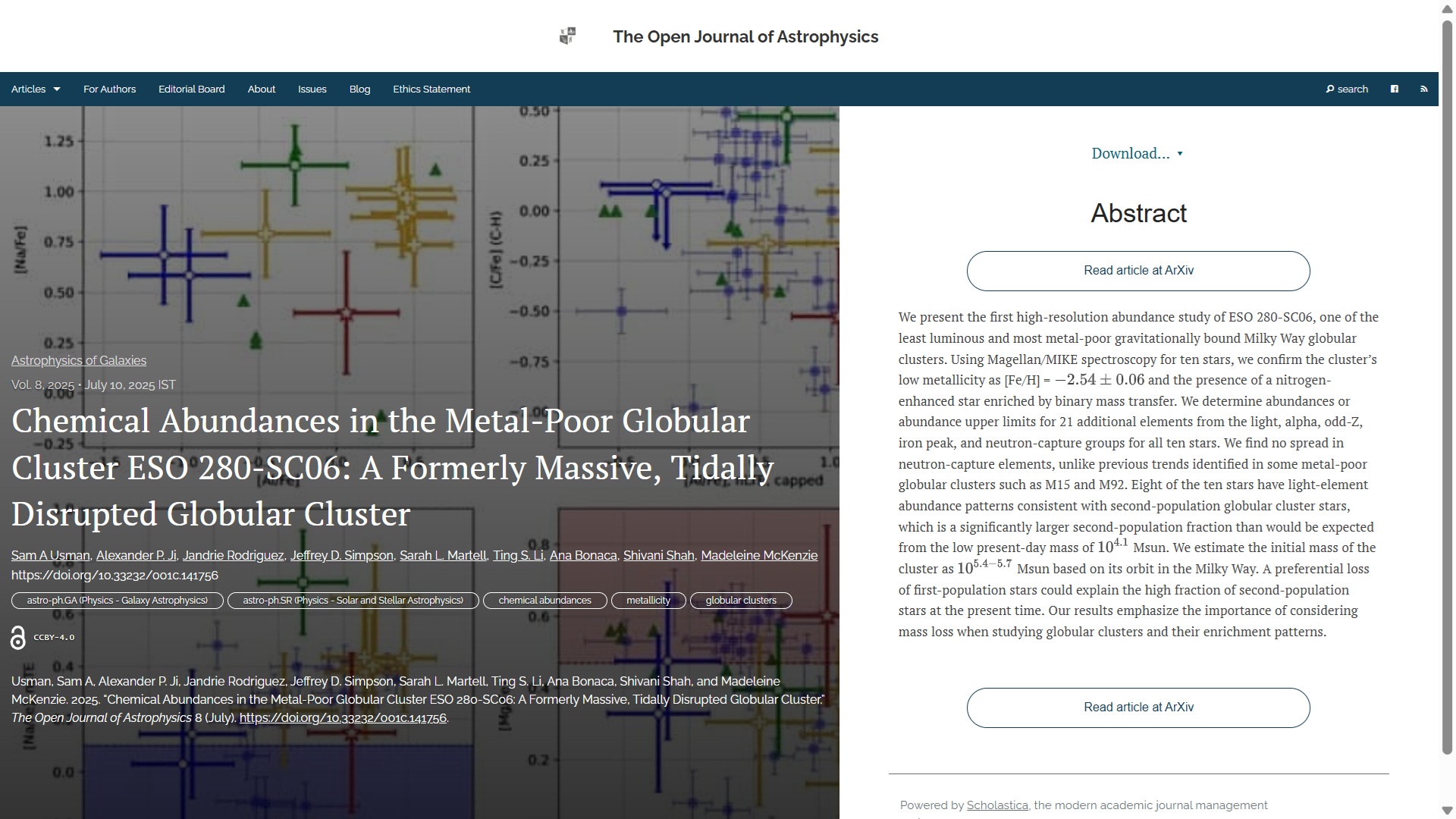
The fourth paper this week, and the second published on 10th July, is “Chemical Abundances in the Metal-Poor Globular Cluster ESO 280-SC06: A Formerly Massive, Tidally Disrupted Globular Cluster” by Sam A. Usman (U. Chicago, USA) and 8 others based in the USA, Canada and Australia. This paper, which is in the folder Astrophysics of Galaxies, presents a detailed spectroscopic study of the chemical abundances in a Milky Way globular cluster ESO 280-SC06. The overlay is here:

The officially accepted version of the paper can be read here.

Next one up, also published on 10th July and also in the folder marked Astrophysics of Galaxies is “Predictions for the Detectability of Milky Way Satellite Galaxies and Outer-Halo Star Clusters with the Vera C. Rubin Observatory” by Kabelo Tsiane (U. Michigan) and 9 others on behalf of the LSST Dark Energy Science Collaboration.

The overlay is here:


You can find the officially-accepted version of the paper on arXiv here.

The penultimate paper for this week, and the last of the batch published on 10th July,  is “Systematically Measuring Ultra-Diffuse Galaxies. VIII. Misfits, Miscasts, and Miscreants” by Dennis Zaritsky, Richard Donnerstein, and Donghyeon J. Khim (Steward Observatory, U. Arizona, USA). This paper presents a morphological study of weird and wonderful galaxies as part of an effort to Systematically Measure Ultra-Diffuse Galaxies (the SMUDGes survey). It is in the folder marked Astrophysics of Galaxies. The overlay is here:


You can find the officially-accepted version of the paper on arXiv here.

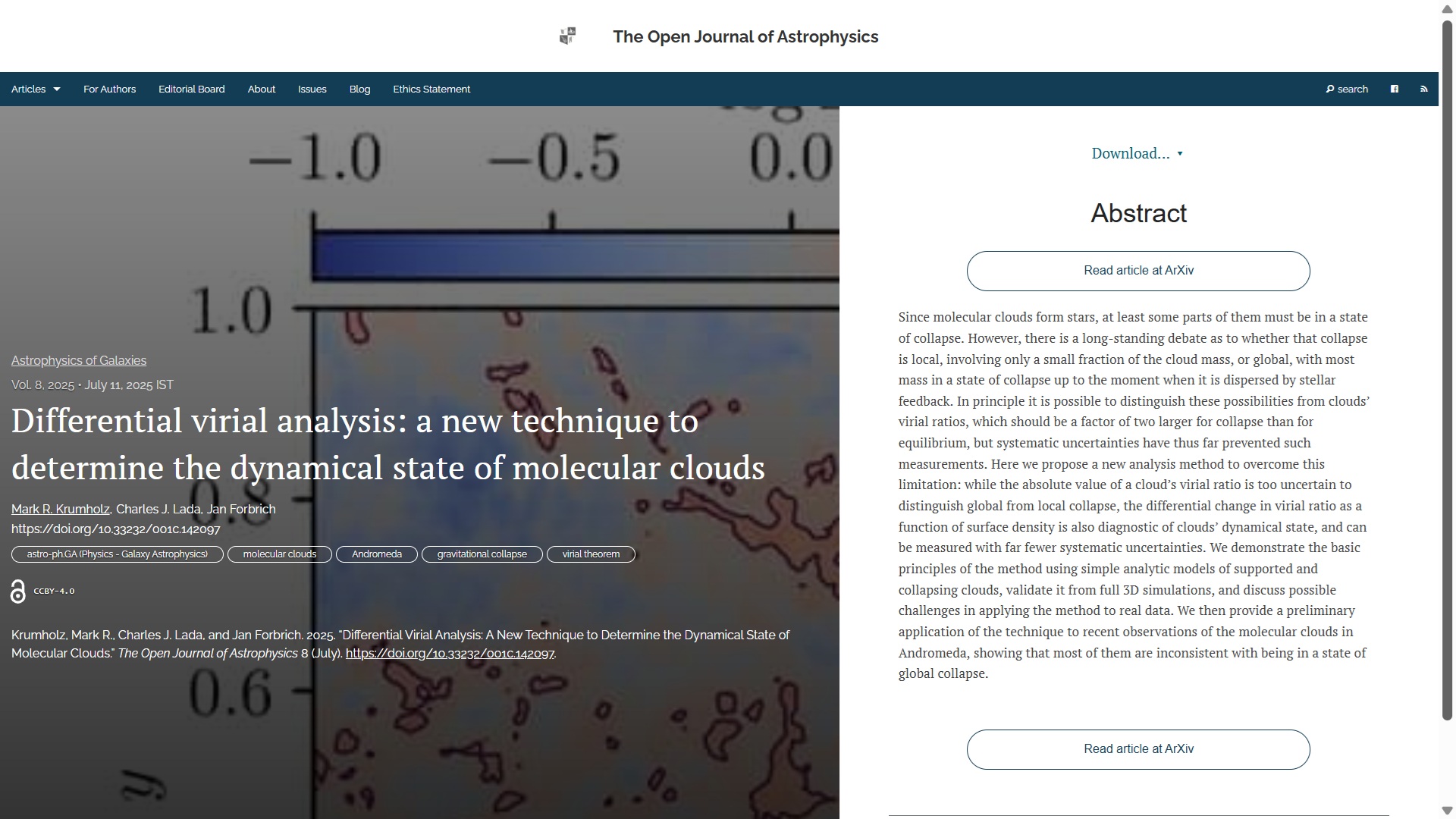
The last article published this week is “Differential virial analysis: a new technique to determine the dynamical state of molecular clouds” by Mark R. Krumholz (ANU, Australia), Charles J. Lada (Harvard, USA) & Jan Forbrich (U. Herts, UK). This paper presents simple analytic models of supported and collapsing molecular clouds, tested using full 3D simulations and applied to observed clouds in Andromeda. It is in the folder marked Astrophysics of Galaxies and was published yesterday, i.e on Friday 11th July 2025. Here is the overlay


You can find the officially-accepted version on arXiv here.

And that’s all the papers for this week. I will, however, take this opportunity to mention that a while ago I was interviewed about the Open Journal of Astrophysics by Colin Stuart on behalf of the Foundational Questions Institute; the write-up of the interview can be found here.