Archive for Cosmology

New Publication at the Open Journal of Astrophysics

Posted in OJAp Papers, Open Access, The Universe and Stuff with tags , , , , , , , on July 5, 2022 by telescoper

Time to announce another new publication in the Open Journal of Astrophysics! This one, published on Sunday, is the 8th paper in Volume 5 (2022) and the 56th in all.

The latest publication is entitled “Search for a distance-dependent Baryonic Tully-Fisher Relation at low redshifts” and is written by by Aditi Krishak (IISER-Bhopal, India) and Shantanu Desai (IIT Hyderabad, India).

This paper is in the Cosmology and Nongalactic Astrophysics folder.

Here is a screen grab of the overlay which includes the abstract:


You can click on the image to make it larger should you wish to do so. You can find the arXiv version of the paper here.

R.I.P. Jim Bardeen (1939-2022)

Posted in Biographical, The Universe and Stuff with tags , , , , , on July 4, 2022 by telescoper

I was saddened this morning to hear news of the death at the age of 83 of Jim Bardeen who passed away on June 20th 2022. Jim – the son of John Bardeen, who won two Nobel physics prizes – did important work in theoretical cosmology and general relativity. In my own field of cosmology he is probably best known for his work on perturbation theory where he clarified many longstanding issues about gauge-dependence and as the first author of the famous and heavily cited “BBKS” (Bardeen, Bond, Kaiser & Szalay) paper, published in 1986:

BBKS

I received this as a very hefty preprint when I started my graduate studies back in 1985 and it scared the hell out of me. I still have the photocopy of the published version I made when it came out (in the days when PhD meant Doctor of Photocopying). You can find the paper on the NASA/ADS system here.

I met Jim Bardeen only once, at an Aspen Summer Workshop back in the 90s. He was a very shy and modest man but very kindly and polite. I remember a couple of times out hiking with him, when a discussion about physics was going on he would keep quiet until he had figured out what he thought and when he did choose to speak it was usually brief and invariably very incisive. He didn’t write all that many papers either, but those he did publish were invariably excellent.

Rest in peace, James Maxwell Bardeen (1939-2022)

Final Reminder – Professorial Position in Observational Astrophysics or Cosmology at Maynooth!

Posted in Maynooth, The Universe and Stuff with tags , , , , on July 1, 2022 by telescoper

With just a few days to go to the deadline (3rd July), I thought I would take the opportunity to remind readers that Maynooth University has a Chair (i.e. Full Professor) position in Astrophysics or Cosmology under the Strategic Academic Leadership Initiative (SALI). I blogged about this scheme here and announced this Chair position originally here.

You can find the full announcement of the competition for all the SALI positions here; you can apply for the position at Maynooth here. The position is now also advertised on the AAS Jobs Register here.

As I said, the deadline for applications is 3rd July 2022, and the provisional start date is January 2023 (although this is flexible). As well as a good salary (starting at €124,683 at current rates, rising by annual increments to €157,611) the position comes with membership of the Irish public service pension scheme, a defined benefit scheme (comparable to the older version of the UK’s USS which has now been scrapped).

The key rationale for these SALI positions is clear from the statement from Simon Harris, the Minister responsible for Third Level education in Ireland:

“Championing equality and diversity is one of the key goals of my department. The Senior Academic Leadership Initiative (SALI) is an important initiative aimed at advancing gender equality and the representation of women at the highest levels in our higher education institutions.

We have a particular problem with gender balance among the staff in Physics in Maynooth, especially in Theoretical Physics where all the permanent staff are male, and the lack of role models has a clear effect on our ability to encourage more female students to study with us.

The wider strategic case for this Chair revolves around broader developments in the area of astrophysics and cosmology at Maynooth. Currently there are two groups active in research in these areas, one in the Department of Experimental Physics (which is largely focussed on astronomical instrumentation) and the other, in the Department of Theoretical Physics, which is theoretical and computational. We want to promote closer collaboration between these research strands. The idea with the new position is that the holder will nucleate and lead a new research programme in the area between these existing groups as well as getting involved in outreach and public engagement.

It is intended that the position to appeal not only to people undertaking observational programmes using ground-based facilities (e.g. those provided by ESO, which Ireland recently joined), or those exploiting data from space-based experiments, as well as people working on multi-messenger astrophysics, gravitational waves, and so on.

Exciting as this position is in itself, it is part of wider developments and we are expecting to advertise further job opportunities in physics and astronomy very soon! I’d be happy to be contacted by any eligible person wishing to discuss this position (or indeed the general situation in Maynooth) on an informal basis.

Professorial Position in Observational Astrophysics or Cosmology at Maynooth!

Posted in Maynooth, The Universe and Stuff with tags , , , , on May 30, 2022 by telescoper

With about a month to go to the deadline, I thought I would take the opportunity to remind readers that Maynooth University has a Chair (i.e. Full Professor) position in Astrophysics or Cosmology under the Strategic Academic Leadership Initiative (SALI). I blogged about this scheme here and announced this Chair position originally here.

You can find the full announcement of the competition for all the SALI positions here; you can apply for the position at Maynooth here. The position is now also advertised on the AAS Jobs Register here.

The deadline for applications is in July 2022, and the provisional start date is January 2023 (although this is flexible). As well as a good salary (starting at €124,683 at current rates, rising by annual increments to €157,611) the position comes with membership of the Irish public service pension scheme, a defined benefit scheme (comparable to the older version of the UK’s USS which has now been scrapped).

The key rationale for these SALI positions is clear from the statement from Simon Harris, the Minister responsible for Third Level education in Ireland:

“Championing equality and diversity is one of the key goals of my department. The Senior Academic Leadership Initiative (SALI) is an important initiative aimed at advancing gender equality and the representation of women at the highest levels in our higher education institutions.

We have a particular problem with gender balance among the staff in Physics in Maynooth, especially in Theoretical Physics where all the permanent staff are male, and the lack of role models has a clear effect on our ability to encourage more female students to study with us.

The wider strategic case for this Chair revolves around broader developments in the area of astrophysics and cosmology at Maynooth. Currently there are two groups active in research in these areas, one in the Department of Experimental Physics (which is largely focussed on astronomical instrumentation) and the other, in the Department of Theoretical Physics, which is theoretical and computational. We want to promote closer collaboration between these research strands. The idea with the new position is that the holder will nucleate and lead a new research programme in the area between these existing groups as well as getting involved in outreach and public engagement.

It is intended that the position to appeal not only to people undertaking observational programmes using ground-based facilities (e.g. those provided by ESO, which Ireland recently joined), or those exploiting data from space-based experiments, as well as people working on multi-messenger astrophysics, gravitational waves, and so on.

Exciting as this position is in itself, it is part of wider developments and we are expecting to advertise further job opportunities in physics and astronomy very soon! I’d be happy to be contacted by any eligible person wishing to discuss this position (or indeed the general situation in Maynooth) on an informal basis.

Two New Publications at the Open Journal of Astrophysics

Posted in Open Access, The Universe and Stuff with tags , , , , , , on May 29, 2022 by telescoper

Last week was rather busy. Amongst other things I managed to complete the publication process for two more papers in the Open Journal of Astrophysics (one on Tuesday and one on Thursday) although there was a small delay in registering the metadata so I didn’t fully announce them until yesterday. I’ve only just managed to find time today to advertise them here. These two are the sixth and seventh papers in Volume 5 (2022) and the 54th and 55th in all respectively. Both the new papers are in the folder marked Cosmology and Nongalactic Astrophysics.

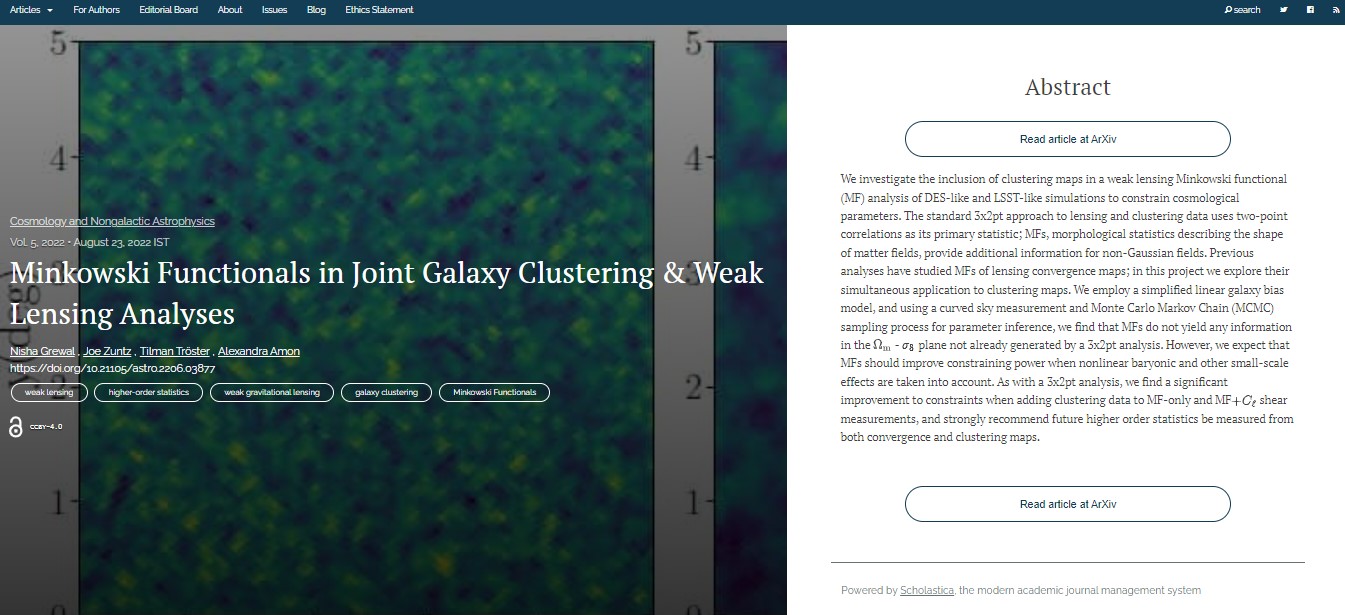
The first of these two new publications is entitled “The Impact of Quadratic Biases on Cosmic Shear” and is written by Tom Kitching and Anurag Deshpande of the Mullard Space Science Laboratory in Surrey (UK).

Here is a screen grab of the overlay which includes the abstract:

You can click on the image to make it larger should you wish to do so. You can find the arXiv version of this paper directly here.

The second new publication is entitled “Cosmo-Paleontology: Statistics of Fossil Groups in a Gravity-Only Simulation” and is written by Aurora Coissairt, Michael Buehlmann, Eve Kovacs, Xin Liu, Salman Habib and Katrin Heitmann all from the Argonne National Laboratory which is just outside Chicago in the USA.

Here is the overlay of that paper which includes the abstract:

Once again You can click on the image to make it larger should you wish to do so. You can find the arXiv version of the paper here.

We have quite a few more papers in the pipeline so expect to be announcing more quite soon, probably early next month.

Euclid Launch Concern

Posted in Euclid, Politics, Science Politics, The Universe and Stuff with tags , , on April 27, 2022 by telescoper

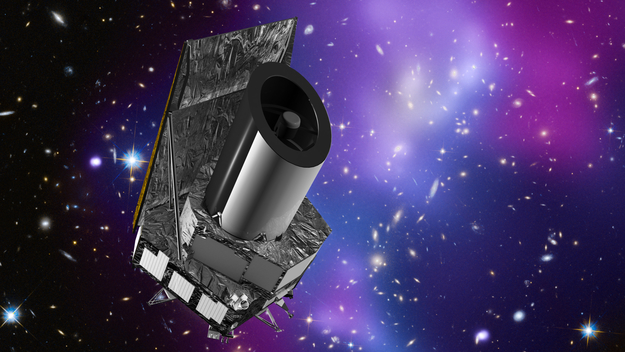
I saw the following picture on Twitter. It was taken during a talk at the annual Euclid Consortium Meeting (which I am not at) and it gives a not -very-optimistic update about the timescale for the launch of Euclid.

Picture Credit: Hervé Aussel

I thought a delay in the launch was inevitable as soon as news broke of the Russian invasion of Ukraine (see here) because the original plan was to launch on a Russian Soyuz vehicle. The subsequent decision by the Russians to remove all their personnel from the launch site at Kourou (see here) made these even more likely, although according to the slide not certain.

The basic problem is that Plan B involves launching Euclid on an Ariane 6 rocket (which comes in two varieties, Ariane62 and Ariane64, with two and four payloads boosters respectively). The problems are (a) that Ariane 6 is that it hasn’t yet had its first flight and (b) Euclid isn’t the only spacecraft having to find an alternative launcher. The competition from commercial and military satellites may mean a lengthy delay to the Euclid Launch unless lobbying succeeds at a political level, which is what the last lines of the slide are about.

Being one of life’s pessimists I think a long delay is the likeliest outcome, though this is not based on any specific knowledge at all about the discussions going on and I’d be delighted to be proved wrong. I am now however seriously wondering whether Euclid will be launched before I retire!

Distant Things!

Posted in The Universe and Stuff with tags , , , on April 1, 2022 by telescoper

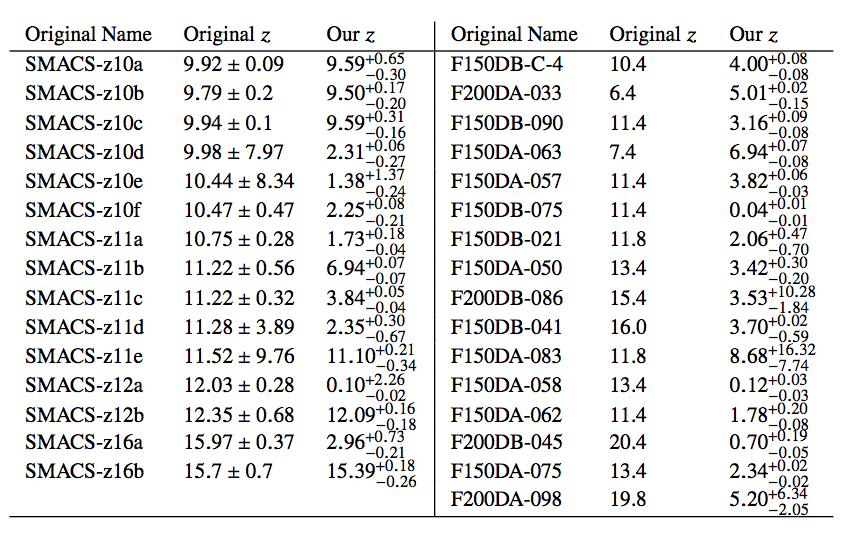
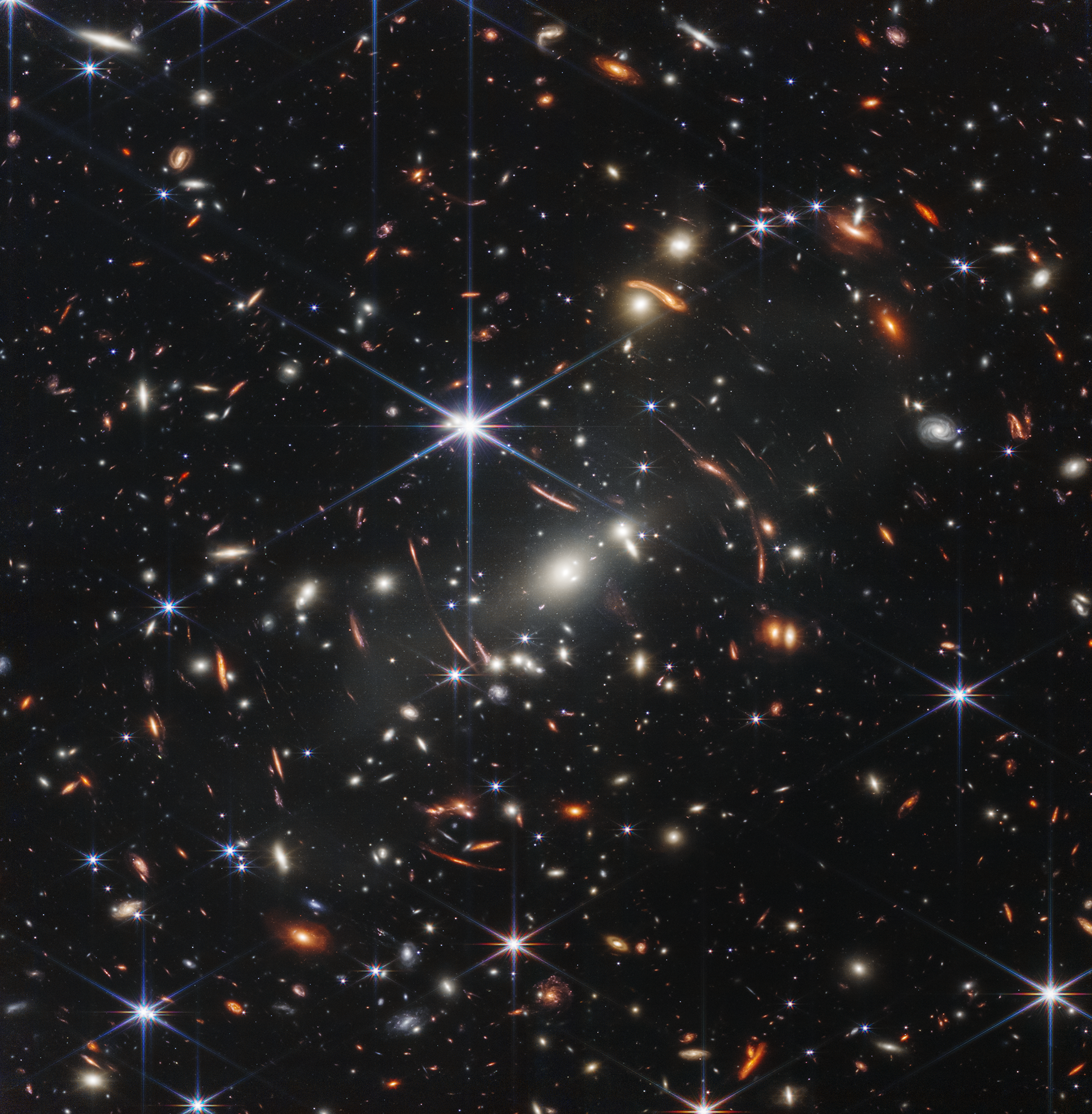
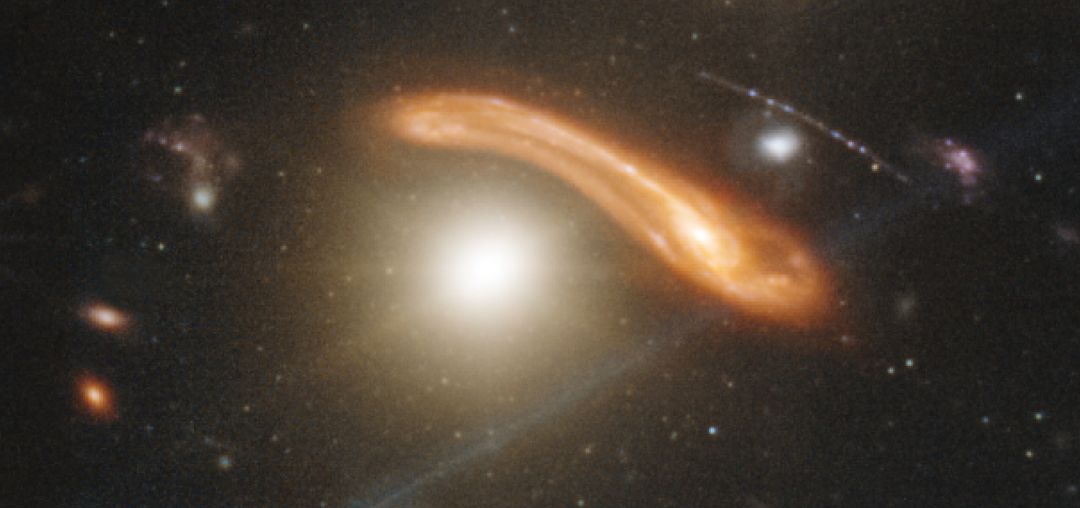
I’m a bit late passing this on but there was a great deal of excitement this week at the news that the Hubble Space Telescope (HST) has made an astonishing discovery about the early Universe as illustrated by the above picture published in Nature. As well as an individual star (?) observed at redshift 6.2, so distant that its light set out when the Universe was just 8% of its current age, the image also reveals the presence in the early Universe of large geometric shapes (such as rectangles) as well as a remarkable giant arrow. The presence of these features at such high redshift is completely inconsistent with the standard theory of structure formation.

New Professorial Position in Astrophysics or Cosmology at Maynooth!

Posted in Maynooth, The Universe and Stuff with tags , , , , on March 31, 2022 by telescoper

You may recall that back in November 2021 we received word that Maynooth University had been awarded one of ten new senior professorial positions under the Strategic Academic Leadership Initiative (SALI). I blogged about this scheme here. The position we have been awarded is a Chair (Full Professorship) in Observational Astrophysics or Cosmology; you can find Maynooth University’s official response to the original announcement here.

The wheels have turned fairly slowly since the announcement but today at last the applications opened for the new Chairs, including the one in Maynooth. You can find the full announcement of the competition for all the positions here; you can apply for the position at Maynooth here. I think the advertisement will appear on a number of the standard job platforms (such as the Times Higher) too, although this is all being managed centrally. The deadline is in July 2022, and the provisional start date is January 2023 (although this is flexible).

Update: you can find an advertisement for the position on the Times Higher website here. A more complete advertisement can be found here.

The key rationale for these SALI positions is clear from the statement from Simon Harris, the Minister responsible for Third Level education in Ireland:

“Championing equality and diversity is one of the key goals of my department. The Senior Academic Leadership Initiative (SALI) is an important initiative aimed at advancing gender equality and the representation of women at the highest levels in our higher education institutions.

We have a particular problem with gender balance among the staff in Physics in Maynooth, especially in Theoretical Physics where all the permanent staff are male, and the lack of role models has a clear effect on our ability to encourage more female students to study with us.

The wider strategic case for this Chair revolves around broader developments in the area of astrophysics and cosmology at Maynooth. Currently there are two groups active in research in these areas, one in the Department of Experimental Physics (which is largely focussed on astronomical instrumentation) and the other, in the Department of Theoretical Physics, which is theoretical and computational. We want to promote closer collaboration between these research strands. The idea with the new position is that the holder will nucleate and lead a new research programme in the area between these existing groups as well as getting involved in outreach and public engagement.

It is intended that the position to appeal not only to people undertaking observational programmes using ground-based facilities (e.g. those provided by ESO, which Ireland recently joined), or those exploiting data from space-based experiments, as well as people working on multi-messenger astrophysics, gravitational waves, and so on.

Exciting as this position is in itself, it is part of wider developments and we are expecting to advertise further job opportunities in physics and astronomy very soon! I’d be happy to be contacted by any eligible person wishing to discuss this position (or indeed the general situation in Maynooth) on an informal basis.

P. S. For those of you reading this from outside Ireland the job includes a public service pension, a defined benefit scheme way better than the UK’s USS.

The art of building a smooth cosmic distance ladder in a perturbed universe

Posted in The Universe and Stuff with tags , , on February 22, 2022 by telescoper

Catching up on some literature on the inestimable arXiv I came across this paper by Obinna Umeh which I haven’t gone through in detail but which looks very interesting:

How does a smooth cosmic distance ladder emerge from observations made from a single location in a lumpy Universe? Distances to the Type Ia supernova (SN1A) in the Hubble flow are anchored on local distance measurements to sources that are very nearby. We described how this configuration could be built in a perturbed universe where lumpiness is described as small perturbations on top of a flat Friedmann-Lemaıtre Robertson-Walker (FLRW) spacetime. We show that there is a non-negligible modification (about 11%) to the background FLRW area distance due to the presence of inhomogeneities in the immediate neighbourhood of an observer. We find that the modification is sourced by the electric part of the Weyl tensor indicating a tidal deformation of the local spacetime of the observer. We show in detail how it could impact the calibration of the SN1A absolute magnitude in the Hubble flow. We show that it resolves the SN1A absolute magnitude and Hubble tensions simultaneously without the need for early or late dark energy.

The area distance here is what I usually call the angular-diameter distance; when one thinks of supernova measurements one usually thinks of the luminosity distance but these are related through the reciprocity relation discussed here which applies to each source regardless of whether the metric is of FLRW form or not. For a general discussion of cosmological distances see here.

New Publication at the Open Journal of Astrophysics

Posted in OJAp Papers, Open Access, The Universe and Stuff with tags , , , on February 21, 2022 by telescoper

It’s time yet again to announce a new publication in the Open Journal of Astrophysics! This one is the 3rd paper in Volume 5 (2022) and the 51st in all. We actually published this on Friday, byt I’ve only just got around to announcing it here now.

The latest publication is entitled Differentiable Predictions for Large Scale Structure with SHAMNet and is written by Andrew Hearin, Nesar Ramachandra and Matthew R. Becker of the Argonne National Laboratory and Joseph DeRose of the Lawrence Berkeley Laboratory (both institutions being in the USA).

Here is a screen grab of the overlay which includes the abstract:

You can click on the image to make it larger should you wish to do so. You can find the arXiv version of the paper here. This paper is in our popular Cosmology and Non-galactic Astrophysics section.

P. S. Here’s a bit of feedback from the author of this paper about the referees:

They reviewed the paper in conscientious detail, and every comment was thoughtful. We feel that our paper has materially improved in clarity as a result of their critique.”