Archive for Cosmology

New Publication at the Open Journal of Astrophysics

Posted in OJAp Papers, Open Access, The Universe and Stuff with tags , , , on February 21, 2022 by telescoper

It’s time yet again to announce a new publication in the Open Journal of Astrophysics! This one is the 3rd paper in Volume 5 (2022) and the 51st in all. We actually published this on Friday, byt I’ve only just got around to announcing it here now.

The latest publication is entitled Differentiable Predictions for Large Scale Structure with SHAMNet and is written by Andrew Hearin, Nesar Ramachandra and Matthew R. Becker of the Argonne National Laboratory and Joseph DeRose of the Lawrence Berkeley Laboratory (both institutions being in the USA).

Here is a screen grab of the overlay which includes the abstract:

You can click on the image to make it larger should you wish to do so. You can find the arXiv version of the paper here. This paper is in our popular Cosmology and Non-galactic Astrophysics section.

P. S. Here’s a bit of feedback from the author of this paper about the referees:

They reviewed the paper in conscientious detail, and every comment was thoughtful. We feel that our paper has materially improved in clarity as a result of their critique.”

Sins of Omission

Posted in The Universe and Stuff with tags , , , , , on February 20, 2022 by telescoper

There’s a paper recently published in Nature Astronomy by Moreno et al, which you can find on the arXiv here. The title is Galaxies lacking dark matter produced by close encounters in a cosmological simulation and the abstract is here:

The standard cold dark matter plus cosmological constant model predicts that galaxies form within dark-matter haloes, and that low-mass galaxies are more dark-matter dominated than massive ones. The unexpected discovery of two low-mass galaxies lacking dark matter immediately provoked concerns about the standard cosmology and ignited explorations of alternatives, including self-interacting dark matter and modified gravity. Apprehension grew after several cosmological simulations using the conventional model failed to form adequate numerical analogues with comparable internal characteristics (stellar masses, sizes, velocity dispersions and morphologies). Here we show that the standard paradigm naturally produces galaxies lacking dark matter with internal characteristics in agreement with observations. Using a state-of-the-art cosmological simulation and a meticulous galaxy-identification technique, we find that extreme close encounters with massive neighbours can be responsible for this. We predict that approximately 30 percent of massive central galaxies (with at least 1011 solar masses in stars) harbour at least one dark-matter-deficient satellite (with 108 – 109 solar masses in stars). This distinctive class of galaxies provides an additional layer in our understanding of the role of interactions in shaping galactic properties. Future observations surveying galaxies in the aforementioned regime will provide a crucial test of this scenario.

It’s quite an interesting result.

I’m reminded of this very well known paper from way back in 1998, available on arXiv here, by Priya Natarajan, Steinn Sigurdsson and Joe Silk, with the abstract:

We propose a scenario for the formation of a population of baryon-rich, dark matter-deficient dwarf galaxies at high redshift that form from the mass swept out in the Intergalactic Medium (IGM) by energetic outflows from luminous quasars. We predict the intrinsic properties of these galaxies, and examine the prospects for their observational detection in the optical, X-ray and radio wavebands. Detectable thermal Sunyaev-Zeldovich decrements (cold spots) on arc-minute scales in the cosmic microwave background radiation maps are expected during the shock-heated expanding phase from these hot bubbles. We conclude that the optimal detection strategy for these dwarfs is via narrow-band Lyman-α imaging of regions around high redshift quasars. An energetically scaled-down version of the same model is speculated upon as a possible mechanism for forming pre-galactic globular clusters.

It’s true that the detailed mechanism for forming dwarf galaxies with low dark matter densities is different in the two papers, but it does show that the issue being addressed by Moreno et al. had been addressed before. It seems to me therefore that the Natarajan et al. paper is clearly relevant background to the Moreno et al. one. I always tell junior colleagues to cite all relevant literature. I wonder why Moreno et al. decided not to do that with this paper?

Had Moreno et al. preprinted their paper before acceptance by Nature Astronomy I’m sure someone would have told them of this omission. This is yet another reason for submitting your papers to arXiv at the same time as you submit them to a journal rather than waiting for them to be published.

New Publication at the Open Journal of Astrophysics

Posted in OJAp Papers, Open Access, The Universe and Stuff with tags , , , , on January 18, 2022 by telescoper

It’s a New Year and therefore a new Volume of the Open Journal of Astrophysics and it’s time to announce the first publication in it! This one is the 1st paper in Volume 5 (2022) and the 49th in all.

The latest publication is entitled Validating Synthetic Galaxy Catalogs for Dark Energy Science in the LSST Era and is written by Eve Kovacs of Argonne National Laboratory and 38 others on behalf of the LSST Dark Energy Science Collaboration.

Here is a screen grab of the overlay which includes the abstract:

You can click on the image to make it larger should you wish to do so. You can find the arXiv version of the paper here. This is another one for the Cosmology and Nongalactic Astrophysics folder, which remains the most popular category so far on the Open Journal of Astrophysics site.

There is a little bit of a backlog in OJAp Towers owing to the Christmas break as some authors have been on leave and not doing their revisions, so I’d anticipate a few more papers in the next few weeks.

Congratulations to the 2022 RAS Award Winners!

Posted in The Universe and Stuff with tags , , , , , on January 15, 2022 by telescoper

Given all the doom and gloom going around I thought I’d take the opportunity to share some good news and also offer my public congratulations to the all the winners of medals and awards announced yesterday by the Royal Astronomical Society. Let me draw particular attention to the following subset, purely on the grounds that I know them and their work personally (and because they’ve all either been mentioned on this blog recently and/or been known to read it from time to time and/or have recently published in the Open Journal of Astrophysics and/or are on the Editorial Board thereof).

First, the Gold Medal goes to Professor George Efstathiou of Cambridge University a true giant of cosmology (metaphorically speaking of course – I’m actually taller than him):

I’m looking forward to George receiving his medal so he can tell us what kind of chocolate is inside.

Second, Professor Alan Heavens of South Kensington Technical College Imperial College London who gets the Eddington Medal:

I should mention that among many other things Alan has worked extensively on the application of Bayesian methods to cosmological data.

Third, Professor Catherine Heymans of Edinburgh, Astronomer Royal for Scotland, wins the Herschel medal;

Catherine was actually a PhD student supervised by Alan Heavens back in the day. I wonder if this is the first time that a PhD student/supervisor combination has won RAS medals in the same year?

Correction: I’m now told that Catherine actually did her PhD in Oxford supervised by Lance Miller so I withdraw the question.

And last but by no means least we have Professor Pedro Gil Ferreira who will give this year’s Gerald Whitrow lecture:

Two interesting facts about Pedro: (i) a direct English translation of “Pedro Ferreira” would be “Peter Smith”; and (ii) he is a member of the Editorial Board of the Open Journal of Astrophysics.

Congratulations to them and indeed to all the winners of awards and medals, a complete list of whom may be found here.

P.S. It suddenly struck me when I saw the announcements yesterday evening that it’s now two years since I last attended the RAS Ordinary Meeting in person or the RAS Club Dinner. Let’s hope these can start again reasonably soon.

The Largest Map of the Universe

Posted in The Universe and Stuff with tags , , , on January 14, 2022 by telescoper

Now I’m going to have to update the bit of my popular talks (e.g this one) about `Mapping the Universe’!

After just seven months of operations of the Dark Energy Spectroscopic Instrument (DESI) we now have the largest galaxy redshift survey – and it’s only about 10% of the way through its 5-year programme. Currently mapping the positions of about 7.5 million galaxies, the map will contain over 35 million by the time the survey is complete. Even now it is larger than all previous spectroscopic galaxy redshift surveys put together. The speed of DESI is accounted for by its use of 5000 robotically-positioned fibre-optic cables that can generate spectra of thousands of galaxy from a single pointing of the 4-m telescope on which it is mounted.

You can read more about the latest results from DESI here. I’ll just whet your appetite with this groovy animated picture:

DESI’s three-dimensional “CT scan” of the Universe. We are at in the lower left, looking out over 5 billion light years in the direction of the constellation Virgo. As the video progresses, the perspective sweeps toward the constellation Bootes. Each colored point represents a galaxy; gravity has pulled the galaxies into a “cosmic web” of dense clusters, filaments and voids. (Credit: D. Schlegel/Berkeley Lab using data from DESI)

The twinkling effect arises from the fact that you are viewing different thin slices through the 3D distribution. The dark sections that appear and disappear from time to time are just bits not yet included in the survey.

For those of you not familiar with astronomical distance measurements, 1500 megaparsecs = 1.5 Gigaparsecs = 4.5 billion light years (approximately), so this map is not only mapping the spatial distribution of galaxies but also how this distribution has evolved with cosmic time over billions of years.

A Piece of Euclid

Posted in Biographical, Euclid, Maynooth, The Universe and Stuff with tags , , on January 6, 2022 by telescoper

Fame at last! A colleague from the Department of Theoretical Physics at Maynooth University told me the above piece appeared in today’s Irish Times so I rushed out and bought the paper. My rapture was rapidly modified however when I discovered that my name was given incorrectly (as Cole instead of Coles), but that was to some extent offset by the amusement it would give my colleagues to see me described as an “Experiment Physicist”. These two slips are now corrected in the online version of the article which you can find here.

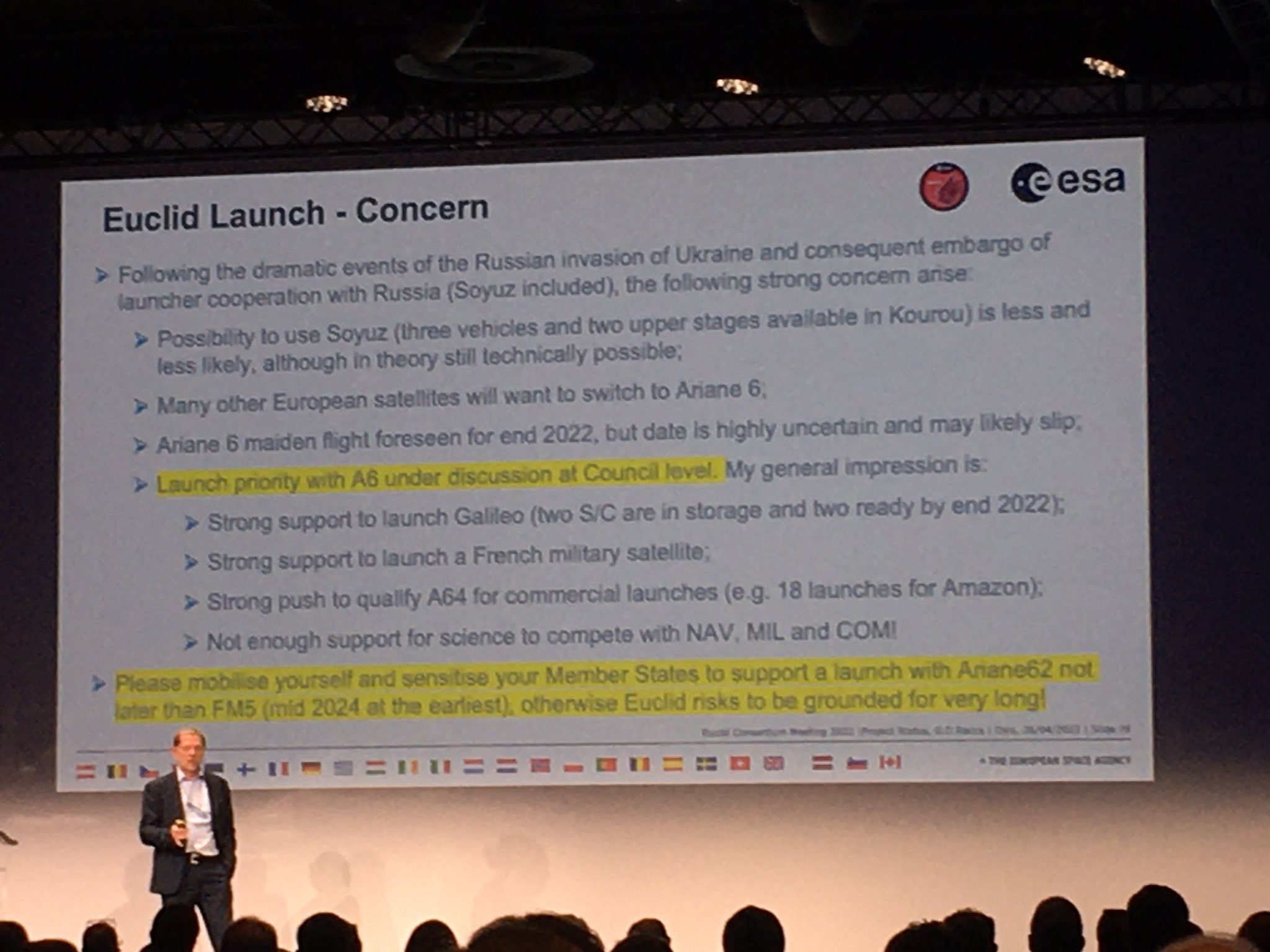
I was quite surprised by the sudden appearance of the article today because I spoke to the writer, Seán Duke, about Euclid well over a year ago (May 2020). That’s the reason that some things are a bit out of date. For example, the launch of Euclid will now not take place until the first quarter of 2023. Also the piece states that the largest telescope in space is the Hubble Space Telescope (HST) which is no longer the case (as of Christmas Day 2021…).

I’ll leave it as an exercise for the student to spot any other errors. Please feel free to point them out through the Comments Box. If you’re not banned, that is…

New Publication at the Open Journal of Astrophysics

Posted in OJAp Papers, Open Access, The Universe and Stuff with tags , , , , , , on December 17, 2021 by telescoper

It’s nice to be able to announce another publication in the Open Journal of Astrophysics before the Christmas break. This one was published yesterday, actually, but I didn’t get time to post about it until just now. It is the 17th paper in Volume 4 (2021) and the 48th in all.

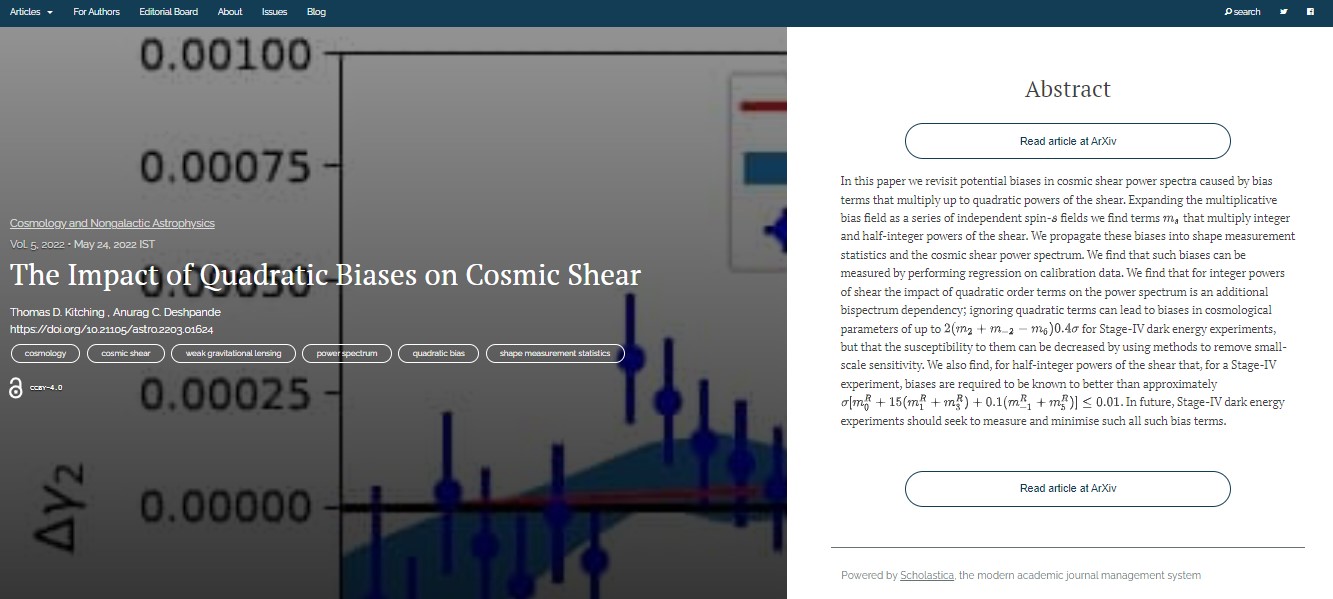
The latest publication is entitled Mapping Spatially Varying Additive Biases in Cosmic Shear Data and is written by Tom Kitching and Anurag Deshpande of the Mullard Space Science Laboratory (UCL) and Peter Taylor of the Jet Propulsion Laboratory (Caltech).

Here is a screen grab of the overlay which includes the abstract:

You can click on the image to make it larger should you wish to do so. You can find the arXiv version of the paper here. This is another one for the Cosmology and Nongalactic Astrophysics folder, which is the most popular category so far on the Open Journal of Astrophysics site.

P. S. Let me apologise for any inconvenience caused by a recent temporary outage on our Scholastica platform overnight between 16th & 17th December (US time). Normal service has now been restored.

Yet another Hubble Constant Update

Posted in The Universe and Stuff with tags , , , , on December 13, 2021 by telescoper

The latest contribution to the ongoing debate about the Hubble constant is a new paper by Adam Riess and collaborators which you can find on the arXiv here. The abstract reads:

As you can see, this group is doubling down up on a high value for the Hubble constant. This longstanding discrepancy gives me an excuse to post my longstanding opinion polls on the topic.

First, would you go for a “high” (73-ish) or “low” (68-ish) value:

Second, do you think the discrepancy or tension is anything to get excited or even tense about?

New Publication at the Open Journal of Astrophysics

Posted in OJAp Papers, Open Access, The Universe and Stuff with tags , , , , , , , on December 10, 2021 by telescoper

Time to announce yet another publication in the Open Journal of Astrophysics. This one was published yesterday, actually, but I didn’t get time to post about it until just now. It is the 16th paper in Volume 4 (2021) and the 47th in all.

The latest publication is entitled MCMC generation of cosmological fields far beyond Gaussianity and is written by Joey Braspenning and Elena Sellentin, both of Leiden University.

Here is a screen grab of the overlay which includes the abstract:


You can click on the image to make it larger should you wish to do so. You can find the arXiv version of the paper here. This is another one for the Cosmology and Nongalactic Astrophysics folder.

New Publication at the Open Journal of Astrophysics

Posted in OJAp Papers, Open Access, The Universe and Stuff with tags , , , , , , , on December 6, 2021 by telescoper

Time to announce yet another publication in the Open Journal of Astrophysics. This one is the 15th paper in Volume 4 (2021) and the 46th in all.

The latest publication is entitled  Interplanetary Dust as a Foreground for the LiteBIRD CMB Satellite Mission by Ken Ganga (Paris), Michele Maris (Trieste) and Mathieu Remazeilles (Santander) on behalf of the LiteBIRD collaboration. For information about the LiteBIRD mission see here.

Here is a screen grab of the overlay which includes the abstract:

You can find the paper on the Open Journal of Astrophysics site here and can also read it directly on the arXiv here.