Archive for Cosmology

More Lockdown Perspectives on the Hubble Tension and thoughts on the future of scientific publications

Posted in Open Access, The Universe and Stuff with tags , , , , on July 28, 2020 by telescoper

This is interesting. Remember last week when I posted about a paper by George Efstathiou on the Hubble Constant controversy. This is the abstract.
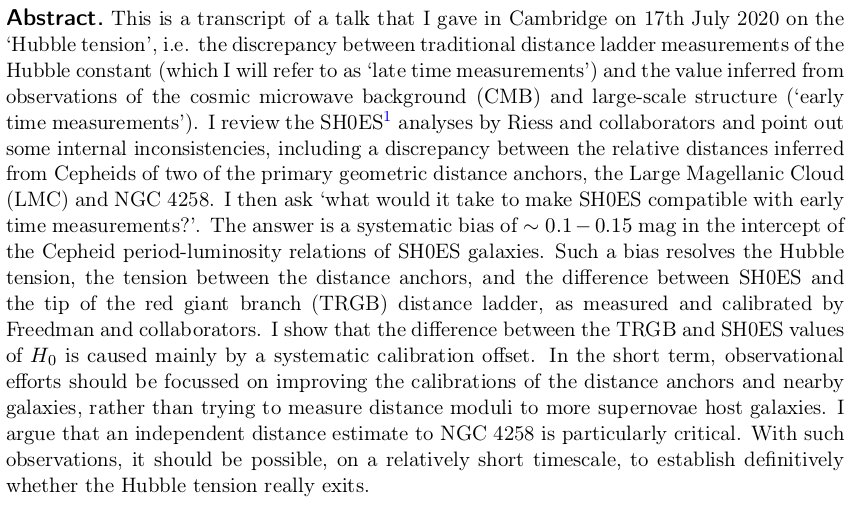
Well, a new version of the paper has just appeared on the arXiv that includes some comments in response from the SH0ES team.

It is of course interesting in itself to see the cut and thrust of scientific debate on a live topic such as this, but in my mind at least it raises interesting questions about the nature of scientific publication. To repeat something I wrote a a while ago, it seems  to me that the scientific paper published in an academic journal is an anachronism. Digital technology enables us to communicate ideas far more rapidly than in the past and allows much greater levels of interaction between researchers. I agree with Daniel Shanahan that the future for many fields will be defined not in terms of “papers” which purport to represent “final” research outcomes, but by living documents continuously updated in response to open scrutiny by the research community.

The Open Journal of Astrophysics is innovative in some ways but remains wedded to the paper as its fundamental object, and the platform is not able to facilitate interaction with readers. Of course one of the worries is that the comment facilities on many websites tend to get clogged up with mindless abuse, but I think that is manageable. I have some ideas on this, but for the time being I’m afraid all my energies are taken up with other things so this is for the future.

I’ve long argued that the modern academic publishing industry is not facilitating but hindering the communication of research. The arXiv has already made academic journals virtually redundant in many of branches of  physics and astronomy; other disciplines will inevitably follow. The age of the academic journal is drawing to a close, and it is consequently time to rethink the concept of a paper.

A Lockdown Perspective on the Hubble Tension (plus Poll)

Posted in The Universe and Stuff with tags , , on July 22, 2020 by telescoper

These are busy days in cosmological circles, especially regarding the Hubble Constant controversy. The latest contribution to appear on the arXiv is by George Efstathiou of Cambridge. Here is the abstract:

I don’t know if George has voted in my ongoing poll relating to this issue, but I bet that if he did he would vote low – along with the majority (so far):

Incidentally, I have seen no evidence of Russian interference in the voting.

Poll – The Hubble Constant: High or Low?

Posted in The Universe and Stuff with tags , on July 17, 2020 by telescoper

Given yesterday’s news from the Atacama Cosmology Telescope, among other things suggesting a low value of the Hubble constant of around 67.6 km s-1 Mpc-1, it might be fun to run another totally unscientific poll about which of the two Hubble constant camps has the most support in the community. The two camps are:

  • A `high’ value H0 ~ 73.5 ± 1.5 km s-1 Mpc-1 (as favoured by most stellar distance indicators, i.e. `local’ measurements).
  • A `low’ value H0 ~ 67.5 ± 0.5 km s-1 Mpc-1 (as favoured by most `cosmological’ estimates, e.g. cosmic microwave background fluctuations).

Of course you might also believe that both are wrong and the `true’ result lies outside both error regions but I’d like to focus on these two possibilities, so the question is posed assuming that one of them is right, which one is that most likely to be. In your opinion. Humble or otherwise.


New Results from the Atacama Cosmology Telescope!

Posted in The Universe and Stuff with tags , , , , on July 16, 2020 by telescoper

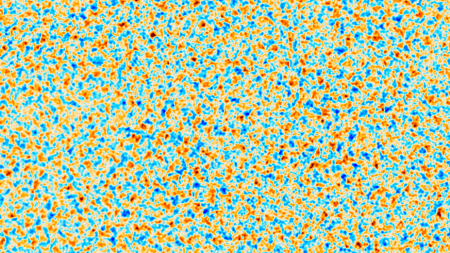
There’s some excitement in cosmological circles with the announcement of new results from the Atacama Cosmology Telescope, which is situated in the Atacama Desert in Chile. The two papers describing the new results can be found on the arXiv here and here and the data set will be made available here (it is Data Release 4; or DR4 for short).

If you want a laugh, the structure in the above map is on arc-minute scales – exactly the sort of thing I was trying to simulate way back in the 1980s. Here’s an ancient monochrome plot! The contours show 1σ, 2σ and 3σ fluctuations above the mean rather than the full distribution shown in the map above.

The full results will be discussed at a Zoom presentation at 11am Eastern Time (4pm Irish Time). I suspect it will be very busy so you will have to register in advance.

UPDATE: The Webinar is over but was recorded. I will post a link to the video when it is available. You can then guess which question was mine!

The new results from ACTPol are consistent with those from Planck, even down to the colour scheme used for the map, but the line taken by most media presentations I’ve seen (e.g. here and here) has been the issue of the Hubble Constant. The value of around 67.6 km s-1 Mpc-1 obtained by the Atacama Cosmology Telescope, though consistent with Planck measurements, is lower than most distance-scale measurements of H0. The dichotomy between `low’ estimates from cosmological observations and `high’ values persists.

This gives me an excuse to include my poll again:

There have been nearly a thousand responses so far, with opinion very divided.

The burning question however is when will face masks featuring the above map be made available for purchase? It could be a nice little earner…

The Cosmological Evidence – 25 Years Ago

Posted in Biographical, The Universe and Stuff with tags , , , on July 15, 2020 by telescoper

Today Facebook reminded me that the picture below is now 25 years old. I have posted it before and it has done the rounds at a number of cosmology conferences (usually to the accompaniment of lots of laughter), but I thought I’d circulate again as a bit of nostalgia and also to embarrass all concerned with this image. The picture was taken at a graduate school in cosmology in Leiden (in The Netherlands) in July 1995. In my memory that was a sweltering hot summer, which is my excuse for the informality of my attire.

Anyway, various shady characters masquerading as “experts” were asked by the audience of graduate students at a summer school to give their favoured values for the cosmological parameters. from from top to bottom these are:

  • the Hubble constant H0;
  • density parameter Ω0 (not split into dark matter and `ordinary’  matter as is now customary);
  • cosmological constant Λ0,
  • curvature parameter k
  • and age of the Universe t0.


From left to right we have Alain Blanchard (AB), Bernard Jones (BJ, standing), John Peacock (JP), me (yes, with a beard and a pony tail – the shame of it), Vincent Icke (VI), Rien van de Weygaert (RW) and Peter Katgert (PK, standing). You can see on the hi-tech digital display screen blackboard that the only one to get anywhere close to correctly predicting the parameters of what would become the standard cosmological model was, in fact, Rien van de Weygaert. Actually he was the only one of us to include a non-zero cosmological constant. My own favourite model at the time was a low-density model with negative spatial curvature.

Nobody is suggesting that panel discussions are the right way to settle scientific questions, of course, but it is interesting to see the diversity of opinions that were around in 1995.

P.S. Note that not all the combinations of parameters presented there are consistent with a Friedman model, but nobody said they had to be!


Cosmology Examination Results

Posted in Education, Maynooth, The Universe and Stuff with tags , , , , on July 14, 2020 by telescoper

The examination season in Maynooth being now over, and the results having been issued, I thought I’d pass on the results not for individual students but for the Universe as a whole.

As you can see Dark Energy is top of the class, with a good II.1 (Upper Second Class). A few years ago this candidate looked likely to get a mark over 70% and thus get First Class Honours, but in the end fell just short. Given the steady performance and possible improvement in future I think this candidate will probably be one to reckon with in a future research career.

In second place, a long way behind on about 27%, is Dark Matter. This candidate only answered some of the questions asked, and those not very convincingly. Although reasonably strong on theory, the candidate didn’t show up at all in the laboratory. The result is a fail but there is an opportunity for a repeat at a future date, though there is some doubt as to whether the candidate would appear.

At the bottom of the class on a meagre 5% we find Ordinary Matter. It seems this candidate must have left the examination early and did not even give the correct name (baryons) on the script. Technically this one could repeat but even doing so is unlikely even to get an Ordinary Degree. I would suggest that baryons aren’t really cut out for cosmology and should make alternative plans for the future.


P.S. Photons and neutrinos ceased interacting with the course some time ago. Owing to this lack of engagement they are assumed to have dropped out, and their marks are not shown.


R.I.P. Olivier Le Fèvre (1960-2020)

Posted in The Universe and Stuff with tags , , , , , on June 29, 2020 by telescoper

Olivier Le Fèvre (1960-2020)

The international cosmological community was deeply saddened last week to hear of the death on 25th June after a long illness of Olivier Le Fèvre. He was 59 years old.

Olivier was a specialist in astronomical spectroscopy and as such he made important contributions to cosmology through galaxy redshift surveys. He was Director of the Laboratoire d’Astrophysique de Marseille from 2004 to 2011. In latter years he was involved, among many other things, in the Euclid space mission.

You can find a full obituary and appreciation of Olivier’s life and work here. His funeral takes place this morning and there is an online book of condolence here to send messages of condolence and support to his family, friends and colleagues at this difficult time.

Rest in peace, Olivier Le Fèvre (1960-2020).

New Publication at the Open Journal of Astrophysics!

Posted in OJAp Papers, Open Access, The Universe and Stuff with tags , , , , , , on June 25, 2020 by telescoper

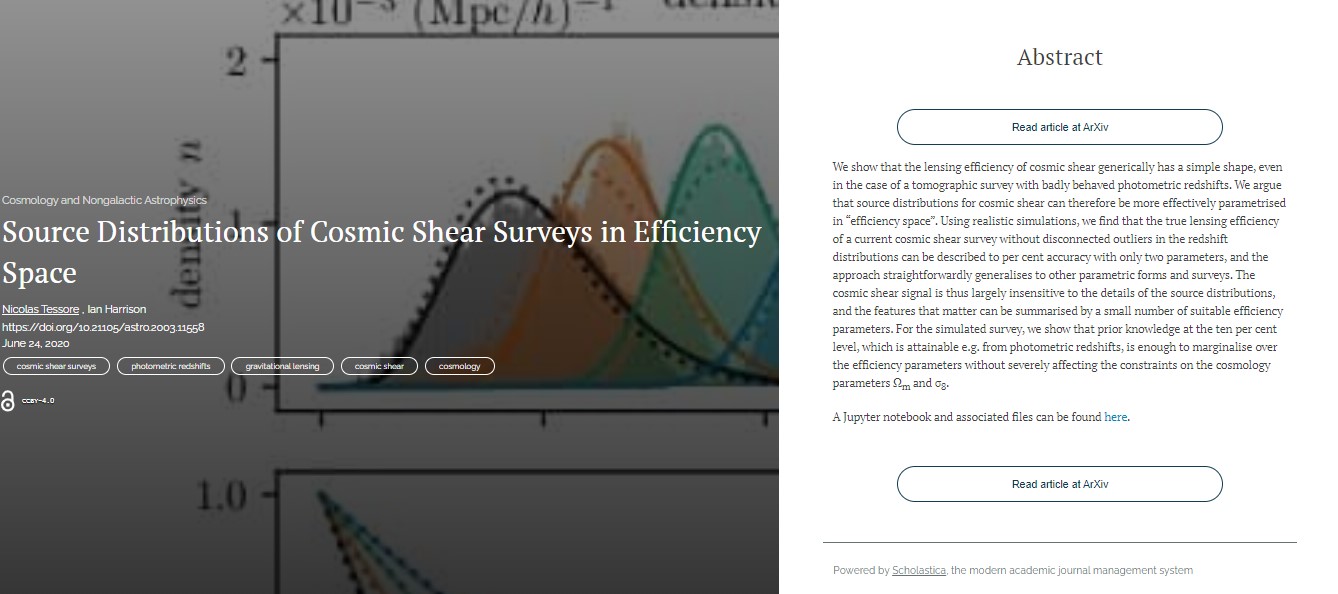
Proving further the point that the The Open Journal of Astrophysics is definitely fully open we have published yet another paper. This one was actually published yesterday, which means that we had two in two days..

This one is in the Cosmology and Nongalactic Astrophysics section and is entitled Source Distributions of Cosmic Shear Surveys in Efficiency Space. The authors are Nicolas Tessore and Ian Harrison, both from the University of Manchester. The paper is concerned with the extraction of cosmological information from cosmic shear surveys.

Here is a screen grab of the overlay:

You can find the arXiv version of the paper here.

Varun Sahni on Dark Matter & Dark Energy

Posted in The Universe and Stuff with tags , , , , on June 17, 2020 by telescoper

I’m very happy to be able to share a couple of lectures by esteemed cosmologist and erstwhile co-author Varun Sahni of the Inter University Centre for Astronomy & Astrophysics (IUCAA) in Pune, India. They’re at an introductory level appropriate for a summer school so I think quite a lot of students will find them interesting and informative!

Cosmology Talks – Clare Burrage on Chameleon Dark Energy

Posted in The Universe and Stuff with tags , , , , , , on June 11, 2020 by telescoper

Here is another one of those Cosmology Talks curated on YouTube by Shaun Hotchkiss.

In this talk, Clare Burrage of Nottingham University explains how chameleon dark energy models can be very tightly constrained by laboratory scale experiments (as opposed to particle accelerators and space missions). Chameleon models were popular for dark energy because their non-linear potentials generically create screening mechanisms, which stop them generating a fifth force despite their coupling to matter, the net effect of which is to make them hard to detect on Earth. On the other hand , in a suitably precise atomic experiment the screening can be minimised and the effect of the Chameleon field measured. Such an experiment has been constructed, and it rules out almost all of the viable parameter space where a chameleon model can explain dark energy.

The paper that accompanies this talk can be found here and the talk is here: