Archive for Cosmology

That Big Black Hole Story

Posted in The Universe and Stuff with tags , , , , , , , , on February 28, 2015 by telescoper

There’s been a lot of news coverage this week about a very big black hole, so I thought I’d post a little bit of background.  The paper describing the discovery of the object concerned appeared in Nature this week, but basically it’s a quasar at a redshift z=6.30. That’s not the record for such an object. Not long ago I posted an item about the discovery of a quasar at redshift 7.085, for example. But what’s interesting about this beastie is that it’s a very big beastie, with a central black hole estimated to have a mass of around 12 billion times the mass of the Sun, which is a factor of ten or more larger than other objects found at high redshift.

Anyway, I thought perhaps it might be useful to explain a little bit about what difficulties this observation might pose for the standard “Big Bang” cosmological model. Our general understanding of galaxies form is that gravity gathers cold non-baryonic matter into clumps  into which “ordinary” baryonic material subsequently falls, eventually forming a luminous galaxy forms surrounded by a “halo” of (invisible) dark matter.  Quasars are galaxies in which enough baryonic matter has collected in the centre of the halo to build a supermassive black hole, which powers a short-lived phase of extremely high luminosity.

The key idea behind this picture is that the haloes form by hierarchical clustering: the first to form are small but  merge rapidly  into objects of increasing mass as time goes on. We have a fairly well-established theory of what happens with these haloes – called the Press-Schechter formalism – which allows us to calculate the number-density N(M,z) of objects of a given mass M as a function of redshift z. As an aside, it’s interesting to remark that the paper largely responsible for establishing the efficacy of this theory was written by George Efstathiou and Martin Rees in 1988, on the topic of high redshift quasars.
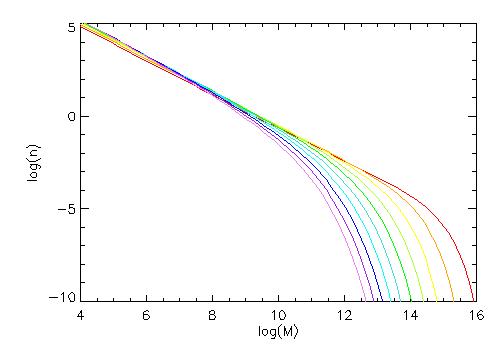
Anyway, this is how the mass function of haloes is predicted to evolve in the standard cosmological model; the different lines show the distribution as a function of redshift for redshifts from 0 (red) to 9 (violet):

Note   that the typical size of a halo increases with decreasing redshift, but it’s only at really high masses where you see a really dramatic effect. The plot is logarithmic, so the number density large mass haloes falls off by several orders of magnitude over the range of redshifts shown. The mass of the black hole responsible for the recently-detected high-redshift quasar is estimated to be about 1.2 \times 10^{10} M_{\odot}. But how does that relate to the mass of the halo within which it resides? Clearly the dark matter halo has to be more massive than the baryonic material it collects, and therefore more massive than the central black hole, but by how much?

This question is very difficult to answer, as it depends on how luminous the quasar is, how long it lives, what fraction of the baryons in the halo fall into the centre, what efficiency is involved in generating the quasar luminosity, etc.   Efstathiou and Rees argued that to power a quasar with luminosity of order 10^{13} L_{\odot} for a time order 10^{8} years requires a parent halo of mass about 2\times 10^{11} M_{\odot}.  Generally, i’s a reasonable back-of-an-envelope estimate that the halo mass would be about a hundred times larger than that of the central black hole so the halo housing this one could be around 10^{12} M_{\odot}.

You can see from the abundance of such haloes is down by quite a factor at redshift 7 compared to redshift 0 (the present epoch), but the fall-off is even more precipitous for haloes of larger mass than this. We really need to know how abundant such objects are before drawing definitive conclusions, and one object isn’t enough to put a reliable estimate on the general abundance, but with the discovery of this object  it’s certainly getting interesting. Haloes the size of a galaxy cluster, i.e.  10^{14} M_{\odot}, are rarer by many orders of magnitude at redshift 7 than at redshift 0 so if anyone ever finds one at this redshift that would really be a shock to many a cosmologist’s  system, as would be the discovery of quasars with such a high mass  at  redshifts significantly higher than seven.
Another thing worth mentioning is that, although there might be a sufficient number of potential haloes to serve as hosts for a quasar, there remains the difficult issue of understanding precisely how the black hole forms and especially how long it takes to do so. This aspect of the process of quasar formation is much more complicated than the halo distribution, so it’s probably on detailed models of  black-hole  growth that this discovery will have the greatest impact in the short term.

What is the Scientific Method?

Posted in The Universe and Stuff with tags , , on February 25, 2015 by telescoper

Twitter sent me this video about the scientific method yesterday, so I thought I’d share it via this blog.

The term Scientific Method is one that I find it difficult to define satisfactorily, despite having worked in science for over 25 years. The Oxford English Dictionary  defines Scientific Method as

..a method or procedure that has characterized natural science since the 17th century, consisting in systematic observation, measurement, and experiment, and the formulation, testing, and modification of hypotheses.

This is obviously a very general description, and the balance between the different aspects described is very different in different disciplines. For this reason when people try to define what the Scientific Method is for their own field, it doesn’t always work for others even within the same general area. It’s fairly obvious that zoology is very different from nuclear physics, but that doesn’t mean that either has to be unscientific. Moreover, the approach used in laboratory-based experimental physics can be very different from that used in astrophysics, for example. What I like about this video, though, is that it emphasizes the role of uncertainty in how the process works. I think that’s extremely valuable, as the one thing that I think should define the scientific method across all disciplines is a proper consideration of the assumptions made, the possibility of experimental error, and the limitations of what has been done. I wish this aspect of science had more prominence in media reports of scientific breakthroughs. Unfortunately these are almost always presented as certainties, so if they later turn out to be incorrect it looks like science itself has gone wrong. I don’t blame the media entirely about this, as there are regrettably many scientists willing to portray their own findings in this way.

When I give popular talks about my own field, Cosmology,  I often  look for appropriate analogies or metaphors in television programmes about forensic science, such as CSI: Crime Scene Investigation which I used to watch quite regularly (to the disdain of many of my colleagues and friends). Cosmology is methodologically similar to forensic science because it is generally necessary in both these fields to proceed by observation and inference, rather than experiment and deduction: cosmologists have only one Universe;  forensic scientists have only one scene of the crime. They can collect trace evidence, look for fingerprints, establish or falsify alibis, and so on. But they can’t do what a laboratory physicist or chemist would typically try to do: perform a series of similar experimental crimes under slightly different physical conditions. What we have to do in cosmology is the same as what detectives do when pursuing an investigation: make inferences and deductions within the framework of a hypothesis that we continually subject to empirical test. This process carries on until reasonable doubt is exhausted, if that ever happens. Of course there is much more pressure on detectives to prove guilt than there is on cosmologists to establish “the truth” about our Cosmos. That’s just as well, because there is still a very great deal we do not know about how the Universe works.


When random doesn’t seem random..

Posted in Crosswords, The Universe and Stuff with tags , , , , , on February 21, 2015 by telescoper

A few months have passed since I last won a dictionary as a prize in the Independent Crossword competition. That’s nothing remarkable in itself, but since my average rate of dictionary accumulation has been about one a month over the last few years, it seems a bit of a lull.  Have I forgotten how to do crosswords and keep sending in wrong solutions? Is the Royal Mail intercepting my post? Has the number of correct entries per week suddenly increased, reducing my odds of winning? Have the competition organizers turned against me?

In fact, statistically speaking, there’s nothing significant in this gap. Even if my grids are all correct, the number of correct grids has remained constant, and the winner is pulled at random  from those submitted (i.e. in such a way that all correct entries are equally likely to be drawn) , then a relatively long unsuccessful period such as I am experiencing at the moment is not at all improbable. The point is that such runs are far more likely in a truly random process than most people imagine, as indeed are runs of successes. Chance coincidences happen more often than you think.

I try this out in lectures sometimes, by asking a member of the audience to generate a random sequence of noughts and ones in their head. It seems people are very conscious that the number of ones should be roughly equal to the number of noughts that they impose that as they go along. Almost universally, the supposedly random sequences people produce only have very short runs of 1s or 0s because, say, a run like ‘00000’ just seems too unlikely. Well, it is unlikely, but that doesn’t mean it won’t happen. In a truly random binary sequence like this (i.e. one in which 1 and 0 both have a probability of 0.5 and each selection is independent of the others), coincidental runs of consecutive 0s and 1s happen with surprising frequency. Try it yourself, with a coin.

Coincidentally, the subject of randomness was suggested to me independently yesterday by an anonymous email correspondent by the name of John Peacock as I have blogged about it before; one particular post on this topic is actually one of this blog’s most popular articles).  What triggered this was a piece about music players such as Spotify (whatever that is) which have a “random play” feature. Apparently people don’t accept that it is “really random” because of the number of times the same track comes up. To deal with this “problem”, experts are working at algorithms that don’t actually play things randomly but in such a way that accords with what people think randomness means.

I think this fiddling is a very bad idea. People understand probability so poorly anyway that attempting to redefine the word’s meaning is just going to add confusion. You wouldn’t accept a casino that used loaded dice, so why allow cheating in another context? Far better for all concerned for the general public to understand what randomness is and, perhaps more importantly, what it looks like.

I have to confess that I don’t really like the word “randomness”, but I haven’t got time right now for a rant about it. There are, however, useful mathematical definitions of randomness and it is also (sometimes) useful to make mathematical models that display random behaviour in a well-defined sense, especially in situations where one has to take into account the effects of noise.

I thought it would be fun to illustrate one such model. In a point process, the random element is a “dot” that occurs at some location in time or space. Such processes can be defined in one or more dimensions and relate to a wide range of situations: arrivals of buses at a bus stop, photons in a detector, darts on a dartboard, and so on.

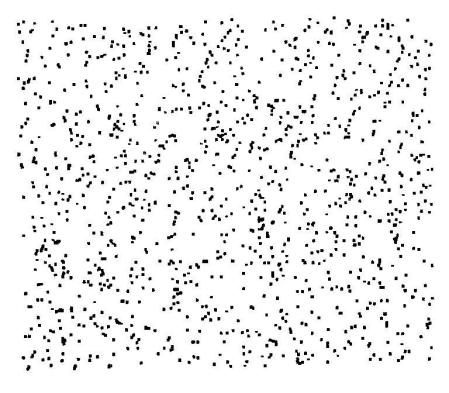
The statistical description of clustered point patterns is a fascinating subject, because it makes contact with the way in which our eyes and brain perceive pattern. I’ve spent a large part of my research career trying to figure out efficient ways of quantifying pattern in an objective way and I can tell you it’s not easy, especially when the data are prone to systematic errors and glitches. I can only touch on the subject here, but to see what I am talking about look at the two patterns below:

pointbpointa

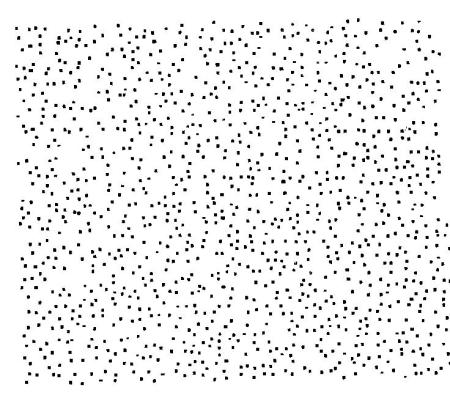
You will have to take my word for it that one of these is a realization of a two-dimensional Poisson point process and the other contains correlations between the points. One therefore has a real pattern to it, and one is a realization of a completely unstructured random process.

I show this example in popular talks and get the audience to vote on which one is the random one. In fact, I did this just a few weeks ago during a lecture in our module Quarks to Cosmos, which attempts to explain scientific concepts to non-science students. As usual when I do this, I found that the vast majority thought  that the top one is random and the bottom one is the one with structure to it. It is not hard to see why. The top pattern is very smooth (what one would naively expect for a constant probability of finding a point at any position in the two-dimensional space) , whereas the bottom one seems to offer a profusion of linear, filamentary features and densely concentrated clusters.

In fact, it’s the bottom  picture that was generated by a Poisson process using a  Monte Carlo random number generator. All the structure that is visually apparent in the second example is imposed by our own sensory apparatus, which has evolved to be so good at discerning patterns that it finds them when they’re not even there!

The top  process is also generated by a Monte Carlo technique, but the algorithm is more complicated. In this case the presence of a point at some location suppresses the probability of having other points in the vicinity. Each event has a zone of avoidance around it; the points are therefore anticorrelated. The result of this is that the pattern is much smoother than a truly random process should be. In fact, this simulation has nothing to do with galaxy clustering really. The algorithm used to generate it was meant to mimic the behaviour of glow-worms which tend to eat each other if they get  too close. That’s why they spread themselves out in space more uniformly than in the “really” random pattern.

I assume that Spotify’s non-random play algorithm will have the effect of producing a one-dimensional version of the top pattern, i.e. one with far too few coincidences to be genuinely random.

Incidentally, I got both pictures from Stephen Jay Gould’s collection of essays Bully for Brontosaurus and used them, with appropriate credit and copyright permission, in my own book From Cosmos to Chaos.

The tendency to find things that are not there is quite well known to astronomers. The constellations which we all recognize so easily are not physical associations of stars, but are just chance alignments on the sky of things at vastly different distances in space. That is not to say that they are random, but the pattern they form is not caused by direct correlations between the stars. Galaxies form real three-dimensional physical associations through their direct gravitational effect on one another.

People are actually pretty hopeless at understanding what “really” random processes look like, probably because the word random is used so often in very imprecise ways and they don’t know what it means in a specific context like this.  The point about random processes, even simpler ones like repeated tossing of a coin, is that coincidences happen much more frequently than one might suppose.

I suppose there is an evolutionary reason why our brains like to impose order on things in a general way. More specifically scientists often use perceived patterns in order to construct hypotheses. However these hypotheses must be tested objectively and often the initial impressions turn out to be figments of the imagination, like the canals on Mars.

Perhaps I should complain to WordPress about the widget that links pages to a “random blog post”. I’m sure it’s not really random….

A First Author Paper

Posted in The Universe and Stuff with tags , , , , , on February 16, 2015 by telescoper

I thought I’d take a few minutes to celebrate the fact that the first first-author paper by my PhD student here at the University of Sussex, Mateja Gosenca, has just hit the arXiv. The abstract reads:

We explore the dynamical behaviour of cosmological models involving a scalar field (with an exponential potential and a canonical kinetic term) and a matter fluid with spatial curvature included in the equations of motion. Using appropriately defined parameters to describe the evolution of the scalar field energy in this situation, we find that there are two extra fixed points that are not present in the case without curvature. We also analyse the evolution of the effective equation-of-state parameter for different initial values of the curvature.

There has been a lot of interest recently in treating cosmological models as dynamical systems, and the class of models we studied has been analysed before (see the references in the paper) but this paper addresses them in a different (and perhaps slightly more elegant) way and in the context of quintessence models for dark energy. It also contains some very pretty multi-dimensional phase portraits, like this:

Mateja

Of course these figures are self-explanatory, so I’ll say no more about them…

Planck Update

Posted in The Universe and Stuff with tags , , , , on February 5, 2015 by telescoper

Just time for a very quick post today to pass on thhe news that most of the 2015 crop of papers from the Planck mission have now been released and are available to download here. You can also find some related data products here.

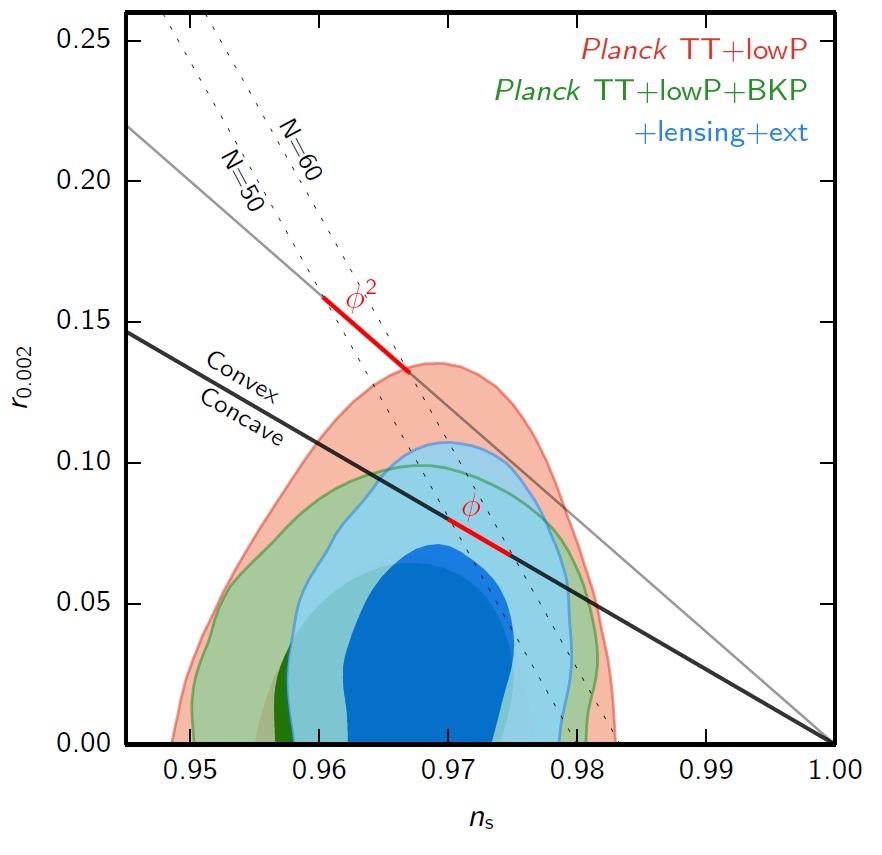
I haven’t had time to look at these in any detail myself, but my attention was drawn (in the light of the recently-released combined analysis of Planck and Bicpe2/Keck data) to the constraints on inflationary cosmological models shown in this figure:

inflation

It seems that the once-popular (because it is simple) m^2 \phi^2 model of inflation is excluded at greater than 99% confidence…
Feel free to add reactions to any of the papers in the new release via the comments box!

The BICEP2 Bubble Bursts…

Posted in The Universe and Stuff with tags , , , , on January 30, 2015 by telescoper

I think it’s time to break the worst-kept secret in cosmology, concerning the claimed detection of primordial gravitational waves by the BICEP2 collaboration that caused so much excitement last year; see this blog, passim. If you recall, the biggest uncertainty in this result derived from the fact that it was made at a single frequency, 150 GHz, so it was impossible to determine the spectrum of the signal. Since dust in our own galaxy emits polarized light in the far-infrared there was no direct evidence to refute the possibility that this is what BICEP2 had detected. The indirect arguments presented by the BICEP2 team (that there should be very little dust emission in the region of the sky they studied) were challenged, but the need for further measurements was clear.

Over the rest of last year, the BICEP2 team collaborated with the consortium working on the Planck satellite, which has measurements over the whole sky at a wide range of frequencies. Of particular relevance to the BICEP2 controversy are the Planck mesurements at such high frequency that they are known to be dominated by dust emission, specifically the 353 GHz channel. Cross-correlating these data with the BICEP2 measurements (and also data from the Keck Array which is run by the same team) should allow the identification of that part of the BICEP2 signal that is due to dust emission to be isolated and subtracted. What’s left would be the bit that’s interesting for cosmology. This is the work that has been going on, the results of which will officially hit the arXiv next week.

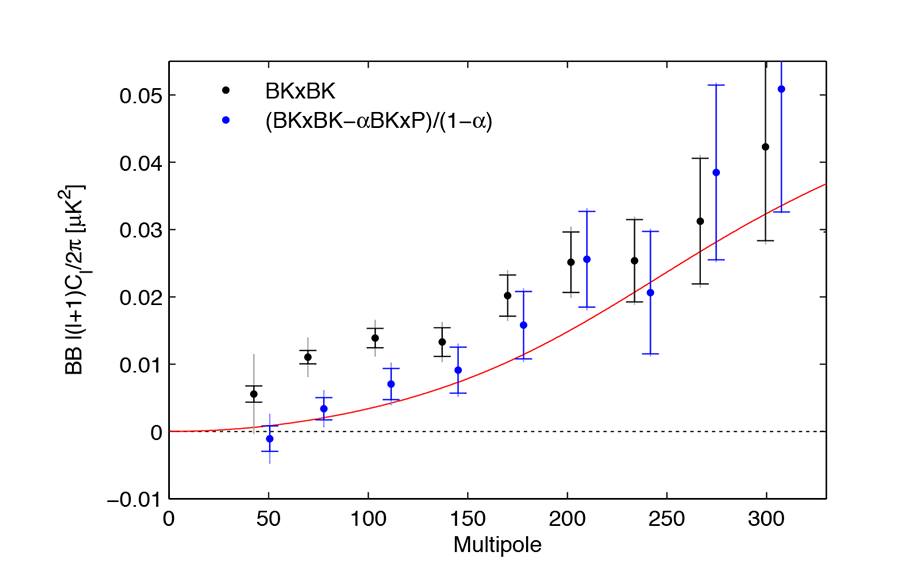
However, news has been leaking out over the last few weeks about what the paper will say. Being the soul of discretion I decided not to blog about these rumours. However, yesterday I saw the killer graph had been posted so I’ve decided to share it here:

cross-correlation

The black dots with error bars show the original BICEP/Keck “detection” of B-mode polarization which they assumed was due to primordial gravitational waves. The blue dots with error bars show the results after subtracting the correlated dust component. There is clearly a detection of B-mode polarization. However, the red curve shows the B-mode polarization that’s expected to be generated not by primordial gravitational waves but by gravitational lensing; this signal is already known. There’s a slight hint of an excess over the red curve at multipoles of order 200, but it is not statistically significant. Note that the error bars are larger when proper uncertainties are folded in.

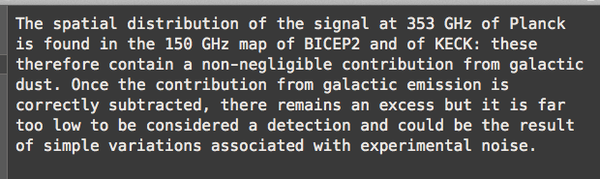
Here’s a quasi-official statement of the result (orginall issued in French) that has been floating around on Twitter:

BICEP_null

To be blunt, therefore, the BICEP2 measurement is a null result for primordial gravitational waves. It’s by no means a proof that there are no gravitational waves at all, but it isn’t a detection. In fact, for the experts, the upper limit on the tensor-to-scalar ratio  R from this analysis is R<0.13 at 95% confidences there’s actually till room for a sizeable contribution from gravitational waves, but we haven’t found it yet.

The search goes on…

UPDATE: As noted below in the comments, the actual paper has now been posted online here along with supplementary materials. I’m not surprised as the cat is already well and truly out of the bag, with considerable press interest, some of it driving traffic here!

UPDATE TO THE UPDATE: There’s a news item in Physics World and another in Nature News about this, both with comments from me and others.

Social Physics & Astronomy

Posted in The Universe and Stuff with tags , , , , , , on January 25, 2015 by telescoper

When I give popular talks about Cosmology,  I sometimes look for appropriate analogies or metaphors in television programmes about forensic science, such as CSI: Crime Scene Investigation which I watch quite regularly (to the disdain of many of my colleagues and friends). Cosmology is methodologically similar to forensic science because it is generally necessary in both these fields to proceed by observation and inference, rather than experiment and deduction: cosmologists have only one Universe;  forensic scientists have only one scene of the crime. They can collect trace evidence, look for fingerprints, establish or falsify alibis, and so on. But they can’t do what a laboratory physicist or chemist would typically try to do: perform a series of similar experimental crimes under slightly different physical conditions. What we have to do in cosmology is the same as what detectives do when pursuing an investigation: make inferences and deductions within the framework of a hypothesis that we continually subject to empirical test. This process carries on until reasonable doubt is exhausted, if that ever happens.

Of course there is much more pressure on detectives to prove guilt than there is on cosmologists to establish the truth about our Cosmos. That’s just as well, because there is still a very great deal we do not know about how the Universe works.I have a feeling that I’ve stretched this analogy to breaking point but at least it provides some kind of excuse for writing about an interesting historical connection between astronomy and forensic science by way of the social sciences.

The gentleman shown in the picture on the left is Lambert Adolphe Jacques Quételet, a Belgian astronomer who lived from 1796 to 1874. His principal research interest was in the field of celestial mechanics. He was also an expert in statistics. In Quételet’s  time it was by no means unusual for astronomers to well-versed in statistics, but he  was exceptionally distinguished in that field. Indeed, Quételet has been called “the father of modern statistics”. and, amongst other things he was responsible for organizing the first ever international conference on statistics in Paris in 1853.

His fame as a statistician owed less to its applications to astronomy, however, than the fact that in 1835 he had written a very influential book which, in English, was titled A Treatise on Man but whose somewhat more verbose original French title included the phrase physique sociale (“social physics”). I don’t think modern social scientists would see much of a connection between what they do and what we do in the physical sciences. Indeed the philosopher Auguste Comte was annoyed that Quételet appropriated the phrase “social physics” because he did not approve of the quantitative statistical-based  approach that it had come to represent. For that reason Comte  ditched the term from his own work and invented the modern subject of  sociology…

Quételet had been struck not only by the regular motions performed by the planets across the sky, but also by the existence of strong patterns in social phenomena, such as suicides and crime. If statistics was essential for understanding the former, should it not be deployed in the study of the latter? Quételet’s first book was an attempt to apply statistical methods to the development of man’s physical and intellectual faculties. His follow-up book Anthropometry, or the Measurement of Different Faculties in Man (1871) carried these ideas further, at the expense of a much clumsier title.

This foray into “social physics” was controversial at the time, for good reason. It also made Quételet extremely famous in his lifetime and his influence became widespread. For example, Francis Galton wrote about the deep impact Quételet had on a person who went on to become extremely famous:

Her statistics were more than a study, they were indeed her religion. For her Quételet was the hero as scientist, and the presentation copy of his “Social Physics” is annotated on every page. Florence Nightingale believed – and in all the actions of her life acted on that belief – that the administrator could only be successful if he were guided by statistical knowledge. The legislator – to say nothing of the politician – too often failed for want of this knowledge. Nay, she went further; she held that the universe – including human communities – was evolving in accordance with a divine plan; that it was man’s business to endeavour to understand this plan and guide his actions in sympathy with it. But to understand God’s thoughts, she held we must study statistics, for these are the measure of His purpose. Thus the study of statistics was for her a religious duty.

The person  in question was of course  Florence Nightingale. Not many people know that she was an adept statistician who was an early advocate of the use of pie charts to represent data graphically; she apparently found them useful when dealing with dim-witted army officers and dimmer-witted politicians.

The type of thinking described in the quote  also spawned a number of highly unsavoury developments in pseudoscience, such as the eugenics movement (in which Galton himself was involved), and some of the vile activities related to it that were carried out in Nazi Germany. But an idea is not responsible for the people who believe in it, and Quételet’s work did lead to many good things, such as the beginnings of forensic science.

A young medical student by the name of Louis-Adolphe Bertillon was excited by the whole idea of “social physics”, to the extent that he found himself imprisoned for his dangerous ideas during the revolution of 1848, along with one of his Professors, Achile Guillard, who later invented the subject of demography, the study of racial groups and regional populations. When they were both released, Bertillon became a close confidante of Guillard and eventually married his daughter Zoé. Their second son, Adolphe Bertillon, turned out to be a prodigy.

Young Adolphe was so inspired by Quételet’s work, which had no doubt been introduced to him by his father, that he hit upon a novel way to solve crimes. He would create a database of measured physical characteristics of convicted criminals. He chose 11 basic measurements, including length and width of head, right ear, forearm, middle and ring fingers, left foot, height, length of trunk, and so on. On their own none of these individual characteristics could be probative, but it ought to be possible to use a large number of different measurements to establish identity with a very high probability. Indeed, after two years’ study, Bertillon reckoned that the chances of two individuals having all 11 measurements in common were about four million to one. He further improved the system by adding photographs, in portrait and from the side, and a note of any special marks, like scars or moles.

Bertillonage, as this system became known, was rather cumbersome but proved highly successful in a number of high-profile criminal cases in Paris. By 1892, Bertillon was exceedingly famous but nowadays the word bertillonage only appears in places like the Observer’s Azed crossword.

The main reason why Bertillon’s fame subsided and his system fell into disuse was the development of an alternative and much simpler method of criminal identification: fingerprints. The first systematic use of fingerprints on a large scale was implemented in India in 1858 in an attempt to stamp out electoral fraud.

The name of the British civil servant who had the idea of using fingerprinting in this way was Sir William James Herschel (1833-1917), the eldest child of Sir John Herschel, the astronomer, and thus the grandson of Sir William Herschel, the discoverer of Uranus. Another interesting connection between astronomy and forensic science.


Last days on the Ice

Posted in The Universe and Stuff with tags , , on January 25, 2015 by telescoper

Earlier this month I reblogged a post about the launch of the balloon-borne SPIDER experiment in Antarctica. Here’s a follow up from last week. Spider parachuted back down to the ice on January 17th and was recovered successfully. Now the team will be leaving the ice and returning home, hopefully with some exciting science results!

I’d love to go to Antarctica, actually. When I was finishing my undergraduate studies at Cambridge I applied for a place on the British Antarctic Survey, but didn’t get accepted. I don’t suppose I’ll get the chance now, but you never know…

annegambrel22's avatarSPIDER on the Ice

Four of the last five of the SPIDER crew– Don, Ed, Sasha, and I– are slated to leave the Ice tomorrow morning. That means this is probably my last blog post– at least until SPIDER 2! It has been an incredible few months, but I can’t say I’m all that sad for it to be ending. I’m ready to have an adventure in New Zealand and then get home to all the people I’ve missed so much while I’ve been away.

As is the nature of field campaigns, it has been an absolute roller coaster, but the highs have certainly made the lows fade in my memory. We got SPIDER on that balloon, and despite all of the complexities and possible points of failure, it worked. That’s a high I won’t be coming down from any time soon.

On top of success with our experiment, we’ve also had the privilege of…

View original post 98 more words

Cosmology – Confusion on a Higher Level?

Posted in Biographical, The Universe and Stuff with tags , , , , , on January 19, 2015 by telescoper

I’ve already posted the picture below, which was taken at a conference in Leiden (Netherlands) in 1995. Various shady characters masquerading as “experts” were asked by the audience of graduate students at a summer school to give their favoured values for the cosmological parameters (from top to bottom: the Hubble constant, density parameter, cosmological constant, curvature parameter and age of the Universe).

From left to right we have Alain Blanchard (AB), Bernard Jones (BJ, standing), John Peacock (JP), me (yes, with a beard and a pony tail – the shame of it), Vincent Icke (VI), Rien van de Weygaert (RW) and Peter Katgert (PK, standing). You can see on the blackboard that the only one to get anywhere close to correctly predicting the parameters of what would become the standard cosmological model was, in fact, Rien van de Weygaert.

Well, my excuse for posting this again is the fact that a similar discussion was held at a meeting in Oslo (Norway) at which a panel of experts and Alan Heavens did a similar thing. I wasn’t there myself but grabbed the evidence from facebook:

experts

I’ll leave it as an exercise for the reader to identify the contributors. The 2015 version of the results is considerably more high-tech than the 1995 one, but in case you can’t read what is on the screen here are the responses:

panel_vote

The emphasis here is on possible departures from the standard model, whereas in 1995 the standard model hadn’t yet been established. I’m not sure exactly what questions were asked but I think my answers would have been: 3+1;  maybe; maybe; don’t know but (probably) not CDM; something indistinguishable from GR given current experiments; Lambda; and maybe. I’ve clearly become a skeptic in my old age.

Anyway, this “progress” reminded me of a quote I used to have on my office door when I was a graduate student in the Astronomy Centre at the University of Sussex many years ago:

We have not succeeded in answering all our problems. The answers we have found only serve to raise a whole set of new questions. In some ways we feel we are as confused as ever, but we believe we are confused on a higher level and about more important things.

The attribution of that quote is far from certain, but I was told that it was posted outside the mathematics reading room, Tromsø University. Which is in Norway. Apt, or what?

Planck Talks Online!

Posted in The Universe and Stuff with tags , , , , , on December 11, 2014 by telescoper

After yesterday’s frivolity, I return to community service mode today with a short post before a series of end-of-term meetings.

You may recall that not long ago  I posted an item about a meeting in Ferrara which started on 1st December and which  concerned results from the Planck satellite. Well, although the number of new results was disappointingly limited, all the talks given at that meeting are now available online here. Not all of the talks are about new Planck results, and some of those that do are merely tasters of things that will be more completely divulged in due course, but there is still a lot of interesting material there so I recommend cosmology types have a good look through. Any comments would be welcome through the usual channel below.

I’ll take this opportunity to pass on another couple of related items. First is that there is another meeting on Planck, in Paris next week. Coincidentally, I will be in Paris on Monday and Tuesday for a completely unrelated matter (of which more anon) but I will try to keep up with the cosmology business via Twitter etc and pass on whatever I can pick up.

The other bit of news is that there is to be a press conference on December 22nd at which I’m led to believe the outcome of the joint analysis of CMB polarization by Planck and BICEP2 will be unveiled. Now that will be interesting, so stay tuned!

Oh, and my poll on this subject is still open: