Archive for Cosmology

**** Energy

Posted in Poetry, The Universe and Stuff with tags , , , , , on March 30, 2009 by telescoper

The phrase expletive deleted was made popular at the time of Watergate after the release of the expurgated tapes made by Richard Nixon in the Oval Office when he was President of the United States of America. These showed that, as well as been a complete crook, he was practically unable to speak a single sentence without including a swear word.

Nowadays the word expletive is generally taken to mean an oath or exclamation, particularly if it is obscene, but that’s not quite what it really means. Derived from the latin verb explere (“to fill out”) from which the past participle is expletus, the meaning of the word in the context of English grammar is  “something added to a phrase or sentence that isn’t strictly needed for the grammatical sense”.  An expletive is added either to fill a syntactical role or, in a poem, simply to make a line fit some metrical rule.

Examples of the former can be found in constructions like “It takes two to Tango” or “There is lots of crime in Nottingham”; neither  “it” nor “there” should really be needed but English likes to have something before the verb.

The second kind of use is illustrated wonderfully by Alexander Pope in his Essay on Criticism, which is a kind of guide to what to avoid in writing poetry. It’s a tour de force for its perceptiveness and humour. The following excerpt is pricelessly apt

These equal syllables alone require,
Tho’ oft the open vowels tire;
While expletives their feeble aid do join;
And ten low words oft creep in one dull line

Here the expletive is “do”,  and it is cleverly incorporated in the line talking about expletives, adding  the syllable needed to fit with a strict pentameter. Apparently, poets often used this construction before Pope attacked it but it quickly fell from favour afterwards.

His other prosodic targets are the “open vowels” which means initial vowels that produce an ugly glottal sound, such as in “oft” (especially ugly when following “Tho”). The last line is brilliant too, showing how using only monosyllabic “low” words makes for a line that plods along tediously just like it says.

It’s amazing how much Pope managed to fit into this poem, given the restrictions imposed by the closed couplet structure he adopted. Each idea is compressed into a unit of twenty syllables, two lines of ten syllables with a rhyme at the end of each. This is such an impressive exercise in word-play that it reminds me a lot of the skill showed by the best cryptic crossword setters. Needless to say I’m no more successful at writing poetry than I am at setting crossword clues.

After my talk in Dublin last Friday, somebody in the audience asked me what I thought about Dark Energy. There’s some discussion in the comments after my post on that too.

The Dark Energy is an ingredient added to the standard model of cosmology to reconcile  observations of a flat Universe with a matter density that seems too low to account for it.

Other than that it makes the  cosmological metric work out satisfactorily (geddit?), we don’t understand what Dark Energy means and would rather it wasn’t there.  Most people think the resulting model is inelegant or even ugly.

In other words, it’s an expletive…

Dublin Back

Posted in Art, Books, Talks and Reviews, Crosswords, The Universe and Stuff with tags , , , , on March 28, 2009 by telescoper

I’m just back from a flying visit to Dublin, where I gave a talk yesterday at a meeting of the Astronomical Science Group of Ireland (ASGI), an organization which promotes scientific collaborations between individuals and institutions on both sides of the border between Northern Ireland and the Republic of Eire. The venue for the twice-yearly meetings moves around both countries, but this time it was held in the splendid environment of Trinity College, Dublin.

It turned out to be an easy trip from Cardiff to Dublin and my first opportunity to try out Cardiff’s fine little airport. A small airline called Air Arann operates the route to Dublin from there, and it all went to schedule despite the plane having to struggle against a 70 mph head wind across the Irish sea. For our small propeller-driven plane, that made a signficant difference to the flying time.

Arriving in Dublin on Thursday I had time to have a nice dinner before settling in to my hotel in the Temple Bar region of the city. There’s a huge concentration of bars and nightclubs there and it’s a traditional area for Stag and Hen Parties. There was plenty of evidence of drunken debauchery going on into the early hours of the morning, which remind me of the way the Irish rugby fans carried on last weekend in Cardiff.

Anyway, the meeting itself was interesting with a wide range of talks most of which were given by PhD students. I enjoy meetings where the younger scientists are encouraged to speak; too many conferences involve the same people giving the same talk time after time. Solar Physics was particularly  well represented, and I learned quite a bit about about things that are far from my own province. 

There isn’t much actual cosmology done in Ireland (North or South) so my brief as invited speaker was to give an overview of the current state of the field for astronomers who are not  experts in cosmological matters. I therefore gave a summary of the concordance model which I’ve blogged about before and then made some comments about things that might point to a more complete theory of the Universe. I also mentioned some of the anomalies in the cosmic microwave background that I’ve also blogged about on here.

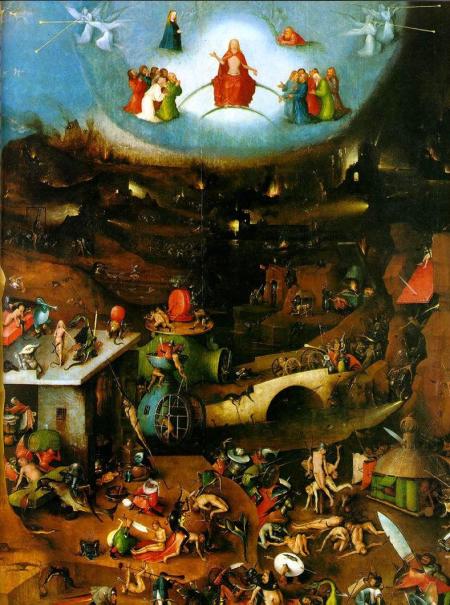
I usually use this piece of Hieronymus Bosch The Last Judgement to illustrate my feelings about the concordance model:

das_letzte_gericht


The top part represents the concordance cosmology. It clearly features an eminent cosmologist surrounded by postdoctoral researchers. Everything appears to be in heavenly harmony, surrounded by a radiant glow of self-satisfaction. The trumpets represent various forms of exaggerated press coverage.

But if you step back from it, and get the whole thing in a proper perspective, you realise that there’s an awful lot going on underneath that’s not so pleasant or easy to interptet. I don’t know what’s going down below there although the unfortunate figures slaving away in miserable conditions and suffering unimaginable torments are obviously supposed to represent graduate students.

The main point is that the concordance model is based on rather strange foundations: nobody understands what the dark matter and dark energy are, for example. Even more fundamentally, the whole thing is based on a shotgun marriage between general relativity and quantum field theory which is doomed to fail somewhere along the line.

Far from being a final theory of the Universe I think we should treat our standard model as a working hypothesis and actively look for departures from it. I’m not at all against the model. As models go, it’s very successful. It’s a good one, but it’s still just a model.

That reminds me of the school report I got after my first year at the Royal Grammar School. The summary at the bottom described me as a “model student”. I was so thrilled I went and looked up the word model in a dictionary and found it said “a small imitation of the real thing.”

Anyway, the talk went down pretty well (I think) and after a quick glass of Guinness (which definitely went down well) I was back to Dublin airport and home to Cardiff soon after that: Cardiff airport to my house was less than twenty minutes. I greatly enjoyed my short visit and was delighted to be asked to do a couple of seminars back there in the near future.

I was in a  good mood when I got home, which got even better when I found out that I won the latest Crossword competition in the Times Literary Supplement. And the prize isn’t even a dictionary. It’s cash!

Social Physics and Astronomy

Posted in The Universe and Stuff with tags , , , , , on March 23, 2009 by telescoper

When I give popular talks about Cosmology,  I sometimes look for appropriate analogies or metaphors in television programmes about forensic science, such as CSI: Crime Scene Investigation which I used to watch quite regularly (to the disdain of many of my colleagues and friends). Cosmology is methodologically similar to forensic science because it is generally necessary in both these fields to proceed by observation and inference, rather than experiment and deduction: cosmologists have only one Universe;  forensic scientists have only one scene of the crime. They can collect trace evidence, look for fingerprints, establish or falsify alibis, and so on. But they can’t do what a laboratory physicist or chemist would typically try to do: perform a series of similar experimental crimes under slightly different physical conditions. What we have to do in cosmology is the same as what detectives do when pursuing an investigation: make inferences and deductions within the framework of a hypothesis that we continually subject to empirical test. This process carries on until reasonable doubt is exhausted, if that ever happens.

Of course there is much more pressure on detectives to prove guilt than there is on cosmologists to establish the truth about our Cosmos. That’s just as well, because there is still a very great deal we do not know about how the Universe works.I have a feeling that I’ve stretched this analogy to breaking point but at least it provides some kind of excuse for writing about an interesting historical connection between astronomy and forensic science by way of the social sciences.

The gentleman shown in the picture on the left is Lambert Adolphe Jacques Quételet, a Belgian astronomer who lived from 1796 to 1874. His principal research interest was in the field of celestial mechanics. He was also an expert in statistics. In Quételet’s  time it was by no means unusual for astronomers to well-versed in statistics, but he  was exceptionally distinguished in that field. Indeed, Quételet has been called “the father of modern statistics”. and, amongst other things he was responsible for organizing the first ever international conference on statistics in Paris in 1853.


His fame as a statistician owed less to its applications to astronomy, however, than the fact that in 1835 he had written a very influential book which, in English, was titled A Treatise on Man but whose somewhat more verbose original French title included the phrase physique sociale (“social physics”).

Apparently the philosopher Auguste Comte was annoyed that Quételet appropriated the phrase “social physics” because he did not approve of the quantitative statistical-based  approach that it had come to represent. For that reason Comte  ditched the term from his own work and invented the subject of  sociology…

Quételet had been struck not only by the regular motions performed by the planets across the sky, but also by the existence of strong patterns in social phenomena, such as suicides and crime. If statistics was essential for understanding the former, should it not be deployed in the study of the latter? Quételet’s first book was an attempt to apply statistical methods to the development of man’s physical and intellectual faculties. His follow-up book Anthropometry, or the Measurement of Different Faculties in Man (1871) carried these ideas further, at the expense of a much clumsier title.

This foray into “social physics” was controversial at the time, for good reason. It also made Quételet extremely famous in his lifetime and his influence became widespread. For example, Francis Galton wrote about the deep impact Quételet had on a certain British lady:

Her statistics were more than a study, they were indeed her religion. For her Quételet was the hero as scientist, and the presentation copy of his “Social Physics” is annotated on every page. Florence Nightingale believed – and in all the actions of her life acted on that belief – that the administrator could only be successful if he were guided by statistical knowledge. The legislator – to say nothing of the politician – too often failed for want of this knowledge. Nay, she went further; she held that the universe – including human communities – was evolving in accordance with a divine plan; that it was man’s business to endeavour to understand this plan and guide his actions in sympathy with it. But to understand God’s thoughts, she held we must study statistics, for these are the measure of His purpose. Thus the study of statistics was for her a religious duty.

The name of the lady in question was Florence Nightingale. Not many people know that she was an adept statistician who was an early advocate of the use of pie charts to represent data graphically; she apparently found them useful when dealing with dim-witted army officers and dimmer-witted politicians.

The type of thinking described in the quote  also spawned a number of highly unsavoury developments in pseudoscience, such as the eugenics movement (in which Galton himself was involved), and some of the vile activities related to it that were carried out in Nazi Germany. But an idea is not responsible for the people who believe in it, and Quételet’s work did lead to many good things, such as the beginnings of forensic science.

A young medical student by the name of Louis-Adolphe Bertillon was excited by the whole idea of “social physics”, to the extent that he found himself imprisoned for his dangerous ideas during the revolution of 1848, along with one of his Professors, Achile Guillard, who later invented the subject of demography, the study of racial groups and regional populations. When they were both released, Bertillon became a close confidante of Guillard and eventually married his daughter Zoé. Their second son, Adolphe Bertillon, turned out to be a prodigy.

Young Adolphe was so inspired by Quételet’s work, which had no doubt been introduced to him by his father, that he hit upon a novel way to solve crimes. He would create a database of measured physical characteristics of convicted criminals. He chose 11 basic measurements, including length and width of head, right ear, forearm, middle and ring fingers, left foot, height, length of trunk, and so on. On their own none of these individual characteristics could be probative, but it ought to be possible to use a large number of different measurements to establish identity with a very high probability. Indeed, after two years’ study, Bertillon reckoned that the chances of two individuals having all 11 measurements in common were about four million to one. He further improved the system by adding photographs, in portrait and from the side, and a note of any special marks, like scars or moles.

Bertillonage, as this system became known, was rather cumbersome but proved highly successful in a number of high-profile criminal cases in Paris. By 1892, Bertillon was exceedingly famous but nowadays the word bertillonage only appears in places like the Observer’s Azed crossword.

The main reason why Bertillon’s fame subsided and his system fell into disuse was the development of an alternative and much simpler method of criminal identification: fingerprints. The first systematic use of fingerprints on a large scale was implemented in India in 1858 in an attempt to stamp out electoral fraud.

The name of the British civil servant who had the idea of using fingerprinting in this way was William Herschel, although I don’t think he was related to the astronomer of the same name.

That would be too much of a coincidence.

Throwing a Fit

Posted in Bad Statistics, The Universe and Stuff with tags , on February 18, 2009 by telescoper

I’ve just been to a very interesting and stimulating seminar by Subir Sarkar from Oxford, who spoke about Cosmology Beyond the Standard Model, a talk into which he packed a huge number of provocative comments and interesting arguments. His abstract is here:

Precision observations of the cosmic microwave backround and of the large-scale clustering of galaxies have supposedly confirmed the indication from the Hubble diagram of Type Ia supernovae that the universe is dominated by some form of dark energy which is causing the expansion rate to accelerate. Although hailed as having established a ‘standard model’ for cosmology, this raises a profound problem for fundamental physics. I will discuss whether the observations can be equally well explained in alternative inhomogeneous cosmological models that do not require dark energy and will be tested by forthcoming observations.

He made no attempt to be balanced and objective, but it was a thoroughly enjoyable polemic making the point that it is possible that the dark energy whose presence we infer from cosmological observations might just be an artifact of using an oversimplified model to interpret the data. I actually agreed with quite a lot of what he said, and certainly think the subject needs people willing to question the somewhat shaky foundations on which the standard concordance cosmology is built.

But near the end, Subir almost spoiled the whole thing by making a comment that made me decide to make  another entry in my Room 101 of statistical horrors.  He was talking about the  spectrum of fluctuations in the temperature of the Cosmic Microwave Background as measured by the Wilkinson Microwave Anisotropy Probe (WMAP):


I’ve mentioned the importance of this plot in previous posts. In his talk, Subir wanted to point out that the measured spectrum isn’t actually fit all that well by the concordance cosmology prediction shown by the solid line.

A simple way of measuring goodness-of-fit is to work out the value of chi-squared which relates to the sum of the squares of the residuals between the data and the fit. If you do this with the WMAP data you will find that the value of chi-squared is actually a bit high, so high indeed that there is only a 7 per cent chance of such a value arising in a concordance Universe.  The reason is probably to do with the behaviour at low harmonics (i.e. large scales) where there are some points that do appear to lie off the model curve. This means that the best fit concordance model  isn’t a really brilliant fit, but it is acceptable at the usual 5% significance level.

I won’t quibble with this number, although strictly speaking the data points aren’t entirely independent so the translation of chi-squared into a probability is not quite as easy as it may seem.  I’d also stress that I think it is valuable to show that the concordance model isn’t by any means perfect.  However, in Subir’s talk the chi-squared result morphed into a statement that the  probability of the concordance model being right is only 7 per cent.

No! The probability of chi-squared given the model is 7%, but that’s quite different to the probability of the model given the value of chi-squared…

This is a thinly disguised example of the prosecutor’s fallacy which came up in my post about Sir Roy Meadow and his testimony in the case against Sally Clark that resulted in a wrongful conviction for the murder of her two children.

Of course the consequences of this polemicist’s fallacy aren’t so drastic. The Universe won’t go to prison. And it didn’t really spoil what was a fascinating talk. But it did confirm in my mind that statistics is like alcohol. It makes clever people say very silly things.

Ecliptic Anomalies

Posted in Cosmic Anomalies, The Universe and Stuff with tags , , , , on February 12, 2009 by telescoper

Once a week the small band of cosmologists at Cardiff University have a little discussion group during which we look at an interesting and topical subject. Today my PhD student Rockhee chose an interesting paper by Diego et al entitled “WMAP anomalous signal in the ecliptic plane”. I thought I’d mention it here because it relates to an ongoing theme of mine, and I’ll refrain from commenting on the poor grammatical construction of the title.

The WMAP referred to is of course the Wilkinson Microwave Anisotropy Probe and I’ve blogged before about the tantalising evidence it suggests of some departures from the standard cosmological theory. These authors do something very simple and the result is extremely interesting.

In order to isolate the cosmic microwave background from foreground radiation produced in our own Galaxy, the WMAP satellite is equipped with receivers working at different frequencies. Galactic dust and free-free emission dominate the microwave sky temperature at high frequencies and Galactic synchotron takes over at low frequencies. The cosmic microwave background has the same temperature at all frequencies (i.e. it has a thermal spectrum) so it should be what’s left when the frequency-dependent bits are cleaned out.

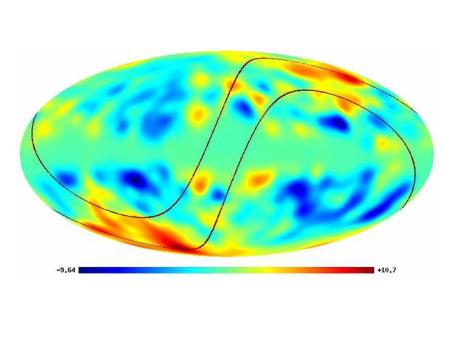
What Diego et al. did was to make a map by combining the cleaned sky maps obtained at different frequencies obtained by WMAP in such a way as to try to eliminate the thermal (CMB) component. What is left when this is done should be just residual noise, as it should contain neither known foreground or CMB. The map they get is shown here.ecliptic

What is interesting is that the residual map doesn’t look like noise that is uniformly distributed over the sky: there are two distinct peaks close to the Ecliptic plane delineated by the black tramlines. Why the residuals look like this is a mystery. The peaks are both very far from the Galactic plane so it doesn’t look like they are produced by Galactic foregrounds.

One suggestion is that the anomalous signal is like an infra-red extension of the Zodiacal light (which is produced inside the Solar System and therefore is too local to be confined to the Galactic plane). The authors show, however, that a straightforward extrapolation of the known Zodiacal emission (primarily measured by the IRAS satellite) does not account for the signal seen in WMAP. If this is the explanation, then, there has to be a new source of Zodiacal emission that is not seen by IRAS but kicks in at WMAP frequencies.

Another possibility is that it is extragalactic. This is difficult to exclude, but is disfavoured in my mind because there is no a priori reason why it should be concentrated in the Ecliptic plane. Coincidences like this make me a bit uncomfortable. Some turn out to be real coincidences, but more often than not they are clues to something important. Agatha Christie would have agreed:

“Any coincidence,” said Miss Marple to herself, “is always worth noting. You can throw it away later if it is only a coincidence.”

On the other hand, the dipole asymmetry of the CMB (thought to be caused by our motion through a frame in which it is isotropic) is also lined up in roughly the same direction:

The dipole has a hot region and a cold region in places where the residual map has two hot regions and anyway it’s also a very large scale feature so the chances of it lining up by accident with the ecliptic plane to the accuracy seen is actually not small. Coincidences definitely do happen, and the rougher they are the more commonly they occur.

Obviously, I don’t know what’s going on, but  I will mention another explanation that might fit. As I have already blogged, the WMAP satellite scans the sky in a way that is oriented exactly at right angles to the Ecliptic plane. If there is an as yet unknown systematic error in the WMAP measurements, which is related in some way to the motion of the satellite, it could at least in principle produce an effect with a definite orientation with respect to the Ecliptic.

The only way we can rule out this (admittedly rather dull) explanation is by making a map using a different experiment. It’s good, then, that the Planck satellite is going to be launched in only a few weeks’ time (April 16th 2009). Fingers crossed that we can solve this riddle soon.

From Here to Eternity

Posted in Books, Talks and Reviews, The Universe and Stuff with tags , , , , on February 3, 2009 by telescoper

I posted an item about astronomy and poetry a couple of days ago that used a phrase I vaguely remember having used somewhere else before. I’ve only just remembered where. It was in this book review I did for Nature some time ago. Since I’m quite keen on recycling, I’d thought I’d put it on here.

How do physicists cope with the concept of infinity in an expanding Universe?

BOOK REVIEWED – The Infinite Cosmos: Questions from the Frontiers of Cosmology

by Joseph Silk

Oxford University Press: 2006. 256 pp. £18.99, $29.95

Scientists usually have an uncomfortable time coping with the concept of infinity. Over the past century, physicists have had a particularly difficult relationship with the notion of boundlessness. In most cases this has been symptomatic of deficiencies in the theoretical foundations of the subject. Think of the ‘ultraviolet catastrophe’ of classical statistical mechanics, in which the electromagnetic radiation produced by a black body at a finite temperature is calculated to be infinitely intense at infinitely short wavelengths; this signalled the failure of classical statistical mechanics and ushered in the era of quantum mechanics about a hundred years ago. Quantum field theories have other forms of pathological behaviour, with mathematical components of the theory tending to run out of control to infinity unless they are healed using the technique of renormalization. The general theory of relativity predicts that singularities in which physical properties become infinite occur in the centre of black holes and in the Big Bang that kicked our Universe into existence. But even these are regarded as indications that we are missing a piece of the puzzle, rather than implying that somehow infinity is a part of nature itself.

The exception to this rule is the field of cosmology. Somehow it seems natural at least to consider the possibility that our cosmos might be infinite in extent or duration. If the Universe is defined as everything that exists, why should it necessarily be finite? Why should there be some underlying principle that restricts it to a size our human brains can cope with?

But even if cosmologists are prepared to ponder the reality of endlessness, and to describe it mathematically, they still have problems finding words to express these thoughts. Physics is fundamentally prosaic, but physicists have to resort to poetry when faced with the measureless grandeur of the heavens.

In The Infinite Cosmos, Joe Silk takes us on a whistle-stop tour of modern cosmology, focusing on what we have learned about the size and age of the Universe, how it might have begun, and how it may or may not end. This is a good time to write this book, because these most basic questions may have been answered by a combination of measurements from satellites gathering the static buzz of microwaves left over from the Big Bang, from telescopes finding and monitoring the behaviour of immensely distant supernova explosions, and from painstaking surveys of galaxy positions yielding quantitative information about the fallout from the primordial fireball. Unless we are missing something of fundamental importance, these observations indicate that our expanding Universe is about 14 billion years old, contains copious quantities of dark matter in some unidentified form, and is expanding at an accelerating rate.

According to the standard model of cosmology that emerges, the Universe has a finite past and (perhaps) an infinite future. But is our observable Universe (our ‘Hubble bubble’) typical of all there is? Perhaps there is much more to the cosmos than will ever meet our eyes. Our local patch of space-time may have its origin in just one of an infinite and timeless collection of Big Bangs, so the inferences we draw from observations of our immediate neighbourhood may never tell us anything much about the whole thing, even if we correctly interpret all the data available to us.

What is exciting about this book is not so much that it is anchored by the ramifications of infinity, but that it packs so much into a decidedly finite space. Silk covers everything you might hope to find in a book by one of the world’s leading cosmologists, and much more besides. Black holes, galaxy formation, dark matter, time travel, string theory and the cosmic microwave background all get a mention.

The style is accessible and informative. The book also benefits from having a flexible structure, free from the restrictions of the traditional historical narrative. Instead there are 20 short chapters arranged in a way that brings out the universality of the underlying physical concepts without having too much of a textbook feel. The explanations are nicely illustrated and do not involve any mathematics, so the book is suitable for the non-specialist.

If I have any criticisms of this book at all, they are only slight ones. The conflation of the ‘expanding Universe’ concept with the Big Bang theory, as opposed to its old ‘steady state’ rival, is both surprising and confusing. The steady-state model also describes an expanding Universe, but one in which there is continuous creation of matter to maintain a constant density against the diluting effect of the expansion. In the Big Bang, there is only one creation event, so the density of the expanding Universe changes with time. I also found the chapter about God in cosmology to be rather trite, but then my heart always sinks when I find myself lured into theological territory in which I am ill-equipped to survive.

A New Theory of the Universe

Posted in The Universe and Stuff with tags , , , , on January 24, 2009 by telescoper

Yesterday I went on the train to London to visit my old friends in Mile End. I worked at the place that is now called Queen Mary, University of London for nearly a decade and missed it quite a lot when I moved to Nottingham. More recently I’ve had a bit more time and plausible excuses to visit London, including yesterday’s invitation to give a seminar at the Astronomy Unit. Although we were a bit late starting, owing to extremely slow service in the restaurant where we had lunch before the talk, it all seemed to go quite well. Afterwards we had a few beers and a nice chat before I took the train back to Cardiff again.

In the pub (which was the Half Moon, formerly the Half Moon Theatre,  a place of great historical interest) I remembered a joke I sometimes make during cosmology talks but had forgotten to do in the one I had just given.  I’m not sure it will work in written form, but here goes anyway.

I’ve blogged before about the current state of cosmology, but it’s probably a good idea to give a quick reminder before going any further. We have a standard cosmological model, known as the concordance cosmology, which accounts for most relevant observations in a pretty convincing way and is based on the idea that the Universe began with a Big Bang.  However, there are a few things about this model that are curious, to say the least.

First, there is the spatial geometry of the Universe. According to Einstein’s general theory of relativity, universes come in three basic shapes: closed, open and flat. These are illustrated to the right. The flat space has “normal” geometry in which the interior angles of a triangle add up to 180 degrees. In a closed space the sum of the angles is greater than 180 degrees, and  in an open space it is less. Of course the space we live in is three-dimensional but the pictures show two-dimensional surfaces.

But you get the idea.

The point is that the flat space is very special. The two curved spaces are much more general because they can be described by a parameter called their curvature which could in principle take any value (either positive for a closed space, or negative for an open space). In other words the sphere at the top could have any radius from very small (large curvature) to very large (small curvature). Likewise with the “saddle” representing an open space. The flat space must have exactly zero curvature. There are many ways to be curved, but only one way to be flat.

Yet, as near as dammit, our Universe appears to be flat. So why, with all the other options theoretically available to it, did the Universe decide to choose the most special one, which also happens in my opinion to be also the most boring?

Then there is the way the Universe is put together. In order to be flat there must be an exact balance between the energy contained in the expansion of the Universe (positive kinetic energy) and the energy involved in the gravitational interactions between everything in it (negative potential energy). In general relativity, you see, the curvature relates to the total amount of energy.

On the left you can see the breakdown of the various components involved in the standard model with the whole pie representing a flat Universe. You see there’s a vary strange mixture dominated by dark energy (which we don’t understand) and dark mattter (which we don’t understand). The bit we understand a little bit better (because we can sometimes see it directly) is only 4% of the whole thing. The proportions look very peculiar.

And then finally, there is the issue that I talked about in my seminar in London and have actually blogged about (here and there) previously, which is why the Universe appears to be a bit lop-sided and asymmetrical when we’d like it to be a bit more aesthetically pleasing.

All these curiosities are naturally accounted for in my New Theory of the Universe, which asserts that the Divine Creator actually bought  the entire Cosmos  in IKEA.

This hypothesis immediately explains why the Universe is flat. Absolutely everything in IKEA comes in flat packs. Curvature is not allowed.

But this is not the only success of my theory. When God got home he obviously opened the flat pack, found the instructions and read the dreaded words “EASY SELF-ASSEMBLY”. Even the omnipotent would struggle to follow the bizarre set of cartoons and diagrams that accompany even the simplest IKEA furniture. The result is therefore predictable: strange pieces that don’t seem to fit together, bits left over whose purpose is not at all clear, and an overall appearance that is not at all like one would have expected.

It’s clear  where the lop-sidedness comes in too. Probably some of the parts were left out so the whole thing isn’t  held together properly and is probably completely unstable. This sort of thing happens all the time with IKEA stuff. And why is it you can never find the right size Allen Key to sort it out?

So there you have it. My new Theory of the Universe. Some details need to be worked out, but it is as good an explanation of these issues as I have heard. I claim my Nobel Prize.

If anything will ever get me a trip to Sweden, this will.

What’s all the Noise?

Posted in Science Politics, The Universe and Stuff with tags , , , , on January 18, 2009 by telescoper

Now there’s a funny thing…

I’ve just come across a news item from last week which I followed up by looking at the official NASA press release. I’m very slow to pick up on things these days, but I thought I’d mention it anyway.

The experiment concerned is called ARCADE 2, which is an somewhat contrived acronym derived from Absolute Radiometer for Cosmology, Astrophysics and Diffuse Emission. It is essentially a balloon-borne detector designed to analyse radio waves with frequencies in the range 3 to 90 Ghz. The experiment actually flew in 2006, so it has clearly taken considerable time to analyse the resulting data.

Being on a balloon that flies for a relatively short time (2.5 hours in this case) means that only a part of the sky was mapped, amounting to about 7% of the whole celestial sphere but that is enough to map a sizeable piece of the Galaxy as well as a fairly representative chunk of deep space.

There are four science papers on the arXiv about this mission: one describes the instrument itself; another discusses radio emission from our own galaxy, the Milky Way; the third discusses the overall contribution of extragalactic origin in the frequency range covered by the instrument; the last discusses the implications about extragalactic sources of radio emission.

The thing that jumps out from this collection of very interesting science papers is that there is an unexplained, roughly isotropic, background of radio noise, consistent with a power-law spectrum. Of course to isolate this component requires removing known radio emission from our Galaxy and from identified extragalactic sources, as well as understanding the systematics of the radiometer during its flight. But after a careful analysis of these the authors present strong evidence of excess emission over and above known sources. The spectrum of this radio buzz falls quite steeply with frequency so appears in the two long-wavelength channels at 3 and 8 GHz.

So where does this come from? Well, we just don’t know.

The problem is that no sensible extrapolation of known radio sources to high redshift appears to be able to generate an integrated flux equivalent to that observed. Here is a bit of the discussion from the paper:

It is possible to imagine that an unknown population of discrete sources exist below the flux limit of existing surveys. We argue earlier that these cannot be a simple extension of the source counts of star-forming galaxies. As a toy model, we consider a population of sources distributed with a delta function in flux a factor of 10 fainter than the 8.4 GHz survey limit of Fomalont et al. (2002). At a flux of 0.75 μJy, it would take over 1100 such sources per square arcmin to produce the unexplained emission we see at 3.20 GHz, assuming a frequency index of −2.56. This source density is more than two orders of magnitude higher than expected from extrapolation to the same flux limit of the known source population. It is, however, only modestly greater than the surface density of objects revealed in the faintest optical surveys, e.g., the Hubble Ultra Deep Field (Beckwith et al. 2006).  The unexplained emission might result from an early population of non thermal emission from low-luminosity AGN; such a source would evade the constraint implied by the far-IR measurements.

The point is that ordinary galaxies produce a broad spectrum of radiation and it is difficult to boost the flux at one frequency without violating limits imposed at others. It might be able to invoke Active Galactic Nuclei (AGN) to do the trick, but I’m not sure. I am sure there’ll be a lot work going on trying to see how this might fit in with all the other things we know about galaxy formation and evolution but for the time being it’s a mystery.

I’m equally sure that these results will spawn a plethora of more esoteric theoretical explanations, inevitably including the ridiculous as well as perhaps the sublime. Charged dark matter springs to mind.

Or maybe it’s not even extragalactic. Could it be from an unknown source inside the Milky Way? If so, it might shed some light on the curiosities we find in the cosmic microwave background that I’ve mentioned here and there, but it seems to peak at too low a frequency to account for much of the overall microwave sky temperature.

But it does have a lesson for astronomy funders. ARCADE 2 is a very cheap experiment (by NASA standards). Moreover, the science goals of the experiment did not include “discovering a new cosmic background”. It just goes to show that even in these times of big, expensive and narrowly targetted missions there is still space for serendipity.

Job Advertisement

Posted in The Universe and Stuff with tags , , on January 14, 2009 by telescoper

This may not be a conventional use for a blog, but I thought I’d give it a go.

After receiving the news a while ago that I had a new research grant, I subsequently got official approval to advertise for a new postdoc and the advert has now been submitted to various places. I thought I might as well put the advertisement on here as well as the usual outlets. It will be on the AAS Jobs Register next month.

Research Associate
Cardiff School of Physics and Astronomy

Applications are invited for a position as Research Associate in Theoretical Cosmology in the School of Physics & Astronomy at Cardiff University. You will undertake research into departures from the standard “concordance” cosmological model and methods for extracting relevant evidence from observations of the cosmic microwave background and large-scale structure in the galaxy distribution. This position is funded by a grant from the Science & Technology Facilities Council.

You will have (or expect to obtain very soon) a PhD or have equivalent research experience in astronomy, astrophysics, cosmology or a closely related subject. A strong theoretical background and experience in the analysis of cosmological data are essential.

The School of Physics & Astronomy at Cardiff University hosts a broad and stimulating research program in astrophysics, cosmology and gravitational physics, encompassing theory, observation and instrumentation. In particular, it is involved in a large number of important cosmological experiments, including Planck, Quad and Clover.

See http://www.astro.cf.ac.uk/ for more information.

This post is fixed-term for 3 years.

Salary: £29704 – £35469 per annum.

Informal enquiries can be made to Professor Coles (Peter.Coles@astro.cf.ac.uk)

For an application pack and details of all Cardiff vacancies, visit www.cardiff.ac.uk/jobs alternatively email vacancies@cardiff.ac.uk or telephone +44 (0) 29 2087 4017 quoting vacancy number 2009/034.

For specific information on this particular vacancy, please go here.

Closing date: Monday, 02 March 2009.

I’ll take this post offline after the deadline passes.

Power isn’t Everything

Posted in The Universe and Stuff with tags , , , , , , , on January 6, 2009 by telescoper

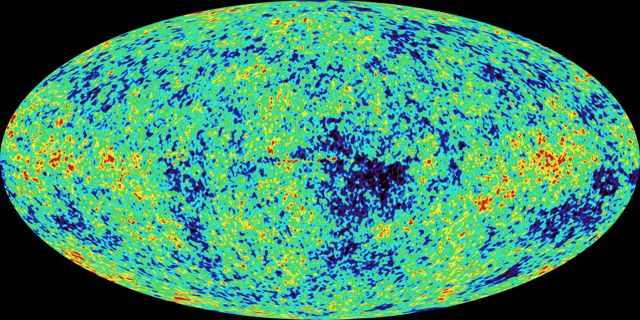
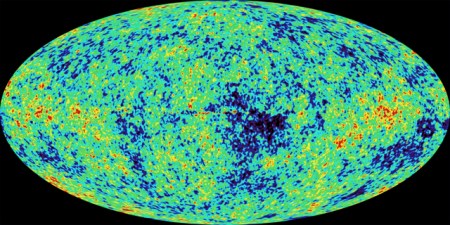
WMapThe picture above shows the latest available all-sky map of fluctuations in the temperature of the cosmic microwave background across the sky as revealed by the Wilkinson Microwave Anisotropy Probe, known to its friends as WMAP.

I’ve spent many long hours fiddling with the data coming from the WMAP experiment, partly because I’ve never quite got over the fact that such wonderful data actually exists. When I started my doctorate in 1985 the whole field of CMB analysis was so much pie in the sky, as no experiments had yet been performed with the sensitivity to reveal the structures we now see. This is because they are very faint and easily buried in noise. The fluctuations in temperature from pixel to pixel across the sky are of order one part in a hundred thousand of the mean temperature (i.e. about 30 microKelvin on a background temperature of about 3 Kelvin). That’s smoother than the surface of a billiard ball. That’s why it took such a long time to make the map shown above, and why it is such a triumphant piece of science.

I blogged a few days ago about the idea that the structure we see in this map was produced by sound waves reverberating around the early Universe. The techniques cosmologists use to analyse this sound are similar to those used in branches of acoustics except that we only see things in projection on the celestial sphere which requires a bit of special consideration.

One of the things that sticks in my brain from my undergraduate years is being told that if a physicist doesn’t know what they are doing they should start by making a Fourier transform. This breaks down the phenomenon being studied into a set of independent plane waves with different wavelengths corresponding to the different tones present in a complicated sound.

It’s often very good advice to do such a decomposition for one-dimensional time series or fluctuation fields in three-dimensional Cartesian space, even you do know what you’re doing, but it doesn’t work with a sphere because plane waves don’t fit properly on a curved surface. Fortunately, however, there is a tried-and-tested alternative involving spherical harmonics rather than plane waves.

Spherical harmonics are quite complicated beasts mathematically but they have pretty similar properties to Fourier harmonics in many respects. In particular they are represented as complex numbers having real and imaginary parts or, equivalently, an amplitude and a phase (usually called an argument by mathematicians). The latter representation is the most useful one for CMB fluctuations because the simplest versions of inflation predict that the phases of each of the spherical harmonic modes should be randomly distributed. What this really means is that there is no information content in their distribution so that the harmonic modes are in a state of maximum statistical disorder or entropy. This property also guarantees that the distribution of fluctuations over the sky should have a Gaussian distribution.

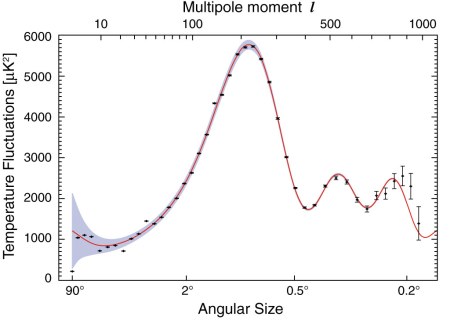
If you accept that the fluctuations are Gaussian then only the amplitudes of the spherical harmonic coefficients are useful. Indeed, their statistical properties can be specified entirely by the variance of these amplitudes as a function of mode frequency. This pre-eminently important function is called the power-spectrum of the fluctuations, and it is shown here for the WMAP data:
080999_powerspectrumm

Although the units on the axes are a bit strange it doesn”t require too much imagination to interpret this in terms of a sound spectrum. There is a characteristic tone (at the position of the peak) plus a couple of overtones. However these features are not sharp so the overall sound is not at all musical.

If the Gaussian assumption is correct then the power-spectrum contains all the useful statistical information to be gleaned from the CMB sky, which is why so much emphasis has been placed on extracting it accurately from the data.

Conversely, though, the power spectrum is completely insenstive to any information in the distribution of spherical harmonic phases. If something beyond the standard model made the Universe non-Gaussian it would affect the phases of the harmonic modes in a way that would make them non-random.

So far, so good. It sounds like it should be a straightforward job to work out whether the WMAP phases are random or not. Unfortunately, though, this task is heavily complicated by the presence of noise and systematics which can be quite easily cleaned from the spectrum but not from more sophisticated descriptors. All we can say so far is that the data seem to be consistent with a Gaussian distribution.

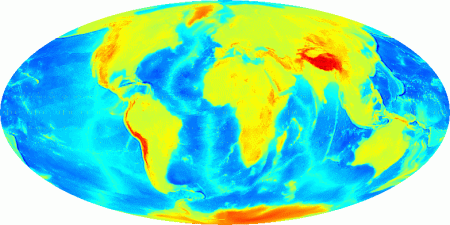
However, I thought I’d end with a bit of fun and show you how important phase information could actually be, if only we could find a good way of exploiting it. Let’s start with a map of the Earth, with the colour representing height of the surface above mean sea level:
sw_world

You can see the major mountain ranges (Andes, Himalayas) quite clearly as red in this picture and note how high Antarctica is…that’s one of the reasons so much astronomy is done there.

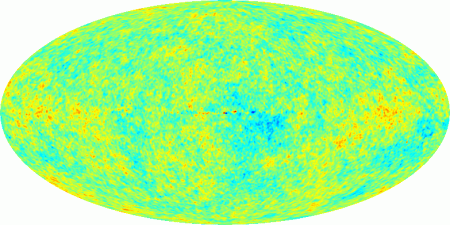
Now, using the same colour scale we have the WMAP data again (in Galactic coordinates).
sw_ilc

The virture of this map is that it shows how smooth the microwave sky is compared to the surface of the Earth. Note also that you can see a bit of crud in the plane of the Milky Way that serves as a reminder of the difficulty of cleaning the foregrounds out.

Clearly these two maps have completely different power spectra. The Earth is dominated by large features made from long-wavelength modes whereas the CMB sky has relatively more small-scale fuzz.

Now I’m going to play with these maps in the following rather peculiar way. First, I make a spherical harmonic transform of each of them. This gives me two sets of complex numbers, one for the Earth and one for WMAP. Following the usual fashion, I think of these as two sets of amplitudes and two sets of phases. Note that the spherical harmonic transformation preserves all the information in the sky maps, it’s just a different representation.

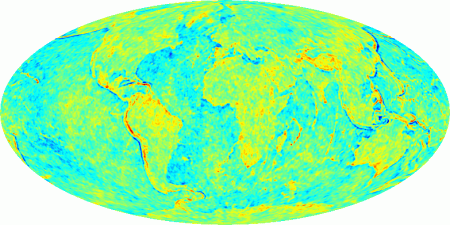
Now what I do is swap the amplitudes and phases for the two maps. First, I take the amplitudes of WMAP and put them with the phases for the Earth. That gives me the spherical harmonic representation of a new data set which I can reveal by doing an inverse spherical transform:
sw_worldphases

This map has exactly the same amplitudes for each mode as the WMAP data and therefore possesses an identical power spectrum to that shown above. Clearly, though, this particular CMB sky is not compatible with the standard cosmological model! Notice that all the strongly localised features such as coastlines appear by virtue of information contained in the phases but absent from the power-spectrum.

To understand this think how sharp features appear in a Fourier transform. A sharp spike at a specific location actually produces a broad spectrum of Fourier modes with different frequencies. These modes have to add in coherently at the location of the spike and cancel out everywhere else, so their phases are strongly correlated. A sea of white noise also has a flat power spectrum but has random phases. The key difference between these two configurations is not revealed by their spectra but by their phases.

Fortunately there is nothing quite as wacky as a picture of the Earth in the real data, but it makes the point that there are more things in Heaven and Earth than can be described in terms of the power spectrum!

Finally, perhaps in your mind’s eye you might consider what it might look lie to do the reverse experiment: recombine the phases of WMAP with the amplitudes of the Earth.
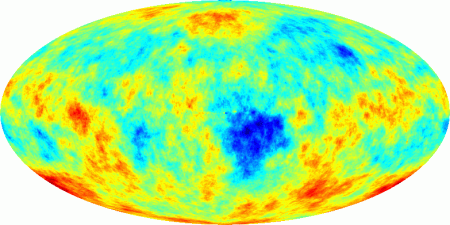
sw_ilcphases

If the WMAP data are actually Gaussian, then this map is a sort of random-phase realisation of the Earth’s power spectrum. Alternatively you can see that it is the result of running a kind of weird low-pass filter over the WMAP fluctuations. The only striking things it reveals are (i) a big blue hole associated with foreground contamination, (ii) a suspicious excess of red in the galactic plane owing to the same problem, and (iiI) a strong North-South asymmetry arising from the presence of Antarctica.

There’s no great scientific result here, just a proof that spherical harmonics can be fun.

PS. These pictures were made by a former PhD student of mine, Patrick Dineen, who has since quit astronomy to work in high finance. I hope he is weathering the global financial storm!