Archive for dark matter

Three New Publications at the Open Journal of Astrophysics

Posted in OJAp Papers, Open Access, The Universe and Stuff with tags , , , , , , , , , , , , , on April 27, 2024 by telescoper

It’s time for the usual  Saturday roundup of business at the  Open Journal of Astrophysics. The latest batch of publications consists of three papers, taking the count in Volume 7 (2024) up to 30 and the total published by OJAp up to 145.

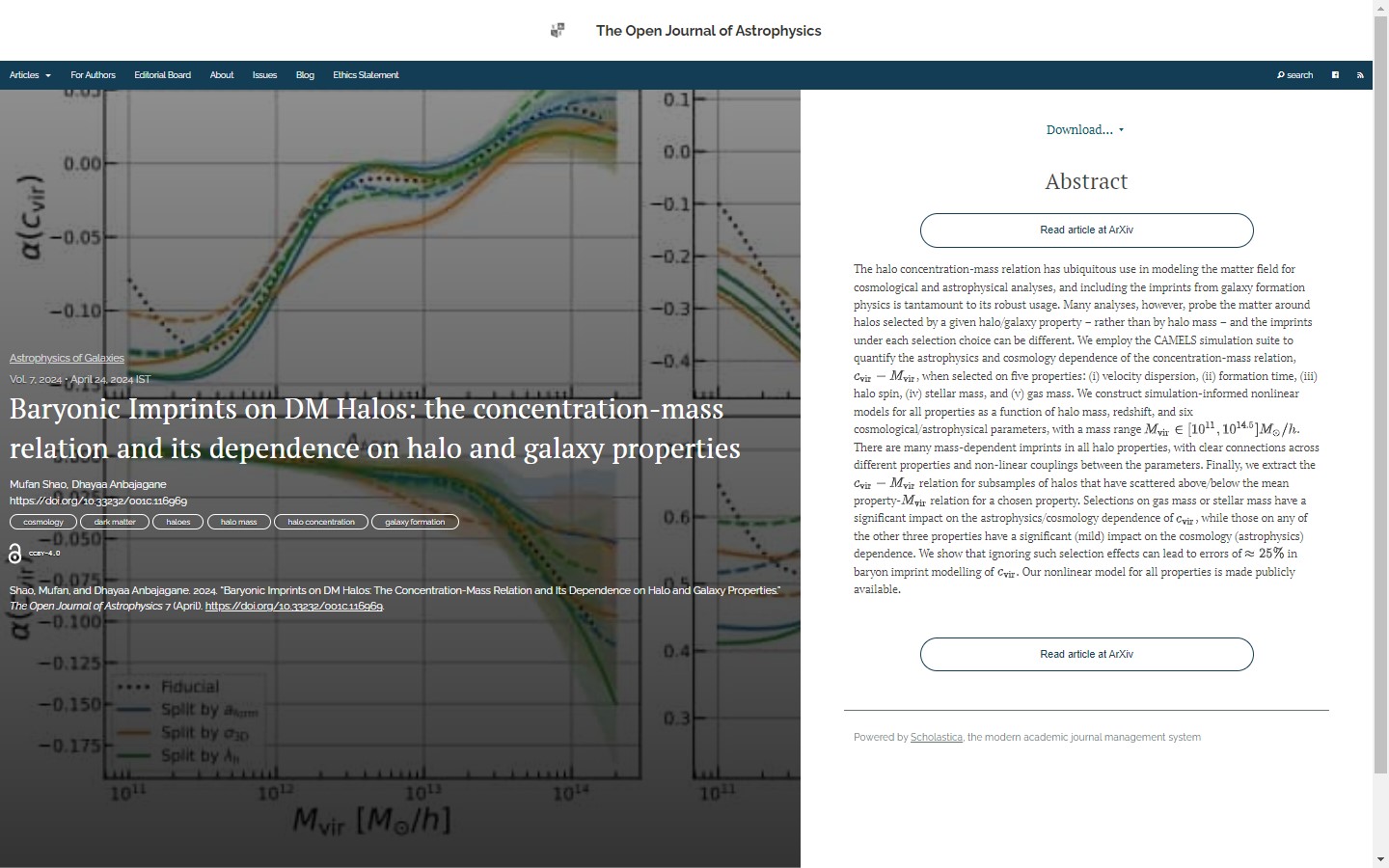
First one up is “Baryonic Imprints on DM Halos: the concentration-mass relation and its dependence on halo and galaxy properties” .  The authors, Mufan Shao and Dhayaa Anbajagane of the University of Chicago, USA, use  a non-linear model informed by simulations to study the imprint of galaxy formation physics on the concentration-mass relationship using various different choices of halo selection criteria. This one is in the folder marked Astrophysics of Galaxies and was published on 24th April 2024.

Here is a screen grab of the overlay, which includes the abstract:
 

You can read the paper directly on arXiv here.

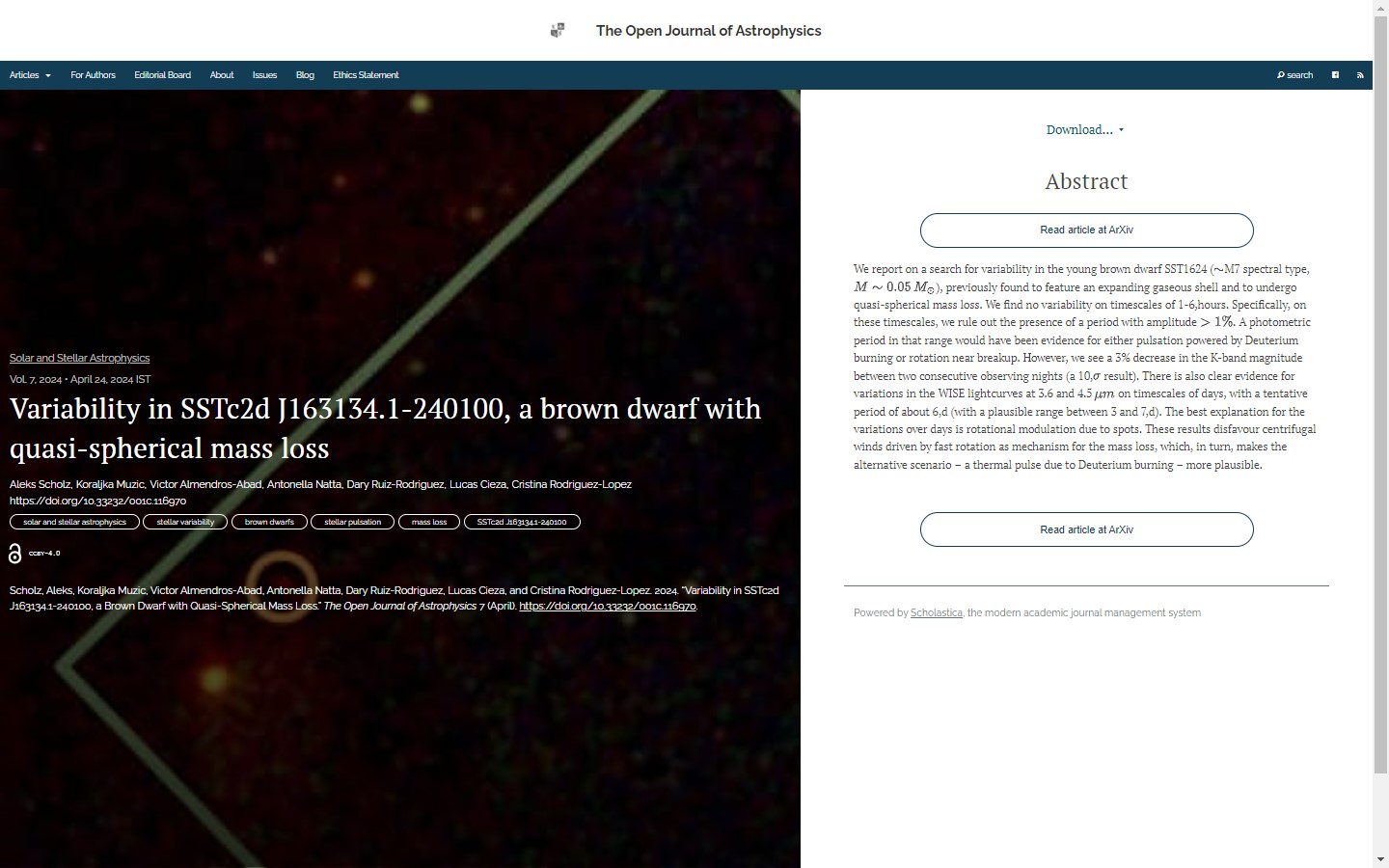
The second paper to announce is “Variability in SSTc2d J163134.1-240100, a brown dwarf with quasi-spherical mass loss” which describes a search for variability in a brown dwarf star known to be losing mass and the implications of the lack thereof for the reason for the outflow therefrom. The authors are Aleks Scholz (St Andrews, UK),  Koraljka Muzic (Lisbon, Portugal), Victor Almendros-Abad (Palermo, Italy), Antonella Natta (DIAS, Ireland), Dary Ruiz-Rodriguez (NRAO, USA), Lucas Cieza (Uni. Diego Portales, Chile), Cristina Rodriguez-Lopez (IAA-CSIC, Granada, Spain)

This one is in the folder Solar and Stellar Astrophysics and was also published on 24th April 2024. The overlay looks like this:
 

You can read this paper directly on the arXiv here.

The last paper of this batch, also in the folder marked Astrophysics of Galaxies, is  entitled “MAGICS I. The First Few Orbits Encode the Fate of Seed Massive Black Hole Pairs”  and is a computational study of the process by which massive black holes are formed by merging smaller seed black holes. It was published on April 26th 2024 (i.e. yesterday). The authors are: Nianyi Chen, Diptajyoti Mukherjee and Tiziana Di Matteo (all Carnegie Mellon University); Yueying Ni (Harvard); Simeon Bird (University of California, Riverside); and Rupert Croft (Carnegie Mellon University). All authors are based in the USA.

Here is a screengrab of the overlay:
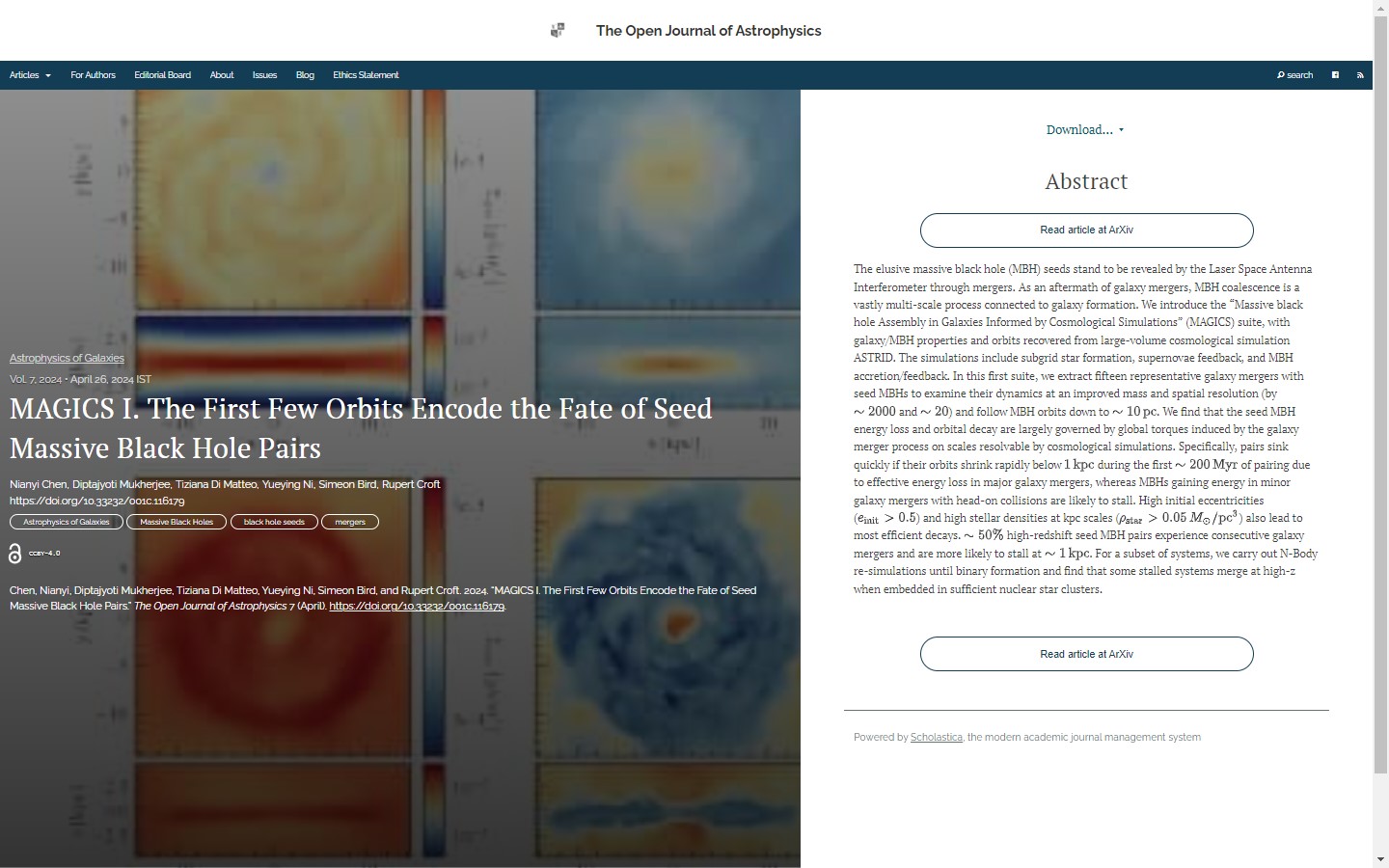
 

To read the accepted version of this on the arXiv please go here.
That’s all for now. More news in a week or so!


Euclid on Ice

Posted in Euclid, The Universe and Stuff with tags , , , , , , on March 25, 2024 by telescoper

I thought it would be appropriate to add a little update about the European Space Agency’s Euclid mission. I’ll keep it brief here because you can read the full story on the official website here.

You may have seen in the news that the Euclid telescope has been having an issue with ice forming on surfaces in its optical systems, especially the VIS instrument. This is a common problem with telescopes in space, but the extent of it is not something that can be predicted very accurately in advance so a detailed strategy for dealing with it had to be developed on the go.

The layers of ice that form are very thin – just tens of nanometres thick – but that is enough to blur the images and also reduce the throughput of the instruments. Given that the objects we want Euclid to see are faint, and we need very sharp images then this is an issue that must be dealt with.

Soon after launch, the telescope was heated up for a while in order to evaporate as much ice as possible, but it was not known how quickly the ice would return and to what parts of the optical system. After months in the cold of space the instrument scientists now understand the behaviour of the pesky ice a lot better, and have devised a strategy for dealing with it.

The approach is fairly simple in principle: heat the affected instruments up every now and again, and then let them cool down again so they operate; repeat as necessary as ice forms again. This involves an interruption in observations, it is known to work pretty well, but exactly how frequently this de-icing cycle should be implemented and what parts of the optical system require this treatment are questions that need to be answered in practical experimentation. The hope is that after a number of operations of this kind, the amount of ice returning each time will gradually reduce. I am not an expert in these things but I gather from colleagues that the signs are encouraging.

For more details, see here.

UPDATE: The latest news is that the de-icing procedure has worked better than expected! There’s even a video about the result of the process here:

New Publication at the Open Journal of Astrophysics

Posted in OJAp Papers, Open Access, The Universe and Stuff with tags , , , , , on March 12, 2024 by telescoper

It’s my last morning in Phoenix and since I was too busy at the weekend to post the usual update from the Open Journal of Astrophysics I will do so now, before I go to the Airport for my flight home.

Looking at the workflow I see that there is a considerable backlog of papers that have been accepted but are waiting for the authors to put the final version on arXiv.  As a result there is only one paper to report for last week, being the 17th paper in Volume 7 (2024)  and the 132nd altogether; it was published on March 6 2024. I expect more soon!

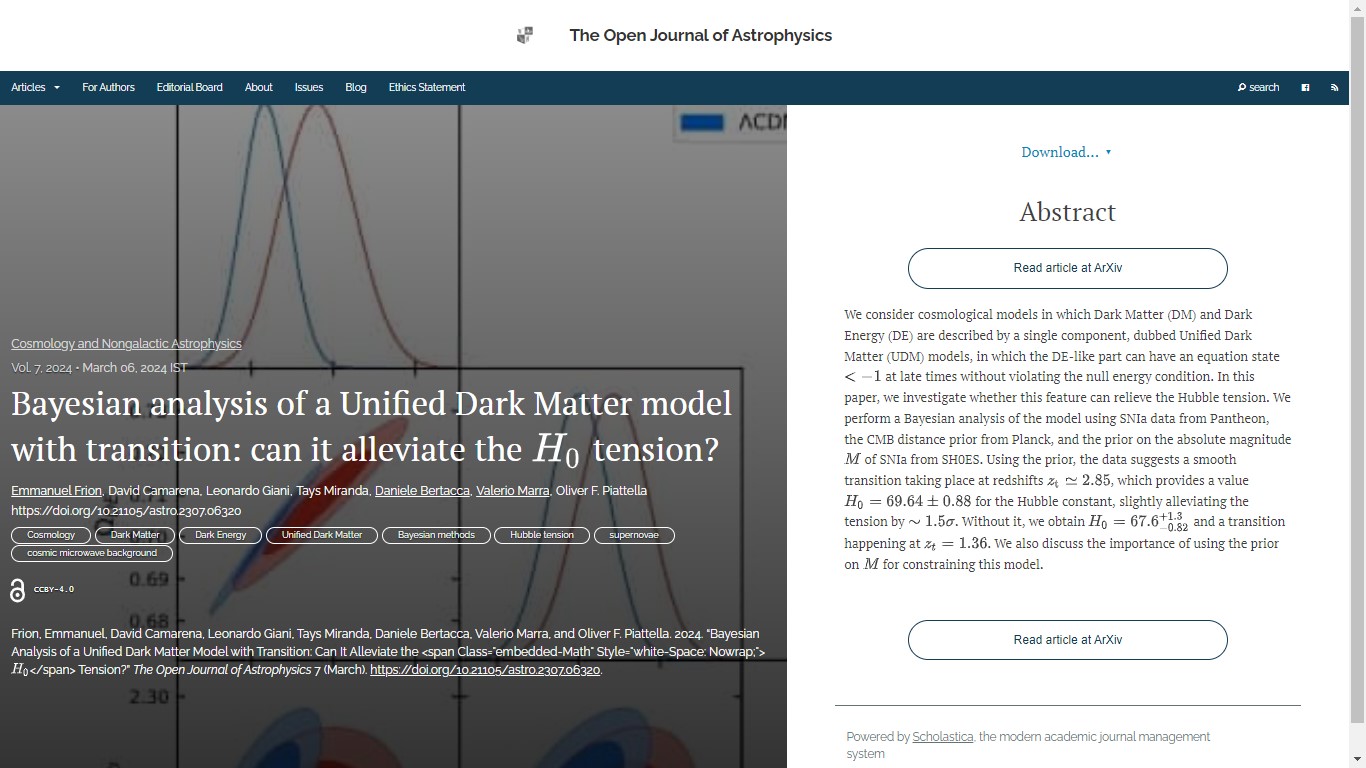
The title of the latest paper is “Bayesian analysis of a Unified Dark Matter model with transition: can it alleviate the H0tension?” and it  is in the folder marked Cosmology and NonGalactic Astrophysics.  The article presents an investigation using Bayesian techniques of a specific cosmological model, in which dark matter and dark energy are aspects of a single component, with particular emphasis on the Hubble tension.

The authors are seven in number: Emmanuel Frion (University of Helsinki, Finland, and Western University, Canada); David Camarena (University of New Mexico, USA); Leonardo Giani (University of Queensland, Australia); Tays Miranda (University of Helsinki and University of Jyväskylä, both in Finland); Daniele Bertacca (Università degli Studi di Padova, Italy); Valerio Marra (Universidade Federal do Espírito Santo, Brazil and Osservatorio Astronomico di Trieste, Italy);
and Oliver F. Piattella (Università degli Studi dell’Insubria, Como, Italy).

Here is the overlay of the paper containing the abstract:


You can click on the image of the overlay to make it larger should you wish to do so. You can also find the officially accepted version of the paper on the arXiv here.


A Euclid Milestone!

Posted in Euclid, The Universe and Stuff with tags , , , , , , , , on February 9, 2024 by telescoper

I just heard some excellent news about Euclid so thought I would post a quick update here. I won’t say much because there will no doubt be official communications from the European Space Agency and the Euclid Consortium. You can find a variety of Euclid-related posts on this blog here.

Over the past few months, there has been a huge amount of activity relating to commissioning the instruments, verifying their performance, and measuring parameters of the optical system that will be needed for analysis of the huge amount of data due to come from Euclid. All this effort fed into the Mission Commissioning Results Review (MCRR) which concluded yesterday that all was well.

This is an important milestone for Euclid because, in ESA parlance, it marks the change from a project to a mission. Until commissioning, there is a project manager who works with ESA and the industrial contractors to ensure everything functions properly; when nominal operations start the project team is disbanded and the mission team takes over; and so it came to pass that the Project Manager (Giuseppe Racca) handed over the reins to the Mission Manager (Pierre Ferruit).

That’s when the role of the Euclid Consortium increases substantially. In particular the Science Ground Segment (SGS), which includes the pipelines that will process the data, has been declared to be ready for business. You can read more about the SGS here but here’s a graphic that shows how data comes from the telescope, external telescopes, or simulations, then run through their respective pipelines for VIS, NISP, or external data, then are merged into a coherent format. Pipelines then extract scientific information and compute science data products for further analysis

Each element of this diagram is rather complex. Here, for example, is the organization of the Science Data Centre (SDC) component of the Science Ground Segment at the bottom of the above picture, consisting of computing centers responsible for implementing and running the data processing pipelines:

Anyway, the immediate upshot of all this is that full surveying activities of Euclid can now proceed. The Euclid mission will conduct primarily two different surveys: a “Wide Survey”, covering about 15,000 square degrees on the sky, and a “Deep Survey” of about 50 square degrees, where the instruments will observe three fields much longer than the rest of the sky to capture much fainter galaxies and hence look further out into space. I understand that the Wide Survey will commence in earnest on 14th February.The timescale from now is that the first full set of survey data (DR1) will be available internally to the Euclid Consortium in May or June 2025 and will be made public a year later (i.e. by June 2026).

That doesn’t mean that Euclid will be silent until 2026. In fact, the first batch of post-launch papers will come out very soon, in May 2024. This will include science papers resulting from the Early Release Observations – the data from these will also be made public at the same time – as well as an overview paper for the whole mission and papers describing the details of NISP and VIS instruments using measurements made during commissioning. There will also be a release in May 2025 of data from the Deep Survey patch of about 50 square degrees.

So, the board is set. The pieces are moving.

Euclid Early Release Observations

Posted in Euclid, The Universe and Stuff with tags , , , , , , , , on November 7, 2023 by telescoper

So today’s the day. The first science-quality observations from Euclid have now been released to the public. The official press release is here, and the press conference showcasing the new observations can be viewed here:

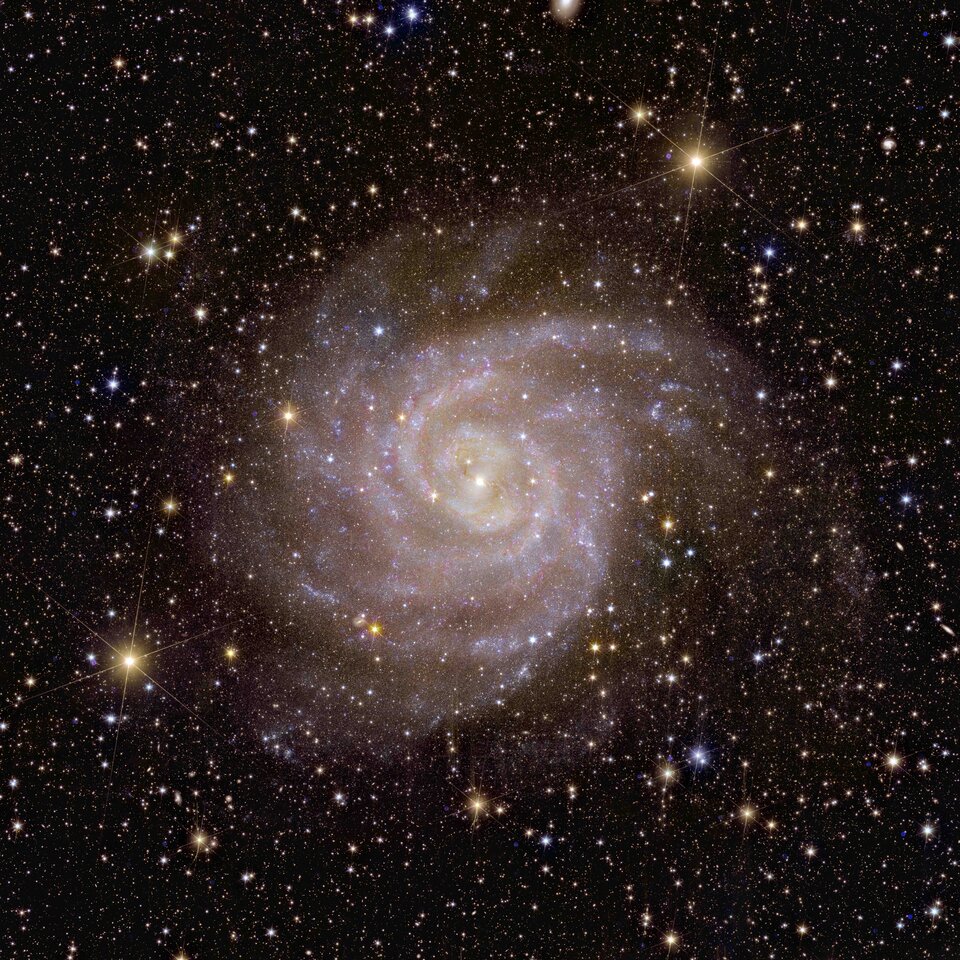
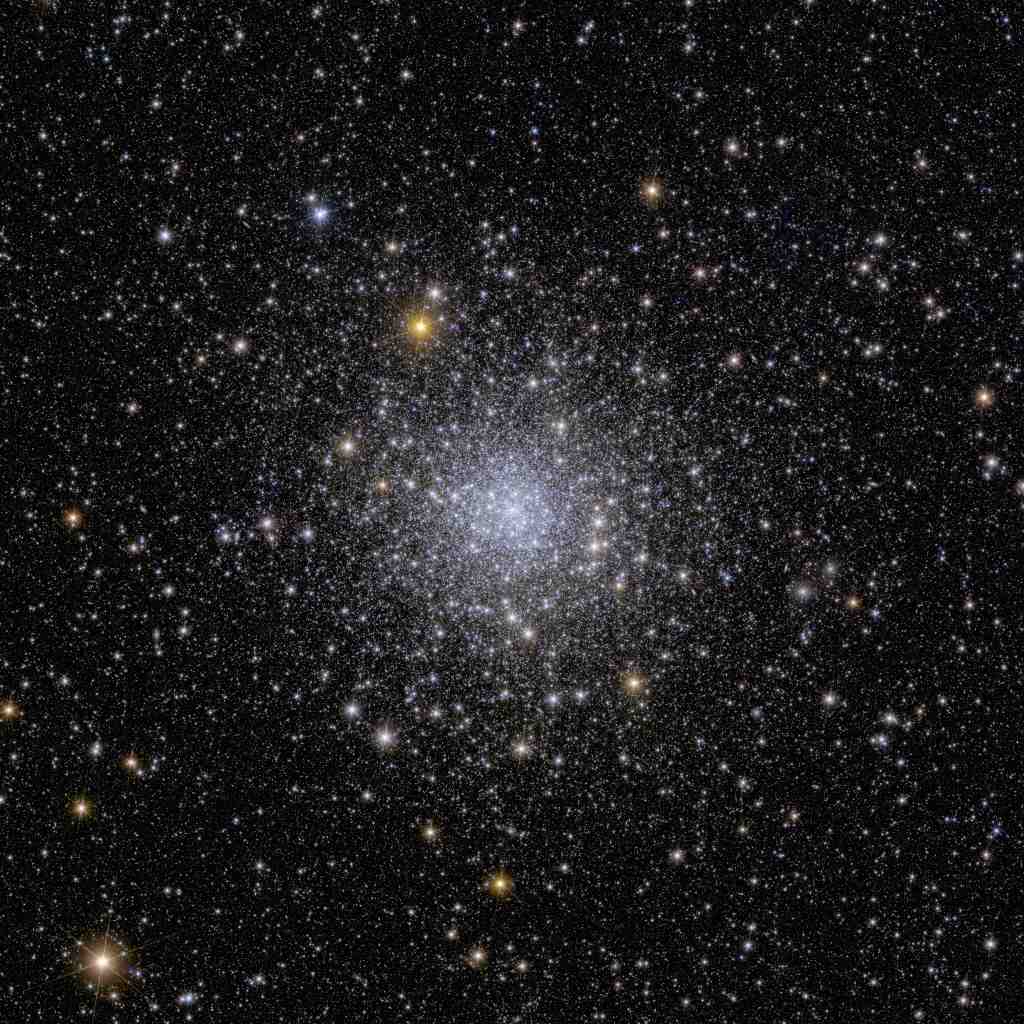
The images themselves can be found in this repository. In summary they are (in no particular order):

  1. Galaxies in the Perseus Cluster
  2. Spiral galaxy IC 342
  3. Irregular galaxy NGC 6822
  4. Globular cluster NGC 6397
  5. The Horsehead Nebula

And here they are – you can click on them to make them bigger:

A few points of my own.

First, it is important to realise that these observations are not part of the full Euclid survey, which will start in early 2024, but were produced during the process of verification the capabilities of the telescope and detectors. They are all very short exposures, taking up less than a day to make all the images, but they demonstrate that Euclid is performing very well indeed!

Euclid is designed to achieve very sharp optical quality across a very wide field of view, so its strength is that it will produce beautiful images like these not only of a handful of objects but for billions. We need to map very large numbers of galaxies to perform the careful analysis needed to extract information about dark matter and dark energy, which is the main goal of the mission.

While these images are, in a sense, by-products of the Euclid mission, not specifically related to the main aims of the mission, they are interesting in their own right and there are proper scientific papers related to each of the five sets of observations released today. We expect many more non-cosmological spinoffs like these as the mission goes on.

There were some problems during the commissioning of the instruments carried by Euclid, the most serious of which was an issue with the Fine Guidance Sensor used to control the pointing of the telescope. This has been fixed by a software update and everything is now functioning well, as today’s new results confirm!

Euclid has arrived…

Posted in Euclid, The Universe and Stuff with tags , , , on July 29, 2023 by telescoper

Here’s a little video update to accompany the news that, as of yesterday (28th July), the European Space Agency’s Euclid spacecraft has reached its orbit around L2, the second Lagrange Point of the Earth-Sun system:

More news is on the way. Commissioning of the instruments is now complete and the telescope is in focus. On Monday 31st July, ESA will release the first actual images from the Euclid telescope!

Stay tuned here.

The Euclid Public Website

Posted in Euclid, The Universe and Stuff with tags , , , , , on February 2, 2023 by telescoper

With the European Space Agency’s Euclid mission now scheduled for launch in the 3rd Quarter of 2023 a lot of work has been put in recently in developing the Euclid mission’s public website. For those of you not in the know, there is a summary on the new website:

ESA’s Euclid mission is designed to explore the composition and evolution of the dark Universe. The space telescope will create a great map of the large-scale structure of the Universe across space and time by observing billions of galaxies out to 10 billion light-years, across more than a third of the sky. Euclid will explore how the Universe has expanded and how structure has formed over cosmic history, revealing more about the role of gravity and the nature of dark energy and dark matter.

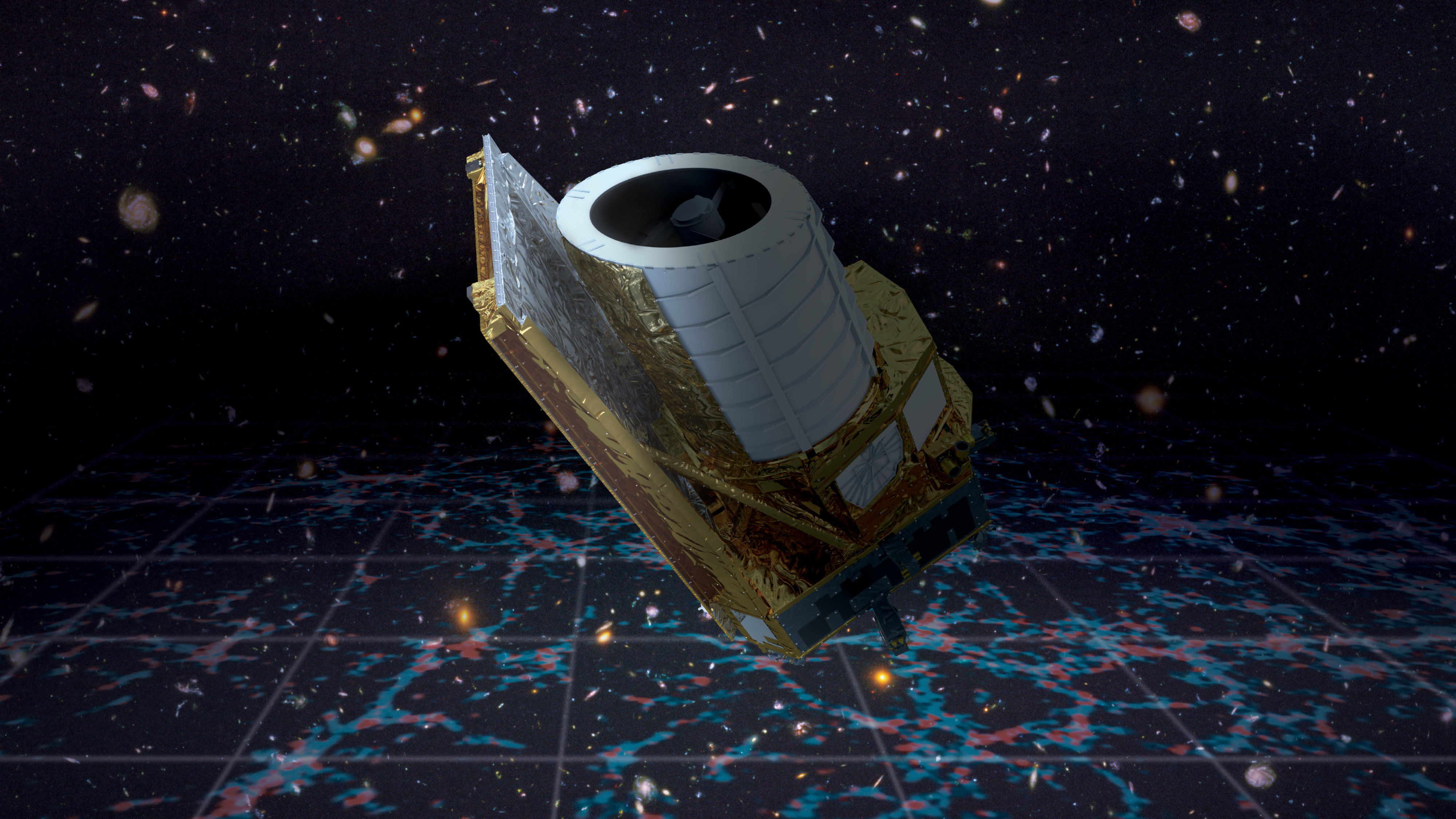
The public website is can be found here. Check it out. Many more stories, pictures and videos will be added over the forthcoming weeks but in the mean time here is a taster animated movie that shows various elements of the Euclid spacecraft, including the telescope, payload module and solar panels.

Even more information about the science to be done with Euclid can be found on the Euclid Consortium website, which is being revamped ahead of the launch.

“New” Publication at the Open Journal of Astrophysics

Posted in OJAp Papers, Open Access, The Universe and Stuff with tags , , , , , on September 15, 2022 by telescoper

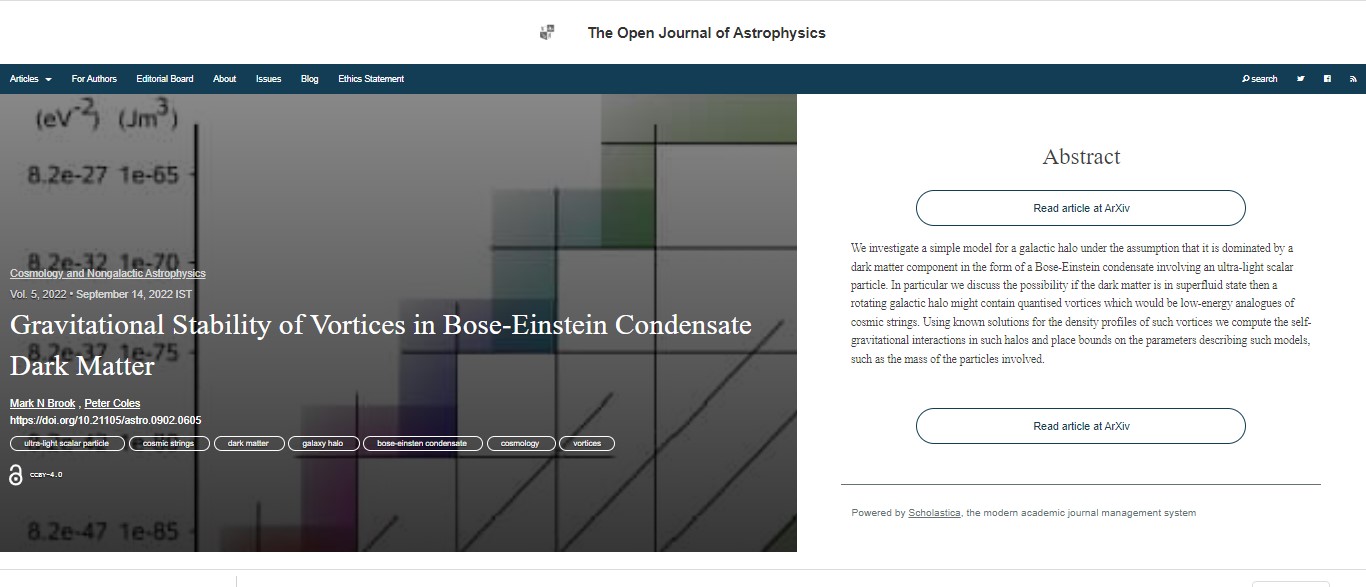
It’s time once again for me to announce the publication of another paper at the Open Journal of Astrophysics. The new paper, published last week, is the 14th paper in Volume 5 (2022) and the 62nd in all. The latest publication is entitled “Gravitational Stability of Vortices in Bose-Einstein Condensate Dark Matter”. This paper is another one for the folder marked Cosmology and Non-Galactic Astrophysics and the authors are Mark N Brook Now at the Institute for Cancer Research in London) and Peter Coles (Who he? Ed).

There is a bit of a story behind this one. The work on which this paper is based was done while both authors (Mark and I) were at the University of Nottingham. Mark was my PhD student at the time.  I left Nottingham for Cardiff in 2007 but Mark stayed behind to finish his thesis and write this paper, which appeared on the arXiv in 2009. The paper wasn’t accepted in its original form, Mark left the field after obtaining his PhD, and I was working on other things at Cardiff so the paper remained unpublished on the arXiv.

Last year, however, I was updating my publication list and noticed the old preprint so looked it up on NASA/ADS. Although not Earth-shattering, I found it had been acquiring a reasonable number of citations (16 according to ADS, including some this year) as an unpublished work largely because of increased interest in the field of condensate dark matter. I therefore approached the Editorial Board of the Open Journal of Astrophysics to ask their opinion about whether it would be appropriate to consider it for publication. They agreed and the paper was assigned to an Editor. Obviously I recused myself from the process.

Somewhat to my surprise, given that it’s basically an old paper, the referee comments were supportive. I’ve been very busy for the past year and communication with Mark was slow so it’s taken a while to revise and update the paper in line with the referee requests. We also took the opportunity to include a brief review of some papers that had come out since the original version of the paper appeared. Mark and I agreed a final text l and the paper was accepted last week. I uploaded the agreed version to arXiv and now the paper is now published. It was all a bit unconventional but there we are. It was interesting to be on the author side of the process for a change!

Anyway, here is a screen grab of the overlay which includes the  abstract:


You can click on the image to make it larger should you wish to do so. You can find the accepted version of the paper on the arXiv here.

Making (Dark Matter) Waves: Untangling Wave Interference in Multi-Streaming CDM

Posted in Open Access, The Universe and Stuff with tags , , , , on September 13, 2022 by telescoper

A couple of days ago I announced the publication of a new paper in the Open Journal of Astrophysics called Making (dark matter) waves: Untangling wave interference for multi-streaming dark matter by Alex Gough and Cora Uhlemann. I forgot on that occasion to mention that there is a video of a talk by the first author in the series Cosmology at Home, so I’m remedying that now by posting the video here. Enjoy!

New Publication at the Open Journal of Astrophysics

Posted in OJAp Papers, Open Access, The Universe and Stuff with tags , , , , , , on September 11, 2022 by telescoper

It’s time once again for me to announce another new paper at the Open Journal of Astrophysics. The new paper, published last week, is the 13th paper in Volume 5 (2022) and the 61st in all. The latest publication is entitled “Making (dark matter) waves: Untangling wave interference for multi-streaming dark matter” and the authors are Alex Gough and Cora Uhlemann (both of Newcastle University). The paper is another one for the folder marked Cosmology and Non-Galactic Astrophysics.

Here is a screen grab of the overlay which includes the  abstract:

You can click on the image to make it larger should you wish to do so. You can find the accepted version of the paper on the arXiv here.

This is a paper that’s close to one of my current research interests. I think it’s really excellent and I am very happy the authors chose to publish it in the Open Journal of Astrophysics.

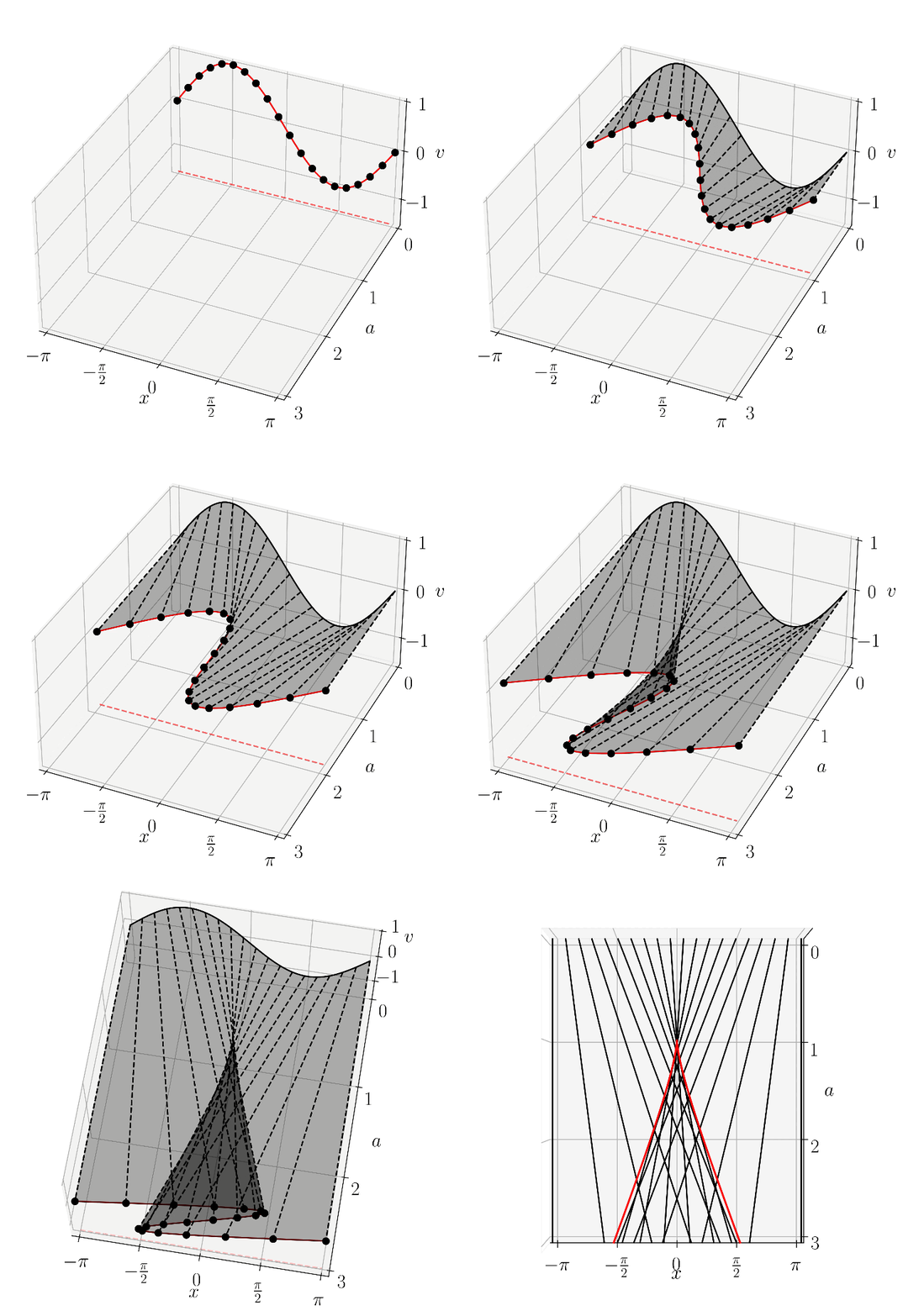
As a bonus here is a groovy animated version of Figure 1 from the paper showing the development of a multi-stream region.

And if that weren’t enough here is a short talk about their work in the Cosmology From Home series by the first author Alex Gough.