Archive for Diamond Open Access

Four New Publications at the Open Journal of Astrophysics

Posted in OJAp Papers, Open Access, The Universe and Stuff with tags , , , , , , , , , , , , , , , , on November 9, 2024 by telescoper

Once again it’s time for a quick update of activity at the Open Journal of Astrophysics. Since the last update a week ago we have published  four papers, which takes the count in Volume 7 (2024) up to 102 and the total published altogether by OJAp up to 217.   This means not only that we have reached a century for the year but also that so far in 2024 we have published more than double the number of papers that we published in all of 2023. I blogged about the significance of the figure 217 here.

In chronological order, the four papers published this week, with their overlays, are as follows. You can click on the images of the overlays to make them larger should you wish to do so.

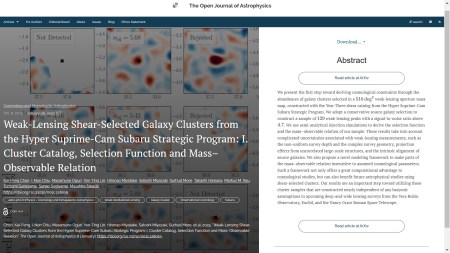
First one up is “A generative model for Gaia astrometric orbit catalogs: selection functions for binary stars, giant planets, and compact object companions” by Kareem El-Badry (Caltech, USA), Casey Lam (Carnegie Observatories), Berry Holl & Jean-Louis Halbwachs (U. Geneva), Hans-Walter Rix (MPA Heidelberg, Germany), Tsevi Mazeh (Tel Aviv, Israel) and Sahar Shahaf (Weizmann Institute of Science, Israel). This one is in the folder Solar and Stellar Astrophysics. The paper presents a forward method for estimating the selection function (i.e. the probability of a system with a given set of parameters being included in a catalog). It was published on November 4th 2024.

Here is a screen grab of the overlay, which includes the abstract:
 

You can find the officially accepted version of the paper on the arXiv here.

The second paper to announce, published on 5th November 2024. is “Primordial magnetogenesis in a bouncing model with dark energy” by Marcus V. Bomfim (Rio de Janeiro, Brazil), Emmanuel Frion (Western U. Canada), Nelson Pinto-Neto (Espírito Santo, Brazil), and Sandro D. P. Vitenti (Paraná, Brazil). This paper, in the section on Cosmology and NonGalactic Astrophysics, presents a discussion of the possible generation of magnetic fields on cosmological scales by in a model involving a scalar field coupled to electromagnetism

You can see the overlay here:


The accepted version of this paper can be found on the arXiv here.

The third paper, published on 6th November 2024 in the folder marked Astrophysics of Galaxies, is called  “Evidence for large scale compressible turbulence in the ISM of CSWA13, a star-Forming Lensed Galaxy at z = 1.87 with outflowing wind” by Itzhak Goldman (Tel Aviv, Israel). It presents a statistical analysis of the spatial distribution and kinematics of nebular gas with discussion of the nature of the turbulence present.

Here is the overlay


The final version accepted on arXiv is here.

Last in this batch is “Star formation in the high-extinction Planck cold clump PGCC G120.69+2.66” by Anlaug Amanda Djupvik (Aarhus, Denmark), João L. Yun (Lisbon, Portugal), and Fernando Comerón (ESO, Garching, Germany). It was published on 7th November 2024 in the folder marked Astrophysics of Galaxies. The paper uses imaging and spectroscopy  information to identify sites of star formation in a molecular cloud. This is the overlay:

You can find the official accepted version on the arXiv here.

That’s all for now. I will post another update in a week.

Three New Publications at the Open Journal of Astrophysics

Posted in OJAp Papers, Open Access, The Universe and Stuff with tags , , , , , , , , , , , on November 2, 2024 by telescoper

It’s Saturday, so it’s time once again for another summary of business at the  Open Journal of Astrophysics. This week I have three papers to announce, which brings the total we have published so far this year (Vol. 7) to 98 and the total published by OJAp to 213.

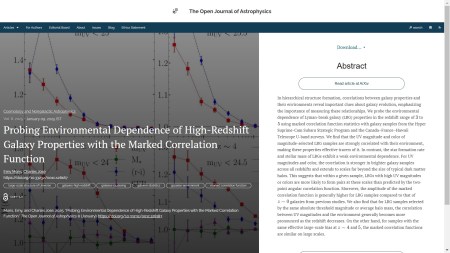
First one up, published on Tuesday 29th October 2024, is “Cosmology with shear ratios: a joint study of weak lensing and spectroscopic redshift datasets” by Ni Emas & Chris Blake (Swinburne U., Australia), Rossana Ruggeri (Queensland U, Australia) and Anna Porredon (Ruhr University, Bochum, Germany). This paper is in the folder marked Cosmology and NonGalactic Astrophysics. The paper investigates the use of shear ratios as a cosmological diagnostic, with applications to lensing surveys

Here is a screen grab of the overlay, which includes the abstract:

You can read the paper directly on arXiv here.

The second paper to present, also published on Tuesday 29th October 2024, is “Echo Location: Distances to Galactic Supernovae From ASAS-SN Light Echoes and 3D Dust Maps” by Kyle D. Neumann (Penn State), Michael A. Tucker & Christopher S. Kochanek (Ohio State), Benjamin J. Shappee (U. Hawaii), and K. Z. Stanek (Ohio State), all based in the USA. This paper is in the folder marked High-Energy Astrophysical Phenomena and it presents a new approach to estimating the distance to a source by combining light echoes with recent three-dimensional dust maps with application to supernova distances.

The overlay looks like this:


You can read this paper directly on the arXiv here.

Last, but by no means least, comes  “A deconstruction of methods to derive one-point lensing statistics” by Viviane Alfradique (Universidade Federal do Rio De Janeiro, Brazil), Tiago Castro (INAF Trieste, Italy), Valerio Marra (Trieste), Miguel Quartin (Rio de Janeiro), Carlo Giocoli (INAF Bologna, Italy), and Pierluigi Monaco (Trieste).  Published in the folder marked Cosmology and NonGalactic Astrophysics, it describes a comparative study of different methods of approximating the one-point probability density function (PDF) for use in the statistical analysis of gravitational lensing.

Here is a screengrab of the overlay:


To read the accepted version of this on the arXiv please go here.

That’s it for this week. I hope to post another update next weekend, by when we might well have reached a century for this year!

Open Access Week 2024: Community over Commercialization

Posted in Open Access with tags , , , , , on October 22, 2024 by telescoper

This week is Open Access Week 2024, the theme of which is Community over Commercialization. In light of this, among with some other journal editors I was contacted by Scholastica to provide some comments for their blog, Scholastica being the provider of the platform used by The Open Journal of Astrophysics. I was happy to respond to a couple of questions about how to build engaged communities.

Here are the comments of mine that they used in the blog post:

We started with a small editorial board basically formed from people who read various blog posts I’d written about the idea of the journal and followed its germination. We were lucky to have an initial group of high-profile scientists based all around the globe, including the USA. We started to get some papers from very well-known authors from leading institutes, and large international consortia. Some of these papers have generated large numbers of citations and have attracted coverage in the mainstream media, which also helped raise our profile.

Last year I was on sabbatical, which gave me the opportunity to travel and give invited talks about open access publishing in astrophysics at institutions in France, Spain, the UK, and Australia, and to audiences around the world via the Internet. Other members of the editorial board have also done their bit in promoting the journal. Our submission rate increased only slowly at first but is now more than doubling each year and we are currently receiving several submissions a day.  It has taken a while to establish the reputation of the Open Journal of Astrophysics this way, (i.e., mainly by word of mouth), but that has been good for us because it has enabled us to scale up our processes without becoming overwhelmed by a deluge.

My advice to others trying to set up a new journal would be to have a strong editorial board and clear policies, and above all to be patient. It takes a while — in our case more than 5 years — to establish a reputation in the academic community. These days there are too many people talking about this sort of publishing and not enough actually doing it. It’s time for researchers and research institutions to claim back the original purpose of academic publishing, the free dissemination of research for the public good.

You can read comments from three other editors of open access journals in the original Scholastica blog post.

The 200th Publication at the Open Journal of Astrophysics

Posted in OJAp Papers, Open Access, The Universe and Stuff with tags , , on October 8, 2024 by telescoper

It was on September 11th last year that we published the 100th paper at the Open Journal of Astrophysics. Today, on 8th October 2024, just over a year later we have reached the 200 mark with this paper:

In fact this looks like being a record-breaking week for OJAp as we have published four papers already and its only Tuesday. To be fair, most of these were accepted last week but were slow appearing on the arXiv – I think partly due to glitches on arXiv – but still it’s nice to be this active. I’ll do a regular post at the weekend with details of how many we published in total by then. I’m very confident that we will reach 100 for the calendar year.

Four New Publications at the Open Journal of Astrophysics

Posted in OJAp Papers, Open Access, The Universe and Stuff with tags , , , , , , , , , , , , on September 29, 2024 by telescoper

A day later than has been usual for such things, it’s now time for a quick update of activity at the Open Journal of Astrophysics. This week we have published another batch of four papers which takes the count in Volume 7 (2024) up to 81 and the total published altogether by OJAp up to 196. I think there may come a week in we publish papers on every day of that week, but it was not this week…

In chronological order, the four papers published this week, with their overlays, are as follows. You can click on the images of the overlays to make them larger should you wish to do so.

First one up is “Finding the unusual red giant remnants of cataclysmic variable mergers” by Nicholas Z. Rui and Jim Fuller of California Institute of Technology (Caltech), USA. It presents a discussion of the possible photometric, astroseismological, and surface abundance signatures of red giants formed by mergers of cataclysmic variable stars. It was published on 23rd September 2024 and is in the folder marked Solar and Stellar Astrophysics.

Here is a screen grab of the overlay, which includes the abstract:


You can find the officially accepted version of the paper on the arXiv here.

The second paper to announce, also published on 23rd September 2024, is “Notes on the Practical Application of Nested Sampling: MultiNest, (Non)convergence, and Rectification” by Alexander Dittmann (U. Maryland, USA). A critical analysis of the MultiNest algorithm together with suggestions for approving its applicability. It is in the folder Instrumentation and Methods for Astrophysics.

You can see the overlay here:


The accepted version of this paper can be found on the arXiv here.

The third paper, published on 24th September 2024 in the folder marked High-Energy Astrophysical Phenomena, is called  “Merger Precursor: Year-long Transients Preceding Mergers of Low-mass Stripped Stars with Compact Objects” and is by Daichi Tsuna, Samantha Wu & Jim Fuller (Caltech), Yize Dong (UCLA) and Anthony Piro (Carnegie Observatories), all based in the USA.

Here is the overlay


The final version accepted on arXiv is here.

Last in this batch is “Spectroscopic Observations of the GALEX Nearby Young Star Survey Sample. I. Nearby Moving Group Candidates” by Navya Nagananda (Rochester, NY, USA), Laura Vican (UCLA), Ben Zuckerman (UCLA), David Rodriguez (STScI), Alexander Binks (Tübingen, Germany) & Joel Kastner (Rochester). It describes investigations of the spectra of the GALNYSS sample of over 2000 young stars and the assignment of these stars into moving groups. It is is in the folder marked Solar and Stellar Astrophysics, and was published on 25th September 2024 with this overlay:


You can find the official accepted version on the arXiv here.

That’s all for now. I will post another update in a week.

Two New Publications at the Open Journal of Astrophysics

Posted in OJAp Papers, Open Access, The Universe and Stuff with tags , , , , , , , , , on September 7, 2024 by telescoper

It’s Saturday morning again so here’s another report on activity at the  Open Journal of Astrophysics.  Since the last update we have published two more papers, taking  the count in Volume 7 (2024) up to 73 and the total published by OJAp up to 188.  We’ve still got a few in the pipeline waiting for the final versions to appear on arXiv so I expect we’ll reach the 200 mark fairly soon.

The first paper of the most recent pair, published on September 4th 2024,  and in the folder marked Astrophysics of Galaxies, is “Massive Black Hole Seeds”  by John Regan of the Department of Theoretical Physics at Maynooth University and Marta Volonteri (Sorbonne Université, Paris, France). This article presents a discussion of the pathways to the formation of massive black holes, including both light and heavy initial seeds.

Here is a screen grab of the overlay which includes the abstract:


You can click on the image of the overlay to make it larger should you wish to do so. Those of you who are paying attention will see that there is a bit of a glitch on the left hand side where software has thrown a line break in between the two author names. I have no idea what caused this so I raised a ticket with Scholastica and no doubt it will soon be fixed.  (Update: it is now fixed, 12th September 2024). You can find the officially accepted version of this paper on the arXiv here.

The second paper has the title “The future of cosmological likelihood-based inference: accelerated high-dimensional parameter estimation and model comparison” and was published on 5th September 2024. The authors are Davide Piras (Université de Genève), Alicja Polanska (MSSL) , Alessio Spurio Mancini (Royal Holloway, London), Matthew A. Price(UCL) & Jason D. McEwen (UCL); the latter four are all based in the UK. This paper, which is in  the folder marked Cosmology and NonGalactic Astrophysics, describes an accelerated approach to Bayesian inference in higher-dimensional settings, as required for cosmology, based on recent developments in machine learning and its underlying technology.

Here is a screen grab of the overlay which includes the abstract:


You can click on the image of the overlay to make it larger should you wish to do so. You can find the officially accepted version of the paper on the arXiv here.

That concludes this week’s update. More  next week!

The Editorial Board of the Open Journal of Astrophysics

Posted in Open Access, The Universe and Stuff with tags , , on September 6, 2024 by telescoper

A couple of months ago, I issued a call for new Editors of the Open Journal of Astrophysics. That was very successful and we added a number of new Editors. The complete list (of 20 members) follows:

Peter Coles* (Department of Theoretical Physics, Maynooth University, Ireland). Cosmology, astrophysics, statistics and methodology.

Thierry Appourchaux (CNRS, Institut d’Astrophysique Spatiale, Orsay, France). Space instrumentation, astroseismology, helioseismology, statistics and methodology.

Emory (Ted) Bunn (Department of Physics, University of Richmond, USA). Relativity, cosmology.

Walter Dehnen (Astronomisches Rechen-Institut, University of Heidelberg, Germany). Stellar dynamics, galaxy dynamics, galaxies, bars, Milky-Way dynamics, Gaia, numerical methods, N-body techniques, smooth particle hydrodynamics (SPH).

Philipp Edelmann (Los Alamos National Laboratory, New Mexico, USA). Stellar astrophysics, hydrodynamics, high-performance computing, supernovae, internal waves, stellar evolution, numerical methods.

Pedro Ferreira (Department of Physics, University of Oxford, UK). Large-scale structure, general relativity, cosmic microwave background, early universe, cosmology.

Andrew Jaffe (Department of Physics, Imperial College, London, UK). Astrophysics, statistics and methodology, cosmology.

Harley Katz (Department of Astronomy and Astrophysics, University of Chicago, USA). Galaxy formation and evolution, numerical simulations

Lucyna Kedziora-Chudczer (School of Physics, University of New South Wales, Sydney, Australia). Active galactic nuclei, polarimetry, atmospheres of planets, exoplanets, solar system planets.

Julien Larena (Laboratoire Univers et Particules de Montpellier, Université de Montpellier, France). Cosmology, gravitation, lensing, large-scale structure, general relativity.

Manuela Magliocchetti (National Institute of Astrophysics, Rome, Italy). Cosmology, galaxies, active galactic nuclei (AGN).

Sean McGee (Department of Physics & Astronomy, University of Birmingham, UK). Galaxy formation, galaxy clusters, galaxy surveys.

Manolis Plionis (Department of Physics, Aristotle University of Thessaloniki, Greece). Observational cosmology, extragalactic astrophysics, large-scale structure, active galactic nuclei.

Alkistis Pourtsidou (Higgs Centre & Institute for Astronomy, Edinburgh, UK). Cosmology, large-scale structure of the Universe, radio astronomy, galaxy surveys.

Justin Read (School of Mathematics and Physics, University of Surrey, UK). Dark matter, cosmology, galaxy formation and evolution, dwarf galaxies, milky way, galactic dynamics, galactic archaeology, computational modeling.

Hanno Rein (Department of Physics and Environmental Sciences, University of Toronto at Scarborough, Canada). Numerical methods, in particular N-body codes and integration methods for planetary systems, planet formation, stochastic processes, planet migration, celestial mechanics, and Saturn’s rings.

Aleks Scholz (School of Physics & Astronomy, University of St Andrews, UK). Exoplanets, brown dwarfs, protoplanetary disks, stellar evolution, star formation.

Elena Sellentin (Sterrewacht Leiden, Leiden University, The Netherlands). Applied Mathematics, Cosmology, Statistics, Statistical Inference.

Elena Terlevich (Instituto Nacional de Astrofísica, Óptica y Electrónica, Puebla, Mexico). Stellar populations in galaxies, observational cosmology, violent star formation, element abundances, dynamics of stellar systems.

Bingbing Wang (Center for Space Plasma and Aeronomic Research, University of Alabama in Huntsville, USA.) Particle astrophysics, MHD turbulence, cosmic rays acceleration, cosmic ray propagation in the Galaxy and heliosphere.

Apologies to anyone who volunteered but has not yet received a reply from me. I’ve been a bit preoccupied these last weeks! The call is still open, though. Here are the areas of arXiv covered by the journal:

  1. astro-ph.GA – Astrophysics of Galaxies. Phenomena pertaining to galaxies or the Milky Way. Star clusters, HII regions and planetary nebulae, the interstellar medium, atomic and molecular clouds, dust. Stellar populations. Galactic structure, formation, dynamics. Galactic nuclei, bulges, disks, halo. Active Galactic Nuclei, supermassive black holes, quasars. Gravitational lens systems. The Milky Way and its contents
  2. astro-ph.CO – Cosmology and Nongalactic Astrophysics. Phenomenology of early universe, cosmic microwave background, cosmological parameters, primordial element abundances, extragalactic distance scale, large-scale structure of the universe. Groups, superclusters, voids, intergalactic medium. Particle astrophysics: dark energy, dark matter, baryogenesis, leptogenesis, inflationary models, reheating, monopoles, WIMPs, cosmic strings, primordial black holes, cosmological gravitational radiation
  3. astro-ph.EP – Earth and Planetary Astrophysics. Interplanetary medium, planetary physics, planetary astrobiology, extrasolar planets, comets, asteroids, meteorites. Structure and formation of the solar system
  4. astro-ph.HE – High Energy Astrophysical Phenomena. Cosmic ray production, acceleration, propagation, detection. Gamma ray astronomy and bursts, X-rays, charged particles, supernovae and other explosive phenomena, stellar remnants and accretion systems, jets, microquasars, neutron stars, pulsars, black holes
  5. astro-ph.IM – Instrumentation and Methods for Astrophysics. Detector and telescope design, experiment proposals. Laboratory Astrophysics. Methods for data analysis, statistical methods. Software, database design
  6. astro-ph.SR – Solar and Stellar Astrophysics. White dwarfs, brown dwarfs, cataclysmic variables. Star formation and protostellar systems, stellar astrobiology, binary and multiple systems of stars, stellar evolution and structure, coronas. Central stars of planetary nebulae. Helioseismology, solar neutrinos, production and detection of gravitational radiation from stellar systems.

We are looking for experienced scientists in any of these areas, and it would indeed be useful to have people who can cover a range of subjects (as some of our existing editors do), but there I think we’re still a bit short on High-Energy Astrophysics, Solar and Stellar Physics, and Galactic Astrophysics. I’d also like to see a better gender balance so applications from female scientists are particularly welcomed, as are astrophysicists from geographical areas not currently covered. The Open Journal of Astrophysics is intended to be a global enterprise!

Please follow the instructions here if you would like to volunteer!

New Publication at the Open Journal of Astrophysics

Posted in OJAp Papers, Open Access, The Universe and Stuff with tags , , , , , on August 17, 2024 by telescoper

It’s Saturday morning and time for the usual weekly update of publications at the Open Journal of Astrophysics. This will be a short post because there is only one paper to report this week, being  the 68th paper in Volume 7 (2024)  and the 183rd  altogether. It was published on Thursday August 15th 2024.

The title of the latest paper is is “Spatial segregation of massive clusters in a simulation of colliding dwarf galaxies” and it  is in the folder marked Astrophysics of Galaxies. The authors are Bruce Elmegreen (IBM, NY, USA) and Natalia Lahen (MPA Garching, Germany);  the paper presents a numerical study of the properties and spatial distribution of star clusters resulting from a collision between dwarf galaxies.

Here is the overlay of the paper containing the abstract:


You can click on the image of the overlay to make it larger should you wish to do so. You can also find the officially accepted version of the paper on the arXiv here.

Open Access Updates & Announcements

Posted in Open Access with tags , , , on August 3, 2024 by telescoper

When I wrote last week’s update on papers published at the Open Journal of Astrophysics, I was a little surprised that our publishing activity had not tailed off because of the summer vacations. Well, it has now because we haven’t publish any papers this week! Rather than not post an update at all, however, I thought I’d point out a few interesting things that have happened in the world of open access.

First. I draw your attention to an article in C&EN (Chemical & Engineering News) reflecting on the fact that the Gates Foundation (one of the largest research charities in the world) announced in March 2024 that, starting from Jan. 1, 2025, it would no longer cover publishing costs. I actually wrote about this decision here. The article is largely about the threat this poses to the Gold Open Access model, which in my opinion thoroughly deserves to be threatened. It does, however, talk briefly about Diamond Open Access which commercial publishers don’t like as it removes – or should do – their source of profits:

Another alternative model is diamond OA, in which all research papers and their associated peer-reviewed reports are published without fees for the author or the reader and are also freely available to read and reuse. 

It goes on to say:

Under diamond OA, publishers are no longer gatekeepers of research. Instead, they become service providers that handle manuscript submissions, typesetting, and copyediting. This is in contrast to the current publishing system, in which the publisher controls everything from the copyright to the production process.

I don’t really agree with even the limited role of “service providers” mentioned here, as much of what that role entails just involves a decent reviewing platform. Elsewhere the article says that moving to Diamond OA would entail a significant cost. That may be but, as I’ve said over and over again, the actual cost of online publishing is low compared to the level of profit extracted by commercial publishers. The cost to academia of moving to Diamond OA would be much less than not moving to Diamond OA.

The second item I’d like to draw your attention is called Choosing a publisher? It’s not all about the impact factor and is by Antigoni Messaritaki, a senior publisher at IOP Publishing,  When I saw the title I thought that it might be about the uselessness of Journal Impact Factors and a commitment by IOP Publishing to stop using them. Sadly it’s nothing of the sort. It tries to entice authors to look beyond journal impact factors when choosing a publisher, pushing Open Access as an important factor to consider. It admits that APCs are expensive, but never even mentions Diamond OA. It’s an entirely self-serving piece. I find the IOP’s stance on publishing, and the disingenuous way they try to excuse their own profiteering, unethical and unacceptable. That’s why I resigned my fellowship of the IOP.

Last, and by all means least, I should draw your attention that the 32nd General Assembly of the International Astronomical Union takes place next week in Cape Town. I’m not attending in person – I’ve done enough travelling this year! – but I have accepted an invitation to give a remote talk at a side event called Open Access Encounters on Wednesday 7th August:

Four New Publications at the Open Journal of Astrophysics

Posted in OJAp Papers, Open Access, The Universe and Stuff with tags , , , , , , , , , , , , , , , , , , on July 27, 2024 by telescoper

It’s Saturday morning, so once again it’s time for an update of activity at the Open Journal of Astrophysics. This week we have published another batch of four papers, the same number as last week, which takes the count in Volume 7 (2024) up to 64 and the total published altogether by OJAp up to 179.

Before announcing the week’s papers I’ll add three other updates you might find interesting:

  1.  When I looked at NASA/ADS this morning to help construct this post I saw that papers published in OJAp have now garnered over 2500 citations between them;
  2. We had a good response to our recent call for new members of the Editorial Board and have added four new members here;
  3. Last week we received a significant (unsolicited) cash donation from a higher education institution based in Europe to help with our work in Diamond Open Access. If any other organizations or individuals would like to do similar then please contact me!

Now, in chronological order, the four papers published this week, with their overlays, are as follows. You can click on the images of the overlays to make them larger should you wish to do so.

First one up is: “Widespread disruption of resonant chains during protoplanetary disk dispersal by Bradley M S Hansen (UCLA), Tze-Yeung Yu (UCLA) and Yasuhiro Hasegawa (JPL), all based in California, USA.  The paper presents a discussion of the effect of a dispersing protoplanetary disk on the evolution of low-mass planets around a Solar mass star.  It was published on 21st July 2024 and is in the folder marked Earth and Planetary Astrophysics.

Here is a screen grab of the overlay, which includes the abstract:


You can find the officially accepted version of the paper on the arXiv here.

The second paper to announce is “Using A One-Class SVM To Optimize Transit Detection” by Jakob Roche of the University of South Florida, also in the USA (but not in California). This articles discusses the advantages of One-Class Support Vector Machines (SVMs) over Convolutional Neural Networks (CNN) in the context of exoplanet detection. Its in the folder called Instrumentation and Methods for Astrophysics and was published on 25th July 2024.

You can see the overlay here:


The accepted version of this paper can be found on the arXiv here.

The next paper, also published on 25th July 2024, is in the folder marked High-Energy Astrophysical Phenomena. Its primary classification on arXiv is General Relativity and Quantum Cosmology (gr-qc), but it is cross-listed on astro-ph so we considered it for publication and had it refereed, with favourable results. It is entitled “What no one has seen before: gravitational waveforms from warp drive collapse” and is by Katy Clough (QMUL, UK), Tim Dietrich (Potsdam, Germany) and Sebastian Khan (Cardiff, UK).  Looking at the title of this paper you might be tempted to dismiss it on the grounds that warp drives are the stuff of science fiction (which they are), but this paper is really a rigorous technical study of the dynamical evolution and stability of spacetimes that violate the null energy condition, inspired by the idea of a warp drive.

Here is the overlay:


You can find the full text for this one on the arXiv here.

Last, published on 26th July 2024, we have a paper with the title “A study of gamma-ray emission from OJ 287 using Fermi-LAT from 2015-2023” by Vibhavasu Pasumarti and Shantanu Desai of the Indian Institute of Technology, Hyderabad, India. It is an investigation of the properties of gamma-ray emission from OJ287 (a BL Lac object) using the Fermi Large Area Telescope (LAT).  This one is also in the folder marked High-Energy Astrophysical Phenomena; here is the overlay

You can find the officially accepted version of this paper on the arXiv here.

That’s all for this week. Stay tuned for another update next week.