Archive for dwarf galaxies

Weekly Update from the Open Journal of Astrophysics – 27/09/2025

Posted in OJAp Papers, Open Access, The Universe and Stuff with tags , , , , , , , , , , , , , , , , , , , , , , on September 27, 2025 by telescoper

It’s Saturday again, so it’s time for a summary of the week’s new papers at the Open Journal of Astrophysics. Since the last update we have published five new papers, which brings the number in Volume 8 (2025) up to 141, and the total so far published by OJAp up to 376.

The first paper to report this week is “The Bispectrum of Intrinsic Alignments: Theory Modelling and Forecasts for Stage IV Galaxy Surveys” by Thomas Bakx (Utrecht U., NL), Alexander Eggemeier (U. Bonn, DE), Toshiki Kurita (MPA Garching, DE), Nora Elisa Chisari (Leiden U., NL) and Zvonimir Vlah (Ruđer Bošković Institute, Croatia). This paper was published on Monday 22nd September 2025 in the folder Cosmology and NonGalactic Astrophysics. It studies the bispectrum of intrinsic galaxy alignments, a possible source of systematic errors in extracting cosmological information from the analysis of weak lensing surveys.

The overlay is here:

You can make this larger by clicking on it.  The officially accepted version of this paper can be found on the arXiv here.

The second paper this week, published on Tuesday 23rd September 2025 is “Reanalysis of Stage-III cosmic shear surveys: A comprehensive study of shear diagnostic tests” by Jazmine Jefferson (University of Chicago, USA) and 13 others for the LSST Dark Energy Science Collaboration. It is also in the folder Cosmology and NonGalactic Astrophysics; it describes diagnostic tests on three public shear catalogs (KiDS-1000, Year 3 DES-Y3 s, and Year 3 HSC-Y3); not all the surveys pass all the tests.

The corresponding overlay is here:

You can find the officially accepted version on arXiv here.

The third one this week, published on Wednesday 24th September 2025 in the folder Astrophysics of Galaxies, is “Is feedback-free star formation possible?” by Andrea Ferrara, Daniele Manzoni, and Evangelia Ntormousi (all of the Scuola Normale Superiore, Pisa, Italy). This paper presents an argument that Lyman-alpha radiation pressure strongly limits star formation efficiency, even at solar metallicities, so that a feedback-free star formation phase is not possible without feedback. The overlay is here:

You can find the officially-accepted version on arXiv here.

Next we have “Microphysical Regulation of Non-Ideal MHD in Weakly-Ionized Systems: Does the Hall Effect Matter?” by Philip F. Hopkins (Caltech, USA), Jonathan Squire (U. Otago, New Zeland), Raphael Skalidis (Caltech) and Nadine H. Soliman (Caltech). This was also published on Wednesday 24th September 2025, but in the folder Earth and Planetary Astrophysics. It presents an improved treatment of non-ideal effects in magnetohydrodynamics, particularly the Hall effect, and a discussion of the implications for weakly-ionized astrophysical systems.

The corresponding overlay is here:


You can find the officially accepted version of this one on arXiv here.

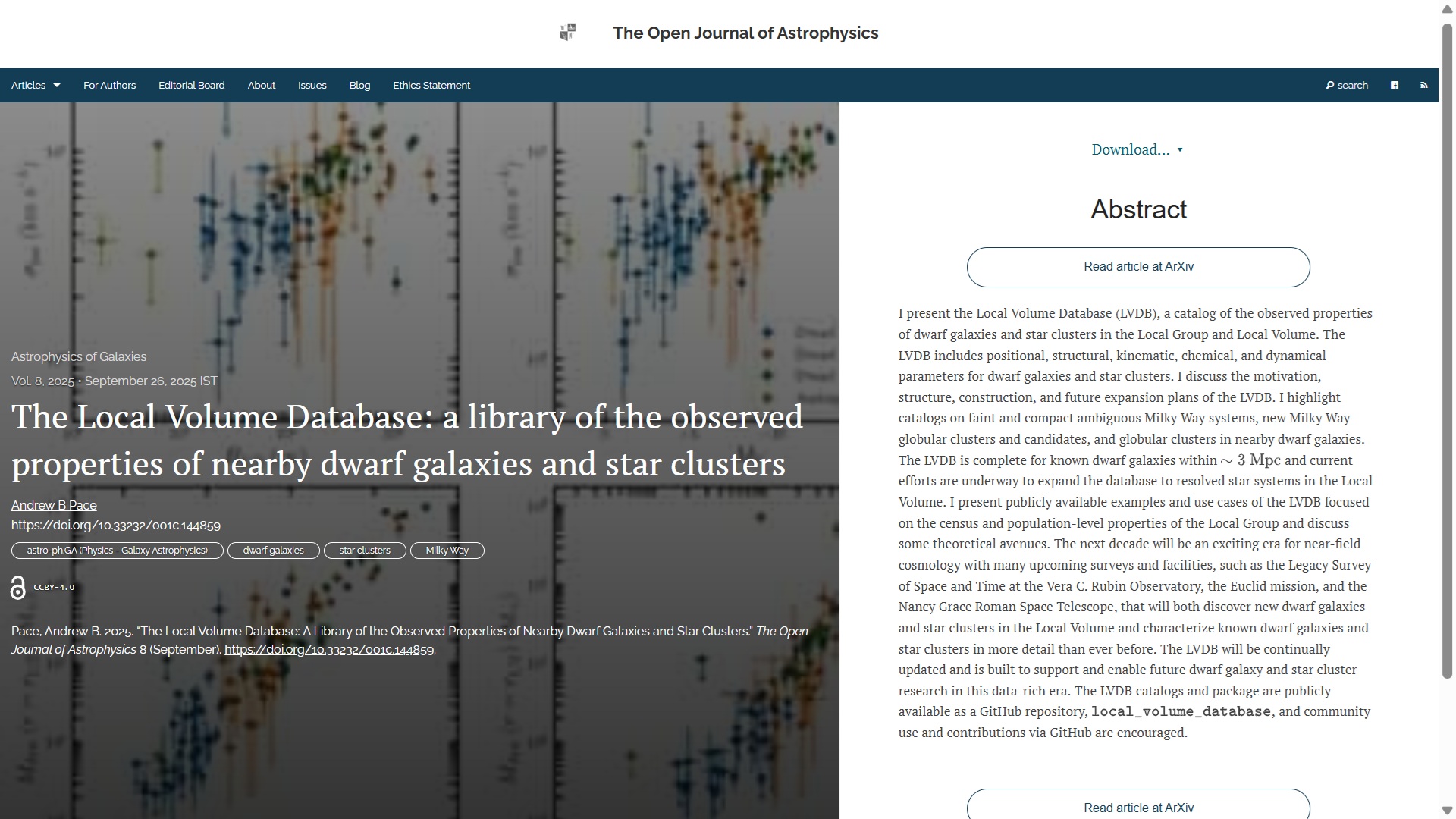
The fifth, and last, one for this week is “The Local Volume Database: a library of the observed properties of nearby dwarf galaxies and star clusters” by Andrew B. Pace (University of Virginia, USA). This one was published on Friday 26th September (i.e. yesterday) in the folder Astrophysics of Galaxies. It presents a catalogue of positional, structural, kinematic, chemical, and dynamical parameters for dwarf galaxies and star clusters in the Local Volume. The overlay is here:
You can find the officially-accepted version of this paper on arxiv here.


And that concludes the report for this week. I’ll post another update next Saturday.
Weekly Update from the Open Journal of Astrophysics – 26/04/2025

Posted in OJAp Papers, Open Access, The Universe and Stuff with tags , , , , , , , , , , , on April 26, 2025 by telescoper

It’s Satuday morning once again, and time for another update of papers published at the Open Journal of Astrophysics. Since the last update we have published two papers, which brings the number in Volume 8 (2025) up to 44 and the total so far published by OJAp up to 279.

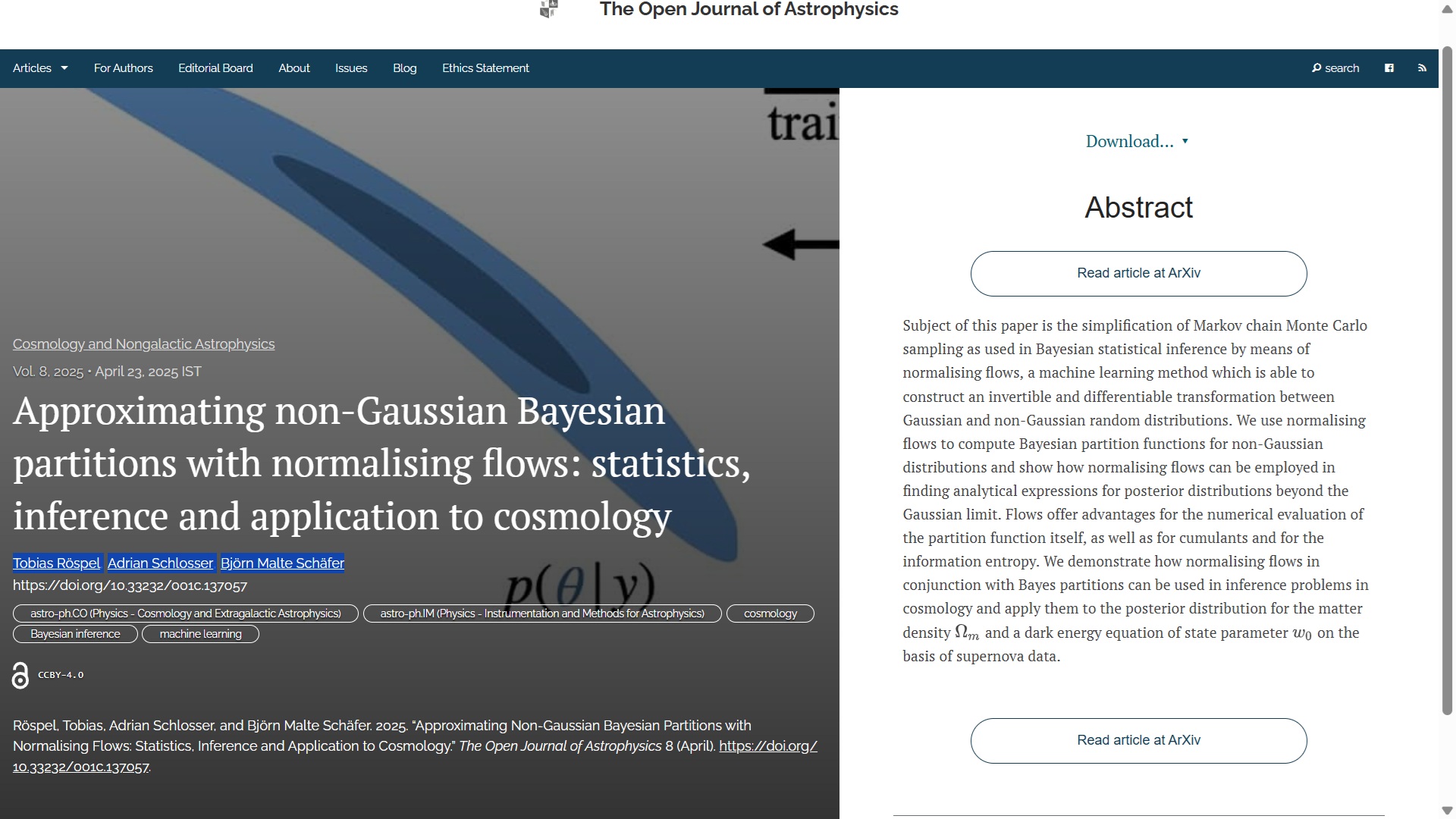
The first paper to report is “Approximating non-Gaussian Bayesian partitions with normalising flows: statistics, inference and application to cosmology” by Tobias Röspel, Adrian Schlosser & Björn Malte Schäfer (Universität Heidelberg, Germany) which was published on April 23rd 2025 in the folder Cosmology and NonGalactic Astrophysics. It is an introduction to normalizing flows – a machine learning technique for transforming distributions – and its application to the extraction of cosmological parameters from supernova data.

The overlay is here:

You can find the officially accepted version on arXiv here.

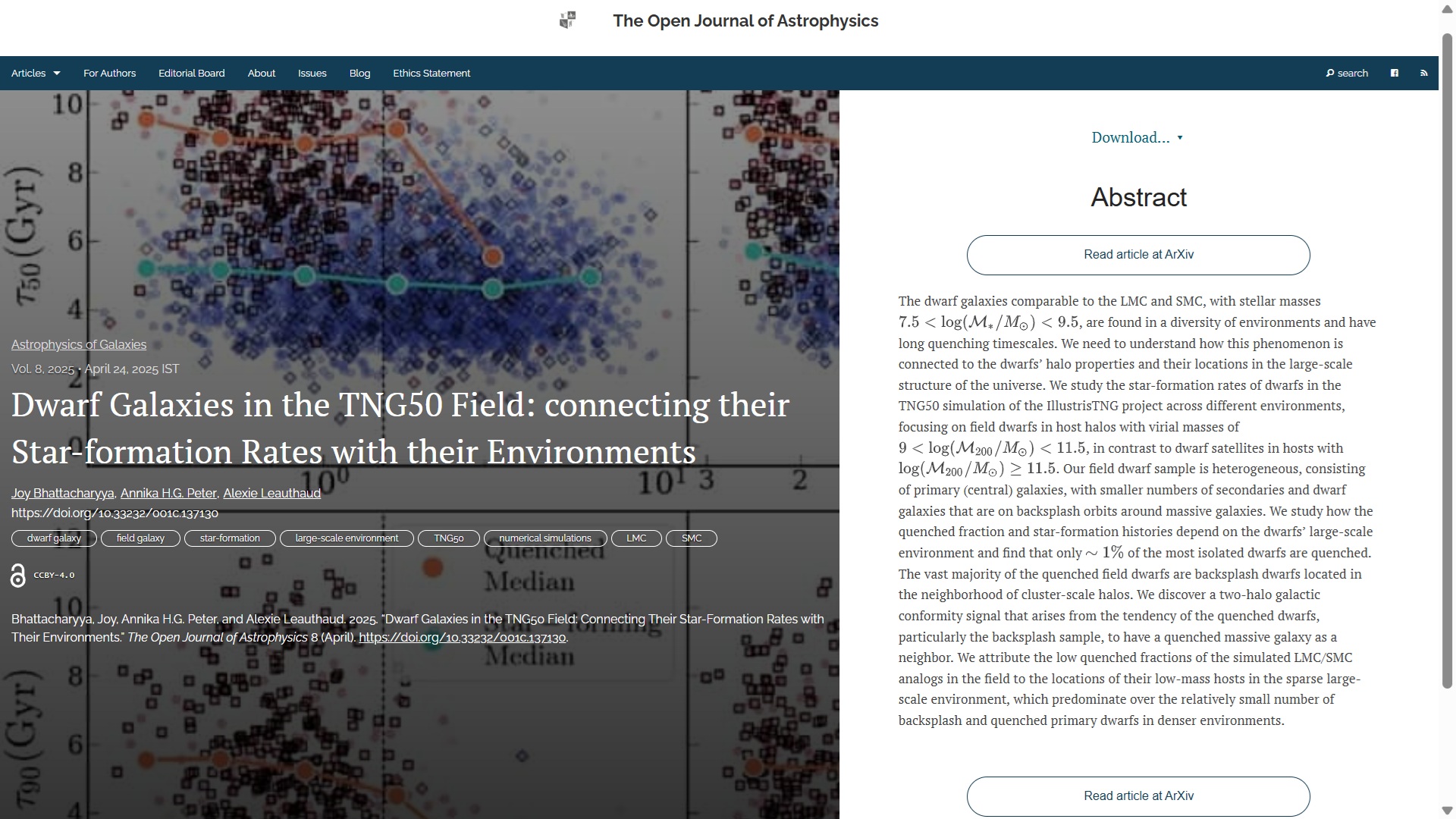
The other paper this week is “Dwarf Galaxies in the TNG50 Field: connecting their Star-formation Rates with their Environments” by Joy Bhattacharyya & Annika H.G. Peter (Ohio State University, USA) and Alexie Leauthaud (UC Santa Cruz, USA).  This one was published on 24th April 2025 in the older Astrophysics of Galaxies and it studies dwarf galaxies with properties similar to the Large and Small Magellanic Clouds that form in different environments in the TNG50 simulation of the IllustrisTNG project.

The overlay is here:


and you can find the final accepted version on arXiv here.


That’s all for this week. I’ll have another update next Saturday.

Weekly Update from the Open Journal of Astrophysics – 18/01/2025

Posted in OJAp Papers, Open Access, The Universe and Stuff with tags , , , , , , , , , , on January 18, 2025 by telescoper

It’s Saturday morning so once again it’s time for an updated of papers published at the Open Journal of Astrophysics. Since the last update we have published three new papers which brings the number in Volume 8 (2025) up to 7 and the total so far published by OJAp up to 242.

In chronological order of publication, the three papers published this week, with their overlays, are as follows. You can click on the images of the overlays to make them larger should you wish to do so.

First one up is “Potential-density pairs for Galaxy discs with exponential or sech^2 vertical profile” by Walter Dehnen and Shera Jafaritabar (Heidelberg, Germany). This paper was published on Tuesday 14th January 2025 in the folder marked Astrophysics of Galaxies. It presents a new set of analytic models for the structure of disc galaxies. The overlay, which includes the abstract, is here:

You can find the officially accepted version of this paper on arXiv here.

The second paper, which was published on Thursday 17th January 2025 also in the folder Astrophysics of Galaxies, is “Quantifying Bursty Star Formation in Dwarf Galaxies” by Yuan-Sen Ting (Ohio State University) and Alexander Ji (U. Chicago). This paper describes an application of Gaussian mixture models to distinguish between discontinuous and continuous star formation histories in dwarf galaxies.

Here is a screen grab of the overlay, which includes the abstract:You can find the officially accepted version of the paper on the arXiv here.

The third paper to announce, also published on 17th January 2025 but in the folder Cosmology and NonGalactic Astrophysics, is “Fast Projected Bispectra: the filter-square approach” by Lea Harscouet, Jessica A. Cowel, Julia Ereza & David Alonso (Oxford U., UK), Hugo Camacho (Brookhaven National Laboratory, USA), Andrina Nicola (Bonn, Germany) and Anže Slosar (Brookhaven). This paper presents Presenting the filtered-squared bispectrum (FSB), a fast and robust estimator of the projected bispectrum for use on cosmological data sets.

You can see the overlay here:

The accepted version of this paper can be found on the arXiv here.

That’s all for this week. I’ll do another update next Saturday.

Weekly Update from the Open Journal of Astrophysics – 11/01/2025

Posted in OJAp Papers, Open Access, The Universe and Stuff with tags , , , , , , , , , , , , on January 11, 2025 by telescoper

Welcome to the first update of 2025 from the Open Journal of Astrophysics. For the new year we have started Volume 8. Since the last update of 2024 we have published four new papers which brings the total so far published by OJAp up to 239.

In chronological order of publication, the four papers published this week, with their overlays, are as follows. You can click on the images of the overlays to make them larger should you wish to do so.

First one up is “Weak-Lensing Shear-Selected Galaxy Clusters from the Hyper Suprime-Cam Subaru Strategic Program: I. Cluster Catalog, Selection Function and Mass–Observable Relation” by Kai-Feng Chen (MIT, USA), I-Non Chiu (National Cheng University, Taiwan), Masamune Oguri (Chiba University, Japan), Yen-Ting Lin (IAAAS, Taiwan), Hironao Miyatake (Nagoya, Japan), Satoshi Miyazaki (Nat. Astr. Obs. Japan), Surhud More (IUCAA, India), Takashi Hamana (Nat. Astr. Obs. Japan), Markus M. Rau Carnegie Mellon University, USA), Tomomi Sunayama (Steward Obs., USA), Sunao Sugiyama (U. Penn, USA), Masahiro Takada (U. Tokyo, Japan).

This paper, which was published on Monday 6th January 2025 is in the folder Cosmology and NonGalactic Astrophysics, discusses steps towards towards the extraction of cosmogical constraints from a sample of galaxy clusters selected via weak gravitational lensing

Here is a screen grab of the overlay, which includes the abstract:

You can find the officially accepted version of the paper on the arXiv here.

The second paper to announce, published on 7th January 2025 and also in the folder Cosmology and NonGalactic Astrophysics, is “Cosmology on point: modelling spectroscopic tracer one-point statistics” by Beth McCarthy Gould (Newcastle U., UK), Lina Castiblanco (Bielefeld, Germany), Cora Uhlemann (Bielefeld, Germany), and Oliver Friedrich (LMU, Germany).

You can see the overlay here:

The accepted version of this paper can be found on the arXiv here.

The third paper, published on 9th January 2025, also in the folder Cosmology and NonGalactic Astrophysics, is “Probing Environmental Dependence of High-Redshift Galaxy Properties with the Marked Correlation Function” by Emy Mons and Charles Jose (Cochin University of Science and Technology, India). This paper uses the marked two-point correlation function to measure the environmental dependence of galaxy clustering at high redshift.

Here is the overlay:

The final version accepted on arXiv is here.

Last of this quartet, also published on 9th January 2025, but in the folder Astrophysics of Galaxies is “The infrared luminosity of retired and post-starburst galaxies: A cautionary tale for star formation rate measurements” by Vivienne Wild (St Andrews, UK), Natalia Vale Asari (Universidade Federal de Santa Catarina, Brazil), Kate Rowlands (STScI, Sara L. Ellison (U. Victoria, Canada), Ho-Hin Leung (St Andrews), Christy Tremonti (U. Wisconsin-Madison, USA).

The paper proposes an extension of the semi-analytic formalism to weak lensing and thermal Sunyaev-Zeldovich (tSZ) fields directly on the full-sky, with an emphasis on higher-order correlations. The overlay is here:

You can find the official accepted version on the arXiv here.

That’s all for this week. I’ll do another update next Saturday.

New Publication at the Open Journal of Astrophysics

Posted in OJAp Papers, Open Access, The Universe and Stuff with tags , , , , , on August 17, 2024 by telescoper

It’s Saturday morning and time for the usual weekly update of publications at the Open Journal of Astrophysics. This will be a short post because there is only one paper to report this week, being  the 68th paper in Volume 7 (2024)  and the 183rd  altogether. It was published on Thursday August 15th 2024.

The title of the latest paper is is “Spatial segregation of massive clusters in a simulation of colliding dwarf galaxies” and it  is in the folder marked Astrophysics of Galaxies. The authors are Bruce Elmegreen (IBM, NY, USA) and Natalia Lahen (MPA Garching, Germany);  the paper presents a numerical study of the properties and spatial distribution of star clusters resulting from a collision between dwarf galaxies.

Here is the overlay of the paper containing the abstract:


You can click on the image of the overlay to make it larger should you wish to do so. You can also find the officially accepted version of the paper on the arXiv here.

Sins of Omission

Posted in The Universe and Stuff with tags , , , , , on February 20, 2022 by telescoper

There’s a paper recently published in Nature Astronomy by Moreno et al, which you can find on the arXiv here. The title is Galaxies lacking dark matter produced by close encounters in a cosmological simulation and the abstract is here:

The standard cold dark matter plus cosmological constant model predicts that galaxies form within dark-matter haloes, and that low-mass galaxies are more dark-matter dominated than massive ones. The unexpected discovery of two low-mass galaxies lacking dark matter immediately provoked concerns about the standard cosmology and ignited explorations of alternatives, including self-interacting dark matter and modified gravity. Apprehension grew after several cosmological simulations using the conventional model failed to form adequate numerical analogues with comparable internal characteristics (stellar masses, sizes, velocity dispersions and morphologies). Here we show that the standard paradigm naturally produces galaxies lacking dark matter with internal characteristics in agreement with observations. Using a state-of-the-art cosmological simulation and a meticulous galaxy-identification technique, we find that extreme close encounters with massive neighbours can be responsible for this. We predict that approximately 30 percent of massive central galaxies (with at least 1011 solar masses in stars) harbour at least one dark-matter-deficient satellite (with 108 – 109 solar masses in stars). This distinctive class of galaxies provides an additional layer in our understanding of the role of interactions in shaping galactic properties. Future observations surveying galaxies in the aforementioned regime will provide a crucial test of this scenario.

It’s quite an interesting result.

I’m reminded of this very well known paper from way back in 1998, available on arXiv here, by Priya Natarajan, Steinn Sigurdsson and Joe Silk, with the abstract:

We propose a scenario for the formation of a population of baryon-rich, dark matter-deficient dwarf galaxies at high redshift that form from the mass swept out in the Intergalactic Medium (IGM) by energetic outflows from luminous quasars. We predict the intrinsic properties of these galaxies, and examine the prospects for their observational detection in the optical, X-ray and radio wavebands. Detectable thermal Sunyaev-Zeldovich decrements (cold spots) on arc-minute scales in the cosmic microwave background radiation maps are expected during the shock-heated expanding phase from these hot bubbles. We conclude that the optimal detection strategy for these dwarfs is via narrow-band Lyman-α imaging of regions around high redshift quasars. An energetically scaled-down version of the same model is speculated upon as a possible mechanism for forming pre-galactic globular clusters.

It’s true that the detailed mechanism for forming dwarf galaxies with low dark matter densities is different in the two papers, but it does show that the issue being addressed by Moreno et al. had been addressed before. It seems to me therefore that the Natarajan et al. paper is clearly relevant background to the Moreno et al. one. I always tell junior colleagues to cite all relevant literature. I wonder why Moreno et al. decided not to do that with this paper?

Had Moreno et al. preprinted their paper before acceptance by Nature Astronomy I’m sure someone would have told them of this omission. This is yet another reason for submitting your papers to arXiv at the same time as you submit them to a journal rather than waiting for them to be published.

Cosmology Talks: Alvaro Pozo on Potential Evidence for Wave Dark Matter

Posted in The Universe and Stuff with tags , , , , , , , , , on February 19, 2021 by telescoper

It’s time I shared another one of those interesting cosmology talks on the Youtube channel curated by Shaun Hotchkiss. This channel features technical talks rather than popular expositions so it won’t be everyone’s cup of tea but for those seriously interested in cosmology at a research level they should prove interesting. This is quite a recent one, from about a week ago.

In the talk, Alvaro Pozo tells us about a recent paper where he an collaborators detect the transition between a core (flat density profile) and halo (power law density profile) in dwarf galaxies. The full core + halo profile matches very closely what is expected in simulations of wave dark matter (sometimes called “fuzzy” dark matter), by which is meant dark matter consisting of a particle so light that its de Broglie wavelength is long enough to be astrophysically relevant. That is, there is a very flat core, which then drops off suddenly and then flattens off to a decaying power-law profile. The core matches the soliton expected in wave dark matter and the halo matches an outer NFW profile expected outside the soliton. They also detect evidence for tidal stripping of the matter in the galaxies. The galaxies closer to the centre of the Milky Way have their transition point between core and halo happen at smaller densities (despite the core density itself not being systematically smaller). The transition also appears to happen closer to the centre of the galaxy, which matches simulations. Of course the core+halo pattern they have clearly observed might be due to something else, but the match between wave dark matter simulations and observations is impressive. An important  caveat is that the mass for the dark matter that they use is very small and in significant tension with Lyman Alpha constraints for wave-like dark matter. This might indicate that the source of this universal core+halo pattern they’re observing comes from something else, or it might indicate that the wave dark matter is more complicated than represented in the simplest models.

P. S. The papers that accompany this talk can be found here.

P.P.S. If you’re interested in wave dark matter there is a nice recent review article by Lam Hui here.