Archive for galaxy clustering

Weekly Update from the Open Journal of Astrophysics – 25/10/2025

Posted in OJAp Papers, Open Access, The Universe and Stuff with tags , , , , , , , , , , , , , , , , , , , , on October 25, 2025 by telescoper

It may be a Bank Holiday weekend here in Ireland, but it’s still time for the usual Saturday update of the week’s new papers at the Open Journal of Astrophysics (although a bit later in the day than usual). Since the last update we have published another five papers, which brings the number in Volume 8 (2025) up to 161, and the total so far published by OJAp up to 396.

This week’s update  is rather unusual because there are four papers in a series (or, more precisely, mathematically speaking, a sequence) all published on the same day (Wednesday October 22nd 2025), in the same folder (Cosmology and NonGalactic Astrophysics), with the same first author (Dhayaa Anbajagane of the University of Chicago), with long author lists and many co-authors in common. These papers all relate to the DECADE cosmic shear project. Instead of doing them one by one, therefore, I’ve decided to put all four overlays together and provide links to all the papers afterwards. As I’m trying to encourage people to follow our feed on the Fediverse via Mastodon (where I announce papers as they are published, including the all-important DOI),  I’ll include links to each announcement there too.

  1. The DECADE cosmic shear project I: A new weak lensing shape catalog of 107 million galaxies“, accepted version on arXiv here.
  2. The DECADE cosmic shear project II: photometric redshift calibration of the source galaxy sample“, accepted version on arXiv here.
  3. The DECADE cosmic shear project III: validation of analysis pipeline using spatially inhomogeneous data“, accepted version on arXiv here.
  4. The DECADE cosmic shear project IV: cosmological constraints from 107 million galaxies across 5,400 deg2 of the sky“, accepted version on arXiv here.

The fediverse announcements follow:

Open Journal of Astrophysics

New Publication at the Open Journal of Astrophysics: "The DECADE cosmic shear project I: A new weak lensing shape catalog of 107 million galaxies" by Dhayaa Anbajagane (University of Chicago, USA) et al. (54 authors)

doi.org/10.33232/001c.146158

October 22, 2025, 12:42 pm 2 boosts 0 favorites

Open Journal of Astrophysics

New Publication at the Open Journal of Astrophysics: "The DECADE cosmic shear project II: photometric redshift calibration of the source galaxy sample" by Dhayaa Anbajagane (University of Chicago, USA) et al. (53 authors)

doi.org/10.33232/001c.146159

October 22, 2025, 1:07 pm 2 boosts 0 favorites

Open Journal of Astrophysics

New Publication at the Open Journal of Astrophysics: "The DECADE cosmic shear project III: validation of analysis pipeline using spatially inhomogeneous data" by Dhayaa Anbajagane (University of Chicago, USA) et al. (53 authors)

doi.org/10.33232/001c.146160

October 22, 2025, 1:57 pm 1 boosts 0 favorites

Open Journal of Astrophysics

New Publication at the Open Journal of Astrophysics: "The DECADE cosmic shear project IV: cosmological constraints from 107 million galaxies across 5,400 deg^2 of the sky" by Dhayaa Anbajagane (University of Chicago, USA) et al. (75 authors)

doi.org/10.33232/001c.146161

October 22, 2025, 2:47 pm 1 boosts 0 favorites


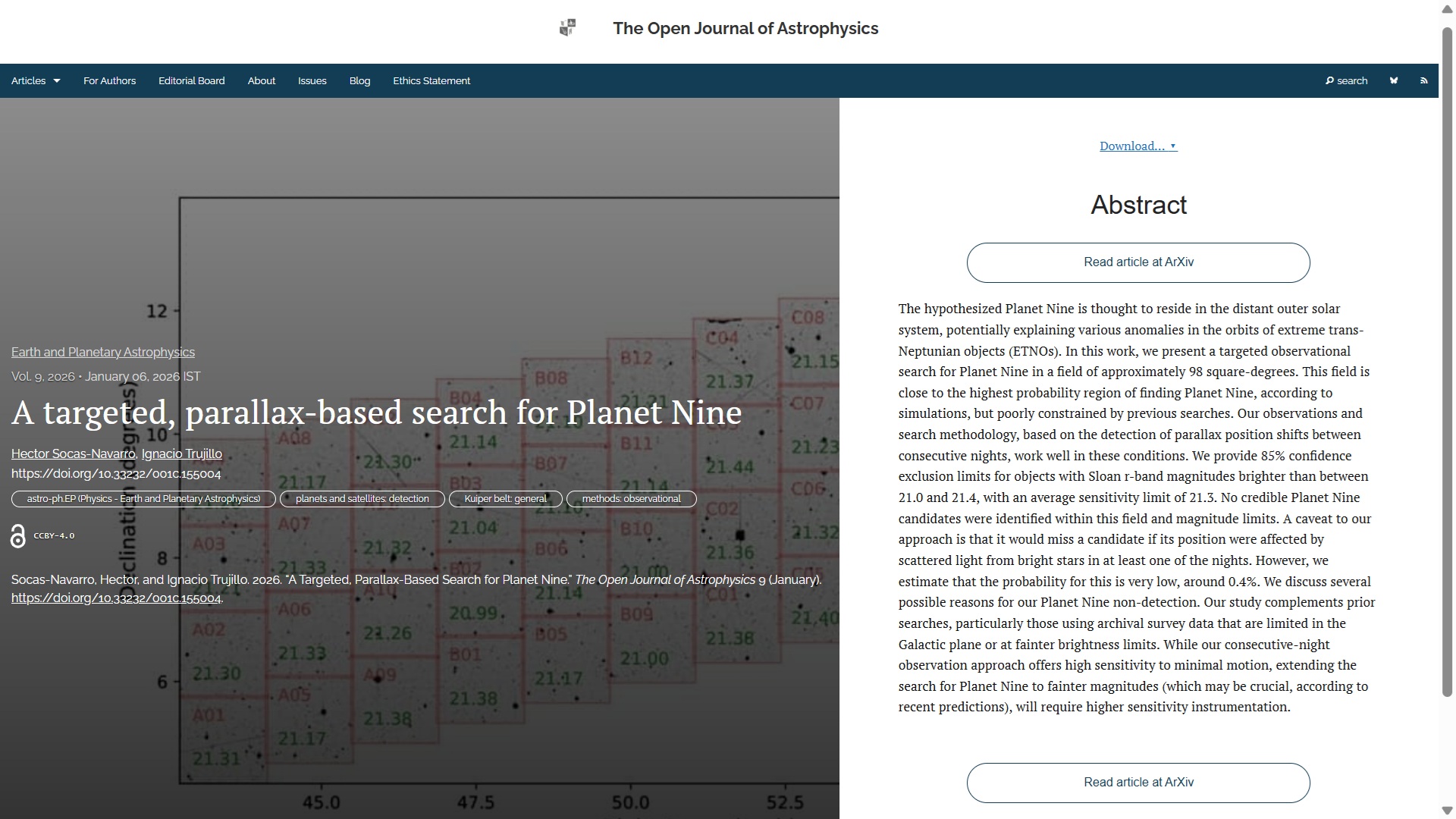
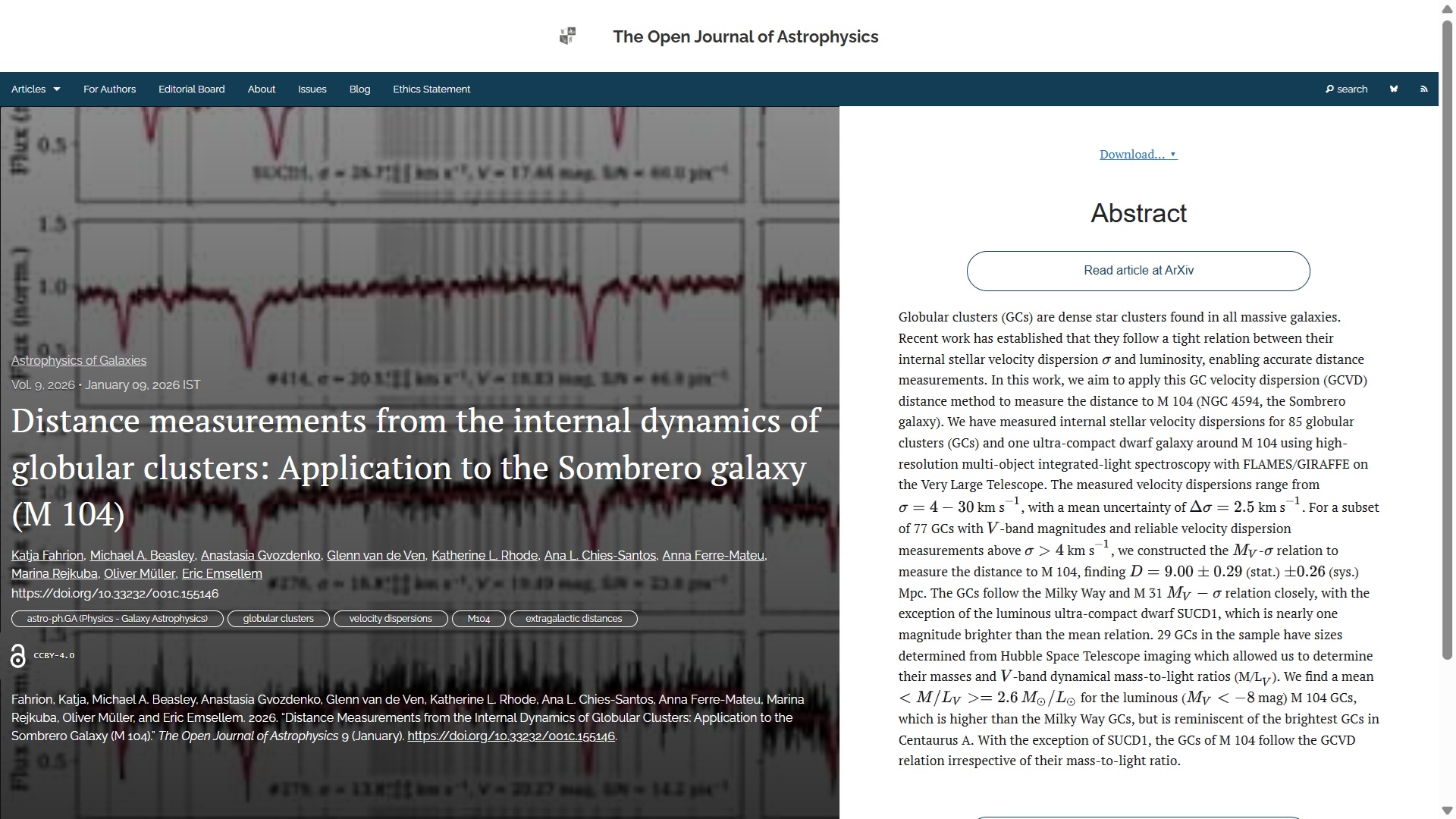
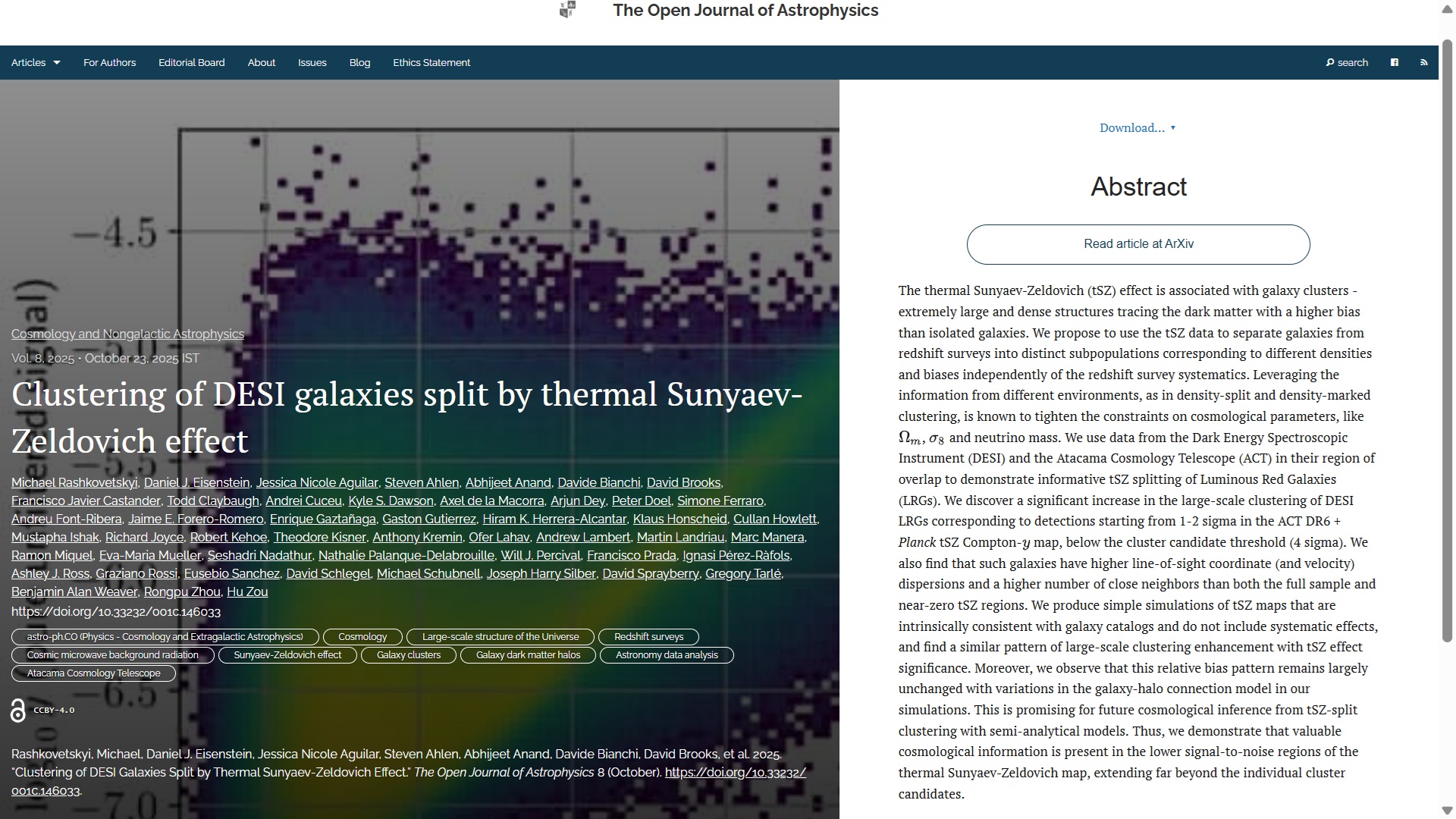
The fifth and final paper for this week is “Clustering of DESI galaxies split by thermal Sunyaev-Zeldovich effect” by Michael Rashkovetskyi of the Harvard-Smithsonian Center for Astrophysics, or CfA for short, and 48 others. This one was published on Wednesday 23rd October in the folder Cosmology and NonGalactic Astrophysics. This paper explores how the clustering properties of galaxies mapped by the Dark energy Spectroscopic Instrument (DESI) relate to the local thermal Sunyaev-Zeldovich emission mapped by the Atacama Cosmology Telescope (ACT). The overlay is here:

The officially accepted version can be found on arXiv here, and the fediverse announcement is here:

Open Journal of Astrophysics

New Publication at the Open Journal of Astrophysics: "Clustering of DESI galaxies split by thermal Sunyaev-Zeldovich effect" by Michael Rashkovetskyi (Cfa Harvard-Smithsonian, USA) et al. (49 authors)

doi.org/10.33232/001c.146033

October 23, 2025, 8:28 am 1 boosts 0 favorites


That concludes the papers for this week. With one week to go and our total at 396, I still think we might reach the 400 total by the end of October.

Weekly Update from the Open Journal of Astrophysics – 18/10/2025

Posted in OJAp Papers, Open Access, The Universe and Stuff with tags , , , , , , , , , , , , , , , , , , , , on October 18, 2025 by telescoper

It’s time once again for the usual Saturday update of the week’s new papers at the Open Journal of Astrophysics. Since the last update we have published four  more papers, which brings the number in Volume 8 (2025) up to 156, and the total so far published by OJAp up to 391.

I’d like to encourage people to follow our feed on the Fediverse via Mastodon (where I announce papers as they are published, including the all-important DOI) so this week I’ll include links to each announcement there.

The first paper to report is “Shot noise in clustering power spectra” by Nicolas Tessore (University College London, UK) and Alex Hall (University of Edinburgh, UK). This was published in the folder Cosmology and NonGalactic Astrophysics on Tuesday October 14th 2025. This presents a discussion of the effects of ‘shot noise’, an additive contribution due to degenerate pairs of points, in angular galaxy clustering power spectra. Here is a screen grab of the overlay:

You can find the officially accepted version of the paper here. The Mastodon announcement is here:

Open Journal of Astrophysics

New Publication at the Open Journal of Astrophysics: "Shot noise in clustering power spectra" by Nicolas Tessore (University College London, UK) and Alex Hall (University of Edinburgh, UK)

doi.org/10.33232/001c.145919

October 14, 2025, 7:07 am 2 boosts 0 favorites

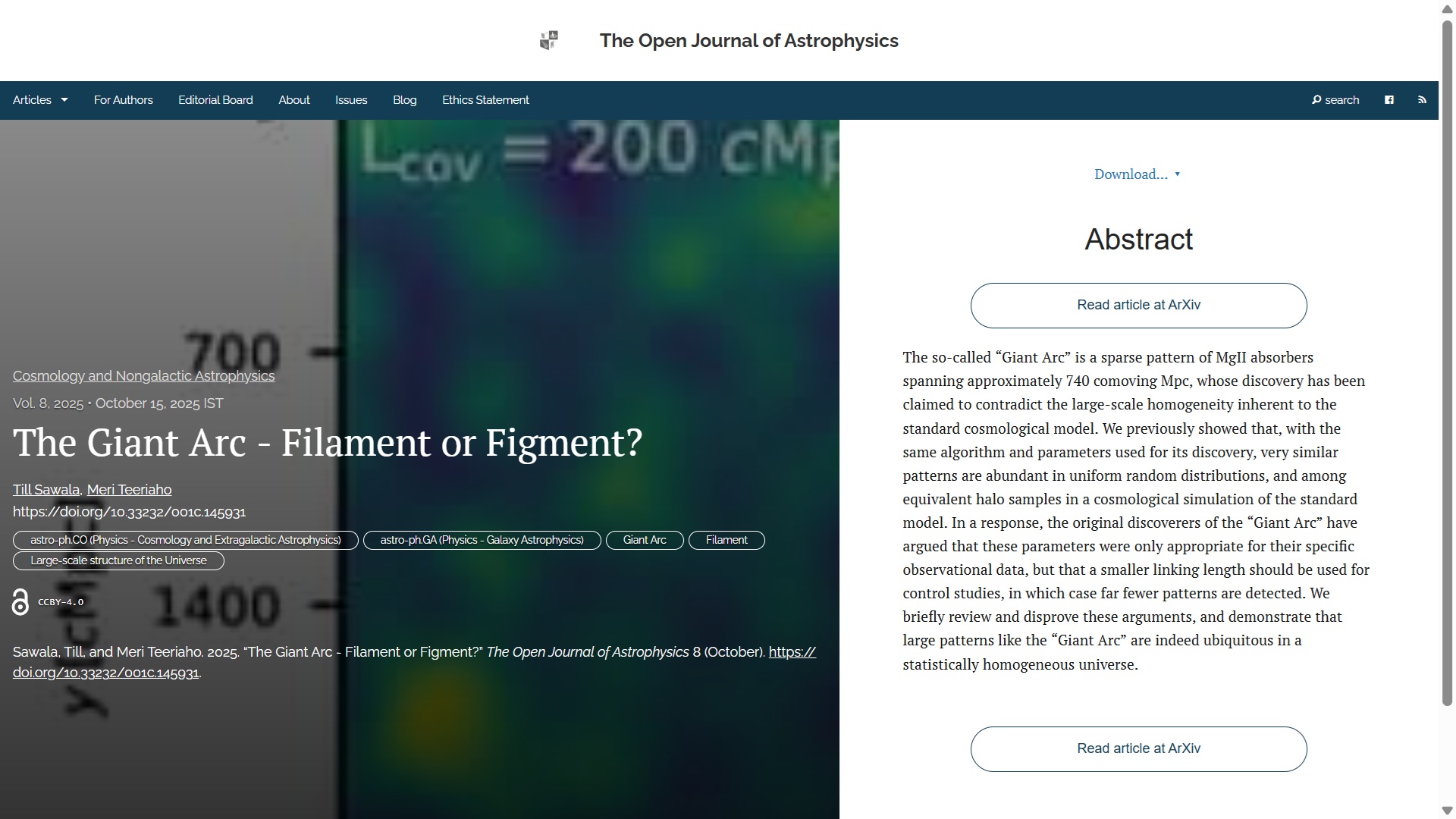
Next one up is “The Giant Arc – Filament or Figment?” by Till Sawala and Meri Teeriaho (University of Helsinki, Finland). This paper discusses the abundance of large arc-like structures formed in the standard cosmological model, with reference to the “Giant Arc” identified in MgII absorption systems. It was published on Wednesday October 15th in the folder Cosmology and NonGalactic Astrophysics. The overlay is here:

The officially accepted version of this paper can be found on the arXiv here and the Mastodon announcement is here:

Open Journal of Astrophysics

New Publication at the Open Journal of Astrophysics: "The Giant Arc – Filament or Figment?" by Till Sawala and Meri Teeriaho (University of Helsinki, Finland)

doi.org/10.33232/001c.145931

October 15, 2025, 6:33 am 2 boosts 3 favorites


The third paper this week,  published on Monday 6th October, is “Detecting wide binaries using machine learning algorithms” by Amoy Ashesh, Harsimran Kaur and Sandeep Aashish (Indian Institute of Technology, Patna, India). This was published on Friday 17th October (yesterday) in the folder Astrophysics of Galaxies. It presents a method for detecting wide binary systems in Gaia data using machine learning algorithms.

The overlay is here:


You can find the officially accepted version of this paper on arXiv here. The announcement on Mastodon is here:

Open Journal of Astrophysics

New Publication at the Open Journal of Astrophysics: "Detecting wide binaries using machine learning algorithms" by Amoy Ashesh, Harsimran Kaur and Sandeep Aashish (Indian Institute of Technology, Patna, India)

doi.org/10.33232/001c.146027

October 17, 2025, 6:55 am 0 boosts 0 favorites

The last one this week is “Learned harmonic mean estimation of the Bayesian evidence with normalizing flows” by Alicja Polanska & Matthew A. Price (University College London, UK), Davide Piras (Université de Genève, CH), Alessio Spurio Mancini (Royal Holloway, London, UK) and Jason D. McEwen (University College London). This one was also published on Friday 17th October, but in the folder Instrumentation and Methods for Astrophysics; it presents a new method for estimating Bayesian evidence for use in model comparison, illustrated with a cosmological example.

The corresponding overlay is here:


You can find the officially accepted version on arXiv here. The Mastodon announcement is here:

Open Journal of Astrophysics

New Publication at the Open Journal of Astrophysics: "Learned harmonic mean estimation of the Bayesian evidence with normalizing flows" by Alicja Polanska & Matthew A. Price (University College London, UK), Davide Piras (Université de Genève, CH), Alessio Spurio Mancini (Royal Holloway, London, UK) and Jason D. McEwen (University College London)

doi.org/10.33232/001c.146026

October 17, 2025, 7:06 am 0 boosts 0 favorites

That concludes the papers for this week. With two weeks to go I think we might reach the 400 total by the end of October.

Weekly update from the Open Journal of Astrophysics – 29/03/25

Posted in OJAp Papers, Open Access, The Universe and Stuff with tags , , , , , , , , , , , on March 29, 2025 by telescoper

It’s time once more for the regular Saturday morning update of papers published at the Open Journal of Astrophysics. Since the last update we have published three new papers which brings the number in Volume 8 (2025) up to 32 and the total so far published by OJAp up to 267.

We’re almost at the end of March so I checked the records. In the first three months of last year we published 22 papers, compared to the 32 so far this year.

We were affected by a few gremlins in the works at Crossref this week which delayed some submissions. Since our DOIs are generated and registered with Crossref at the time of publication this delayed some papers a little.  I think these problems are ongoing but I know that the team at Crossref are working on them so expect will be fixed soon.

Anyway, in chronological order of publication, the three papers published this week, with their overlays, are as follows. You can click on the images of the overlays to make them larger should you wish to do so.

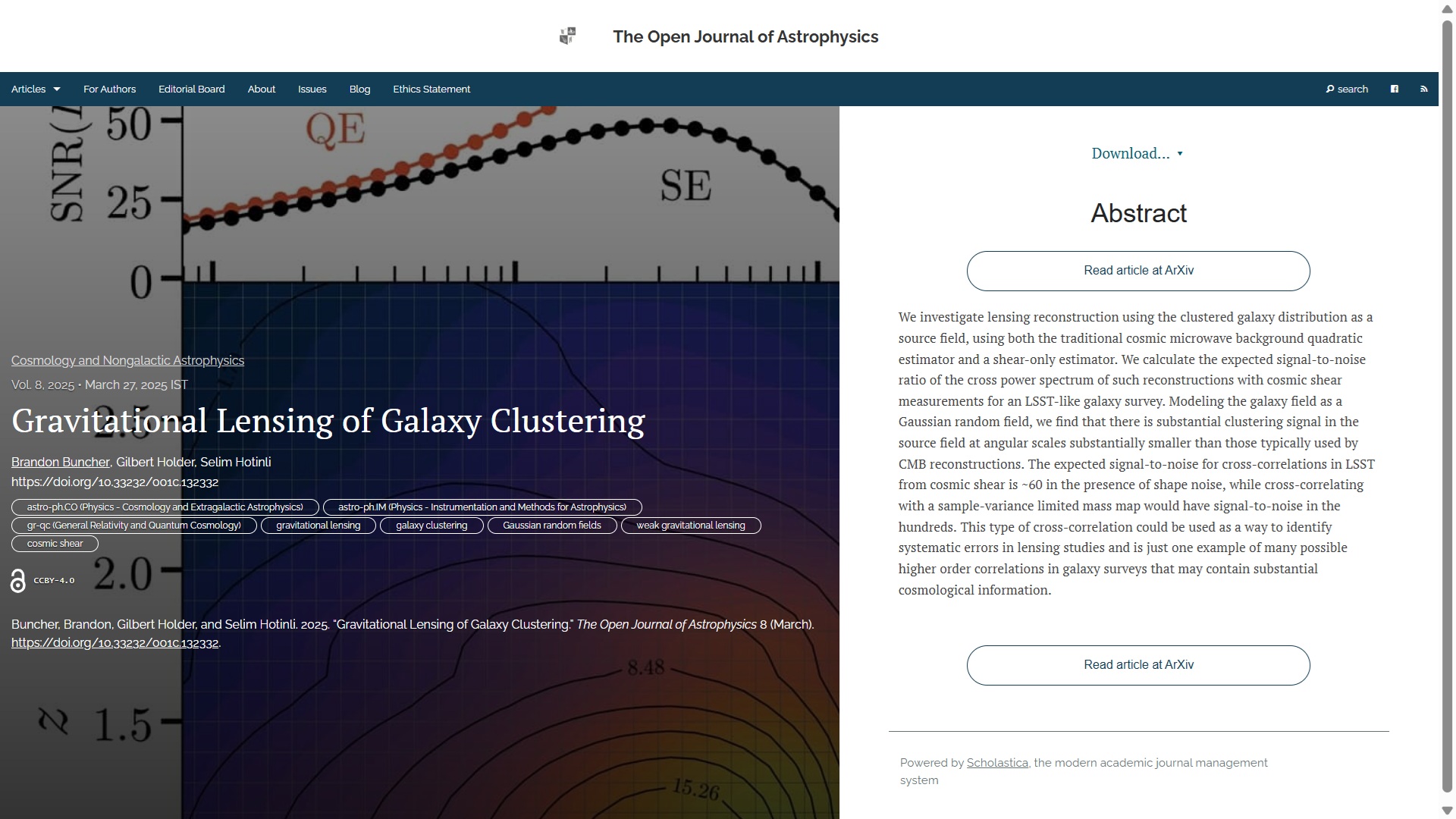
The first paper to report is “Gravitational Lensing of Galaxy Clustering” by Brandon Buncher & Gilbert Holder (University of Illinois Urbana Champaign) and Selim Hotinli (Perimeter Institute, Canada). This paper is in the folder marked Cosmology and NonGalactic Astrophysics and it was published on Thursday 27th March 2025. it presents a study of the cross-correlations between lensing reconstruction using galaxies as sources with cosmic shear measurements.

Here is the overlay:


You can read the officially accepted version of this paper on arXiv here.

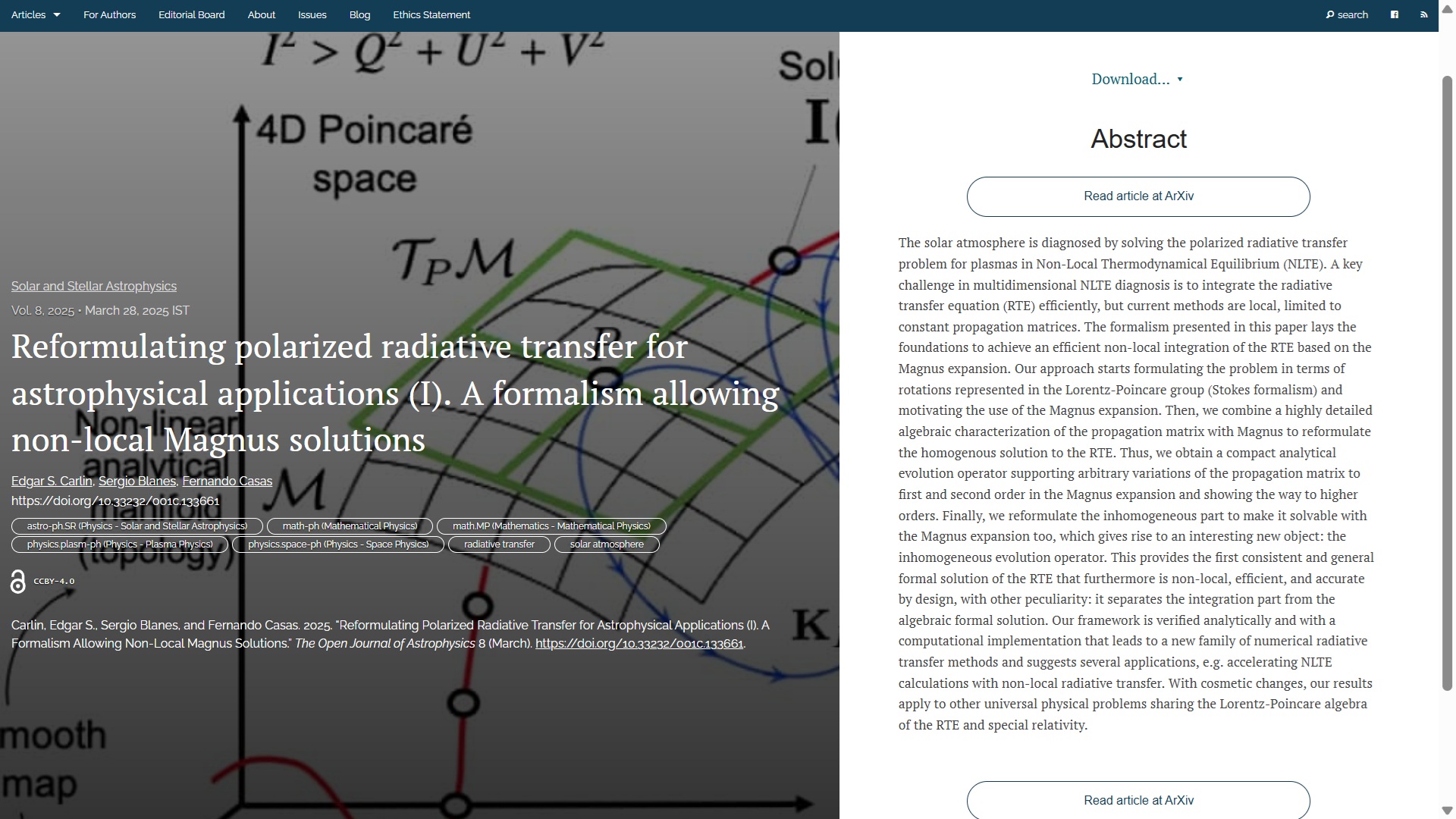
The second paper of the week is “Reformulating polarized radiative transfer for astrophysical applications. (I) A formalism allowing non-local Magnus solutions” by Edgar S. Carlin (Instituto de Astrofísica de Canarias), Sergio Blanes (Universitat Politcècnica de Valencia) & Fernando Casas (Universitat Jaume I), all in Spain.

It appears in the folder Solar and Stellar Astrophysics. It presents a new family of numerical radiative transfer methods and their potential applications such as accelerating calculations involving Non-Local Thermodynamic Equilibrium. This paper was published on Friday 28th March 2025.

Here is the overlay:


You can find the officially accepted version of this paper on arXiv here.

The final paper, also published on Friday 28th March, is in the folder
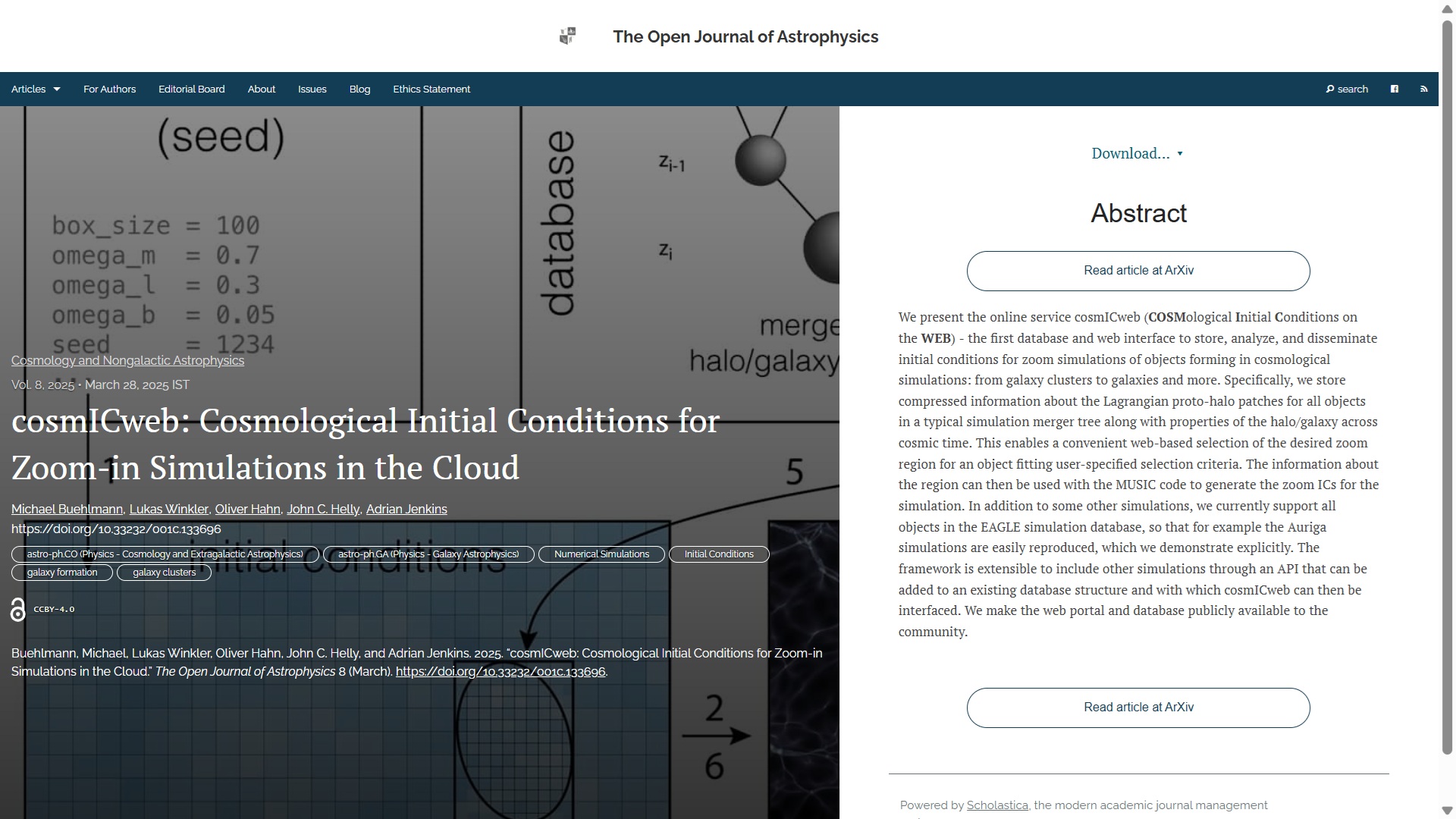
Cosmology and NonGalactic Astrophysics. The title is “CosmICweb: Cosmological Initial Conditions for Zoom-in Simulations in the Cloud” and the authors are Michael Buehlmann (Argonne National Laboratory), Lukas Winkler (U. Wien), Oliver Hahn (U. Wien), John C. Helly (ICC Durham) and Adrian Jenkins (ICC Durham).

This paper describes a new database and web interface to store, analyze, and disseminate initial conditions for zoom simulations of objects forming in cosmological simulations. The database can be accessed directly here.

Here is the overlay:


The official published version can be found on the arXiv here.

That’s all for this week. I’ll do another update next Saturday.

Three New Publications at the Open Journal of Astrophysics

Posted in OJAp Papers, Open Access, The Universe and Stuff with tags , , , , , , , , on May 25, 2024 by telescoper

After a very busy and unusual week, it’s time to get back to normal with the usual  Saturday roundup of business at the  Open Journal of Astrophysics. If you want to know how many papers we have published so far this year (Vol. 7), the answer is 42. The total published by OJAp is now 157. We’re still on track to publish around 100 papers this year, possibly more, compared to last year’s 50.

All the members of this week’s trio are in the folder marked Cosmology and Nongalactic Astrophysics, and indeed all three relate in one way or another to the topic of weak gravitational lensing.  All three were published on Wednesday 22nd May 2024.

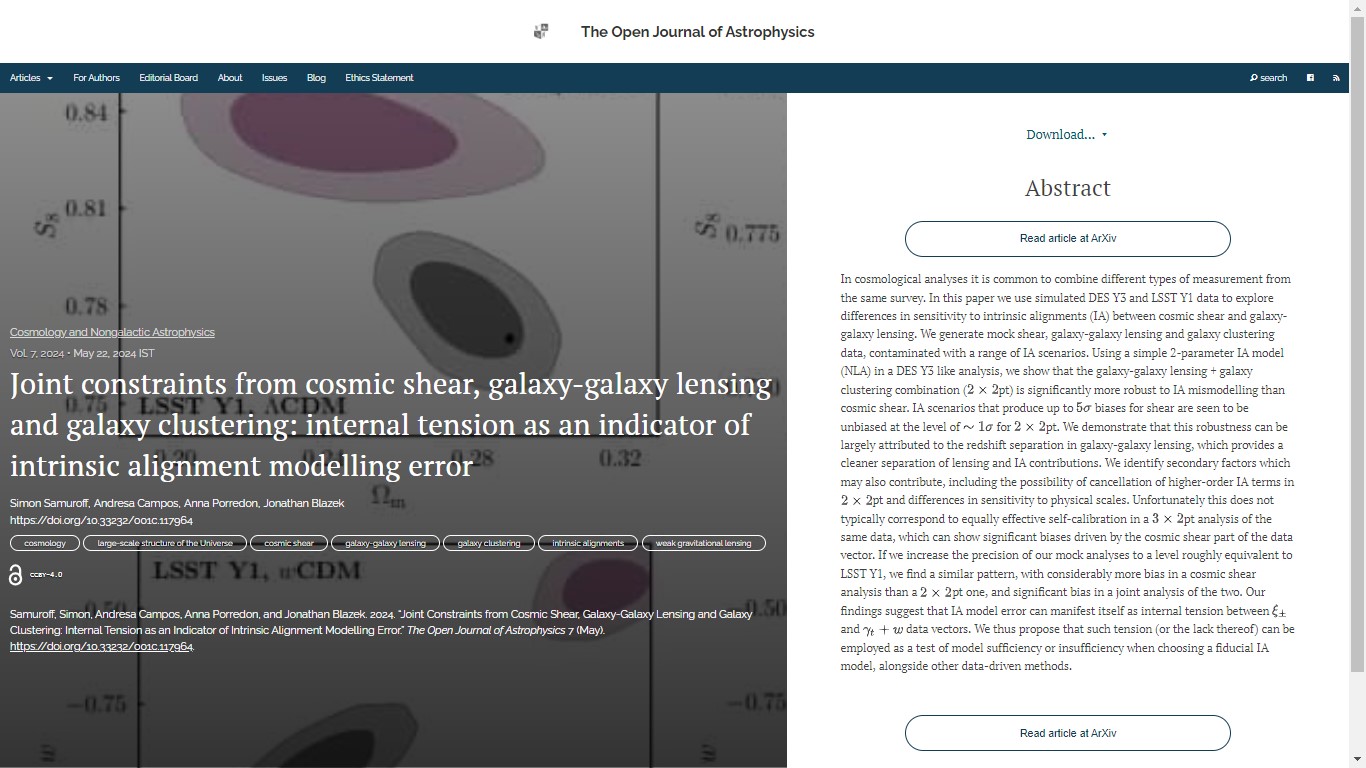
First one up is “Joint constraints from cosmic shear, galaxy-galaxy lensing and galaxy clustering: internal tension as an indicator of intrinsic alignment modelling error” which is by Simon Samuroff (Northeastern U., USA), Andresa Campos (Carnegie Mellon U., USA), Anna Porredon (Bochum, Germany) and Jonathan Blazek (Edinburgh, UK).   A combined statistical approach to the identification of errors arising in cosmic shear analysis due to intrinsic alignments.

Here is a screen grab of the overlay, which includes the abstract:

You can read the paper directly on arXiv here.

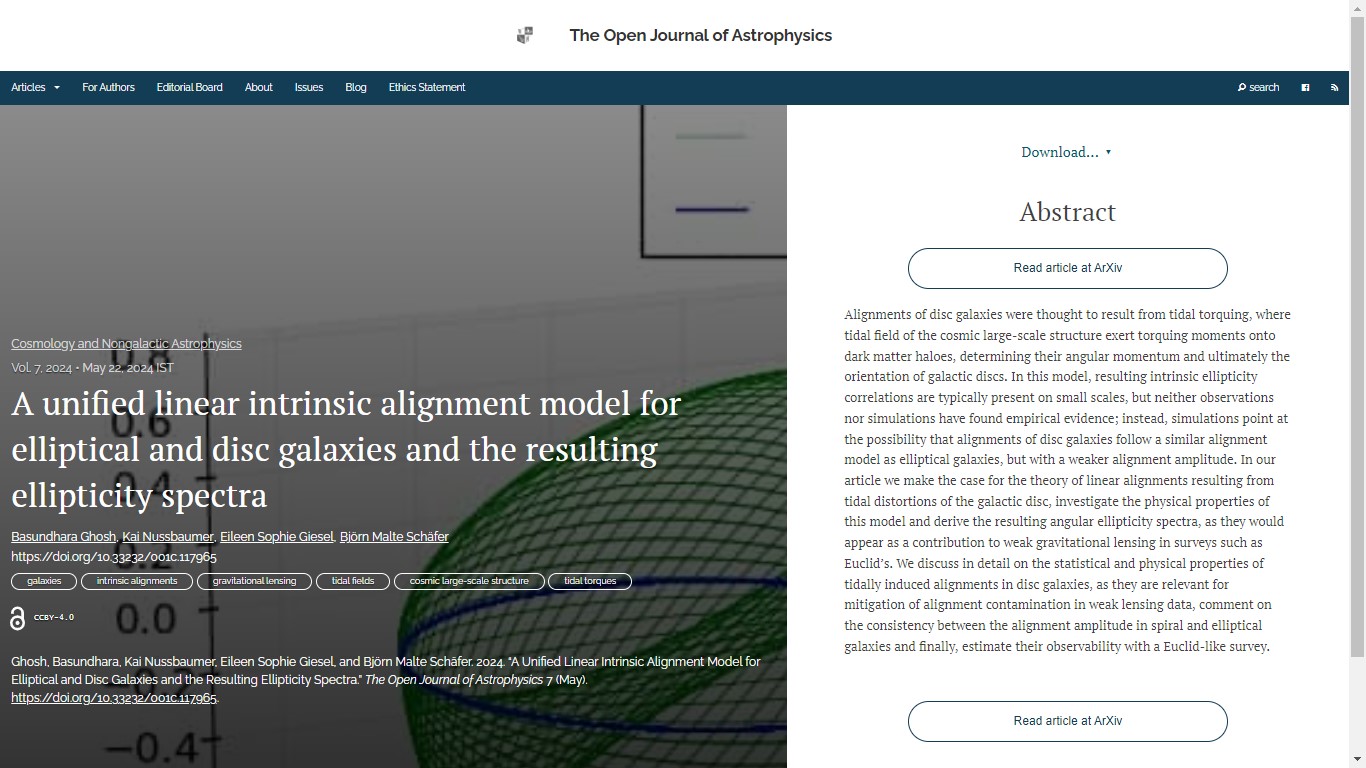
The second paper to present is “A unified linear intrinsic alignment model for elliptical and disc galaxies and the resulting ellipticity spectra” by Basundhara Ghosh (Bangalore, India), with Kai Nussbaumer, Eileen Sophie Giesel & Björn Malte Schäfer (Heidelberg, Germany). It presents a discussion of the physical origin of intrinsic alignments of both elliptical and disk galaxies and the implications for cosmological studies

The overlay looks like this:


You can read this paper directly on the arXiv here.

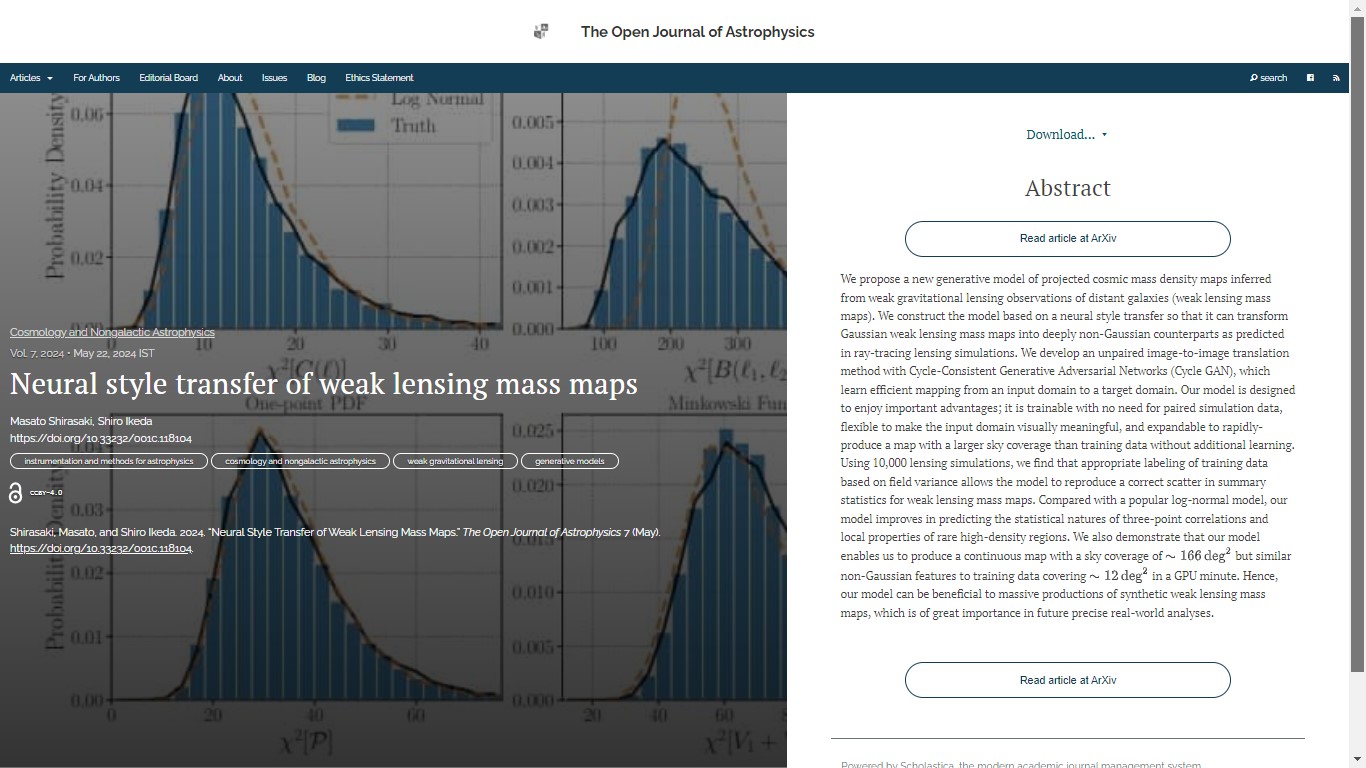
The last paper of this batch is entitled “Neural style transfer of weak lensing mass maps”  and proposes a generative model for the mass-production of weak-lensing maps. The authors are Masato Shirasaki and Shiro Ikeda (both of the University of Tokyo, Japan)

Here is a screengrab of the overlay:


To read the accepted version of this on the arXiv please go here.
That’s all for now. I will do another update next week.


Two New Publications at the Open Journal of Astrophysics

Posted in OJAp Papers, Open Access, The Universe and Stuff with tags , , , , , , , , , , on February 24, 2024 by telescoper

It’s Saturday morning in Sydney, and time to post another update relating to the  Open Journal of Astrophysics.  Since the last update we have published two more papers, taking  the count in Volume 7 (2024) up to 15 and the total published by OJAp up to 130. I should have posted these before leaving but it slipped my mind.

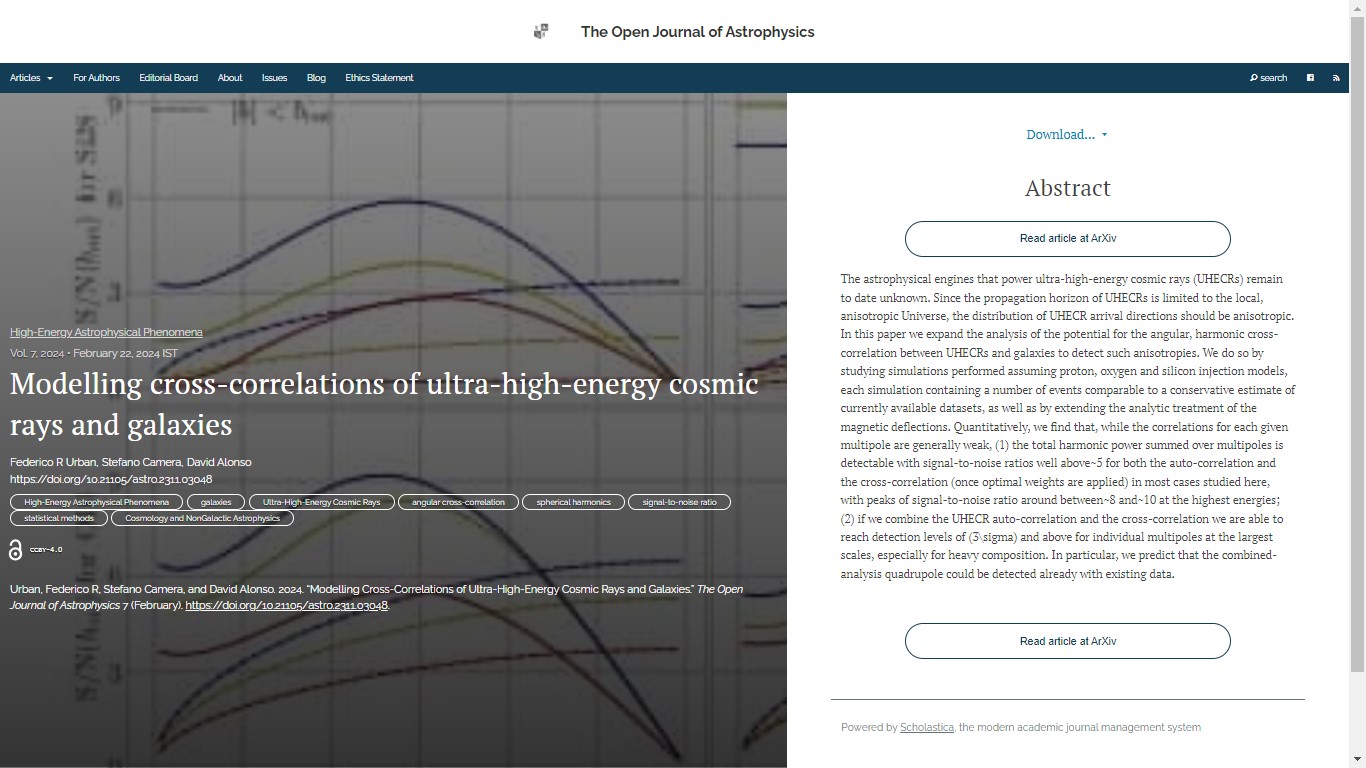
The first paper of the most recent pair – published on  Thursday 22nd February – is “Modelling cross-correlations of ultra-high-energy cosmic rays and galaxies” by Federico Urban (Prague, Czech Republic), Stefano Camera (Torino, Italy) and David Alonso (Oxford, UK). It presents a discussion of the possible statistical correlations between Ultra-High-Energy Cosmic-Ray (UHECR) directions in various models and structure in the galaxy distribution and whether or not this signal could be measurable.  This one is in the folder marked “High-Energy Astrophysical Phenomena“.

Here is a screen grab of the overlay which includes the abstract:

You can click on the image of the overlay to make it larger should you wish to do so. You can find the officially accepted version of the paper on the arXiv here.

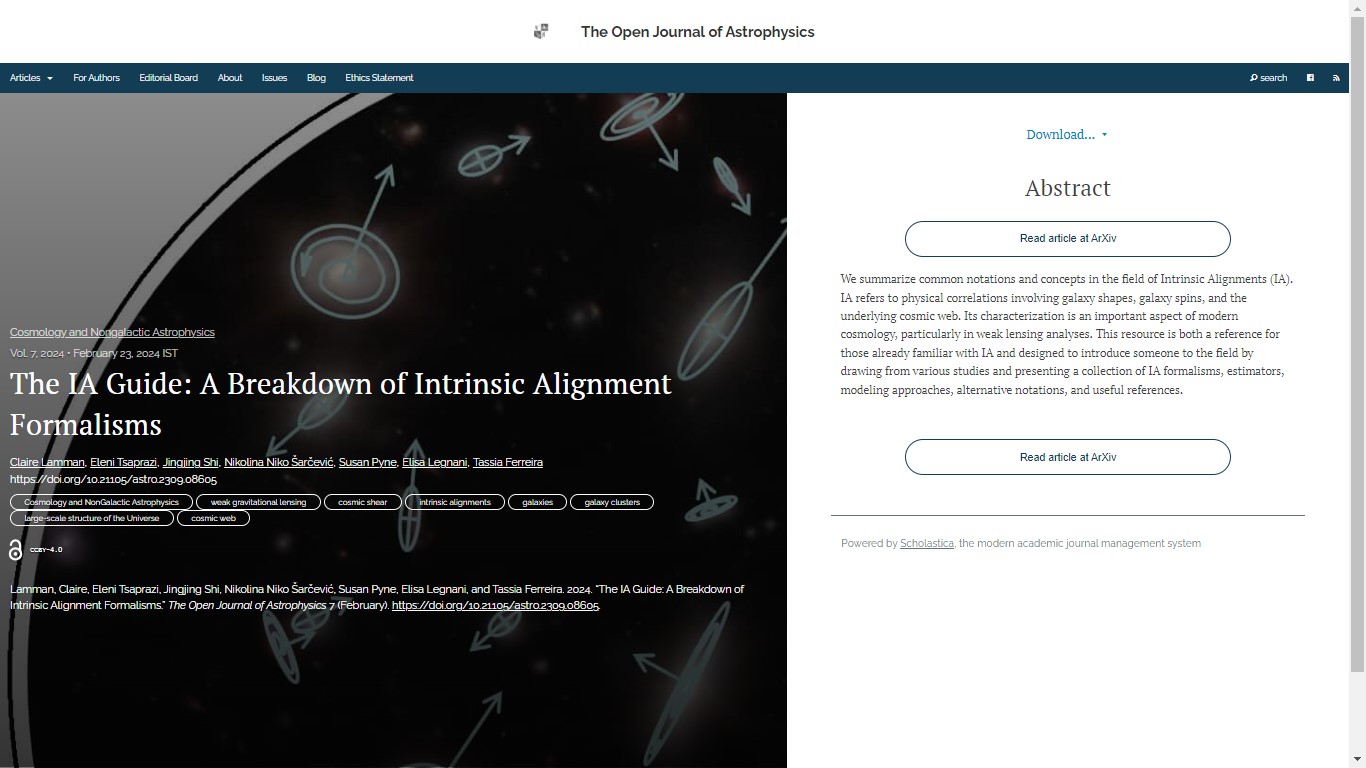
The second paper was published on Friday 23rd February and has the title “The IA Guide: A Breakdown of Intrinsic Alignment Formalisms” and the authors are: Claire Lamman (Harvard, USA);  Eleni Tsaprazi (Stockholm, Sweden);  Jingjing Shi (Tokyo, Japan); Nikolina Niko Šarčević (Newcastle, UK); Susan Pyne (UCL, UK); Elisa Legnani (Barcelona, Spain); and Tassia Ferreira (Oxford, UK). This one, which is in the folder marked Cosmology and NonGalactic Astrophysics, presents a review of Intrinsic Alignments, i.e. physical correlations involving galaxy shapes, galaxy spins, and larger scale structure, especially important for weak gravitational lensing

Here is a screen grab of the overlay which includes the abstract:


You can click on the image of the overlay to make it larger should you wish to do so. You can find the officially accepted version of the paper on the arXiv here.

That concludes this week’s update!

New Publication at the Open Journal of Astrophysics

Posted in OJAp Papers, The Universe and Stuff with tags , , , , , , , on April 25, 2023 by telescoper

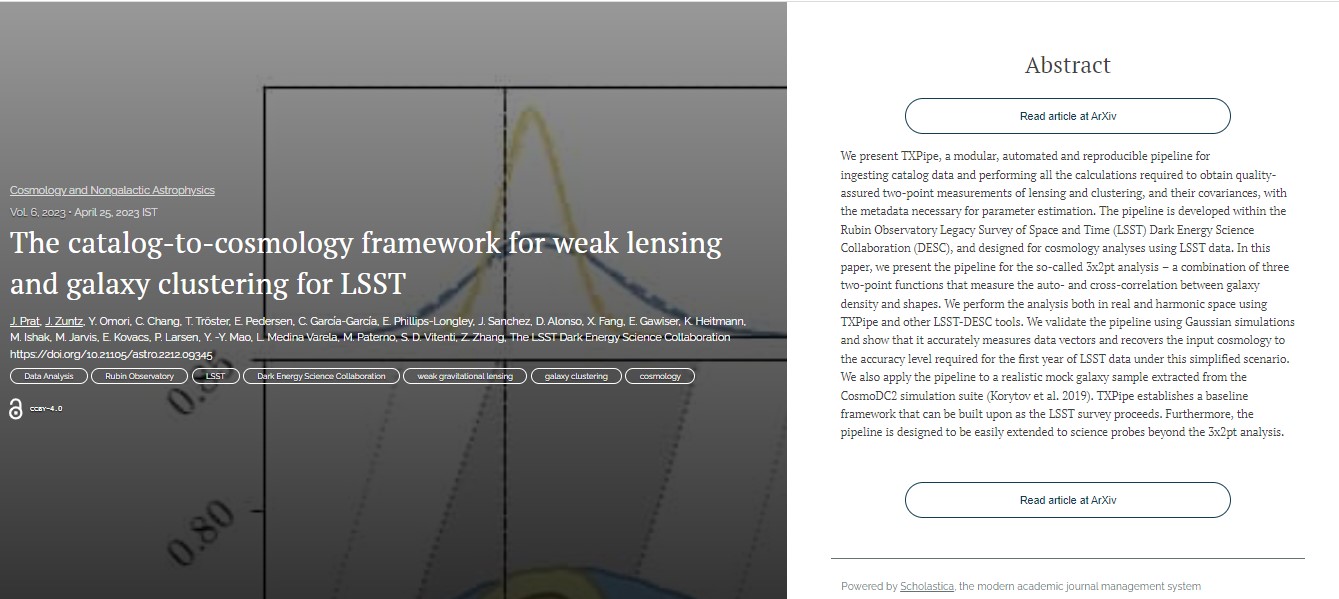
It’s time once more to announce a new paper at the Open Journal of Astrophysics. The latest paper is the 13th paper so far in Volume 6 (2023) and the 78th in all. This one is another for the folder marked Cosmology and NonGalactic Astrophysics and its title is “The catalog-to-cosmology framework for weak lensing and galaxy clustering for LSST”.

The lead author is Judit Prat of the University of Chicago (Illinois, USA) and there are 21 co-authors from elsewhere in the USA and in the UK. The paper is written on behalf of the LSST Dark Energy Science Collaboration (LSST DESC), which is the international science collaboration that will make high accuracy measurements of fundamental cosmological parameters using data from the Rubin Observatory Legacy Survey of Space and Time (LSST). The OJAp has published a number of papers involving LSST DESC, and I’m very happy that such an important consortium has chosen to publish with us.

Here is a screen grab of the overlay which includes the  abstract:

You can click on the image of the overlay to make it larger should you wish to do so. You can find the officially accepted version of the paper on the arXiv here.

New Publication at the Open Journal of Astrophysics

Posted in OJAp Papers, Open Access, The Universe and Stuff with tags , , , , , , , , , on August 24, 2022 by telescoper

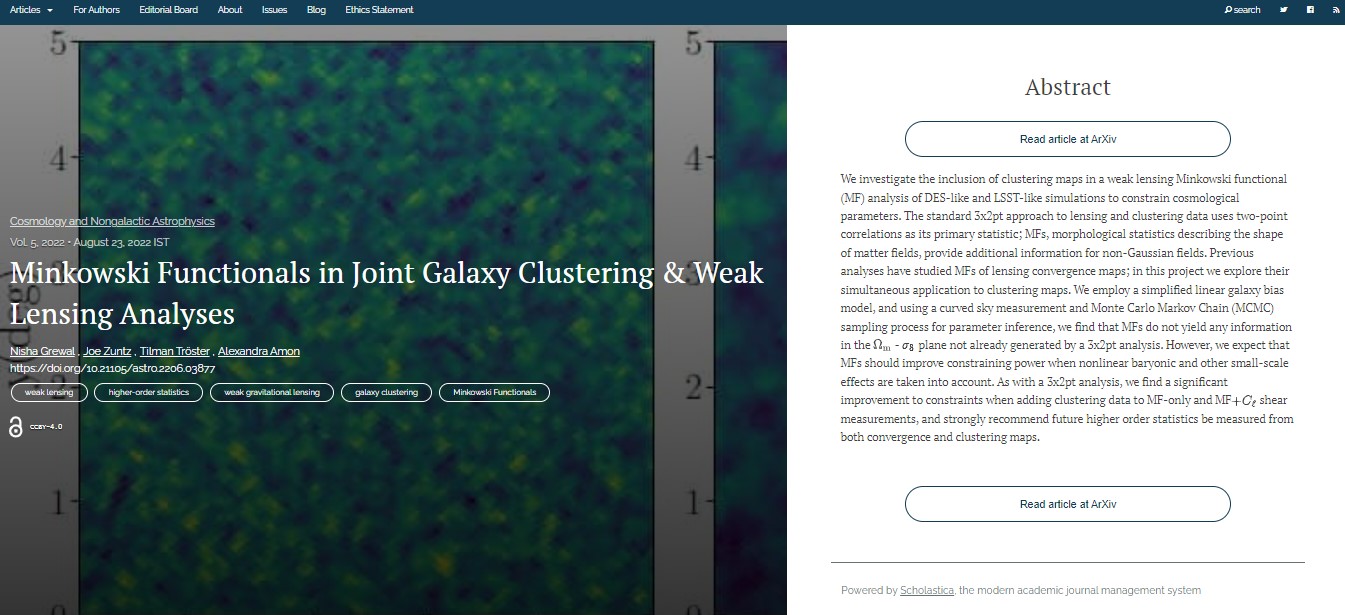
It’s time once again for me to announce another new paper at the Open Journal of Astrophysics. The new paper, published yesterday, is the 12th paper in Volume 5 (2022) and the 60th in all. The latest publication is entitled “Minkowski Functionals in Joint Galaxy Clustering & Weak Lensing Analyses” and the authors are Nisha Grewal, Joe Zuntz and Tilman Tröster of the Institute for Astronomy in Edinburgh and Alexandra Amon of the Institute of Astronomy in Cambridge. The paper is in the folder marked Cosmology and Non-Galactic Astrophysics.

Incidentally, Dr Alexandra Amon is the winner of this year’s Caroline Herschel Lectureship in Astronomy, so congratulations to her for that too!

The new paper is about the application of topological characteristics known as Minkowski Functionals to cosmological data. This approach has been used in the past to study the pattern cosmic microwave background temperature fluctuations; see e.g. here for one of my forays into this way back in 2008. Now there are more high-quality datasets besides the CMB so there are more opportunities to use this elegant approach. Perhaps I should do a blog post about Minkowski Functionals? Somewhat to my surprise I can’t find anything on that topic in my back catalogue here In The Dark

Anyway, here is a screen grab of the overlay which includes the  abstract:


You can click on the image to make it larger should you wish to do so. You can find the accepted version of the paper on the arXiv here.

GAA Clustering

Posted in Bad Statistics, GAA, The Universe and Stuff with tags , , , , , , on July 25, 2022 by telescoper
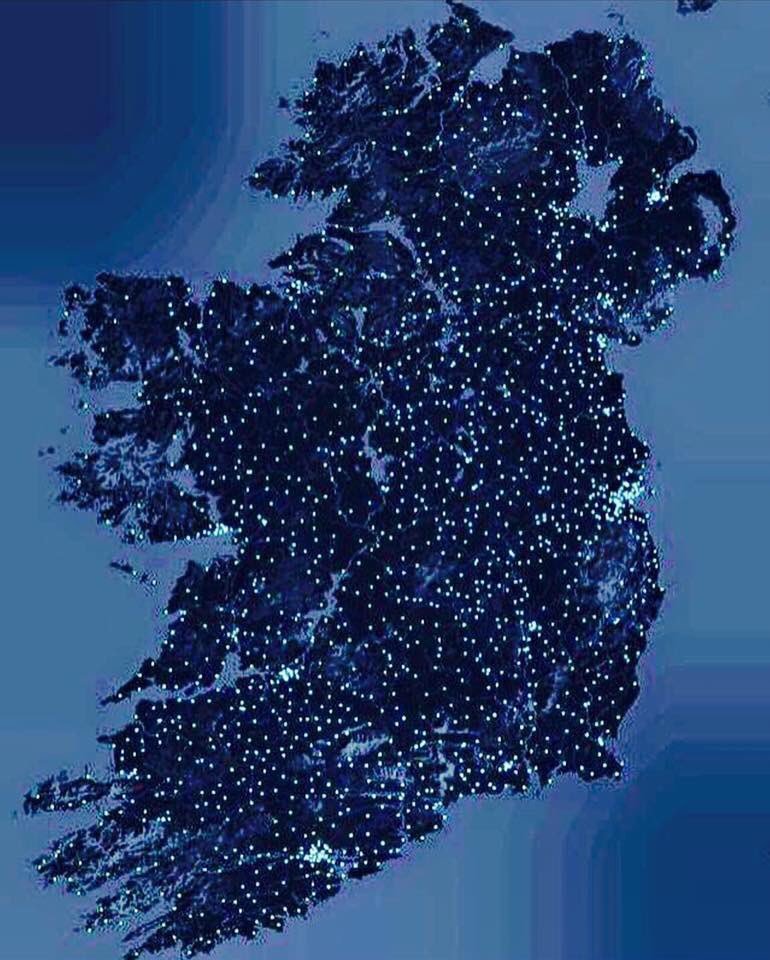
The distribution of GAA pitches in Ireland

The above picture was doing the rounds on Twitter yesterday ahead of this year’s All-Ireland Football Final at Croke Park (won by favourites Kerry despite a valiant effort from Galway, who led for much of the game and didn’t play at all like underdogs).

The picture above shows the distribution of Gaelic Athletics Association (GAA) grounds around Ireland. In case you didn’t know, Hurling and Gaelic Football are played on the same pitch with the same goals and markings on the field. First thing you notice is that the grounds are plentiful! Obviously the distribution is clustered around major population centres – Dublin, Cork, Limerick and Galway are particularly clear – but other than that the distribution is quite uniform, though in less populated areas the grounds tend to be less densely packed.

The eye is also drawn to filamentary features, probably related to major arterial roads. People need to be able to get to the grounds, after all. Or am I reading too much into these apparent structures? The eye is notoriously keen to see patterns where none really exist, a point I’ve made repeatedly on this blog in the context of galaxy clustering.

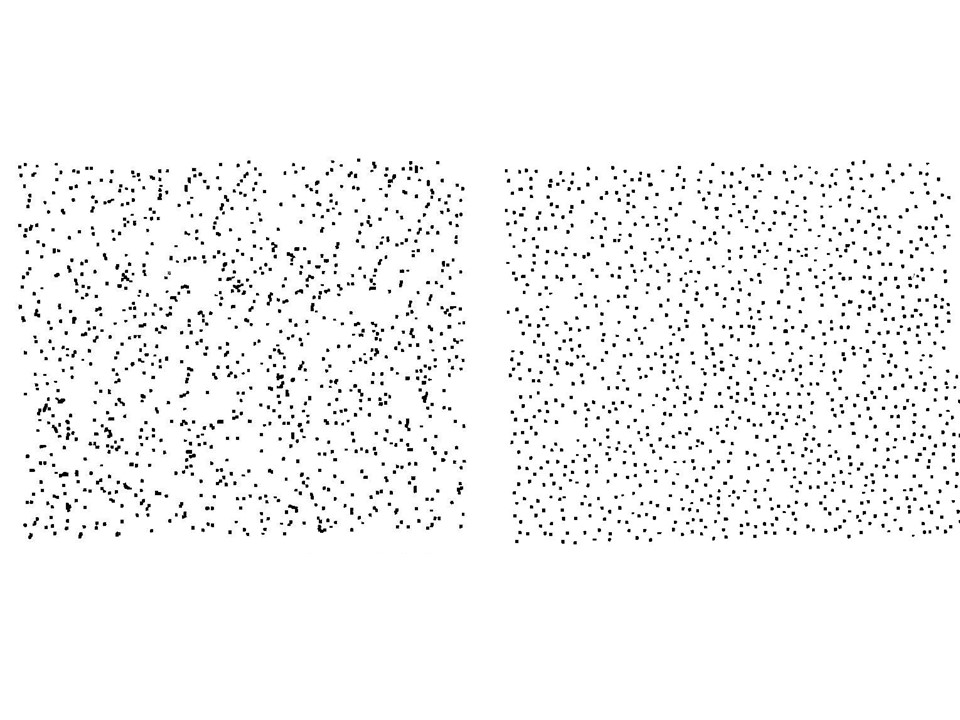
The statistical description of clustered point patterns is a fascinating subject, because it makes contact with the way in which our eyes and brain perceive pattern. I’ve spent a large part of my research career trying to figure out efficient ways of quantifying pattern in an objective way and I can tell you it’s not easy, especially when the data are prone to systematic errors and glitches. I can only touch on the subject here, but to see what I am talking about look at the two patterns below:

You will have to take my word for it that one of these is a realization of a two-dimensional Poisson point process and the other contains correlations between the points. One therefore has a real pattern to it, and one is a realization of a completely unstructured random process.

random or non-random?

I show this example in popular talks and get the audience to vote on which one is the random one. The vast majority usually think that the one on the right that  is random and the one on the left is the one with structure to it. It is not hard to see why. The right-hand pattern is very smooth (what one would naively expect for a constant probability of finding a point at any position in the two-dimensional space) , whereas the left-hand one seems to offer a profusion of linear, filamentary features and densely concentrated clusters.

In fact, it’s the picture on the left that was generated by a Poisson process using a  Monte Carlo random number generator. All the structure that is visually apparent is imposed by our own sensory apparatus, which has evolved to be so good at discerning patterns that it finds them when they’re not even there!

The right-hand process is also generated by a Monte Carlo technique, but the algorithm is more complicated. In this case the presence of a point at some location suppresses the probability of having other points in the vicinity. Each event has a zone of avoidance around it; the points are therefore anticorrelated. The result of this is that the pattern is much smoother than a truly random process should be. In fact, this simulation has nothing to do with galaxy clustering really. The algorithm used to generate it was meant to mimic the behaviour of glow-worms which tend to eat each other if they get  too close. That’s why they spread themselves out in space more uniformly than in the random pattern.

Incidentally, I got both pictures from Stephen Jay Gould’s collection of essays Bully for Brontosaurus and used them, with appropriate credit and copyright permission, in my own book From Cosmos to Chaos.

The tendency to find things that are not there is quite well known to astronomers. The constellations which we all recognize so easily are not physical associations of stars, but are just chance alignments on the sky of things at vastly different distances in space. That is not to say that they are random, but the pattern they form is not caused by direct correlations between the stars. Galaxies form real three-dimensional physical associations through their direct gravitational effect on one another.

People are actually pretty hopeless at understanding what “really” random processes look like, probably because the word random is used so often in very imprecise ways and they don’t know what it means in a specific context like this.  The point about random processes, even simpler ones like repeated tossing of a coin, is that coincidences happen much more frequently than one might suppose.

I suppose there is an evolutionary reason why our brains like to impose order on things in a general way. More specifically scientists often use perceived patterns in order to construct hypotheses. However these hypotheses must be tested objectively and often the initial impressions turn out to be figments of the imagination, like the canals on Mars.

R.I.P. Sir David Cox (1924-2022)

Posted in Biographical, mathematics, The Universe and Stuff with tags , , , , on January 21, 2022 by telescoper

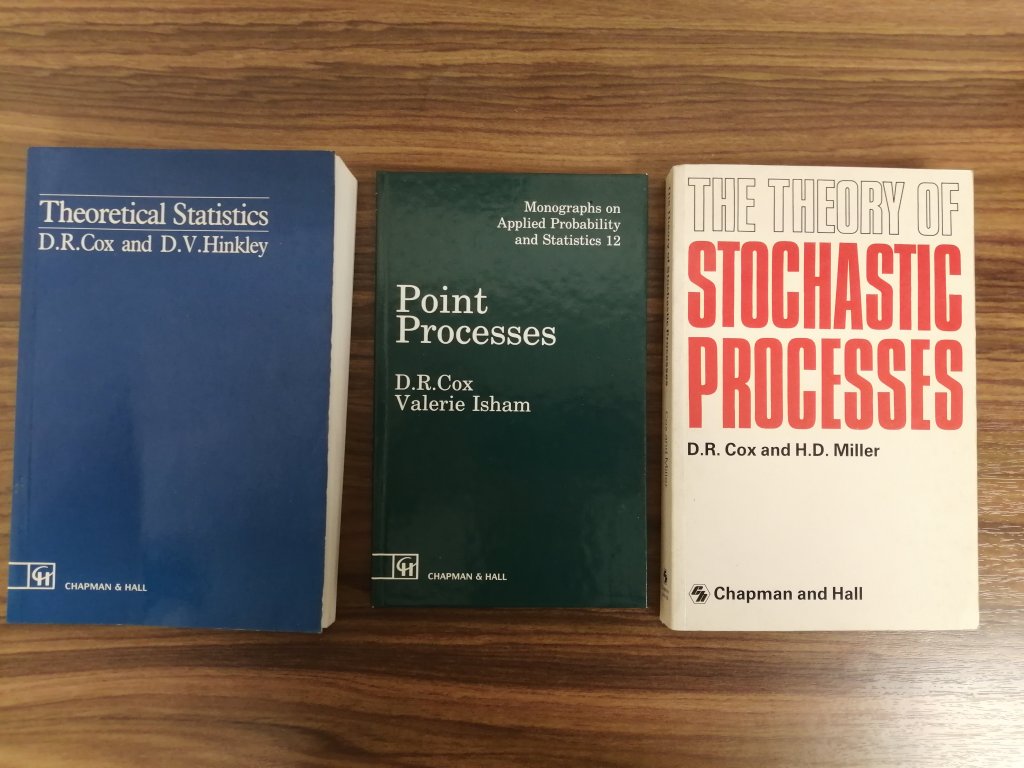
I was saddened to hear a few days ago that the eminent statistician David Cox has passed away at the age of 97. I didn’t know Professor Cox personally – I met him only once, at a joint astronomy-statistics meeting at (I think) the Royal Astronomical Society back in the day – but I learnt a huge amount from books he co-wrote, despite the fact that he was of the frequentist persuasion. Three examples from my bookshelf are shown above.

I started my PhD DPhil in 1985 with virtually no formal study of statistics under my belt so I had to follow a steep learning curve and I was helped enormously by these books. I bought the book on Point Processes so as to understand some of the ideas being applied to galaxy clustering. It’s only a short book but it’s crammed with interesting ideas. Cox & Miller on Stochastic Processes is likewise a classic.

I know I’m not the only person in astrophysics whose career has been influenced by David Cox and I’m sure there are many other disciplines who have benefitted from his knowledge.

Among many other awards, David Cox was elected a Fellow of the Royal Society in 1973 and knighted in 1985.

Rest in peace Sir David Cox (1924-2022)

Cosmology with the Minimal Spanning Tree

Posted in The Universe and Stuff with tags , , , , , , on July 8, 2019 by telescoper

There’s a nice paper on the arXiv (by Naidoo et al) with the abstract:

The code mentioned at the end can be found here.

The appearance of this paper gives me an excuse to mention that I actually wrote a paper (with Russell Pearson) on the use of the Minimal (or Minimum) Spanning Tree (MST) to analyze galaxy clustering way back in 1995.

Here’s how we described the Minimal Spanning Tree in that old paper:

Strictly speaking , we used the Euclidean Minimum Spanning Tree in which the total length of the lines connecting a set of points in a tree is minimized. In general cases a weight can be assigned to each link that is not necessarily defined simply by the length. Here is visual illustration (which I think we drew by hand!)

You can think of the MST as a sort of pre-processing technique which accentuates linear features in a point process that might otherwise get lost in shot noise. Once one has a tree (pruned and/or separated as necessary) one can then extract various statistical properties in order to quantify the pattern present.

Way back in 1995 there were far fewer datasets available to which to apply this method and it didn’t catch on at the time. Now, with  ever-increasing availability of spectroscopic redshift surveys maybe its time has come at last! I look forward to playing with the Python code in due course!