Archive for Neutron Stars

Two New Publications at the Open Journal of Astrophysics

Posted in OJAp Papers, Open Access, The Universe and Stuff with tags , , , , , , , , , , , , on August 31, 2024 by telescoper

I am back in circulation after my little break and, since it’s Saturday, I will resume blogging with another report on activity at the  Open Journal of Astrophysics.  Since the last update we have published two more papers, taking  the count in Volume 7 (2024) up to 71 and the total published by OJAp up to 186.  We’ve still got a few in the pipeline waiting for the final versions to appear on arXiv so I expect we’ll reach the 200 mark fairly soon.

The first paper of the most recent pair, published on August 26th 2024,  is “Impact of lensing of gravitational waves on the observed distribution of neutron star masses”  by Sofia Canevarolo, Loek van Vonderen and Nora Elisa Chisari, all of Utrecht University in the Netherlands. This article presents a discussion of the bias in neutron star mass determinations caused by gravitational lensing of the gravitational waves they produceThe paper is in the folder marked Cosmology and NonGalactic Astrophysics.

Here is a screen grab of the overlay which includes the abstract:


You can click on the image of the overlay to make it larger should you wish to do so. You can find the officially accepted version of the paper on the arXiv here.

The second paper has the title “FORGE’d in FIRE III: The IMF in Quasar Accretion Disks from STARFORGE” and was published (in the early hours of the morning) on 29th August 2024. The authors, all based in the USA, are Philip F. Hopkins (Caltech), Michael Y. Grudic (Carnegie Observatories), Kyle Kremer (Caltech), Stella S. R. Offner (UT Austin), David Guszejnov (UT Austin) and Anna L. Rosen (UCSD). This paper, which is in the folder marked Astrophysics of Galaxies, presents a numerical study of star formation and the initial mass function in quasar accretion disks. The previous two papers in this series have also been published in the OJAp: you can find them here and here; images and movies related to this project can be found here.

Here is a screen grab of the overlay which includes the abstract:


You can click on the image of the overlay to make it larger should you wish to do so. You can find the officially accepted version of the paper on the arXiv here.

That concludes this week’s update. We still have quite a few papers in the pipeline after the summer lull so I expect I’ll have a larger update for you next week!

Four New Publications at the Open Journal of Astrophysics

Posted in OJAp Papers, Open Access, The Universe and Stuff with tags , , , , , , on July 20, 2024 by telescoper

This week we have published four papers at the Open Journal of Astrophysics, which I now present to you here. These four take the count in Volume 7 (2024) up to 60 and the total published altogether by OJAp up to 175. It is gratifying to see the range of high-quality papers published steadily increasing. We are getting several papers submitted every day now.

In chronological order, the four papers published this week, with their overlays, are as follows. You can click on the images of the overlays to make them larger should you wish to do so.

First one up is: “A population of neutron star candidates in wide orbits from Gaia astrometry” by Kareem El-Badry (Caltech, USA) and 12 others based across the world.  The paper presents  a spectroscopic study of neutron star candidates identified using GAIA astrometry to be in wide binary orbits around main sequence stars,  was published on 15th July 2024 and is in the folder marked Solar and Stellar Astrophysics. For more information about this one, see here.

Here is a screen grab of the overlay, which includes the abstract:


You can find the officially accepted version of the paper on the arXiv here.

The second paper to announce is “Systematic Effects in Galaxy-Galaxy Lensing with DESI” and was written by Johannes Ulf Lange (University of Michigan, Ann Arbor, USA) and 58 others, again distributed internationally.  This one reports a study of systematic effects (such as incompleteness and intrinsic alignment) on galaxy-galaxy lensing results from the Dark Energy Spectroscopic Instrument (DESI) survey. This one is in the folder called Cosmology and NonGalactic Astrophysics and was published on 16th July 2024.

You can see the overlay here:


The accepted version of this paper can be found on the arXiv here.

The next paper is also in the folder called Cosmology and NonGalactic Astrophysics.  It is entitled “Unleashing cosmic shear information with the tomographic weak lensing PDF” and is by by Lina Castiblanco (Newcastle Univresity, UK), Cora Uhlemann (Bielefeld University, Germany), Joachim Harnois-Déraps (Newcastle University, UK) and Alexandre Barthelemy (Ludwig-Maximilians-Universität, Germany). This one was published on 17th July 2024.

Here is the overlay:


You can find the full text for this one on the arXiv here.

Last but by no means least, published on 18th July 2024, we have a paper  entitled “When to interfere with dark matter? The impact of wave dynamics on statistics“. The primary classification for this one is again Cosmology and Nongalactic Astrophysics and it discusses the imprint of wave-mechanical behaviour, perhaps associated with ultra-light scalar field dark matter on the statistical properties of large-scale structure. The authors are Alex Gough (Newcastle University, UK) and Cora Uhlemann (Bielefeld University, Germany; who also featured in the author list of the previous paper). This is a paper close to my own interests, but because I know both authors well and was the PhD examiner of the first author I thought it best to recuse myself from an editorial role on this one.


You can click on the image of the overlay to make it larger should you wish to do so. You can find the officially accepted version of the paper on the arXiv here.

It did look likely at one stage that we might publish a paper every day last week, but the final version of one other paper didn’t make it onto arXiv in time to be announced on Friday so I will publish that one on Monday.

Sun-like Stars with Hidden Companions

Posted in OJAp Papers, Open Access, The Universe and Stuff with tags , , , , , , on July 16, 2024 by telescoper

I usually only do updates at weekends about papers published in the Open Journal of Astrophysics but I’m making an exception today because a paper we published yesterday is making some waves that I think are worth propagating. The paper is called “A population of neutron star candidates in wide orbits from Gaia astrometry” and the first author is Kareem El-Badry of Caltech (USA); his institution have put out a press release to go with the paper which you an read for more details. They key point is that these are main sequence stars with (probably) neutron star companions and nobody really knows how such systems formed. The paper is also yet another illustration of the amazingly rich source of discovery data that is the European Space Agency’s Gaia mission.

The press release also contains some snazzy graphics, such as this:

The press release explains

The new study, which includes a team of co-authors from around the world, was published in The Open Journal for Astrophysics. Data from several ground-based telescopes, including the W. M. Keck Observatory on Maunakea, Hawai‘i; La Silla Observatory in Chile; and the Whipple Observatory in Arizona, were used to follow up the Gaia observations and learn more about the masses and orbits of the hidden neutron stars.

It is very gratifying to see one of our papers gaining such traction. It also exemplifies something that has struck me recently. Obviously, when we started the Open Journal of Astrophysics I really had no idea how it would go, but one thing that has surprised me (in a pleasant way) is how many articles we are getting from authors based in high-profile US institutions, such as Caltech, Harvard, Princeton and Berkeley (among others). I always assumed that such institutions were rich enough not to be worried by the cost of Article Processing Charges and, being based in America, the authors would in any case be used to paying page charges for the Astrophysical Journal which has been standard practice for ages. Whatever the reason, it sends a great message to the community to see these leading institutions going via the Diamond Open Access route. I hope this provides even more evidence to persuade even more authors that OJAp is a serious journal!

Three New Publications at the Open Journal of Astrophysics

Posted in OJAp Papers, Open Access, The Universe and Stuff with tags , , , , , , , , , on May 18, 2024 by telescoper

It’s time once more for the usual  Saturday roundup of business at the  Open Journal of Astrophysics. The latest batch of publications consists of three papers, taking the count in Volume 7 (2024) up to 39 and the total published by OJAp up to 154. We’re still on track to publish around 100 papers this year, compared to last year’s 50.

All three of this week’s papers involve use of data from the European Space Agency’s Gaia mission, which is proving an immensely rich resource for astrophysics.

First one up is “Asymmetric Drift Map of the Milky Way Disk Populations between 8 -16 kpc with LAMOST and Gaia datasets” which is by  Xin Li (Nanchong, China), Peng Yang (Chengdu, China) , Hai-Feng Wang (Nanchong, China), Qing Li (Jiangmen, China), Yang-Ping Luo (Nanchong, China), Zhi-Quan Luo (Nanchong, China), Guan-Yu Wang (Nanchong, China). This is a study  of the asymmetric drift, the difference of the local circular speed and the mean rotational speed of the stellar population, for various stellar populations in the Milky Way. It is in the folder marked Astrophysics of Galaxies and was published on Tuesday 14th May 2024.

Here is a screen grab of the overlay, which includes the abstract:


You can read the paper directly on arXiv here.

The second paper to announce is “On the formation of a 33 solar-mass black hole in a low-metallicity binary” by Kareem El-Badry (Caltech, USA). It discusses theoretical models for the formation of a black hole in a particular binary system discovered in Gaia data.

This one is in the folder Solar and Stellar Astrophysics and was published on 16th May 2024. The overlay looks like this:


You can read this paper directly on the arXiv here.

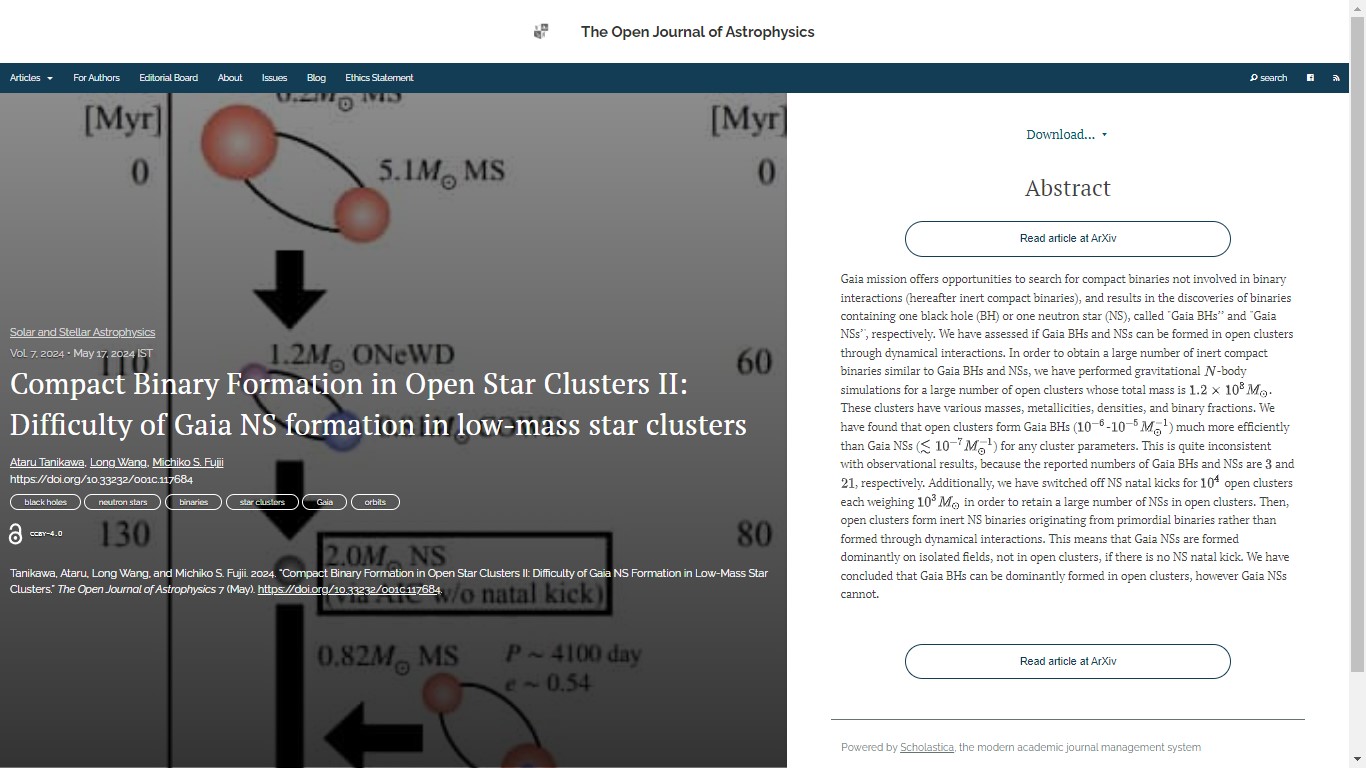
The last paper of this batch, also in the in the folder Solar and Stellar Astrophysics, is entitled “Compact Binary Formation in Open Star Clusters II: Difficulty of Gaia NS formation in low-mass star clusters”  and it presents a discussion of the formation of binary neutron stars and black holes found in Gaia data based on their orbital properties. It was published on Friday May 17th 2024 (i.e. yesterday). The authors are Ataru Tanikawa (Fukui University, Japan), Long Wang (Sun-yat Sen University, China) and  Michiko S. Fujii (Tokyo University, Japan).

Here is a screengrab of the overlay:


To read the accepted version of this on the arXiv please go here.
That’s all for now. Another update next week!


Two New Publications at the Open Journal of Astrophysics

Posted in OJAp Papers, Open Access, The Universe and Stuff with tags , , , , , , , , , , on April 20, 2024 by telescoper

It’s Saturday, and it’s time to post another update relating to the  Open Journal of Astrophysics.  Since the last update we have published two more papers, taking  the count in Volume 7 (2024) up to 27 and the total published by OJAp up to 142.

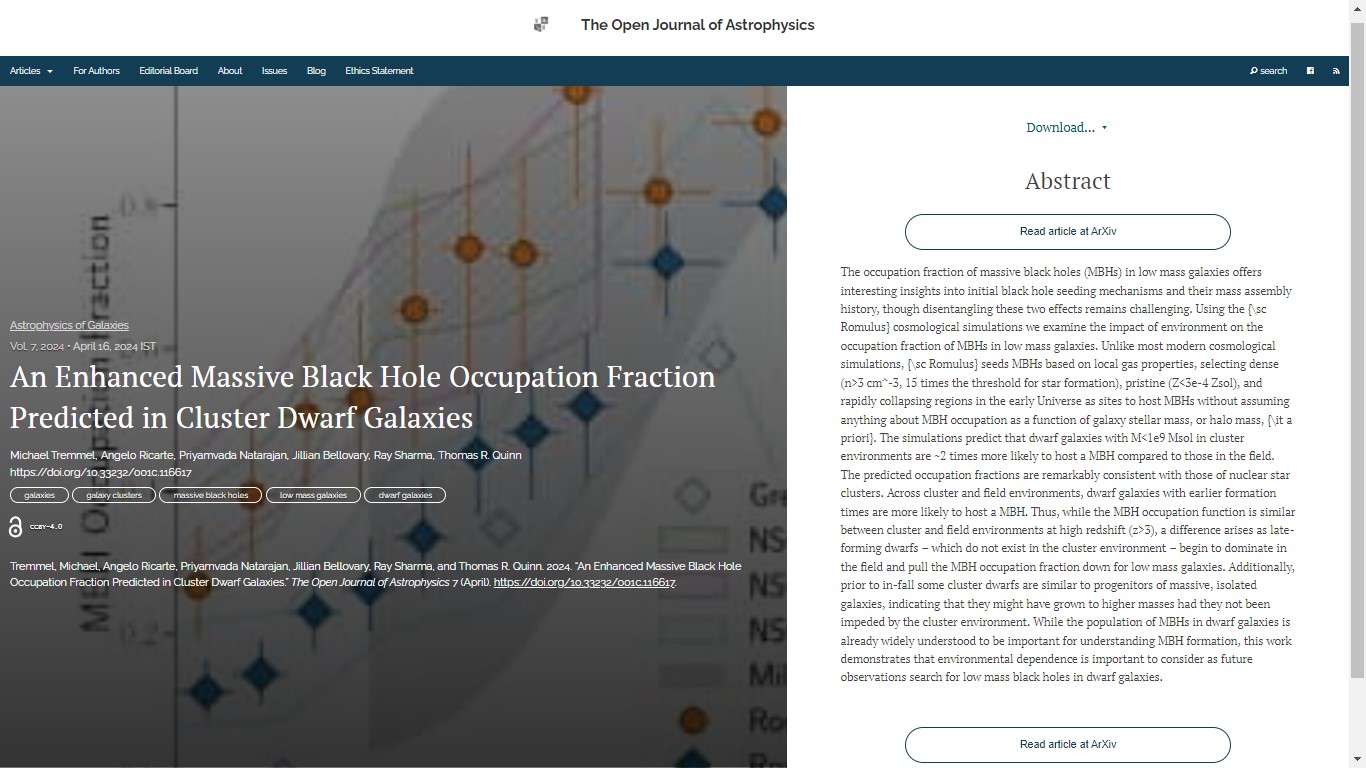
The first paper of the most recent pair – published on  Tuesday April 16th – is “An Enhanced Massive Black Hole Occupation Fraction Predicted in Cluster Dwarf Galaxies” by Michael Tremmel (UCC, Ireland), Angelo Ricarte (Harvard, USA), Priyamvada Natarajan (Yale, USA), Jillian Bellovar (American Museum of Natural History, New York, USA), Ray Sharma (Rutgers, USA), Thomas R. Quinn (University of Washington, USA). It presents a  study, based on the Romulus cosmological simulations, of the impact of environment on the occupation fraction of massive black holes in low mass galaxies. This one is in the folder marked “Astrophysics of Galaxies“.

Here is a screen grab of the overlay which includes the abstract:


You can click on the image of the overlay to make it larger should you wish to do so. You can find the officially accepted version of the paper on the arXiv here.

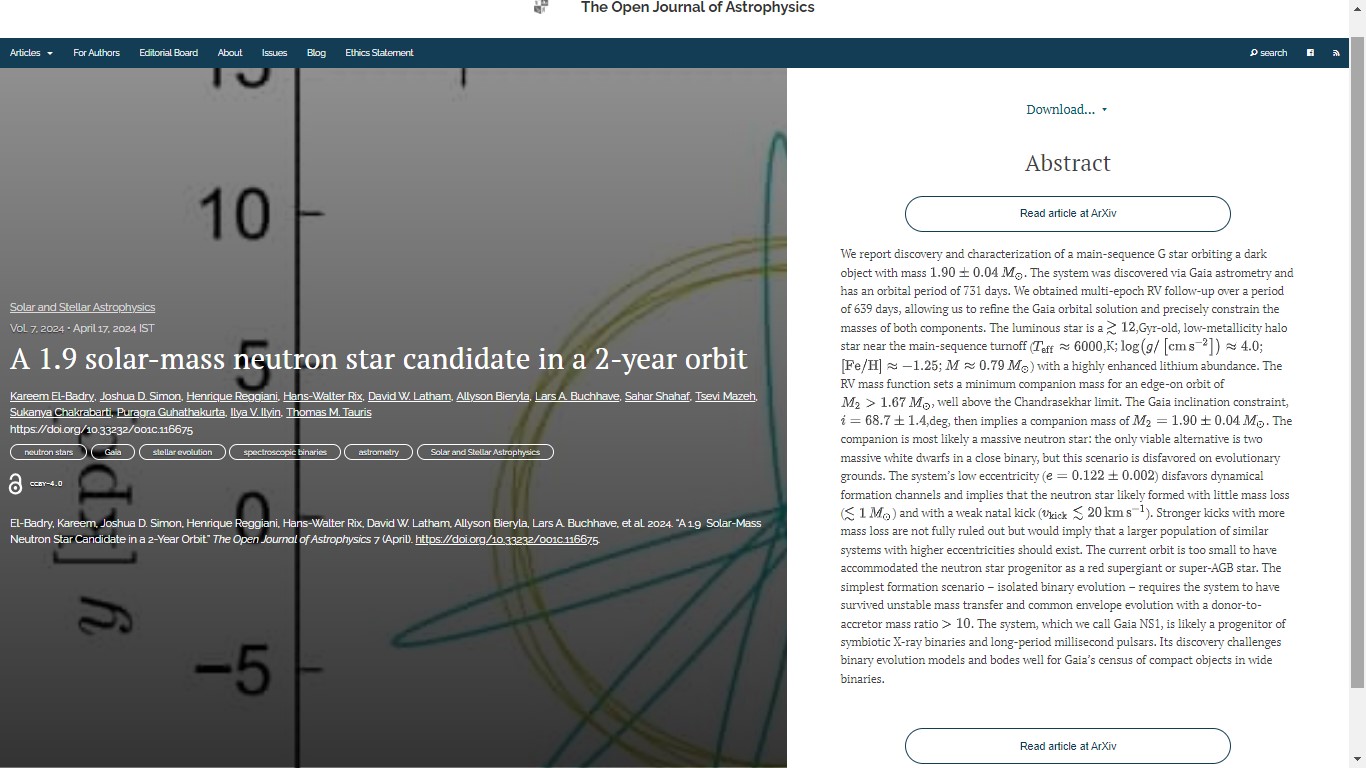
The second paper was published on Wednesday 17th April and has the title “A 1.9 solar-mass neutron star candidate in a 2-year orbit” and the authors are: Kareem El-Badry (Caltech, USA), Joshua D. Simon (Carnegie Observatories, USA), Henrique Reggiani (Gemini Observatory, Chile), Hans-Walter Rix (Heidelberg, Germany),  David W. Latham (Harvard, USA),  Allyson Bieryla (Harvard, USA),  Lars A. Buchhave (Technical University of Denmark, Denmark),  Sahar Shahaf (Weizmann Institute of Science, Israel),  Tsevi Mazeh (Tel Aviv University, Israel), Sukanya Chakrabarti (University of Alabama, USA), Puragra Guhathakurta (University of California Santa Cruz, USA), Ilya V. Ilyin (Potsdam, Germany), and Thomas M. Tauris (Aalborg University, Denmark)

This one, which is in the folder marked Solar and Stellar Astrophysics, presents a discussion of the discovery of a 1.9 solar mass neutron star candidate using Gaia astrometric data, together with the implications of its orbital parameters for the formation mechanism.

Here is a screen grab of the overlay which includes the abstract:


You can click on the image of the overlay to make it larger should you wish to do so. You can find the officially accepted version of the paper on the arXiv here.

That concludes this week’s update!

Bernard Schutz FRS!

Posted in Cardiff, The Universe and Stuff with tags , , , , on May 6, 2021 by telescoper

I was idly wondering earlier this week when the annual list of new Fellows elected to the Royal Society would be published, as it is normally around this time of year. Today it finally emerged and can be found here.

I am particularly delighted to see that my erstwhile Cardiff colleague Bernard Schutz (with whom I worked in the Data Innovation Research Institute and the School of Physics & Astronomy) is now an FRS! In fact I have known Bernard for quite a long time – he chaired the Panel that awarded me an SERC Advanced Fellowship in the days before STFC, and even before PPARC, way back in 1993. It just goes to show that even the most eminent scientists do occasionally make mistakes…

Anyway, hearty congratulations to Bernard, whose elevation to the Royal Society follows the award, a couple of years ago, of the Eddington Medal of the Royal Astronomical Society about which I blogged here. The announcement from the Royal Society is rather brief:

Bernard Schutz is honoured for his work driving the field of gravitational wave searches, leading to their direct detection in 2015.

I thought I’d add a bit more detail by repeating what was included in the citation for Bernard’s Eddington Medal which focuses on his invention of a method of measuring the Hubble constant using coalescing binary neutron stars. The idea was first published in September 1986 in a Letter to Nature. Here is the first paragraph:

I report here how gravitational wave observations can be used to determine the Hubble constant, H 0. The nearly monochromatic gravitational waves emitted by the decaying orbit of an ultra–compact, two–neutron–star binary system just before the stars coalesce are very likely to be detected by the kilometre–sized interferometric gravitational wave antennas now being designed1–4. The signal is easily identified and contains enough information to determine the absolute distance to the binary, independently of any assumptions about the masses of the stars. Ten events out to 100 Mpc may suffice to measure the Hubble constant to 3% accuracy.

In this paper, Bernard points out that a binary coalescence — such as the merger of two neutron stars — is a self calibrating `standard candle’, which means that it is possible to infer directly the distance without using the cosmic distance ladder. The key insight is that the rate at which the binary’s frequency changes is directly related to the amplitude of the gravitational waves it produces, i.e. how `loud’ the GW signal is. Just as the observed brightness of a star depends on both its intrinsic luminosity and how far away it is, the strength of the gravitational waves received at LIGO depends on both the intrinsic loudness of the source and how far away it is. By observing the waves with detectors like LIGO and Virgo, we can determine both the intrinsic loudness of the gravitational waves as well as their loudness at the Earth. This allows us to directly determine distance to the source.

It may have taken 31 years to get a measurement, but hopefully it won’t be long before there are enough detections to provide greater precision – and hopefully accuracy! – than the current methods can manage!

Here is a short video of Bernard himself talking about his work:

Once again, congratulations to Bernard on a very well deserved election to a Fellowship of the Royal Society.

UPDATE: a more detailed biography of Bernard is now available on the Royal Society website.

Bernard Schutz wins the 2019 Eddington Medal

Posted in Cardiff, The Universe and Stuff with tags , , , on January 14, 2019 by telescoper

I wasn’t able to get to the Ordinary Meeting of the Royal Astronomical Society on Friday 11th January as I was otherwise engaged. In case you didn’t know, these meetings happen on the second Friday of every month and consist of short talks, longer set-piece prize lectures and Society business. The January meeting is when the annual awards are announced, so I missed the 2019 crop of medals and other prizes. When I got to the Athenaeum for dinner I was delighted to be informed that one of these – the prestigious Eddington Medal – had been awarded to my erstwhile Cardiff colleague Bernard Schutz (with whom I worked in the Data Innovation Research Institute and the School of Physics & Astronomy).

Here is a short video of the man himself talking about the work that led to this award:

The citation for Bernard’s award focuses on his invention of a method of measuring the Hubble constant using coalescing binary neutron stars. The idea was first published in September 1986 in a Letter to Nature. Here is the first paragraph:

I report here how gravitational wave observations can be used to determine the Hubble constant, H 0. The nearly monochromatic gravitational waves emitted by the decaying orbit of an ultra–compact, two–neutron–star binary system just before the stars coalesce are very likely to be detected by the kilometre–sized interferometric gravitational wave antennas now being designed1–4. The signal is easily identified and contains enough information to determine the absolute distance to the binary, independently of any assumptions about the masses of the stars. Ten events out to 100 Mpc may suffice to measure the Hubble constant to 3% accuracy.

In this paper, Bernard points out that a binary coalescence — such as the merger of two neutron stars — is a self calibrating `standard candle’, which means that it is possible to infer directly the distance without using the cosmic distance ladder. The key insight is that the rate at which the binary’s frequency changes is directly related to the amplitude of the gravitational waves it produces, i.e. how `loud’ the GW signal is. Just as the observed brightness of a star depends on both its intrinsic luminosity and how far away it is, the strength of the gravitational waves received at LIGO depends on both the intrinsic loudness of the source and how far away it is. By observing the waves with detectors like LIGO and Virgo, we can determine both the intrinsic loudness of the gravitational waves as well as their loudness at the Earth. This allows us to directly determine distance to the source.

It may have taken 31 years to get a measurement, but hopefully it won’t be long before there are enough detections to provide greater precision – and hopefully accuracy! – than the current methods can manage!

Congratulations to Bernard on his thoroughly well-deserved Eddington Medal!


Determining the Hubble Constant the Bernard Schutz way

Posted in The Universe and Stuff with tags , , , , , on October 19, 2017 by telescoper

In my short post about Monday’s announcement of the detection of a pair of coalescing neutron stars (GW170817), I mentioned that one of the results that caught my eye in particular was the paper about using such objects to determine the Hubble constant.

Here is the key result from that paper, i.e. the posterior distribution of the Hubble constant H0 given the data from GW170817:

You can also see latest determinations from other methods, which appear to be in (slight) tension; you can read more about this here. Clearly the new result from GW170817 yields a fairly broad range for H0 but, as I said in my earlier post, it’s very impressive to be straddling the target with the first salvo.

Anyway, I just thought I’d mention here that the method of measuring the Hubble constant using coalescing binary neutron stars was invented by none other than Bernard Schutz of Cardiff University, who works in the Data Innovation Institute (as I do). The idea was first published in September 1986 in a Letter to Nature. Here is the first paragraph:

I report here how gravitational wave observations can be used to determine the Hubble constant, H 0. The nearly monochromatic gravitational waves emitted by the decaying orbit of an ultra–compact, two–neutron–star binary system just before the stars coalesce are very likely to be detected by the kilometre–sized interferometric gravitational wave antennas now being designed1–4. The signal is easily identified and contains enough information to determine the absolute distance to the binary, independently of any assumptions about the masses of the stars. Ten events out to 100 Mpc may suffice to measure the Hubble constant to 3% accuracy.

In in the paper, Bernard points out that a binary coalescence — such as the merger of two neutron stars — is a self calibrating `standard candle’, which means that it is possible to infer directly the distance without using the cosmic distance ladder. The key insight is that the rate at which the binary’s frequency changes is directly related to the amplitude of the gravitational waves it produces, i.e. how `loud’ the GW signal is. Just as the observed brightness of a star depends on both its intrinsic luminosity and how far away it is, the strength of the gravitational waves received at LIGO depends on both the intrinsic loudness of the source and how far away it is. By observing the waves with detectors like LIGO and Virgo, we can determine both the intrinsic loudness of the gravitational waves as well as their loudness at the Earth. This allows us to directly determine distance to the source.

It may have taken 31 years to get a measurement, but hopefully it won’t be long before there are enough detections to provide greater precision – and hopefully accuracy! – than the current methods can manage!

Above all, congratulations to Bernard for inventing a method which has now been shown to work very well!

Gravitational Waves Flash!

Posted in The Universe and Stuff with tags , , , , on October 13, 2017 by telescoper

I got up early this morning to hitch a ride in a car to Mumbai so that I can give a talk this afternoon. We left Pune about 6am and got here about 8.30 so the trip was a quite a bit quicker than coming here! I’ll post about that and include some pictures when I get a moment, but first I’ll post a quick announcement.

There will be an announcement on Monday 16th October at 10am EDT (3pm BST; 7.30pm in Pune) by `the National Science Foundation (NSF) as it brings together scientists from the Laser Interferometer Gravitational-Wave Observatory (LIGO) and Virgo collaborations, as well as representatives for some 70 observatories’. Further details can be found here. The European Southern Observatory has also announced that it will be holding a press conference on Monday about an `unprecedented discovery’.

The fact that it involves LIGO, Virgo and representatives of other observatories strongly suggests that this announcement will address the subject of the rumours that were flying around in August. In other words, it’s likely that on Monday we will hear about the first detecting of a coalescing binary neutron star system with an optical counterpart. Exciting times!

I’ll be back in Pune by Monday and will probably be able to watch the announcement and will update if and when I can.

What’s with the Wang Particle?

Posted in Astrohype, The Universe and Stuff with tags , , , , , , on September 11, 2012 by telescoper

Not long ago a colleague ran into my office all of a flutter and asked me about this new discovery called the “Wang particle” that had been in the media. I’m the one around here who’s supposed to know about particle astrophysics stuff, so I was quite embarrassed that I’d never heard of the Wang particle, although I’ll be delighted if it becomes famous as the name has a great deal of comedy potential.

Anyway, I vowed to find out a little bit about it and finally got around this lunchtime to doing so. It turns out that the story was sparked by press release from the British Science Association which, out of the goodness of my heart, I reproduce below (link added by me).

 A new particle, similar to the Higgs Boson, could provide a clue to one of the greatest mysteries of the Universe.

Dr Charles Wang from the University of Aberdeen believes that a new scalar particle is behind the intense supernova explosions that occur when a star implodes. He presented his work to the British Science Association on Tuesday.

Supernova explosions are the most powerful forces in the universe, second only to the Big Bang.

Once frequent, the energy produced in these explosions is responsible for combining particles to produce all the recognisable elements on earth, providing all the known building blocks of life on earth.

There are still many gaps in our understanding of physics and one of the major blanks is how the implosion of a star subsequently produces an intense explosion.

It is known that as elements are created at the centre of a star, a huge amount of energy is released.  However, it is believed that the conversion of known elements would never produce enough energy to result in an explosion.

Dr Wang’s theory states that “a scalar particle – one of the most elementary types of particles in the universe and similar to the Higgs Boson – is at work within these stars and responsible for the additional energy which causes the explosion to take place.”

The scalar particle would effectively enable the high transfer of energy during a supernova, allowing shockwaves from the implosion of a star to become re-energised and cause an explosion.

A new collaboration between Dr Wang and CERN could provide the equipment to make this theory a reality and demonstrate the existence of the ‘Wang particle’ – or as Dr Wang himself refers to it the ‘scalar gravitational particle’. It is hoped that using the ISOLDE facility at CERN it may be possible assimilate a nuclear reaction that would determine the process of a starburst.

If demonstrated, the existence of the ‘Wang particle’, like the Higgs Boson, would hold major implications for physics, shedding new light on the theory of everything and affecting our understanding of how different physical phenomena interact.

There’s no link to an academic paper with it, which is a bit disappointing, but an older piece in the CERN Courier does provide a reference to the paper, which is

C H-T Wang et al. 2011 Parametric instability induced scalar gravitational waves from a model pulsating neutron star, Phys. Letts. B 705 148

If you’re prepared to shake hands with the Devil that is Elsevier you can find the paper here.

I have to confess that this is a new one on me. I haven’t gone through the paper in detail yet but, at a quick skim, it seems to be based on a variation of the  Brans-Dicke scalar-tensor theory of gravity. It’s probably an interesting paper, and I look forward to reading it in detail on a long flight I’m about to take, but I am a bit mystified as to why it created such a stir in the media. Looks more a result of hype than real significance to me. It certainly isn’t the “new Higgs boson” anyway. Nor is it likely to be relevant in explaining Climate Change. Or am I missing something? Perhaps hot air generated by press releases is responsible for global warming?

Anyone out there an expert on Wang’s work? Care to comment?