A couple of months ago I blogged about how the Open Journal of Astrophysics had been accepted for listing on Scopus. The process has turned out to be much slower than I was led to believe and the “technical team” responsible for the indexing required much more help than I’d imagined, so we’re not fully there yet. However, I can confirm that we are in the process. This is an excerpt from the accepted titles list which you can find here:
The Scopus indexation process seems to involve processing every article manually, so it’s possible that there will be some errors. Here is a verbatim excerpt from a recent email from the Scopus team that perhaps illustrates why I lack confidence in the process:
We have activated your journal for Scopus indexation and you will be able to find the content indexed online shortly. The title, however, will take some time to have a source page and you will not be able to view it on source list. If the articles indexed on Scopus exceeds 15, Source Page for your title will be automatically created during Scopus browser update. Post which the title will be discoverable on Scopus source list as well.
It’s Saturday morning in Sydney, and time to post another update relating to the Open Journal of Astrophysics. Since the last update we have published two more papers, taking the count in Volume 7 (2024) up to 15 and the total published by OJAp up to 130. I should have posted these before leaving but it slipped my mind.
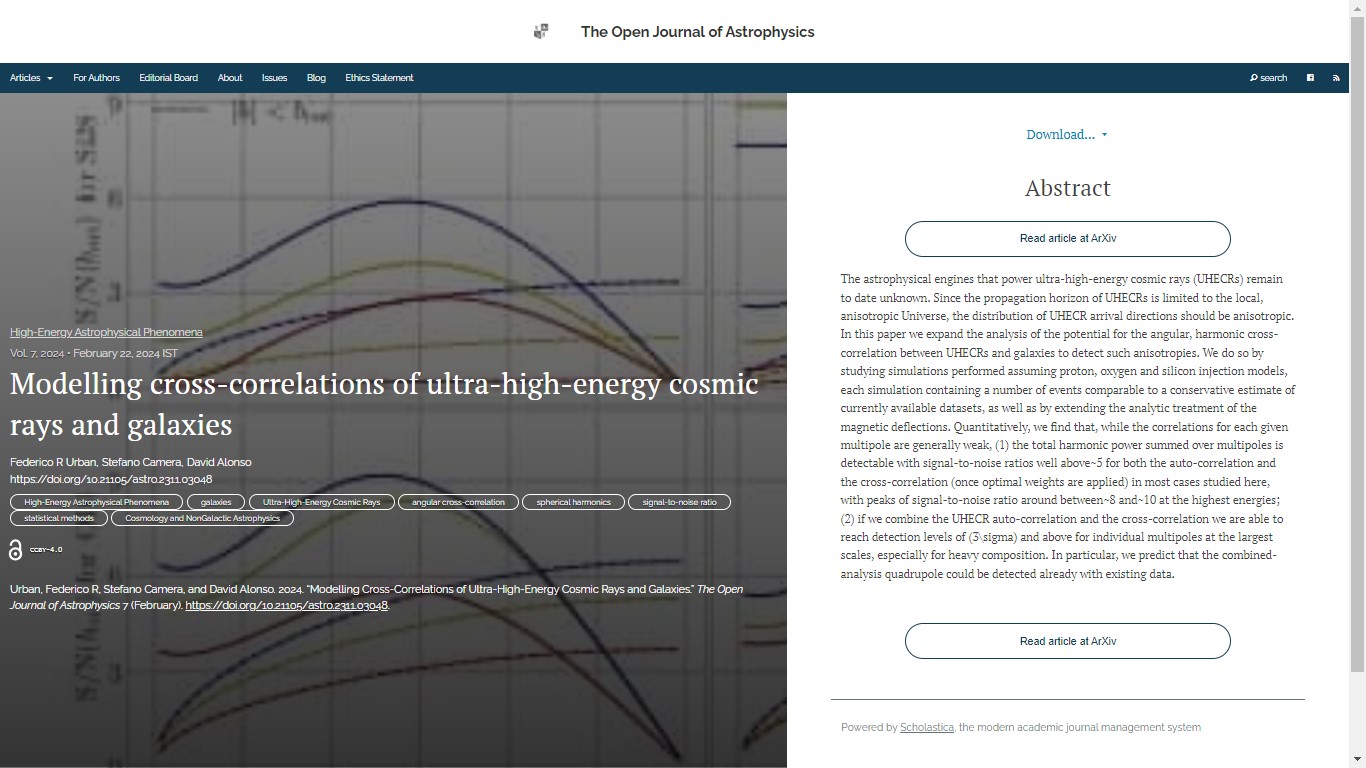
The first paper of the most recent pair – published on Thursday 22nd February – is “Modelling cross-correlations of ultra-high-energy cosmic rays and galaxies” by Federico Urban (Prague, Czech Republic), Stefano Camera (Torino, Italy) and David Alonso (Oxford, UK). It presents a discussion of the possible statistical correlations between Ultra-High-Energy Cosmic-Ray (UHECR) directions in various models and structure in the galaxy distribution and whether or not this signal could be measurable. This one is in the folder marked “High-Energy Astrophysical Phenomena“.
Here is a screen grab of the overlay which includes the abstract:
You can click on the image of the overlay to make it larger should you wish to do so. You can find the officially accepted version of the paper on the arXiv here.
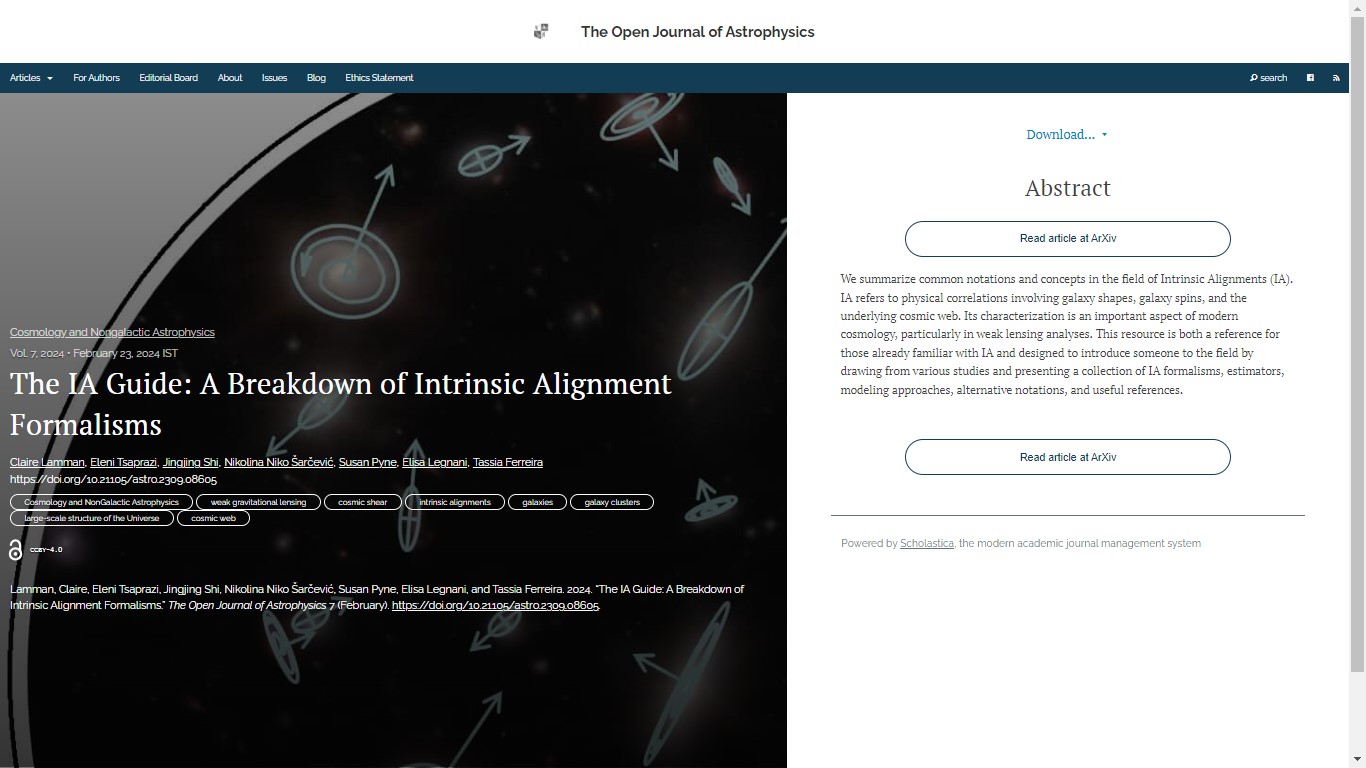
The second paper was published on Friday 23rd February and has the title “The IA Guide: A Breakdown of Intrinsic Alignment Formalisms” and the authors are: Claire Lamman (Harvard, USA); Eleni Tsaprazi (Stockholm, Sweden); Jingjing Shi (Tokyo, Japan); Nikolina Niko Šarčević (Newcastle, UK); Susan Pyne (UCL, UK); Elisa Legnani (Barcelona, Spain); and Tassia Ferreira (Oxford, UK). This one, which is in the folder marked Cosmology and NonGalactic Astrophysics, presents a review of Intrinsic Alignments, i.e. physical correlations involving galaxy shapes, galaxy spins, and larger scale structure, especially important for weak gravitational lensing
Here is a screen grab of the overlay which includes the abstract:
You can click on the image of the overlay to make it larger should you wish to do so. You can find the officially accepted version of the paper on the arXiv here.
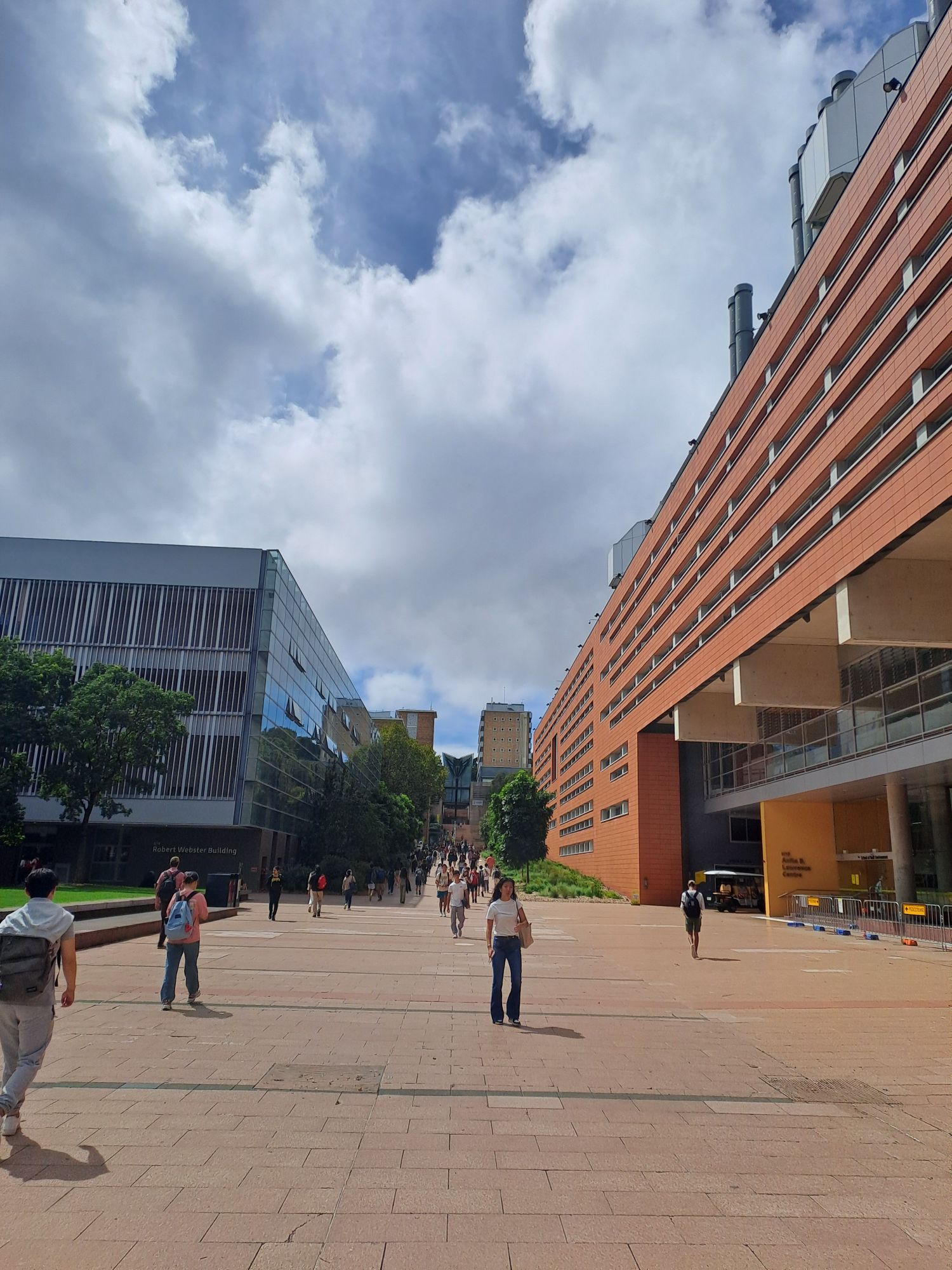
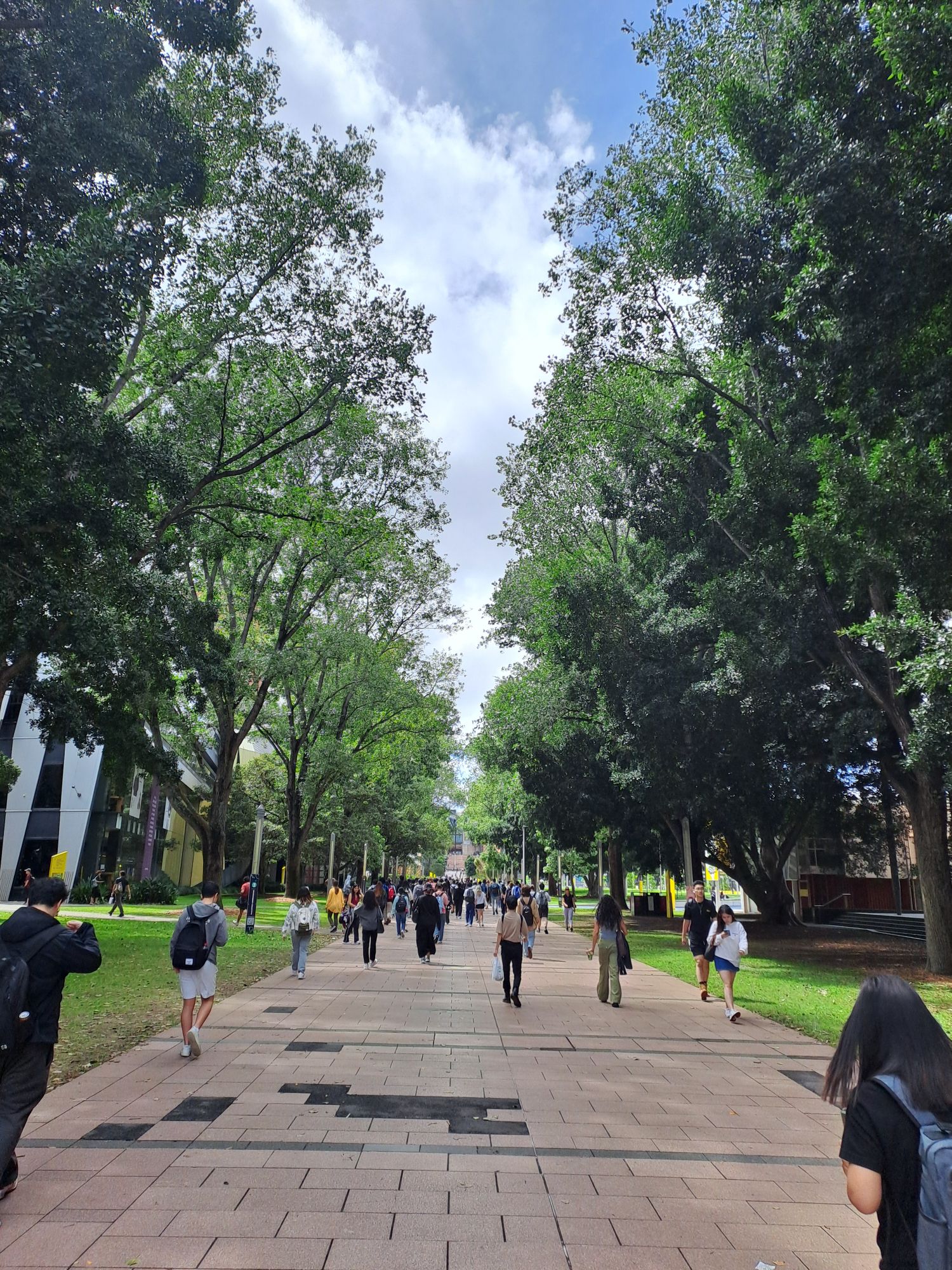
After an exciting start to the day involving a fire alarm and consequent evacuation of my hotel, I today ventured into the suburbs of Sydney via the Light Rail system (i.e. the tram) to the University of New South Wales. The tram ride took about 20 minutes from Central and, incidentally, took me right past the Sydney Cricket Ground. Anyway, the UNSW campus at Kensington is very impressive:
After a few gremlins with the WIFI connection, the talk I gave was a longer version of the one I did at the University of Sydney on Monday. In discussions with the Astrophysics group at UNSW, I found they were particularly unhappy about the decision of Monthly Notices of the Royal Astronomical Society to charge a high level of APC (Article Processing Artificial Profit Charge) so is looking at alternative journals that aren’t so exploitative. A journal has no right to call itself “open access” if it excludes researchers on grounds of cost. The problem with the Open Journal of Astrophysics in this case is that they need their publications to be in “high impact journals” for research assessment purposes, and OJAp doesn’t have an “official” journal impact factor yet. The fascination of bureaucrats with the obviously flawed journal impact factor disturbs me greatly but I hope we will have one soon so we may be able to help them out before too long.
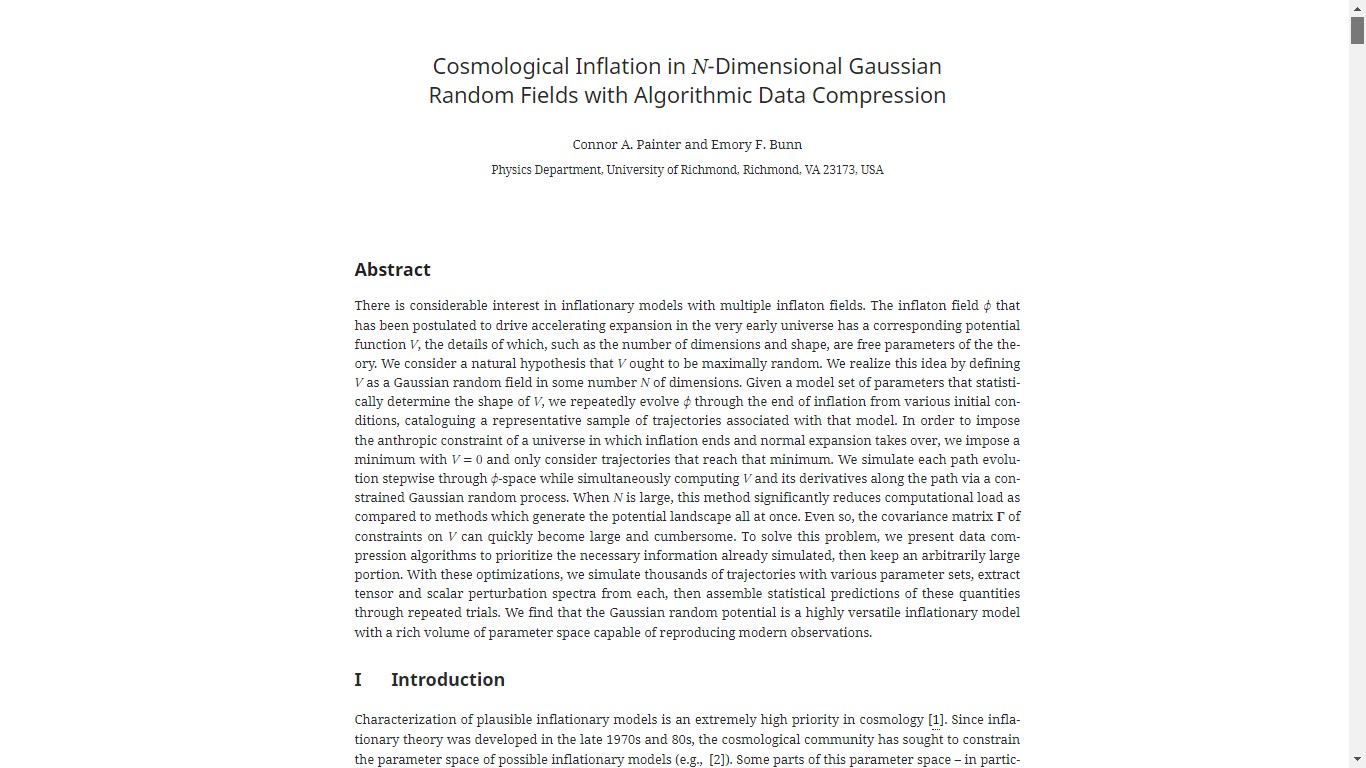
As you can see, it works pretty well for this example.
Naturally I tried out the new “beta” release of the HTML generator, which you can now find on the right-hand panel of the abstract page alongside the PDF download instead of fiddling around with the URL. Here is an example of one of our papers on which it works well:
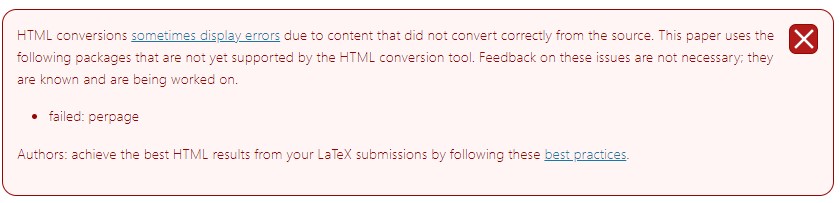
You can see the reason for the failure, which is that the LaTex used to generate the paper contains a package the HTML generator does not know about. One of the difficulties for arXiv is that new packages are always being developed and it is hard to keep up. I’m told that on average arXiv achieves ~75% successful conversions (and 97% partial success), but the articles from January 2024 (which contain more new packages) convert with a success rate of only 62%. It’s far from perfect, but it will improve -especially if authors follow the advice on best practice produced by arXiv; I actually think authors have a responsibility to help arXiv as much as possible in this regard.
This all reminds me of past experiences I’ve had teaching theoretical physics to blind and partially-sighted students. Years ago this used to involve making Braille copies of notes, but there are now various bits of software to help such people manage LaTeX both for creating and reading documents. In particular there are programs that can read Latex documents (including formulae and equations) which means that if a lecturer can supply LaTeX source version of their notes, the student can hear them spoken out loud as well as make their own annotations/corrections. While HTML may well be better for some fields, I do wonder if physicists and other people in disciplines that make heavy use of mathematics might prefer to use the LaTeX source code which is already downloadable from arXiv?
This morning I gave a short talk at the “Astronomy Tea” at the Sydney Institute for Astronomy. No prizes for guessing what I talked about. The talk was followed by questions and then by a huge thunderstorm.
It’s Saturday morning here in Sydney, which means it is time for another weekly update from the Open Journal of Astrophysics. In fact there is only one paper to report this week, being the 13th paper in Volume 7 (2024) and the 128th altogether. It was published on February 15th 2024.
The title is “Jet – counter-jet asymmetry in the jittering jets explosion mechanism of supernovae” and it This one is in the folder called High-Energy Astrophysical Phenomena. The paper presents a discussion of the production of jets in core-collapse supernovae and the resulting formation of neutron stars, and the implications for the morphology of the supernova remnant.
The sole author of the paper is Noam Soker of Technion, Haifa, in Israel.
Here is the overlay of the paper containing the abstract:
You can click on the image of the overlay to make it larger should you wish to do so. You can find the officially accepted version of the paper on the arXiv here.
As it was foretold, since January 1st 2024 the journal Monthly Notices of the Royal Astronomical Society (MNRAS) is now charging authors an Article Processing Charge (APC) at the (suitably astronomical) level of £2310 (approx €2700 at current rates) for each paper. There are exemptions in certain situations, such as if the author’s institution has signed up to a read-and-publish agreement via JISC (although that still involves a researcher’s institution paying unjustifiable amounts to the publisher).
The fundamental fact is that it just doesn’t cost £2310 to publish a paper online. That APC level is – for one paper – larger than the entire running costs of the Open Journal of Astrophysics for a year.
I did actually laugh out loud when I saw the spin the RAS tried to put on this decision:
The RAS is excited to be a key contributor to the open science movement, helping to drive discoverability and change.
Au contraire. Gold Open Access a serious hindrance to the open science movement, as it involves hugely inflated costs to the authors in attempt to protect revenue in the face of declining subscription income. This means that many potential authors just will not be able to pay. That’s not Open Access. Switching from a ‘fleece-the-libraries’ model to a ‘fleece-the-authors’ alternative can in no way be regarded as a progressive move.
It is true that some institutions will pay the APC on behalf of their authors, but that is hardly the point. If institutions have cash to pay for astronomy publications to be open access then they would do far more good to the research community by giving it to the arXiv rather than to the publishing industry. When authors themselves see how much they have to pay to publish their work, many will realize that it is simply not worth the money. I refuse to pay any APC on principle.
The question for the Royal Astronomical Society, and indeed the other learned societies that fund their activities in a similar way, is whether they can find a sustainable funding model that takes proper account of the digital publishing revolution. If their revenue from publishing does fall, can they replace it? And, if not, in what form can they survive? I’d like to think that future operating models for such organizations would involve serving their respective communities, rather than fleecing them. I’d advocate a institutional subscriptions as a fairer and more transparent alternative to syphoning funds from library budgets or research grants.
Meanwhile, the new regime at MNRAS (and possibly its acceptance on Scopus) have led to steadily increasing activity at the Open Journal of Astrophysics. This morning I announced three more papers. I will post about them on here tomorrow. Diamond Open Access is the way forward. It’s just a question of time before everyone realizes it.
A week or so before Christmas I posted about a new organization called Irish Open Access Publishers whose mission statement is as follows:
Irish Open Access Publishers (IOAP) is a community of practice driven by Irish open access publishers for Irish open access publishers. The IOAP promotes engagement with the Diamond Open Access publishing model (free to publish and free to read) as well as indexing on the Directory of Open Access Journals and the Directory of Open Access Books. The aim of this dynamic community of practice is to promote publishing activity that is free of pay walls and publication embargoes to further the dissemination of high quality scholarly output to all in society.
These aims are laudable and I support them wholeheartedly. I should also mention that the Open Journal of Astrophysics is listed in the Directory of Open Access Journals here, where you will find details of all the papers we have published so far. This index is all part of the service. We have also been accepted for inclusion in Scopus, in case that matters to you.
Anyway, I thought I would remind readers of this blog (both of them) about the fact that the IOAP is offering a new set of awards, for which nominations are now open:
(Unfortunately the links in the above image are not clickable, but you can the award details here…)
Nominations for the first three categories are by self-nomination only. I will of course, on behalf of Maynooth Academic Publishing, the Editorial Board, the authors, and everyone who has helped behind the scenes, be nominating the Open Journal of Astrophysics.
Nominations for the final category, Outstanding Contribution to the OA Field are described thus:
Category 4 welcomes third party as well as self nominations from academics, students, librarians, research managers, academic leaders, publishers and other stakeholders across further and higher education for an individual who has made an outstanding contribution to open access publishing in Ireland. Nominations from scholarly societies and other scholarly organisations are also welcome. Nominations for individuals based in Northern Ireland are also invited.
Self nominations are restricted to individuals based in Ireland including Northern Ireland. Third party nominations are invited from individuals based in Ireland including Northern Ireland as well as individuals based overseas. All third party nominations must be for individuals practising in the field of open access publishing in Ireland including Northern Ireland solely.
Notice that nominations are not restricted to individuals based in Ireland. So, wherever you are, if you can think of any individual based in Ireland who has done enough to merit being described as having made an “outstanding contribution”, perhaps not only for being a long-term advocate of Diamond Open Access but also for setting up and being Managing Editor of a successful Diamond Open Access journal in the field of astrophysics, then please feel free to nominate me them. I hope you get the message. If you want subtle, you’ve come to the wrong place!
The nomination form is here. The closing date for nominations is 1st February 2024.
Last week I found out about a new organization called Irish Open Access Publishers whose mission statement is as follows:
Irish Open Access Publishers (IOAP) is a community of practice driven by Irish open access publishers for Irish open access publishers. The IOAP promotes engagement with the Diamond Open Access publishing model (free to publish and free to read) as well as indexing on the Directory of Open Access Journals and the Directory of Open Access Books. The aim of this dynamic community of practice is to promote publishing activity that is free of pay walls and publication embargoes to further the dissemination of high quality scholarly output to all in society.
These aims are laudable and I support them wholeheartedly. I should also mention that the Open Journal of Astrophysics is listed in the Directory of Open Access Journals here, where you will find details of all the papers we have published so far. This index is all part of the service.
The reason I found out about the existence of IOAP is that they are offering a new set of awards, for which nominations are now open:
(Unfortunately the links in the above image are not clickable, but you can the award details here…)
Nominations for the first three categories are by self-nomination only. I will of course, on behalf of Maynooth Academic Publishing, the Editorial Board, the authors, and everyone who has helped behind the scenes, be nominating the Open Journal of Astrophysics.
Nominations for the final category, Outstanding Contribution to the OA Field are described thus:
Category 4 welcomes third party as well as self nominations from academics, students, librarians, research managers, academic leaders, publishers and other stakeholders across further and higher education for an individual who has made an outstanding contribution to open access publishing in Ireland. Nominations from scholarly societies and other scholarly organisations are also welcome. Nominations for individuals based in Northern Ireland are also invited.
Self nominations are restricted to individuals based in Ireland including Northern Ireland. Third party nominations are invited from individuals based in Ireland including Northern Ireland as well as individuals based overseas. All third party nominations must be for individuals practising in the field of open access publishing in Ireland including Northern Ireland solely.
Notice that nominations are not restricted to individuals based in Ireland. So, wherever you are, if you can think of any individual based in Ireland who has done enough to merit being described as having made an “outstanding contribution”, perhaps not only for being a long-term advocate of Diamond Open Access but also for setting up and being Managing Editor of a successful Diamond Open Access journal in the field of astrophysics, then please feel free to nominate me them. I hope you get the message. If you want subtle, you’ve come to the wrong place!
The nomination form is here. The closing date for nominations is 1st February 2024.
It’s been a busy week generally, and specifically at the Open Journal of Astrophysics. In fact, this week we have published three papers, which I didn’t have time to post here at the time we published them but now present to you. These take the count in Volume 6 (2023) up to 44 and the total published by OJAp up to 109. With many more in the pipeline we’re still on for 50 by the end of the year.
In chronological order, the three papers published this week, with their overlays, are as follows. You can click on the images of the overlays to make them larger should you wish to do so. All three of these papers are in the folder Cosmology and Nongalactic Astrophysics.
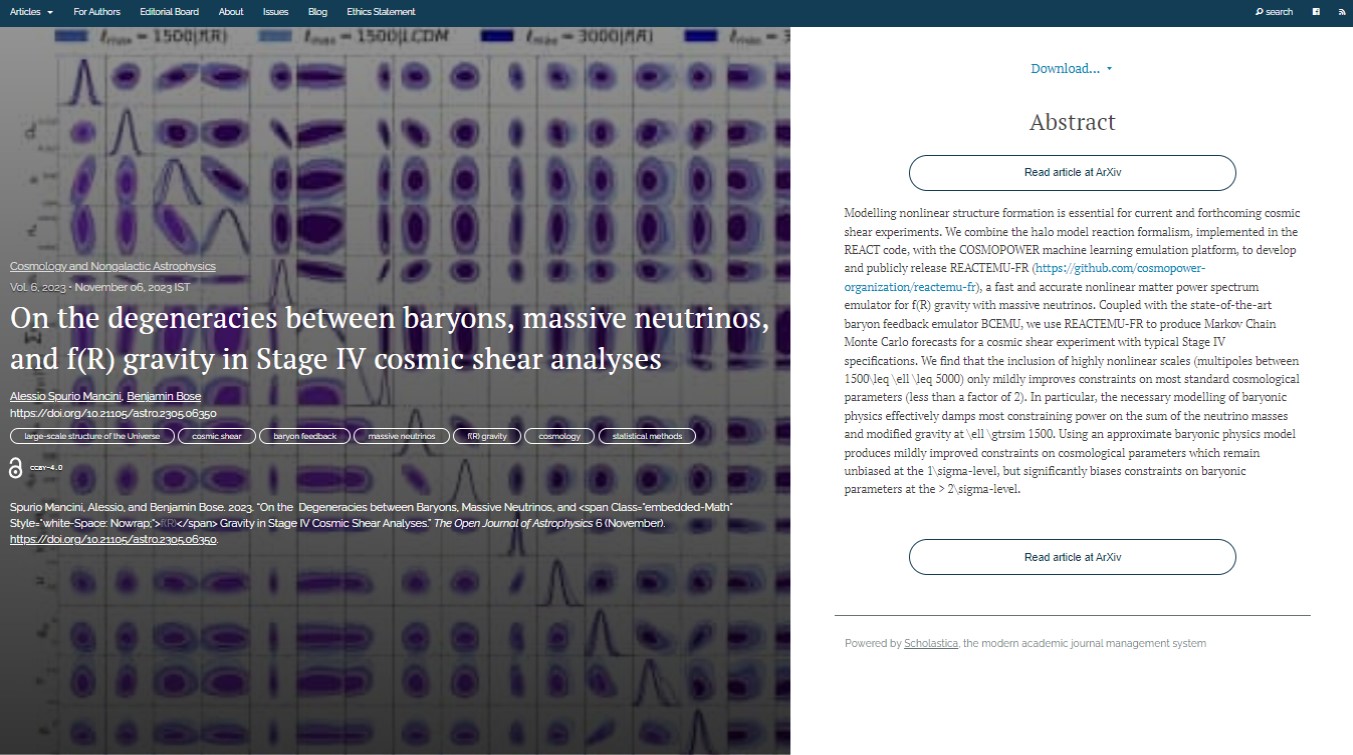
First one up is “On the degeneracies between baryons, massive neutrinos and f(R) gravity in Stage IV cosmic shear analyses” by Alessio Spurio Mancini (Mullard Space Sciences Laboratory, University College London, UK) and Benjamin Bose (Royal Observatory Edinburgh, UK). This presents a fast nonlinear matter power spectrum emulator for f(R) gravity with massive neutrinos, coupled with a baryon feedback emulator forecasts for a cosmic shear experiment with typical Stage IV specifications. This paper was published on 6th November 2023.
Here is a screen grab of the overlay, which includes the abstract:
You can find the officially accepted version of the paper on the arXiv here.
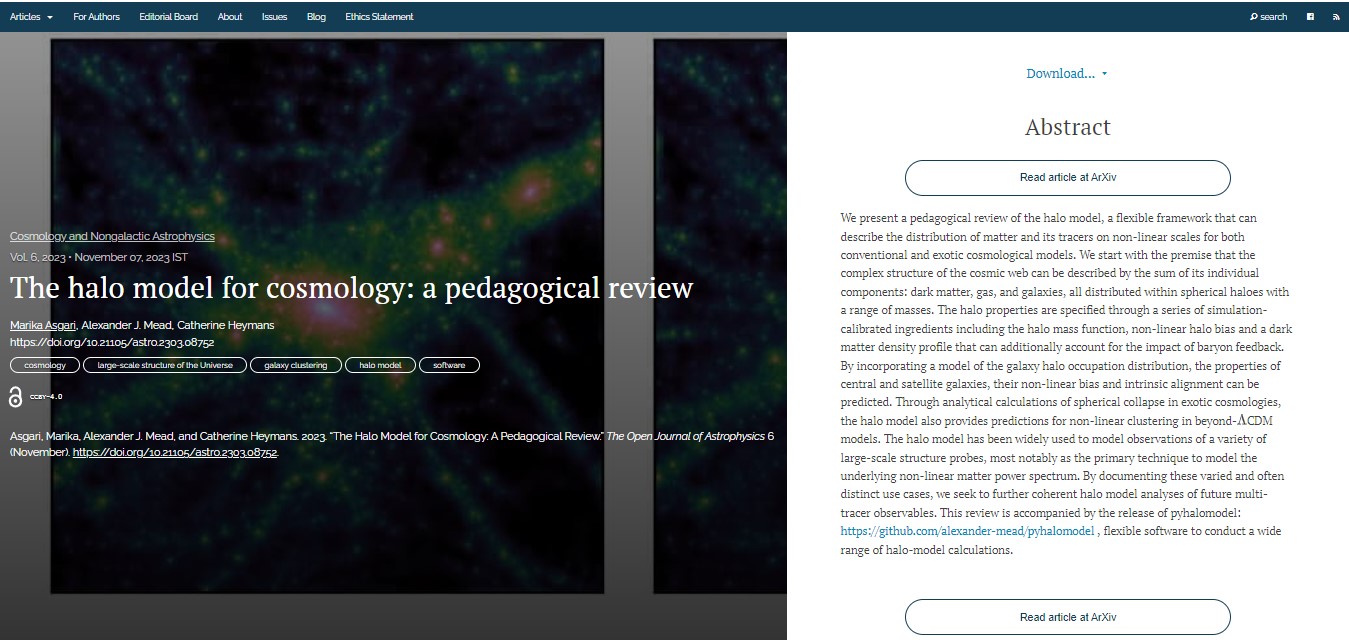
The second paper to announce is “” by Marika Asgari (Hull, UK), Alexander Mead (Bochum, Germany) and Catherine Heymans (Edinburgh, UK). This presents a thorough discussion of the popular halo model for cosmological structure with applications, accompanied by the release of a software suite called pyhalomodel (which you can download here). The paper was also published on 7th November 2023 and you can see the overlay here:
The accepted version of this paper can be found on the arXiv here.
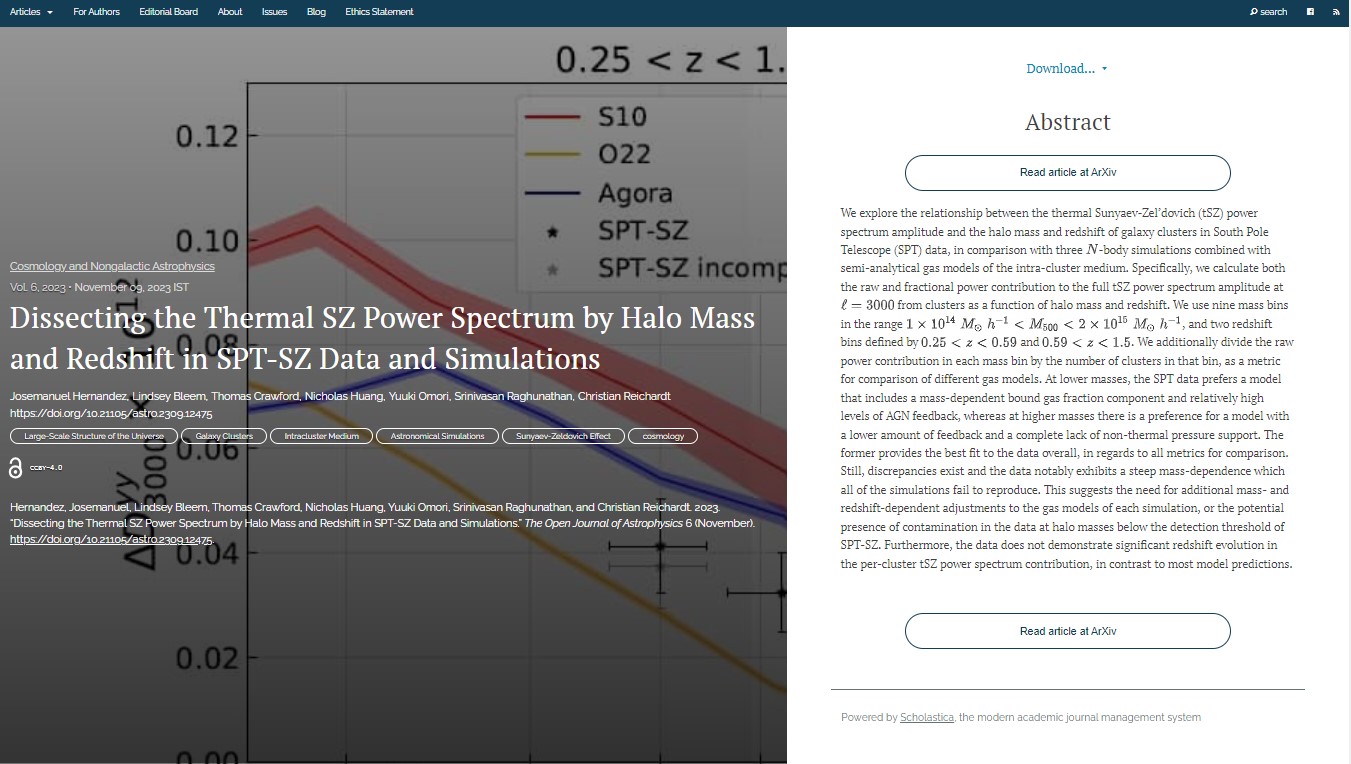
The last paper of this batch is entitled “Dissecting the Thermal SZ Power Spectrum by Halo Mass and Redshift in SPT-SZ Data and Simulations” and the authors are: by Josemanuel Hernandez (Chicago), Lindsey Bleem (Chicago) , Thomas Crawford (Chicago), Nicholas Huang (Berkeley), Yuuki Omori (Chicago), Srinivasan Raghunathan (NCSA, Urbana) & Christian Reichardt (Melbourne). This paper, a study of the mass and redshift dependence of the thermal Sunyaev-Zeldovich effect in South Pole Telescope data and a comparison thereof with theoretical calculations, was published on 9th November 2023.
Here is the overlay:
You can find the full text for this one on the arXiv here.
The views presented here are personal and not necessarily those of my employer (or anyone else for that matter).
Feel free to comment on any of the posts on this blog but comments may be moderated; anonymous comments and any considered by me to be vexatious and/or abusive and/or defamatory will not be accepted. I do not necessarily endorse, support, sanction, encourage, verify or agree with the opinions or statements of any information or other content in the comments on this site and do not in any way guarantee their accuracy or reliability.







 In the Dark