Archive for Pyotr Ilyich Tchaikovsky

Clyne, Tchaikovsky and Shostakovich at the National Concert Hall

Posted in Biographical, Music with tags , , , , , , , , on October 18, 2025 by telescoper

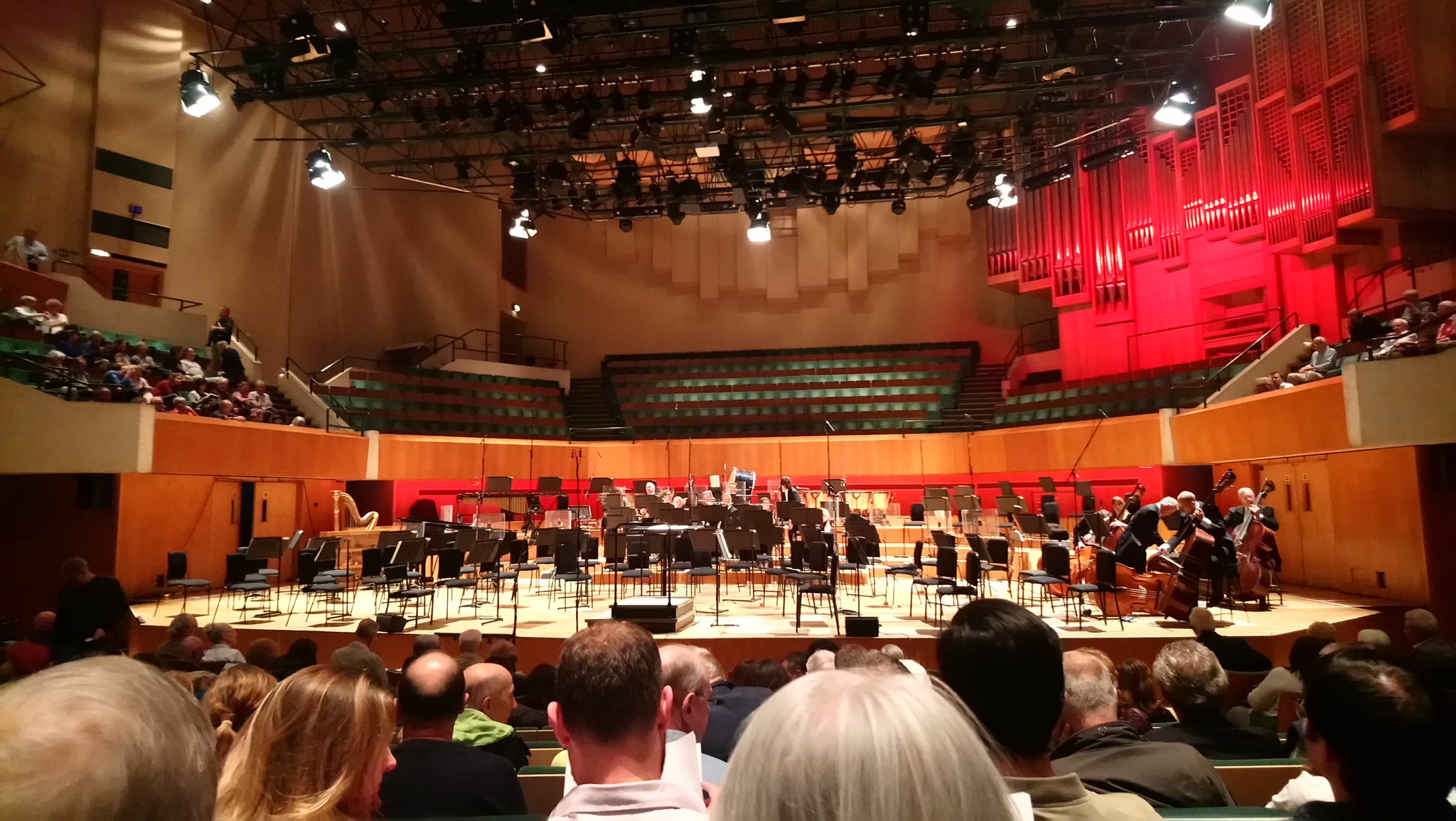
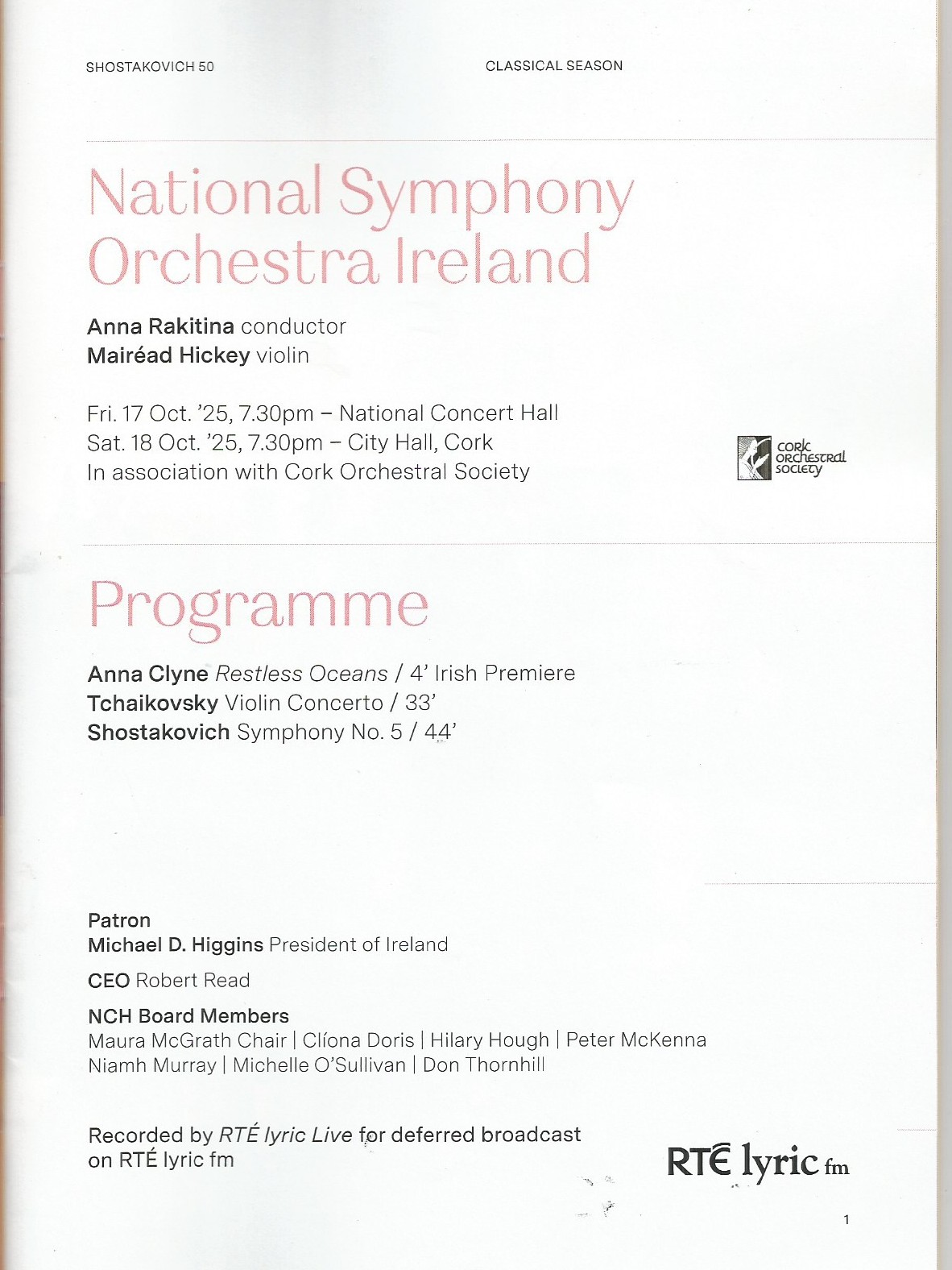
It had been over a month since my last visit to the National Concert Hall in Dublin so I was happy to be able to attend this week’s Friday night concert last night. It was great to see that the venue was very full too. I think that was at least partly down to the fact that one of the pieces featured Irish violinist Mairéad Hickey who has a sizeable local following. Conductor for the evening with National Symphony Orchestra Ireland was Anna Rakitina (who was born in Russia).

The concert began with a short piece by Anna Clyne called Restless Oceans. This is an energetic and an excellent way to get the orchestra revved up for the rest of the evening. I’d never heard this work before and I think it must be the first time I’ve seen a performance in which the string section sang or hummed a wordless accompaniment in one part and, in another, the whole orchestra provided extra percussion by stamping their feet.

After that zesty appetiser, Mairéad Hickey appeared on stage, resplendent in a green dress, to perform the first course proper, the Violin Concerto by Pyotr Ilyich Tchaikovsky. This is a familiar work but it was ravishingly played by Mairéad Hickey, who seem to revel in the virtuosic elements of this work, as well as bringing out the lyricism in the more romantic passages. The only things I don’t like about this composition are the gratuitously showy cadenzas which go on far too long, in my opinion. The audience clearly loved the performance, though, as did I, and we were treated to an encore in the form of some traditional Irish fiddle playing which was lovely.

After the wine break, we had the main dish for the evening, the Symphony No. 5 by Dmitri Shostakovich. This is a very famous work and one of the higlights of the entire symphonic repertoire. It is also perhaps the most accessible of all the Shostakovich symphonies. It was an immediate success with Soviet critics and public alike when it was first performed in 1937, and though it marked Shostakovich’s return to favour with the authorities after his denunciation by Stalin, this work has the composer’s very characteristic sense of things not being quite as they seem on the surface. Indeed, in this and many other of his compositions, seems to manage to say one thing at the same time as saying the exact opposite of that thing; nowadays this might be called `constructive ambiguity’. This is especially true in the finale, in which the sense of triumph it ostensibly portrays seems rather forced, so it approaches a parody of itself. This tension between possible interpretations gives the piece a palpable sense of danger.

Overall the Fifth Symphony is a sombre work, the dark undertone established right at the start with an imposing theme on the cellos and double basses, but it has passages of great beauty too, especially in the slow third movement. Like all great symphonies – and this is one of the greatest – it takes you on a journey full of of excitement and interest. It was a compelling performance by the NSOI, with outstanding playing by the whole orchestra, but especially the woodwinds.The 45 minutes or so of this performance seemed to fly by. It’s ending ending was greeted with rapturous applause and a standing ovation from many in the audience.

It’s interesting to consider that only 60 years had elapsed between the composition of these pieces by Tchaikovsky and Shostakovich, but what different musical worlds they represent!

Ring, Dvořák and Tchaikovsky at the National Concert Hall

Posted in Music with tags , , , , , , on November 30, 2024 by telescoper

After a gap of a few weeks due to other commitments, last night I went to the National Concert Hall in Dublin to see and hear another programme of music performed by the National Symphony Orchestra. Unusually for these Friday evening concerts by the NSO, it wasn’t broadcast live or even, judging by the absence of microphones on and over the stage, recorded. I suppose that might have been for some contractual reason.

Tyhe conductor for this performance was Patrik Rinborg, from Sweden. The first thing that struck me about him was that he is very tall – his was a towering presence on the podium. Looking through my back catalogue I find I attended a performance of the Dvořák Requiem conducted by him back in January 2020, not long before the pandemic struck.

The first piece, Everything was asleep as if the universe was a vast mistake by Judith Ring, received its performance in January 2023. The title is from a translation of a quite by Fernando Pessoa. I found this piece quite interesting, especially the changes of colour and energy, but spoilt a little for me by the repeated short sliding phrases coming from the trombones, which I thought sounded rather lavatorial and therefore jarring in the context of the work. Anyway, Judith Ring was in the audience last night and came up on stage at the end of the performance to great applause.

The second work was a perennial favouite in the concert hall, the Cello Concerto in B minor by Antonín Dvořák. I think most people, if asked to name half-a-dozen great works for cello and orchestra would put this one on their list. Last night’s soloist was Camille Thomas, resplendent in a glamorous purple frock, who played beautifully. Her body language was interesting even when she wasn’t playing, sometimes leaning back with her arms by her sides as if transported by the music, and sometimes turning around to look at the orchestra to encourage them. She got a well-deserved ovation at the end, and did a solo encore in the form of a piece called Song of the Birds by Pablo Casals.

After the wine break we returned for Symphony No. 5 in E minorOp. 64 by Pyotr Ilyich Tchaikovsky. In advance of the concert I had this muddled up with the Manfred Symphony, which I have heard live before. That was indeed the fifth symphony that Tchaikoksky composed, but is not counted among the numbered symphonies. I hadn’t previously heard a full performance of the Symphony No. 5 we heard last night, so I came to it relatively fresh. Things to note about it are distinct shifts in tonality through the four movements, and a single motif repeated throughout in different forms. It did make me think of the Symphony No. 7 “Leningrad” by Shostakovich who seems to have borrowed the idea for the “invasion” theme of the first movement.

I enjoyed the performance a lot – it was played with much vigour and nuance by the NSO – but at a first hearing I’m not a huge fan of the piece. It’s a bit less than 50 minutes long and by the end I was very bored with the motif. I wasn’t as uplifted by the final movement, where it reaches resolution in E Major, as I think I was supposed to feel as I thought it very brash and unsubtle.

Anyway the audience responded with generous applause at the end of this concert, which was quite a long one (partly because of the encore). For one thing that meant I had much less time to wait for my train back to Maynooth than usual.

Tchaikovsky, O’Leary and Beethoven at the NCH

Posted in Music with tags , , , , , , , , on October 8, 2022 by telescoper

Last night I attended another Friday evening concert at the National Concert Hall in Dublin by the National Symphony Orchestra directed by Kenneth Montgomery, featuring yet another world premiere.

Friday evening concerts are all broadcast live on RTÉ Lyric FM and Jane O’Leary, the composer of the intriguing work unfolding soundscapes for piano and orchestra, was in the audience last night for what was the broadcast premiere of her composition; the world premiere of this piece was the night before, in Galway, where Jane O’Leary lives.   I thought it was a fascinating atmospheric piece with the brightness of the piano played by Finghin Collins contrasted with a wide variety of orchestral colours.

Talking of contrasts, the O’Leary piece was itself contrasted sharply with the two more familiar pieces performed either side of it. The concert opened with Tchaikovsky’s Serenade for Strings. This is a bit more than the usual lollipop you tend to get to start a concert, as it is a substantial work of four movements that lasts about 30 minutes. Though not a symphony, and performed by strings only rather than a full orchestra, it is a rather symphonic piece in the way it develops. The first movement, in Sonatina form, is a clear tribute to Mozart. The second movement, Valse, is very familiar and is sometimes performed on its own. Though not in my view one of Tchaikovsky’s more compelling works, it makes for a very enjoyable listen.

After the wine break we had a very familiar piece, Beethoven’s 6th Symphony (“The Pastoral”). It’s interesting that this hugely popular work was actually composed alongside the 5th Symphony (and both were premiered at the same concert in 1808) because they contrast so much in temperament and texture and that the 6th Symphony is an overtly programmatic work, which the 5th definitely is not. The Pastoral is celebration of the composer’s love of nature, starting with “awakening of joyful feelings upon arrival in the country” depicted in the first movement. It does have its darker moments, especially in the tempestuous 4th movement but the overall mood is upbeat and at times even jolly.

Unusually, Kenneth Montgomery had the double basses all lined up at the back of the orchestra, behind the wind instruments, for this performance which is something I’ve never seen before. The winds, especially the brass instruments, were in particularly good form and the orchestra definitely succeeded in evoking the elemental power expressed by Beethoven’s composition. The performance was much appreciated by the audience at the NCH.

It was quite a long programme and I only just made it back to Pearse station in time to have my usual hot sausage roll before the train back to Maynooth. This is the kind of concert I like very much, juxtaposing the familiar classics with brand new works and am very happy the NSO does programmes like this!

Sugar Rum Cherry – Duke Ellington

Posted in Biographical, Jazz with tags , , , , , on December 3, 2021 by telescoper

Today has been one of those days on which I’ve been quite busy all day but seem to have achieved very little so I eventually retreated home in the rain to have a drink or several before making dinner.

Jazz and classical music don’t always provide a palatable blend, but here’s one cocktail that definitely works, especially as the festive season approaches. It’s from the 1960 album The Nutcracker Suite by Duke Ellington, based on original music for the ballet by Pyotr Ilyich Tchaikovksy. Most of the arranging on the album was done by Duke Ellington’s regular collaborator Billy Strayhorn,  and the result is every bit as witty, elegant and charming as you’d expect.  This is their gorgeous take on The Dance of the Sugar Plum Fairy:

BBC NOW: Tchaikovsky and Shostakovich at St David’s Hall

Posted in Biographical, Music with tags , , , , , on June 8, 2018 by telescoper

Last night I took my seat in St David’s Hall for a concert by the BBC National Orchestra of Wales under the direction of Principal Conductor Thomas Søndergård. It was an all-Russian menu, and very enjoyable it was.

The first course was the Violin Concerto by Pyotr Ilyich Tchaikovsky. It’s a familiar work but it was ravishingly played by Latvian soloist Baiba Skride, who seemed to revel in the virtuosic elements of this work, as well as bringing out the lyricism in the more romantic passages. The Orchestra were on top form too. I particularly enjoyed the way they dealt with the introduction of the famous `big tune’ in the first movement: brisker and with less of the tendency to wallow in it than you find in many performances.

Then, after the wine break, we had the main dish for the evening, the Symphony No. 5 by Dmitri Shostakovich. This is a very famous work and is perhaps the most accessible of all the Shostakovich symphonies. It was an immediate success with Soviet critics and public alike when it was first performed in 1937, and though it marked Shostakovich’s return to favour with the authorities after his denunciation by Stalin, this work has the composer’s very characteristic sense of things not being quite as they seem on the surface. Indeed, in this and many other of his compositions, he seems to manage to say one thing at the same time as saying the exact opposite of that thing; nowadays this might be called `constructive ambiguity’. This is especially in the finale, in which the sense of triumph is almost a parody of itself. Overall the Fifth Symphony is a sombre work, the dark undertone established right at the start with an imposing theme on the cellos and double basses, but it has passages of great beauty too, especially in the slow third movement. Like all great symphonies – and this is one of the greatest – it takes you on a journey full of of excitement and interest. The 45 minutes or so of this performance seemed to fly by, and its ending was greeted with rapturous applause and a standing ovation from many in the audience.

It’s interesting to consider that only 60 years had elapsed between the composition of these two pieces, but what different worlds they represent!

Anyway, the full strength National Orchestra of Wales, produced a gripping performance of this tremendous work with every section playing at the top of its form and the finale really brought the house down. But you don’t have to take my word for it – the whole concert will be broadcast on BBC Radio 3 next Tuesday, 12th June.

This concert is the last of the BBC National Orchestra of Wales season at St David’s Hall and indeed the last of at St David’s with Thomas Søndergård as Principal Conductor (though he will be conducting the Orchestra a couple of times at the Proms this summer). I wish him all the very best for his future musical adventures. It’s also the last concert by the BBC National Orchestra of Wales I’ll be attending before departing for Ireland. I don’t think I’ll get much chance to hear them after I’ve relocated, so let me take this opportunity to thank every single member of the Orchestra for the many performances I’ve enjoyed over the years, and to wish them well for the future.

Ellington meets Tchaikovsky

Posted in Jazz with tags , , on December 9, 2017 by telescoper

Jazz and classical music don’t always provide a palatable blend, but here’s one cocktail that definitely works, especially in the festive season. It’s from the 1960 album The Nutcracker Suite by Duke Ellington, based on original music for the ballet by Pyotr Ilyich Tchaikovksy. Most of the arranging on the album was, I think, done by Duke Ellington’s regular collaborator Billy Strayhorn,  and the result is every bit as witty, elegant and charming as you’d expect. No doubt some classical music fans will hate this, but I think it’s wonderful!

This is the Overture. If you like it do check out the other tracks!

WNO Eugene Onegin

Posted in Opera with tags , , , on October 2, 2017 by telescoper

Just time for a quick review of my second opera of the new season at Welsh National Opera, Eugene Onegin by Pyotr Ilyich Tchaikovsky which I saw on Friday evening. This Opera, based on a famous novel in verse by Alexander Pushkin continues this Autumn’s Russian theme, though it is very different in style from Khovanshchina which I saw last week.

The plot revolves around the eponynmous character Eugene Onegin who is dashing and handsome but also arrogant and self-centred. Young Tatyana becomes infatuated with Onegin, and writes him an an impassioned love letter but he haughtily dismissed her advances, not least because she is a simple country girl. Onegin then decides to flirt with Olga, girlfriend of his best friend Lensky who, infuriated, challenges Onegin to a duel. Onegin kills Lensky in the duel then, in remorse, Onegin travels abroad for many years (during which he grows his hair long but apparently doesn’t change his suit). He returns to St Petersburg and attends a posh shindig only to find Tatyana all grown up and the belle of the ball. Now that she has some social standing he now finds her desirable, but it turns out that she’s married (to a Prince no less). Though she still fancies him – Heaven knows why, as Onegin is not at all a likeable character – she puts loyalty before passion, and Onegin is left alone with his regrets.

Tchaikovsky’s music is very beautiful, with memorable arias and passages for the chorus. The most famous piece is, of course, the Polonaise that opens Act III. I have to admit that although I’ve heard this piece dozens of times I never knew how to dance the Polonaise before seeing this production. Here’s what it looks like (from a rather more opulent production):

This production has a conventional design and overall look, and is none the worse for that. It’s very much a piece about a particular time and place. Classic countryside settings are contrasted with beautiful ballroom scenes using a simple but effective staging involving a wall across the entire stage with a large rectangular gap in the centre. This aperture is used as a window, or a grand door for the interior scenes but also as a clever way to suggest outdoor settings. The only problem with this device is that it does restrict the stage area quite a bit, so the ballroom scenes look a bit cramped. Costumes are in period style, their rich colours complementing the rather simple staging. Onegin makes his first appearance in black, complete with a top hat, looking rather like an undertaker.

The Opera is in Three Acts, adding up to seven scenes in all. That makes for quite a few changes of scenery and two intervals or, as I call them, wine breaks. The kind of opera I like best of all is the kind with two intervals…

Nicholas Lester (baritone) was a fine Onegin in a role that’s challenging mainly because the character is so unsympathetic; he does get to sing some lovely music. Natalya Romaniw (soprano) sang and acted beautifully, her transformation from country girl to high society lady was very convincing. Miklós Sebestyén (bass-baritone) took the singing honours, though, with a stunning vocal performance that was very warmly received by the audience. It almost goes without saying that the WNO chorus were excellent, but I’ll say it anyway.

P.S. The house was pretty much full, by the way, which is good news. I just wish more people would turn up for the less familiar works!

Vladimir Ashkenazy and the Philharmonia Orchestra

Posted in Music with tags , , , , , , , , , on November 21, 2016 by telescoper

I was indisposed over the weekend so I wasn’t able to do a write-up of the concert I attended at St David’s Hall on Friday evening, featuring the Philharmonia Orchestra conducted by Vladimir Ashkenazy in a programme of all-Russian music. Ashkenazy is of course best known as a pianist, but he has in recent years increasingly appeared in public performances as a conductor, apparently preferring to confine his piano playing to the recording studio. I’d never seen him in the flesh before and was surprised when this rather diminutive man bounded onto the stage and, hardly pausing for breath, started the concert. He’s obviously not one for hanging about.

First item on the menu was the Overture to the Opera Prince Igor by Alexander Borodin. At least the piece is attributed to Borodin, but no trace of the original score has ever been found; the piece as performed nowadays was entirely reconstructed from memory by Alexander Glazunov. It’s a rather conventional overture for the time, consisting of a sort of fast-forward of some of the outstanding themes and musical motifs that occur in the Opera.

In case you didn’t know Borodin was only a part-time composer. His day job was as a Professor of Organic Chemistry. He also died quite young – at the age of 53 – suffering a heart attack at a fancy dress ball.
Given is relatively short life and his occupation with other matters, Borodin didn’t write all that much music, but what survives is of generally very high quality, and this piece is no exception. A very nice warm-up for the larger works to come.

(Yes, I say Borodin was “quite young” at the age of 53 because that’s how old I am…)

Next up was one of the most familiar concert pieces of the entire classical repertoire, the  Piano Concerto No. 1 by Pyotr Ilyich Tchaikovsky. Certainly the spectacular opening, with its fanfare-like introduction followed by a dramatic string theme supported by huge chords from the piano, must be one of the best-known introductions to a classical work. It’s curious though that the theme that gives it such an imposing start is not heard anywhere else in the concerto, though what follows is hugely absorbing and entertaining, if a bit theatrical for some tastes. It’s not too theatrical for me, I hasten to add. I love it.

(Coincidentally, Tchaikovsky also died at the age of 53.)

The soloist for the performance was Alice Sara Ott who played with great verve and virtuosity. It’s a piece that calls for some muscular playing, and despite her slender build, Alice Sara Ott was up tot the task. She practically lifted herself up off the stool on a number of occasions to generate enough downward force on the keys.

After the interval we had Symphony Number 1 in D Minor by Sergei Rachmaninov. The first performance of this work in 1897, conducted by Glazunov with the composer in the audience, was a complete disaster and the piece was so badly received that Rachmaninov refused to allow it to be published (and even destroyed the score). It wasn’t until 1945 that the orchestral parts were found and the symphony reconstructed that it was performed again. I think it’s a very satisfying symphonic work. Although ostensibly in D Minor it spends most of the time in major keys (F major in the second movement, B♭ major in the third, and D major in the finale).  Like all great symphonies it takes the listener on a journey through a very varied soundscape – and times wistful and  and at others exuberant. I particularly enjoyed the lengthy coda at the end of the 4th movement.

I really don’t know why this work was so savaged by the critics when it was first performed, although Rachmaninov laid the blame firmly at  the conductor’s feet. I think he would have appreciated last night’s concert a lot more than

[twitter-f0llow screen_name=’telescoper’]